Skip to content

Posts from the ‘Uncategorized’ Category

A Few Words with Alec Toller, Director of Caryl Churchill’s Drunk Enough to Say I Love You? – 2014 Playwright Project

Interview by Ryan Quinn

RQ: So, Alec Toller, you’re putting up Drunk Enough to Say I Love You? with Circlesnake Productions for the Playwright Project.

AT: So I’ve heard!

RQ: As have I! Can you tell me a bit about the show?

AT: It is telling the story of Guy and Sam, and Sam is basically a country. Sam is the US So it’s sort of examining the world and people’s love/hate relationship with the United States through the lens of a homosexual relationship. Because of course, how else would you look at it?

Alec Toller, Director of Drunk Enough to Say I Love You?

Alec Toller, Director of Drunk Enough to Say I Love You?


RQ: What drew you to this show, out of all of Caryl Churchill’s writing?

AT: It was the only one I read. No, no, I’m kidding. I read a bunch and with Churchill (as with many other playwrights), when they do short work, they lean more toward the experimental, and that’s not something that I usually know how to do. With this play, although it’s still experimental, there’s a clear through-line with story and plot and characters who have wants and needs. A lot of the dialogue is very fragmented, so instead of saying something like “Hey, let’s go to the store”, they’ll say “let’s store go”. So, it’s quite weird. On top of that, the majority of it is historical or political references to things the US has done in the past seventy years in its interaction with the rest of the world. So, it’s very complex and very dense but you get these little pockets or windows of them speaking to each other and it’s just as people. That really provides this arc and through-line that allows you to hear what the political stuff is from a different perspective or a different angle that’s maybe a bit more digestible or it may be just a very confusing buffet.

RQ: Do you think there’s anything in this show that’s relevant to the current political climate?

AT: Totally! Yup! This play was actually written in 2006, so it has references to twin towers, and Guantanamo, and Iraq, so there’s very recent political stuff along with Truman doctrine stuff. Fighting communism is a very strong through-line. Also, when I did research for the show, it was very illuminating to see just how much the States (and many other countries, I’m sure) involve themselves in other countries’ affairs in very deliberate and often nefarious ways. Like the US really enjoys overthrowing governments, democratically elected or not. As long as they are communist or left-leaning, they’ll just get rid of them. They would even fund drug dealers to fight communists because communism was scarier than drug-dealing. This is well-known, the Contra affair.

Playwright of 2014 The Playwright Project- Caryl Churchill

Playwright of 2014 The Playwright Project- Caryl Churchill


RQ: One of the major themes in Churchill’s work is the exploitation of the downtrodden or the underprivileged, do you see that in this work, or is it more of a representation of these national and socio-economic powers?

AT: I would say that it shows in the relationship between Sam, who is the United States, and Guy, who is a person. Their relationship is definitely unequal in power. One of the main themes of the show is that whether you like what the States has done or not, they are still the biggest superpower. They are enormously influential. You just sort of have to accept that and then deal with it. Guy is definitely secondary to Sam.

RQ: So it sounds like there’s a sense of inevitability, or an unstoppable force.

AT: It certainly doesn’t celebrate or even defend some of America’s less pleasant actions but what I’ve found that it does is not even look at what they’ve done from a moral position, but just as a country that has power trying to maintain that power. When you re-contextualize that into a relationship, it gives you that perspective of “Oh, when a country overthrows another country’s government because they’re afraid of them, that’s like someone in a relationship deleting their ex-girlfriends’ numbers from their phone”, you know? It’s a way of maintaining power and control, and the ways we do that socially and politically are way more similar than we think.

10155049_674841159245160_1461255070_n


RQ: Where do you think these smaller festivals like Playwright Project fit into the Toronto theatre community? What can you get out of them that you can’t get out of the smaller ones?

AT: I’m in it for the ladies, mostly. One thing I really like about the Playwright Project in comparison to other festivals is that it does give you the opportunity to work on modern classic work, which you can’t do at Fringe or Summerworks. It’s pretty unique. Generally my interest is in doing new work, but there’s a slew of plays that we’ve all read or playwrights we’re excited by, and there’s not much opportunity to mount their work. There’s not much room in the Canadian landscape at all to do any kind of established text. Generally, the way grant funding and all of that works is really geared toward new work, which can be actually destabilizing. There was that big push from the 1960s onward to make Canadian culture a “thing”. And that push is still going on now. And it’s great, don’t get me wrong, but it is useful to drop in and look at older work. It seems like a kind of hamster wheel thing to keep focusing on new work and never revisiting work that’s even ten years old. Really great narratives drop you into pre-existing stories or unknown worlds. When you see a show about something that’s happened that year, it can be very exciting, and you feel like a part of something, but when you see work that’s twenty years old, or fifty years old, there can be a deeper sense of connection or of reducing alienation. You can realize that the things you’re experiencing are things that people have experienced forever. That is something that storytelling aims to do, and sometimes, when it succeeds, it can be more powerful with older work.

Drunk Enough To Say I Love You?

By Caryl Churchill presented by Circlesnake Productions as part of the 2014 Playwright Project

10170718_10100201053096006_2794351032948053646_n

Drunk Enough To Say I Love You? places the world’s love-hate relationship with the United States in the form of a romantic relationship. When Guy is seduced by Sam, who represents the U.S., she feels intoxicated by her but shocked by her ruthlessness. Guy must determine whether the love she feels for Sam is worth staying with her, and if she can ever leave.

Directed by: Alec Toller
Starring: Claire Armstrong, Caitlin B. Driscoll
WhereThe Downstage (798 Danforth Avenue)
Tickets: Available  HERE
Single Tickets: Weeknight Single Ticket: $10.00, Weekend Single Ticket: $15.00
Project Passes: Weeknight 2-Show Pass: $15.00 (see both shows playing on a weeknight), Weekend 4 Show-Pass: $45.00 (see all four shows playing on a Saturday or Sunday)

About the Director:

Alec is the artistic director of Circlesnake Productions and director of Dark Matter,  Special Constables (The Storefront Theatre Season), Angel City, (Playwrights Projectthe feature film Play. Alec was the assistant director on the triple Dora-nominated Laws of Motion (Small Elephant Co-op, dir. Christopher Stanton).

Company: 

Circlesnake Productions creates film and theatre work for modern audiences who have adapted to a cinematic language. Circlesnake’s plays blaze by like an action film, and its films pop with dialogue found in the theatre. We match works to their appropriate medium to best tell their story while breaking down artistic divisions. Older works return in new forms and new works borrow from the old because at Circlesnake, good stories come back.

A Few Words with Sarah Kitz – Director of Caryl Churchill’s Three Sleepless Nights – 2014 Playwright Project

Interview by Ryan Quinn

RQ: So, Sarah Kitz! You are directing Three Sleepless Nights by Caryl Churchill with Bad Joe Theatre for the 2014 Playwright Project.

SK: I am!

RQ: And this show takes place around the beginning of Margaret Thatcher’s government.

SK: It’s early in her reign of terror.

RQ: Yeah! I was wondering if you could speak to the point of view the show takes on her. She was the first female British prime minister, but she didn’t leave a fantastic legacy.

SK: Well, it’s interesting because Churchill stridently doesn’t talk about her shows. Other people talk about them, but she doesn’t do interviews. So, you’re forced to just go to the text. She is such an overt feminist, and Margaret Thatcher obviously was no feminist, even though she was holding the highest office in the land, it was all about pulling yourself up by your bootstraps. Women did not do better under her government, and minorities didn’t do better, and underprivileged people didn’t do better. It’s a political play because of the context, but we don’t hear people discussing much politics. What we get instead is people in tenuous circumstances that are getting increasingly dangerous and just the traps closing around them. We understand because of the framing of the show that that’s largely, but not totally, Thatcher’s doing.

RQ: A society or a community in flux, and how it affects the people in it.

SK: Yeah, and not so dissimilar from now, with the economic divide widening dramatically. The people on the bottom end of that are going from a hand-to-mouth situation that’s bearable into a really precarious place.

RQ: Well that’s something I wanted to ask you about, how the world of this show parallels our own, but you just touched on it, how social classes are becoming further apart.

SK: When I chose this show, I realized that with some of her work, you can get away with not doing a British accent very easily, but I don’t think this is one of them. It’s very “London working class”, so we decided to keep that, but the resonances in people with economic hardship is so unfortunately similar to what’s happening right now that I think that will reverberate very strongly.

RQ: How do you approach something like this that’s so similar to our world now, but also so firmly planted in a certain era?

SK: I think, fortunately, with someone like Churchill, she’s so clever in her writing that you can just serve the text and know that it will resonate. The actors are really, really good, and the scenes are stand-alone but interrelated so we get a few different viewpoints going on and that’s helpful as well. It’s not just one bedroom with two people for the entire show. One of the couples has a bit more money and resources than another, so you do see some change. I don’t think it’s ultimately a very optimistic play, but I think that making art is overtly an optimistic venture, so they balance out.

RQ: What is it about Caryl Churchill that you think makes her great for a festival like this?

SK: She’s so political, and the politics in our country are so in-your-face right now that we need to have more politics in our theatre. And her political discourses are very palatable in how theatrical they are. So you can come see a political show and it will be entertaining, not didactic, though there is a lot of substance in there. Plus, since she doesn’t talk about it, as artists working on the show, you can kind of do whatever you want in the realm of working with the script you have. She hasn’t said, like Shaw, the table must go here beside the french door. You can imagine it fresh every time and that’s really exciting. I don’t know what the other directors are doing with their shows, but I imagine we’ll see four drastically different, ambitious theatrical adventures, that’s really exciting.

Playwright of 2014 The Playwright Project- Caryl Churchill

Playwright of 2014 The Playwright Project- Caryl Churchill

RQ: What do you think the place is of these small festivals in a city with a few large festivals every year?

SK: I think it’s fabulous. With the Playwright Project in particular, we get to focus in on a particular writer, one who has a broad body of work to choose from. It’s incredible immersion. Plus I think the selection body is very interesting, why we choose these shows. Part of it is practicality, what we can do on a small budget in a small space. A lot of her shows are gigantic, and nobody in this festival is doing a show with a cast of fifty. Also, though, there’s not a lot of Caryl Churchill done in this city, and what is done is put on at a very high level like Alisa Palmer did Top Girls for Soulpepper, and then she did Cloud Nine for Mirvish. If you want to talk politics, that’s a different price bracket, those tickets. So there are a lot of people in this city that don’t have access to those shows just by virtue of how much they cost. And they have to cost that much because it costs so much to put them on.

10155049_674841159245160_1461255070_n

RQ: So she’s a playwright that’s speaking directly to the hardship of the lower half of society, and yet most people in that lower half can’t afford to see it.

SK: I mean she doesn’t always put her words in the mouth of the lower class, but she does have a focus on the vulnerable, the disadvantaged, the politically under-served. She is very populist in that way.

RQ: What do you hope people discuss, or think about, or argue about on the way home?

SK: I hope people argue about what the traps are, because I think there is more than one in my show. And also how familiar the refrains are that we get ourselves into in relationships. How much fine negotiation it takes to get out. Fine negotiation or revolution, explosions of the status quo.

RQ: In some senses, is the explosion ever justified, or is it ever essential?

SK: Exactly. If they’re justified, how they’re justified, and the disparity between the lip service and the execution. And if the execution ever happens, or if we stay trapped and talk about it and do nothing. If silent revolution is possible, or if that’s a lot of tongue wagging and a lot of sitting around.

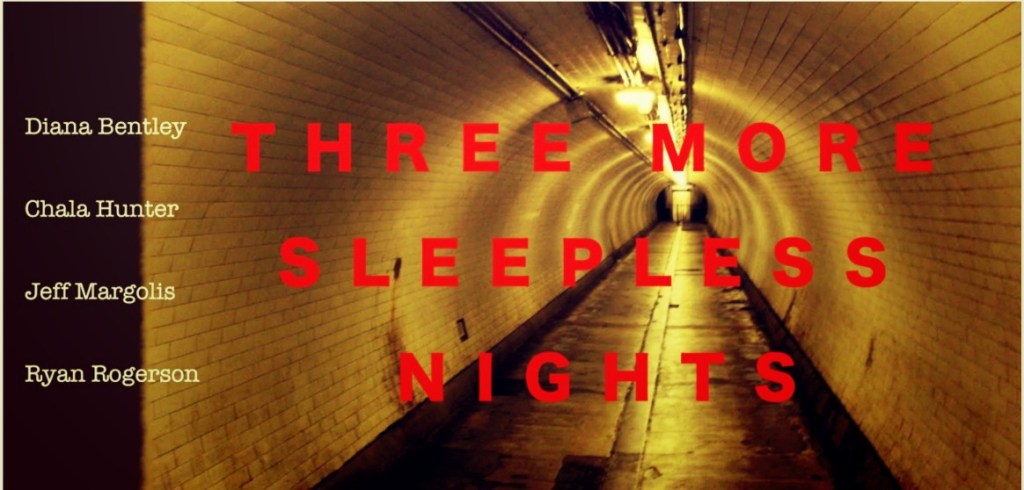
Three More Sleepless Nights

by Caryl Churchill, presented by Bad Joe as part of the 2014 Playwright Project

kitz-bright

London, 1980. Thatcher is newly in office. It’s the end of an era; it’s a new age. Late night communication breakdown. In the close quarters of the bedroom, enter people on the brink.

Directed by: Sara Kitz
Starring: Diana Bentley, Chala Hunter, Jeff Margolis, Ryan Rogerson,
Where: The Downstage (798 Danforth Avenue)
Tickets: Available  HERE
Single Tickets: Weeknight Single Ticket: $10.00, Weekend Single Ticket: $15.00 

Project Passes: Weeknight 2-Show Pass: $15.00 (see both shows playing on a weeknight), Weekend 4 Show-Pass: $45.00 (see all four shows playing on a Saturday or Sunday)

About Sarah Kitz:
A Toronto writer, director and actor, Sarah recently directed the hit show Savage in Limbo for Bob Kills Theatre, which extended its run at The Downstage. She has assistant directed Long Days Journey Into Night at Soulpepper (dir. Diana Leblanc); associate directed This Wide Night at Summerworks (dir. Kelli Fox), and has directed for Fringe, Summerworks, Here Is My Hand, Leah Posluns Theatre, One Night Stand, My Livingroom’s New Art Night, and Birmingham Readings at The Stratford Festival.
 
As an actor Sarah has been a member of the Stratford Festival Company and a graduate of the Birmingham Conservatory for Classical Theatre, where she played Eliza in Pygmalion (dir. Chris Newton) and Fool in Lear (dir. Martha Henry). Sarah has played Olivia in Twelfth Night (Dream North); Hali in The Sicilian (Fringe); Portia in The Merchant of Venice (St Lawrence Shakespeare Company); One Woman Freak Show (Buddies/Cheap Queers).
 
Upcoming Sarah is directing a new play by Nicolas Billon. This fall Sarah will play Edna St Vincent Millay in With Individual Desire, currently in development with Lady Parts Theatre and Nightwood Theatre, to be presented at Groundswell.

Artist Profile: James Wallis & Julia Nish-Lapidus – The LaBute Cycle – This Week Only at Unit 102 Theatre – “We are who we are inside… The rest is unimportant.”

Interview by Hallie Seline

I had a chat with one of my favourite couples in Toronto Theatre, James Wallis and Julia Nish-Lapidus, to discuss their most recent project – The LaBute Cycle, going from Shakespeare (known most notably from Shakespeare BASH’d sold-out Toronto Fringe shows and their most recent production of Romeo and Juliet last fall) to LaBute, working professionally as a couple and their favourite places in Toronto. reasons to be pretty runs for one week only (April 8th-13th) with a special PWYC staged reading of Fat Pig on Sunday April 13th.

HS: Tell me a little about yourselves and about the show. 

JNL: We are doing reasons to be pretty, by Neil LaBute and a staged reading of his other play, Fat Pig. Originally we were presenting full productions of both plays in rep, but unfortunately, one of the actors was badly injured earlier this week, and is no longer able to do the show. James Wallis, our director, has stepped in to play his role in reasons to be pretty, but we are not going to be presenting a full production of Fat Pig at this time. We will be doing a staged reading of Fat Pig on Sunday, April 13 at 2pm, with another amazing actor, Jesse Griffiths, stepping into the role of Tom.

JW: Both of these shows examine how we value female beauty. We’ve worked with a lot of the team doing The LaBute Cycle while working with my other company, Shakespeare BASH’d, doing classical work. The LaBute Cycle is a passion project for myself and all those involved.

HS: Why LaBute?

JW: LaBute to me is a fantastic playwright, as he is very honest and focused with his characters’ worldviews. In reasons to be pretty, he tackles a very sensitive issue with the way we value beauty in the modern world. He doesn’t pull any punches and, in my opinion, writes with a great gusto about what he knows and doesn’t try to be politically correct. Also, I love his text; it’s extremely conversational and it’s a complete 180 from what I’m used to with Shakespeare’s work.

JNL: It’s a really interesting and sensitive subject matter to explore. And it’s fascinating to explore it so publicly. The issue of beauty and how we value it is pretty prominent in our world today and I think this play offers many different perspectives, and asks a lot of questions about the subject.

8442768

Original Cast: Milan Malistic (TL), Elisabeth Lagerlöf (TR) Julia Nish-Lapidus (BL), Steve Boleantu (BR)

HS: What have you found interesting about working on something so different together. You normally work on Shakespeare together, this is quite a change. 

JW: It is! It’s been really great to get to explore these new characters, but bring a lot of the basics we use with our Shakespeare work into approaching these roles. I like the role of Kent for sure, he’s a malicious person, a person who is very selfish, but I think that he’s his own person and fights for what he thinks is his, regardless of who he hurts along the way. It’s not pretty but it’s honest. He’s verbose and nasty at times, which isn’t such a stretch for me but it is not where I live most of the time when it comes to acting. I’m excited for the challenge.

JNL: It’s really great to get to work with James on something contemporary for a change, and now I get to work with him as both a director and fellow actor! Being a married couple who works together so often (yes, James is my husband) is really great and it’s interesting to be exploring this sort of subject matter together. For me to be doing a big fight scene with Steve, who plays my boyfriend in the show, and have James be directing it is really cool, because he knows me so well and for material like this that sits in such a natural world, he can really help me bring a lot of myself to it, since he obviously knows me so well.

429146_10151405502180701_196929419_n

Power Couple: Julia Nish-Lapidus & James Wallis

HS:This is being performed in Unit 102 theatre. Tell me about working in the space.

JW: In my opinion, it’s one of the most amazing spaces in the city. It is a complete blank slate that I have seen transformed in so many ways. I really like the enthusiasm of the guys who run the place. They want to see great theatre come out of their space and I admire their tenacity for finding it.

JNL: It’s a really great space. There’s a lot of flexibility to use it however you want and the team of people who run it are awesome! It’s so important to have small, flexible spaces like that in the city.

HS: If you could entice people to come see the show in five to ten words, what would they be?

JW: We are who we are inside. The rest is unimportant.

JNL: Hilarious, heart breaking, and oozing with talent.

HS: What inspires you as artists?

JNL: James, my husband? Is that super cheesy? This is really a passion project for him, and he’s pushed me to take risks artistically that I don’t think I would have without that push from him.

482243_10151567059200701_1277760830_n

JW: The people I am fortunate to be surrounded by. The constant creativity that they exude is without equal. Also, my wife, Julia, whom I am completely enthralled by, her grace under pressure, her faculties with producing a play and her wonderful intelligence when it comes to any work she does.

JW: He just said that because of what I said. He felt like he had to…

HS: Best advice you’ve ever gotten.

JW: It’s just a play.

JNL: Act better.

HS: What are your favourite places in the city?

JW: Victory Café, my home, the Dank and any used book store.

JNL: Home! And Bar + Karaoke (the best karaoke place to drink your face off and sing 90’s pop songs)

reasons to be pretty

by Neil LaBute
The LaBute Cyclelabutecycle_postcard_front

WhereUnit 102 Theatre (376 Dufferin Street)
When: April 8th-13th *Special staged reading of LaBute’s Fat Pig will be presented at 2pm on Sunday April 13th
Tickets: $17 – Available at www.labute-cycle.com and at the door. The staged reading of Fat Pig on April 13th is PWYC at the door

A Chat with Ryan Robertson & Peter Hodgins of Two Chips Theatre’s “Copy”

Interview by Ryan Quinn

We sat down with Ryan Robertson and Peter Hodgins of Two Chips Theatre Group to discuss their current production of Copy.

RQ: Tell me a bit about the show!

RR: Sure! It’s a workplace show, a comedy/drama. It has a few themes. Firstly, it’s about people who are frustrated about their job, who are not achieving what they want to achieve. The tension between men and women, and between generations of people. So, it’s a comedy, but with a lot of darkness in it as well. We see these characters superficially at the beginning, and then they reveal a bit more about themselves and open up.

RQ: So, you wrote this piece, you’re directing it, and you’re performing in it as well.

RR: Yes. By default, essentially. When you’re a new theatre company in Toronto, it is difficult. I wanted to start from scratch because, as a writer, if you want to put a play up you normally have to go about it certain ways and work with different companies; and you end up with so many oars in the water that your play can be something totally different than what you started with. I also really wanted to have the final say on my cast and whatnot, I mean, for example, Peter is absolutely perfect for his role, and everyone else is fantastic as well. I find that better than the collegiate approach where you have a lot of people involved. These guys are as much a part of it as I am, but I never feel compromised.

PH: (laughs) Yeah, there’s not much in the way of food at rehearsal.

RR: I mean, we got a lot out of it. We do find that there are no egos at this level in the game, when you’re starting at the bottom and working with people who are like-minded.

PH: It’s been a lot of fun, and it’s going to be more fun as time goes on.

RR: Yeah, we have plans to keep going with some of this same core group and with the same kind of mentality. We really want to go back to the idea of the independent repertory company. We don’t do it for money, though I know a lot of people don’t, but we really want to do our own plays, I find that really interesting.

RQ: Do you feel like new original Canadian work is something the independent scene needs more of?

PH: For sure, I mean, Shakespeare is great. Don’t get me wrong. But, I see casting notices for it all the time and I can’t help but think “Who’s going to see that? They must have already seen it three or four times”. Part of it is that there’s no royalties. These plays are all free, and so young companies don’t have to pay a writer. So, it’s good to find new original stuff, which, for the most part, you have to write and create and perform yourself.

RR: When you come forward with something original, some people want to come forward and try to change it, to say “this isn’t right, that isn’t right, etc.”. Okay, we have to put up a few bucks ourselves, but if people really want to support new plays, they have to go to them. I hear a lot of people complaining about the same shows being done over and over, but then they don’t go out and see original plays.

PH: Yeah, we really need this stuff. And I’ve spoken to Ryan about making this into a film because we’ll all be ready for it, and we all love it.

RR: The thing about original plays is, as well, that because you are the creator, it’s a journey. I saw it on the page, I’ve seen the characters brought to life. There’s no need to put a “new spin” on a character because they’re completely new. What’s also important to me is that everything should be natural. We didn’t want to fall into the trap of being a wee bit pretentious. It’s a workplace play, so it has to be kind of earthy. I don’t mean to use the word pretentious, that has a negative connotation, but I mean that as well as depicting higher class things, it should reflect ordinary life. Even in the plays about ordinary people, there’s probably a bit too much wordiness at times. This is a much more down-to-earth workplace show.

RQ: That’s something else I wanted to touch on. This show deals with the minimum wage. So, because of that, it’s inherently political, as well as being comedy. Is that true?

RR: When I spoke to other writers when I was younger, they’d say “never preach”. You find a way to explain big issues with humour or in a way that doesn’t condescend. I’ve tried to do that with all the characters. Characters are more interesting that way, I think, when they don’t have these grand speeches planned.

PH: As long as it’s real. If you accurately portray a segment of society, it’s going to be political.

RQ: What do you want people to be discussing on the way home? What do you hope it leaves an audience with?

RR: I would hope people would get from it that in a way we’re all divided by our employers, and we’re all slaves to our mortgages and our dreams, but we’re fragmenting as a society. If we all got together and understood each others’ pain, we could do a lot better. We are divided, and we do worry about ourselves too much, and that hurts society. After the show, we’d like to talk to the audience, see what they got out of it, right?

PH: Yeah. I agree.

RR: But I do agree that when we attack these things, we have to do it with humour, with a little seriousness thrown in.

RQ: I think it was Shaw that said “If you want to tell people the truth, you’d better make them laugh or they’ll kill you”.

RR: Exactly. That’s perfect.

RQ: And Peter, as a veteran performer, how did this project come about for you?

PH: I believe I found it on Mandy, actually. So I sent in my application and I erroneously asked if I could read the whole script. I guess that was a bad thing to do. So I didn’t hear anything for a while.

RR: So I went back to Peter after a couple cast changes, I wanted Peter from the start, and I sent him the script, and I guess he liked it. I tried to write something where everyone’s involved and has something to do, and consequently everyone in it seems to really enjoy doing it, so I hope that translates to the audience.

RQ: What’s exciting about this show for you, Peter?

PH: Well, this is my first time on a live stage, actually. I’ve done mostly acting in film and directing film, so that’s what’s exciting for me. Mail Room John is a very misunderstood guy, and I feel like that myself pretty often.

RQ: So both of you must have had an interesting time with approaching the work on day one. Peter, with it being your first time doing live theatre; and, Ryan with putting up your own work. How did you approach that?

RR: Well, I try to be a benign dictator. Every member of the cast has ideas and I wanted to avoid ego as much as possible. So, it’s been a real collaboration. We’ve had a lot of fun and I think that’s going to show through when we do it. It’s worked out exactly the way I wanted it to.

RQ: Going forward, what are your hopes for this company?

RR: Well, if people show up to this one, there will be more shows. I think it’ll be good because we don’t plan to stick to a certain group of actors, and everyone feels like a part of it. PH: Now that we have a great location, we can just keep doing it.

RR: It’s important that people come out because we ain’t made of money. We back it as much as we can, but we’re not a professional comedy. We’re just tailoring it to entertainment, not money.

RQ: Well, that’s become the new standard, hasn’t it? Independent companies doing professional-level work?

RR: Right, and you need to get dedication out of people because they are giving their time, so it has to count.

PH: I think it’s guaranteed we won’t make any money.

RR: If we break even, we’ll keep doing shows.


Copy

Written by Ryan Robinson, presented by Two Chips Theatre Group
Directed by Ryan Robinson
Featuring Alene Degian, Brian Stapf, Madryn McCabe, Peter Hodgins and Ryan Robinson
poster1.51123805_std
Where: Sterling Studio Theatre, 163 Sterling Road, Toronto, Ontario, M6P 0A1
When: March 18-22 8pm, doors open at 7:30pm
Tickets: Advance tickets $15+service fee, At-the-door tickets $15 cash only
Concessions available, cash only
For more information:
www.sterlingstudiotheatre.com
www.twochipstheatre.com

A Few Words with Rena Polley on The Chekhov Collective’s “The Seagull”

Interview by Madryn McCabe

We sat down with Rena Polley, producer and actor of The Chekhov Collective’s The Seagull, to discuss the Michael Chekhov technique, theatre in Toronto and what makes The Seagull so special.

MM: The production part of The Seagull is incredible. 

RP: The support team was made up of brilliant people, they’re all award winning, but they had never done theatre before. I got them involved because they’re friends of mine. Rob Gray has won Genies and Geminis. He literally finished filming two weeks ago, came home, pulled in every favour to get the set built, even painted it himself (and it’s been years since he’s done that) and he leaves tomorrow to go to Bucharest for six months, so he very kindly did all this. And it was a learning curve for him. The first time he built the set, it was flat. And Peggy [the director] said, “oh no, it has to be like a W, and this way” so they all learned something because it’s different in film. So, he built this beautiful set. He had it go from something very formal, until it moves across the stage and eventually it disintegrates. Kind of like the play. And the music! Rob [Bertola, Music and Sound Design] is an Emmy and multi award winning sound designer for film, he just finished David Cronenberg’s film, and he’d never really done theatre before either. He came up with the song that’s the theme song. It’s based on an old Russian theme song, but it was rerecorded in the 60’s by The Seekers, and it became this huge popular hit. It’s called “The Carnival is Over”. So he did the reverse; it starts deconstructed and then moves the opposite, so that by the curtain call, the song is sung with full song and lyrics. And Oh Susanna did the music. So it starts deconstructed and ends up full, and the set does the opposite, it starts full and ends up deconstructed as you go across. The lighting designer is Blue Rodeo’s lighting designer. He’d never done theatre before. He finished the Blue Rodeo tour Monday night and was in the theatre Tuesday morning. He’d only seen a run through once. But he’s so brilliant! And Comrags were friends of mine too.

1966802_549145408532794_1292794745_n

MM: Your costumes are works of art!

RP: Comrags had an army of people building all this! Judy [Cornish, Comrags] said, “do you mind if I do the costumes?” I said, “Of course!” and then Joyce [Gunhouse] her partner in the company got involved, and then Joyce’s sister Judy and sewers and interns, and when we all saw the level of the costumes we thought “Uh oh. We’d better up our game!” Everybody felt that. Everybody came with an extraordinary level of work. And it made us up our game as well. And then Peggy came so prepared. She dreamt two ideas. And that was 1) The play within the play. Using the frame, using this kind of deconstructed way of telling a story. Peggy and I did teacher training in New York and our flight got canceled. So we ended up sin Manhattan for two days, and we went to the Museum of Modern Art. There was a show on all these artists that used deconstruction, and we kept seeing references to the frame. Peggy said, “that’s what I want to do at the beginning”. We tried it at a weekend workshop, and she knew it was going to work. We brought in Ellie Hyman from New York, who is a Chekhov person, but also a Viewpoints person, so she did this stuff with us, and we transferred the actors over from Ellie to Peggy. It’s hard as a director to come in to an ensemble that has been working together for a year. She only had three weeks to shape this play. It’s a big play, an epic play. The final image that she came with is when Konstantin rips the papers. Everybody always has him throw the pieces in the air, and she had him stuff them into his clothes, so that he leaves nothing behind. He takes all his writings with him. And it’s such a beautiful, poetic image. So she came with these two very strong ideas that bookend the piece. And she kept hearing rhythms. She could tell when vocally we’d drop the beat and then come up again. She’d say, “Push it. Keep driving it. There’s a pause coming, and you have to earn it.” And you can see these quiet moments in the production. She could really hear the rhythm of the piece, and wanted to honour that. She used Viewpoints from Ellie. She didn’t call it blocking, she called it composition. There are ten actors. There’s a lot to do!

1743632_549145551866113_346019769_n

MM: When you said it was an epic play it really made me think of the number of actors in the play. The nature of the way theatre in Toronto gets produced these days means that ten actors are unheard of. 

RP: Ten big personality characters, and ten big personality actors, that I had empowered, for better or for worse, so everybody had an opinion. Peggy had to really set up a very strong structure for the rehearsal process. We had done all of this Chekhov work and it was all sort of loose and game playing and improv and playing with text, but not making choices about text because that’s directorial. Creating the world of the characters and then when we got to the rehearsal space, it was very traditional. I thought we could continue this process more, but I realized Peggy was right. There’s a three week rehearsal process, there’s a story to tell, and you have to get through each act. We got through each act quite quickly in a big sweep because of the work we had done, and then Peggy went in a worked smaller sections. There was more of a traditional work space. We looked at beats, we looked at text, and objectives. But she would bring in Chekhov vocabulary of “what’s the Atmosphere of this act?” We could get to it quickly because we had been training in that philosophy.

1932373_545819228865412_909286969_n

MM: How did this group of people all come together?

RP: I keep saying that we all worked for a year together, but we really didn’t. Every two or three months we did a three day intensive workshop. So that allowed us to do a lot of stuff, but then let things simmer during that time. And people have lives and shows and lots of stuff going on. So we maybe met three or four times for three or four days each time. In the last month we met every Monday. I knew I wanted to look at this play, and I wanted to see how far I could take the Michael Chekhov technique. Having studied it, I thought, “Okay, I’ve got to put my money where my mouth is”. What this process allowed us to do was to keep expanding and asking questions, instead of contracting and making choices quickly. That was the gift of this process. And even if you look at the program, Peggy talks about how it starts in expansion and ends in contraction. We can use the words of Chekhov. It’s been a really extraordinary process. The question I posed to myself at the beginning was “how far can I take this?” and what I learned is that you can use it all the way through to the end, but you’d better bring along other things as well. There’s a reason the Stanislavski technique is still surviving. It needs to be expanded, and other things looked at, but the ideas of beats, objectives, text analysis is really important, and you need to combine it with the Chekhov work. At some point in the process, you’ve got to throw out the head and let the body speak because it has a bigger vocabulary, but then bring the head back in.

MM: What I found really interesting is that they play is over 150 years old, but it’s still so relevant. 

RP: Every time someone reads this play, they say to me, “It reminds me of Facebook” or we had an athlete in the audience, and she said that Trigoren’s speech about loving the writing process but hating it when it’s published is how every athlete feels when they train. So it speaks to everyone. What we’ve discovered about this play is that there’s no bottom. We could explore this for five more years. For a nanosecond, I thought about modernizing it, but I thought, no, let’s make the audience do a bit of the work. Let them make the leap, put the dots together. Because it’s all there. It’s a story about desire, art, the heart, human nature, relationships, and family. All these things are universal. They’re timeless. We agreed it was best to tell this story simply, and through the heart. Let the play speak for itself. We tried not to add things or colour it.

1907954_549145718532763_1607372493_n

MM: I see the program that you have adapted the play.

RP: I knew I wanted to cut the play, so I looked at about seven different translations. I wanted to make the language accessible, but not too modern. Some of the formality of the language is from the play, but I didn’t want it to be archaic either. I wanted to keep the names simple so that we’re not calling each other by three different names. I trimmed.

MM: There’s also a very strong feeling of the ensemble.

RP: We did that over time, but I also think the Chekhov work can speed that up in a rehearsal. I really want to put this process into the rehearsal process. I’d like to offer myself to directors and say “give me an hour of your day, every day, and I can really help you move this process along. I can help the ensemble, I can help the atmosphere, I can help actors drop into characters”. But rehearsals are short, directors don’t know what it is. I’ve offered a few times and heard no. I understand that, but I think the Chekhov technique can make that happen faster. We had the luxury of time, and I had them do all kinds of things. In the first intensive weekend, I had them read the play and write down images of the play. I collected them, we played with them. We came up with themes, we came up with the set design, I had them come up with one line describing the play, because I wanted them to think about more than their character. I wanted them to take ownership of the play. Sometimes as actors, we just highlight our lines and look at our part in reference to the play. It’s safer. We want to protect ourselves. So I wanted to blow that away, and give responsibility for the play to the actors. We did build the ensemble over time, but I think it could have happened much faster if all we had was the three week rehearsal process. I really want to encourage people to look to the Michael Chekhov technique because I think there’s something in it that every actor, director, designer can use.

10007014_546792548768080_176468322_n

For more information about the Michael Chekhov Technique, visit michaelchekhovcanada.com

For tickets to The Seagull, visit thechekhovcollective.com