Skip to content

An Honest Goodbye

By Jared Bishop

The joy expressed in this collection of festival-goers, meeting one last time in the parking lot behind Honest Ed’s, no longer matched its environment. The lights weren’t twinkling like the eyes of excited Fringe performers. We were all dressed up, sparkly and beautiful, waiting for the parade to start, to say one last goodbye to our ghost of a home. With no more blood pumping through Mirvish Village, we took the life in us to our new home at Scadding Court Community Centre.

Photo Credit: Tanja Tiziana

Mirvish Village was a beautiful space to occupy. There was magic oozing from all those strings of lights and graffitied walls. We radiated that energy right back. The Toronto Fringe is a community brought together once a year and our home base is integral. For every great difficulty faced in independent theatre, the Fringe Club and Mirvish Village had something to offer. Losing this home is sad. It symbolically connected the old Toronto with the new and the Fringe Club felt like a manifestation of those things coming together.

I came to the parade, not to promote a show or give out hand bills to the public, but to work through feelings of grief and sadness. The Toronto Fringe has lost a home and our city is losing honest history and culture. I wanted to bring in the intentions of healing to this Costume Parade. Dressing up, being silly and marching down the street is already a practice I use to heal personal wounds. I often find new confidence and boldness when dressed as something a little outside of myself. I put on one of my partner’s lacy, floral shirts and donned a straw hat I had decorated with flowers and vines. I wanted my costume to represent new life – like a garden in the spring. I walked from my home in Little Italy with a bit more bounce and optimism in each step, towards Bloor and the special place we used to call The Fringe Club.

A large group had amassed in the space surrounded by the boarded up windows. Empty homes and businesses, a place once full of life but now sacrificed for higher profits. It was evident we most move on.

Photo Credit: Tanja Tiziana

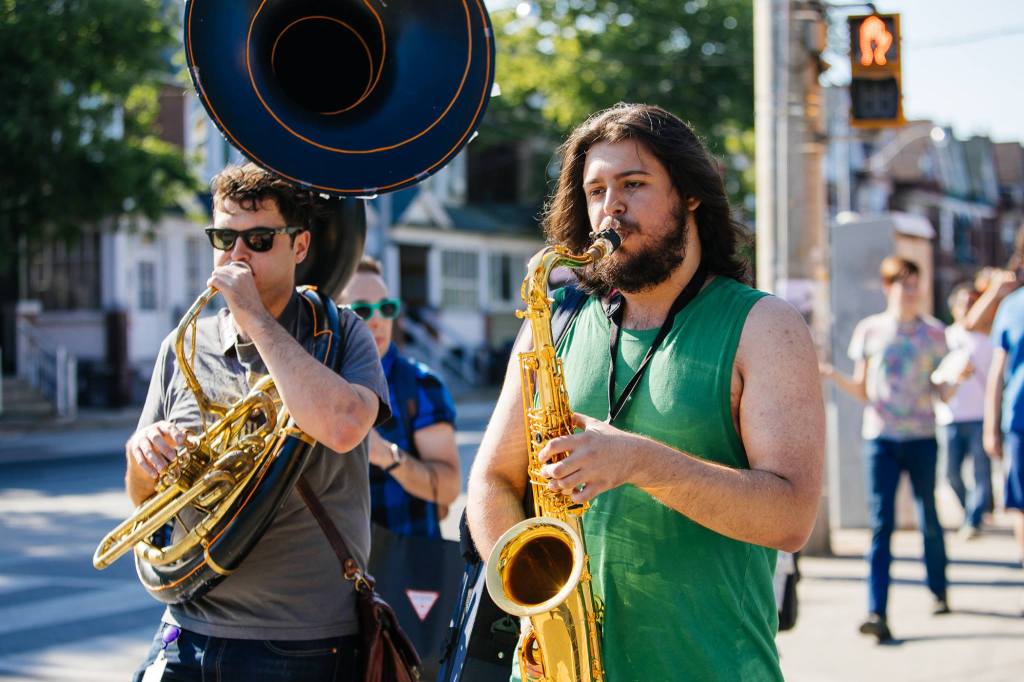
There was a politeness to the way we travelled down Bathurst. We shared the sidewalks, stopped at red lights, smiled, waved and courteously engaged the public. We divided ourselves into groups easily managed by the sidewalks and intersections. Our parade stretched a great distance down Fringe’s main artery. We were a cheerful spectacle moving at an eager pace. Our community features an incredible collection of beauty and inspiration. Amongst us were Mimes moving with mostly muteness – tuba and saxophone singing in their place.

Photo Credit: Tanja Tiziana

High Park Noir’s collection of crime-fighting critters created comradery between the new creations. The feline Fuzz was quite flirtatious. Physical representations of our most private parts were shared to the public for peer review. These fringe folks representing their shows or supporting a friend’s, passed out their offerings of invitation to all who would accept. As we continued closer to our new home at Scadding Court, we announced our presence with confidence and celebration.

Photo Credit: Tanja Tiziana

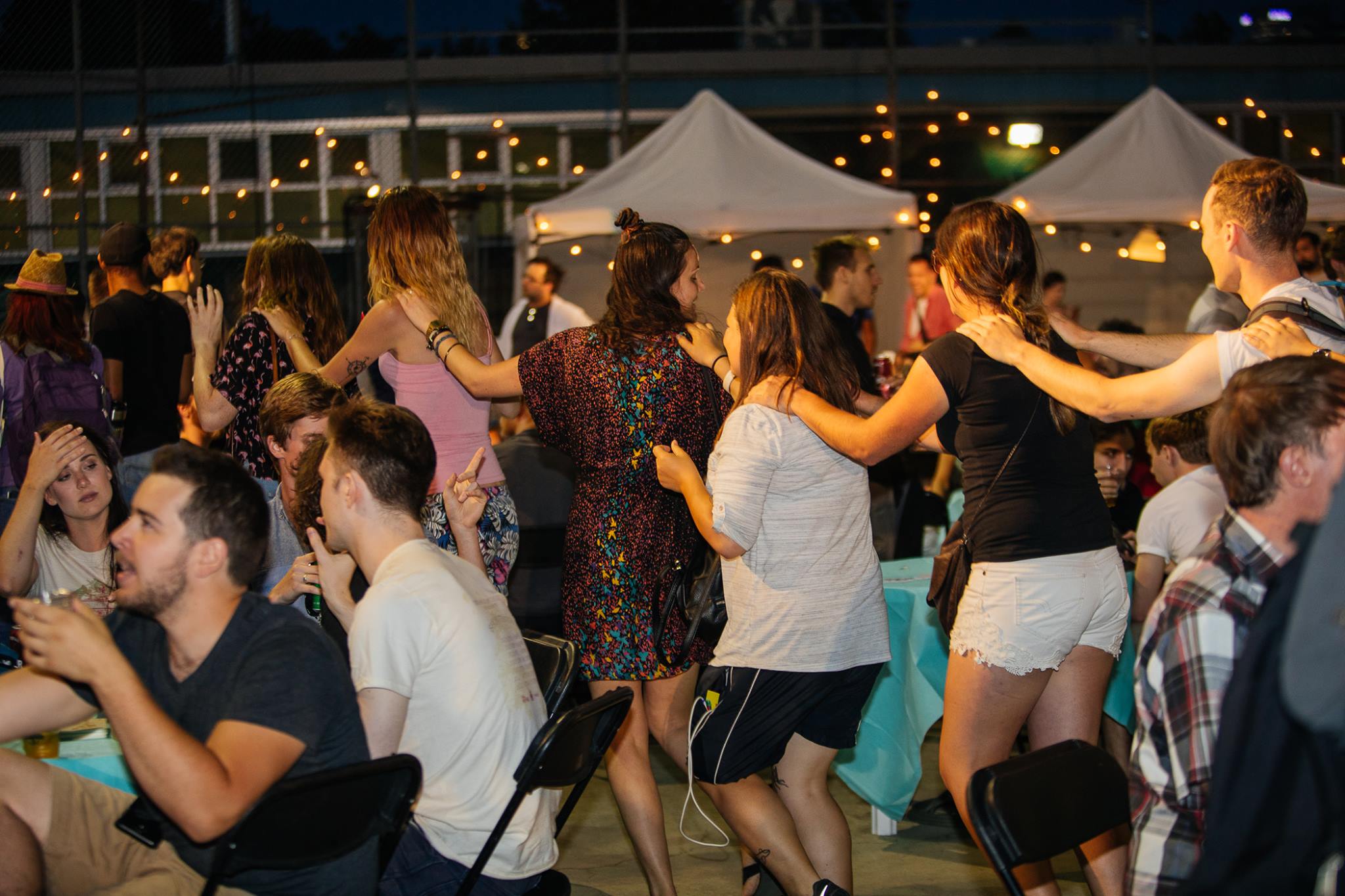
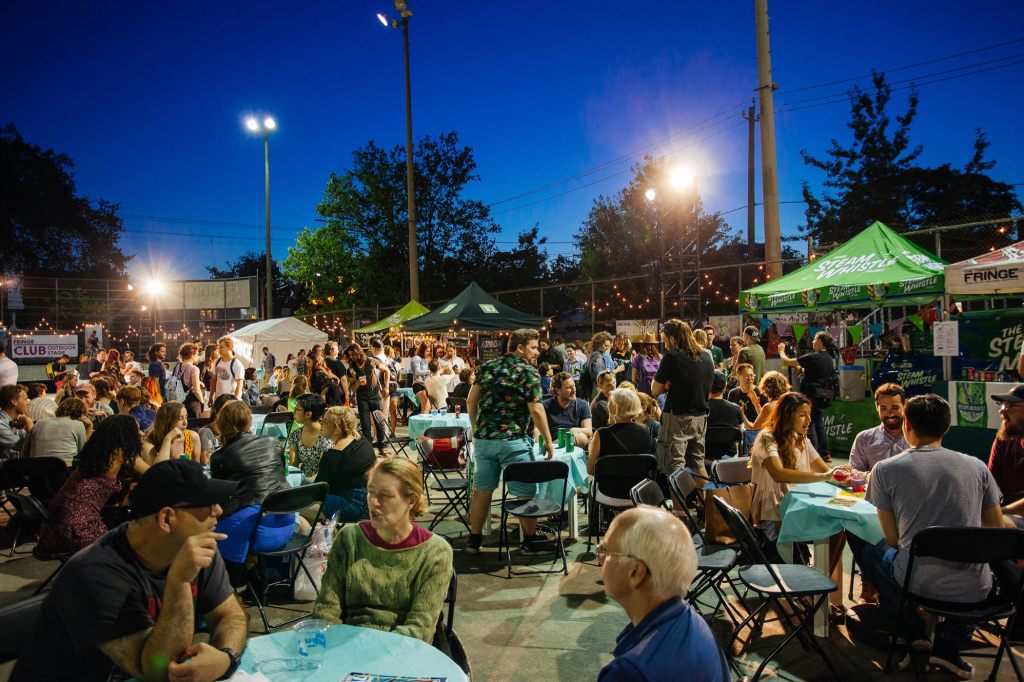
As 100+ fabulous Fringe people filed into our new home it felt like ecstatic celebration. Celebration for our community and the new community welcoming us in. Scadding Court is already a high use centre. Many different groups of people utilize this multifaceted facility. Our presence felt like a positive offering back to these folk. I started to make comparisons between our new and previously used spaces. Has Fringe found a home that builds stronger connections to the larger communities we exist in? Is there greater stability in this type of community space? It is clear we are guests here right now. We share this space with the skateboarders and shipping container merchants, the families and youth groups that use the pool, park and baseball diamonds. This is unlike the alley we used to occupy, that at any other time of the year was a dank space mostly used for leaving a car behind. That parking lot was ours for twelve days and we filled it. We must engage our new space with more intention and mindfulness. It is now important to create something that involves our larger community. Something that offers welcomeness and accessibility to the folks outside of ourselves. I hope this will facilitate growth and deeper roots. Fringe is a tree with many branches and we wish for our fruits to flourish.

Photo Credit: Tanja Tiziana

This club has captivated the neighbourhood and we must stretch out our hands to share the joyous events that make this festival special. The reflections of grief and loss I addressed with my floral costume transformed into celebration of connection and community. I gathered sparkling, joyous energy and wish to radiate that back to Scadding Court and all the other spaces our festival shares. These conclusions were created by the Parade. It provided a space for catharsis if that is what you wanted. The symbolic mobilization of community in response to gentrification instigated honest reflection and a unifying spirit. This is something radiant we can all share. A continuous pursuit of cohesion is what will turn this space into home. I can do little else but emit excitement for our future. It’s something I am a big fan of.


Find out more about The Toronto Fringe, the shows and events in this year’s festival and book tickets here.

Photo Credit: Tanja Tiziana

Inside Fringe: In Conversation with Sam Mullins on creating & re-visiting “Weaksauce” at the 2017 Toronto Fringe

Article by Megan Robinson

Sam Mullins, writer and performer of Weaksauce, has come a long way since his first solo-show, Tinfoil Dinosaur, which opened at the Winnipeg Fringe in 2011. “I’ve never vomited from nerves except for that day […] I tried to drop out of the festival. I wanted to just go home. I was like, I can’t do it.” Mullins relives the memory as he sits across from me at the Theatre Centre, the day after opening Weaksauce at the 2017 Toronto Fringe. “It’s one thing to be running your show in your living room and it’s another thing when the whole city shuts down for the Fringe.”

Though Mullins is much more comfortable as a writer and would like nothing more than to stop performing (for all the enjoyment, there is so much anxiety) he assures me he is not about to quit. Instead, he spins it into a positive. “Nervous energy is a good thing for me on stage. It’s really easy to be vulnerable on stage when you feel really vulnerable. I don’t have to pretend.”

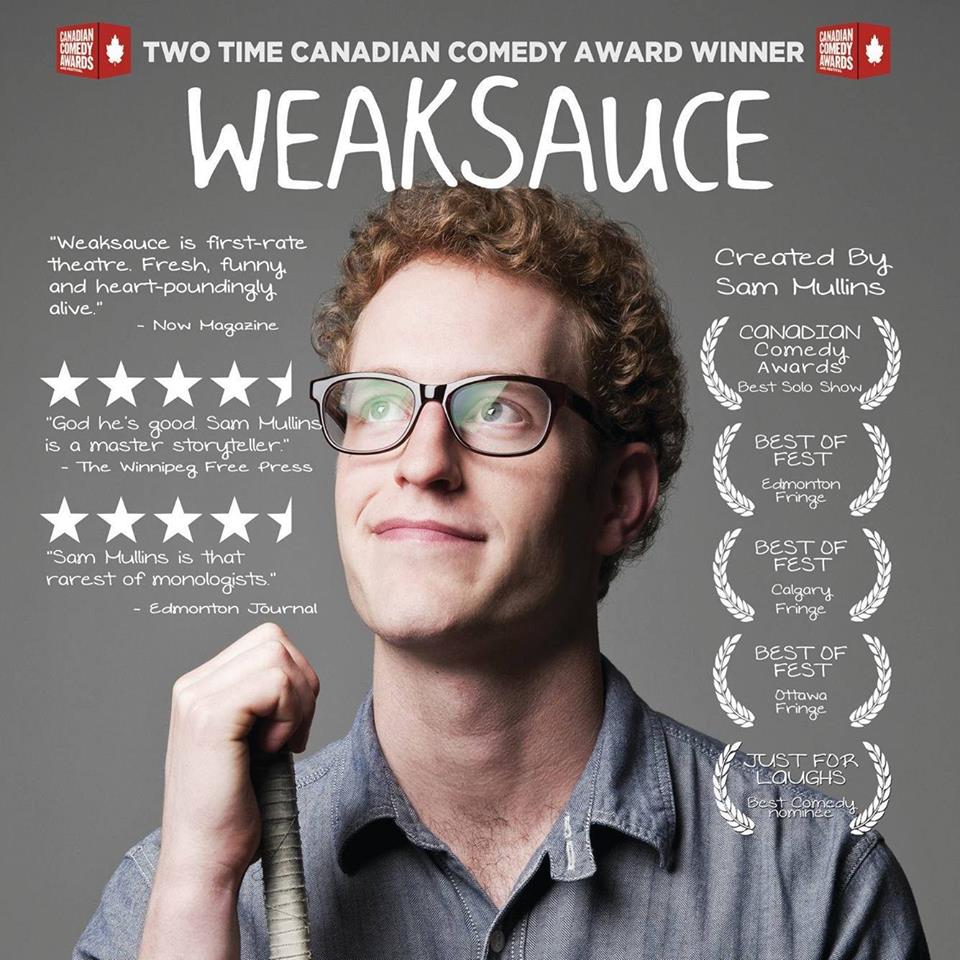
Weaksauce is the story of firsts in Mullins’ life: first time away from home, first love and first love triangle. It’s his contribution to his favourite genre; romantic coming-of-age. And the goal for the show? Storytelling that is efficient while still being as fun as possible. Drawing from influences like Mike Birbiglia and Tig Notaro, Mullins says, “If you can make people laugh for 45 minutes and have a couple moments of poignance, like Tig and Mike can do—I just feel like there’s such great power in it. It lifts it above standup and storytelling, it’s like this hybrid.”

The show, which played at the Toronto Fringe in 2013, remains about 90% the same as the script Mullins wrote “in like a weekend” after a busy summer touring a show with his good friends, Peter and Chris. Faced with only a week to create a whole new show for the final festival of the tour, they all headed to Sam’s family home in Vernon BC. “It was like a writers colony,” Sam recalls, grinning. “Peter and Chris in one room working on their show and me in another.”

This is where Weaksauce came to be, under the guidance of “guru” Elizabeth Blue who was also in attendance of this retreat. “She was like drinking and floating on a tube in the lake and we’d go out on the dock and be like “Lizzy! I need to read you a new draft! […] She was the biggest help ever. She gave me so many great notes. Her fingerprints are all over the show.”

With no formal director for Weaksauce, Mullins tends to ask friends for help when he thinks he needs it. On opening day of Weaksauce, he brought in Johnnie Walker (playwright of Redheaded Stepchild) to help clean up the staging a bit (after offering Walker a hundred bucks for the favour). “Johnnie has a real nose and eye for staging and blocking and character choices, and all those things are after-thoughts for me. I’m just obsessed with what the piece of paper is.” An obsession that means after Mullins has spent his time enjoying the little breakthroughs and finding the perfect line, he often hands the script off to his performer self at the last minute.

From reading through Mullins’ website, it’s clear he some good thoughts for writers. He holds true to advice from his friend and performer James Gangl that what you write about should scare the shit out of you. Mullins writes about loaded topics, stories of angst and embarrassment are where he has found his best stuff. So though there is an importance to first processing an experience, Mullins says, “you can’t be fully over it […] I love going back and working through these things. It’s fun revisiting these old times and places and people and seeing it through your eyes now, and seeing how it is different.”

What’s different for Mullins and for Weaksauce this time around? With more standup experience, he’s better at recognizing opportunities for jokes. He is in a larger venue this year than he was in 2013. Oh, and he’s engaged (!!).

When I ask if there is a connection between getting married this summer and bringing back Weaksauce he nods. “Yeah, when we got engaged and I wanted to remount one of my old shows, I was like it would be really fun to revisit falling in love for the first time in the context of me getting married. And Weaksauce was always my favourite,” Mullins says. “As I’m thinking about my vows and thinking about our journeys to each other this was a really fun thing to think about and immerse myself in […] To remember what it was like the first time that you thought you found your person. And, you know, how all of the failed relationships along the way… they weren’t failures, they were what lead us to each other.”

Weaksauce

Who: Sam Mullins (Writer/Performer)

What: A coming-of-age comedy of first times, second chances and third wheels. ★★Canadian Comedy Award Winner for Best One-Person Show★★ “Weaksauce is first-rate theatre. Fresh, funny, and heart-poundingly alive.” – NOW

Where: Helen Gardiner Phelan Playhouse, 79A Saint George Street.

When:
July 11th 6pm
July 13th 9:15pm
July 14th 12pm
July 15th 3:30pm

Tickets:
fringetoronto.com

Connect:
t: @SamSMullins
f: /sammullinscomedy
w: samsmullins.com

Mixing Burlesque and Greek Theatre in LYSISTRATA at the 2017 Toronto Fringe

Interview by Brittany Kay

“The Fringe is a perfect platform because it is the rock and roll of theatre festivals: anything goes, so the audiences are open and up for surprises.” – Sebastian Marziali

Burlesque and a Greek classic. Both very different genres, both incredibly alike in intention. One wouldn’t normally find this mash-up in the Toronto theatre scene, but this is Fringe, right? After a sold-out opening performance, Kay Brattan’s take on Lysistrata has found the perfect place for its debut.

In this preview, we chat with writer/director/co-producer Kay Brattan, Las Vegas Burlesque Hall of Fame performer St. Stella, and performer Sebastian Marziali/El Toro about their burlesque adaptation of Lysistrata.

Brittany Kay: Tell me a little bit about the show.

Kay Brattan: Historically, Lysistrata is a story about the women of Greece uniting together in a sex strike to end the Peloponnesian war. Our Lysistrata turns the strike into a “strike-tease”, adding slam poetry, songs and strip-tease to heighten the tension of this Greek Comedy. This production is a site-specific piece of immersive theatre that is set in The Painted Lady, a bar in Toronto that is known as a burlesque venue. We’ve chosen to completely annihilate the 4th wall in this show, and present this story to its audience as a burlesque revue. We know you’re there: we want you to know that. Because everything in this play is for you. In the revue style we’re able to explore all the different types of acts that make up the wonderful world of burlesque, from the Can-Can, to Vaudevillian numbers, and the new wave of Neo-Burlesque.

BK: Where did the idea come from to mix Burlesque and Greek theatre?

KB: I studied Lysistrata in university and have always loved this play. It’s funny, playful, and can be contextualized in a way that makes it a strong piece of feminist theatre. Finding a way to marry it to burlesque was actually quite easy because by the end of the play everyone is practically naked. The characters start off in a world that’s a little more conservative and very quickly everything gets turned upside-down. As the clothes fly off, we see their everyday restrictions disappear and it’s incredibly liberating to see. For myself, this is a feeling I’ve always experienced when I watch a burlesque show. Living in a world that constantly makes women feel that our worth is judged by our waistline is daunting, so to be able to have a space that celebrates body positivity and empowers everyone to own their sexuality is exactly what I wanted to explore in this show.

Burlesque is such a big, bold, cheeky, and extravagant form of performance art, so it made sense that the women of the play use it as their tactic to aid them in this sex strike. It’s all about the tease, and not only do they use this to their advantage, they use it as self liberation. Instead of matching violence with violence, they use their femininity and cleverness to fight and win this battle.

Photo of St. Stella by Sly Maria

BK: What do you think will be really successful about this mash-up?

Sebastian Marziali: Plain and simple, burlesque finds its roots in ancient works of comedic satire such as Lysistrata. The strip-teasing style we know today was built on the foundation of making a mockery of those in power, specifically with women lampooning men and turning the tables on the power dynamic of storytelling. Early on in my burlesque career, I came across the idea that “if you get them laughing, you can shove anything down their throats,” and I feel that this show does a beautiful job of just that. It’s fuelled by raunchy, bawdy comedy and dance but upon a foundation of real honest reflection around man’s obsession with war and profit. The other beautiful part about it is the distance that we have from the ancient Greek pieces, which allows more room to play, experiment, and adapt. There is less preciousness than there is with more modern Western classics so we’ve really been able to integrate the eclectic nature of modern burlesque and cabaret, inserting music and dance styles from all across the spectrum but grounded within the structure of the story. It’s a marriage of form that you don’t need the Fates to have seen coming.

BK: The Fringe is all about daring to see something different. This piece is going to be different and definitely stand out. What would you say to Fringers that would entice them to see this show?

St. Stella: I think we are doing a very ambitious show this year. For first time producers, we took on everything and the kitchen sink! I think people will want to see this show for the extravaganza of it all; singing, dancing, striptease, feminism, political relevance, (near) nudity and site-immersion – there are a ton of themes in there for almost everyone to say “Heck yeah! I wanna see that!” I also think people are always interested to see fresh twists on the classics, particularly a text that has been given new relevance in the current political climate.

In photo (l-r): Amanda Mattar, Brittany Cope, St. Stella, Amanda McKnight, Jennah Foster-Catlack. Photo taken by David Kingsmill

BK: The Burlesque community is very real and current in the Toronto arts scene, but some people haven’t tapped into it yet. Why is that? What makes the Burlesque world different and exciting?

SS: A lot of people don’t realize that Toronto really is a leading city in the world, particularly in experimental or what we call ‘neo’ burlesque. But even with that, many people still haven’t seen a show or even heard about our community. I think there are still a ton of misconceptions about what burlesque is, which is fair because burlesque has a ton of permutations. But, the thing I love most about burlesque is that feeling that we so rarely get any more from entertainment – the raw humanity of it. It’s intimate and glamorous, a fantasy, but not fake, it can be simultaneously subversive, sexy and silly. Burlesque is a tease: it keeps people wanting more. And the coolest thing is that the ‘more’ can often be what the audience makes of it themselves; being inspired to buy a sparkly flower for their hair, or some fancy lingerie or dance in front of the mirror… Burlesque invites the audience to take the feeling of the show home with them. I’m really excited that this show might open the door to a whole new audience of burlesque fans.

BK: Why is the Fringe a perfect platform for this experience?

SM: The Fringe is a perfect platform because it is the rock and roll of theatre festivals: anything goes, so the audiences are open and up for surprises. People are at Fringe to have a good time but also to challenge their preferences and expand their scope. What better way than to be immersed in a blend of modern burlesque and Greek comedy which exists and has existed to speak directly to the masses in a way that is entertaining but also sparks curiosity and questioning of our sociopolitical structures. Also, at the end of the day, this show is first and foremost a celebration, a raucous experience that puts the action right in your lap. In the end, isn’t that what Fringe is all about? Getting crotch-deep in art!

SS: I think Fringe has this big beautiful feeling of ‘let’s throw everything at the wall and see what sticks’. For a lot of people, it’s the only theatre they see in the year because it’s so accessible, it’s not elite. That aesthetic fits perfectly with the pathos of burlesque (and Lysistrata!) – it’s by the people, for the people. I also think that the way we have put together this adaptation has a lot to do with the Fringe itself as well – it’s a Pastiche. We rap, we sing, we take our clothes off, we dance, we climb on bar-tops – it’s no holds barred theatre, just like the festival itself!

In photo (l-r): Amanda Mattar, Brittany Cope, St. Stella, Amanda McKnight, Jennah Foster-Catlack. Photo taken by David Kingsmill

BK: You have Burlesque artists but also actors in your show. Why this choice artistically and how does this aid in the performance and storytelling of the piece?

KB: It honestly just worked out that way through the audition process, and I’m so glad it did. Having a mix of both disciplines of performers helped the show in the same way combining the two performance styles did. The burlesque performers were able to share their craft with the actors, and the actors did the same for them. The best part of this experience was just watching how much fun everyone was having. It’s a different way to approach a play, and I think that because we attracted a group of artists that were willing to explore this new side of themselves, and do they ever shine in it! Everyone’s willingness and eagerness to explore this work has been more than a delight to bear witness to and I think it’s something our audience will really enjoy to see as well.

BK: What do you want audiences walking away with?

SM: We want audiences staggering away! Bent over in laughter and arousal with hardly a voice left (hooting and hollering is strongly encouraged). We want people leaving having had an experience desperate to come back and try the ride again from a different angle. We really take advantage of our venue using it in its entirety, which means keeping our audience right in the thick of it all (pun intended). I feel that we also want people going away with a new-found appreciation for both burlesque and theatre as platforms to bring us together in our ever more splintered lives. It’s been my mission, since being sucked into the magical world that is burlesque, to bring “traditional theatre” more into that world. After all that’s what theatre was and is meant to be, a mosh pit where we tear down the world outside and experience something wondrous together.

BK: What other shows are you looking forward to seeing in the Fringe?

SM: If you are even remotely intrigued by our show you are going to absolutely love Shirley Gnome’s Taking it up the Notch a comedian singer with the voice of an angel and the mind of a filthy sailor. So yes, I am excited about her. Also I am dying to see Mind of a Snail’s new show Multiple Organisms. Their work is so enchanting and knowing that they’re marrying that with sexuality and the human form just gets me all tingley.

BK: What are the most exciting parts about the festival?

SM: I think the most exciting part about the festival is the open and engaging interactions. Seeing giant groups of people excited to be in the same room together and take a collective dive into the unknown. Putting aside the phone and Netflix for a couple of weeks and enjoying shared experience. There’s something so necessary about this beautiful space that is created where everyone is just really excited about art and conversation.

LYSISTRATA

Who:
Company – how.dare.collective.
Playwright/Creator – Aristophanes
Starring: St. Stella, with Brittany Cope, Jennah Foster-Catlack, Sebastian Marziali, Amanda Mattar, Amanda McKnight, Timothy Ng, Jordan Shore
Directed and Adapted by Kay Brattan Choreographed by St. Stella
Costume and Props by Stevie Baker Musical Composition by David Kingsmill

What:
Lysistrata leads a rebellious group of women in a sex strike, hoping to end the war that is tearing their country apart. In this modern adaptation of Aristophanes’ classic comedy, how.dare.collective. puts a burlesque spin on this tale of resistance and desire.

Where:
The Painted Lady
218 Ossington Avenue, Toronto, M6J 2Z9

When:
July 5th, 6th, 10th, 11th, 12th, 13th – 7:00pm
July 8th, 9th, 15th, 16th – 2:00pm

Tickets:
fringetoronto.com

Connect:
t: @Lysistrata_TO
f: /LysistrataTO
i: @lysistratato

“The Zombie Apocalypse, Bunker Necessities, and What the Post-Zombie World Would Look Like” – A Chat with Clare Blackwood on WELCOME TO THE BUNKER! at the 2017 Toronto Fringe

Interview by Madryn McCabe

We spoke with Clare Blackwood, co-writer/performer of Welcome to the Bunker! at the 2017 Toronto Fringe. We chatted about why she chose to go for the post-apocalyptic zombie genre, what she would bring to the bunker if/when the zombie apocalypse happens, and what audiences should prepare for when they enter The Bunker this Fringe.

MM: Tell me a little bit about your show.

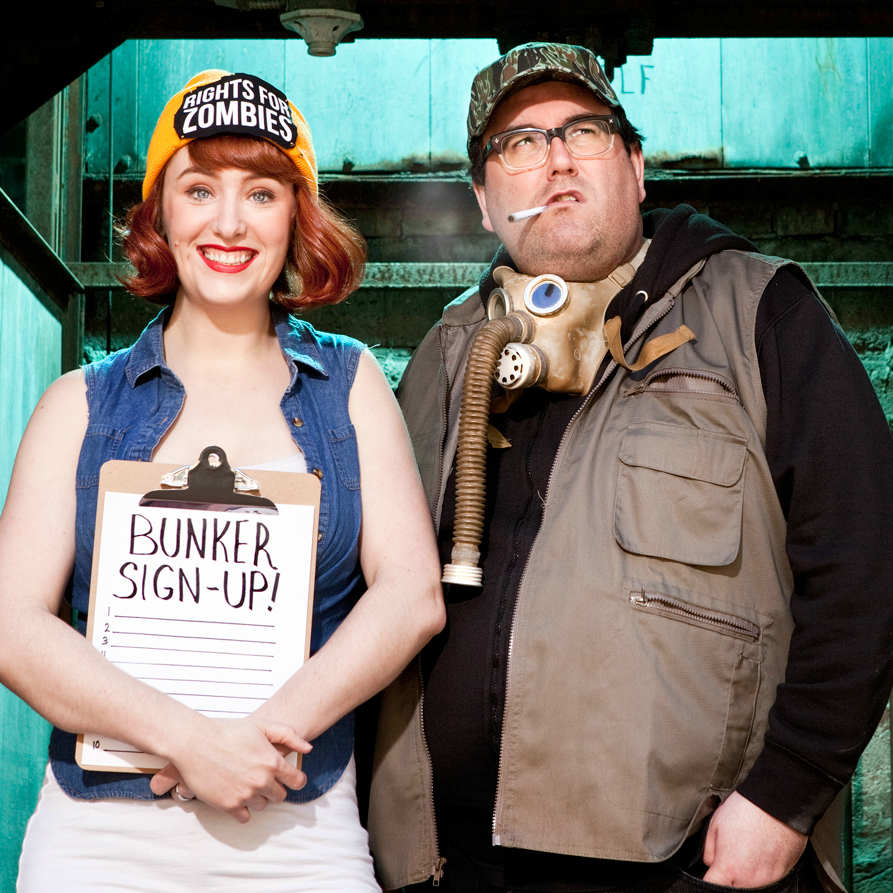
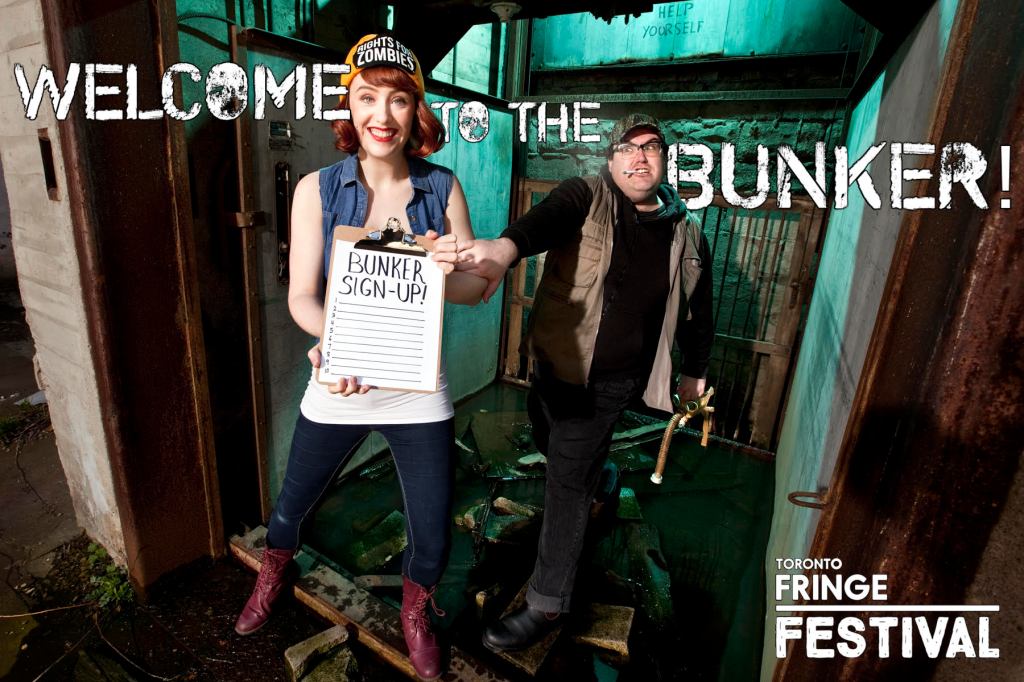
Clare Blackwood: Welcome to the Bunker! is an immersive post-apocalyptic zombie comedy set deep “under” the Theatre Passe Muraille Backspace. Katie, a zombie rights millennial activist, and Todd, an antisocial Gen-X prepper, have holed up in Todd’s bunker after North America has been overrun by the undead and left for…well, dead by the rest of the world. Naturally, Katie has decided that the best thing to do in this situation is to collect as many survivors as possible and bring them down into the bunker, in order to create a harmonious new society when the whole “zombie thing” has died down (pun very much intended). Together, they’ll take each audience of survivors through a very enthusiastic-yet-half-assed apocalypse orientation… that is, unless that scratching in the walls gets any louder…

MM: Why a post-apocalyptic zombie show?

CB: Why not? was my very first response, but I have a feeling you’re looking for more intelligent stuff than that. I’d like to say that with all the chaos that’s going on in the US and abroad, that intelligent theatrical commentary about how the world may very well become a post-apocalyptic wasteland sooner than we think was what we were going for when deciding what to do for Fringe, but if we’re being honest with ourselves, it’s because I’m a giant zombie-obsessed nerd who thought the idea of two weirdos doing PowerPoint presentations about the end of the world was hilarious beyond all reason. However, there are wonderful motifs to explore in the genre, and it was interesting to use it to explore the themes of loss, generational tension, and hope for the future, in the midst of an absurd Armageddon scenario. Zombies have been used forever to make parallels to modern society’s worries and problems, and this play is no exception.

Clare Blackwood and Ryan F. Hughes. Photographer: Max Telzerow.

I originally had an idea for a show about two very polar opposite people stuck in a zombie bunker together over a year ago, when I first considered entering Fringe. However, I had dismissed the idea as unfeasible and too silly (I know, what a ridiculous concept, right? IT’S FRINGE!) and decided to do something else for the Festival. It wasn’t until a series of unforeseen events led me to having to abandon that particular show that I remembered I had this apocalyptic idea in my back pocket. So I followed my nerdy heart and found an incredible team of people ready to take on the zombies head-on. I think we’ve managed to make the zombie apocalypse fun for not only über nerds, but anyone who likes to have a silly, awesome time at the theatre.

MM: What’s your favourite zombie movie/game/TV show and why?

CB: Why must you make me choose one, you temptress?! Okay, so in terms of zombie movie, I would definitely say 28 Weeks Later. I’ve always preferred the fast-moving “infected” to the slow, shambling undead. Mo’ carnage, mo’ fun. Most people prefer the original 28 Days, and it’s admittedly a better movie, but I love Weeks because it’s just non-stop zombie mayhem goodness. In terms of video games, the original Left 4 Dead will always hold a special place in my heart. I will never tire of it. In theatre school, whenever I was super busy, headshotting the undead hordes was the best stress reliever ever. And lastly, I tried to get into The Walking Dead, but was turned off of it in the first few episodes because of the lack of the aforementioned zombie carnage. Call me bloodthirsty, but less bickering and more katana fights, please.

MM: If you could bring three things into your bunker, what would they be and why?

CB: 1) The Lord of the Rings extended edition trilogy.

2) My cat, Gandalf. He would be extraordinarily displeased with me if I didn’t, and would probably find a way in anyway and then barf on all my irreplaceable belongings.

3) My Orlando Bloom waifu body pillow. (Just kidding! Or am I.)

…Wow, that list accidentally ended up being super Tolkien-heavy. I hope you don’t think I’m a nerd. Oh my god.

Clare Blackwood and Ryan F. Hughes. Photographer: Max Telzerow.

MM: What do you think the post-zombie world will look like? After all the carnage, and you emerge from your bunker, what do you think the world will be like?

CB: I step out of the bunker and into the free air. My auburn locks have grown in the years underground, yet despite the lack of shampoo and personal hygiene it has somehow become even sexier and more luscious. My clothes are ripped, yet flattering on my figure that has somehow not become scurvy-ridden and emaciated due to lack of proper nutrition underground. There have been so many beets. So many. I look around, getting a look at a crumbled Toronto I haven’t seen in three long years. The New World Regime has done quick work. I have heard stories of the clashes between the rebels and the Winterfist Government on the bunker radio, but it is clear the military has won the War. Its factions are marked on the jackets of my fellow, similarly-beautiful survivors: the Foragers. The Warriors. The Diplomats. Conform to the characteristics of your faction or be killed. That was the law here, ever since we had won the fight against the Walkers a month ago. Now, I face my biggest challenge yet – to choose between my best friend, Graeden, and the strange, yet enticing man I had shared all those years in the bunker with – Paeder. Together, we would overthrow the dictatorship and bring peace to a land ravaged from the zombie hordes…

Oh wait. My bad. That’s from my upcoming YA dystopian zombie trilogy. Forget that happened. Let’s move along.

MM: What should your audience prepare for as they enter your bunker? What do they need to know going in?

CB: They should get ready for one hell of a ridiculous(ly fun!) immersive ride into the apocalypse! No additional preparation needed. Come in with an open, nerdy heart and be ready to laugh, because we’re going to chat you up and have a party. We can’t wait to have you as our guests down here in the bunker. And don’t worry, we’ll keep you all safe… hopefully.

Welcome to the Bunker!

Who:
Company – Portius Productions
Playwright/Creator – Clare Blackwood and Ryan F. Hughes
Director – Alison Louder
Stage Manager – Justine Cargo
Cast – Ryan F. Hughes, Clare Blackwood

What:
Zombie apocalypse got you down? Grab your prep kit and your fellow survivors and join us underground to start your new life! Say goodbye to foraging for rations, sneaking through abandoned cities, and those pesky marauding death cults! Say hello to life in the bunker, where we will guide you through adjusting to your new surroundings. Generator power! Protection from the elements! Nearly fully figured out chemical toilets! Free canned beets while supplies last!* Join us for your orientation today!

*BEETS ARE GONE

Where:
Theatre Passe Muraille Backspace
16 Ryerson Ave. Toronto

When:
9th July – 9:45pm
11th July – 8:30pm
12th July – 4:45pm
13th July – 6:15pm
14th July – 3:30pm
15th July – 1:00pm

Tickets:
fringetoronto.com

Connect:
t: @bunkertofringe
f: /bunkertofringe


A Chat with Lindsay Bellaire & Phillip Psutka of Theatre Arcturus on ROUGH MAGIC at the 2017 Toronto Fringe

Interview by Madryn McCabe

We were thrilled to see that Theatre Arcturus had another show in this year’s Fringe after being amazed by their awe-inspiring production of Weird last year. We spoke with Lindsay Bellaire and Phillip Psutka about their rigorous process of creation and training and why Rough Magic is a perfect story to explore right now.

MM: Tell us about your show.

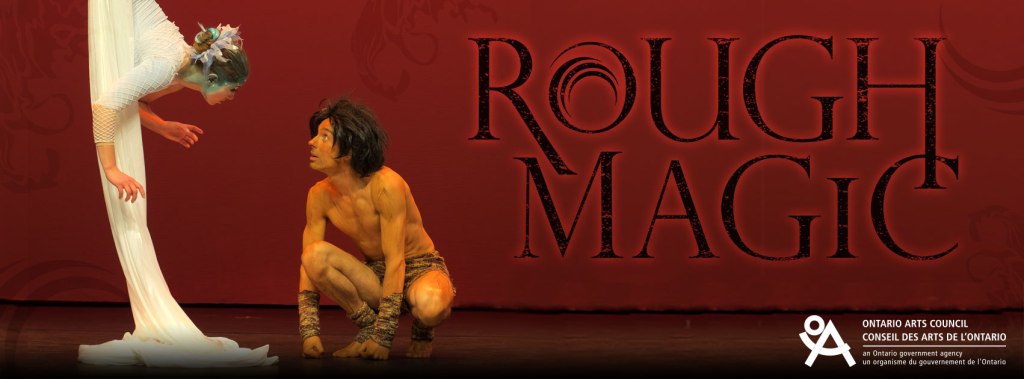
Lindsay Bellaire: A collision of air and earth, Rough Magic creates a vertical world to tell the story of Ariel and Caliban in a newly imagined prequel to Shakespeare’s The Tempest. It’s an aerial theatre piece: a play written in the style of Shakespeare (mostly in verse), with aerial silks and rope weaved into the world of the characters. Ariel, an airy free-spirited sprite, touches down and makes contact with a young Caliban, a ground-dwelling, god-worshipping mortal. Meeting between air and earth as two very different beings, they reach across the boundaries that make us fear the “other”, only to find themselves enslaved in the end, where the storm is conjured that begins The Tempest.

MM: What drives you to tell Shakespeare’s untold stories, the stories he only hints at in his texts?

Phillip Psutka: I’ve always had a passion for Shakespeare and I enjoy the challenge of meticulously researching whichever play of his that I am going off of, while at the same time having to fill in the blanks of the story that I am trying to tell myself. Also, the heightened text is a natural blend with the aerial arts in that they are both larger than life, in a way. Hearing the poetic, image-based language, while simultaneously seeing the intense physicality of the characters take to the air on the apparatus creates a world for the play where one element helps the other out – I feel that the audience can buy into the sound of the verse in an original contemporary script because of the heightened physicality… literally.

Photo Credit: Larry Carroll, The Lens Man

MM: You say that, although this is an original script, it was researched meticulously through Shakespeare’s text and other source material. What was that research process like? Why was it so important to do this research and not just create from an idea?

PP: To start off, I read through The Tempest a number of times – mainly looking for clues to the back story of Ariel and Caliban. Once I had compiled all of the info on them that Shakespeare provides, I then went back through the script focusing on the characters themselves: how they react to certain situations; what kind of language and images they use; how much they speak in verse vs. prose and, when they switch from one to another, what triggers it. It’s like detective work and that’s part of the fun of it. Because I was using the Arden, I also pulled inspiration from one of the Appendices: Robert Browning’s poem Caliban Upon Setebos, which is where I took the idea of Caliban being religious. After I was through with the “Sherlock Holmes” portion of the script development, I outlined the entire show, filling in the blanks of what I wasn’t able to discover through the research before writing the first draft. I think it’s totally valid to create something completely original even if it’s based off of another work; I just enjoy the research part of it so much. More than anything, I like that idea that an audience could watch Rough Magic and then jump right into a production of The Tempest and it would be one continuous story, for Ariel and Caliban at least.

MM: You talk about telling the story of “the other” in your play. Why is that? What do you seek to say to your audience?

PP: That, even though we may live in our own worlds, it’s important to remember that others do as well, and we can never know everything that has shaped that person or being into what they are at this moment in time. I feel that the ongoing challenge of being human is to not make assumptions about others, to stop and listen before passing judgement on their situation. I’ve definitely been guilty of saying irrational and disrespectful things to someone else simply because I had the hangeries, and if it’s that easy to trigger a short response to a situation and shut another person out, I can only imagine what it must be like to try to work constructively with a leader that wants to build a wall between their country and yours and has decided that you are going to pay for it: end of story, not interested in your opinion. I believe that there is always more to learn about the human existence and the best way to learn is to listen before speaking, which is a quality I feel the world is lacking in at the moment. I can certainly do it better myself, but little reminders every now and then are helpful. I hope Rough Magic serves as one of those little reminders.

Photo Credit: Larry Carroll, The Lens Man

MM: I can tell from your press photos that this is a very physically demanding show. What is your rehearsal and training process like? What is your development process? How did you develop your show?

LB: The physical training for our shows is ongoing, even when not in rehearsals or a creation process. Outside of our theatrical productions, the aerialists in the shows are professional performers, training acts for events and teaching aerial classes – it’s not a skill that we learn specifically for the show. The physical training is 4-5 times a week, in 2-3 hour sessions, year-round (with some time taken off for rest and recovery, of course).

The scripts are written by Phillip, usually over an intense period of 2-4 weeks, then edited, read out loud, and edited further. Then the rehearsal process begins, where it becomes a collaboration between the director (whom, at this point, gets final say on all decisions), writer, actors, aerial and fight choreographers, and composer. This is actually a very small team, with the actors doubling up as chorographers and writer. Costumes and lighting are also designed somewhere in there!

For Rough Magic specifically, the script was written first, and the rigging designed to suit the story (the decision to use silks and a rope, and how they would be hung). We were lucky enough to be able to bring Kevin Hammond (former AD of the Humber River Shakespeare co.) on board as our director for a 5+ month development process. Because we were creating out of a studio space in Muskoka, our process for this show was unique in that Phillip and myself would do preliminary work on each scene, getting it on its feet using some basic exercises and following our instincts. Kevin would make a trip up for a weekend intensive every 3 weeks to further develop and sculpt each scene, offering invaluable insight and guidance into the text, and establishing the balance between air and ground work. Our Stage Manager, Lisa Sciannella, travelled up for the last few weekends of rehearsals to work on the sound cues. Her job entails knowing our choreography and some aerial vocabulary, as her sound cues are based on what we’re doing in the air. She’s also a constant safety for us, acting as an outside eye and responding to any little aches, bumps or bruises we inevitably sustain at various points throughout the process.

The music and costumes are also an important component. The music was composed by Rachel C Leger, and was created to suit the feel of the piece (nautical), with a flavour for each moment where music is used. The choreography was created separately, and married together in the last month of rehearsal. The costumes, designed by Lisa Magill (Toronto) were actually designed before most of the show was on its feet, in order to get promo shots long before opening.

MM: What would you like your audiences to know going in to see Rough Magic?

LB: You do not need to have a thorough understanding of The Tempest, or even Shakespeare in general, to follow the story. Although it is inspired by The Tempest, and based on clues from Shakespeare’s text, we purposely created a show that can stand alone and be enjoyed for its own story. For those audience members who have studied The Tempest, there is definitely an added layer.

Rough Magic

Who:
Company: Theatre Arcturus
Playwright/Creator: Phillip Psutka
Director Kevin Hammond
Cast: Lindsay Bellaire, Phillip Psutka
Choreographer: Lindsay Bellaire
Fight Director: Phillip Psutka

What:
Set on a mystical island, ROUGH MAGIC follows the innocent beginnings and volatile consequences of a relationship between two unlikely beings: Ariel, an airy sprite; and Caliban, a ground-dwelling mortal. An intricate weaving of theatre, aerial work and music, the show confronts ideas of freedom and otherness through a story inspired by Shakespeare’s The Tempest.

FROM THE CREATORS OF ‘WEIRD’
WINNER: Cutting-Edge Award (2016 Toronto Fringe)
(5 stars) “Absolutely exquisite and mind blowing in its execution.” – My Entertainment World
(NNNN) “One of the most memorable shows at the Fest.” – NOW Magazine

Where:
RANDOLPH THEATRE
736 Bathurst St, Toronto

When:
9th July – 8:45pm
11th July – 1:00pm
13th July – 12:00pm
14th July – 5:45pm
15th July – 8:00pm

Tickets:
fringetoronto.com

Connect:
t: @TheatreArcturus
f: /theatreacturus
i: @theatrearcturus