Skip to content

Talking Canadian Stories & the Upcoming Production of AGENCY with actor Ben Sanders

Interview by Shaina Silver-Baird

Shaina: What’s different about working on a new play like this that’s never been done before, compared with something that has been in the theatre canon for awhile?

Ben Sanders: It’s very liberating when you don’t have to worry about the burden of a precedent for your character. Rather than doing the ten thousandth Mercutio, I get to be the very first Peter Gottschild (my character in Agency). There’s a great freedom that comes with that. My impulses and choices are brushstrokes on a fresh canvas.

Shaina: What is a ‘Canadian’ story? Would you say this is a Canadian play?

Ben: Canadian stories are anything dreamed up in the mind of a Canadian (including brand new Canadians) or anything set in Canada. Aside from some of our indigenous stories, just about all Canadian stories involve relationships to other countries. Agency is set in Germany, and features all German characters, but it also has a whole lot of the heart and soul – and some of the heritage – of Eva Barrie, a Canadian artist.

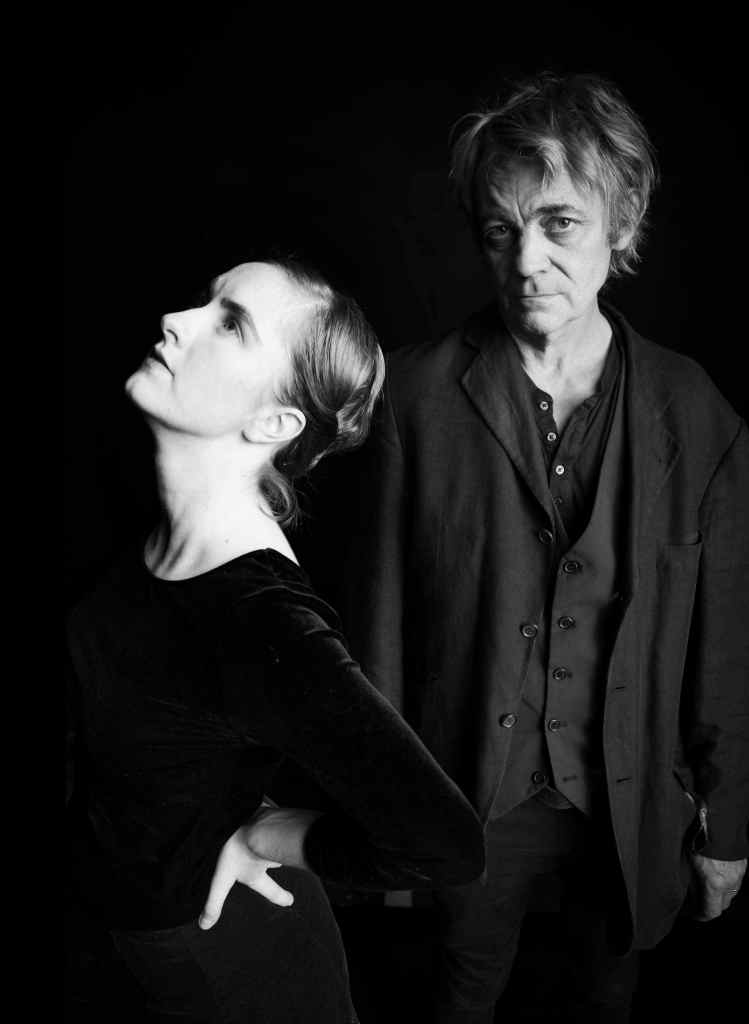
Photo of Eva Barrie & Ben Sanders by Greg Wong

Photo of Eva Barrie & Ben Sanders by Greg Wong

Shaina: What’s been the biggest challenge and biggest joy in tackling your character so far?

Ben: We’re playing with time and memory in the play. Sometimes my character is onstage as a part of someone else’s memory, rather than really being there. So I can’t be too picky about my “reality”, or my circumstances. The biggest joy, so far, is the crackling dialogue – Eva’s lines just roll off your tongue. Makes my job easy!

Shaina: Describe the show in 5 words.

Ben: Suspense. Surveillance. Betrayal. Obsession. Turtlenecks.

Photo of Earl Pastko & Ben Sanders by Greg Wong

Photo of Earl Pastko & Ben Sanders by Greg Wong

Shaina: Do you think it’s important for the other characters to explore the past as they do? At what point is this exploration positive and at what point is it detrimental to get trapped in the past?

Ben: Everybody’s got skeletons in the closet… everybody. So if you want to dig into your own past, or your family tree, you’ve got to do so with empathy, and brace yourself for unseemly discoveries. A family history is just a story we’ve been told, usually edited and revised for our benefit by people who care about us. Do you really want to challenge that story? It takes a lot of courage and offers little reward. But, then again, some stories demand to be told, and don’t ask politely.

Photo of Earl Pastko & Ben Sanders by Greg Wong

Photo of Earl Pastko & Ben Sanders by Greg Wong

Shaina: Did you have to do any research into the specific events of 1980s Berlin to tackle this play? What was the most interesting fact your discovered?

Ben: The extent of the surveillance state was pretty astounding, especially the network of “Inoffizieller Mitarbeiter” – informal collaborators. These were not official Stasi agents, just ordinary people feeding the authorities information on their acquaintances. Friends reported on friends; family reported on family. Once the wall fell, and it all came out in the open – once the hundreds of thousands of shredded files were pieced together by hand – reconciliation was not easy.

One of the most moving stories was of a woman who was devastated to learn, after the wall fell, the names of all the friends that had been reporting on her behind her back. At the end of her research into her file, she was reminded that she, also, had briefly informed on her friends, and completely forgotten about it. Surveillance and betrayal were just a part of everyday life.

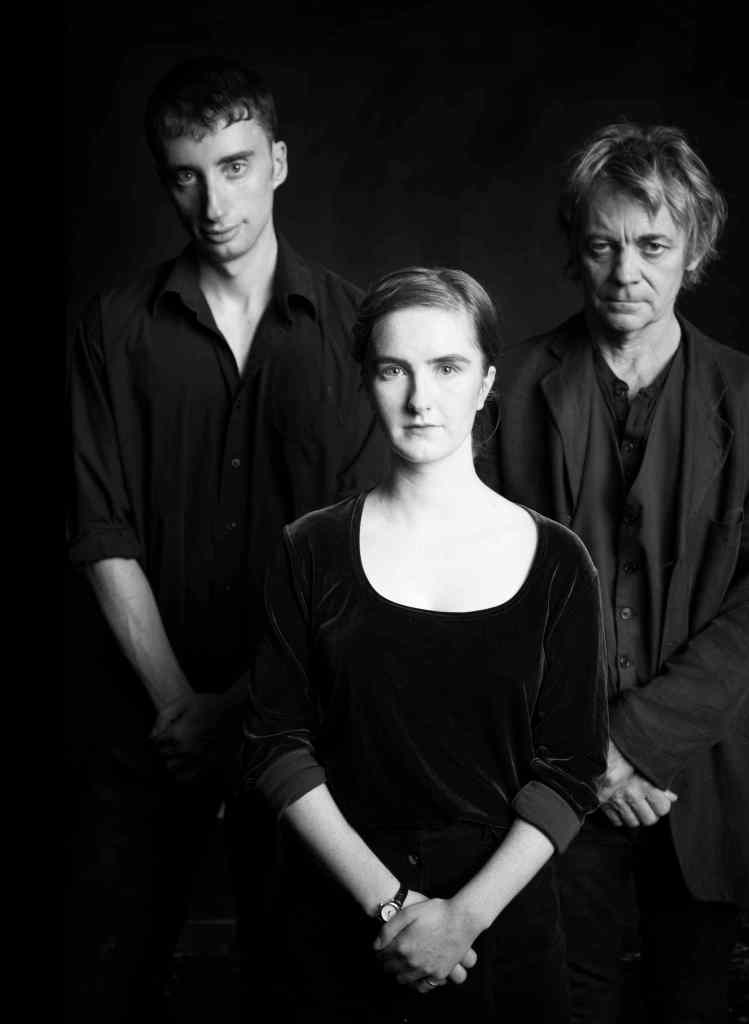
Photo of Earl Pastko, Ben Sanders & Eva Barrie by Greg Wong

Photo of Earl Pastko, Ben Sanders & Eva Barrie by Greg Wong

Shaina: There is so much going on in the city right now, why should people come see this play? What will they get here that they won’t get anywhere else?

Ben: Eva Barrie is a major new talent. Her writing is totally engrossing: it’s got an impressive technical complexity – lots of tasty plot – but also a very natural, relatable tone that will catch you off-guard. And she’s written a terrific role for Earl Pastko to act the hell out of. Which he does.

arn_3517

Photo of Earl Pastko, Ben Sanders & Eva Barrie by Greg Wong.


About Ben Sanders:


headshot-ben-sanders

Ben Sanders is a Toronto-based actor. He has performed at the Shaw Festival for seven seasons, appearing in 14 productions, including The Intelligent Homosexual’s Guide to Capitalism and Socialism with the Key to the Scriptures, The Sea, Major Barbara, Cabaret, Our Betters, French without Tears, Misalliance, Serious Money, and four world premieres: Michel Marc Bouchard’s The Divine: A Play for Sarah Bernhardt, Peter Hinton and Allen Cole’s musical version of Alice in Wonderland, Lisa Codrington’s adaptation of The Adventures of the Black Girl in Her Search for God, and Michael Healey’s reimagining of On the Rocks. He also performed with The Grand Theatre (A Christmas Carol, Dry Streak, Playwright’s Cabaret) and with Toronto’s Praxis Theatre (Objections to Sex and Violence, Tim Buck 2). In 2015, he was named one of NOW Magazine’s Top 10 Theatre Artists of the year, and the My Theatre Awards Performer of the Year. He trained at Ryerson University.
Up next, Ben will be back at the Grand Theatre in The Lion in Winter.

Agency

A New Play by Eva Barrie

agency-banner

Who:
Presented by Yell Rebel
Written by Eva Barrie
Directed by Megan Watson
Dramaturged by Thomas Morgan Jones
Featuring: Earl Paskto, Ben Sanders & Eva Barrie

Set & Costume Designer: Karyn McCallum
Lighting Designer: Mikael Kangas
Sound Designer: Lyon Smith
Stage Manager: Théa Pel
Technical Director: Tamara Vuckovic
Design Assistant: Echo Zhou
Producer/Production Manager: Noah Spitzer

What:
In the height of the Cold War, Hannah’s father is killed as her family makes a desperate escape out of East Berlin. Years later, she reads her father’s Stasi files and unearths a 25 year old mystery. The only one who can help her solve it: the man who spied on her father. Demanding answers and getting far more than she bargained for, Hannah takes a trip into the past.

Where:
The Theatre Centre, 1115 Queen Street West

When:
November 10th – 20th
Tuesday – Saturday 7pm
Saturday/Sunday 1pm

Tickets:
General Admission: $22.00
Arts-worker/Student $18.00
PWYC Performances: Nov. 10th (7pm), Nov. 12th (1pm), Nov. 13th (1pm) & Nov. 19th (1pm)
tickets.theatrecentre.org

Connect:
w: yellrebeltheatre.com
fb: /yellrebeltheatre
t: @yellrebelTO


In Conversation with Joshua Browne & Alec Toller on “The Queen’s Conjuror”

by Bailey Green

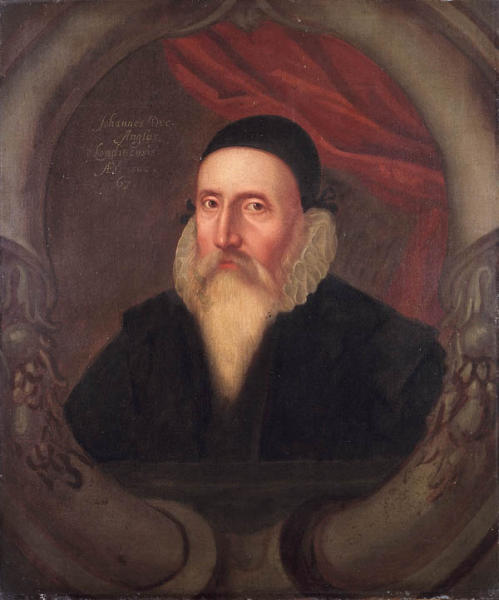
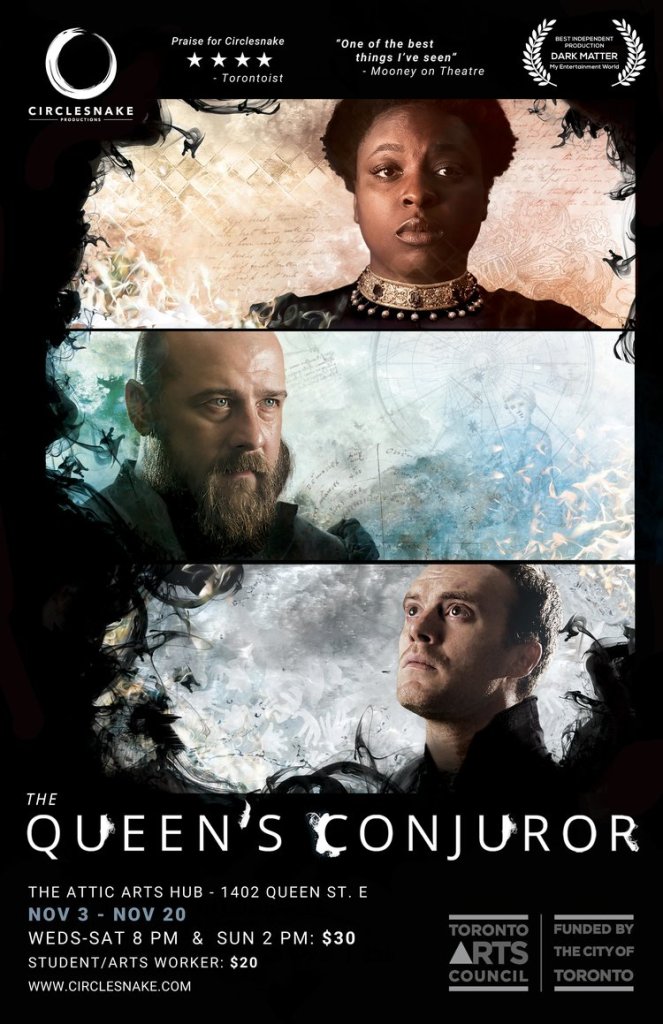
In the 16th century, John Dee—alchemist, scientist and magician—met an erratic, emotionally disturbed scryer named Edward Kelley. Dee believed Kelley had the ability to speak to angels and that this could help Dee unlock secrets beyond man’s understanding. A tumultuous partnership was formed between the two men and their wives. These flawed, complex relationships are explored in Circlesnake Productions’ new play, The Queens Conjuror, written by Joshua Browne and Alec Toller.

Director and writer Alec Toller came across John Dee on Wikipedia after he’d used the word ‘thaumaturgy’ on a date. John Dee is often considered the original wizard archetype. Dee is said to perhaps have inspired the characters of Prospero and Faust. Toller was captivated by Dee’s story and reached out to Joshua Browne. Browne, who had worked with Circlesnake Productions on Dark Matter and Angel City, says he was on board from the word ‘wizard.’

“The relationship between John Dee and Edward Kelley is really fascinating,” Browne says. Browne plays the character of Edward Kelley, “Edward Kelley was a scryer, a channel for the voices of angels. John Dee actually turned to the occult for knowledge because he reached a point in his work where he believed the knowledge of man would not get him closer to God.” Shortly after Dee and Kelley began working together, Edward and Joanna Kelley moved in with John and Jane Dee. The two couples lived and travelled together for years before the relationships began to fracture. “It wasn’t satisfying to write Kelley off as crazy or psychotic,” Toller says. “But he was very emotionally disturbed and we look at how that affects all of the relationships there.”

johndeeforqueen

John Dee with the Queen

The initial drafts of The Queens Conjuror by Toller and Browne, provided a historical baseline for improvisation with the company of actors. Feedback was instrumental when it came to writing the characters of Jane Dee and Joanna Kelley. According to Dee’s writings, Jane was integral to his work. Their relationship was quite egalitarian for the time. By contrast, all that is known of Kelly’s wife Joanna is that he despised her. “We have one man’s opinion of her,” Toller says. Browne and Toller emphasize that a central focus of this piece was ensuring that Jane and Johanna’s voices were heard.“We had to invent them,” Toller says of writing Jane and Joanna. “We explored the gender dynamics involved in the world they were living in, but it is a challenge because how do we show what the reality was without reinforcing it? We wanted to write something that is not going to ring as these women being two props for the ‘larger story’ of these men.”

john_dee_ashmolean

John Dee

Browne speaks of the risk and vulnerability involved in working on this process, “This feels like a risky show to me… I have tons of fear surrounding this show! It’s about the 16th century with very little in the way of budget[…] It’s about these contentious relationships and personal things, and how do you do that without making the play a soap opera or historical drama? And how do you write women and facilitate women writing themselves? How do you represent the patriarchy without reproducing it? As two white, male writers, we had to get our actors’ opinions and involve women in the conversation. We can acknowledge our privilege and ask how can we be better.”

In the rehearsal room Toller and Browne transitioned into their roles as director and performer, respectively. Both Browne and Toller speak of gratitude for their company of actors (Tim Walker, Khadijah Roberts-Abdullah, Sochi Fried, John Fray) whose contributions helped The Queens Conjuror change and grow. The collaborative nature of the rehearsal process is at the core of Circlesnake’s mandate: “It’s really important when we’re engaging artists and actors who are all very talented,” Toller explains, “that they don’t just walk away with the small money you get from a profit share and maybe a fun rehearsal/show process, but that there’s an ownership there. They’ve helped make this together and it’s important that these actors get the most agency and a sense of pride in the show they made with us.”

The Queen’s Conjuror

tqc-11x17-fa-high-page-001

Who:
Directed by Alec Toller
Written by Alec Toller & Joshua Browne

Featuring Tim Walker
Joshua Browne
Khadijah Roberts-Abdullah
Sochi Fried
John Fray

What:
John Dee was a 16th century adviser to Queen Elizabeth, and a scientist and magician when those two professions were indistinguishable. The Queen’s Conjuror follows John Dee as he tries to decipher an enticing but ominous vision which he hopes will provide critical information that will impress the QueenElizabeth enough to gain her patronage. To do this, Dee enlists the help of Edward Kelley, a scryer, medium, and possible charlatan. Kelley proves to be as brilliant as he is disturbed, and Dee must work through the wretchedness of Kelley’s soul and his erratic behaviour to access his revelatory visions and gain the Queen’s support. The show explores the complexity of intimacy, the dangers of vulnerability, and the necessities of both for the alchemical transformation of the soul.

Where:
The Attic Arts Hub
1402 Queen St E

When:
Nov 3 – Nov 20
Wed – Sat, 8pm
Sun 2pm

Tickets:
$30
$20 Student/Arts Worker
queensconjuror.brownpapertickets.com

Connect:
fb: /Circlesnake
t: @Circlesnake
w: circlesnake.com

“A woman in front of a microphone, a master of ceremonies of her story.” In Conversation with Anna Chatterton, creator/performer of QUIVER

Interview by Hallie Seline

I had the chance to speak with prolific Toronto playwright Anna Chatterton, creator/performer/master-of-all of QUIVER. We discussed her inspiration for the piece, the importance of collaboration, taking risks, and allowing her new pieces to breath, grow and adapt with her over time.

QUIVER is on stage now to November 6th at Buddies in Bad Times Theatre, presented by Nightwood Theatre as a double bill with Quote Unquote Collective’s MOUTHPIECE.

Hallie: This is an incredible set up for a show with one performer. How did the idea for the show and then the idea for the need of this specific performance format come about?

Anna Chatterton: This story is inspired by my teenage self. When I was fifteen my older sister moved out and my mom would, at times, spend many nights at her boyfriend’s house. While I was welcome to join them, I was often alone at home. I was close to my dad but he lived in B.C., so we would talk on the phone a lot, but it was different than having him in the same city. Though I could take care of myself, it was pretty lonely. I remember a lot of silence, coming home to silence, waking up to silence.

Quiver was born out of that memory of feeling lonely, the dynamics in our single parent family and my teenage angst and anxieties. This play is a fictional account of that period in my life, and I am playing a fictional and dramatic version of myself, my sister, and my mother. I should point out that my sister and mother are actually very different than I portray them in the play – thus, fiction. The protagonist Maddie is closest to reality and myself, though I exaggerate parts of her for dramatic effect.

Photo by John Lauener

Photo by John Lauener

Hallie: Can you speak about how the play was developed? 

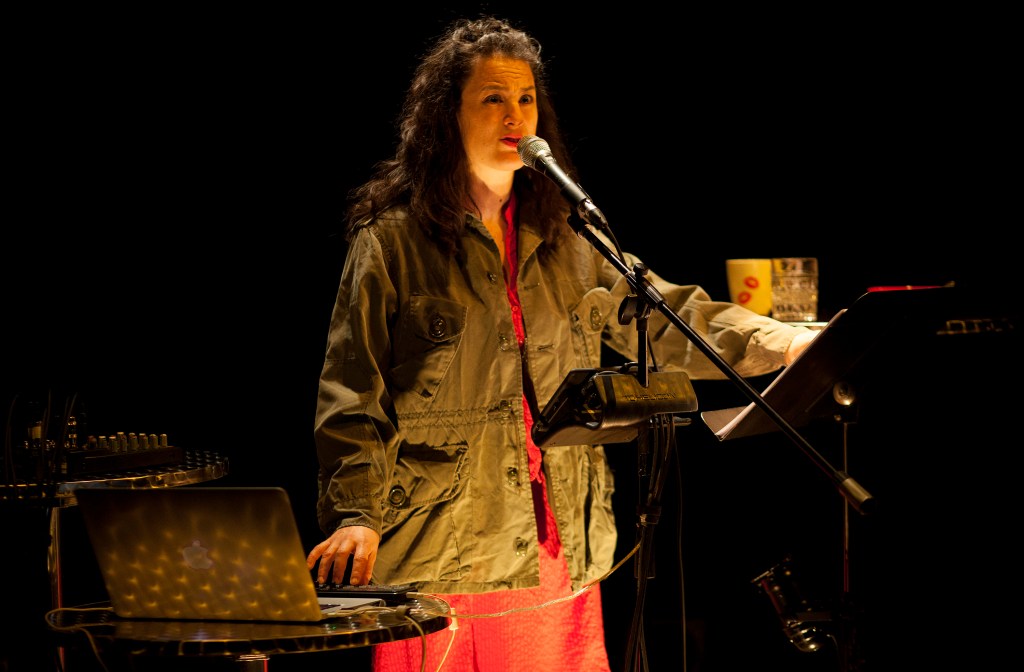
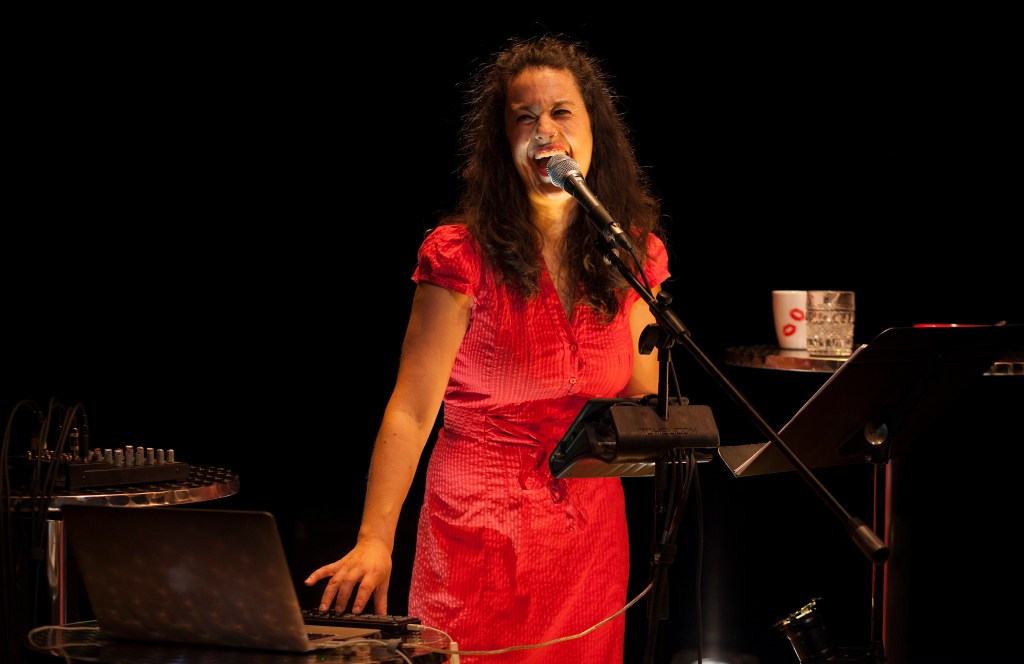
Anna: I originally began writing the play to be a solo show but then I started to write scenes so I thought, okay I guess this is a regular three-person play. Then I started becoming really interested in sound art, and wanted to learn more about creating live vocal effects for a theatre play. Luke Brown at Theatre Aquarius in Hamilton asked me if I had a play for their studio series and I started to think Quiver might actually be the right fit as a solo play working with sound in the forefront. My partner Jim Ruxton, who is an electronics engineer, did some research and found a vocal processor that could pretty much do anything. When I approached Andrea Donaldson to direct Quiver, and told her what I wanted to do she said, “I love it – a woman in front of a microphone, a master of ceremonies of her story.” Then we hired sound designer Mike Rinaldi to help me actualize my sound dreams and we created a workshop production for Aquarius.

Photo by John Lauener

Photo by John Lauener

We talk about this show as being like a radio show that you watch happening live. I think the technology serves this story as the audience is always aware of me, the creator/performer, manipulating sound in front them while telling this intimate tale about a broken family. This woman (me, the performer) needs the technology to help tell the audience this story and I am totally in control of the storytelling.

Photo by John Lauener

Photo by John Lauener

Hallie: This is your 4th premiere in Toronto this year! Can you speak to your creation process and how you like to work and how you decide when a piece is ready to premiere?

Anna: I can write fairly quickly initially but I like to have a lot of time to sit with a piece, to come back to it again and again. I believe in the long process, often I will take up to three to four years before I feel a piece is ready to premiere. I like to allow a play/libretto breathe, as I change, grow, learn, and then let the pieces I am writing to change accordingly. I feel that ideally all plays or operas should have a workshop production, as that is the best way to see a piece, to learn what works and what doesn’t work in front of an audience (who understands they are watching a work in process), and then rewrite it before a premiere.

Photo by John Lauener

Photo by John Lauener

I really like collaborating. If I am writing a play, I like working with directors fairly early in the process so we can share our visions and dreams and thoughts and I can let those dialogues and notes guide the next drafts of the play. I also often work with my company Independent Aunties (with evalyn parry and Karin Randoja), where we create our plays together from the ground up and in the studio, evalyn and I co-write and act in the plays, and Karin dramaturges and directs. In opera the composer and I will come up with the story idea together and then I write the libretto, and the composer will set my text to music. 

Photo by John Lauener

Photo by John Lauener

Hallie: What would you like to see more of in Toronto Theatre?

Anna: More Risk. Allowing ourselves to fail in order to learn. Experimenting as artists, not playing it safe.

Hallie: Any advice for young emerging artists?

Anna: Have patience, and put in the work. It takes a long time to make good art. Ask for what you want, don’t expect to be asked.

Quiver

_mg_0711-johnlauener

Who:
Written and Performed by Anna Chatterton
Directed by Andrea Donaldson
Produced by Nightwood Theatre
Presented as a double bill with Mouthpiece

What:
“A brilliant and brave play.” – JUDITH THOMPSON
A single mother and a rebellious teenage daughter collide when a love interest comes between them, leaving 14 year old Maddie caught in the crossfire. Armed with little more than a microphone, laptop and vocal processor, writer-performer Anna Chatterton crafts and controls a sonic landscape in a masterful performance. A dark, delicious comedy about a passionate and imperfect family.

Where:
Buddies in Bad Times Theatre
12 Alexander Street, Toronto ON, M4Y 1B4

When:
October 21 – November 6, 2016

Tickets:
tickets.buddiesinbadtimes.com

Connect:
t: @a_chatterton
#Quiver

“Performing MOUTHPIECE is a bit like running a marathon & singing an opera simultaneously.” In Conversation with Norah Sadava & Amy Nostbakken of MOUTHPIECE

Interview by Hallie Seline

I had the pleasure of chatting with the fierce artists of Quote Unquote Collective, Norah Sadava & Amy Nostbakken, the creators and performers of MOUTHPIECE. We spoke about the necessity of precision, time and digging deeper in their creation process, the importance of touring and continuing the conversation nation-wide, and finally… #traininglikebeyoncé.

MOUTHPIECE is on stage now to November 6th at Buddies in Bad Times Theatre, presented by Nightwood Theatre as a double bill with Anna Chatterton’s QUIVER (Keep posted for our interview with Anna).

Hallie: I was floored when I first saw MOUTHPIECE, so I’m thrilled Toronto audiences are getting another chance to see this! Can you speak about what sparked the creation of the show?

Norah Sadava: The spark that ignited Mouthpiece happened midway through making an entirely different play. Amy and I had begun working together on a piece about female relationships, but we couldn’t quite get at the heart of it without looking deeply at ourselves, and once we did that some major lightbulbs turned on for us. Once we started to dig inward we suddenly recognized our own hypocrisy, our own contributions to the oppressive heteronormative-white-supremacist-capitalist-patriarchy, our own confusion and inner conflict regarding where and how our generation fit into the ‘women’s movement’, and how we personally could rail against the stereotypes that have been fed to us through every portrayal of women we’ve seen since the moment we were born. So we decided that we had to make a show about that instead. 

Photo by Brooke Wedlock

Photo by Brooke Wedlock

Hallie: How did you develop the piece into what it is today? 

Amy Nostbakken: Mouthpiece was developed over a period of three years. That may seem like a long time but it is a drawn-out creative process that allowed us to insist on every moment being charged with multiple layers of meaning. It’s not an exaggeration to say that every breath and swallow and shrug in this show has been thought about and has a purpose.

Hallie: I’d believe it! You two are so precise in the show. It’s incredible to watch a piece with that much detail, intention and precision. It packs a punch!

Amy: When we decided to tell this utterly personal and extremely necessary story of what it is like to be inside one woman’s head, thus tackling the theme of what it is like to be a woman today, we did not take it on lightly. And it’s complex, you know? It’s subtle and non-linear and messy and also terrifying. So a lot of time was spent going over a piece of text or movement or music and asking – “Is this honest? No, but really? Have I censored this, or molded it to fit into my pre-existing ideas of what is ‘good’ which have inherently been crafted by some dead, white man?” For us it was just too damn important a subject to rush into production.

So to answer this question technically: we developed this piece through years of research, years of digging deep and then deeper, then needling right into our very cores, years of examining our own hypocrisy and privilege, years of stripping away, and countless hours of repetition in front of a mirror.

Amy Nostbakken and Norah Sadava. Photo by Joel Clifton.

Amy Nostbakken and Norah Sadava. Photo by Joel Clifton.

HS: I see you’ve been touring the show across Canada. Can you speak a bit about your experience bringing this show on the road and how it has affected you as performers and creators, and this piece? 

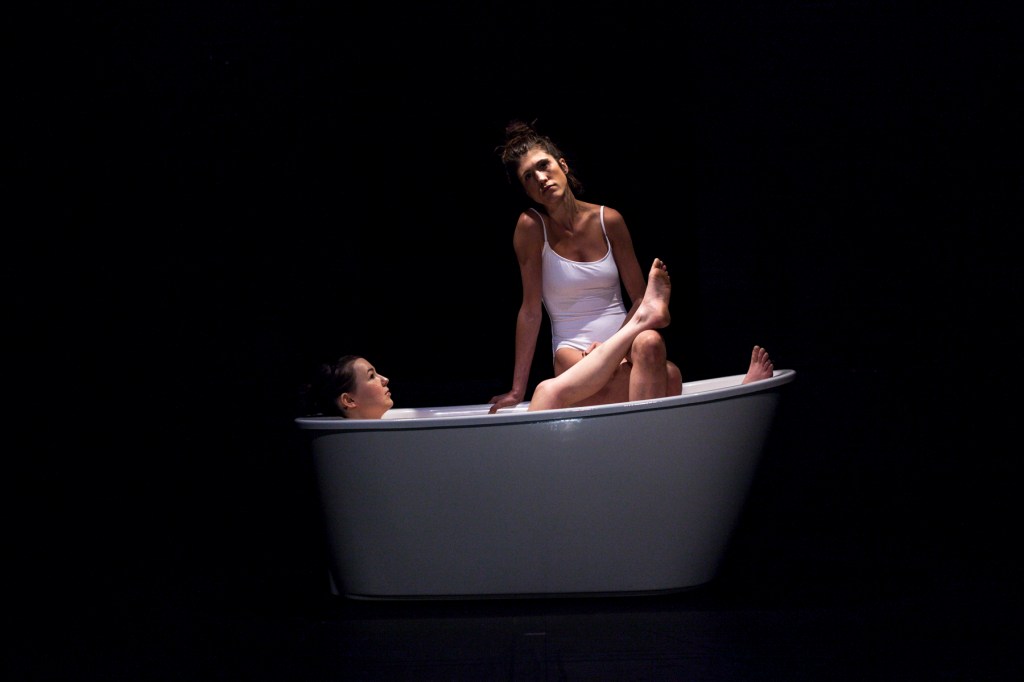
Norah: Taking Mouthpiece on the road has revealed to us that this conversation must be national. We can’t solely exist in our own little liberal-west-Toronto-artist bubble and preach to the choir forever. It is important to us to have our work challenged by other perspectives, other communities, other geographies, and hear responses from people from all sorts of different backgrounds. Feminism has to be intersectional or it’s not really progress at all. Of course we acknowledge that a theatre audience is already inherently biased based on the fact that they are at the theatre (have the money, time and interest to expose themselves to experimental art) no matter what town we are in. But having played this piece across the country, we can say that there are some truths that are a national (and international) matter. We’ve also learned that a bathtub can travel, and how to get the most possible free snacks on airplanes. 

Norah Sadava and Amy Nostbakken. Photo by Joel Clifton.

Norah Sadava and Amy Nostbakken. Photo by Joel Clifton.

Hallie: I’ve been seeing these incredible “training” videos of you both getting yourself ready to perform the show. It’s a huge feat watching you both do this show. Can you speak about doing this training, why you’ve found it’s important and where the idea for this came about? 

Norah: Performing Mouthpiece is a bit like running a marathon and singing an opera simultaneously. When we haven’t done the show for a while it takes a lot of juice to get back into shape; this show requires a great deal of breath control and cardiovascular fitness to carry out movement and vocals simultaneously for an hour straight. So in preparation for this run at Buddies we were trying to think of the very best regimen possible. Then we remembered something that Beyoncé said…

“My father, who was also my manager, made me run a mile while singing so I would be able to perform on stage without becoming exhausted.”

Apparently he would make Destiny’s Child wake up early every morning and jog around a track while singing their whole set. So we bought a cheap treadmill and upright bike off kijiji and started doing the whole show while switching back and forth between running and biking in the front room of my house (without our fathers forcing us into it, luckily).  Sometimes we sing 90’s hits instead of the show, and in honour of the source of inspiration, Destiny’s Child is on high rotation. It seems to work. We still get tired, but because of Queen B we never lose our breath completely.  

Norah Sadava and Amy Nostbakken. Photo by Joel Clifton.

Norah Sadava and Amy Nostbakken. Photo by Joel Clifton.

Hallie: If you could have your audience listen to one song or playlist before coming to see the show, what would it be/consist of?

Amy: The idea behind the music in the show is that you are taken on a journey through an abridged history of the female voice in popular music (so inherently, the female voice filtered through a male lens…). The compositions are inspired by southern hymns, opera arias, Bulgarian choirs, the Andrew Sisters, Billie Holiday, Tina, Janis, Joni, Beyoncé…

So I would pick any female artist that you love and while you’re listening to her sing, appreciate all the hoops she’s had to jump through for you to be able to hear her. Or you could just go for Billie Holiday or Nina Simone, can’t lose.

Norah: I’d also add Millie Jackson – Go out and Get Some. She always puts me in the mood for action. 

Hallie: Describe the show in 5-10 words.

Amy: Woman wakes to find: mom dead, voice lost, womankind still under thumb of patriarchy.
(That was 14 words, but I generally try to take an extra 28% whenever I can to make up for the 28% less I make as a Canadian woman compared to my fellow Canadian men.) 

norah-and-amy-475

Quick Answer Round:

Favourite line or moment in MOUTHPIECE:
Amy/Norah: The opening harmony in the dark.

Favourite place in the city:
Norah: Tie between Sunnyside beach and my kitchen table with a record playing.
Amy: Tie between Kensington Market and my bed.

What you’re currently listening to on repeat:
Norah: The new Leonard Cohen and the new Angel Olsen.
Amy: Solange

Where do you look for inspiration:
Norah/Amy: Lake Ontario, poetry

Best advice you’ve ever gotten:
Amy: It’s a tie between: “Only make good work” and from my grandmother: “Don’t hide your light under a bushel.”
Norah: “Use it or lose it.”

Any advice for young emerging artists:
Amy: Only make good work and don’t hide your light under a bushel.
Norah: Only make work that you feel is absolutely necessary. Have a reason, something that you are burning to say, and the rest is just logistics and hard labour.


MOUTHPIECE

Norah Sadava and Amy Nostbakken. Photo by Brooke Wedlock.

Norah Sadava and Amy Nostbakken. Photo by Brooke Wedlock.

Who:
Created and performed by Norah Sadava & Amy Nostbakken
Directed and Composed by Amy Nostbakken
A Nightwood Theatre presentation of a Quote Unquote Collective production
Presented as a double bill with Quiver

What:
WINNER, Dora Mavor Moore Award for Outstanding Performance by an Ensemble
WINNER, Dora Mavor Moore Award for Outstanding Sound Design/Composition

A harrowing, humorous and heart-wrenching journey into the female psyche. In the wake of her mother’s death, Mouthpiece follows one woman, for one day, as she tries to find her voice. Interweaving a cappella harmonies, dissonance, text and physicality, two performers express the inner conflict that exists within a modern woman’s head: the push and the pull, the past and the present, the progress and the regression.

Where:
Buddies in Bad Times Theatre
12 Alexander Street, Toronto ON, M4Y 1B4

When:
October 21 – November 6, 2016

Tickets:
tickets.buddiesinbadtimes.com

Connect:
w: quoteunquotecollective.com
t: @QUCollective
fb: QUCollective
ig: @qucollective
hashtag: #MOUTHPIECE


“Corpses, Neo–Alt Theatre and Community” In conversation with David Ferry, director of BREATHING CORPSES at the Coal Mine Theatre


“It’s really important in this company that everybody has ownership in the room. It’s the way I like to work. My job as a director is to create an empowered room. It’s not ‘director as boss’, it’s ‘director as facilitator’.”

– David Ferry


Interview by Shaina Silver-Baird

Shaina: The title “Breathing Corpses” is quite potent. What does it mean to you?

David: Well, it’s kinda like The Walking Dead isn’t it? In the idea that people are walking around dead already, they just don’t know it. And they don’t know when they’re going die. For instance, with the characters Kate and Ben, she’s already dead in their relationship in an odd kind of way. So she’s a breathing corpse. And then there’s fate at play: she’s already marked for death. And Amy is marked for death. And Richard is marked for death… So there’s a sense that there’s nothing you can do about it. You may be marked for death sooner rather than later. I think the playwright is saying: we’re all walking around dead, we just don’t know when it’s going to happen.

Shaina: But there are actual dead corpses in the play?

David: The one dead body that we see onstage is at the top of the play. And we find out later that it’s one of the characters we meet during the course of the following scenes. So we go back in time as the play progresses. He’s fated to be dead in a month when we meet him on stage. The other dead character – whose body is found offstage – we see her breathing as well. So at the time that the first scene of the play occurs, two people that we meet on stage, are already dead.

It’s so bizarre trying to figure out the timeline of this.

benjamin-sutherland-kim-nelson-in-breathing-corpses-at-coal-mine-theatre-bensophoto

Photo of Benjamin Sutherland & Kim Nelson by Shaun Benson

Shaina: So as a person discovers a dead body, does that mark them for death? Or is it more complicated than that?

David: There are a couple of things that seem clear to me. Everybody is marked for death. We’re all going to die. But some people are marked for death early, before their time. One of the things I’m playing with in the play is that each character who dies prematurely appears at some point in their bare feet. Nobody’s going to understand what that’s about! But it will set them apart, because they are already walking towards death. And Charlie, who is death himself, also appears in bare feet – he carries death with him… It’s an odd play.

erin-humphry-and-richard-sheridan-willis-in-breathing-corpses-at-coal-mine-theatre-bensophoto

Photo of Erin Humphry & Richard Sheridan Willis by Shaun Benson

Shaina: This is the first Canadian production of this British play. Do you find there’s a difference between working on British, Canadian and American repertoire?

David: English theatre is hundreds and hundreds and hundreds of years old. Canadian theatre is not. It’s a baby, relatively speaking. And the tradition of Canadian-written plays is, relatively speaking, new, especially in comparison. The tradition of English playwriting is far more influenced by the editor, literature and form. They have a different rhythm to them. And American plays are completely different, as well. They have a tradition of writing for commercial theatre, which we essentially don’t have in Canada. The idea of a play being written for a marketplace that has to please a lot of people who are willing to pay $130 – $500 doesn’t exist here. Most Canadian plays are done once, which is a tragedy. It’s a completely different crucible of what a play has to go through.

So when you work on an English play, even with a young feminist writer like Laura, you’re dealing with a long tradition of a commercial theatre, a regional arts funded system which has a long gestation period (think a 6 month rehearsal period instead of a 3 week period). You’re dealing with a play that comes from a more literate background. And you’re dealing with structures and forms and rhythms that come from another culture. And deal with different issues. I mean the whole issue of immigration is treated completely different in English plays than in Canadian plays because it’s a different issue. So it’s always interesting to work on plays from other cultures.

For me, English rhythms, especially urban rhythms, are very fast and very quick thinking. Not that we don’t have that in Canadian theatre, especially with our young playwrights like Jordan Tannahill, who deals with highly literate people and quick thinkers. But even his plays are a different rhythm because he’s Canadian. I would argue that Mamet cannot happen in England and Churchill can’t happen in the United States because they come from different traditions all together.

Photo of Simon Bracken, Erin Humphry & Richard Sheridan Willis by Shaun Benson

Photo of Simon Bracken, Erin Humphry & Richard Sheridan Willis by Shaun Benson

Shaina: So are you using accents in this version?

David: Yes, because it is such a distinctly British play. Ted and Diana – the producers of the Coal Mine – picked the plays. And it was really important to them that in the casting we really find actors that can deliver on the dialogue.

Shaina: How is it different working with Coal Mine, compared with other companies?

David: In an important way, it’s very focused on the actor: good acting, good plays, in an intimate space. There’re no grants, they do everything out of the pockets of the producers and that gets paid back through box office. It’s a big part of their mandate to have a serious footprint in this (Danforth) neighbourhood. This year, their season passes have doubled from last season. We can sell 1700 seats for this show, and they’ve already sold over 500 in advance, which is fantastic for a tiny little theatre like this. It works because of the funding model. You aren’t doing it for the big paycheques. But it also gives you the ability to work on a schedule that is really actor-friendly. For example, I decided to have intense, 5 hour days for the first 2 weeks instead of 8 hours with a break, because the actors have auditions, they have days on set etc. It’s feasible to do all that in this model.

It’s really important in this company that everybody has ownership in the room. It’s the way I like to work. My job as a director is to create an empowered room. It’s not director as boss, it’s director as facilitator.

Photo of Erin Humphry & Johnathan Sousa by Shaun Benson

Photo of Erin Humphry & Johnathan Sousa by Shaun Benson

Shaina: There’s a huge amount on offer in Toronto right now for live performance. What do you think people will get here that they won’t get anywhere else?

David: Well we’re a part of the rise of post-alternate theatre (which is what I call it), “a neo–alt”, like The Storefront Theatre, Red Sand Castle, Coal Mine, site-specific work, which has come to Toronto with a vengeance. What’s interesting to me, is that a lot of the generating forces behind these theatres are female. And for young women like Diana Bentley (producer at Coal Mine Theatre and one of my favourite actors in the world) – there are doors that aren’t open to her that are open to a certain generation of men like myself.

Instead of saying “That’s a drag,” Diana says: “Fuck it, I’m going to start my own space.” These young women are taking ownership of storytelling in a neo-feminist mode. I’m finding it particularly exciting.

I think what these theatres have to offer is access for voices that didn’t have a place to speak before. Access for new faces. Access for types of theatre.

Also, this theatre is an example of theatre owned by a community.

This theatre is not theatre-centric. It is community-centric. So the majority of the people that come live in the Danforth, Leslieville, Riverdale, Beaches area. They come because they can walk to it! And as we see an increasing neighbourhood separation because transit is so bad, people try to live, work and stay in their neighbourhood as much as possible like in New York. I think that’s really important.

Shaina: How would you describe this production in 5 words?

Watch the video to hear David’s answer:


Breathing Corpses

Presented by Coal Mine Theatre

14670781_963250057120206_4274674844723645368_n

Who:
Written by Laura Wade | Directed by David Ferry
Starring Simon Bracken, Erin Humphry, Kim Nelson, Johnathan Sousa,
Benjamin Sutherland, Severn Thompson, Richard Sheridan Willis
Set and Lighting design by Steve Lucas
Costume design by Ming Wong | Sound Design by Verne Good
Fight Director Casey Hudecki | Dialect Coach Rae Ellen Bodie

Where:
Coal Mine Theatre, 1454 Danforth Avenue, Toronto

When:
October 23–November 13, 2016
Tuesday-Saturday @ 7:30 • Sunday Matinee @ 2pm (new this year!)

Tickets:
All Tickets $35 (previews $25)
http://www.brownpapertickets.com/profile/752042

Connect:
w: www.coalminetheatre.com
fb: /coalminetheatre
t: @coalminetheatre
#CoalMineThree #IndieTheatre #BreathingCorpsesTO #Season3