Skip to content

Q&A with Darwin Lyons and Michelle Alexander, co-directors of Well Born

Interview by Bailey Green

BG: What about the script stood out to you?  

Michelle Alexander: Well, the first thing that comes to mind is the obvious answer: a woman haunted by a talking plastic baby. Can’t say I’ve ever come across that in a script before. As a director I’m most drawn to scripts that mess with audience expectation, i.e. scripts that make you think they’re a straight-up comedy and then stab you right in the gut when you least expect it. Celeste has taken subject matter that could easily be written as high drama and made it something special using her unique, twisted sense of humour and unapologetic approach to deep, uncomfortable, human truths.

BG: At the beginning of the play, where do we find the characters? Where are they, what obstacles are they facing?

Darwin Lyons: At the beginning of the play Elizabeth is five months pregnant. She and her husband Chris have just received the results of a test that tell them that their baby has a 50% chance of being born with some sort of incapacity. Elizabeth was adopted and never knew her birth mother and the results of this test make her question if she can handle the struggles of being a mother. Thankfully, she has a talking plastic baby to bounce ideas off of. Oh wait, that’s not so helpful. Elizabeth happens to be someone who likes to control everything, and she wants things to be perfect (I wonder what that’s like? Kidding… I know exactly what that’s like). This play is really the journey of Elizabeth trying to figure out how to accept the real version of life, even if it’s messy.

Photo of Sophia Fabiilli by Darren Goldstein

Photo of Sophia Fabiilli by Darren Goldstein

BG: What has the experience of co-directing been like? How do you navigate shared responsibilities and balancing a common vision of the production?

MA: Co-directing is the woooooorst. Never do it. KIDDING! Co-directing has its challenges, but with the right ‘match of minds’, two heads can truly be better than one.

Working in tandem with another director really forces you to ‘put the art first’ rather than your own ego. When you’re directing solo it can be easy to convince yourself your idea is definitely right and definitely brilliant. The act of bumping that idea up against someone else’s creative vision really forces you to evaluate whether or not it is the best choice for the story of the play.

How do we navigate co-directing? Honestly, I almost think of it like we are co-parenting a play-baby. Yeeeep, I said it! To raise our play-baby as best we can we have to commit to full, open communication, compromise and trust. If we get frustrated with one another we just throw our focus towards what decision will foster the growth and well-being of our play-baby.

*Side bar: I now fear the title of this interview will be ‘Michelle and Darwin made a Play-Baby.’

DL: Like all worthwhile endeavours and relationships co-directing with Michelle is awesome and also hard. The challenges come from the fact that we need to be really keyed into each other and communicate really well. We both work really long hours at many jobs, but we always take 30 seconds at the end of each rehearsal to check in with each other. We have an almost sign language type code—you good? Yes/no? Do we need to have a bigger chat? The joy of co-directing is that two brains are better than one. I believe that the more life experience to bring to the creation of a story the better it will be. Michelle and I have worked together a lot, and we know that our strengths and weaknesses really compliment each other. I don’t know what co-directing with someone else would be like, but I do know that what makes this collaboration work is that I trust her implicitly, I agree with her aesthetic, I think she’s incredibly smart and talented, and I know that we will be able to talk through any challenges.

Photo of Sophia Fabiilli by Darren Goldstein

Photo of Sophia Fabiilli by Darren Goldstein

BG: What has been the most challenging aspect of the process?

DL: This play jumps time, space and logic. Reading Well Born for the first time I loved how I felt like I was right inside of Elizabeth’s brain. It made me so excited because I feel like I get lost in my fantasy world and memories, it’s cool to see that reflected in a story. However staging that can be a bit of a challenge. How would you communicate to an audience that one second your in someone’s fantasy, then memory, then worst case scenario nightmare, then back to reality? Thankfully we have an amazing design team that is willing to really collaborate with us to help the vision of the show come to life.

MA: I’m an actor as well as a director, so I think my greatest strength as a director is working with actors, figuring out their characters, their moments. Staging is a whole other ballgame. Even thinking about staging complicated scene transitions or ‘fancy blocking’ gives me sweaty armpits. Celeste’s play requires a lot of fast scene transitions, many locations and some serious ‘theatre magic’. That has been the biggest challenge: How to fulfill the staging of this play in a fluid way while staying within an indie theatre budget.

BG: What has brought you the most joy in this process?

DL: Last week I ran into a friend and was telling her about the show and she launched into a story about how she struggled with something similar when she was pregnant. After sharing these intimate details from her life she sat back and said, “Sorry, I guess I just really needed to get that out.” It’s great to work on a story that people seem hungry for. I rarely hear women given the platform to talk about the real struggles and fears of being pregnant. I think the most important part of art is that it allows people an opportunity to say, me too! It allows them space to have their experiences shared, or for us to learn about an experience we might not have had. I love being a part of stories that are honest and also rarely told—this story is both. A huge benefit of that is that this story has attracted a wonderful team of actors, designers and production people to work with. Seriously, you would want to hang out with all of them if you got the chance to.

MA: The people! The cast and creative team working on Well Born are not only insanely skilled at what they do, they also work incredibly well as a team. Working on a new play is like following a moving target: the script is constantly changing, the design shifts as the script shifts, actors are given a new scene one day and then have it taken away the next… I know, you’re probably thinking ‘This is your joyful part of the process Michelle?!’ It is! Because when the whole team leaves their ego at the door, rolls up their sleeves and comes in with an attitude of ‘let’s find the guts of this thing!’ it’s not just ‘rehearsing a play’ it’s creating something new together. 

BG: What excites you the most about emerging female playwrights in Toronto? 

MA: That more and more are emerging every day! At Nightwood I get to read a lot of scripts by emerging female writers, and I must say, there are a lot of badass plays by women coming down the pipe! I’ve seen a lot of great scripts in the past few months that aren’t afraid to stand behind a strong point-of-view; that aren’t afraid to be messy and uncomfortable and that aren’t afraid to be funny! Celeste’s play is an example of the incredible, fierce and funny female writers in this city!

(Note: this Q&A has been edited for length and clarity)

WELL BORN

#WellBorn2016 produced by SoCo Theatre in association with Truth ‘n’ Lies Theatre

wellborn

What:

Mother-to-be Elizabeth is haunted by her inconclusive prenatal test results, the fact that she never knew her biological mother… and a talking plastic baby. Deeply personal and darkly comic, Well Born is a twisted dramedy about otherness, acceptance, and facing your fears by emerging playwright Celeste Percy-Beauregard.

Where:

Artscape Youngplace, Studio 109 (180 Shaw St.)

When:

Thursday March 3, 8pm
Friday, March 4, 8pm
Saturday March 5, 2pm
Saturday, March 5, 8pm
Sunday March 6, 8pm (Closing)

Tickets:

$25 general admission | $20 arts worker | PWYC on Sat Jan 27 at 2pm

*PURCHASE TICKETS ONLINE HERE!

*RSVP to the Facebook event to stay in the loop!


“Picasso & Einstein walk into a bar…” – In Conversation with Will King & Dylan Evans of “Picasso at the Lapin Agile”

Interview by Ryan Quinn

RQ: Tell me a little about the show itself and your production of it.

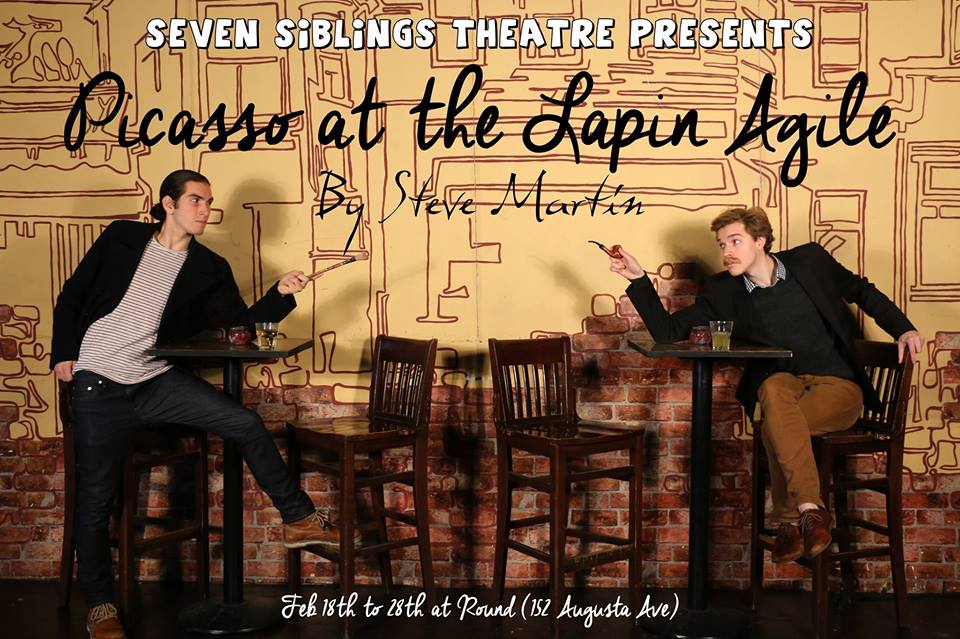
WK: Steve Martin (the established comedian, actor, writer, banjo aficionado) has written a play that features a young Pablo Picasso and Albert Einstein at the tipping point of their careers. It takes place at the Lapin Agile, a fictional bar in 1904 Paris, where notable intellectuals and visionaries go to talk about their manifestos. It also features a wide range of characters that gravitate to that space. It expertly deconstructs the intersection between art and science, and somehow manages to remain brilliantly funny.

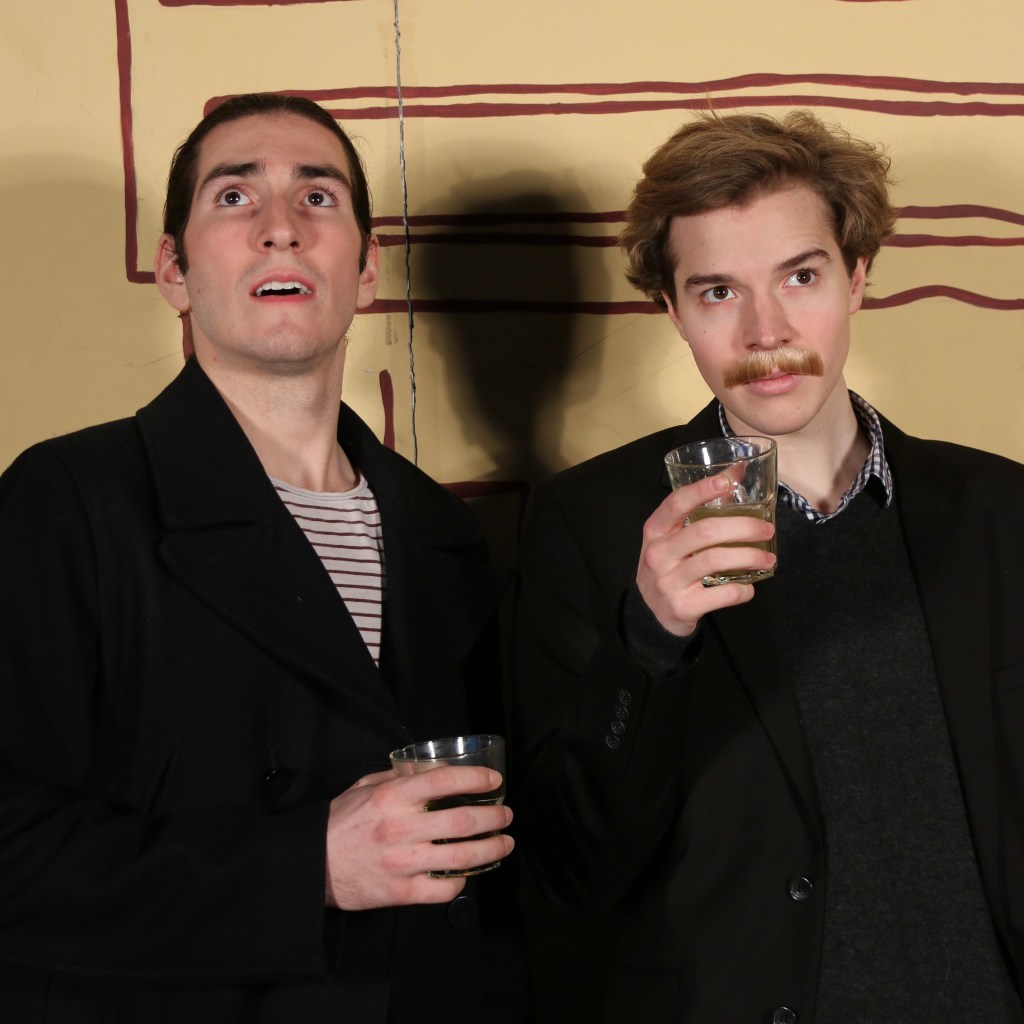
We’re doing it site-specific at an event space in Kensington Market called Round. When we decided to produce it, we knew we wanted to get away from a traditional performance space. We wanted our audience to see the sparks fly between the actors, and really feel immersed in their revelations. We also thought they might like a beer!

IMG_1484

RQ: In what ways do you think this show questions how we look at art or innovation?

DE: This play challenges anyone’s personal definition of art. Einstein argues that his scientific discoveries are art, whereas Picasso dismisses these as mere equations. Steve Martin tells us that science is more than numbers: it’s a vision, it’s imagination, and then it’s trying to capture that and turn it into something calculable. We can’t dive into a black hole, or travel to other solar systems, but we can dream it. And then we can take that dream and see if we can prove it.

RQ: How do you think your choice of site-specific theatre informs or enhances the piece?

WK: I love the intimacy. Performing in the round (pun intended) just feels right.

DE: I had a very clear image in my mind of what I envisioned the space looking like. When we walked into The Round for our photo shoot I was blown away by how much the space looked like what I had imagined. I had no trouble believing that I had just entered a bohemian Paris bar circa 1904. It makes a huge difference as a performer, and hopefully for the audience too. You’re right there in the bar with us. You can grab a drink and be a fellow patron in the Lapin Agile with a host of eccentric characters. So it is definitely an engaging performance and the wonderful venue is a big part of that.

RQ: What can you tell me about Seven Siblings theatre?

WK: Madryn, Erika, and I founded Seven Siblings Theatre while gaining our teacher certification at the Great Lakes Michael Chekhov Consortium in Kent, Ohio. We shared the same ideals of theatre, a similar process, and wanted to bring more Fantastic Realism into Toronto’s indie theatre community. We aim to help artists develop their psychophysical connection, and dig deeply into the atmospheres of each production. By the end of each process, our artists have a range of tools and exercises from the Michael Chekhov work to play with.

IMG_1645 (1)

RQ: Why did you choose this piece as your next production?

WK: I am adamant that everything we work on needs to present a new challenge. We’ve played with malleable classical text, highly dangerous subject matter, explosive absurdist and visual performance styles, and now we’re tapping into an immersive experience. This is one of the most playful pieces I’ve ever worked on, and the incredible duality between farce and intelligence made it a no-brainer.

RQ: If you were going to set this show in 2016, which people would be the closest parallels to the way this show characterizes Picasso and Einstein?

WK: That’s a tough one. A lot of the charm in this piece is that they’re diamonds in the rough.

DE: [In terms of banter] Stephen Hawking and John Oliver (because that first interview was too good not to have a sequel). Bill Nye and Bob Ross. Spock and Han Solo.

WK: Yeah. Einstein’s definitely the Han Solo of this show.

RQ: If you could give this show a soundtrack, what three songs would be must-haves?

DE:
The Scientist – Coldplay
The Life of Pablo (the entire album) – Kanye West (Tidal required)
Blue (Da Ba Dee) – Eiffel 65

WK:
Bistro Fada – Stephane Wrembel (watch Midnight in Paris for context)
Space Oddity – David Bowie
Sounds of Science – Beastie Boys

DE & WK:
*Bonus Track* Tubthumping – Chumbawamba


Picasso at the Lapin Agile

Presented by Seven Siblings Theatre

12494796_409711225904049_4751960345749307790_n

A play by Steve Martin

Who:
Directed by Erika Downie
Featuring Dylan Mawson, Jamie Johnson, Madryn McCabe, Will King, Erin Burley, Erik Helle, Dylan Evans, Andrew Gaunce and Maxwell LeBoeuf
Stage Manager Jocelyn Levadoux
Production Manager Kate MacArthur
Lighting Designer Parker Nowlan
Dialect Coach Margaret Hild

Run Time: 90 minutes

When:
February 25 at 7:30pm
February 26 at 7:30pm
February 27 at 2:00pm (Matinee)
February 28 at 7:30pm

Tickets:
February 25-28 $25

Where:
Round, 152A Augusta Avenue, Kensington Market, Toronto, Ontario

Tickets: http://www.sevensiblingstheatre.ca/picassoatthelapinagile/

In Conversation with Miranda Calderon, performer/producer of Taking Care of Baby

by Bailey Green

Taking Care of Baby is a verbatim/documentary style play focusing on the story of Donna McAuliffe—a woman accused of murdering her two infants. The play uses testimony from those closest to McAuliffe to dig deeper in search of the truth. There’s just one catch—Donna doesn’t exist. It’s all fake.

Miranda Calderon takes on the role of Donna at the Storefront Theatre in Taking Care of Baby, a fake documentary play written by Dennis Kelly. Director Birgit Schreyer Duarte read the script years ago and shared it with Calderon as part of another project they were collaborating on at the time that focused on the victims and perpetrators of domestic violence. “Birgit and I worked together for the first time years ago when we did a SummerWorks show that was an adaptation of a novel,” Calderon recalls. “We both found that we really enjoyed the collaborative process of working together. In the years since, she has had so much more experience directing shows, assisting at Stratford and Canadian Stage where she works as a dramaturge and translator. We’ve both grown, and of course we benefit from being close friends. It’s a treat, and we feel incredibly lucky to be working on this project. And everyone involved is so incredibly wonderful and professional.”

Photo of Dylan Trowbridge by John Gundy.

Photo of Dylan Trowbridge by John Gundy.

By the time we meet Donna McAuliffe, she has already endured a brutal life. She lost two babies and suspicion surrounded the circumstances of their death. She was convicted of murder, sentenced to life and then eventually exonerated with the help of her mother. And now, estranged from her husband, childless, and reeling from 14 months in prison, Donna is living at home trying to put her fractured life back together.

Photo of Miranda Calderon & Astrid Van Wieren by John Gundy.

Photo of Miranda Calderon & Astrid Van Wieren by John Gundy.

Calderon approached the role with a desire to understand the intense experiences her character has been through. She researched prison life and reached out to a friend who works as a defence attorney to better understand the process of a murder trial. Calderon also has a very personal tie to the subject matter of the play. “I’m pregnant for the first time, so when I found out [about the baby] this summer and then when the project was selected by Storefront for their season, I was just wow-ed by the odd timing,” Calderon says. “I wondered whether it was a good idea to put myself in this world while I’m pregnant. But at the same time there was something so exciting and interesting about that coincidence. It’s only added to the process.”

McAuliffe is surrounded by a varied cast of characters, all with their own opinions about whether she did or did not murder her children. The actors often play multiple roles, some of which include: Donna’s mother the politician (Astrid Van Wieren), the estranged husband (Dylan Trowbridge) and more. Donna’s defence hangs on a new diagnosis by a psychologist named Dr. Millard (played by Richard Clarkin). Millard has diagnosed Donna with Leeman-Keatley Syndrome (a fictional disease) where a mother is so overwhelmed by the empathy she feels for the world’s suffering that she turns on the source of her pain, namely her children.

Photo of Richard Clarkin by John Gundy

Photo of Richard Clarkin by John Gundy

“A big part of this process has been the struggle to determine what’s true, what’s not true, who can I trust […] it’s part of what the audience is going through at the same time,” Calderon says when asked about how the style and format of the play affect the story. “When we realize that we were wrong about people, it can be so unsettling. It happens with people we are intimate with, with colleagues, and then public figures as well. The characters in the play operate on all three of those levels and so the audience goes through this questioning with us.”

Taking Care of Baby

Presented by The Care Takers at The Storefront Theatre

TCOB-web-banner-3-862x319

Who:
Featuring: Miranda Calderon, Richard Clarkin, Caroline Gillis, Craig Lauzon, Dylan Trowbridge, Astrid Van Wieren
Written By: Dennis Kelly
Directed By: Birgit Schreyer Duarte
Set Design: Michelle Tracey
Lighting Design: Steve Lucas
Costume Design: Amanda Wong
Sound Design: Matthew Pencer
Video Design: Remington North
Producers: Miranda Calderon & Adam Paolozza

When: January 29th to February 14th, Wednesday through Saturday @ 8pm, Sunday Matinee @ 2pm

Where: The Storefront Theatre – 955 Bloor St. W, Toronto

Tickets: $20-$25, Advance tickets available here.

Connect: http://thestorefronttheatre.com/events/taking-care-of-baby/

‪#‎INDIEUNITE‬ ‪#‎BabySFT‬

#TheresMoreThanOneTruth #BabySFT

Chelsea Hotel is “Magical. Sexy. Haunting. Refreshing. Passionate.” – A few words with Tracey Power, Director/Creator/Performer of Chelsea Hotel – The Songs of Leonard Cohen

Interview by Shaina Silver-Baird

SSB: How did you conceive of the idea for Chelsea Hotel?

Tracey Power: I was interested in creating a show that was a fusion of music, movement and theatre. The poetic quality of Cohen’s music immediately became the inspiration for this desire. The concept for the world in my mind was always one of imagination, magic, love and surprise.

SSB: How was this new musical created?

TP: I began listening to all of Cohen’s music and images and stories began to form. A poetic order began to grow, a seamless flow of consciousness that in my imagination made perfect sense. I could also hear a sound for the show that incorporated the instruments that were played by the team of 6 artists. There are 17 instruments in the show so creativity has always felt limitless.

SSB: It’s been very popular in theatre recently, to have the actor/singers playing the instruments instead of the more traditional band – actor split. Why did you decide to take this approach?

TP: We began creating this show 5 years ago and at that time it was much less popular, certainly on the west coast. The style of Chelsea Hotel stems from a concert or cabaret so that is where the roots of its approach lie.

SSB: What attracted you to Leonard Cohen’s music?

TP: His lyrics. Even after 5 years, there are still words I hear for the first time. They make you curious, they inspire incredible imagery and you discover pieces of yourself within them.

SSB: Describe the show in 5 words:

TP: Magical. Sexy. Haunting. Refreshing. Passionate.

Chelsea Hotel – The Songs of Leonard Cohen

A Firehall Arts Centre Production
Produced by Theatre 20
With the support of Theatre Passe Muraille

ChelseaHotel-photo by Mat Simpson-sm

Who:
Directed and Conceived by Tracey Power
Musical Direction and Arrangements by Steven Charles
Cast: Rachel Aberle, Sean Cronin, Christina Cuglietta, Benjamin Elliot, Jonathan Gould & Tracey Power.
Set Design: Marshall McMahen
Lighting Design: Ted Roberts
Costume Design: Barbara Clayden
Sound Design: Xavier Berbudeau
Dramaturg: James MacDonald
Artistic Producer: Donna Spencer

What:
“It’s written on the walls of this hotel, you go to heaven, once you’ve been to hell.” – Leonard Cohen

CHELSEA HOTEL comes to Toronto fresh from a sold-out national tour! Leonard Cohen’s powerful and inspirational music is the heartbeat of this eclectic cabaret of loves won and lost. With extraordinary arrangements, six performers play seventeen instruments in this rollicking tribute to the remarkable writer. Through Cohen’s transcendent songs and lyrical honesty, you will be transported to New York’s infamous hotel – a place full of music and enchantment, desire and passion.

Where: Theatre Passe Muraille Mainspace, 16 Ryerson Ave. Toronto

When: February 3-21, 2016

Tickets: $25-$55 + limited Pay-What-You-Can for selected performances. Buy tickets here.

Connect:
#chelseahotel2016

O, What a Noble Mind is Here O’erthrown – In Conversation with Julia Nish-Lapidus, Ophelia in Shakespeare BASH’d Hamlet

by Bailey Green

If you’ve ever seen a Shakespeare BASH’d show, then you’ve seen Julia Nish-Lapidus work her magic. Behind the scenes, Julia has an eye for aesthetics and design. As Artistic Producer of the company she handles everything from ticket sales to social media. As an actor, Julia brings intelligence, wit and energy to her text—whether as the fierce Kate in The Taming of the Shrew or the clever Mistress Page in Merry Wives of Windsor. This February Julia is taking on a new challenge, the role of Ophelia in Hamlet (presented by Shakespeare BASH’d.) “She doesn’t have to be a victim,” Julia says of the doomed Ophelia. “She’s actively choosing what she wants, it’s not a blind obedience. And yet she does want the people around her to be happy. And I think that’s in the text, but I do think it will be a different Ophelia than most people are used to.”

In the title role of Hamlet is BASH’d Artistic Director James Wallis. James and Julia have been married since 2012 and Julia discusses how their shared history translates to a powerful connection onstage. “Hamlet and Ophelia don’t have much time together on stage to create this very intense relationship,” Julia says. “So working with James offers me a way in to that world, not to mention the trust and freedom we have in rehearsal.”

Photo of James Wallis & Julia Nish-Lapidus by Kyle Purcell.

Photo of James Wallis & Julia Nish-Lapidus by Kyle Purcell.

Catherine Rainville is taking the helm as director of this production. Catherine—who has acted in several BASH’d shows and co-directed Merry Wives during their Fringe 2015 run—leads a gender balanced cast that includes a female Laertes (played by Jennifer Dzialoszynski) as well as female Rosencrantz and Guildenstern (played by Jade Douris and Megan Miles.) “Catherine is such an actor’s director. She knows how to get you to solidify what you’re thinking.” Julia says of working with Catherine. “She just lets her actors’ impulses come out naturally, and then she helps shape them.” Julia also mentions how interesting it is to watch Hamlet surrounded by women that he mistrusts and how that new element affects the story.

Photo of Jennifer Dzialoszynski by Kyle Purcell

Photo of Jennifer Dzialoszynski by Kyle Purcell

Ophelia’s family dynamic has also been key to Julia’s exploration of Ophelia. Laertes’ (Jennifer Dzialoszynski) apprehension of Hamlet takes on a different tone coming from a sister as opposed to the older brother dynamic that audiences are used to. And Daniel Briere, who plays Polonius, is “such a giving scene partner who knows his text like no one’s business and has really embraced the idea of having two daughters,” says Julia.

Photo of Daniel Briere by Kyle Purcell

Photo of Daniel Briere by Kyle Purcell

Exploring the sister dynamic between Ophelia and Laertes has been a joy for Julia, “I couldn’t ask for better actors to be in a fake family with. And I think Catherine was right on the nose with her casting, especially with Jen. Wait until you see her fight,” Julia says. “The fights for this production, created by Nate Bitton, are incredible, and Jen performing them is amazing. It’s great to see a badass woman at the end of the show taking on the protagonist in a fight. Laertes being a woman brings a whole different quality to the fight at the end because now we’re seeing the rage and heart of a women whose entire family is dead.”

BASH’d shows have a reputation for selling out, so get your tickets early to avoid disappointment (plus when you buy online in advance, you save a dollar!)

Hamlet

Presented by Shakespeare BASH’d

12313755_1166705590023898_1840679382065778869_n

Who:
Directed by Catherine Rainville
Featuring: Daniel Briere, Jade Douris, Jennifer Dzialoszynski, Tim MacLean, Megan Miles, Jesse Nerenberg, Julia Nish-Lapidus, Drew O’Hara, David Ross, Jane Spence, James Wallis
Production Team: Dorea Beaudoin, Nathan Bitton, Darcy Haywood Stoop, Chloe Purcell, Kyle Purcell, Simon Rainville

What:
Shakespeare BASH’d caps off their biggest season yet with one of the Bard’s most beloved plays: Hamlet. Artistic Director James Wallis takes the stage in the title role, alongside a company of Shakespearean powerhouses in this energetic, compelling production. Returning to the Monarch Tavern, Hamlet will mark the fourth and final show of the company’s hitherto sold-out season. Don’t miss this new, fresh, and bold staging of a Shakespearean classic.

When: One week only! February 2-7, 2016

Where:  Monarch Tavern

Tickets$19 online, at shakespearebashd.com, $20 at the door (cash only)

Connect:

@shakesBASHd

@_BaileyGreen

@intheGreenRoom_