Skip to content

Truth, Lies, Shadows, and Ducks – Exploring The Wild Duck Project with Re:Current Theatre

by Bailey Green

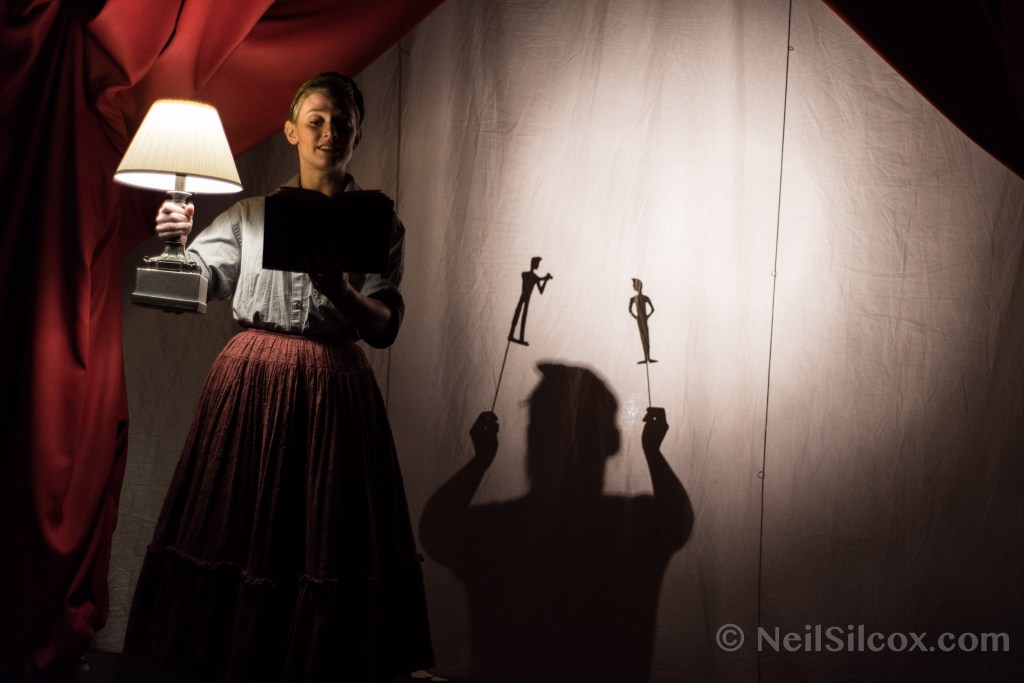
Is it possible to live your life without telling a single lie? This question is at the heart of Re:Current Theatre’s The Wild Duck Project. The piece is an exploration of Ibsen’s The Wild Duck and marries personal testimony, adaptation, shadow puppetry and movement to explore this complex play.

Artistic Director and co-founder of Re:Current Theatre Brian Postalian has led his cast of four actors—co-founders Victor Pokinko and Eliza Martin, and contributing artists Alex Spyropoulos and Zachary Murphy—through a rigorous rehearsal process. Postalian (along with Martin, Pokinko and Spyropoulos) are graduates of the University of Toronto and Sheridan College joint actor training program – Theatre and Drama Studies.

Wild Duck Project (2 of 211)

Postalian’s approach to The Wild Duck uses a combination of academic questioning and organic exploration. He chose to focus on the thematic elements of flawed ideals and obscured truths that pervade the familial relationships at the centre of the play. Postalian notes how in many of Ibsen’s plays, such as An Enemy of the People, the playwright focuses on the effects of revealing the truth:

“At the top of the play, the poorer family lives with all these concealments. Nothing is obviously wrong but there are a lot of secrets. So the son [Gregers] from the rich family comes home and decides to reveal all of this information. I really believe he is Ibsen’s mouthpiece, though in the play he can sound like quite the villain, because he [like Ibsen] believes living in absolute truth is where we need to be. But Ibsen complicates this further because society won’t let us do that, because society is built on lies. So what ends up happening is the daughter [Hedvig] of the poor family kills herself as sort of the ultimate choice. […] In The Wild Duck, in particular, we see how in knowing the truth, things fall apart.”

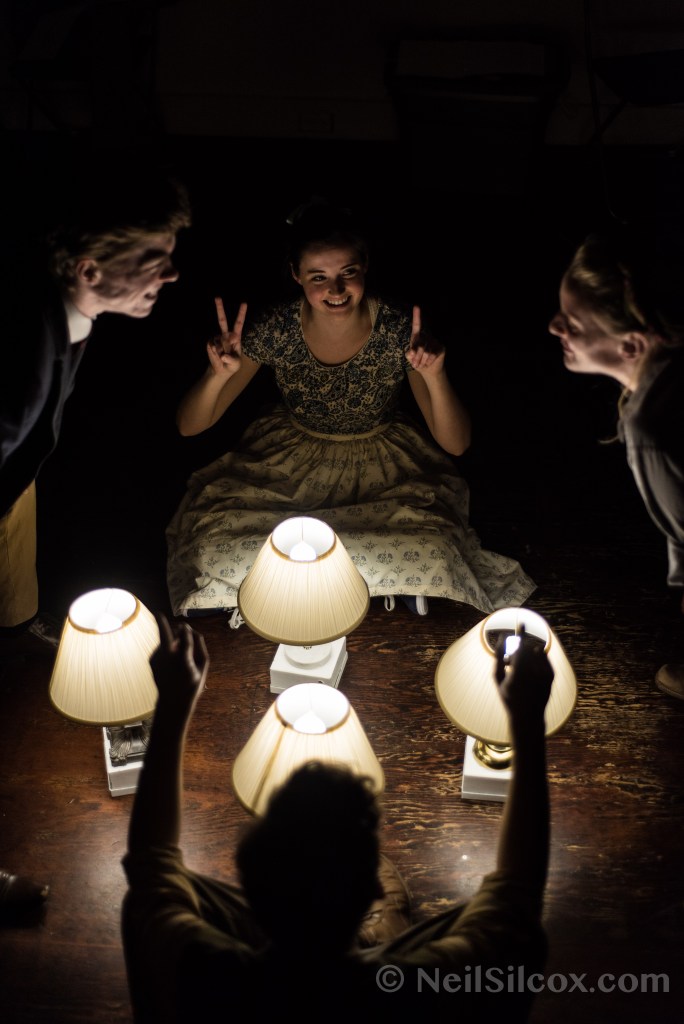
The Wild Duck Project has had several incarnations since 2014 when Re:Current Theatre first took shape. While studying in theatre school together, Martin, Pokinko and Postalian decided that they wanted to form a company to explore the re-interpretation of classical texts. The Wild Duck had its first workshop performance in the MIST theatre in Mississauga. It was there that a key element of its design emerged: lamps, held by the actors, are used to light the majority of the production. “The actors have agency and control, which has been exciting and challenging to explore,” says Postalian.

Wild Duck Project (164 of 211)

When asked about how the project stands today at its current stage, Postalian responds, “There’s a lot of problems in the play itself that we’re still trying to navigate. And even sequences that we have in the play that may be problematic. We’re taking a risk by trying it, but I know that there’s a kernel burning in each scene.” He mentions as well that many persistent problems have lead to new discoveries that drive the piece forward.

When asked about the challenges of directing this piece, Postalian says that finding clarity has been essential. Ensuring that the audience can grab on to the story has been very important to the creators as this play may not be well known to potential audience members. Finding clarity for the actors, who are also co-creators, has also been a challenge. The greatest joy for Postalian has come from watching his cast play with free abandon. “It’s so invigorating to see them go off and find something I could never have found,” Postalian says.

When asked to describe The Wild Duck Project in 5 words, Postalian responds, “Lamps, shadow puppets, Fleetwood Mac, whimsy, ducks.”

12196340_895910420505919_4397161908577260373_n-1

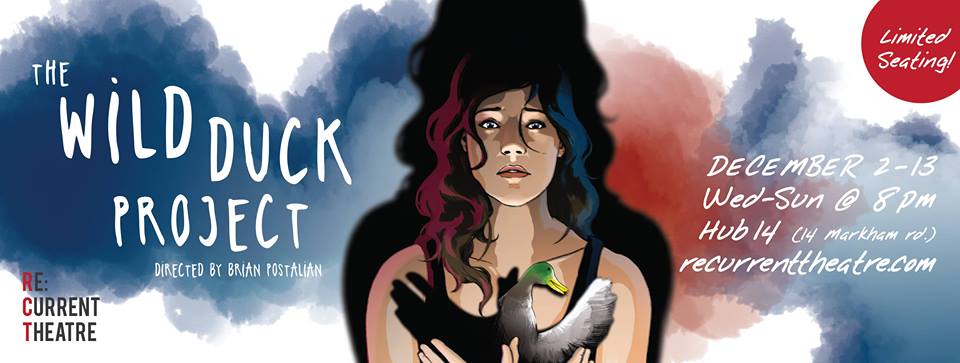
The Wild Duck Project plays at Hub14 until December 13th, Wed-Sun at 8pm.

Reality, Idealism, Fantasy. 
Can we live our lives without telling a single lie?

Wild Duck Project is a new contemporary adaptation, reimagining, and deconstruction from Henrik Ibsen’s cynical play ‘The Wild Duck’.

In the Wild Duck Project, four actors have gathered to tell the story of The Wild Duck. In the process, they take apart the play and find an uneasy resemblance with their own lives. Through their reimagining of the play, they discover that truth is dead and lies are our sustenance. If they choose to follow the ideals of truth over a life of lies, are they noble or foolish? Each night, they invite an audience to answer this with them and discover why lies are not only useful but necessary to life. 

Lit entirely by the actors using four lamps and a set of flashlights, the performance is a mash-up of text from the play, personal testimonials from the performers, remixed classic pop and folks songs, and shadow puppetry. The project asks whether or not human beings can live their lives without telling a single lie.

Wild Duck Project asks if it is truly possible to live free and truthful, and if not, is it so bad to be false?

Director: Brian Postalian
​Cast: Eliza Martin, Zachary Murphy, Victor Pokinko, and Alex Spyropoulos
Production Designer:  Joe Pagnan
Associate Designer: Holly Meyer-Dymny
Costume Designer: Laura Delchiaro
Producer: Michelle Yagi
Stage Management: Heather Bellingham
Dramaturgy: Adrian Beattie
Artistic Outreach Coordinator: Cornelia Audrey
Poster Design: Jacek Kociolek

Tickets: wildduckproject.bpt.me

Connect:

Re:Current Theatre: @ReCurrTheatre
www.recurrenttheatre.com

Bailey Green: @_BaileyGreen

In the Greenroom: @intheGreenRoom_

Nirbhaya and Nightwood – Part Two: In Conversation with Kelly Thorton, Artistic Director of Nightwood Theatre

Interview by Bailey Green 

On a rainy morning in the Distillery District, I sat with down with Nightwood Theatres Artistic Director Kelly Thornton to discuss women in theatre, Nightwoods current season and Nirbhaya. 

In 2014, writer/director Yaël Farber and producer Margaret Moll reached out to Kelly Thornton with the intent of bringing Nirbhaya on a Canadian tour. “I’d known Yaël was working on a piece in India,” remembers Thornton. “And when we looked at the materials and subject matter [of Nirbhaya], for Nightwood, it’s a no brainer. This show had to come to Toronto and Nightwood is the perfect company to bring it here. We’re a politically-based company, that believes in changing the world through art and tackling the urgent issues around people’s lives.” 

Kelly Thornton met Yaël Farber in 2009 when Thornton was running the Four by Four Festival, a festival that focused on female directors, in Montreal. At the recommendation of South African director Lara Foot Newton, Thornton brought Yaël Farber in to teach a master class. They ended up running the directing program at The National Theatre School together. Thornton and Farber’s paths diverged as they went on to work on many different projects, but they remained on each other’s radar.

unnamed

Nirbhaya – The Company. Photo by Sinbad Phgura.

Thornton describes Farber’s theatre as “sacred and ritualistic”. She describes that when Farber directed Miller’s The Crucible at the Old Vic in London, she asked her cast to consider giving something up and to explore the repression of their desires like the Puritans they were portraying.

Farber’s theatre seeks to ground itself in the immediate world we live in. Nirbhaya could not be a more poignant reflection of that principle. When asked about the subject matter of the show, Thornton replies:

“Violence against women has been an issue… well, basically since the beginning of time. It’s tough subject matter but we need to have this conversation. Theatre can give us catharsis and a call to move forward. And with Kathleen Wynne’s action plan to end violence coming into effect and the UN’s International Day for the Elimination of Violence Against Women on November 25th, Nirbhaya is a cultural centre piece on this subject matter. Its impact as it travels around the world is amazing. It’s truly a transformational piece.”

nightwood

(L to R) Poorna Jagannathan and Priyanka Bose in a scene from Nirbhaya.

When Thornton was asked about her focus in programming the current Nightwood season, and whether she found that any common elements appeared, she said “this season feels, for me, as if it is tackling the urgent issues of our time. It’s a highly political season.” Obeah Opera spoke about the Salem witch trials, but from the perspective of the African/Caribbean slave, and gave voice to those whose history had been silenced. Unholy tackled misogyny in religion in the form of a public debate about whether or not women should abandon religion altogether. Nirbhaya seeks to dismantle the oppressive silence surrounding the victims and survivors of sexual assault. The Public Servant deals with how public service was gutted under our former government, and how red tape can stifle the best of intentions. Refuge, written by one of Nightwood’s founders Mary Vingoe, is particularly relevant with the global refugee crisis.

When asked about what action theatre companies should take to be more inclusive of female and female-identified creators, Thornton discusses her extensive history of working with female practitioners, academics, as well as PACT, Playwrights Guild of Canada and more recently, Equity in Theatre. Thornton credits their hard work but acknowledges that we still have a long way to go:

“If you have a predominant Canadian theatre of male artistic directors, unconsciously their programming choices are affected by their gender; so I think two things have to happen. I think male AD’s have to understand that they have a responsibility—as Justin Trudeau just pointed out to the world—to stay awake to the other half of the population.               But also to get more female artistic directors into Canadian theatre. And that’s what the Canadian Women’s Directors Catalogue is about. The least women are in the regional houses, the most are in the independent scene, and so getting them in as directors in the regional houses is very important. Otherwise when the time comes to replace that regional AD, as a woman, if you’ve never directed on a regional stage you will never be consider eligible to be artistic director of that company.”

When asked what advice Thornton would give to young women beginning their careers in theatre, and she replied, “Be bold and unapologetic with your own power. Stand up and have your voice heard. Risk. Ask for what you want.”

Rapid Fire Questions with Kelly Thorton:

Currently Reading: The Element by Ken Robinson

Last Play You Saw: Unholy

TV Show You’re Addicted To: I don’t watch much TV anymore, but I guess the last show would have been Breaking Bad.

Favourite Coffee Shop: Furbo

Song Stuck in Your Head: “Sit Down You’re Rockin’ the Boat” from Guys and Dolls (we were auditioning for the Lawyer Show this week.)

nirbhaya-BIG-header

Written and directed by Yael Farber,
Presented by Nightwood Theatre in association with Amnesty International present an Assembly, Riverside Studios and Poorna Jagannathan Production.

Nirbhaya was inspired by true events that occurred in December of 2012 in India, when a woman boarded a bus heading homeThe piece is a tapestry of personal testimonies, which tears away the shame that silences survivors of sexual violence.

When: November 18-29

Where: Harbourfront Centre Theatre

Tickets: $20-45. Purchase here.

For more info, visit Nightwood Theatre’s website.


In Conversation with Holger Syme – Adaptor & Director of The Howland Company’s upcoming workshop production of “Casimir and Caroline”

Interview by Ryan Quinn

I got the chance to speak with Holger Syme, director of Casimir and Caroline at The Luella Massey Studio Theatre, presented as part of The Howland Company’s four-day workshop weekend. Syme translated the work and adapted it with the company, and this public workshop production will run from November 19th-22nd, with talkback sessions for audience feedback.

RQ: Tell me a bit about Casimir and Caroline, which you’re directing for The Howland Company.

HS: Ah, where to start… a German director said in the 1970s that “To summarize the plot of his plays is mostly fruitless,” and I think that’s right. Casimir and Caroline, as a “story,” is about a whole bunch of people at a party: some hit on each other, some break up with each other, one has a major health disaster, one ends up in jail. But within that kind of banal, kind of mundane scenario, Horváth examines an incredibly rich cluster of questions: what does love mean in a culture in which it’s increasingly difficult to distinguish commercial and emotional relationships? What happens to desire in a consumer culture? What do you do with feelings if you have no words to give them proper expression? And, really, most broadly, how can you live a life that’s in any way ethically justifiable in a world in which everything has become consumable?

RQ: You’ve translated and adapted this text from Ödön von Horváth, and you’re directing it as well. What draws you to this particular text?

HS: Well, first of all, how astonishingly contemporary it feels. I mean, what I just said the play is “about” applies a little bit more to our adaptation than to Horváth’s original, but really only a bit — all of those themes are in the 1932 text as well, although the kind of commodity culture Horváth experienced was of course quite different from ours. He was also writing on the eve of the Nazi’s first major election victory in Germany, and that’s obviously not our political climate. But the broader economic and social picture he’s drawing on — that’s very comparable, with the unspeakable divide between rich and poor, with the widespread condition of living on the brink of social deprivation, in an existence where losing your job can mean losing everything that you think of as “your life,” and so on. So that was the text’s primary appeal: that it seemed to speak so clearly, from the 1930s, to our own moment.

But I also find Horváth’s dramaturgy extremely interesting, and his dramatic language. His plays aren’t really structured as linear narratives — they are panoramic, and that’s a very appealing structure to me. It allows for a sharp focus on character and situation, both of which make, I think, for exciting challenges for actors and directors alike; the “story” is so simple and straightforward that it forces us (makers and audiences alike) to think about the issues that are being negotiated, and it really allows for a focus on the theatrical moment: what someone is doing right now, in front of you. How they’re moving their body, how they’re acting vis-a-vis another person, what they’re saying, how they’re occupying the space. It allows the audience to watch moment by moment without having to think too hard about what happened before and what’s going to happen next.

Screen Shot 2015-11-18 at 2.39.43 PM

RQ: How was the process of adapting this text different from translating it?

HS: That’s where the language bit from earlier becomes relevant: Horváth writes in a really, really odd German. His plays read a lot like Sean O’Casey re-scripted by Pinter, if you can imagine such a thing. They’re extremely idiomatic — some dialect bits, tons of clichés, lots of 1930s pop-culture quotations, literary allusions of a not especially sophisticated kind, etc. If you translate that straightforwardly, it’ll sound awfully stilted — and partly, that stiltedness is absolutely necessary. Very few of Horváth’s characters have access to an “authentic” language: especially when they’re trying to express their deepest feelings, they sound like a Hallmark card or a self-help book. So the big challenge is not making the text sound “natural,” but finding precisely the right kind of stiltedness.

I had a first stab at that in my original translation, and then we worked very intensively, with lots of improv exercises, on finding those lines. We also felt that the gender politics of Horváth’s play were the one aspect that needed updating — his broader political perspective felt current, but his women slipped too easily into victim roles. So we made a lot of changes there, including turning two pretty marginal part-time prostitutes into corporate employees with a good deal more dramatic life. And we transformed the two older wealthy establishment figures in the original into two young overprivileged guys working in the tech industry — partly because of the Howland Company’s mandate, but also because it allowed us to focus on economic privilege more sharply, without having to negotiate generational conflicts as well.

Strictly in terms of process, the difference was that between sitting alone at home, translating the text; and spending many hours in rehearsal rooms, recording totally free and more guided improvisations, and then turning those into scenes by picking and choosing lines (alone at home). What’s really important to me, though, is that while we “adapted” Horváth’s text in the sense that we found contemporary equivalents for his own historically situated language, we are very faithfully following the original play’s dramaturgical structure. His first stage direction says that the play is set “now,” and that’s been my guiding principle: you can’t be “true” to this play if you set it in 1932 and in Munich. It’s not a history play.
Screen Shot 2015-11-18 at 2.45.56 PM

RQ: You’ve done a lot of travel, and taken in theatre in many different cultural and historical contexts. How does that inform your process as a director?

HS: That’s an incredibly difficult question. Partly, this is a research project for me: I wanted to see what happens when you bring theatrical texts and practices from other cultures into contact with actors who are trained to work in the context of our own, Canadian assumptions about theatre. But of course I’m usually “just” an audience member outside of Canada — and what you see on stage relates only in a very complicated way to what happens in the rehearsal room!

It’s definitely true that because I see so much theatre elsewhere, especially in Germany, there are things I just don’t care about that others might consider very important. And there are things that I find totally crucial that others might find silly or negligible.

RQ: Do you find that you find yourself mixing elements of world theatre with Canadian theatre practices? What would you say any uniquely Canadian theatre practices are?

HS: OK, specifics? Er… “world theatre” doesn’t really exist, as far as I’m concerned. And what I find important keeps shifting as well. But here’s a few things: there’s a kind of spontaneity in German performance that I desperately want to see more of — the ability to move while speaking, to respond immediately to anything and anyone around you (in a way that’s going to be different, often radically different, from night to night), the freedom to mess with the text quite a bit, and so on. So I’ve been pushing hard for that. I’ve tried my best to reassure my cast that whatever they think might “make sense” probably does, in that moment — and that my role really is just to tell them if it doesn’t. The impulses should come from them, and they should be empowered to offer whatever they can think of. On the other hand, I also really care about stage images — spatial relations between bodies in particular. So some moments have to be very strictly blocked. There’s a tension between those two directorial impulses.

Uniquely Canadian? I’m not sure. Certainly a focus on story — though that’s a general Anglo theatre preoccupation. A general grounding of everything in psychology, rather than, say, politics. That’s for “straight” theatre such as this — there are other, very powerful “Canadian” theatre practices, in the fields of devised theatre or movement-based theatre, but that’s not really what we’re doing.

The big challenge for me, but also the really exhilarating aspect of the work, has been to put the show on stage in a way that allows the actors to play to their strengths without giving up on my own desire to keep the project focused on politics and dramatic situation. Things like allowing a moment to keep going past what the “story” might require, because it’s interesting, or entertaining, or compelling as a theatrical moment — that’s not something I see very often around here, and it’s something I really love in German theatre. But I think it’s pretty counterintuitive to Canadian actors; I suspect it feels a bit self-indulgent to be so uneconomical. But I don’t think it is. I think it’s exciting.
Screen Shot 2015-11-18 at 2.47.28 PM

RQ: What do you think is the importance of companies like The Howland Company? Is there an eventual reshaping of the Canadian theatre landscape happening?

HS: Companies like Howland are all about creating opportunities for young actors to put thrilling, fresh work on stage — and I thinks that’s crucial if we want our theatre to remain as anything other than a social occasion (or obligation) for well-to-do people above a certain age. If I’m honest, I wish companies like this didn’t need to exist as independent outfits: I wish our larger, established institutions would make more room for this kind of work, and for these kinds of actors. There’s nothing more exciting to me in the theatre than to see actors who are still growing on stage; though it’s even more thrilling to see such actors work with very experienced colleagues, and to see those older actors having to respond to someone who’s doing things in a very different way than they’re used to. But in our current system, that’s very rare, because the young people mostly make their own work and opportunities (and can’t pay well enough to attract many more established figures), whereas actors that survive in the theatre industry for long enough to become established mostly work in a different world. There are exceptions, of course (David Ferry comes to mind as someone who frequently crosses that divide, and Soulpepper has been exemplary at integrating young performers in major roles), but it’s a real problem, and a real limitation. I hope we can figure out a way of changing that.

RQ: What do you hope people are discussing on their way back home after seeing this show?

HS: How to live. How to love. Whether to have a donut, a popsicle, or a rotisserie chicken.

RQ: As we’re heading toward the new year, what changes would you like to see happen in the Toronto theatre community next year? What would you like to see continue?

HS: Ha! See above. I always say the same thing, boringly. I want to see fewer new plays and more classics done in a new way. I want us to stop seeking inspiration on Broadway — because, seriously, why? When has thrilling art ever been inspired by rank commercialism? If we need to look for inspiration in the English-speaking world, look to London (but not the West End). Look to the Almeida and the Young Vic, and occasionally the National Theatre. Continue? To let our actors take all the risks they want. (Or would that be a new thing?) Believe more in performers and less in storytellers.

RQ: You’re the the Associate Professor of English and Chair of the Department of English and Drama at the University of Toronto Mississauga; as well as being a Harvard Graduate. What is the relationship between the academic landscape of theatre and the performance community? Is there enough of a conversation?

HS: In short, no. But that really is a HUGE conversation topic! I’m worried about the anti-intellectual climate in many parts of the theatre world — not just here, but everywhere, really. I’m troubled by a certain kind of aloofness towards theatre people on the part of quite a few academics. I find it really unhelpful how many theatre people and academics think they know right from wrong, and think that the “others” don’t. On the other hand, I’m also always baffled by how similar some academics and some theatre makers are, in a bad way: take Shakespeare. With any given performance, you’ll have plenty of disappointed academics and theatre people who object to performance choices because they don’t reflect their own understanding of the play — but that’s not what they say. They’ll say those choices were bad, or ill-conceived, or stupid, or just “wrong.” There’s too little willingness to let a show speak for itself, to see it as simply an intriguing theatrical event that is valid and compelling in its own right, not because it “interprets” a text. And that’s true for many academics and for theatre makers and critics alike. In general, I think both academics and theatre people should take theatre itself more seriously. (And again, I could name many exceptions to all of this!)

RQ: Any parting thoughts?

HS: Brecht said that theatre had to be entertaining before it could be political. I think we’ve tried to be true to that in Casimir and Caroline — entertaining, exciting, moving, all of those things. But then, political. Or at least I hope so…

C&C

Casimir and Caroline

A workshop production

By Ödön von Horváth
Translated, Adapted, and Directed by Holger Syme
Presented by The Howland Company
Featuring: Alexander Crowther, Sophia Fabiilli, Ruth Goodwin, Courtney Ch’ng Lancaster, Cameron Laurie, Michael Man, Jesse Nerenberg, Hallie Seline, Mishka Thébaud, Kristen Zaza.
Lighting Design: Jareth Li
Sound Design: Samuel Sholdice
Stage Manager: Jordana Weiss
Producer: James Graham

When: Thursday Nov. 19 – Sunday Nov. 22 at 8pm

Where: Luella Massey Studio Theatre, 4 Glen Morris Street, Toronto
(One block North and one block East of the Spadina/Harbord intersection)

Events: Talkbalk sessions to follow each night. All are welcome.

Tickets: $15. Buy here.

Website: howlandcompanytheatre.com


Casimir and Caroline from The Howland Company on Vimeo.

*On Sunday, November 22, presented with Casimir and Caroline as part of The Howland Company’s four-day workshop weekend , at 2pm there will also be a reading of take rimbaud, a new performance text in development by Toronto playwright Susanna Fournier, workshopped by The Howland Company.

take rimbaud

Admission will be free for this reading.

“We are all terrifying creatures these days. The Restless ones. What do the Restless seek? Comfort? Or, oblivion”

By Susanna Fournier
Presented by The Howland Company
Time: Sunday November 22nd, 2015 at 2pm
Location: Luella Massey Studio Theatre, 4 Glen Morris Street, Toronto
(One block North and one block East of the Spadina/Harbord intersection)
Tickets: Free admission

Nirbhaya and Nightwood – Part One: In Conversation with Beth Brown, Managing Director of Nightwood

Interview by Bailey Green 

It was a joy to sit down with Beth Brown, Managing Director of Nightwood Theatre. She has a kind and welcoming spirit that I noticed from the moment I met her. After discussing a shared love of animals (with the exception of mice) and a connection to the city of Montreal, over steaming mugs of tea, we spoke about Nightwood Theatres upcoming production, Nirbhaya, running November 18-29 at the Harbourfront Centre Theatre. The transcript of our conversation has been edited for length and clarity:

BG: How did you come in contact with Nirbhaya?

BB: We were made aware of the project through the producer Margaret Moll. She’s aware of Nightwood Theatre and our mandate and she felt it would be a perfect fit for this show. We were very inspired by the story and how it came to be. So we watched the video, reviewed the materials, and then began thinking about the logistics of bringing it to Toronto.

BG: And how did you bring it to Nightwood and Toronto?

BB: Since the production had toured before, that was very helpful to us. But one of our biggest challenges was finding a venue to put it in. Since we don’t have our own venue, we’re at the mercy of the availability of other theatres. [Nirbhaya] requires a specific stage size and we wanted a specific capacity for the audience of this show. And it was at the last minute when we found Harbourfront. Margaret wanted to get a Canadian tour for the show, so we ended up forming a strong relationship with the Cultch in Vancouver, where the show is, currently, and together we applied for funding from the Canada Council of the Arts.

BG: What common themes or elements do you see in the current Nightwood season?

BB: I love this season because of its diversity of story. There’s a lot of different stories being told. I think they’re all extremely impactful and relevant to now… to this time period. I think that they are entertaining as well as thought provoking. They grapple with issues that hit home for everyone. They are interesting and compelling.

BG: Can you tell me a bit more about your role, and what the most challenging and most rewarding aspects are?

BB: Well, I’m the managing director. Rewarding, for me, is definitely seeing the productions on stage and talking to people about them after. Whether they like them or not, I always find it to be really interesting conversation pieces about how the art affects people… what they take away from it. By and large, I have never had a conversation with someone who has disliked the work we put on stage, so that’s really rewarding to get that positive feedback and the detailed feedback as well. It’s not just ‘oh that was a great show,’ there’s always something specific that hit them or that resonated with them. Challenging is always financing, looking after the various budget lines, the nail biting as you’re watching the box office and hoping that you hit your targets and that people are going to come out and see the shows. That is always challenging. In regards to rewards, I always enjoy working with our staff and our community, the theatre community. The networking is great – so supportive and helpful.

Stay tuned for parts two and three where I speak with Artistic Director of Nightwood – Kelly Thornton, and the Writer/Director of Nirbhaya – Yael Farber!

 nirbhaya-BIG-header

Written and directed by Yael Farber,
Presented by Nightwood Theatre in association with Amnesty International present an Assembly, Riverside Studios and Poorna Jagannathan Production.

Nirbhaya was inspired by true events that occurred in December of 2012 in India, when a woman boarded a bus heading homeThe piece is a tapestry of personal testimonies, which tears away the shame that silences survivors of sexual violence.

When: November 18-29

Where: Harbourfront Centre Theatre

Tickets: $20-45. Purchase here.

For more info, visit Nightwood Theatre’s website.


Legends, Myths and Remounts: In Conversation with Sarah Thorpe – Writer, Co-Director & Solo actor of Soup Can Theatre’s “Heretic”

Interview by Madryn McCabe

I sat down with Sarah Thorpe, writer, co-director and solo actor of Heretic, to talk about legends, myths, and doing it all over again. 

Madryn McCabe: Tell me a bit about Heretic?

Sarah Thorpe: Heretic is essentially Joan of Arc in this afterlife space, looking back on her life and the decisions she made, and questioning whether it was worth it in the end. Should she have made the decisions that she did? I wanted to frame it in that way because, obviously, Joan was killed when she was nineteen because of what she did, so every account of her story is from someone else’s perspective, someone else’s opinion… so with some artistic license, it’s her side of the story – what she was feeling, thinking, going through… I wanted to present her in a way that takes down the saintly persona that surrounds her. She’s always depicted that way in plays and in literature, and I just thought that I wanted to explore her as a regular, vulnerable human being.

MM: What inspired Heretic? Where did the idea come from?

ST: It came from a monologue from Shaw’s Saint Joan that I had done for auditions before, and I found that it really hit an emotional note with me. I thought it would be interesting to explore this emotional connection further, and explore this person. I realized that I had all these questions… What was she thinking before her execution? What was she thinking when she stepped onto the battlefield for the first time? What was going through her mind? Was she terrified? Or thinking ‘No, I’ve got this!’

MM: How much research did you have to do into Joan’s life?

ST: A fair amount of research, but I’ve certainly taken a lot of artistic license as well. Not much of Joan is known before she joined the French army and started fighting in the 100 Years War.

MM: We seem to only know about Joan of Arc the Warrior, who heard voices from God, and only just the very brief period of time when she was fighting in the war.

ST: Right! So, we know about that, and we know that she was captured and executed. But, not a whole lot is known about her life before that. We do touch on that and how she was living this life on a farm with her parents and had a simple, medieval farming existence. The 100 Years War started in the 1330s, so she was born into a period of war going on around her, born into this environment where that was sort of what they were used to. It had gone on for so long. How I interpreted the aspect of her hearing voices was her wanting so much to say ‘No, we shouldn’t put up with this. This isn’t right. We’re being occupied, and it shouldn’t be an English king on the throne. We should do something about it.’

Photo of Sarah Thorpe by Justin Haigh

Photo of Sarah Thorpe by Justin Haigh

MM: Do you have a writing partner, or did you tackle this story on your own?

ST: I wrote it on my own. Justin Haigh did the dramaturgy on this remount. I re-wrote the script from the original version that we did in April.

MM: I was just about to ask, how much of an overhaul has this version gotten? Is there a lot of new stuff going on? What might bring people back who have already seen it?

ST: It’s not a huge overhaul. Some scenes were rewritten, some scenes were cut completely. In doing the remount, I thought that I could write some stuff better, and go into more depth of what I could interpret into what she was thinking and feeling and going through. So, for people who saw the April production and want to come back, I would say that there’s more emotional depth, and a bit more action. It also looks completely different. We have a whole new design team. The look of the show is totally different, yet still keeps with my vision. The way I always pictured it was people coming into a space resembling a medieval tomb. It’s kept with that same idea, but in a totally different way.

MM: Did you find that things changed much in the rehearsal room as well?

ST: Rehearsal was, again, a bit different. We have the same stage manager as last year, which is great. Directing-wise-Matt Bernard directed the April production, and this time around Scott Dermody and I are co-directing. Matt and Scott have different directing styles, so it’s been different rehearsing just because of the different approaches. I feel like I’m working harder this time around! It’s not that I wasn’t into it the first time around, and I don’t know how or why, but I feel extra committed now.

Photo of Sarah Thorpe by Justin Haigh

Photo of Sarah Thorpe by Justin Haigh

MM: Do you find that you can easily separate all your roles as writer, director, actor, or does each one influence what the other does?

ST: I’ve gotten better at knowing when to turn off the producer brain and turn on the actor brain, or the writer brain. Certainly when I was doing the rewrites, it was really just writer brain. I wasn’t thinking about anything else. But once we started rehearsals and looked at the script from an acting perspective, I’d sometimes think ‘Why the hell would I write something that way? What was I thinking?!’ I’ve gotten better at differentiating, and what helps me is making that bit of time to focus on the different things. I have to write a little schedule… so it’s 12-1 I’ll run lines, 1-2 I’ll do a bunch of social media and post things, then I’ll look at the design that’s just been sent, and look from that perspective. And luckily, I’m sharing the directing responsibilities. I wanted to have a hand in the directing this time, as well, to have a say in the design concept but Scott really is the eyes that are making sure I’m delivering a good performance.

MM: Do you prefer this avenue of creating your own show and having so much say in the producing versus the more traditional auditioning for another company and being directed in a specific part?

ST: As an actor, this is the first time I’ve done anything like this. I hadn’t written anything outside of theatre school. I have to say that it’s really satisfying to create my own work from the ground up. As an artist, overall I’ve really enjoyed that process. I do also enjoy the more traditional process, though. There are some scripts that I’d love to tackle as a director too.

MM: What do you want people to know coming into the show?

ST: What I find exciting and compelling is that we’re introducing people to a person who is always portrayed as higher than other humans. She’s a saint, she’s holy, she’s perfect, a saviour. I find her way more interesting when we see that she screwed up sometimes and made mistakes and bad decisions and maybe she shouldn’t have done some of what she did. I find her, and I hope everyone else does, compelling to see as a vulnerable, flawed being just trying to do what she feels is right.

Heretic

Presented by Soup Can Theatre

Photo of Sarah Thorpe by Justin Haigh

Photo of Sarah Thorpe by Justin Haigh

Written and Performed by Sarah Thorpe
Co-Directed by Sarah Thorpe & Scott Dermody
Scenography – Alyksandra Ackerman
Lighting Designer – Randy Lee
Sound Designer/Production Manager – Wesley McKenzie
Dramaturge – Justin Haigh
Stage Manager – Kathleen Hemsworth

When: November 11 – 22, 2015

Where: Theatre Passe Muraille Backspace, 16 Ryerson Ave.

Tickets: $15-22, online: soupcantheatre.com phone: 416-504-7529, in person: 16 Ryerson Ave.

Connect: 

Soup Can Theatre: @SoupCanTheatre

Sarah Thorpe: @thorpe_s

In the Greenroom: @intheGreenRoom_

Madryn McCabe: @FuriousMAD