Skip to content

Artist Profile: Sara Farb, Playwright & Performer of personal piece R-E-B-E-C-C-A at Theatre Passe Muraille

Interview by Brittany Kay

I had the utmost pleasure of sitting down with long time friend, Sara Farb, to discuss her new play, R-E-B-E-C-C-A, which opened this week at Theatre Passe Muraille. We shared our “somewhat” fondness of our suburban bubble and the journey into realizing that theatre is the fundamental lifeline that keeps us going.

Throughout the laughter and reminiscences, I couldn’t help but marvel at this woman. She is one of wit, talent and has created a truly remarkable play that shares a one of a kind story.

Brittany: How did you get to where you are now?

Sara: I’m originally from North York, so technically I’m from Toronto but my entire childhood was in Thornhill. A huge part of my childhood was spent at a community theatre program called Charactors Theatre Troupe. I went to Earl Haig Secondary School in the Claude Watson arts program as a drama major and then decided to go to the University of Toronto to get a normal person degree, because I’d been working as an actor and didn’t want to remove myself for too long. University was a constant struggle. I ended up doing really well, but it took me six years to finish. I don’t regret it for a second. It was a really good balance to exercise, especially entering a life where you know multitasking is sort of essential if you want to remain sane. 

For a while, I was working as an editor for on an online publication and the acting wasn’t really happening. At the age of 24, I made a decision to leave the business. 

Brittany: What made you come to that choice?

Sara: It was mostly musical theatre that I was doing and that’s already such a marginalized part of the arts community. What I offered was too astray from the norm that the musical theatre arts community is so devoted to here in this country. You know, not necessarily to its detriment, but very few risks are taken in casting. It was really hard to establish myself in any real momentous way. In like bits and pieces sure. It was just too much of a struggle… too frustrating.

I’ve always had an affinity for words and for literature and I had dabbled in online journalism. I decided that if I’m going to be unsatisfied in a profession, it might as well be one that is more lucrative, yields better results and where the competition isn’t as ferocious. I made the promise to myself that after I had a show in Halifax, that was going to be it. I enrolled in these courses to be an editor and my entire life perspective was going to be flipped after the show. This new re-focus would be in the middle and theatre would be its orbit. That’s the way it looked.

Brittany: That must have been an incredibly hard moment in your life.

Sara: I remember having this watershed conversation with my boyfriend where I felt like I was getting a divorce. I needed a clean break. It was such a huge decision and so monumental in my life. But the second I let it go, it just all came at me like I was a magnet. It was so crazy, but also very informative. I’m not an avid believer in cosmic anything but that’s the closest thing I can think of, of any universal involvement in ones’ life, it seemed. It’s inexplicable. So I decided to ride the wave, but I still didn’t take my foot out of the writing door.

It was evident that I obviously wasn’t ready to let go entirely. Eventually, it led to being asked to come in to audition for Stratford because they needed an immediate replacement. I got the part and that was sort of a no brainer.

Brittany: Well…obviously.

Sara: And so now I’m an actor. The feeling that this isn’t permanent never goes away. This always feels like a temporary fix and that’s why I still write and that’s why I’m very keen on exercising other skills. I am not delusional and I don’t in any way, shape or form think that this is going to stay as good as it’s been forever. That’s simply not realistic.

It’s important to pour everything you have into what you’re doing, but if that’s all you got then I think that’s a serious problem in this industry.

Sara Farb in R-E-B-E-C-C-A. Photo Credit: Michael Cooper

Sara Farb in R-E-B-E-C-C-A. Photo Credit: Michael Cooper

Brittany: Let’s switch gears and talk about the play. How did this play come to be? What was the development process? 

Sara: The last possible year I could participate in the Paprika Festival, I decided to submit. I had sort of been musing about what a play about my sister would even look like because I didn’t really want it to just be a family drama. That wasn’t it. I was kind of more interested in people’s perceptions of people with disabilities and how they might be wrong, especially in my very specific experience with my sister. I know that it’s easy to look at someone like her and feel an overwhelming sense of pity, but in reality she’s actually probably the happier of the two because she’s not aware of the minutia of day-to-day struggle. It just sort of felt like a really interesting place to start. It developed into a 20-minute piece that examined her day-to-day existence. It built a foundation for the development and growth of the play to where it exists now – with a Rebecca that is portrayed in the present and a hypothetical Rebecca.

Rebecca was born prematurely and there’s been speculation in her life that her developmental delay has to do with that. It’s a theory. That sort of coincided with the big question of what you do with legal adulthood even though there’s no comprehension of what that is or any real way of manifesting that with someone who is a perpetual child. What would a hypothetical Rebecca, who was brought fully to term, look like if she were turning eighteen? The play looks at both of those worlds on each of their respective birthdays.

Brittany: How did it come to Theatre Passe Muraille?

Sara: Rob Kempson, who ran Paprika at the time, invited me to participate in the “Old Spice” program, which invites Paprika alumni to further develop their work with a mentor of their choice. Until then, there were a couple years where the development of the play was kind of dead and I didn’t really know what to do with it. This program really sort of kicked me in the ass and it was more due to Rob’s insistence that I applied because I was on the fence about it. It’s just been a really long line of very supportive people, encouraging me to do something about it. So I had my pick of mentors and Richard Greenblatt had been very interested in the play back when I was first doing it with Paprika, so I invited him to be my mentor and dramaturg. It was a really great match. I really owe this to Rob, who brought it to the attention of Andy McKim. It’s been very much on his radar for a very long time.

Brittany: Talk to me about you relationship with your sister.

Sara: It’s very very close in the way that it is. There are few people that she feels comfortable showing all of her colours to, a part from my mom. I may be the next person in line who knows as much about the parts of Rebecca. Her life and my life will really be fused for our entire lives. I adore her to no end. It’s very protective.

Brittany: Like any other older sister would be.

Sara: Pretty much. Obviously there are significant parts of sisterhood missing. It’s like having a four-year-old sister forever. That has its benefits and its costs, but I’ve never wished her to be anything else. I’m pretty aware that I’d probably be a different person if I had an ally in my sister. That’s sort of fodder for why one writes a play like this.

Sara Farb in R-E-B-E-C-C-A. Photo Credit: Michael Cooper

Sara Farb in R-E-B-E-C-C-A. Photo Credit: Michael Cooper

Brittany: You play two Rebeccas in this play. Can you speak a bit about the two of them?

Sara: The characters’ names in the script are May and July. May is the Rebecca that exists and July is the hypothetical one if she were brought to full term. May is a pretty true to life representation that I’ve been able to master after all the time spent with my sister. It’s a little more articulate than she actually is, but it communicates what I perceive to be her thoughts and feelings. July Rebecca comes from the question of what someone would do if they had the deep feeling that they weren’t supposed to exist. The kind of person July is, is the direct opposite of May who’s fully unaware of her existence. Time is not a concept to May. July’s existence is constant. It is not supposed to have happened to her and therefore it’s always there.

Brittany: What has it been like being both playwright and actor?

Sara: It’s been extremely challenging. Richard gave me a week grace period of allowing the playwright into the room and then the playwright had to leave. It had to just be about performing the play. It’s mostly now about getting 80 minutes of theatre from beginning to end without worrying too much. Being able to treat the words like someone else wrote them is strange. Every now and then I’ll come across something and think, “I can’t believe I wrote that.” I’m trying to shelve those opinions. Not having an opinion on the writing has been a really difficult thing. 

Brittany: Richard Greenblatt has been a part of so much of this process. How has it been having him as your director?

Sara: It’s been outstanding. He’s such a champion of thought-provoking, unusual stories and his commitment to this one is humbling. Anytime my confidence has waivered, he’s there to slap me out of it. He’s just got such a keen eye for developing new work and his dramaturgy skills are unbelievable. I just feel so lucky. The whole team are masters in their field and the fact that they assembled because I wrote this play is a really gratifying thing to feel.

Brittany: Who does this play speak to? Speak for?

Sara: It’s an examination of our experience with people with developmental delay and what we project onto them. How we try to fit them into our world when they necessarily might not want to fit into it. The way they operate may be preferable or more natural. It’s sort of a look at everyone’s struggle of the idea and less about what somebody who is disabled struggles with. They could be the happiest people in life but because we know what they can’t do, that’s immediately a reason for pity.

As well as I know Rebecca this is all largely hypothesized. I’ll never truly know exactly how she feels about certain things because there’s a huge lack in ability of communicating. Even for me to impose all of this on her is sort of the point of what I’m trying to get across.

Brittany: What do you want audiences walking away with?

Sara: All I want is for them to be affected. I want them to like the play. I want it to not suck (she laughs).

It’s important to come to terms with these things and how we approach certain ideas and how much we force ourselves onto everything. How something isn’t necessarily a certain way because you feel a certain way about it.

The notion of the ease with which any one of us could have ended up with a genetic disorder. How easy it is for all of that to not go according to plan. If it does go according to plan is that necessarily better?

Rapid Fire Questions:

What is your favourite…

Book: Of Human Bondage.

Movie: Recently, Whiplash.

Place to write: Revel Caffe in Stratford.

Place in Toronto: I really like walking along Bloor Street.

Food: Lately it’s been Korean food. I cannot get enough kimchi into my mouth.

Best advice you’ve ever gotten: Don’t give up, get ready.

R-E-B-E-C-C-A

Written and performed by Sara Farb. Directed and dramaturged by Richard Greenblatt. A Theatre Passe Muraille production.

RBC TPM Cover Photo

Tickets: PWYC-$33  – Buy here.
Where: Theatre Passe Muraille Backspace (16 Ryerson Avenue)
Length: 80 min
When: On now until March 1st.

Connect: Sara Farb @SaraFarb
Theatre Passe Muraille @beyondwallsTPM
Brittany Kay @brittanylkay

The 36th Rhubarb Festival – Young Creators Unit Preview

by Bailey Green

I met with the Young Creators Unit (kumari giles, Faith-Ann Mendes, Andre Prefontaine and Brian Postalian) at Buddies in Bad Times Theatre to learn more about their individual upcoming performances as part of the 36th annual Rhubarb Festival.

The four artists, along with YCU director, theatre-maker Evalyn Parry, and myself sat around a table in the Buddies Antechamber to discuss the challenges, origins and highlights of their individual creations over a 5 month-long process. Identity, ancestry and memory are some of the common themes that weave their way through the four distinctly different pieces of theatre. The following is drawn from the transcript of our conversation. 

BG: Tell me about your piece, where it began and what it’s about.

Faith-Ann Mendes – Justice Spelled with V(engeance)

I’m working on a show about a young, black woman and her experience at college. It’s a coming of age story about my character, Mia. She starts off trying to fit in, and then it turns into her seeking vengeance. She comes from my time, past and present, at Queens [University] – Super white, super wealthy, and it’s almost comical how extreme it is. I had this feeling like, this can’t be real. And it’s also very violent. I wanted to talk about that and what I would want to happen in a very “theatre” way. [The piece] explores fantasy, rape on campus and the culture of white privilege.”

Brian Postalian – There Was and There Was Not

“My piece started from a place of me not being sure of my history as an Armenian. There was a genocide in 1915 and over a million Armenians were massacred by the Turkish. My grandfather and grandmother were survivors of this genocide. My grandfather was a young orphan who was brought over from Lebanon to a farm in Georgetown, Ontario. However, my grandfather passed away before I was born. My grandmother also passed away when I was young. I didn’t know what the family stories were. The piece has been an exploration of this history that I feel I have been bereft of… that is lacking. It’s changing constantly, but at the moment it’s exploring the relationship between two Armenian orphans in Lebanon who are trying to make sense of the haunting the genocide has left and how they can recover, if they can recover.”

kumari giles – things i cannot speak

“My piece is about what happens when you listen to and uncover body memory. The story comes through a character named kumari, which is also my name, and their grandmother atchcha, their great-grandmother and a mysterious boy who comes in to play. It’s inspired by my own journeys of listening to different things in my body, the people who come to reside in them and spirits who reside around me. The messages that get passed through blood and body and the messages that get passed through voices when they can’t be passed through your body. It relates to queer history, as well as ancestral history, and a longing to find home in an in-between place.”

Andre Prefontaine – (mE)dith Piaf

“My piece is about… how does one find their artistic voice when they spend so much time listening to others? And when life presents you challenges do you succumb to them, or do you rise above? So I paralleled instances in my life to that of Edith Piaf. She’s like a guardian angel that shows up at the very end and gives a sense of purpose to it all. It’s about living your life in a way to find the true sense of your voice, living with no regrets. And then embracing the past, because it’s what gave you your present tense voice and how you use it to then shape what your future will be.

I asked the four artists to describe to me what has been some of the challenges and highlights of this intense creative process. Andre expressed his initial intimidation, coming from a slam poet background as opposed to a theatrical base: “It was equally as exciting because all of my comrades came in with nothing but ideas. Over the past five months it has been so encouraging to see the amount of growth. I’m not in this by myself. I see their pieces grow and that’s the strength I want to have for myself.”

Brian chuckled and revealed to me that Andre is the group’s resident astrologist: “He gives us our moon and star readings for the week.” All four artists smiled as Andre nods and laughs. “It’s nice to know you’re not alone,” Brian continued, “other people have been there and are still going through it. The energy we’ve all brought to the room on a consistent basis just reflects on each other.” Brian emphasized how comforting the shared energy of the group has been in supporting the creative work.

kumari cut right to the core of their challenges: “The whole process is challenging because you have to write a show in five months. I’m grounded in movement, so it was very challenging for me. When text is spoken out loud there’s the challenge of what folks are expecting and what you want out of it.” kumari discussed how in their personal movement practice they often write text, but then the words are translated into pure movement and therefore the writing is never revealed to the audience. For kumari, the most exciting part was meeting with the group and finding solace in shared experience as they delved deeper into the ever-growing, ever-changing work. “Putting this show on its feet and discovering more about the story while workshopping it has been very exciting,” kumari nodded.

Faith-Ann stared at the ceiling as she considered her challenges. “I guess…” she began before cutting herself off with a firm, “no, I know.” The group burst out laughing and I couldn’t help but notice the mutual respect and support shared between the group. Faith-Ann described her biggest adjustment, which was transitioning from a solo process to a collaborative process, with a full-fledged professional company on top of it all. Faith-Ann concluded the interview by saying, “Writing can be such a solitary practice, but theatre is so collaborative. To have that kind of impetus to come together and compare other voices makes my writing better. Less isolated.”

The 36th annual Rhubarb Festival runs from February 11th to the 22nd at Buddies & Bad Times Theatre. 

For more information about the Rhubarb Festival’s Young Creators Unit and the dates & times for each of these performances, please visit their website. 


In Conversation: “Melancholy Play” by Sarah Ruhl

A two-part interview by Shaina Silver-Baird

THE QUICK AND DIRTY: The Empty Room’s Melancholy Play (by Sarah Ruhl)

Rose Napoli

rosenapoli

Character: Francis.

Play in 5 words: Quirky, thoughtful, funny, sad, musical.

What is melancholy?: It’s a longing for something.

What makes you melancholy?: Oh god. What doesn’t? I’m a sap so: commercials, books, my friends, my lovers, pretty much everything.

What makes your character melancholy?: Francis is going through a depression in the play. She wants fulfillment in her life and she’s not finding it with her partner or with her lover or with her job.

What’s one reason people should come see this play?: Completely different than anything I’ve been a part of before. It challenges the idea of theatre as I know it.

Patric Masurkevitch

Patric

Character: Lorenzo.

Play in 5 words or less: Truly, madly, deeply.

What is melancholy?: A sadness of the soul.

What makes you melancholy?: The fact that my children are growing up.

What makes your character melancholy?: Love.

What is the best part of this process so far?: The company. I’m having a blast working with everybody. First of all, it’s a very collaborative process, and everybody has very strong ideas of what they want, but that doesn’t mean that they’re not willing to adjust and play with other people.

What’s one reason people should come see this play: Eva.

Karyn McCallum

Karyn

Role: Set and costume designer.

Play in 5 words or less: The poetic discourse on depression.

What is melancholy?: A pensive condition. It is when one isn’t projecting enthusiasm. I don’t personally equate it with sadness, I think of it as pensiveness. One might appear melancholy when retreating inwards.

What makes you melancholy?: I’m a very cheerful person. Things make me mad but they don’t make me melancholy so much… I suppose loss. I’ve experienced loss, in fact this year, the loss of a family member. I think loss of choices – a sadness about opportunities that have passed that can never be regained.

What makes the characters in this play melancholy?: Loss.

What the best part of this process so far?: In terms of approaching it as a designer, the non-linearity of the text is very freeing because it allows me to not make a literal space, because it doesn’t describe literal circumstances. It is a very freeing thing in terms of design.

What’s one reason people should come see this play?: It does offer different perspectives on melancholy and on compassion.

THE IN DEPTH DISCUSSION: with director Jeff Pufahl and lead actress Eva Barrie (Tilly)


Shaina: Why this specific play?

Eva: Jeff and I were looking for something to work on together, since 2013. We were bouncing back and forth between a couple ideas, never anything that was really sticking. And then I heard a snippet of text from this play in an open Viewpoints session, and I went to the reference library and I just started reading it, and midway through reading it I texted Jeff and said “What do you think of this?”

Jeff: I did my thesis on Sarah Ruhl in my MFA, and the second play I directed after that was Dead Man’s Cell Phone, which is another one of her plays. So Eva said: “Sarah Ruhl’s Melancholy Play”, and it was a natural fit because I have some experience in that area and I love this text. I read all her plays when I was doing my Masters and had noted this was a really fun and interesting puzzle to work on. This play is so much like a puzzle.

Shaina: How would you describe the play in 5 words or less?

Eva: Red, yellow, blue… (She laughs)… quirky, curiosity inciting

Jeff: Exploring sadness & love through the lens of poetry.

Shaina: I’ll accept it.

melancholy_jpgs-048

Photo Credit: Leah Good


Shaina: I know you guys met at the SITI company. Has that informed the way in which you’ve been working with this play?

Jeff: Yes. I think my experience with Viewpoints, has informed my whole way of looking at theatre. Especially as far as looking at theatrical elements as building blocks: time and space and architecture and text and character being all pieces of a puzzle that you can move around horizontally as opposed to stacking up vertically.

Shaina: Does that change the relationship of players and audience in any way?

Jeff: I’m not sure, because an audience’s experience and perception of a play is unique to their experience. So it’s difficult to say what the outcome will be.

Eva: I think this play specifically is so hard in that way because it is so reliant on audience involvement. I mean most are, but in this one specifically, I play to the audience a lot. They are partners.

Jeff: They’re really part of the conversation.

Shaina: So is the audience close enough that you can see them?

Jeff: Yes.

Shaina: That has to change things for you, Eva.

Eva: Yeah. Sarah’s also very specific. She writes: “Don’t talk at them, talk to them.” One thing that Jeff said on day 2 from her book is that “there’s no pillars.” An actor is worried and scared and in Sarah Ruhl’s plays there are no pillars, nothing to hide behind. And she meant set, but it’s just you up there. You cannot fake this language and you cannot fake the way we’re doing it either.

melancholy_jpgs-093

Photo Credit: Leah Good


Shaina: What has been the best part of the process so far?

Jeff: These past couple of days when we’re starting to see how the play begins to live and breath as its own entity, to put it together piece by piece. Right now we’ve worked on all of the pieces, so for me, starting to see it coming together is very exciting, from a directing standpoint.

Eva: For me, what is most funny about this whole process is I had this instinctual urge to do this play, but I couldn’t name why. And it was never a play that I could say “this is the way this should be performed”, which is why I like it. But during the first couple days of being thrown in it, I thought: I understand now why this play resonates so strongly with me, on so many levels. It was amazing to un-peel that and examine how I work with this kind of topic. Discovering how our humanity is in this play. Confronting my own humanity within this play. It’s made me weep A LOT.

Shaina: What does Melancholy mean to you?

Jeff: Melancholia, melancholy is a sadness. It’s a kind of longing. It can be thought of as: you’re missing something, a person who’s no longer there. Or the melancholy we experience when we realize that our youth has passed us by or is passing us – that we may experience a certain sadness just understanding where you are in life. The beauty that we witness in an experience and then the sadness when we realize that it’s going to end, can be thought of as various forms of melancholy.

melancholy_jpgs-046

Photo Credit: Leah Good


Shaina: So what makes you melancholy? And what makes your character melancholy?

Eva: One thing that makes me very melancholy is nostalgia. Just looking back in time. And I think that makes Tilly very sad too, but in a big way. She’s nostalgic for times she’s not experienced. For example, she is nostalgic for King Arthur and she carries that with her.

Shaina: It’s like humanity’s nostalgia.

Eva: These are the moments that are fleeting and passing and it’s overwhelming.

Shaina: Almonds play a huge part in this production. What do they mean?

Jeff: Well, yes the symbolism of the almond is threaded throughout the play. Sarah Ruhl likens it to the amygdala, which is the organ in the brain which is our emotional centre. It’s also a symbol of the mandorla – two circles overlapping, an intersection – which is the shape of an almond. And religious figures are often portrayed in that symbol, so it symbolizes figures in transformation or transfiguration – between two worlds. For the character Francis, her journey in this play is very clear. She transforms. And so the symbolism of the almond is key.

Melancholy Play

presented by The Empty Room

melancholy play

When: January 29th to February 8th 2015
Thursday – Sunday, 8pm
Where: The Collective Space, 
221 Sterling Road, Unit #5, Toronto
Tickets: www.eventbrite.ca/o/the-empty-room-47276585

In Conversation with Michael Ross Albert, Playwright of “For a Good Time, Call Kathy Blanchard” at the NSTF

Interview by Brittany Kay

Like a long distance pen pal, I had the pleasure of corresponding with the talented and compassionate playwright, Michael Ross Albert, whose show, For a Good Time, Call Kathy Blanchard, is playing at the Next Stage Theatre Festival. We spoke of hockey, where and what we call home, and our constant quest to find out where we belong. 

BK: Tell me a bit about yourself. Where you’re from? Your journey to where you are now? 

MRA: I’m from Toronto originally and I started writing plays when I was in high school. I was a participant in one of the first iterations of the Paprika Festival many many years ago. I also used to act, and did that a bunch in university, which hammered home the feeling that I really preferred to be on the other side of the footlights. I was accepted into an MFA Playwriting program at the Actors Studio Drama School in New York, so I moved to the city and started training alongside some wicked talented Method actors. I kept writing plays and putting them on. When I graduated, my friends and I co-founded Outside Inside and started producing under that banner in a bunch of different festivals. And then, my Visa expired and instead of hiring a lawyer, I moved back to Toronto and started re-discovering the city as an adult for the first time. Now, it’s a real joy to be able to produce a play of mine in this particular festival with a cast and creative team who I’m proud to call friends.

BK: What inspired this play? 

MRA: In the summer of 2012, I was very interested in the idea of home. I was in the process of moving back to Canada, but was putting on a show in New York at the same time. So, I was sleeping on people’s floors, either in my mom’s basement or my old roommate’s living room. I didn’t really know where I belonged; I was unclear as to where “home” was (which is something customs agent ask you a lot when you cross the border fairly regularly and don’t have a job).

One night, in Queens, I happened to run into an old friend of mine. We started nostalgically rehashing these minute details about our shared past, like the time this funny thing happened to so-and-so, this piece of graffiti that had stuck in both our minds. Those small but very clear memories had become almost like personal talismans against… something. Adulthood, maybe. There we were, so far removed from our youth, so completely unsure of what was going to happen next in our lives, so far away from this place we hardly even thought about anymore. And those small details were the ones that still, somehow, burned very brightly. As directionless as we were at the time, these very personal but, otherwise, forgettable memories were quite comforting. I thought it was sad, but I also thought it was pretty funny. And that’s how the play was born.

Also, after years of crafting “well-made plays” at school, I wanted to rip a kitchen sink out of the wall.

Geoffrey Pounsett & Daniel Pagett in For A Good Time, Call Kathy Blanchard

Geoffrey Pounsett & Daniel Pagett in For A Good Time, Call Kathy Blanchard

BK: Are there familial ties from your own life to this play? 

MRA: Not really, but there are shadows of myself in each of the characters, and aspects of my own family members and our dynamics that must have influenced the relationships in the play. But not in any glaringly autobiographical way. It’s fiction for sure.

BK: After watching the show, I assume you’re a huge hockey fan? How did hockey influence your life and this play? 

MRA: I like hockey a lot. I can’t help getting swept up in it, especially if the stakes are high, like during a playoff game. What Jim Warren’s production of this play does very well, I think, is that it sets up the characters themselves as the opposing teams in a hockey game. They’re members of a family pit against one another in this very fast-paced, high-stakes competition. But, unlike hockey, even in this combative family, there’s no clear winner. In fact, probably, everyone in this play is a bit of a loser. But that’s because they don’t want to be pitted against each other. In fact, they really really love one another.

BK: What’s your favourite team? 

MRA: The Leafs.

BK: Why do you think the NSTF is important for the Toronto arts community and Toronto as a whole?

MRA: The festival is curated and they program new works that appeal to various demographics. Their programming is diverse, which brings people who wouldn’t necessarily see theatre into that tent. Each show is completely different from the others. Tickets are inexpensive, so for the same price as a movie, audiences can see really high quality indie theatre, or dance, or comedy. And, the festival literally brings arts-minded people closer together, huddled in that very cozy beer tent. January can be a very depressing month in a cold city and, if nothing else, NSTF gives you an excuse to tear yourself away from Netflix vortexes and be part of a community.

BK: What is your favourite part about the NSTF tent? 

MRA: It’s not the beer. It’s meeting, getting to know, and commiserating with all of the other NSTF artists, whose excellent work I’ve gotten to experience in the festival. The beer is pretty good, too.

BK: What inspires your stories? Where does your inspiration come from when you write?

MRA: I think, first and foremost, I want to write characters that actors would like to play. I think that’s the constant. Apart from that, I have no idea where the inspiration comes from most of the time. Overheard dialogue on the street, stories I’ve been told, phrases, songs, memories. Anything that surprises me.

BK: Do you have a favourite place to write?

MRA: Anywhere private with a window.

BK: What do you want audiences to walk away with?

MRA: I hope they’re able to see themselves and their loved ones in these characters. And I hope they know that, even in those moments when life sucks, they’ve got worth and they mean something to someone else.

Rapid Fire Question Round:

Best show you saw in 2014: Jesus Hopped the ‘A’ Train at Unit 102

Favourite play: Either Three Sisters by Anton Chekhov or A Delicate Balance by Edward Albee

Favourite actor: Phillip Seymour Hoffman comes to mind

Major influence: Edward Allan Baker

Best advice you’ve ever gotten: From a writing standpoint: “Cut into the action as close to the conflict as possible.” From a producing standpoint: “If it’s not fun, it’s not worth doing in the first place.”

For a Good Time, Call Kathy Blanchard

by Michael Ross Albert, presented by Outside Inside as part of the Next Stage Theatre Festival

Entire-Cast

Game Four, Stanley Cup finals. Lawrence is having a breakdown. Sky’s been kicked out of his house. Amanda’s career is going nowhere. Mary won’t leave the living room until someone wins the Stanley Cup. And they’re all preparing for a devastating loss, both on the ice and at home. But, Lawrence has a plan to fix his family for good. A tragic comedy about heartbreak, hockey, and the places we used to call home.

Tickets – $15

Connect: Outside Inside @OutsideInsideCo

Where: Factory Theatre Mainspace (125 Bathurst St.)
Length: 75 mins

Playwright Michael Ross Albert
Director Jim Warren
Featuring Jennifer Dzialoszynski, Daniel Pagett, Geoffrey Pounsett, Caroline Toal

When:

Wed Jan 7 – 8:15pm
Fri Jan 9 – 10:00pm
Sat Jan 10 – 4:45pm
Sun Jan 11 – 4:30pm – followed by a Talkback at The Hoxton
Mon Jan 12 – 9:30pm
Thurs Jan 15 – 7:30pm
Fri Jan 16 – 7:00pm
Sat Jan 17 – 2:30pm
Sun Jan 18 – 6:15pm

Artist Profile: Gwynne Phillips & Briana Templeton of The Templeton Philharmonic’s “Unbridled & Unstable” at the NSTF

Interview by Hallie Seline

I had the pleasure of chatting with two hugely-talented, intelligent and down-right hilarious performers – Gwynne Phillips and Briana Templeton of The Templeton Philharmonic about their current sketch show, Unbridled & Unstable, a good-time-havin’ must-see at the Next Stage Theatre Festival (NSTF). 

We discussed the importance of taking risks, the freedom of making your own work, a remixed Downton Abbey theme song, inspiring artists, The Comedy Bar and putting the focus on the work.

HS: Tell us about yourselves.

B: I grew up in Kitchener, ON.

G: And I grew up in the country, near Orangeville, ON.

B: Both of us studied drama at the University of Toronto, where we met. We ended up doing a play together at Il Piccolo Teatro in Milan through the program, which needless to say was very, VERY fun. Since then, I’ve done a lot of theatre and worked behind the scenes for film companies. Right now, in addition to acting, I work as a writer and producer for advertising. It’s very fun and beneficial to infuse whatever comedy I can into my work in that arena, as well.

G: When I’m not performing with The Templeton Philharmonic, I work for a charity called A Ticket Forward as their Social Media Manager. Briana and I have also worked for TIFF doing various jobs. As far as other acting gigs go, I also starred as Barbra in Night Of The Living Dead Live! directed by Christopher Bond last year, which was an incredible experience and probably the most fun I’ve had on stage other than doing sketch.

HS: What sparked The Templeton Philharmonic to get started? 

B: We wanted to create something together as writers and performers, so we applied to the Montreal Fringe back in 2011. Thus, we were forced to create something and ended up making a comedy show. Nothing helps bring art to life like a solid deadline.

G: We were also never cast in anything together at U of T and wanted to create our own work where we could have the freedom to play any type of character we wanted… for instance… two monks in a monastery.

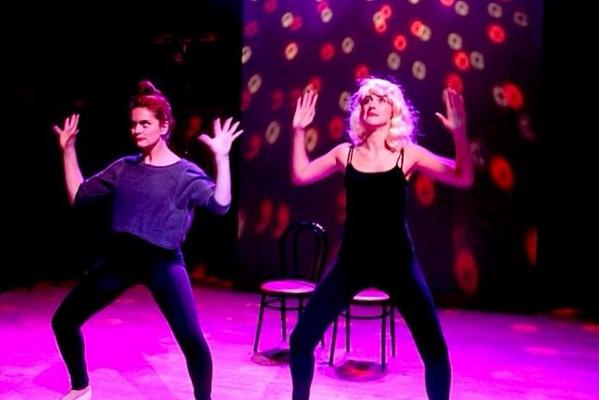
Briana Templeton & Gwynne Phillips

Briana Templeton & Gwynne Phillips

HS: Tell us a bit about Unbridled & Unstable at the NSTF.

B: It’s a comedy show that features a lot of surreal, strange and silly sketches. It’s a lot of fun to perform, and to watch as well (so we hear).

G: U&U (no one calls it that) is a loosely equestrian-themed sketch comedy show with a variety of characters who are all, in some way, either unbridled or unstable.

HS: We are thrilled at how many female artists are representing at the NSTF this year. As artists who hang out in the comedy circuit as well, is that somewhere you see the same vibrancy of female talent being recognized? We’d love to hear your thoughts. 

B: Yup, it’s great. We feel lucky to be a part of both the theatre AND comedy scenes in Toronto – which are home to some awesome talent (of all genders).

G: The calibre of talented ladies in the Toronto comedy scene is exceptional. We are very fortunate to have such a supportive comedy community.

To state the obvious: the entertainment industry is a tough one. And in many ways: it can be even more brutal if you’re female. I think that it’s important for the genders of creators and characters to be more evenly represented in media (the The Geena Davis Institute on Gender in Media has some great stats if you feel like being depressed). And that includes comedy. I think it’s important to acknowledge the disparity and try and actively change that state of affairs.

B: That said… we get asked A LOT about what it’s like to be female comedians. I suppose it’s because humour can be a very powerful thing to wield and/or master… you sink or swim. And there’s that myth that women aren’t as funny, due to our lady brains and all. As such, we’ve had interviewers focus on whether or not we cry after we bomb a set. Somehow, I doubt that’s something they would ask a male comedian…

Of course, our viewpoints as feminists and females does inform our work. It has to, and that’s a good thing. But, I don’t think that’s the ONLY thing we can focus on in our writing, either. We want to be good comedians, period. Not good for comedians that get their period (see what I did there? A pun!). What I’m saying is: we’re very grateful for being recognized as artists, and that people like and/or connect with our work. That’s marvellous. But I hope we don’t get extra kudos just because of our chromosomes, but because we’re doing interesting work. Ya dig?

HS: Totally. Great answer!  Why do you think the NSTF is important for the Toronto arts community and Toronto as a whole? 

B: It helps artists reach a bigger audience, and it helps us to access venues that would be difficult for us to afford otherwise (without jacking up our ticket prices). Getting to perform at the Factory Theatre, for example, is such a pleasure for us.

G: NSTF is great for creating a supportive community of artists gathered in one place to see each other’s work and inspire one another. It’s also refreshing to see so many people lined up outside at the coldest time of year to see some theatre!

Briana Templeton & Gwynne Phillips

Briana Templeton & Gwynne Phillips

HS: Who inspires you?

B: We both really like offbeat, old movies. We recently watched The Innocents (1961) together which is delightfully creepy. And of course, other writers and performers and comedians. I really love Maria Bamford and Key & Peele. In terms of fellow Canadians, I’d say: Tony Ho, Peter ‘n Chris, Kathleen Phillips, Mark Little and Dan Beirne (especially their recent “Space Riders” and “Dad Drives”), we could go on and on.

G: Obviously love Tina Fey, Amy Poehler, Kristen Wiig, and Sarah Silverman, among others. But if you just pop into Comedy Bar here in TO, you are surrounded by talented and inspiring folks from stand-ups to sketch comedians who are going out and performing almost every night of the week and just trying stuff out. That’s inspiring.

HS: What is your favourite part of Toronto and why?

B: I love Toronto Island. Probably because of the insane 50-100 year wait list to live there. It makes it that much more appealing because it’ll never happen. Also, name wise: I like Baby Point and Crestfallen Lane.

G: I really love biking in Toronto in the summer and going through all the different neighbourhoods. Seems like it’s becoming a really cool place to live all of a sudden. Maybe too cool…

HS: I would love to hear the best advice you’ve ever gotten. 

B: “Those pants look terrible”. KIDDING. That’s one of the not-so-helpful pieces of advice I’ve gotten. Hmm… a theatre teacher once said “Don’t move unless you need to move, don’t speak unless you need to speak” in regards to being on stage. The point is not to be hesitant on stage but to find your intension and have stakes. Everything you write as a writer and everything you do as an actor should serve a purpose. And, don’t be afraid to streamline your work and distill it. Zero in on what you’re trying to get across, and/or how you are moving the action.

G: Take risks. This is a hard one because it is easy to fall into a pattern that is comfortable – whether it’s in comedy or in life. Just do things that scare you. Don’t fall into old habits or repeat yourself too often. Shake things up!

HS: Favourite part about the NSTF tent? 

B: The heaters. Also, the people huddling around them.

G: The twinkly lights. And one year they had stew. I hope they have stew again.

HS: If you could have your audience listen to a song or playlist before seeing the show, what would it be? 

G: “The Downton Abbey Opening Theme Song” immediately interrupted by “Pump Up The Jam”.

(For your remixing purposes:)

HS: Describe Unbridled and Unstable in 5-10 words.

G: A fast-paced, energetic, comedy/variety show featuring hobby horses.

HS: What’s another NSTF show that you are most excited about?

B: I’m excited to see Dink! Kris Siddiqi makes a voiceover cameo in our show, and Jasmine Chen guest starred in our CBC Punchline web series, “Womanish”. Also, Graham Clark Reads The Phone Book and For A Good Time, Call Kathy Blanchard seem very promising.

G: I would love to see all the shows if I get the chance! They all look intriguing to me. That being said, Graham Clark Reads The Phonebook seems right up my alley.

Unbridled & Unstable

by Gwynne Phillips and Briana Templeton of The Templeton Philharmonic, presented as part of the Next Stage Theatre Festival

Horse-Photoshoot

Playing everything from upper crust Edwardian snobs to unhinged modern suburbanites, Briana Templeton and Gwynne Phillips have created a show loaded with surreal humour, outrageous dance sequences, and biting social commentary. Unbridled & Unstable will feature best-loved sketches from the duo’s repertoire alongside plenty of daring new material. Expect the unexpected.

Tickets: $15 – Buy here.

Connect: The Templeton Philharmonic

http://templetonphilharmonic.com/
@TempletonPhil 

Where: Factory Theatre Studio (125 Bathurst St.)
Length: 60 min

Created by Gwynne Phillips and Briana Templeton
Featuring Gwynne Phillips and Briana Templeton
Stage Manager Vanessa K. Purdy

When:

Wed Jan 7 – 8:30pm
Fri Jan 9 – 5:15pm
Sat Jan 10 – 2:45pm
Sun Jan 11 – 7:00pm – followed by a Talkback at The Hoxton
Mon Jan 12 – 9:15pm
Wed Jan 14 – 6:45pm
Thu Jan 15 – 7:15pm
Sat Jan 17 – 9:00pm
Sun Jan 18 – 6:00pm