Skip to content

A Chat with Alisa Palmer, Director of Body Politic by Nick Green

by Ryan Quinn

We sat down with Alisa Palmer, multiple award winner and current Artistic Director of the National Theatre School, to discuss her latest director project, Body Politic, a lemonTree creations workshop.
 
Body Politic re-imagines the story of The Body Politic, Canada’s most important queer publications, exploring its unique beginning, its community successes, its legal challenges and its eventual demise. This project is a commission of lemonTree creations and is currently in residency at Buddies In Bad Times Theatre.
 

Ryan Quinn: So, I’m here with Alisa Palmer, director of Body Politic, which will be doing its workshop presentation this Thursday May 30th, Friday May 31st and Saturday June 1st at 8pm. Would you like to tell me a little bit about the show?

Alisa Palmer: Yeah, certainly. This is a workshop exploration of a script by Nick Green. It takes place in one evening, and it’s an encounter between a young gay man and an older gay man. It is a significant night for one of the characters, and because of the nature of their conversation, and what they talk about, this man’s past comes to the fore. He was an activist and writer on The Body Politic, and his history and experiences with the magazine are fully brought to life throughout the evening. He has to do a lot of self-examination, a lot of self-exploration. In it, we, the audience, experience the trajectory of that incredible magazine, and that collective, and the fervor of a certain time in Toronto history.

RQ: It sounds like a conversation between the past and the present, bridging that gap.

AP: Yes, and then it launches straight into the future, I think. It definitely puts some questions out there.

RQ: I’m not sure if you were involved with the show at this point, but there was a reading of it…

AP: There was, yes, and I directed that reading. We had just a couple of days to get the actors together and work on it. It was much more modest. It was so invaluable, though, because since that meeting, Nick has gone away and really dug into how to bring the past more into contact with the present so that the play isn’t exclusively dedicated to only telling the story of the Body Politic, but rather about looking into what is still alive and what is missing in our communities and our psyches in terms of all this kind of discussion and the freedom of expression, and the challenges to our own assumptions about what is right and wrong in the world.

RQ: And this isn’t only a workshop for the script at this point, but I hear that you’re workshopping the design as well, with the two going hand-in-hand.

AP: Yes. This week we’ve been focusing on the actors and the script, and next week we move into the theatre, and there will be a sort of prototype of the set. A slice of what the set might be, some ingredients that may be in the design, projections, lighting… just a tasting menu of it all. That way, we can explore how the past and the present are interacting with each other through these design elements that support the story.

RQ: And this is going up…

AP: At the Helen Gardiner Phelan Playhouse at U of T. What we’re going to do, then, is we’re going to spend a lot of time exploring the production elements and how the play works with all of these lights and sounds and so on. We’re going to read the script for the audience, so they’ll hear the whole story, and then we’ll show them a few highlights of things that are exciting to us as to how the story is going to be told three-dimensionally.

RQ: It also must be a look at where the show can go from here.

AP: It’s a really great opportunity for all of the artists involved to get to know the world of the play and Nick’s imagination; and for Nick to also experience how things can be communicated to the audience and captured in the human body, with the presence of the actors, and the design elements. There are so many opportunities, so nobody has to do all of the heavy lifting alone. It’s kind of a reflection of how The Body Politic was created, you know? We are that much more effective at communicating if we share the wealth of our talents.

RQ: So you have the history of the real Body Politic resonating in the show, going back and forth into a conversation with the entire genderqueer community.

AP: Yep, it’s all on the go. This is the end of week one, so if there’s smoke coming out of my ears, it’s because we’ve been dealing with all of these interacting and intersecting themes and ways of working.

RQ: And you’re having a two-week rehearsal process?

AP: It’s about eight days of being able to work with actors and design elements, in total. Then we’re presenting it for three nights, but every evening will be slightly different because we’ll learn from the night before and maybe adjust our goals, or what we’re playing with.

RQ: Even though it’s every bit as stressful to mount a workshop production, there must be more of a freedom to explore the material and process that’s sometimes not there.

AP: What I love about readings is that there’s no pretence that it’s finished. So actors are listening to the audience in a way that is much freer than when they have to do the marathon of a whole show. I think there’s a kind of spontaneity and a really live communication that is quite unique when you have your script in hand. It doesn’t even have to pretend to be perfect. It’s just alive. Very, very alive.

RQ: Any kind of pretence that it’s not a conversation is gone.

AP: Right, so I’m relishing the audience coming and seeing what it’s like each night and hearing what their responses are because it’s informing what aspects are hitting home with people, and what things are questions and ambiguities that are valuable to maintain. Provocation. In the true spirit of The Body Politic, provocation and moral ambiguity; which are really good ingredients of any project.

RQ: What are you hoping people take home from this? Conversation and debate?

AP: I think that the most challenging questions that The Body Politic brought forth into the world are “how do we work together, and listen to each other, and care for each other even through our differences?” That doesn’t mean, to me, “how do we let anything happen without moral grounding?” Not everything is okay, not everything is equally acceptable or valuable. Certain behaviours are more threatening than others, but how do we negotiate our lives together and maintain and appreciate the differences amongst us? Loving each other, knowing that we’re not going to agree. The goal is to come away having encouraged awareness of that in people. That is my question about how to live well. So if the project engenders some of that discussion or debate or awareness in people, that’s great.

RQ: It sounds like you’re wanting people to make the effort to go out and help instead of assuming that not making the effort to hurt is the same as helping.

AP: Oh yeah, engagement.

RQ: Engagement.

AP: Exactly. There are things in The Body Politic that are contentious and disagreeable and fabulous, as in human behaviour. But I think you’re hitting onto something that’s incredibly important, to remember how valuable engagement is, to really get in there and participate and express yourself, and listen as much as expressing yourself, which is a two way street. This play is a dialogue between two people but that is infused with many, many more voices.

RQ: And there is a talkback after all three performances?

AP: Yes, lemonTree creations is so great. They are organizing some discussions that are focused around certain topics and certain activists that are with us today, as well as certain aspects dealing with the themes of the play. There will be a discussion about more than the art.

RQ: Getting the discussion started so that once people leave, they have that grounding.

AP: Yes! I really want people to know about this. We all know that in the arts now, it’s extremely important to remember how much people want these stories and want art. That notion of engagement you were taking about is how we are living in the arts. We all know it to be true that people want to engage in the arts. Some people in the higher echelons of the government may have their doubts, but we know. We just have to tell ourselves that.

RQ: I do find that recently we’ve started getting rid of this notion that passivity is implicit support, and I think that our arts are what are creating that drive, so shows like this are incredibly important.

AP: It’s really exciting. I feel like the opportunity to work with lemonTree creations reminds me about how much growth there is in the arts. It’s really incredible because up in the upper echelons of the economic circles, they see that the audiences are dwindling, but, in fact, in this environment, working with lemonTree, there is so much going on that is so powerful. There is real direct contact with audiences that is really alive, culturally. It’s fantastic. It’s so inspiring to me. I’m at the head of the National Theatre School now, I just started, so for me to be on the ground with these indie companies with young artists, I know exactly what I’m training people for. There’s a huge set of opportunities for young artists that we are all creating together.

RQ: A lot of times, this is the really gutsy, painful stuff.

AP: Yeah, it’s really fun! (laughs)

RQ: Yeah, there’s nothing more fun than emotional pain!

AP: Oh exactly! In a safe environment, when we’re all sharing it together, it’s fantastic. Distribute the load.
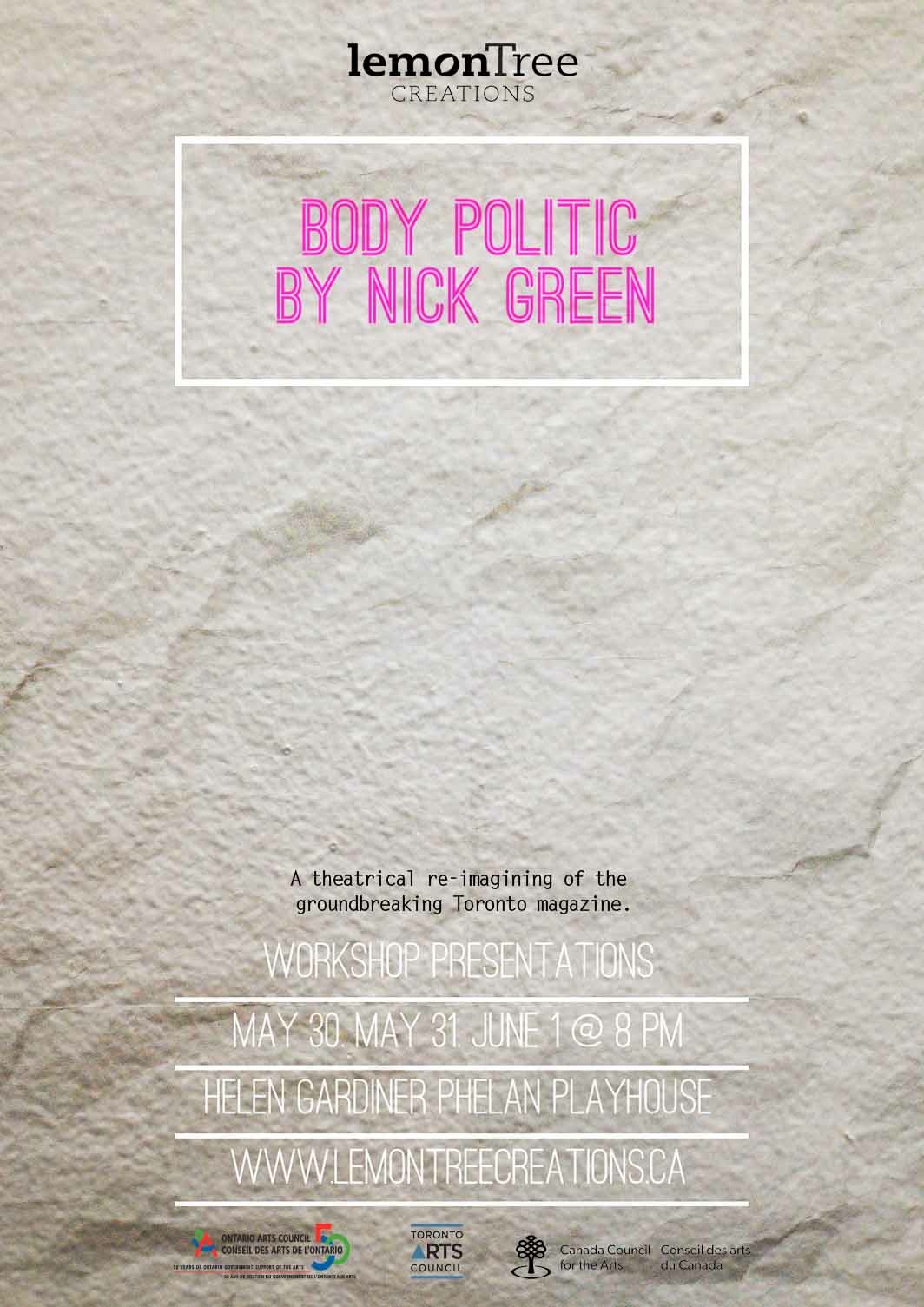
Body Politic workshop poster

RQ: Catharsis!

AP: Right!

RQ: Well, thank you very much for talking!

AP: No problem, it’s been a pleasure!

 
BODY POLITIC by NICK GREEN
Who: lemonTree creations
When: MAY 30, MAY 31, JUNE 1, 2013 @ 8 pm
Where:  Helen Gardiner Phelan Playhouse, 79 St George St #302  Toronto, ON (Just south of Harbord St, on the east side of St. George Street)
Tickets: $15 (Youth Group Discounts Available – $5 each for groups of 10 or more!)
Buy tickets online at http://www.bodypolitic.bpt.me or call 1-800-838-3006

Toronto’s Favourite Cost-Effective Rehearsal Spaces

by Ryan Quinn & Hallie Seline

We asked Toronto theatre artists what their favourite cost-effective rehearsal spaces were:

b current’s studio theatre

Located within the beautiful Artscape Wychwood Barns at St. Clair and Bathurst, b current performing art’s new 700-foot studio theatre is perfect for rehearsals, workshops, intimate theatre events, meetings, and community gatherings!

Features include: 50 seat capacity, wheelchair accessible, with elevator access, dressing room/backstage area, lighting and sound system to be installed by end of May 2017, charming vintage Edison bulb string lights for general non-theatre events, Hardwood floor, wireless internet access, 50+ chairs for your use, dry bar and front of house area for concessions by donation, gender neutral washroom, air conditioning, high vaulted ceilings and is steps away from public transportation.

Rate: $15/hour and all monies earned go towards b current performing arts’ programming and community building initiatives, which uplift the voices of racialized theatre artists from the page to the stage.

To book, please contact Artistic Director, Catherine Hernandez at catherine@bcurrent.ca

Enlight19


The Attic

1200sft open concept unit is a beautiful space for rehearsals of all kinds. The space features a private bathroom, ceilings which range from 6′ to 14′, and it is not attached to any residential units. The space is available to book from 8am to 12am. theatticartshub.com

DSC_0115

The Box

The Box is a large, multipurpose rehearsal space located at 103-89 Niagara Street that often holds open movement classes and other events. It’s a 600 square foot space with beautiful exposed-brick walls (we love that stuff) that also includes a greenroom, kitchen, and bathroom. http://www.theboxtoronto.com

$T2eC16d,!)UE9s3wDcj8BRULuWhRHw~~48_35

Collective Studio (Theatre Lab and Pandemic Theatre)

Collective Studio is run by Theatre Lab and Pandemic Theatre, and is located near Lansdowne station. It is a newly-renovated 500 square foot adaptable studio for things like rehearsals, readings and workshops! http://theatrelab.ca/space/

photo

FuGEN Theatre

FuGEN Theatre at 157 Carlton Street is a 430 square foot studio space equipped with dance floors and mirrors, which could be very useful for those of you working on physical theatre or perhaps for those who just like to watch themselves act… It also has free Wi-Fi, a stereo system, air conditioning and a full kitchen. http://fu-gen.org/about-us/fu-gen-rental-space/

Rental-Space-2

lemonTree Creations

The lemonTree Creations Studio is a large space that regularly holds classes for those looking to hone their craft. They will also soon be instituting a residency program, which is a great opportunity for dedicated artists to have a regular rehearsal home. This space also comes equipped with a kitchenette and Wi-Fi.  http://www.lemontreecreations.ca/

16302544802_e927319636_z-min

Aluna Theatre’s Studio Space

Located at 1 Wiltshire Ave. Unit 124, in Toronto, Aluna’s Studio is a beautiful 750 sq. foot studio with sprung floors and two-piece washroom. Equipped with a fridge, coffee maker, microwave, tables, chairs, and mats.  Sound and lighting equipment available for an additional charge. Read more about prices and availability here: http://www.alunatheatre.ca/studio/

studio-imaging1-bwweb

**Are we missing your favourite Toronto Cost-Effective Rehearsal Space?
E-mail us at inthegreenroom.ca@gmail.com and we will add it to our list!**

Sophia Fabiilli – Assistant Producer of One Little Goat Theatre Company’s “The Charge of the Expormidable Moose” Shares her TOP TEN THINGS She’s Learned About Producing

 Sophia Fabiilli is a Toronto-based actor and budding theatre producer. This spring she had the opportunity to work with One Little Goat Theatre Company, assistant producing their current production of ‘The Charge of the Expormidable Moose’ (on stage NOW at the Tarragon Theatre Extra Space until May 26th).
 
What does an indie assistant producer do? How was it been transitioning from acting to life on “the other side of the table”? Sophia shares her top ten lessons on producing thus far.
 

1) Input does not equal output

My first experience as a producer came last spring when the Amy Project facilitated an internship withSeventh Stage’s production of ‘Stockholm’, in partnership with Nightwood Theatre. I was lucky enough to be an intern producer and worked under the guidance of the magnificent Melissa Jane Shaw, Artistic Producer of Seventh Stage. One of my focuses was educational outreach. I called ninety-one high schools in the GTA and booked zero school groups. Zero. This was a crushing blow to my rookie producer ego…

If you work hard, it’ll pay off, right? It doesn’t always work that way when building new audiences. It’s extremely difficult and you must brace yourself with patience. Lots of patience. Remember: even if it doesn’t work out this time, reaching out to new people will somehow pay off down the road.

2) Cold calling perseverance

Let’s be real: people are busy and inevitably think that you want their money/will waste their time. From my experience, know exactly what you’re going to say before you pick up the phone, but don’t sound like a robot. Be concise. Spark their curiosity. And if they’re not interested, be polite and thank them for their time.

Once in a while, you’ll call someone who is absolutely thrilled that you’re not a pre-recorded message announcing that they’ve won a phony free cruise. “You’re inviting me to your play? Awesome!” You willconnect with people who will be excited to hear from you (and you’ll be happy that you made the call).

3) Know what you’re talking about

This spring, I was fortunate to be hired as the Assistant Producer for One Little Goat Theatre Company’s English language world premiere of ‘The Charge of the Expormidable Moose’ (on stage at the Tarragon Extra Space NOW until May 26th – go see it!). I assisted Artistic Director/Executive Producer/my incredible mentor, Adam Seelig, with everything from securing rehearsal spaces to sourcing insurance to locking down cross-promo deals to brainstorming ways to spread word about the show.

At one point, Adam suggested that I contact some local galleries that showcased surrealist artwork. Claude Gauvreau, who wrote ‘MOOSE’, was part of a radical group of surrealist artists and political activists in Montreal, called Les Automatistes.

This was a brilliant idea on Adam’s part, but when it came time to make the cold call, I got cold feet. I realized that I didn’t know enough about what our project and these galleries had in common. I was going to look like a fool… and worse, make One Little Goat and ‘MOOSE’ look second rate.

I confessed my concerns to Adam and put myself through a crash course on the core and content of the play’s cultural history. Moral of the story? Be an expert on your show. You need to be able to speak passionately about your project and tell people why they shouldn’t miss it.

4) Get organized

This one sounds like I’m running out of ideas, but it could easily be my #1 piece of advice. Keeping track of a thousand details can be overwhelming, especially when you have other projects, a ‘Joe’ job, and a semblance of a social life on the go as well…

The following is completely stolen from Arts Planner Extraordinaire, Sue Edworthy, who did the marketing for ‘MOOSE’ and from whom I’ve learned lots… (do yourself a favour and read Sue’s blog –www.sueedworthy.ca)

In order to keep our Expormidable team on the same page, we created a shared Google calendar and a giant grid of all our reciprocal deals in DropBox. Everyone kept the calendar and the grid up-to-date with deadlines, show openings, and important dates. We scheduled everything (e v e r y t h i n g), even down to our social media postings. It worked brilliantly.

5) Reciprocals are your best friend

What’s a reciprocal anyway? Basically, it’s an agreement between two companies to help promote each other’s shows. If your shows run at the same time, you can trade postcards or program ads. If they don’t, get creative… Offer shout-outs in your e-blast or on your website, free tickets, social media or blog posts, whatever you got!

Advertising is expensive, my friends. What better way to pump your shows than to connect with each other’s audiences?

The Charge of the Expormidable Moose - One Little Goat Theatre Company

The Charge of the Expormidable Moose – One Little Goat Theatre Company

6) Use social media wisely

Remember last July? Remember receiving 12,000 notifications a day about Fringe shows? Remember how much you loved that? …Yeah. Social media is a powerful tool, but it won’t do squat if someone stops following you or turns off notifications about your event.

I’m going to take a page from Sue Edworthy again. For the ‘MOOSE’ event page we posted: “IMPORTANT: We will not be posting to this page. To keep up-to-date about the show, please “like” One Little Goat Theatre’s page. Thanks!

SUCH a great idea! By directing people to “like” your page instead of “attend” your event, you retain those Facebook followers after your show closes… and have them on hand for your next project. LOVE. IT.

7) Be thoughtful about online etiquette

I was in charge of social media posting for ‘MOOSE’ and my first thought was “everyone is going to think it’s Adam posting, not me”. It was really important that I wrote in a style and tone that suited the aesthetic of One Little Goat Theatre.

Being the voice of someone else’s company is a huge responsibility! Go the extra mile and triple check… This is important to remember when it’s so easy to tweet or send off a quick email in a matter of seconds. Careful that what you’re writing won’t be misinterpreted or, quite frankly, sound rude. And while you’re at it, respond to correspondence in a timely matter. It makes a HUGE difference.

8) Get your hands dirty!

AH YEAH! This one sounds like fun!

When Adam and I were planning in January, I suggested that we create a promo video. Great idea, Sophia! Fast forward to April, when I shot and edited seven one-minute videos interviewing our incredible cast members (here’s an example: http://onelittlegoat.org/blog/2013/5/6/video-actor-sochi-fried-talks-moose).

I have neither shot nor edited a video in my life, but let me tell you… iMovie and I are intimate partners at this point. I also catered our opening night reception. Sometimes you just need to jump in and get a job done.

9) Ask questions

Holy hell, I asked a lot of questions! You can ask Adam. Actually don’t… that poor man needs a rest.

I’m new to this and didn’t want to screw up. So, I asked a bunch of questions and learned a lot (although I still have so many more to ask…). If you’re new to producing like I am, get out there and talk to people who’ve done it. There are incredible people in this community who are happy to share advice (and war stories).

10) Praise to producers everywhere!

Producing is an all-encompassing (and sometimes thankless) job and your work is never totally done. There’s always another post to be writing or another invite to send. Honestly, it has been a challenge to balance the workload with my other life as an actor.

Struggles aside, it has been fascinating to see a show come together from the “other side”. I had expected to find it artistically unsatisfying; I wondered if I would envy the cast, wishing that I were up there instead. I am happy to report the opposite! There is a creative side to this job and, let me tell you, sitting in a full house on opening night of the show you helped to produce feels DAMN GOOD.

So far, producing has been an eye-opening experience for me. The next time I work as an actor, I’ll remember that my director, producers, and designers have been working on the production for months(maybe years!) before I came onto the scene. The show cannot go on… without everybody’s efforts.

 
THE CHARGE OF THE EXPORMIDABLE MOOSE
by Quebec visionary Claude Gauvreau 
“A tour de force” -GLOBE AND MAIL
“A production not to be missed” -STAGE DOOR
“An unforgettable performance” -CHARLEBOIS POST 
 
Runs: May 10 – 26, 2013, Tue-Sat 8pm | Sun 2:30pm
Where: Tarragon Theatre Extra Space, 30 Bridgman Avenue Toronto
Tickets: $25 | $20 student senior artist + $3 final week | Fri & Sun rush tix $13
Buy your tickets over the phone: 416-531-1827 (no service fees!)or 
In person at the Tarragon box office: 30 Bridgman Ave. 
 
For more info go to One Little Goat Theatre Company’s Website – onelittlegoat.org/moose/

A Chat with Alex Johnson. The Playwright Project A Year Later: Sam Shepard May 1-7th

by Ryan Quinn

Q: Here with the brilliant Alex Johnson. The Playwright Project kicked off last night to a great start. Tell me a little bit about what you’re doing with the project this year.

A: It’s the exact same format as last year with a different playwright and several different venues. We wanted to rebrand as The Playwright Project and move away from being a Tennessee Williams festival. We never had any interest in being a Tennessee Williams festival; it’s more the format, the community-mindedness, and the artistic collaboration that we were interested in. So, we rebranded as The Playwright Project and went with Sam Shepard for a number of reasons. I guess the first and most important one was that we’re all absolutely in love with him. He’s exciting, he’s a little filthy, you know, “the sacred and the profane”. There’s great music in his plays, huge amounts of live music, that awesome, bluesy, folksy stuff. There’s all that sweaty, New-York-in-the-60’s experimental theatre, but there’s also some really down-to-Earth and conventional work. So, there’s a huge variety. Also, they’re plays our generation can really sink their teeth into. They’re restless and young and urban. So, it seemed like a good fit for the people we were working with.

Q: And who are you working with this year?

A: So, we’ve got Heart in Hand Productions, who actually just did a Sam Shepard play. They did Cowboy Mouth at the Cameron House, which is also a venue that we are working in this year. Those girls are great and they were very keen to re-enter the world of Shepard and investigate a different play with us. They’re also this great team of babes doing a really masculine Shepard play, so I’m really excited about that. They’re doing Fool for Love. Peter Pasyk from Surface/Underground will be joining us, doing When the World Was Green. He was just chosen to be the 2013/14 Urjo Kareda Resident at Tarragon Theatre, so that’s amazing. Theatre Brouhaha and Red One Theatre Collective are both back on the project; they were with us last year as well. We’ll actually be working in Red One’s new venue, The Storefront Theatre, which those boys are also running. We’ve also got Alec Toller, who is more known for being a filmmaker. He’s got a film coming out called Play, that Kelly McCormack was in, and it’s about theatre. He’s doing Angel City which is very cool because it’s really film noir and cinematic, so I’m really curious to see how this filmmaker meets this live filmic piece. Natasha Greenblatt and Pomme Grenade Productions, who just did The Peacemaker at Next Stage, which was a huge hit. She will actually be doing Cowboy Mouth. Lastly, and this is really exciting, Alex McCooeye has adapted a Sam Shepard short story called Saving Fats into a play. Alex and I actually worked on his adaptation of a Poe short story about a year ago with the incredible Greg Kramer who sadly passed away a couple weeks ago. Alex is a really great writer with an amazing eye for adaptation, so I’m really excited he’s taking this adventure on. Jeremiah Sparks is in it, so, yeah, it’s going to be great.

Q: Are you doing it in the same venues as last year?

A: Yeah, so we are back in the Curzon in Leslieville. I was in there the other day and since we were in there last year, it’s been revamped into this amazingly Sam Shepard-like space. It’s the coolest. There are these white embossed animal heads on the walls, and it’s all…country. It’s so cool. It’s so cool. I walked in and I was just like “Why? This is so perfect. This is touched by God”. We’re also back in the Magic Oven. The interesting thing about that space is that once the Project is done for this year (although we’re already vamping up for next year), I’m partnering up with Tony at the Magic Oven to turn that downstairs space into an actual year-round, multi-disciplinary performance space. Tony has built a full kitchen and bar in the back, so it’s going to be fully operational by the fall. I will be managing and programming everything in that space. I mean, there’s not a lot like that out there on the Danforth. You have the Fraser Rehearsal Studios, the Danforth Music Hall, you’ve got the Red Sandcastle, but it’s significantly more south. We’re really going to try to engage with the Danforth community and be a new place where culture can happen. It’s really exciting. We have not confirmed a name for the space yet. We jokingly call it The Tragic Oven.

Q: That sounds horrible, haha. That’s a horrible name.

A: I know! We’re just going to program Greek tragedies. So, yeah, we’re back there. I think everything else is new. We’re at the Storefront; we’re at the Cameron House…oh! The Cameron House is partnering with us this year to be the post-show hub every night. So at the Cameron House every night at 10pm, Cameron House records and our director of music Gaby Grice have co-curated a whole line-up of Shepard-y music in that bluesy, folksy, rock and roll cowboy vein. So, every night at 10pm, a whole different lineup of Shepard-y music at the Cameron House. So, that’s going to be a blast. We’re also in some other great spaces, the May Café in Little Portugal, Lazy Daisy’s in The Beach, Annette Studios in The Junction. I’m really excited about the venues.

Q: Now, sometimes you call it a project, and sometimes a festival. It also kind of seems to walk a line close to being a repertory season. Where is that line?

A: It’s so funny that you bring that up. We were just talking about this last night, actually, that the language that we use needs to be paid close attention to because the end result is festival-like but the process is not. The process is much more collaborative and about the seven companies as well as the administrative body supporting each other as opposed to them working independently of us until show time like you would for Fringe or Summerworks. So, the process is much more, as our initial vision from last year stated, about creating a tighter-knit community of artists who work toward one communal goal together. In that regard, I don’t think you could call us a festival.
I like what you said about thinking of it almost as a repertory season. It’s like a really fast, really intense repertory season that goes down. If I can find a more succinct way of phrasing that, I might steal it from you for next year. I actively avoided calling it a festival last year, but the language sort of just became easier to use. People understood more what the end result was, what May 1-7 would be. But, yeah, I think I want to go back next year, for 2014, and re-examine what we call ourselves.

Q: Do you feel like the community has gotten more tight-knit since the festival last year?

A: Yeah, I mean, I don’t think we’ve changed the theatre scene. I think what Playwright Project has served to do is broaden many of our artists’ connections and resources. They now know, in some cases, almost a hundred new people that they can access in the community and that they can share with. The thing is, though, everybody works differently. Everyone has their own process. Some are more about reaching out and bringing people into the fold, and some people are much more isolated. One is not better than the other. Some people work better in isolated think-tanks, and some work better with an “it takes a village” mentality. So, I wouldn’t qualify the festival as being some giant community. What I know it is, is an opportunity to access things that you wouldn’t be able to access otherwise. And you’ve got a really strong support system under you. So, like, the Playwright Project team and I are here to handle the things that could take away from your artistic focus and clarity of vision. We are here to enable you to do what you want to do.
But, in the bigger picture of things, is the Toronto community getting tighter? Yeah. I think it is. I think I see things changing and I see the grassroots stuff growing and I see people reaching out more.

Q: What have you learned since last year that’s been implemented this year?

A: It’s so funny. We were talking last night about how at the end of last year we went “Oh alright, we know what to do now. We know now. We get it now. We got it”. And now it’s coming up to the end of the rehearsal period and I’m like “Oh wait. I still don’t know anything”. What have I learned? I’ve learned so much. I’ve learned that people want to help. People want you to call them up and present them with an idea and a way they can get involved. I’ve also learned a lot of practical things. I’ve learned how to rent a van and how to hang a piece of black fabric. I’ve learned a lot about Equity and the new agreement and the festival waiver.
I have learned that it is very important, whether you’re an arts institution, or an organization, or a collective, or an individual artist, every project and every endeavour needs to have a personality. It needs to know what it is and have a clarity of what it’s doing. When our logo started going into development and our amazing graphic designer Lisanne Binhammer was sending us sheets of proposals, picking it was remarkably hard because we didn’t yet have that seed of exactly as an organization, what our personality was. As the logos started to come in, I started to see it. Started to visually see what we look like on paper, and it helped us to better understand what we are. We’re this scrappy, spirited group of young people, and trying to fight it and become something more polished is not helpful. I was at the Shakespeare in the Ruff gala and they know so well who they are as an organization. They have such a specific sense of humour and how they put themselves out into the world is so clear. I’m becoming more and more aware of how important that is. I mean, I guess, in simple words: branding. The importance of branding. You can’t engage people if you don’t know who you are. You can’t get them on your team if you don’t know who that team is.

Q: Looking into the future, in five years, where would you like to see the project?

A: There are a lot of internal things I would like to see change. Just in terms of, you know, office space. Things that would make the daily practical work easier. I think much of our personality is that every year, we’re going to be different. Last year was Tennessee Williams, and this year is Sam Shepard and there are cowboy hats everywhere and the music at the Cameron House. If it’s Ibsen (and it won’t be, but hypothetically), if it’s Ibsen, the personality of that week in May will be entirely different. Instead of having music at the Cameron House, we might have…sad Norwegian poetry nights. Every year there will be a different flavour to what we do.

Q: An atmosphere?

A: An atmosphere, yeah! And secondary programming will arise from that, and different people we can work with will arise from that. Different things these neighbourhoods can engage with and see that they wouldn’t normally. I want to be surprising people five years down the road with what we do. I don’t want to sit still too long. As I said, we’re already in talks for next year, and it will be surprising. I can tell you right now, the format will not be changing, but some things will be and it’ll surprise you. You’ll like it.

The Playwright Project: Sam Shepard runs May 1st-7th
For show listings check out our complete Toronto Theatre Listings page.
For exact venue schedule and ticket purchase go to The Playwright Project’s website!

We want YOU!

Hey nifty peeps! Like the cut of our jib? Want to join the fun? Check out our latest Job Posting for Writers/Contributors for our In the Greenroom team! We want YOU! Read more on our Job Board.