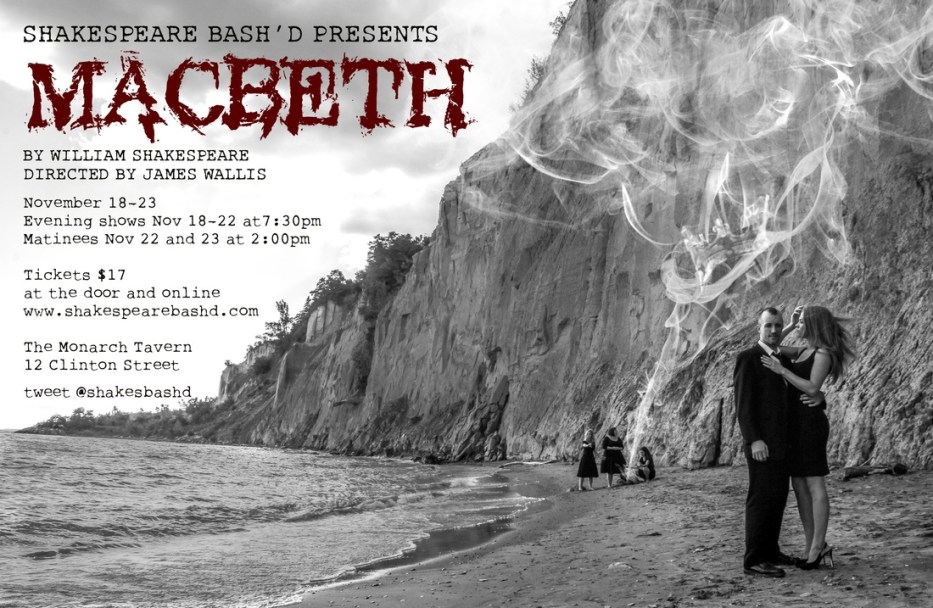
I interviewed actors Amelia Sargisson and David Ross who play the Macbeths in Shakespeare Bash’d upcoming production of the Scottish play. We discuss working with Bash’d, focusing on storytelling and taking on the title roles.
About the actors:
Amelia was born and raised in Montreal, she moved to Toronto to attend Ryerson Theatre School under the direction Perry Schniederman. Post graduation she decided to stay in Toronto to pursue her career. Her love of the city was a “slow burn” and she finds the city’s openness to new, and international, ideas and methodologies inspirational.
David is originally from New Hamburg, a menonnite town, and didn’t start out as an actor. He actually left a career as an engineer to attend the University of Windsor’s Acting program. Both actors share a healthy list of theatre credits to their name with companies across the province and the country.
Bash’d does Macbeth, how will it be different from other productions?
AMELIA: There isn’t a concept per-se. Bash’d built their reputation on a bare bones approach to the text which highlights the characters with their relationships and scenes above all. The action isn’t transposed, it’s just letting the words do the storytelling.
DAVID: I get questions from people all the time, what’s your concept? Are you doing Elizabethan? But our goal is just to be clear with the storytelling. For example, we fight with Bowie knives and there are garments that distinguish people as military or non-military, but there’s no time period. The story telling is clear and our main focus.
Julia Nish-Lapidus, Maggie Blake and Hallie Seline. Photo by Kyle Purcell
On the challenges of these well-known roles:
AMELIA: Director James Wallis has insisted several times in rehearsal that there is no “Lady Macbeth,” there is only you. In some ways I agree with him, I only have myself to bring to the part. I can only trust that the words and language of this character will be the gateway into her soul, heart and thoughts. Her ambition is fierce in a way that is kind of frightening. I would call myself fierce, but I would never consider murder to achieve my objective, thankfully, so trying to make that leap is where I have to fill in the blanks.
DAVID: The expectations of people are astounding and if I think that for a second I get a little panicked. People love this show. When people say they can’t wait, the outside part of me smiles and the inside says what the bleep. I am what I am. I draw on my life experience; I’ve had a scrap at a hockey game but I’ve never dissected humans on the battlefield and been lauded and given medals for it. I’m an urban dweller that grew up in the country. Growing up, I knew men that were honourable and noble, warriors and athletes. It’s been wonderful getting him [Macbeth] to walk when I wanted him to run. I lost a lot of sleep, but even that gave me insight into the show.
On building the marriage of the Macbeths:
DAVID: When I first found out about Amelia’s casting I was thrilled. But then I laughed a lot because the woman playing the love of my life is actually the wife of my mortal enemy onstage (Macduff, played by Kyle Purcell) and they got married during the rehearsal process! Amelia is amazing, as attested I think by how busy she’s been in the theatre world. It’s such a terrifying relationship, and she plays a character that convinces me that one of the worst sins in the world is a-okay. It’s exciting for me to be convinced by her and it’s tough to put up obstacles. The relationship, for me, is the crux of the play. When it starts to fall apart, the plays goes to hell.
AMELIA: James [Wallis] identified that we have good chemistry onstage and we didn’t have to work for that. The privilege of working with Dave is that he’s game to try it every way, preposterous or silly or wrong and in doing that we’ve discovered textures and layers in all forms. There’s only so much you can learn by talking about it [which we did] but sometimes you just have to get in the muck of it. It’s important for me to have esteem and love and admiration for this man, for his courage and nobleness. I have found that easy to access because he is all of those things, lovable with a true heart.
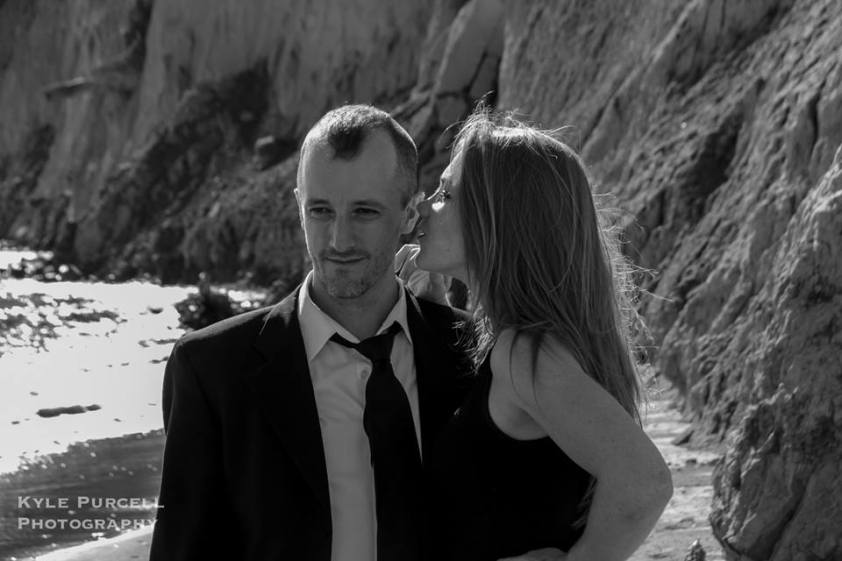
David Ross and Amelia Sargisson – Photo by Kyle Purcell
On working with Bash’d:
Amelia met Artistic Director James Wallis at Ryerson, and Amelia and David met when they were cast as the Capulets in Wallis’ staged reading of Romeo and Juliet, which was Bash’d first theatrical endeavor.
AMELIA: Beyond the first two staged readings, this is only the second full production I’ve done with Bash’d but it’s the first time James has directed me. It’s a privilege for me to work with him. His ability to illuminate the text is unmatched. The company is less practiced in doing tragedies, focusing on lighter content in the Fringe Festival. But last year they did R & J, and [Macbeth] is one of Shakespeare’s more mature tragedies. The company is continuing to grow and taking on more ambitious projects.
DAVID: Many things are different and the same. The same is James’ knowledge of Shakespeare. Before the show he has mined every source for context, meaning, double meaning, triple meaning, historical basis and he’s done that for every word of the play. What is different is I have never been a part of the rehearsal process this much. It’s my first crack at a title character. James and I have discussed things over drinks, through text and email, in moments passing each other in the hall. I have to say the process of building my character hasn’t been much different, but the journey is just a bit longer.
AMELIA: And the result will surely be different.
Why theatre?
AMELIA: I believe in the power of a well-told story to affect people in different ways […] and to inspire them to make changes in their own lives. I love and appreciate the opportunity theatre creates for communion, to be in a room of sentient beings with a shared life and away from the solipsism of our glowing screens. The power of live theatre is very unique.
One week only, Macbeth runs at the Monarch Tavern (12 Clinton Street, just south of College) until Sunday November 23rd.
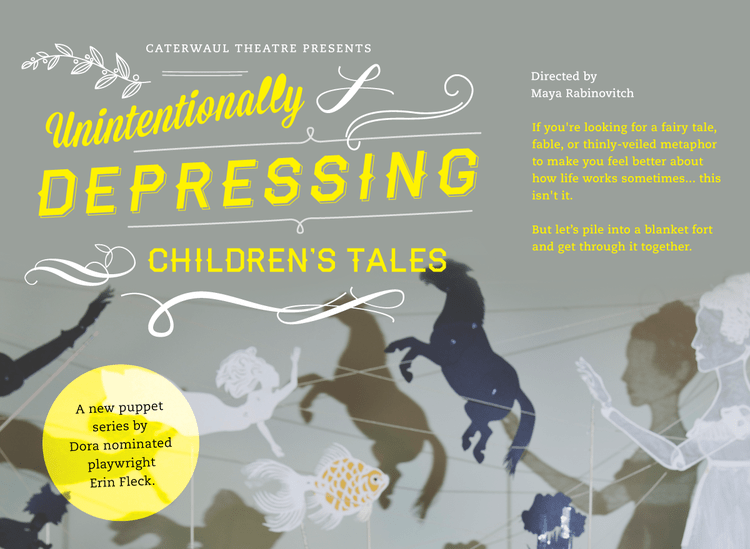
Hallie Seline: Could you talk a bit about your show Unintentionally Depressing Children’s Tales playing now as part of the SummerWorks 2014 Juried Series and where you got the inspiration to write it?
Erin Fleck: Growing up, I remember my parents, grandparents and important adults in my life telling me fairy-tales, fables and other stories to teach me about the world. In many cases, they were lessons outlining morality, how to be a good person to others, or how to find my place in the world. Which, according to them, and me, was going to be something important, something for the history books. We all are the heroes of our own story, right?
I remember most of the stories told to me by my parents tending to frame life as a positive adventure, where things always work out in the end, even if the journey gets hard along the way. Good things happen to “good” people, and “bad” people get what’s coming to them… or at the very least they learn something and become better people.
But when you grow up, it becomes very apparent that this isn’t the case most of the time. Of course, there can be a lot of beautiful things to celebrate in life, but things don’t always work out, even for the nicest, most caring, well-intentioned people out there. And people who do evil things don’t always have to answer for them.
(And to add another level to that, ideas of what or who is “good” or “bad” are never that cut and dry.)
Life often throws you disappointments, unwanted responsibilities, lowered expectations, and in some cases, tragedies that you have to survive. I think this realization also coincides with an age where most people consider us too old to sit down, curl up and have someone read aloud to us from a book of treasured tales.
So, I started writing the Tales with that idea in mind. People who are trying to be heroes in their own stories, but end up having the heroism or that poignancy snatched away by circumstance. But I still wanted the telling of their stories to capture the magic and whimsy of the tales I loved as a kid. And also, I didn’t want to lose the sense of surviving those things, and keeping on, because we do that every day.
HS: You have quite the team of creative people working on it with you (sound designers, puppet makers, video artists etc.) Being the playwright, what surprised you the most while developing the show to its current version?
EF: Honestly, the amount of enthusiasm, passion and resourcefulness that all of the artists have, who’ve been involved with the development since the beginning. I love the show and the stories, but there was a part of me in the early stages that thought, who besides me is going to care about this whimsical and sad little world, that is actually a huge logistical undertaking? And to have so many talented people throw themselves into it has been overwhelming and wonderful.
We had Jordan [Tannahill] and Will [Ellis] at Videofag back in January (where we did the first workshop) saying “We will give you space, make this thing happen”. My director Maya [Rabinovitch] heard my ideas about a puppet show in a blanket fort and what I was trying to create as an experience with this show, and thought “Ya, let’s just go for it. We’ll deal with logistics later.” Our designer Roxanne Ignatius has been living with 100 yards of blankets for the last few months to build a tent big enough for the LOT Studio space. Sarah Fairlie, who runs Caterwaul with me, and is the puppet designer and main builder, has designed five puppet shows and a stop motion film in the last eight months. The puppeteers and narrators that have come on board, are all incredibly talented and busy actors and performers, and they’ve just taken whatever has been thrown at them, and given back insight into the stories that has been so helpful to me as the creator. And since she’s come on board, Pip [Bradford], our stage manager and technician, somehow managed to look at our five shows worth of puppets, a 25 x 30 foot tent, four projectors and a puppet screen and say “Why yes, we can get that ready in 25 minutes before curtain, no problem, Erin.”
Erin Fleck & Sarah Fairlie. Photo by: Juni Bimm
HS: What are you most excited for the audience to experience with the show (We’re really excited about this blanket fort that you can watch in!)
EF: We opened on Thursday, so I’m cheating a little bit with this question. We’d just gotten the tent up and set up all of the inside seating and puppets, and I was waiting behind our shadow screen as the audience was let in. And all I could hear were people reacting to realizing that they were walking into a giant blanket fort built for them. They were pointing out details to each other, exploring the space, identifying knickknacks, wondering what everything was going to mean to the show they were about to see. Having that off the top of the show really sets the performance for me. We’re doing five different puppet shows in and around the audience. Sometimes you can see us as puppeteers and narrators and sometimes you can’t. Having the audience already curious, already engaging with the space, really sets the tone for how we want to engage them with the stories. It really is a “these stories are sad, but we’re all in this together” kind of environment for that 60 minutes.
HS: Why do you think festivals like SummerWorks are so important to the Toronto theatre scene?
EF: I’m a playwright who creates new work primarily, and I’m also a puppeteer. Having a festival that focuses on supporting artistic risk and innovation on stage, while encouraging their audiences to do the same, provides artists with a relatively safe space to create, develop and showcase their work. Those opportunities aren’t always so available with such a high level of exposure for that work.
HS: Best advice you’ve ever gotten.
EF: This was about being a writer:
No one cares about your work as much as you do. So make sure you’re doing it. People will invest in it, and you, only if you believe in it and put it out into the world for others to see.
HS: Favourite place in Toronto.
EF: Toronto Island. Hands down.
HS:Where do you look for inspiration?
EF: I write a lot from personal experience, but I’m also a pretty big history, literary, folklore nerd, so I find as a writer I’m often trying to weave those things together. It harkens back to the inspiration for the show really. It’s the attempt to find the epic in your own personal narrative.
HS: Tell us in five to ten words why you think someone should come see the show?
EF:We’ll make you sad, but we’ll hold your hand through it.
HS: If the audience were to listen to a song or soundtrack before coming to see the show, what should it be?
EF: I’ve had a lot of music playing during the writing and building of this piece. (You need it when you are exacto-knifing bristol board for hours on end!) In fact, on our production blog I was tracking an “Unintentionally Depressing Soundtrack” If you’re interested, it’s here: erinmaefleck.tumblr.com
But in terms of a go-to for the writing of the Tales, I always came back to this:
Just Another Diamond Day – Vashti Bunyan
Unintentionally Depressing Children’s Tales
Written by Erin Fleck, Directed by Maya Rabinovitch presented by Caterwaul Theatre as part of the 2014 SummerWorks Festival
Puppet Design by Sarah Fairlie and Erin Fleck
Video Art Direction by Sarah Fairlie
Musical Direction by Brad Casey
Set Design by Roxanne Ignatius
Lighting Design by Pip Bradford
Performed by Glyn Bowerman, Sascha Cole, Talia DelCogliano, Erin Fleck, Marcus Jamin, Jordi Mand, Michelle Urbano, Brian Webber
Where – The Lower Ossington Theatre Studio
When -Thursday August 7, 8:30pm
Saturday August 9, 8:00pm
Sunday August 10, 12:30pm
Monday August 11, 9:00pm
Wednesday August 13, 4:00pm
Thursday August 14, 10:00pm
Saturday August 16, 6:00pm
Sunday August 17, 7:00pm
2014 Fringe Artist Profile: Melanie Hrymak of Licking Knives
by Brittany Kay
Melanie Hrymak is no ordinary gal when you get in a room with her.
She exhibits a fierce confidence while radiating the warmest of hearts. That is why it was my pleasure to talk about her latest show, Licking Knives, which premiers at the 2014 Toronto Fringe Festival.
BK: Can you talk a little about your show? And what were your inspirations behind it?
MH: Licking Knives was inspired by the ideas of identity and self-determination. It’s loosely based on the lives of my Ukrainian family members, and it’s a story about how a young woman travels from a farm in rural Ukraine to Paris over the course of World War II. I am very interested in how we become the people that we become: are we shaped by circumstance? Do we decide our own fate? What happens when you are forced to become someone you never thought you would have to be? Maybe it has something to do with being in my mid-20s and watching friends and colleagues really start to define their lives by going back to school, getting married, having kids, or none of the above.
BK: We’ve known each other for many years and I never knew you were a playwright!? When did this start? Can you talk to me about when and why you became a playwright?
MH: I think I am a playwright by necessity. I used to do a lot of creative writing as a child. During theatre school, where we met, I started to do some writing for various projects and a little bit for fun. I just always seem to have 2 or 3 half-finished plays on my hard-drive, and this year I decided the time had come to take the plunge and put my work out there. Also, I needed an acting job.
Artistically though, I think I became a playwright because I am often so bored by the female roles out there. I have been lucky enough to play a few really awesome male roles, which put the situation into high relief for me. There are some wonderful roles out there for women, but not enough, and certainly not enough for the number of incredibly talented actresses out there.
BK: Describe your process of creating a piece?
MH: I am a percolator. I think about the questions that I want the play to ask (which is something my very first acting teacher taught me to look for), and what the spine of the play is. I think for a long time about the characters. I walk around like them for awhile and see how it changes my view of the world. I muddle obsessively over the arc of the play. I research endlessly, particularly for this play, which is set in a historical reality that most people don’t know too much about. After I have procrastinated in every possible way, I sit down and write the thing in a relatively short period of time.
BK: What have the challenges been being both playwright and actor?
MH: Honestly, I like both roles very much. The hard part has been putting my playwright hat down and saying, okay, this is the script. I remember the first time I read the script with my actor hat on, and all I could think was “why did I do this to myself?!” Then I put on my producer hat and told everybody to get back to work.
BK: What do you want audiences walking away with after seeing your play?
MH: I hope people learn something new about this time and place. I think most people know a lot about World War II from a very Western perspective, and I hope people become interested in learning more about the other side of the war. I hope people start to wonder where women’s voices are in our history, because we don’t get to hear a lot about the female experience. But mostly, I hope people look at their own lives and question whether they are living the life they want or the one they think they have to. I think we are always growing and changing and adapting, and I think it’s really important to ask yourself if you are happy. If you’re not, no one is going to fix it but you.
Licking Knives playwright & performer: Melanie Hrymak. Photo Credit: “The Story is Mostly True” by Lauren Vanderbrook of LV Imagery
BK: What are the best aspects of this show, for yourself and for the audience?
MH: I find this show really inspiring. Yes, it deals with very dark subject matter at times, but it is a story of survival and finding your true strength. I have tried to find the humour of the situation as well, because that’s how human beings roll. We have to lift ourselves up, it’s the only way to keep going!
There is also a goat joke that I think is hilarious. I really hope someone laughs.
BK: Now about you! Where did you grow up and when did you move to the city?
MH: I am from Hamilton, Ontario. I moved to Toronto four years ago, after completing my degree at Sheridan College and the University of Toronto in Theatre and Drama.
BK: What are some of your favourite spots in the city? Places to go eat, drink, bike ride?
MH: Oh goodness. So many. I have become a true Torontonian, I am obsessed with brunch. My favourite spots are Emma’s Country Kitchen, Sadie’s, and Rose & Sons. I really love craft beer, so I tend to drink at places like Bar Hop, the Victory Cafe, and Grapefruit Moon. I am one of those people who hang out a lot in parks like St. James Park, High Park, and obviously Bellwoods. And I ride my bike everywhere. I really like biking in my neighbourhood, around St. Clair and Bathurst, but I am just so happy biking anywhere (except on Adelaide – what a deathtrap).
BK: What are you currently obsessed with? Any blogs, pod casts, films or artists?
MH: I have been so obsessed by the show that everything else has pretty much been on hold. However, I adore Orange is the New Black and House of Cards. Who ever thought some of the best TV would eventually come out of Netflix?! I love binge-listening to This American Life and I have recently realized how much I admire Tilda Swinton in every single possible way (artist, filmmaker, actor, activist, human being).
BK: Who is your role model, and why?
MH: I don’t really have one. Is that terrible? I admire so many people in so many different ways. I think my grandmother was the strongest person I know. I think my dad is the hardest working person I know. I think my mother is the kindest person I know. I think Oscar Wilde was the cleverest person of all time. I wish I could be some kind of hybrid of those people.
BK: What’s your superpower?
MH: I can usually tell when someone is lying. I have learned that people generally don’t like it when you call them on this.
BK: What is some of the best advice ever given to you?
MH: Not to be an actor. No, really. It’s the hardest thing ever, and if you are bull-headed enough to ignore it, you might be bull-headed enough to succeed in the industry.
BK: Any advice for aspiring playwrights or actors?
MH: Make stuff. Go to museums. Read books. Go to art galleries. Put your phone down and talk to people. Travel. Make friends who are not playwrights or actors. Be fearless.
RAPID FIRE QUESTION ROUND:
Favourite Play: The Importance of Being Earnest by Oscar Wilde
Favourite Book: Pride and Prejudice by Jane Austen
HS: Tell us a bit about your show & where it came from
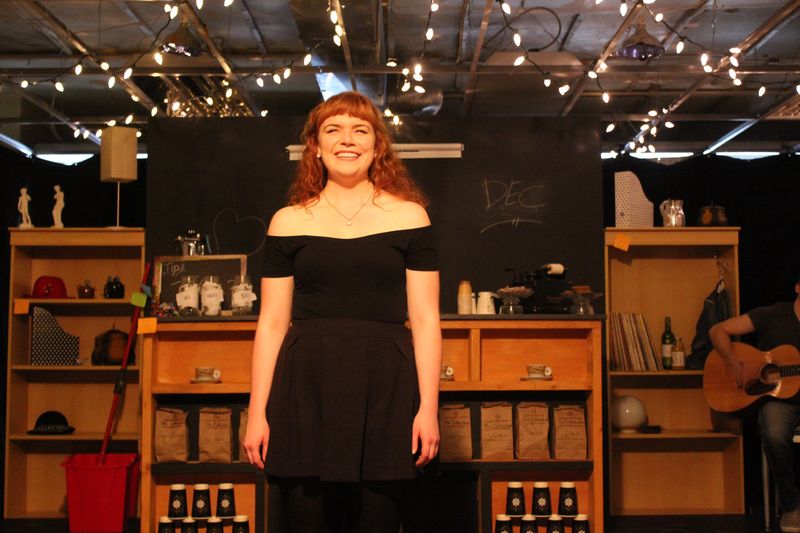
Confessions of a Redheaded Coffeeshop Girl: It’s a story that comes from the real life experiences myself and other twenty-something graduates had while working at various coffee shops in Toronto. I interviewed a myriad of graduates to see what their most hilarious, poignant or upsetting moments were while working behind the counter. And that is what this show is about, it examines the customer/employee relationship in the most hilarious of ways.
So come on down to the Toronto Fringe and meet Joanie Little, an “adorkable” anthropology graduate who decides to make the most out of her barista day job by ‘reporting’ about the humans of her coffee shop as though she were Jane Goodall herself, bushwhacking through the African jungle to observe the chimps. A tour-de-force that makes you laugh one minute and cry the next. Complete with live music, hurricanes, co-worker showdowns and a gorilla for a boss.
HS: Not only are you presenting at the Toronto Fringe, but you are doing a whole Fringe tour. Tell us a bit about where you’ve been, where you’re going and, being a Fringe vet, what’s the benefit to doing a fringe tour.
RP: RCSG has toured to six other fringes throughout Canada and the US: Winnipeg, Edmonton, Victoria, New York City, Stratford & London – this year was particularly exciting because we got a lot of love from CBC and Audience Choice in New York City!
We couldn’t be happier to finally perform it in our hometown! That was one of our initial goals! And what better place to perform it then in the Annex, one of Toronto’s fantastic indie coffee hubs! We are thrilled to be performing in The Annex Theatre, one of the two theatres at the Randolph Academy of Performing Arts – just behind the infamous fringe tent!
We really hope Toronto Fringe audiences like the show! It’s something our creative team is proud of. We have dramaturged the show with the wonderful Canadian playwright and author Ron Fromstein and are excited to see where the “updated” version of the show will take us. So far this summer we are touring to Saskatoon, Victoria, Seattle and New Orleans! And we have been offered a spot in a solo festival in New York City for summer 2015!
Confessions of a Redheaded Coffeeshop Girl playwright & performer: Rebecca Perry as Joanie Little. Photo Credit: Bryan Zilyuk
I’d say the benefits of doing a fringe tour are endless, you develop a Fringe touring family, lifelong friendships are forged and you start to develop a relationship with each city. You get to know the fringe staff, the media, the volunteers and what makes each city and fringe festival so special and original.
HS: What is the biggest thing you’ve learned so far touring your show to various fringe festivals?
RP: Always, always show your tech team some love. Holy cow do they have a crazy job!
HS: If you could give a new fringer or someone who is considering doing a fringe tour one piece of advice, what would it be?
RP: Be as organized as possible aka: plan in advance! The biggest thing is being ready before everyone else is. Get all your posters up and postcards out, be the person to flyer the first day of lines, know where every venue is and be a social butterfly.
HS: Why do you think festivals like the Toronto Fringe, and the Fringe festivals around Canada and the world, are so important?
RP: I’ve seen some of the most ground breaking, heart-wrenching and fascinating theatre at the Fringe. It’s no wonder some filmmakers and fringe performers are finally making a documentary about it (shout outs to Nancy Kenny, Natalie, Cory and the rest of the “On The Fringe” documentary crew!) I know Fringe gets a bad rap for having “weird” or “inaccessible theatre” but honestly that just sounds like pretentious theatre-goers trying to pigeonhole the fringe into a certain category. For every “bad” show there are 15 amazing ones. I’ve seen so many mediums of theatre excel at Fringe festivals. I think that is the only way certain forms of theatre can exist what with the declining audiences of theatre these days. For some reason the Fringe just gets everyone out!
HS: If you could entice someone in 5-10 words to come see your show, what would they be?
RP: Challenge accepted! I’ll make a little 10 word equation:
Hilarious (caffeinated) situations + indie music = my love letter to Toronto.
Short & Sweet Questions:
Favourite Coffee place in Toronto: Abbott of Parkdale
Go-to Fringe drink in the tents: CIDER!!!
What inspires you as an artist? When other artists around me are so brave. It inspires me to put my heart on the table like they do.
What’s your favourite thing about the Toronto theatre scene? That the indie scene is just as alive and kicking as the established groups.
What’s your artistic mantra?/Best advice you’ve ever gotten. “You won’t know until you try”
Written and Performed by Rebecca Perry as part of the 2014 Toronto Fringe Festival
Where – The Annex Theatre
When – July 3rd-13th, 2014
Thursday, July 3 – 7:00pm
Saturday, July 5 – 11:00pm
Monday, July 7 – 1:30pm
Wednesday, July 9 – 7:30pm
Friday, July 11 – 5:45pm
Saturday, July 12 – 12:30pm
Sunday, July 13 – 4:00pm
I had a chat with one of my favourite couples in Toronto Theatre, James Wallis and Julia Nish-Lapidus, to discuss their most recent project – The LaBute Cycle, going from Shakespeare (known most notably from Shakespeare BASH’d sold-out Toronto Fringe shows and their most recent production of Romeo and Juliet last fall) to LaBute, working professionally as a couple and their favourite places in Toronto. reasons to be pretty runs for one week only (April 8th-13th) with a special PWYC staged reading of Fat Pig on Sunday April 13th.
HS: Tell me a little about yourselves and about the show.
JNL: We are doingreasons to be pretty, by Neil LaBute and a staged reading of his other play, Fat Pig. Originally we were presenting full productions of both plays in rep, but unfortunately, one of the actors was badly injured earlier this week, and is no longer able to do the show. James Wallis, our director, has stepped in to play his role in reasons to be pretty, but we are not going to be presenting a full production of Fat Pig at this time. We will be doing a staged reading of Fat Pig on Sunday, April 13 at 2pm, with another amazing actor, Jesse Griffiths, stepping into the role of Tom.
JW: Both of these shows examine how we value female beauty. We’ve worked with a lot of the team doing The LaBute Cycle while working with my other company, Shakespeare BASH’d, doing classical work. The LaBute Cycle is a passion project for myself and all those involved.
JW: LaBute to me is a fantastic playwright, as he is very honest and focused with his characters’ worldviews. In reasons to be pretty, he tackles a very sensitive issue with the way we value beauty in the modern world. He doesn’t pull any punches and, in my opinion, writes with a great gusto about what he knows and doesn’t try to be politically correct. Also, I love his text; it’s extremely conversational and it’s a complete 180 from what I’m used to with Shakespeare’s work.
JNL: It’s a really interesting and sensitive subject matter to explore. And it’s fascinating to explore it so publicly. The issue of beauty and how we value it is pretty prominent in our world today and I think this play offers many different perspectives, and asks a lot of questions about the subject.
Original Cast: Milan Malistic (TL), Elisabeth Lagerlöf (TR) Julia Nish-Lapidus (BL), Steve Boleantu (BR)
HS: What have you found interesting about working on something so different together. You normally work on Shakespeare together, this is quite a change.
JW: It is! It’s been really great to get to explore these new characters, but bring a lot of the basics we use with our Shakespeare work into approaching these roles. I like the role of Kent for sure, he’s a malicious person, a person who is very selfish, but I think that he’s his own person and fights for what he thinks is his, regardless of who he hurts along the way. It’s not pretty but it’s honest. He’s verbose and nasty at times, which isn’t such a stretch for me but it is not where I live most of the time when it comes to acting. I’m excited for the challenge.
JNL: It’s really great to get to work with James on something contemporary for a change, and now I get to work with him as both a director and fellow actor! Being a married couple who works together so often (yes, James is my husband) is really great and it’s interesting to be exploring this sort of subject matter together. For me to be doing a big fight scene with Steve, who plays my boyfriend in the show, and have James be directing it is really cool, because he knows me so well and for material like this that sits in such a natural world, he can really help me bring a lot of myself to it, since he obviously knows me so well.
Power Couple: Julia Nish-Lapidus & James Wallis
HS:This is being performed in Unit 102 theatre. Tell me about working in the space.
JW: In my opinion, it’s one of the most amazing spaces in the city. It is a complete blank slate that I have seen transformed in so many ways. I really like the enthusiasm of the guys who run the place. They want to see great theatre come out of their space and I admire their tenacity for finding it.
JNL: It’s a really great space. There’s a lot of flexibility to use it however you want and the team of people who run it are awesome! It’s so important to have small, flexible spaces like that in the city.
HS: If you could entice people to come see the show in five to ten words, what would they be?
JW: We are who we are inside. The rest is unimportant.
JNL: Hilarious, heart breaking, and oozing with talent.
HS: What inspires you as artists?
JNL: James, my husband? Is that super cheesy? This is really a passion project for him, and he’s pushed me to take risks artistically that I don’t think I would have without that push from him.
JW: The people I am fortunate to be surrounded by. The constant creativity that they exude is without equal. Also, my wife, Julia, whom I am completely enthralled by, her grace under pressure, her faculties with producing a play and her wonderful intelligence when it comes to any work she does.
JW: He just said that because of what I said. He felt like he had to…
HS: Best advice you’ve ever gotten.
JW: It’s just a play.
JNL: Act better.
HS: What are your favourite places in the city?
JW: Victory Café, my home, the Dank and any used book store.
JNL: Home! And Bar + Karaoke (the best karaoke place to drink your face off and sing 90’s pop songs).
Where: Unit 102 Theatre (376 Dufferin Street) When: April 8th-13th *Special staged reading of LaBute’s Fat Pig will be presented at 2pm on Sunday April 13th Tickets: $17 – Available at www.labute-cycle.com and at the door. The staged reading of Fat Pig on April 13th is PWYC at the door
HS: We hear you wear many hats (Comedy, Radio, Playwright, Performer etc). Tell us a bit about yourself and what draws you to the playwright/performer medium with stories like Weaksauce andFatherly?
SM: So many silly hats.
I spend the largest portion of my creative time writing sketch comedy for CBC’s The Irrelevant Show. This is my first year as a full time writer on that show, and it’s been a really terrific experience. Also radio-wise, I’m a regular contributor to the CBC storytelling program Definitely Not the Opera, and I was fortunate enough to get a story on NPR’s The Moth Radio Hour recently, which was always a dream of mine.
So. I work in radio, I suppose, which is really exciting for my Grandmother. She tells me that radio used to be a thing.
In the summers, I tour my one-man comedy monologues on the Canadian Fringe circuit. This will be my 4th summer doing the Fringe, and I’m currently trying to decide whether or not I’ll be touring with a version of this current show. I might want to write something new, but then of course, I’d have to go through the agonizing process of premiering a brand new show all over again – which is not for the faint of heart.
So simply, I write sketch comedy and am a storyteller.
What draws me to storytelling? Hm.
I guess I love the simplicity of it. I like the idea of taking something completely stripped of all artifice and theatricality and mounting it in a theatrical space. Of watching something that doesn’t feel like theatre as if it were theatre. I like that I can be funny or poignant or dark or light all at the same time. It doesn’t have to be heavy handed. It doesn’t have to be hilarious. It just has to be true. Theatre is very much a pursuit of truth, so what makes me love going to see a storytelling show, is that it isn’t even a pursuit of truth. It can just be the truth. That will always be captivating to me.
Also. I wasn’t a great actor. And in storytelling, I don’t have to act.
HS: Can you speak about Fatherly and where you found the inspiration to write it.
SM: The main story around which I built the show has been my favourite “over beers” story to tell people for a few years now, and it was only a matter of time before I wrote it into a show. It’s a crazy story. Also, I’m a big fan of real-life characters, and the man who raised me is one of those real-life character with whom I knew that audiences would want to be acquainted.
HS: If you could give me 5 words to entice someone to come see Fatherly, what would they be?
SM: You must meet Bill Mullins
HS: What song should someone listen to before coming to see Fatherly?
SM: Yikes. Maybe “The Greatest” by Kenny Rogers. My mother recommended it to be my curtain call song, and thematically, it’s pretty perfect. Maybe too perfect.
HS: Where do you look to find inspiration?
SM: My heroes: Ira Glass, Marc Maron, Woody Allen, Judd Apatow, Mike Birbiglia and David Sedaris.
HS: What’s the best advice you have ever received?
SM: I used to work in this busy restaurant in Vancouver, and our staff mantra was “Keep doing things. Keep doing things.” The theory behind it is that there’s always something to do in a restaurant. Polish cutlery. Sweep. Clear some plates. But now I’ve kind of extended that mantra into my creative life. Theoretically, if I keep doing things, everything will run more efficiently in my career. It helps me kick myself in the ass.
“Aw shit. I’m watching hockey highlights again. I should be doing a “thing” instead.“
Also, I’m a fan of this Louis CK quote:
“Everything you do should be better than everything you’ve done before. That, to me, is a guiding principle.”
HS: What’s your favourite place in Toronto/in Canada and why?
SM: Favourite place in Toronto is the outdoor skating rink by Bathurst and Dundas. I love playing shinny, and with the city skyline as the backdrop, it’s just stunning.
My favourite place in Canada is the lake on which I grew up – Kalamalka in the Okanagan. Google it. You’ll never see a more beautiful place.
HS: What is you favourite beer in the Next Stage Festival beer tent?
SM: When I’m at a theatre festival, I’m all about the Apricot St Ambroise. I only drink it in the context of a theatre beer tent, so it tastes like I’m having the time of my life.
Fatherly
Written and performed by Sam S. Mullins Where: Factory Theatre Antechamber When:
Mon Jan 13 8.30pm
Wed Jan 15 8.15pm
Thu Jan 16 6.15pm
Fri Jan 17 6.15pm
Sat Jan 18 8.15pm
Sun Jan 19 6.45pm Tickets: $10 www.fringetoronto.com/next-stage-festival/












 inthegreenroom