Skip to content

Posts tagged ‘Bailey Green’

Tarragon Theatre’s Playwrights Unit: Playwright Profile – Evan Webber

by Bailey Green

I connected with Evan Webber to ask him a few questions about working with the current Tarragon Playwrights Unit. The upcoming Play Reading Week runs from Tuesday November 18th to Saturday November 29th in the Near Studio in the Tarragon Theatre. Each reading is at 8pm. Other Jesus, the play Webber workshopped in the Unit, will be read on Friday November 21st.

BG: Tell me a bit about yourself, where you’re from and where you live now.

EW: I’m from Ottawa, or at least I mostly grew up there. I came to Toronto when I was still young enough to do some growing up here too. But I was old enough that I only have one layer of association on things. No nostalgia.

BG: When did you start writing? Did it begin with plays or have you experimented with different forms?

EW: I always wrote things as a sort of game with myself, from when I was very young. I couldn’t read or write until I was pretty old so I listened to things and got my mom to help me write things down.

Later, writing plays became a way of expanding that game to include other people, so I started doing that when I was in high school. It gave some form to the socializing, helped me to understand the dynamics of people, so I guess I liked that. I always felt drawn more to other forms of writing, but I liked the way that reading and writing plays always implied or assumed some other collective action to come, one set in motion by the text. Most of the writing I’ve done in the last five or ten years has been with other people, collaborative writing of one kind or another.

BG: Tell me about the play you’ve written with the Unit this year.

EW: I’d had this very schematic idea to make a pageant play about the life of Jesus for non-performers, a kind of allegory about virtuosity for presumably non-virtuosic people. It’s about the life of a teacher in ancient Judea who starts performing miracles and how that changes him and his friends, and about how he takes on that identity as a miracle-performer. I guess it’s about leadership in cultural projects. 

14563

BG: What was the experience of working with the Playwrights Unit like?

EW: It’s nice to realize that everyone has a different idea about what makes something good. Like I don’t think anyone agrees. That’s really cool. That’s evident all the time.

BG: How has the Unit helped with the creation process of this play?

EW: I wanted to produce something out of the constraints of the theatre and the Playwrights Unit. There was no other good reason for me to be there or for me to take part. I don’t mean to say that you’re only supposed to do one thing in the Playwrights Unit, I just mean that there are a number of assumptions that a conventional theatre company like Tarragon holds, it’s in the walls and the floor, it affects everyone there. So I thought, maybe I can exaggerate these particular institutional assumptions into a kind of system and make something out of that. So the play is all about the Unit from that perspective. Every part of the play reflects the conditions of the Unit.

BG: What has been the most challenging aspect of this play? What themes does it deal with?

EW: Sticking with the approach. The play sketches some people who grapple with their fundamental interchangeability. So I didn’t want to write something I recognized as my own: I wanted the language of the play and its structure to come to terms with interchangeability too, to be just barely acceptable or competent. It was a challenge to stay committed to that, to not make it more clever or polished, to stick to my constraints, even when they seem to deflate the drama.

BG: What advice has helped you the most in your creative career?

EW: I don’t know. I had a dream once where I went to a Japanese restaurant with an artist I really respect and this artist told me, “Okay Evan, you’re an okay writer, you work hard and you’re thoughtful but you don’t have any vision for feelings, and without that your work is meaningless, you’re in the wrong business…”

But that was just a dream.


Some Favourites:

Playwright(s): Heiner Müller’s and Gertrude Stein’s plays always surprise me. Richard Maxwell

Author(s): Lately, I keep going back to Kathy Acker and Roberto Bolaño

Time to write: Whenever

Coffee shop: Oh, huh

Website or Blog: Facebook or maybe Bomb magazine


More information on the Tarragon Playwrights Unit and the playwrights involved can be found on their website


Past In the Greenroom Playwrights Profiles:

Playwright Alexandria Haber: https://inthegreenroom.ca/2014/09/16/tarragon-playwright-profile-alexandria-haber/

Dramaturg Andrea Romaldi: https://inthegreenroom.ca/2014/06/19/tarragon-theatres-playwright-unit-an-introduction-with-dramaturg-andrea-romaldi/


Follow our writer Bailey on Twitter: @_BaileyGreen

ARTIST PROFILE: The afteROCK Plays: In Conversation with Sébastien Heins and Catherine Hernandez of Brotherhood and Femme Playlist.

Interview by Bailey Green

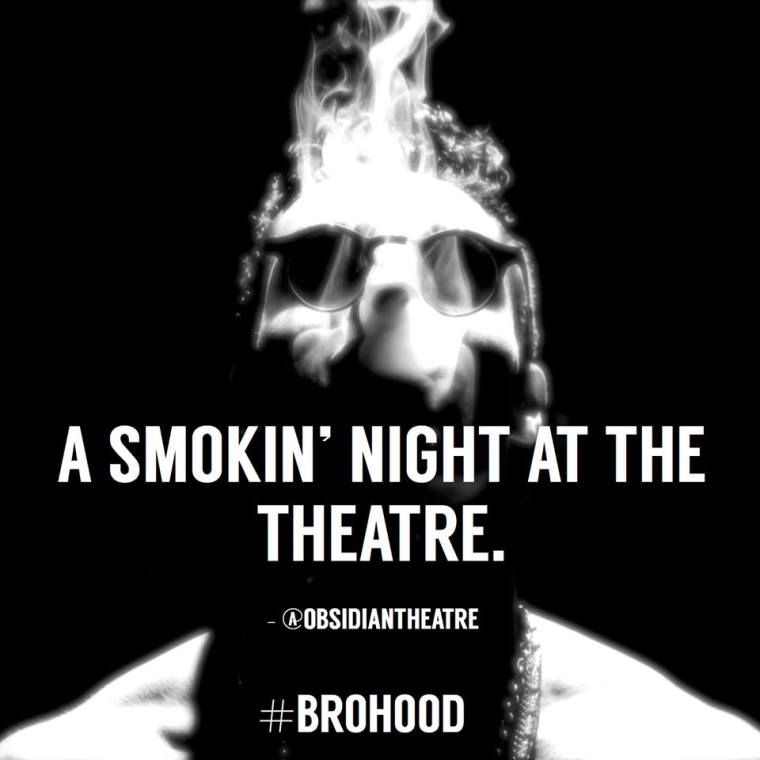
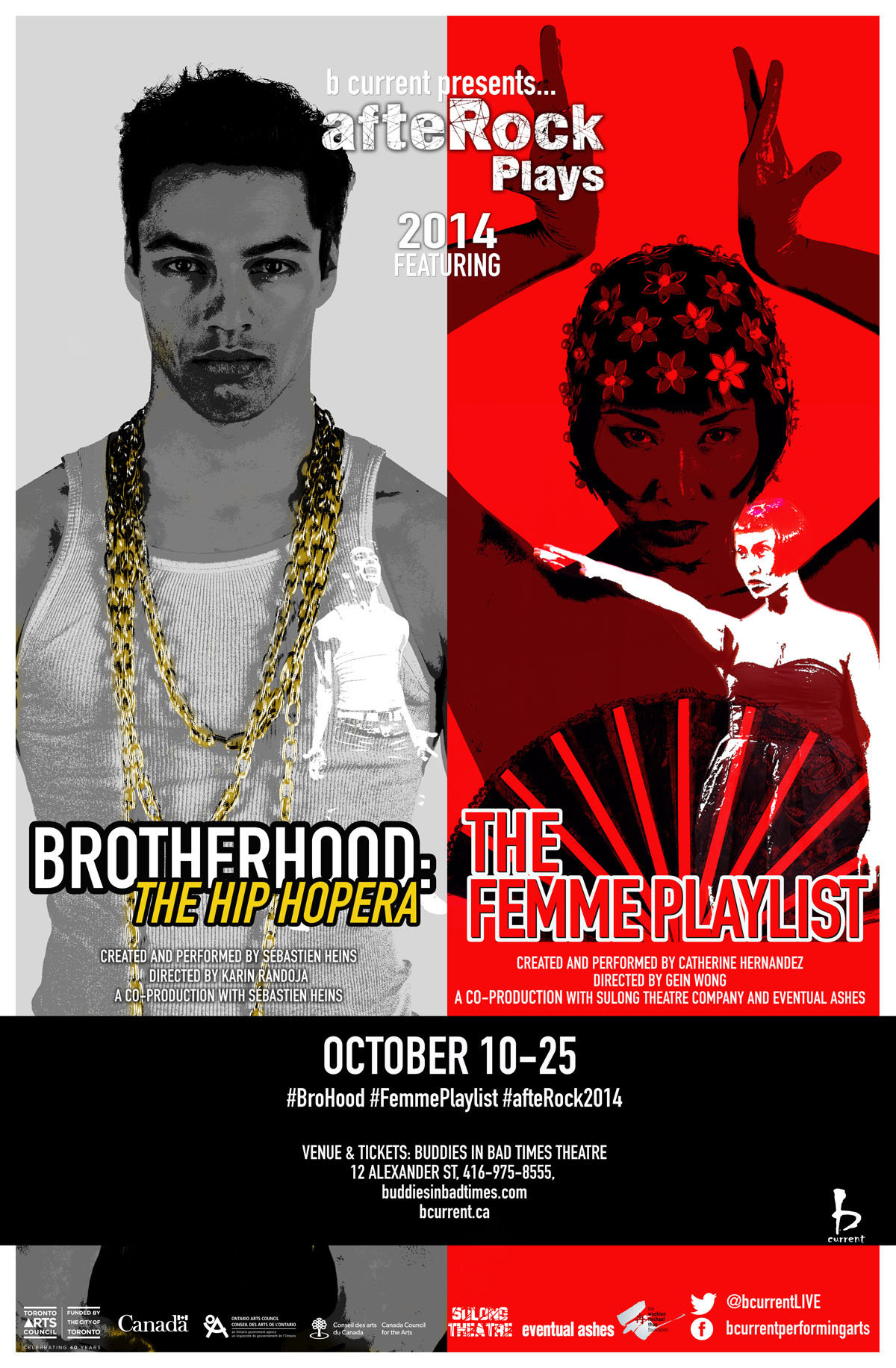
I interviewed Sébastien Heins and Catherine Hernandez about their solo shows, Brotherhood and Femme Playlist, playing at Buddies in Bad Times presented by b current as part of their afteROCK Plays series. They were both such a joy to interview. Their passion, gratitude and openness radiated as they spoke about their work. Catherine’s interjections with the children she cares for in her home daycare peppered our chat, “I’m feel like I’m the queer filipino version of Louis CK, children are very funny creatures and I approach my care of them with honour and humour.” And Sébastien had me laughing with his enthusiasm and bashfulness when discussing the title, and the creation, of his piece’s opening song, “Threesome with my bro.” #BroHood and #FemmePlaylist captivated me with each performance’s tremendous energy and detail. I had the pleasure of witnessing their creations and hope that many of you will too.

On the origins of the piece:

SÉBASTIEN: Brotherhood the hip hopera started as a fifteen minute solo show when I was a student at NTS. We were tasked with creating a show that was spurred on by a burning question. My burning question was “what if I had had a brother?” As an only child, this question held a lot of ammunition for me. So the piece is about these two brothers, Cash Money and Money Pussy. They have this crazy night where they rap at and with each other, sing r&b songs, and the night culminates into an epic climax where one of the brothers is killed in a car accident.

CATHERINE: The idea began when I did an interview for Ron Jones’ radio show in Harlem. He asked for was a playlist of your life. So I did that interview and it was a three hour long conversation. I was laughing and crying along to the soundtrack of my life. My friend Kim Katrin Milan began to host a retreat, often at my house, called Brave New Girls Retreats, for queer femmes of colour. We talk, meditate, do yoga and practice self-care. It was around then that I realized that my narrative was experienced by so many, but heard by none. Originally it [Femme Playlist] was a fifteen minute excerpt at Amplify Femme at VideoFag and then it snowballed from there to became a 45 minute piece that I did at a decolonizing conference and it went on from there.

483461_523027841048635_613575341_n

On the path to the afteROCK Plays series:

CATHERINE: In 2013 I called b current just before the rock.paper.sistahz festival. It was past the submission date, but I called anyway. I needed a night to perform the show in it’s entirety to test out the flow. I wanted to get a sense of the narrative and transitions. And b current said yes. It was a hit [with the audience] and there was a standing O. That was my first draft so [it was good to know] it connected. It moved on to Rhubarb, which is usually only shorter pieces, but Brendan Healy wanted it to stay intact and be full length. I was so, so honoured and I knew it [the piece] had legs (which is actually my burlesque name.) Then when I was selected for afteROCK, Gein Wong came on board as my director which was great. I feel very blessed.

SÉBASTIEN: [At National Theatre School] People liked it [Brotherhood], the dance and physicality, theatre and storytelling, they dug it. So I challenged myself to create a 60 minute version. I took Brotherhood to the largest solo festival in the world in NYC, United Solo, and I won Best Emerging Artist, but I knew I wasn’t done. Then b current gave me this opportunity to be in their afteROCK play series. They give me [and Catherine] everything a professional production would get. We built a light wall, like Kanye or Jay-z would have. My director Karin Randoja—one of the founders of Primus Theatre—she directed and dramaturged it into a new show. It’s more mature and braver than it was before, and I’m very proud of it.

On the experience for the audience: 

SÉBASTIEN: We have local up and coming hip hop acts opening the show, a couple nights we have ten year old breakdancers outside. It should feel like the fiction has already started, so it’s like you’re at a Cash Money/Money Pussy show when it starts. The piece deals with fame, facades, masculinity, the way men have to front and show themselves off which doesn’t always coincide with how they feel. There’s the bond of brothers and how it’s broken by the stress and the game. It is a hip hop opera, so you’ll recognize the medium as you watch it. There’s large emotions and big, arcing, epic story-line.

CATHERINE: Femme Playlist is a one woman show that tells the realities of being a queer woman of colour, a single mom and a femme. Queer theatre a lot of the time is grown in very subversive spaces, the tradition of the queer salon is in someone’s basement or small theatre hovel. So being in a much larger space with lighting and sound, it’s magic.

Photo Credit: Jacklyn Atlas

Photo Credit: Jacklyn Atlas

On being part of a team:

SÉBASTIEN: I have to shout out my sound designer Micky Rodriguez. He’s a beat maker and rapper, and he has been amazing. The music in the show before served a purpose but now the tracks are all bumped up, which is a game changer. We have this opening, I laugh every time I have to say it outside the show, but it’s called “Threesome with my Bro” which is like Cash Money and Money Pussy’s greatest single. I originally did the instrumental and I knew it was so not up to par, but Micky really put his energy into it and gave it a trap beat. We have another song where it’s raining and the droplets become a beat for the song, with like an usher “U got it Bad” feel, so the sound helps create the next moment in the story musically

CATHERINE: Gein Wong is so special with her vision when it comes to lighting and sound. I love having a team. The team is a chosen family. Our production manager Suzie Balogh was one of my students when I taught at Factory Theatre. She was a kid in highschool studying my play Singkil and now I look over and she’s at the board. It means a lot to see a story like this in the mainspace, that this story is being heard and that their [femme] lives are important.

On the challenges faced with this piece:

SÉBASTIEN: Not being the producer actually. This piece is my baby, so when you hire outside people you just have to trust them to do their job and not think about it. I took that freefall in letting go and it’s a huge step to go in and just be a performer. It can also be hard to re-vamp and re-envision a work, before it was more crowd pleasing. The second act starts in the 70s and 80s, and it’s still funny but it does get dark and scary. I never would have had such an intimate look at these characters had we not done that. They’re men who inspire and challenge me as characters in a way they have never done before. All I can do is bare myself and show my work and hope people get something out of it.

CATHERINE: I’m a brown woman which means that the traditions that I heed to are multidisciplinary, but to me that’s storytelling. It can be hard for people to understand that sometimes. People are getting there, but this piece will help people understand my jive. Written down it doesn’t always translate, you need to see it visually. I hope it helps bring about a greater understanding of multidisciplinary.

On the greatest joy experienced with this piece: 

SÉBASTIEN: [Through this process] there was many times in rehearsal where I felt I’m part of a team. And as a solo performer I think that’s rare. It can be really lonely, and it’s all on you. The audience is just staring at you. I feel so supposed by my team, they’re like my rock. Like 300 Spartans behind me.

CATHERINE: The day of opening night I found out on Twitter that Jennifer Laude, a trans Filipina, was found dead in a motel room. She was murdered by a U.S. marine. This news is tragic because it’s so widespread. I knew I needed to dedicate my performance to her for opening night, if there’s any femme I could give this to…and I felt her all day. Every queer that hugged me yesterday [opening night], we have a narrative of loss and judgement and danger and to know that I have the privilege to be the person on stage to speak on behalf of all of us. [When I’m onstage I have] queer in my ears, between my fingers, in my hair and all around me. What I love about being queer is we can laugh and cry about our triumphs and tragedies.

afteRock EFLYER

Brotherhood: The Hip Hopera

10712910_10202376879777096_18159579963476806_n

Created/Performed by Sébastien Heins

Directed by Karin Randoja

a co-production with Sébastien Heins

This live virtuosic hip hop show tells the story of superstar sibling duo CashMoney & MoneyPussy, chronicling their climb to success, breaking apart, and epic reunion.

#BroHood trailer: 

fb event: https://www.facebook.com/events/687971971283848/declines/

Tag photobooth selfies with @CashMoneyRaps on twitter & instagram

The Femme Playlist

IMG_8654

Created/Performed by Catherine Hernandez

Directed by Gein Wong

a co-production with Sulong Theatre Company and Eventual Ashes

From masturbation to motherhood, body shame to burlesque, Catherine Hernandez uncovers the realities of living as a queer woman of colour set to the music of her life.

#FemmePlaylist trailer: 

fb event: https://www.facebook.com/events/1458812434386125/

Mature sexual content and coarse language in both shows – recommended for ages 16 and older.

Showtimes:

Both shows play every day (except Monday, October 20) until Ocotber 25. Schedule below.

Additional performance of Brotherhood: The Hip Hopera on Wednesday, October 22nd at 1pm, $10 (purchase by phone or in person, available online soon).

Regular updates via social media

@bcurrentLIVE on twitter

#afteRock2014 #bcurrent

www.facebook.com/bcurrentperformingarts

Tickets & Venue:

Buddies in Bad Times Theatre, 12 Alexander Street | Toronto | M4Y 1B4

Box Office: 416-975-8555

http://buddiesinbadtimes.com/2014-15/afterock-plays/

$15-$50

Student/Senior/Arts Worker/Underemployed discounts available

Rush tickets ($15) available the day of, in person only at noon.

Pay-what-you-can to this Sunday’s performances

2-for-1 tickets for femmes to The Femme Playlist on Friday, October 17, and Tuesday-Thursday October 21-23.

Get 50% off second ticket to Brotherhood: The Hip Hopera when you bring your sibling.

afteRock-Schedule

What afteRock is:

A play series that takes select plays from past b current rock.paper.sistahz theatre+ Festivals to the next level as workshop and full productions co-produced by b current and the show’s artists.

This edition of the series is presented by b current as part of the Buddies in Bad Times Theatre’s 2014-2015 – both shows were hand-picked by Artistic Director Jajube Mandiela from the 12th rock.paper.sistahz Festival.

Tarragon Theatre’s Playwrights Unit: Playwright Profile – Alexandria Haber

by Bailey Green

I interviewed playwright, actor and fellow Montrealer, Alexandria Haber as part of our series of profiles on the members of the 2014 Playwrights Unit at Tarragon Theatre.

Too busy to write? Alexandria Haber might inspire you to re-think what’s possible. A mother of four, Haber writes in the chunks of time she can find throughout the day, “It can be difficult to take advantage of those moments, but it has made me the writer I am.” It was during her second pregnancy that Haber began writing plays as a creative outlet. Birthmarks, her first work, led to her acceptance into the unit at Playwrights Workshop Montreal. With several years of writing credits under her belt, a few highlights include multiple Fringe shows, productions throughout Canada and collaborations with companies like Imago Theatre, Edmonton Theatre, Centaur Theatre (to name a few) and plays included in the Wildside Festival (essentially Montreal’s Best of Fringe.)

When the email came from Andrea Romaldi saying that the Tarragon Playwrights Unit was interested in Haber’s work, she actually didn’t have a play at the ready. What she did have was the image of a couple who had hit a girl with their car while on their way to a party. The girl survives and the couples takes her to the ER, where things become very uncomfortable for multiple, and undisclosed, reasons. The first pieces of this idea had taken shape a few years ago, but were put aside to make way for another play. “I dug it up, spoke to Andrea and then barreled through a first draft in three months,” Haber recalls.

14563

Over the months that the Unit has been working together, On This Day has been workshopped several times in meetings with dramaturg Romaldi, with actors reading scenes and in hearing feedback from the other writers. Haber’s play deals with happiness—the ways we define it, the choices we make to obtain it and what happens when those choices come at the expense of other people’s happiness. On the process with the Unit, Haber says that to sit in a rehearsal room with other writers and work on scripts for several days every three months has been a great experience. She also mentions the importance of moving a piece past the workshop phase, “At times, in Canada, I think we over-develop. When a play is done, it’s done. Not everything is going to be perfect about every piece you write. Some things only show up in the rehearsal room or in production.”

Born in Hamilton, Haber moved to Montreal when she was 5. She had some experience with Toronto’s theatre scene before the Unit, but not as much as in her home city. “[The community in] Montreal is smaller, so you immediately have that comfort level. I didn’t know the Toronto community very well,” Haber says, “but we have really gelled as a group which has been so nice.” Navigating how to speak with each other as fellow artists is always part of the learning curve, especially given the variety of voice and subject matter with each individual play and writer.

“I’ve had a lot of people who believed in me and supported me and I feel very fortunate to have had that experience,” Haber says of the tight-knit English theatre community in Montreal. “There’s a lot of self-perpetuated work and people getting things off the ground. It’s a great city, and an affordable city, which has helped me a lot as a theatre artist.” Haber’s husband, an actor and director, is one of her greatest supports and the first person to read every draft she writes. With an objective eye and her best interests at heart, he explores with her to discover what works and what doesn’t. Their fellow actor friends also deserve due credit for coming over to their house on Saturday night to share a bottle of wine and read scripts. Haber stresses the importance of hearing your script read out loud by people outside the immediate process.

Her advice to anyone struggling with their own writing? “It’s advice everyone has heard, but if you want to write, you just have to write.”

Some Favourites:

Playwrights: Caryl Churchill, Judith Thompson, Tennessee Williams, Craig Wright.

Authors: A.S. Byatt, Donna Tartt (The Goldfinch), Sebastian Faulks (Birdsong.)

Time to write: Mornings, and whenever she gets the chance.

Coffee Shop: Shäika Café.

Website or Blog: Not a huge website or blog person, but she currently enjoys Renegade Mothering

What she can’t live without (besides the obvious, e.g. her family, oxygen): My morning coffee. It’s gets me out of bed and I look forward to it the second I’m opening my eyes. And my yoga.

Be sure to check back over the next few months to follow our Tarragon Playwrights Unit Feature as we meet with each of the playwrights, culminating in their Play Reading Week in November 2014.

Follow our writer Bailey on Twitter: @_BaileyGreen

2014 Fringe Interview – Here After – Upstart Theatre

by Bailey Green

Meg Moran and I met up in the Fringe cafe where we bonded over our mutual love for the sci fi genre and chatted about her show Here After as part of the Toronto Fringe.

Here After is set 150 years in the future and humanity is in a dire state. We’ve become immortal. The immortality drug is discovered close to our present day in 2014 and, as you can imagine, it didn’t take long for things to rapidly fall apart. “The problem is that even if your body can live forever, your mind just can’t keep up,” says director and writer Meg Moran. Four people are trapped in an underground bunker, having retreated there shortly after civilization began to rip at the seams, where they are forced to keep their minds constantly stimulated. Otherwise, they’ll slip into a “coma-like state” and go blank.

“If everyone is immortal, overpopulation immediately becomes an issue, resource depletion accelerates, pollution increases and then you can’t breathe,” Moran sketches the timeline for the setting of the play. The four people have been trapped in the bunker together for over a hundred years, creating a pseudo-family. Very recently to the beginning of the play one of the character’s lovers goes brain dead. Here After examines issues relevant to society today through a unique lens, “this is a story of what could be the fallout of something that happens two weeks from now. The characters are people of this time dealing with the long term consequences of problems we are currently facing as a society,” Moran says. “We look at responsibility, loss, hope and the struggle to survive. Why do we keep going under extremely difficult circumstances?”


“What we’re looking at in some ways is the shift from the Jetsons future, to the more Hunger Games future,” Moran explains, “As we become more technologically advanced, we’re starting to realize that being constantly connected can have a sinister element to it.” The idea for the play first came to Moran on a plane where she imagined four characters playing games. The play itself is written by Moran and the process has been very collaborative. “I had a clear vision of the events and the world, but we did workshop it. If they need to play games to survive, we had to figure out what that looks like. It has been a growing changing thing for a long time,” says Moran of the process. She speaks very highly of her actors, of their inspiration, sense of play and willingness to give feedback.

Moran says her greatest challenge has been “finding the point where the script is done and the directing starts.” She feels this process has taught her how to better identify that point, and how to hand it off to someone else, in this case the actors. “You have to allow room for the happy accidents,” Moran smiles.

Upstart is a relatively new company founded by Meara Tubman-Broeren and Meg Moran, who met during their undergrad at York University. The company began with their site specific adaptation of Chekhov’s Three Sisters. They’re still exploring what having a company means and what theatre they want to bring to the stage. For Moran, she’s passionate about experimenting with form, movement oriented pieces and re-telling of classic stories. “I will see anything,” she says, “You have to see things you don’t know about or understand. Otherwise you won’t grow as an artist.”

Here After

Photo Credit: Madeline Haney

Photo Credit: Madeline Haney

by Meg Moran, presented by Upstart Theatre as part of the Toronto Fringe Festival

Where: Theatre Passe Muraille Backspace, 16 Ryerson Ave.

Directed by Meg Moran

Featuring Owen Fawcett, Elizabeth Tanner, Chiamaka Ugwu, and Enzo Voci

Produced by Meara Tubman-Broeren

When: 

Thursday July 3rd, 2014 at 7:45 p.m.
Saturday July 5th, 2014 at 3:15 p.m.
Sunday July 6th, 2014 at 4:30 p.m.
Monday July 7th, 2014 at 2:15 p.m.
Wednesday July 9th, 2014 at 10:00 p.m.
Thursday July 10th, 2014 at 4:30 p.m.
Friday July 11th, 2014 at 8:45 p.m.
Sunday July 13th, 2014 at 2:15 p.m.

Tickets: $10 at the door/$12 in advance. Tickets can be purchased online at www.fringetoronto.com, by phone at 416-966-1062, or at the door.

For more information, go to http://hereafterfringe.wordpress.com/

Twitter: @Upstart_Twitter

2014 Fringe Preview – Andy Warhol Presents: Valerie – Fail Better Theatre

by Bailey Green

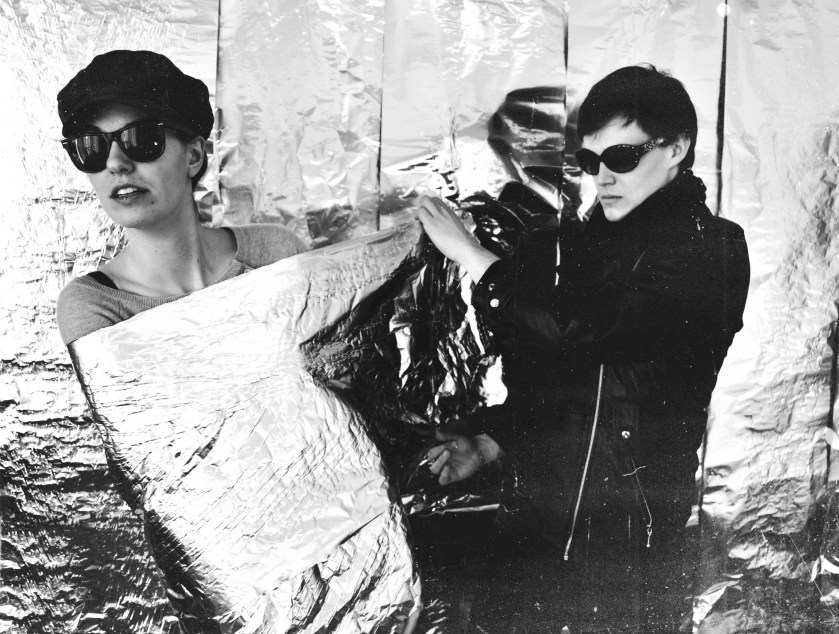
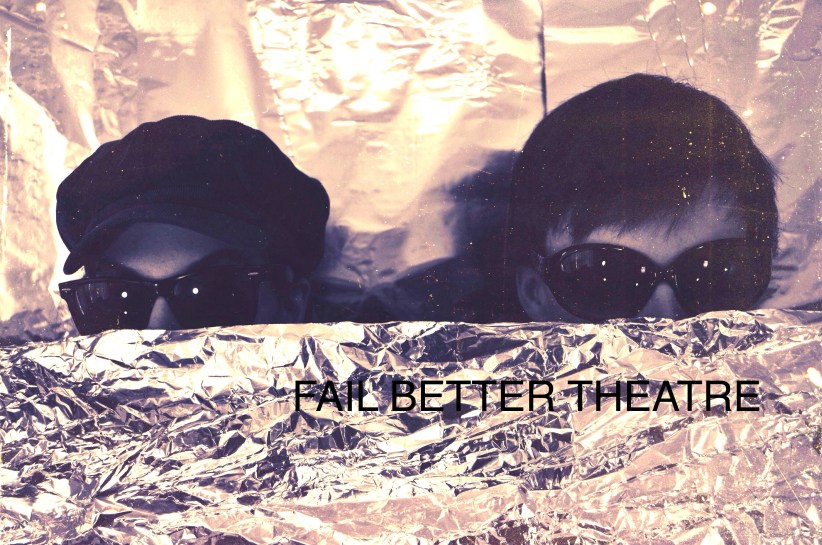
Intelligent, witty, political, sharp, funny and exciting—a few words I would use to describe this show after sitting in on a rehearsal with the cast of Andy Warhol Presents: Valerie by Fail Better Theatre. The name of their company comes from a Samuel Beckett quote that is one of my personal favourites, “Ever tried. Ever failed. No matter. Try Again. Fail again. Fail Better.” Director Matt White and actors (and the company’s co-artistic directors) Ben Hayward and Ali Richardson talked to me about their process.

Ask a person on the street if they know of Andy Warhol, and they probably will. But what about Valerie Solanas? Chances are slim. History forgot the woman who shot Andy Warhol, but Fail Better Theatre is bringing her story to light in a powerful new piece of theatre premiering at the Toronto Fringe Festival. This immersive, site specific piece takes place at the Influx Creative Space, an art studio, where Andy Warhol and his assistant Gerard are holding a party for Val—and you’re invited.

“We didn’t initially know this piece would be about Valerie,” says actor and writer Ben Hayward, “We thought it would be about their relationship or the shooting, but the more we read we realized there’s tons of stuff about Andy Warhol but nothing about Valerie. She’s always just a footnote in Warhol’s biography.” The collaborators chose to focus on Valerie because of her dynamic and active voice. Through the process they discovered Warhol to be a much more passive and less dramatic character who often allows things to happen around him instead of provoking the action. “Rather than giving him an exorbitant amount of text, we make him a presence by omitting text,” director Matt White describes. “But he’s still there, this is his world that everyone is playing in.”

Processed with Rookie

The idea of creating “a better play” comes from the collective process of Hayward, Richardson and White. “There can’t be an ego,” Matt White says and then chuckles, “because if there was Ben would have shot me about ten days ago.” This project has been in the works for eight months and has underwent multiple radical changes. It began with Richardson and Hayward writing together, but eventually progressed to Hayward taking over the bulk of the writing—though Richardson still contributes to the script. “It’s a delicate balance have the playwrights in the room with you,” says White. “From the top you just have to instill a non-fragile environment. At the core, we have to trust that everyone is good. So you’re good, but you can always be better.” Hayward agrees, “it’s actually nice to have it change so much. I go home and work on the script and it’s awesome. Meanwhile Ali goes home and memorizes a thousand lines and then has to forget eight hundred the next day.” The three collaborators jokingly refer any and all major cuts or changes as ‘building a better play.’ “In a different play, this scene or that scene would have been really cool,” Hayward smiles.

Richardson and Hayward got lucky when a new biography about Valerie Solanas came out this past spring. “At Christmas I looked online and the biography came up for pre-order, so I emailed Professor Breanna Fahs at the Arizona State University and asked for an advance copy,” Richardson says. “That wasn’t possible but what she [the professor] did do was verify our sources.” They had found an online PDF copy of Valerie Solanas’ play Up Your Ass, but according all sources only one copy of the play exists in a museum in Pittsburgh. “It’s in the Andy Warhol museum, in a drawer in a vault because no one knows who she [Valerie] is or cares. The ultimate irony is that Andy in fact finally did steal her work, in way,” Ben says. The PDF turned out to be Valerie’s play and became one of the many sources integrated into the text of Andy Warhol Presents. To name a few of their sources: Up Your Ass, the film “I shot Andy Warhol,” Valerie Solanas’ SCUM Manifesto, Valerie’s biography, multiple Andy Warhol books and a four hour PBS documentary about Warhol. Needless to say, they know the history of these two people inside and out.

The SCUM manifesto itself is widely available, and it began as the bulk of Valerie’s text. “We kept tweaking and tweaking the text to be more experientiel and to give it a storytelling quality,” Hayward says of the writing process. The company includes original music in the piece, with lyrics inspired by Valerie’s manifesto and the production added a chorus of five other actors a few weeks ago. “Matt suggested more people would help make the piece more interactive,” Hayward says—which is key for a show that requires a level of audience participation and engagement. “Ben and Ali wanted to include these adapted scenes from [Valerie’s play] Up Your Ass. But we had no one to play them. So we brought in a chorus to help animate the piece,” says White. The scenes were written with Valerie’s politics in mind, but are not actual extractions from Up Your Ass. However much of Warhol’s text in the play is actual quotes and adaptations of quotes, and the same goes for Valerie’s text.

The company is excited for their first production, and look forward to the new challenges that will come with an interactive audience. “If there is a call to action in the play, it is avoiding the temptation to be passive,” Richardson says. “The form of the piece speaks to that. There is no getting away from what’s happening in the room.”

Andy Warhol Presents: Valerie

by Fail Better Theatre presented as part of the 2014 Toronto Fringe Festival

Processed with Rookie

Directed by Matt White

Written and Performed by Ben Hayward and Ali Richardson

With Ray Jacildo, Emily Johnston, April Leung, Nick Potter, Natasha Ramondino & Jon Walls

When: July 3rd – 13th. 8pm nightly + 2pm July 10th

Where: InfluxCreative Space (141 Spadina at Richmond)

Ticketshttp://fringetix.ca/