Skip to content

Posts tagged ‘Bailey Green’

2014 Fringe Preview – Valkyrie – Rarely Pure Theatre

by Bailey Green

Sex, violence and theatre create a wicked combination. Rarely Pure Theatre presents Valkyrie, a new work by Thomas McKechnie that promises to “walk a fine line between agony and ecstasy” (says stage manager and RPT member Christina Bryson). In Norse mythology, Valkyries were immortal female warriors that chose who lived and died on the battlefield. These Valkyries are on a different mission, in a different time and sans immortality. Bradley and Erin (played by Monique Renaud and Tara Koehler) have both undergone very scarring experiences with men. They take it upon themselves to begin a Valkyrie quest to deliver justice to other men who have caused trauma to women. But this night is different. They bring a victim back to their lair. To find out what happens after that, you’ll have to see the show.

Artistic director (and the third member of the Valkyrie cast) Spencer Robson explains more about what is at the core of the piece, “it deals with spousal abuse and with sexism in multiple ways. The most interesting part about this piece, for me, is that the characters are far from heroic. You want to be able to root for them but, though every character might be justified in their actions, they are still bad people. It will be jarring for the audience. There’s justice but it isn’t what you want or expect.”

Valkyrie was born back in February of this year when the members of Rarely Pure (Spencer, Monique and Christina) met with Soulpepper Academy playwright Thomas McKechnie. “We really wanted to do an original piece at Fringe this year. Thomas saw our production of As You Like It and we had a meeting after. We asked if he would be interested in writing for us and he was,” Spencer says. “After that we bounced some ideas off him. He asked us what sort of play we would be interested in, what the traits of the actors were. Eight days later he had the first draft.” What followed were months of workshops and readings. The show’s veteran director Bruce Gooch is also a playwright, so his professional eye helped search the script for adjustments. “Bruce, and Tara who is also a playwright, aren’t afraid to stop and ask questions about the script, which is very new for me. I’m used to working with a more “finished” product,” says Spencer.

Planning has been key to finding balance in this process, especially for Robson as he juggles the roles of co-producer, artistic director and actor. “It sounds like a nightmare every time I say it out loud,” Spencer laughs, “but working with my friends who I trust and respect has really made this show possible.” He also says that taking on different roles on the production side has helped him as a working actor in the industry. “Now when I’m working for someone else, whether a theatre company or on a film set, I understand how difficult the production side is. So now I know that while I may not always understand what is going on or why a decision is made, I know that it isn’t my job to. They [the producers] spent time mulling over that decision, I just wasn’t part of their process.” Spencer continues, “I can better understand where people are coming from. It’s helped me lower my stress levels and just be immediately more comfortable.”

Rarely Pure Theatre was founded in the winter of 2012/2013 with its inaugural production “Until Our Paths Cross Again,” which was written, produced and directed by Monique Renaud. “The fact that Mo did that all on her own just really made me want to jump on board,” Spencer says of the company’s beginnings. Robson, Monique Renaud and Christina Bryson formed the company. The name comes from an Oscar Wilde quote, “The truth is rarely pure and never simple.” Now almost two years later, the company has several productions under their belt including, The Pillowman and As You Like It. As a new company their mandate isn’t yet set in stone. They are still open to experimenting as the company collaborates with new artists, like National Theatre School graduate Tara Koehler. The company is passionate about theatre and exploring work that excites them as artists. Spencer says that the commitment to each project comes naturally, “we get to choose what we want to do, the people we want to work with, the plays and themes we want to work on.” The company has sights for the future as well, determining what show, or show(s), they want to do in the fall. Another priority is the re-definition of roles within the company and investing in a better website.

But for now they’re immersed in Valkyrie, facing the powerful and dark piece head-on as opening night approaches.

Valkyrie

by Thomas McKechnie, presented by Rarely Pure Theatre as part of the 2014 Toronto Fringe Festival

10367152_767231409994313_5162183784216093173_n


Where: Tarragon Extra Space (30 Bridgeman Ave, Toronto)

When: July 2-13th, 2014

July 2nd: 10:30pm

July 5th: 8:45pm

July 8th: 7pm

July 9th: 5:15pm

July 10th: 12:00pm

July 12th: 3:30pm

July 13th: 12:00pm

Tickets: $10 at the door, OR you can order online: www.fringetoronto.com as part of the Toronto Fringe Festival


2014 Fringe Preview – 52 PICK-UP with The Howland Company

Interview by Bailey Green

I interviewed Paolo Santalucia, James Graham and Ruth Goodwin about The Howland Company’s inaugural show for the Toronto Fringe, 52 PICK-UP written by TJ Dawe and Rita Bozi. The show tells the story of a relationship, from coming together to falling apart. The Howland Company chose to have a rotating cast of four different couples (two male/female couples, one male/male and one female/female) who each perform two shows over the run.

Bailey: Tell me about the show in simplest terms, what is it about? What’s unique about it?

James: Well it’s about the whole duration of a relationship from beginning to end. The story is told in 52 scenes, some are three pages and some are ten seconds long. Each scene is written on a playing card. At the beginning of every show the actors throw the cards up into the air and then they play out the show in the order that they pick up the cards. If it was a standard production of this show, with two actors for the whole run, each show would still be unique because scenes would be highlighted in a different way with each different order. But The Howland Company is doing something a little different with this piece.

Courtney Ch'ng Lancaster & Ruth Goodwin

52 PICK-UP: Courtney Ch’ng Lancaster & Ruth Goodwin

Ruth: 52 PICK-UP is about falling in and out of love. The structure of it is unique (being in a different order every night) but the play stands out because of how relatable it is. Each scene is written like a conversation that any of us could have had with a significant other. TJ Dawe and Rita Bozi have really touched on the universal moments (good and bad) that many couples face. And for that reason, its random order makes so much sense. It’s almost like playing back your memories of a relationship. They come to you in moments or flashes – sometimes when you least expect them to and that’s kind of how 52 PICK-UP works.

Paolo: For co-director Courtney [Ch’ng Lancaster] and I, part of what we wanted to do with this piece is heighten the super-changeable aspect of each relationship. Each night would already be so different and so we thought why not push that further in a theatrical way? Each relationship in and of itself is different, so we thought let’s embrace that and cast multiple groups of people to highlight some different kinds of relationships. The scenes range from the first meeting to the first fight to the first time sleeping together. So what does that mean when it’s two men who just slept together for the first time, what does it mean when you’re actually watching a couple in real life act out a version of their relationship onstage together and what do these scenes mean for two women? It takes the play out of a context of “this is how men and women are in relationships.” It removes that aspect from the production and doesn’t allow the audience to make universal assumptions of how men and women behave. The play itself doesn’t actually go there, it remains open-ended while highlighting the reasons why people come together and fall apart. TJ and Rita, the playwrights of 52 PICK-UP, actually said that no one has done this to the play before and they were excited about that exploration.

Bailey: What has the experience of the rehearsal been like?

James: Well I just get to parachute in and have a blast every week or so and just try to keep my head above water. I think Paolo can speak more to that.

Paolo: It’s been really exciting and very scary for lots of reasons. Each person brings to the table their own set of experiences and absolute truths about relationships. Everyone in the company has a relationship to relationships. [For example] some people are talking about financing a home for the first time, or people are in the midst of moving in together or people are coming out of a relationship or beginning a new one. There’s a variety of experiences that people can speak to with this play.

Ruth: The process has been scary. Scary. And also… scary! There’s a lot to cover…and no order. It’s also been a lot of self-reflection on relationships in general. It’s kind of hard not to put yourself in your character’s shoes. We jump around in the story so much. Some scenes are so short that you really have to define what each moment means to you. Luckily we have really supportive directors who are patient with us.

Ruth Goodwin & Alex Crowther

52 PICK-UP: Ruth Goodwin & Alex Crowther

James: One of the great things about this project is that the actors can all jump into these scenes and this world very easily. We can identify very clearly with this subject matter. On some level that is one of the reasons the Howland Company was formed, for a group of young actors to find plays and projects that spoke to experiences that as artists in our mid-to-late twenties we can step in and offer something (without always having to tear our hair out.)

Paolo: Yet at the same time it is incredibly challenging. The only thing Courtney and I can attribute it to is studying for an exam. On the day you know there’s a task you’re going to have to complete and the variables on that task are going to be something you can prep for. You’re going to know what the questions might be about just as you’re going to know what the scenes are. But the way they’re presented to you and what your emotional response will be in the moment? There’s no way to prep for that. All we can do is help the actors and in turn help ourselves.

Some scenes have one line in them and they’re only spoken by one character. But that doesn’t mean the inner life for the other character is any less intense. For example there’s one scene where the woman calls the man, he picks up the phone and she hangs up. With each couple we’ve explored what that scene means at different moments in the show. We spent a lot of time on text work. Each couple created a timeline for themselves so they had a linear progression of this play for themselves. Each group is different, some scenes that people have at the beginning of the relationships others have at the end. What James and I have as our storyline, and what it’s based on for two men, is completely different than what for example Ruth and Alex are finding as a man and a woman coming together. A man and a woman have had many relationships of this kind and this is just one along the way that really sticks out for them whereas for us [James and I], and with Courtney and Kristen, we’re exploring that it’s the first time for one of the lovers that they have been in a same sex partnership. The text lends itself to that. Rehearsal has been really like four different plays.

James: It makes the run an experience. One of the things we discussed is how are people going to review this play, because of the way that it is structured? It didn’t bother us because one of the challenges is that we’re offering a whole experience, as opposed to each individual show or couple being self-contained. The experience of the whole seven shows is the experience of 52 PICK-UP. Whether you see one, two or all four couples if you’re a Fringe all-star, you will get your own experience of the show. That’s where our focus is and we hope, for those that do come more than once, to hear about their experiences!

1972477_486955604739103_9098784248676815771_n

Full cast of 52 PICK-UP featured in their YouTube campaign. Click here to watch.

Bailey: Tell me about The Howland Company, how you came together and for what purpose?

Ruth: James and I met in high school doing awkward tween theatre. When we both moved back to the city after school we decided to start something that we both wanted to be a part of. That’s how The Howland Company’s Reading Group got started. Then James brought Paolo in—who he met doing slightly more sophisticated tween theatre—and we each approached actors in the city that we wanted to work with to invite them to join us.

James: We began to recruit people and each of us went off and looked for people of a similar mind, people who wanted a chance to work, work together, a chance to make theatre about our generation, which spoke to us more, and hopefully contribute to a new generation of Canadian stories. And what does that mean? Not that we’ve figured it out, by any means, but to join the conversation. Most of all we wanted people who were willing to be patient. We wanted to create something with long-term aspirations. The idea was that we would take our time to build an ensemble and establish a relationship with the community. We wanted to start a dialogue between the next generation of theatre companies and hosting the play reading series every two weeks was part of that. We had no idea what we were going to do for our first show and then this show just fell into our laps. That patience has really paid off.

Paolo: How do we as a group of young actors take these artistic tools and keep working without always saying what’s the next production? What’s the next thing? It’s not about the production, it’s about how do you contribute to the community and use your artistic voice to further the conversation. 52 PICK-UP is absolutely about hopes and fears for the future.

James: What happens from here remains to be seen. On the simplest level, we’re a group of young actors who wanted to make work together, to find a community where we could practice our craft, take risks and contribute our voice.

52 PICK-UP

Presented by The Howland Company as part of The Toronto Fringe

IMG_4490

52 PICK-UP: Cameron Laurie & Hallie Seline

Directed by Courtney Ch’ng Lancaster & Paolo Santalucia

Where? Tarragon Extra Space

When? July 3rd-13th, 2014

Tickets: Can be purchased via http://fringetix.ca/ or by calling 416-966-1062


Follow The Howland Company:

Twitter:
#52PickUpHC @TheHowlandCo
Facebook:TheHowlandCompanyTheatre
Website: http://howlandcompanytheatre.com/
Youtube: The Howland Company


Follow In the Greenroom writer Bailey Green:

@_BaileyGreen


2014 Fringe Preview – Love’s Labour’s Lost – Shakespeare BASH’d

Interview by Bailey Green

As I entered the rehearsal hall for Love’s Labour’s Lost (presented by Shakespeare BASH’d) I was struck by the amount of people in the room. With no role double cast, the cast of 16 generated such an exuberant atmosphere that I couldn’t believe they had just finished a run. Their attitude as an ensemble reflected the youthful energy of the play.

In Love’s Labour’s Lost, the King of Navarre and his three men swear an oath to remain celibate so that they can focus on academic pursuits. Unfortunately the day after the men swear this oath, the Princess of France and her three ladies—a group of fierce, grounded, intelligent women—arrive on a political mission. Passion, poetry and chaos ensue. I sat down with the four—that’s right, four—pairs of lovers to chat about their character’s relationships, their own quirks and the upcoming Fringe production.

Love's Labour's Lost - Hallie Seline & Jesse Nerenburg - Photo Credit: Jesse Griffiths & Kyle Purcell

Love’s Labour’s Lost – Hallie Seline & Jesse Nerenberg – Photo Credit: Jesse Griffiths & Kyle Purcell

Princess of France (Hallie Seline) and the King of Navarre (Jesse Nerenberg)

Hallie’s Pet Peeve: Slow walkers.
Jesse’s Fave Rehearsal Snack: The vietnamese steamed buns from Banh Mi Boyz
Post-Show Drink of Choice: “Wine wine wine” (Hallie), Hawaiian Pale Ale (Jesse).
Describe your characters’ relationship:
Hallie: We’re both people in power. We like to outwit each other, top each other. We don’t want to admit that we’re into each other but we are. We totally are.
Jesse: We’re both the leaders of our kingdoms so that definitely plays a part. But why I’m attracted to her is because she’s not afraid to push back. I don’t see her for many pages after the first meeting, but when I do, I am really in love with her. I’ve written all of these poems about her. Once you’re in, you’re in.

Love's Labour's Lost - Suzette McCanny and Jeff Hanson - Photo Credit: Jesse Griffiths & Kyle Purcell

Love’s Labour’s Lost – Suzette McCanny and Jeff Hanson – Photo Credit: Jesse Griffiths & Kyle Purcell

Rosaline (Suzette McCanny) and Berowne (Jeff Hanson)

Suzette’s Pet Peeve: Bus windshield wipers.
Jeff’s Favourite Rehearsal Snack: Chocolate chip cookies.
Post show drink of choice: Apricot beer (Suzette), “Any drink anyone will buy for me” (Jeff)
Describe your character’s relationship:
Suzette: They have such a love/hate relationship, as in they love to get the best of one another. Rosaline would like to pretend she doesn’t love him or that she’s better than that. But she’s very intrigued by his wit. She thinks he’s smart and he can hold his own next to her. She also sees his cons and can be open about that. She can be herself with him.
Jeff: They had met before at the same party [as Longaville and Maria] and for Berowne he doubts the oath the men all swear to right from the beginning. He doesn’t really think it is going to work. Berowne’s always had control over his emotions and has never fallen madly in love. When they first meet, what Rosaline says to him, how she uses her wit and beats him at his own game, it really intrigues him. He doesn’t really get it, being in love, he’s taken aback. He almost goes through the seven stages of grief, but more like the seven stages of love. He doesn’t understand why but he does truly love her.

Love's Labour's Lost - Catherine Rainville & Joshua Browne - Photo Credit: Jesse Griffiths & Kyle Purcell

Love’s Labour’s Lost – Catherine Rainville & Joshua Browne – Photo Credit: Jesse Griffiths & Kyle Purcell

Katherine (Catherine Rainville) and Dumaine (Joshua Browne)

Catherine’s Pet Peeve: People chatting in the background while she’s rehearsing a scene
Josh’s Rehearsal Snack: Cigarettes. If he could eat ’em, he would.
Post show drink of choice: A glass of Scotch (both).
Describe your character’s relationship:
Catherine: It’s so instantaneous for everyone, but Dumaine and Katherine have moments of looking at each other and trying to figure each other out. It’s really playful. I get to be aggressive which is fun. We all tease the boys, which for Katherine is her way of playing hard to get. But she’s so obvious when she’s around him.
Joshua: We don’t have a lot of text together, or any really. But we have built this aspect of Katherine being the aggressor. I catch her checking me out at the beginning and I’m a bit more timid. I’m sort of shocked she likes me. Similarly [to the Princess and the King] we have many pages where we don’t see each other at all yet I’m madly in love and have written horrible poetry about her. She’s also pretty sassy. I like that.

10403653_847988535228940_2276093921829860528_n-1

Love’s Labour’s Lost – Andrew Gaboury & Sheelagh Darling – Photo Credit: Jesse Griffiths & Kyle Purcell

Maria (Sheelagh Darling) and Longaville (Andrew Gaboury)

Sheelagh’s Pet Peeve: People who stand really close to you for no reason. Also, toe shoes.
Andrew’s Favourite Rehearsal Snack: Nuts, specifically almonds.
Post show drink of choice: Oatmeal Stout (Andrew), St. Ambroise Apricot Beer (Sheelagh)
Describe your character’s relationship:
Sheelagh: We really like each other right from the beginning. There’s no qualms, we know we’re going to get together. I play along with the Princess but whenever Longaville’s around I’m just making googly eyes and waving. Even when the rest of the girls are berating and chiding the boys, I’m just still waving at Longaville.
Andrew: We kind of met before, it seems we were at the same party. I’m the most serious in terms of the oath the men swear [to stay away from women]. And then I see Maria and I throw it all away. It’s funny watching how I try to logically get around the oath in my poetry.

This slideshow requires JavaScript.

Bailey: What makes this production stand out? What will an audience member experience coming to see your show at the Fringe?

Jesse (King): Love’s Labour’s Lost is a very youthful play, it’s one of Shakespeare’s earlier work and it has a rhyming structure which is really unique. The women hold their own. And it’s not a play that is done very often. People are going to be coming out to see a show where they can have a beer and experience a classic that they may have never seen on stage before.

Josh (Dumaine): It’s zany. The men are writing really bad poetry and dressing up as “Russians”. The show is going to be fast, snappy, fun and silly, but it also has vulnerable moments. It’s really relatable.

Hallie (Princess): James [Wallis], our director, said at the beginning that the best way into this story is through yourself. These characters come alive through the energy of the people doing them. And in this cast you have a bunch of really interesting, funny, weird and smart people who come out through the words of these characters. That’s what makes it fun. I hope that will stand out to our audiences.

Suzette (Rosaline): The characters play the whole time! Let’s play this game, let’s play that game. Whenever I see a BASH’d show I feel like I’m part of the team as an audience member, that I’m part of how the story unfolds. Each time we run the show there’s new surprises. And it’s so refreshing to be in a play where my character doesn’t have to be a lost puppy who only cares about being in love. It’s a love story, for sure, but there’s an edge. My goal in life is not just “to be loved by another person.” I still feel that’s very rare.

Jeff (Berowne): People will get a sense of [director] James’ respect for the text, but there’s also a joy and a sense of ensemble and the fun that this rehearsal room has been that I feel will be evident for anyone watching. The audience hopefully should go through the journey with us.

Andrew (Longaville): There’s a real sense of great respect for the text, but also using it as a blueprint. There’s a balance of not bulldozing the words, but really using them and at the same time using yourself in the text.

Hallie (Princess): All pomp is taken out of it with a BASH’d show. It has that “Fringe” energy. You go to the Victory Cafe just a step away from the tents and everything that’s going on in the Mirvish alley. You can sit down and have a beer and listen to a classic tale that is so clear and fresh and fun and full of energy. It’s enjoyable, which is sometimes exactly how you want to spend your time. There’s also wonderful dance that happens that I cannot WAIT for each audience to experience.

Bailey: Well I for one can’t wait for the dance number.

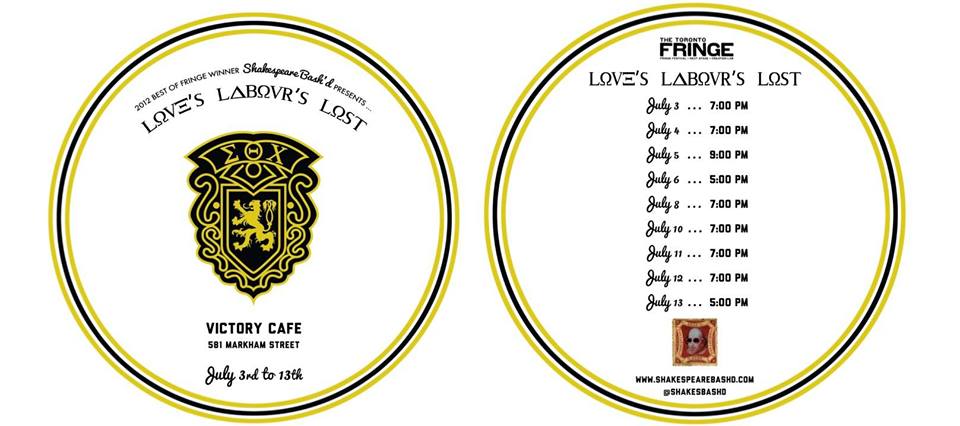
Love’s Labour’s Lost

by William Shakespeare, presented by Shakespeare BASH’d

Love's Labour's Lost - Photo by Jesse Griffiths and Kyle Purcell

Love’s Labour’s Lost – Photo by Jesse Griffiths and Kyle Purcell

Directed by James Wallis

Where? The Victory Cafe, 581 Markham St.
When? Thursday, July 3 @7:00pm
Friday, July 4 @ 7:00pm
Saturday, July 5 @9:00pm
Sunday, July 6 @5:00pm
Tuesday, July 8 @7:00pm
Thursday, July 10 @7:00pm
Friday July, 11 @7:00pm
Saturday, July 12 @7:00pm
Sunday, July 13 @5:00pm
Tickets are $12 and can be purchased via the Toronto Fringe website: https://www.fringetix.ca/

10440657_845760552118405_7235464256632023655_n

Follow this wild bunch on Twitter:

Shakespeare Bash’d@ShakesBASHd
Hallie Seline (Princess) – @HallieSeline
Joshua Browne@joshu_ashua
Andrew Gaboury (Longaville) – @afieldofcrowns
Jeff Hanson (Berowne) – @The_Hanman
Suzette McCanny (Rosaline) – @suzettemccanny

In the Greenroom Writer Bailey Green: @_baileygreen

** Want In the Greenroom to catch your Fringe show or have an interesting idea for an interview? Email us at inthegreenroom.ca@gmail.com! **

Tarragon Theatre’s Playwrights Unit: An Introduction with Dramaturg Andrea Romaldi

by Bailey Green

I sat down with Andrea Romaldi, Literary Manager at the Tarragon, to discuss the 2014 Playwrights Unit. This piece is the first of an ongoing series of profiles on the members of the Unit. A playwright profile will be launched each month leading up to the play reading week at the Tarragon in November.

The Tarragon Playwrights Unit 2014 announcement arrived in my email inbox earlier this year. The playwrights? Rachel Blair, Alexandria Haber, Jessica Moss, Kat Sandler and Evan Webber. These five talented individuals will spend a year working on one of their own projects in collaboration with dramaturg Andrea Romaldi. But what exactly is this unit and how does it function? I contacted Andrea Romaldi to learn more about the process. All five playwrights generously agreed to participate in this series of features. I hope other writers or artists will find connection in these pieces. The writer’s profession is a solitary one. But the Playwrights Unit, just like In the Greenroom, encourages community.

The Unit has been in existence since 1982. The last four units have been primarily under the dramaturgical care of Andrea Romaldi. Artistic Director Richard Rose passed the reins a few years ago as demands of Tarragon’s season became more insistent. Rose returns to the process in November to direct the play reading week. Andrea Romaldi began working at Tarragon in October 2007 after completing internships with Maureen Labonté at Shaw Festival and Brian Quirt of Nightswimming. Romaldi was part of the inaugural Festival of Ideas and Creation at CanStage and worked with the Alumnae Theatre’s New Ideas Festival for a several years. And her joe job? Teaching as an artist in schools and working at the ROM’s summer camps.

The Unit meets in January, May and September with a day or half day dedicated to each play. The playwrights attend each meeting and give feedback to each other on their work. After the meetings, the writers return to their drafts until the next meeting. “Writing is a very lonely profession and so when people have the opportunity to work with others, they don’t take it lightly,” Romaldi says of the dedication of playwrights to the unit.

14563

In between Unit meetings, writers have the opportunity to meet with Romaldi who dramaturges their work. She offers feedback, suggests new avenues to explore or requests revisions. Romaldi adapts to each writer’s process, “some people take me up on meetings, some don’t. Part of that is how people create. Some glean what they need from the readings or discussion and some people require constant checking in to feel supported. Everyone’s process is unique.” In her many years of experience, Romaldi recognizes the sensitivity required in dealing with artists and the varied challenges each playwright faces. In the past, Romaldi has worked with a variety of challenges such as writing a play in real time or writing a play out of chronological order. Many plays require the challenge of an extensive research process. This can stunt the writer when they come to actually putting words to paper. Breaking out of the comfort zone is also a common challenge, “many playwrights cut their teeth doing a certain kind of play, for example a one person show or an episodic play,” says Romaldi. “When playwrights challenges themselves it will always challenge their process.” Other playwrights struggle with their material and fears of what others might think of them if they create unlikeable characters or tackle difficult subject matter. “Write the play you need to write,” Romaldi encourages.

The selection process is very challenging for Romaldi. She invites six playwrights a year to join the Unit. “People who are brand new to writing want to work at the Tarragon, however they often don’t have enough experience,” Romaldi says of many writers who contact her through the Tarragon website. “I direct them to places or institutions where they can develop their skills.” Romaldi says she often comes across new writers typically at festivals like SummerWorks, Fringe and occasionally Rhubarb (Rhubarb shows are often more performance art/creation based). Romaldi also draws from Tarragon’s RBC Playwriting Competition and the Theatre Creators Reserve. The Unit is open to working with alternative creators however, “the unit has a very specific infrastructure which is geared towards playwright-driven, text-based plays,” Romaldi says. The budget often can’t accommodate paying creators for the extended rehearsal period required with a collective creation or movement-based performance. “We do make offers to people who work in a less conventional way than I think people perceive of Tarragon,” Romaldi says, “they [the creators] just have to be more flexible with their needs.”

When asked what she looks for in selecting the playwrights for the unit Romaldi replied: “At Tarragon we’re looking for plays whose primary focus is exploring the human condition. We’re not looking for plays with a single perspective, an easy hero and an easy villain. Our plays ask people to look at themselves and others with complexity and compassion. No matter how good a character tries to be there’s always something that eats at them. It can cause them to do thing we may not admire, but that we are forced to understand.”

Romaldi also listed several basic qualities: strong dialogue, a clear understanding of drama and above all that scripts are written for the theatre (as opposed to the mediums of film or poetry).

The level of experience varies within the unit. Romaldi looks for playwrights who have put a play through the production process, whether it was at a small indie venue or at the Fringe. The experience of putting original work through rehearsals with actors, meetings with designers and performances with audiences is crucial to growing as a playwright. Romaldi looks for a diverse group in terms of age, skills, and experience, “some people are well beyond the minimum, some have experience in film and television want to return to theatre, some have had experience in cities outside Toronto and so perhaps Tarragon isn’t familiar with their work.” Each playwright comes into the unit at a different stage in their plays’ development. Some plays may have been in the works for years while others may have only gained an ending the night before.

Romaldi’s advice for young writers and emerging artists? “Read and see as many plays as possible.” Be analytical, but generous, and always speak about plays in compassionate terms and “respect the integrity of the creators.” Romaldi notices that writers commonly have a lot of talent but are afraid to claim their confidence. Romaldi searched for the right words to describe what she feels is essential for life as an artist, “I am allowed to be a writer. It doesn’t make me inferior or superior, it just makes me who I am. Building up the idea of the ‘nobility of the artist’ won’t help. Part of what artists are offering people is a piece of themselves. It’s complicated and it’s not easy. But at some point you just have to accept that this is who you are and this is what you are meant to do.”

Be sure to check back over the next few months to follow our Tarragon Playwrights Unit Feature as we meet with each of the playwrights.

Follow our writer Bailey on Twitter: @_BaileyGreen


Events We’re Crushin’ On: Everybody to the Theatre Company’s “Theatre on a Theme: Love” – Sunday February 23rd

Interview by Bailey Green

Everybody to the Theatre Company unintentionally greeted me with piano chords and harmonized voices as the cast rehearsed a musical interlude for their upcoming show, Theatre on a Theme: Love. This unique show is EtoTCompany’s second production, following the success of their first show Theatre on a Theme: Failure (September 2013).

“The interesting thing about the theme of love is how much it is related to pain. This show isn’t just a happy stroll through the park, under the stars,” director Drew O’Hara says of his cast. “The company have brought some really personal stuff to the work.” Artistic Director O’Hara founded Everybody to the Theatre Company with several members of his Ryerson acting class. The soon-to-be graduates were looking for a creative outlet and something they could call their own. O’Hara had conceived the idea of constructing a show called “Theatre on a Theme” where new, short plays would be woven into a whole, cohesive performance.

ToaT LOVE PR Photo 5

This winter the company put out its second call for submissions on the theme of “Love”. The plays have to be 5-10 minutes in length and use up to any of the three men and three women of the company (and of course be based around the selected theme). “When the audience watches through the lens of a theme, it allows them to make the connections for themselves,” said director Drew O’Hara. “It gives our audiences a more immediate connection to the actors and to the show. The experience of seeing Theatre on a Theme is more personal.”

Everybody to the Theatre wants to explore the theme of love in all its facets. Though many of the submissions were romantic, and that aspect is not ignored in the performance, O’Hara looked for plays that explored love in many forms. “The goal is that hopefully we’re going to find something for everybody,” said Artistic Producer Jade Douris. “But there are as many different kinds of love as there are people.“

Then something amazing happened when the call for new plays was posted for Theatre on a Theme: Love website. “The submission post went viral in the United States,” O’Hara said. None of the company knew how it had happened. Somehow the call for plays about love made its way into the right hands. Everybody to the Theatre Company was rewarded with almost two hundred plays from LA to New York, from Ohio and Michigan and from Halifax to Texas to Toronto.

Artistic director O’Hara selects the plays for each show by searching for the most unique perspectives, the variety of character or shows that may compliment and contrast each other. “We got so many submissions in the last ten days,” said producer Jade Douris. “Sometimes we just couldn’t cast the show, say a grandmother and grandchild scene, but for the most part it wasn’t easy. We read all of them.”

ToaT LOVE PR Photo 3

Everybody to the Theatre Company’s mandate reflects its name as they focus on bringing theatre to different audiences. Theatre on a Theme searches to find stories from as many different voices as possible. The playwrights range in age from 19-65 and include a past Dora nominee, a graduate of two masters programs, not to mention both experienced and amateur playwrights.

Two members of the company have their own work included in Love. “Owen and I both wrote for this show for the first time,” says Jade Douris pointing to founding member and actor Owen Stahn. Stahn smiles and admits, “Yeah, I’m still pretty self-conscious about that.” They laugh, grin and shift in their chairs.

Not to mention that the company still balances a full semester of theatre school. The collective process can be challenging and the company works hard to knit the plays into a cohesive whole. Honesty is key. “It requires you to bring a lot of passion and energy to rehearsal and risk getting completely rejected by your peers,” O’Hara says of the process. “Most of us learn to let go,” Jade Douris smiles as she teases Owen. Owen mourns for a vignette of his that was cut from Failure, the company’s first production. “By the end of the process, we learned that failure is an absolute part of life and a critical part of growing,” Owen says. “You can escape it, but you can also just embrace it.”

ToaT LOVE PR Photo 1

These intrepid artists have plans for future themes, but plan to adjust them depending on the social climate or what life throws at them. They hope to one day bring their shows to as many audiences as possible. After the performance in Toronto, Theatre on a Theme: Love is travelling to Peterborough to perform at the Theatre on King. Showtime is at 9:30pm, tickets are $15 or $10 if you see The Dumb Waiter, the show performing before theirs.

If you see an Everybody to the Theatre show and think of a theme you would love to see, visit their website and drop them an email. They are always open to hearing suggestions from their audiences.

Theatre on a Theme: Love

Presented by Everybody to the Theatre Company

1521276_648268825216817_631302206_n

When: Sunday February 23rd at 2pm and 8pm
Where: Unit 102 Theatre (376 Dufferin Street)
Tickets: Visit their website: www.everybodytotheatrecompany.com  $10 in advance, $15 at the door.

Everybody to the Theatre Company rehearses in the UCRC Studio. It’s a lovely studio space on Saint Clair West and has great, affordable rental prices, (http://www.uppercanadarep.com/#!rentals/cij8).