Skip to content

Posts tagged ‘Bailey Green’

In Search of Truth (Whatever That May Be) with Craig Hall, Director of Faith Healer

Interview by Bailey Green

Acclaimed director Craig Hall called me from Alberta to talk about his experience directing Faith Healer at the Shaw Festival this season. Written by Irish playwright Brian Friel, Faith Healer is the story of a man, his love, his manager and his gift (to skim the surface). The text is elusive, complex and haunting. I spoke with Craig about direct address, rehearsal process and personal truth.

“Friel sent us a letter at the very beginning. It was waiting for me in my mailbox: written with an old manual typewriter with little cross outs in pen. You could only get in touch with him by fax. I fax-ed him saying I had a lot of questions. He faxed me back and said I don’t have any answers,” Craig laughs as we begin our conversation.

Craig got involved with the Shaw Festival a few summers ago. He was festival attendee for a few years before the offer to direct came at the right time as he was considering transitioning out a job. It was a great opportunity to take the summer to take stock and “really see where my career was going”. I asked Craig how similar or different Faith Healer was to his prior body of work, “Oddly it was kind of right of my alley. For some reason I have done a lot of solo shows with a lot of direct address”. He had worked on Greg MacArthur pieces which involve hindsight and memory as dramatic devices. “Stylistically, there’s a kinship. Direct address storytelling with this show is where the events have transpired but they are still living in the immediacy of it” he adds, “But once we got into the density of it none of us were prepared for how complex the piece ended up being.”

Shaw_FAITH_WebGallery_7

The structure of the show is deceptively simple: four sections, three characters, direct address and pure storytelling. It was the simplicity of one actor and an audience that drew Craig in to the piece. That and the complicated overlapping narrative structure. And though Craig had recently taken over a theatre company in Calgary, the fantastic writing helped make his decision.

With such an intense script, I inquired about the rehearsal process.

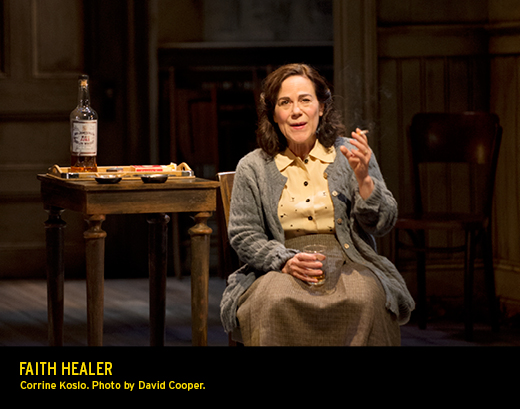
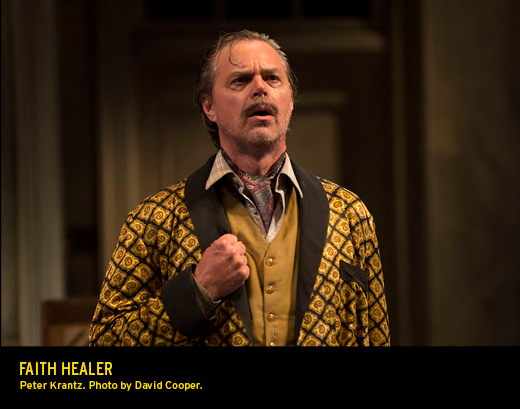
“It was pretty straightforward. And yet there’s no interactions between the actors [on stage] yet they have lived twenty years together. I had a lot of ideas in my mind about a complex rehearsal process but the actual structure of the rehearsal process didn’t work with that. We went through [the script] and scheduled in such a way that we touched on them [Jim Mezon, Corrine Koslo and Peter Krantz] all individually and kept them at the same pace. We let them have their own individual process but we wanted them to be moving through the piece at a similar speed.

Over the course of a month and a half, I would bring them every seven days into the room together to run through the whole piece so they could hear each other’s stories. You never wanted them to forget that their truth wasn’t the truth of the others. They embraced it and railed against it based on what their experience was. They wanted to love each other and be together [as a cast] but still it [the show] was so individual.

We went in there thinking it was a simple thing and were floored by how complex it really was. It was so complete unto itself. Every time we tried to add something it felt wrong. We became very happy with that fact.”
Shaw_FAITH_WebGallery_2

There are many challenges in a monologue play and we discussed the fine line between directorial and playwright decisions for staging. The play often had been produced on a mostly bare stage with perhaps the addition of a curtain at the back. Craig wanted to “put the story in a place that was charged with their history. Some people liked it, some didn’t. Jim [Mezon] said I get it, it’s a bare bones version of where they spent their lives while the other two [Corrine and Peter] were more literal. [The set] is a place for remembering.” He praised lighting designer Bonnie Beecher’s talents. She crafted a beautiful sequence at the top of the play of sunlight traveling from morning to night, spilling in the windows and marking the passage of time. She drew inspiration from Edward Hopper’s painting.

In his director notes, Craig spoke about truth. I asked if him and the cast had a found a solid truth beneath the tangled stories of this play or if they found everyone’s truth to be valid for themselves. He spoke to the latter:

“I think that’s where we landed. We rigorously went down this road. There were times when we thought this guy [Frank] was full of shit. These characters have their own individual truth. That and there is no way to play a lie like that on stage. If any one of these characters is consciously lying what does that mean? It would undercut the power of what they were talking about. There were so many things we didn’t reconcile ourselves with but let it go. Each of the characters is telling the truth as they see it. I think people are doing that constantly. There are people who know they are pulling the wool over someone else’s eyes. And some people keep telling the same lie until it becomes a sort of truth. If we play him [Frank] as a liar, the audience writes him off, but if you play it truthfully you leave it up to the audience.”

And how was it working at the Shaw Festival? “It was an exciting experience to me to work with this amazing talent and have the time and resources that we don’t normally have in the theatre world.”

Faith Healer puts the audience in limbo as we experience three characters’ individual re-experiencing of the traumatic and marvelous experiences from their shared past. And as their stories collide and contrast we debate and wonder what is true and false. But in life, as in the theatre, “we recreate history to benefit ourselves. If you can’t deal with something you paint it a different way in your mind so it is more palatable.”
Shaw_FAITH_WebGallery_9

Faith Healer

by Brian Friel
Directed by Craig Hall
Where: The Shaw Festival, Royal George Theatre
When: June 13th-October 6th
For more information and tickets, check out the Shaw Festival Website.


Theatre of the Absurd, Indeed – A Conversation with Bobby Del Rio on “The Trial of Ken Gass”

Interview by Bailey Green

I spoke with Bobby Del Rio about his new play The Trial of Ken Gass currently in the midst of its run at Sterling Studio Theatre. We talked capitalism, casting, Jess Salgueiro and of course, Ken Gass.

BG: Something so unique about this show is that there’s a different actor playing Ken Gass every night – how did you get all of these actors involved?

BDR: Well, I originally tried to get one Ken Gass. I offered it to several actors but I just couldn’t get them to commit to a full run. Peter Keleghan was my first choice, but he was doing a documentary for CBC so he didn’t have the time. Two weeks away from the show I still didn’t have someone so I called Jack Grinhouse cause I think I’m fucked. It was Jack who suggested that maybe I could get different people to do different shows, which wasn’t far from my first idea of having actors do two or three shows each. This idea of different people enabled flexibility. The flexibility to have people other than older white men come play Ken Gass. A lot of great actors like Diane Flacks, Dinesh Sachdev and Huse Madhavji from Saving Hope could get involved. It really opened up the play and the production.

So I asked Peter if he would play Ken Gass on opening night and he said absolutely. After I got Peter I was able to approach almost anyone: Tom McCamus, Rick Mercer, Daniel Brooks… They said they would love to do it but it was a lot of scheduling things that got in the way. But I got amazing people like Art Hindle and Diane Flacks. Once I got Peter, once you get the first domino, everything falls into place.

BG: Since you didn’t really have a rehearsal period, how did Jess Salgueiro (who plays Sarah Bright) cope with creating her character when she would be acting with a new Ken every night?

BDR: Another question not a lot of people have asked. It’s funny, Ken Gass in real life got the head line because he was the name for the news story when it all happened and then the production pretty much focuses on the casting of…Ken Gass. But Jess Salgueiro is the star of the show. We only had three rehearsals of about three hours each and a tech. She did so much work on her own. I played Ken Gass in rehearsal and I would purposely do it differently every time. I was helping her get off book and at the same time not just attacking or trying tactics differently but playing with weird blocking, like things no one would expect for you to do. I’m glad we did that because…well for example Diane Flacks did whatever she wanted to do, in an amazing way! I mean I love her; she is so free with her body. In her cold read she just owned it. So physically free and alive she would run around and dance. It was a turning point for the run too because after that Jess was so free.

Jess Salgueiro plays Sarah Bright in The Trial of Ken Gass

Jess Salgueiro plays Sarah Bright in The Trial of Ken Gass

[In rehearsal] we focused beyond her text and tactics. In order to establish consistency of performance we established what her character truly wants. Beats may change performance to performance but her super-objective didn’t change nor did the secret parts of her character Jess knew about. Secrets pockets of anger and rage that she can draw on. We knew exactly who this character was so this character could encounter any other character.

We did an improv where I went on several blind dates with her. And I was a different guy each time but she was still her character. I think it helped prepare her. Evidently, she didn’t need it. She’s fantastic. I’m the only person who has seen every show and she finds a way to hit the same beats and fight for the same objective with people throwing completely different tactics at her. She finds a way to get there. It’s quite amazing.

BG: Where or when did the inspiration for this play come from? Was it during all the chaos or afterward?

BDR: Before the Factory Theatre controversy I had this title in my head, “The Trial of Ken Gass.” I had a sort of long standing relationship with Factory; I had been developed numerous times at Factory over the year and had readings and units with them. I acted in a play called Tide Line in 2005. So I got to know Ken over the years. Ken is a brilliant artist and true visionary and because of this is a pretty controversial guy. I don’t mean that in a negative way, in Canada sometimes anyone who speaks the truth is called controversial. He’s an interesting dude, quirky, when he walks in the room you know he’s there. So I had wanted to write about Ken Gass for years because of this idea about gleaning his character.

I found out he was fired on Twitter. It was the first time I found out something major in my life on Twitter. I think it was Bridget MacIntosh who first tweeted it. All of a sudden everybody within the theatre community was posting on Facebook and tweeting at each other. Fun piece of trivia, I was the first person to post on Ken’s Facebook wall when he was fired. I don’t think it means anything but still it’s interesting. He’d gotten fired and his wall was completely blank. What do you say, right? At the time we didn’t know yet what had actually happened so I wrote something like “I’m not sure what’s happening but I wish you the best of luck”.

The theatre community did all this investigative reporting, extrapolation and innuendo. It became clearer what happened. Then (I always think I’m busy but maybe I’m not) I read three hundred pages of blogs, newspaper articles, the comments on the articles, Facebook pages, literally read every single thing, every name on the petition and what they wrote. It became very hostile. There were decisions made. Flame wars, series of mini dramas that exploded across Facebook. It got so crazy. No one would give me a straight answer.

BG: Is this what made you choose to write an absurdist play?

BDR: Theatre of the Absurd would be the perfect way to identify with the way it all happened – this amazing cesspool of drama. So when I found out I was a finalist in a playwriting competition at Sterling Studio Theatre I asked for Ken’s permission. I’ll never forget what he said, “Theatre of absurd, indeed.” I’d never written absurdism. I wrote a play that became a film called The Market (like Glengarry Glen Ross meets Reservoir Dogs which I had never written about before) about four bond traitors. So I used the content to mirror the form. Genre expressed the ideals of the story and the same thing happened with The Trial of Ken Gass. And the truth of it is there was no resolution. It was the ultimate anti climax. So why did we all experience this as a community if there was not going to be a resolution? Part of writing this play is the quest for that.

BG: You say The Trial of Ken Gass is the plight of every artist. How have you experienced this?

BDR: Partly the frustration in dealing with all levels of bureaucracy and institutions my entire life. Before Erindale I was an economics student. I noticed that I hadn’t attended calculus for months but I was ten minutes early for rehearsal.  I was a Sarah Bright, the institutionalized capitalist but then I became an artist. I realized all my friends, my whole world, was capitalism. All artists can relate to this, like having a conversation with a bank manager about how much money you make year to year. This play and Ken Gass channel the difficulty to persist and subsist in the capitalist hierarchy.

Every day as an artist is a challenge in this society that is so consumerist and fact-based.

You know, I went into this thinking that it could be the biggest failure of my career. I mean, it’s weird! A different Gass every night? I had people tip me off (in the theatre community) that there were people very angry with me for writing this play “so soon”. So I knew I may be offending some people by doing this but I’m going to do it anyway! And why not? I’ve met some great people.

So take risks.

The Trial of Ken Gass

Written & Directed by Bobby Del Rio

When: July 23rd, 2013 – Aug 3rd, 2013
Where: Sterling Studio Theatre, 163 Sterling Road
Tickets: $10 & PWYC Sundays
More information is available at www.sterlingstudiotheatre.com

Peter Keleghan (Made in Canada, The Newsroom, 18 to Life) played Ken Gass opening night.

Every night, a new actor plays Ken Gass including: Diane Flacks, Art Hindle, Pat Thornton, Julian DeZotti, Kyle McDonald, David Macniven, Dave Sparrow, Greg Dunham and DineshSachdev. Jess Salgueiro plays SARAH BRIGHT every night!