Skip to content

Posts tagged ‘Bailey Green’

One More Time With Feeling… And A Beer, Of Course! The Cast of “The Comedy of Errors” on the final Fringe hurrah for Shakespeare BASH’d

by Bailey Green

One of my first articles for In the Greenroom was an interview about the Shakespeare BASHd production of Loves Labours Lost. I remember the amazing atmosphere of the rehearsal room and how much everyone laughed. Two years later, I could not be more thrilled to be making my Toronto Fringe debut with this incredible cast, crew and company. Here are some glimpses into our process. We cant wait to share it with you. Interviews have been edited for length and clarity.

Comedy of Errors 2 - Tim Welham and Kelly Penner (as Dromio and Antipholus), photo by Kyle Purcell

Tim Welham and Kelly Penner Twinning. Photo by Kyle Purcell.

Tim Welham, who plays Dromio of Syracuse and of Ephesus, on acting Shakespearean text:

As an actor living in Canada in 2016, my world view is considerably different from someone living in Elizabethan England in 1594. Four hundred years of cultural shifts makes working within the images and references of the text feel like a herculean task. Sometimes when read, the grammar seems awkward, the sentence structure appears backwards and the words sound archaic. So I well understand why confusion and frustration is a common reaction when first reading Shakespeare.

But Shakespeare’s words were never originally intended to be read. They were meant to be spoken aloud and performed; designed for a stage, and intended for ears. This is why the language comes alive in a listener’s ear; crackling and popping into being.

While it sometimes takes serious academic work to comprehend Shakespearean textual meaning, the work of embodying how a character thinks, speaks, feels and imagines is a simpler, more practical process of allowing the language to inspire your imagination and alter your mind, body, heart and soul.

This is how an onstage Shakespearean character is created: through the sounds of the words, and how they affect the imagination of both the actor and audience. This is, of course, more difficult than it sounds, but the brilliance of Shakespeare’s writing makes it possible. By allowing the words to affect an actor’s mind, body, heart, and soul, the character is birthed into being, and a unique imaginative sonic world is created in turn for the audience.

The language, and the images the words conjure, must always be the starting point when working on Shakespeare’s texts. A Shakespearean character is just like any other human being: they have a wide vocabulary to articulate their incredible humanity – and that is a gift for any actor.

Comedy of Errors 1 - Kelly Penner as Antipholus, photo by Kyle Purcell

Kelly Penner as Antipholous of Syracuse and Ephesus. Photo by Kyle Purcell.

Kelly Penner, who plays Antipholous of Syracuse and of Ephesus, on playing double:

I was pretty excited by the idea of playing these two guys. I GET the idea of two actors playing two parts, and I’m sure I could get into it, but I dislike the idea. At least I find it far less interesting, because who are you fooling, really? Not us (the audience) but you would expect us (the audience) to believe this. “Oh, those two guys are wearing the same clothes. They must be TWINS!” So when I was asked to do this I was excited by the idea and the challenge.

Continuing from the idea of the clothes I would also dislike the idea of Antipholous of Syracuse having a limp or glasses or a mustache etc, while Antiphous of Ephesus has a hump or monocle or beard. Again, you expect [the audience] to believe this? When I finally started to build my twins, I wanted things to be simpler. My cast mate/friend/part-time lover Dave Gingerich said to me after the first read that one Antipholous was country and the other Antipholous was city. Once I had those general headings to build under, it happened pretty quickly.

Now, I had an idea where they came from, how they might speak and ideas of how they would have grown up. From there, I tried to find a simple physical and vocal cue that would help give a clear switch for myself. That’s really it. After that I just tried to learn all the lines and be open to ideas and impulses.

Oh, and breathe, listen, and trust. Those old gems.

Comedy of Errors 3 - Suzette McCanny as Adriana, photo by Kyle Purcell

Suzette McCanny as Adriana. Photo by Kyle Purcell.

Suzette McCanny, who plays Adriana, on returning to the Victory Cafe, one last time:

There is nowhere in the world I would rather be July 1st than on the deep carpeted stage of the Victory Cafe. Before I was involved as an actor with Shakespeare BASH’d, I was a dedicated fan! Lining up in the sticky Fringe heat to get a spot and a beer. The energy from the upstairs bar/theatre overflowed down the stairs and drew me in.

I have been privileged to be involved in the Shakespeare BASH’d Fringe show for the last three years and in that time I have been so lucky to work on some of Shakespeare’s lesser known plays. To the Shakespeare geeks out there perhaps Love’s Labours Lost, The Merry Wives of Windsor and The Comedy of Errors would not be considered obscure but I had not seen any of them in production before I was cast in the shows. What freedom and what a treat to pour myself into a brand new work from an old friend.

The women in these shows are mature and feisty. Fireballs who are full of love and justice. Even when the 400 year old text is complicated politically or sociologically, in the hands of Julia [Nish-Lapidus] and James [Wallis], I find that Shakespeare’s love for and understanding of humanity bubbles up from the depths and cannot go unnoticed. No character is shallow or incomplete.

When I first graduated from theatre school, that first year felt impossibly long and lonely but then summer came around and that first Fringe erupted. I was overwhelmed by the tent, the community, the celebration of one another’s accomplishments! I had lived through the dreary winter and had discovered manna from heaven! All my long lost friends, all the people I admired crowded into these two weeks of joy. I didn’t know then that it was cyclical and that this feeling would be back next year and that it is a part of the Toronto Theatre ecosystem, there to sustain us and give us energy to get through the dank months of February and March.

So this year, as Shakespeare BASH’d gets ready for the most exciting party of the year and says farewell to the space that has housed their overflowing energy for years, I am comforted because I know this feeling is not going anywhere. This energy is ours forever. Thank you to the community for your talent, your energy and your enthusiasm. Merry Fringemas to all and to all a good tent! See you at the Vic!

The Comedy of Errors

Presented by Shakespeare BASH’d as part of the 2016 Toronto Fringe Festival

comedy_group

Photo by Kyle Purcell

Who:
Written By: William Shakespeare
Company: Shakespeare BASH’d
Director: Julia Nish-Lapidus
Cast: Bailey Green, David Mackett, Suzette McCanny, Brenhan McKibben, Julia Nish-Lapidus, Drew O’Hara, Kelly Penner, David Ross, James Wallis
Creative team:
Megan Miles – Associate Director
James Walllis, Julia Nish-Lapidus – Producers
Jade Douris – Associate Producer
Kyle Purcell – Director of Marketing
Nate Bitton – Fight Director

What:
It’s the biggest party of the year and you’re invited! Join Shakespeare BASH’d in bidding a fond farewell to the Toronto Fringe the only way they know how…by having a huge party with the best audience in the city. Don’t miss their final Fringe performance: The Comedy of Errors, the Bard’s hilarious tale of shipwrecks, mistaken identity, and all out madness!

Where:
Victory Café, 581 Markham Street

When:
July 1st at 7:00 PM
July 2nd at 5:00 PM
July 2nd at 9:00 PM
July 3rd at 5:00 PM
July 5th at 7:00 PM
July 6th at 7:00 PM
July 7th at 7:00 PM
July 8th at 7:00 PM
July 9th at 7:00 PM
July 10th at 5:00 PM

Tickets: fringetoronto.com

Connect:
Web: shakespearebashd.com
Twitter: @ShakesBASHd

7483583_orig

In Conversation with David Yee about “Walk the Walk”, fu-Gen’s National Festival of Asian Canadian Women

by Bailey Green

During a fu-GEN theatre planning meeting in 2010, former general manager Carin Lowerison remarked on the lack of plays produced by the company that were written by Asian women. It was an off the cuff comment but the weight behind the statement hit home. “I really wanted to do something,” says fu-GEN artistic director David Yee. “Stats were coming out about the percentages of women directors and writers across the country, and reality is a fraction of those [directors and writers] are women of colour. Theatres were called out and they would say that they believe in women and women of colour, but they just don’t know any, or everyone’s busy, or we don’t have access. And then the initiatives by theatre companies weren’t about engaging with communities or putting a focus on the work.”

Walk the Walk is a national festival presented by fu-GEN theatre and six partner theatres from across the country. The format for the festival was inspired by a conference the company had mounted in 2010 called GENesis. The conference had staged readings, panels and paper presentations from academics in the field of Asian Canadian theatre. It was fu-GEN’s first foray into something large scale and was a week geared towards meshing art and academia. But with Walk the Walk the focus will be on new work by Asian Canadian women from across the country.

“The plan with Walk the Walk was to partner with organizations who had historically not done very well supporting women of colour, even if that was now taking an upswing,” Yee says of the new festival. “We sent out our offer to a lot of theatres. Some of them just didn’t respond, some responded that they didn’t have the time or the money, but some of them really engaged with us. Manitoba Theatre Centre really engaged with us and worked to find a candidate, and to make up the money they were missing from their budget. We found six theatre companies who would go the distance and were invested in changing the landscape.” Yee mentions 2B theatre and Theatre New Brunswick who searched tirelessly to find a candidate. fu-GEN held on for a month before they had to move on. At a national panel at GENesis in 2010, there was an empty chair to represent Atlantic Canada.

The goal of Walk the Walk is to connect artists with theatre companies that may not have had the opportunity to engage with their work. Walk the Walk seeks to create routes of access for women of colour. Mel Hague is facilitating the KXIII this year and the playwright unit is comprised of four emerging Asian Canadian women. “We’re partnering them with the more established creators in the main event for mentorship opportunities and celebrating the work that is out there,” say Yee, “ and it’s exceptional work.”

The week includes four new play readings, a panel, a cabaret and the annual Potluck Festival.

The festival opens with the funny and touching Burning Mom. Written by Mieko Ouchi from Edmonton, Burning Mom tells the true story of the author’s mother and her decision to go to Burning Man after the death of her husband. Tuesday night presents Chinoiserie by Marjorie Chan, “Marjorie engages with history in such an intersting way,” says Yee. “She deals with epic, complex human emotions and roots them in these sort of grand mysteries.” Wednesday night is a panel on the link between nostalgia and colonization, and the friction between them. The panel is facilitated by cognitive psychologist, neurologist and artist Dr Shanti Ganesh from the Netherlands.

Thursday night is Da Jia by Sophie Gee from Montreal. Da Jia is an Asian Canadian meditation on Arthur Miller’s All My Sons and is a multilingual play told in English, Mandarin and Cantonese (with surtitles.) And Friday night is Chinese Vaginies, a performance installation presented by Natalie Gan (one third of Vancouver group Hong Kong Exile). Yee doesn’t reveal the content of the piece, but shares that it is an interactive one on one, that somehow Drake’s involved and that the performance is an investigation of food, labour, racism, violence and the human body. The weekend closes the festival with a cabaret and the Potluck Festival and KXIII.

“It’s stunning, exciting work,” Yee says. “These communities have been under-served for so long and the strength of the theatre community has always been determined by its women. All of the mentors I have had in building fu-GEN were women and women of colour. So when I compare it to my personal history, I find it so strange that that isn’t the work that is celebrated or lauded nationally. They have been the ones driving artistic innovation to a greater degree than anyone.”

Walk-the-Walk-1b-revised-2

When: June 13th – 29th

Where: Factory Studio Theatre, 125 Bathurst Street

Tickets: fu-gen.org

For the full festival schedule and more information, visit: fu-gen.org

In Conversation with Jennifer Brewin about “The Public Servant”, on stage now until April 3

by Bailey Green

“A healthy, strong civil service makes for a freer, diverse and inclusive world, and that is just my world view,” says Jennifer Brewin when asked about what she hopes audiences will take away from the upcoming production of The Public Servant (presented by Common Boots Theatre and Nightwood Theatre). “We vote for politicians and those are the people who determine what kind of civil service we’re going to get. An accountable robust civil service is best for everyone.”

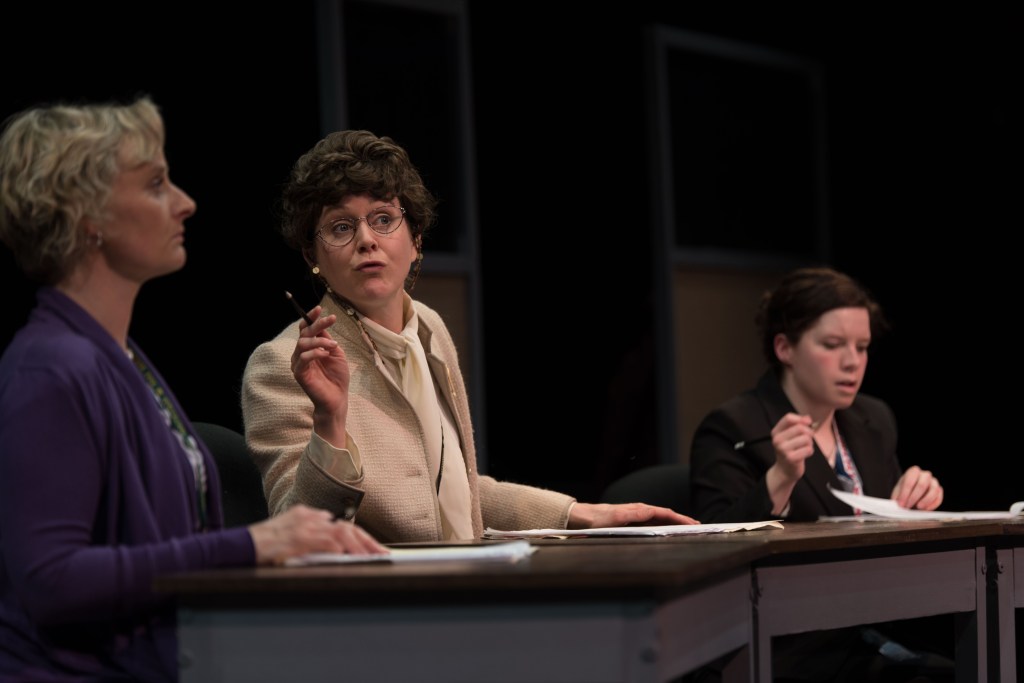
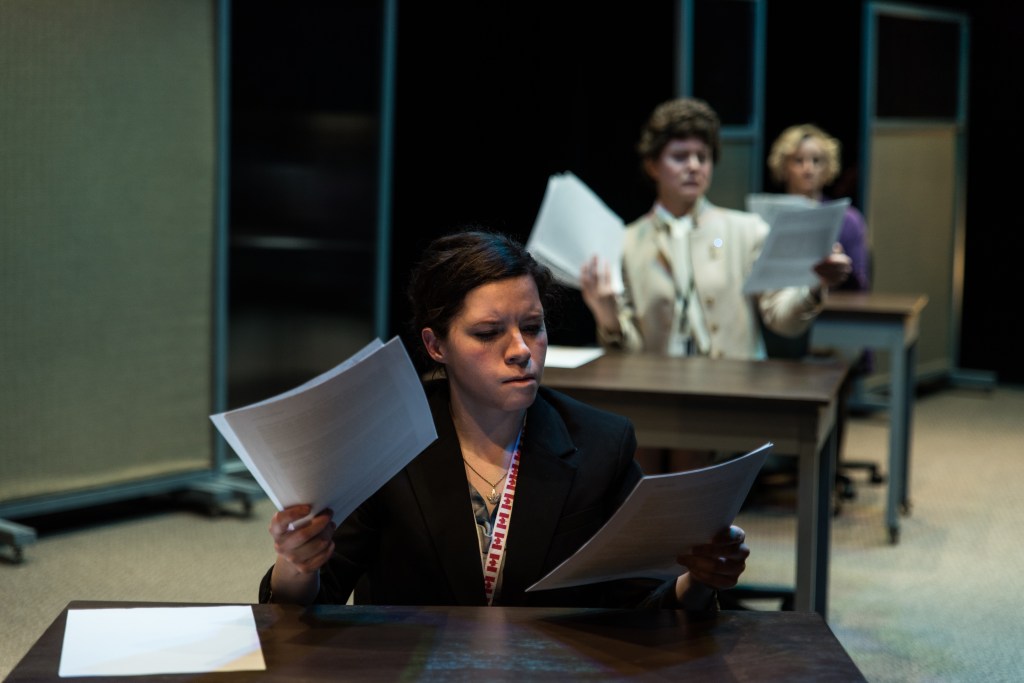
The Public Servant began about 6 years ago, shortly after Brewin was made Artistic Director of Common Boots Theatre (formerly known as Theatre Columbus). Brewin knew she wanted to work with Sarah McVie, Haley McGee and Amy Rutherford and she was drawn to the idea of exploring the strains of public life. “The people who work in admin or in management are often these unsung heros,” Brewin says. “Literature tends to mock them or reduce them, and they haven’t had their place in the sun. So it was an important idea to me, especially because so many people who work in administration are women. Where are the songs about the heroic work of that, getting a report in on time or completing an audit. Those things create foundation, support and innovation.”

Photo Credit: Neil Silcox

Photo Credit: Neil Silcox

The team (Brewin, McVie, McGee and Rutherford) interviewed a wide range of women working in the public service in Ottawa. Over the course of their interviews, they encountered three generations of women working in the public service. There were the women who had worked during Pierre Elliott Trudeau’s time, who had been given responsibility to create new policies and laws for a more inclusive society. “They told incredible stories of fighting for equal pay, for changing maternity leave laws and regulations,” Brewin says. Then there were women who were currently working and were nearing the mid to end point of their careers. These women had worked during Mulroney, Chretien and Martin’s terms as prime minister. “They had faith in what they were doing but their faith was strained,” Brewin says. “Jobs were cut under the Harper administration and people were let go. And then we met young people going in to public service, which was a very different experience. They wanted to be good administrators and managers, but didn’t have particular ambitions to change the world.”

Photo Credit: Neil Silcox

Photo Credit: Neil Silcox

The women wrote the play through long form improvisation. Each of the actors was drawn to a different generation of public service and each character became a composite of the different people the team had met. The character of Madge, a young and eager public servant, originally created by McGee, brings us into the world of The Public Servant. The play originally premiered in Ottawa, where Brewin found it was incredibly exciting to watch a play about women speak to all kinds of people. For this run, McGee had booked a contract in London England, and the role of Madge was taken on by Amy Keating. “Amy’s understanding of the script and the story has really helped reveal new things about the play and the character,” Brewin says. “It’s been really exciting working with her and clarifying her intentions.”

When asked about Brewin’s joys and challenges when working as a director on the piece, she said, “The joy was experiencing Amy, Sarah, Haley and, later, Amy [Keating] interpret the entire art of the play/production. It’s incredibly exciting to throw up all our rules of engagement and just dig into it.”

The Public Servant

BrochureImage
Written by Jennifer Brewin, Haley McGee, Sarah McVie and Amy Rutherford
Directed by Jennifer Brewin
Produced by Common Boots Theatre (formerly Theatre Columbus) in association with Nightwood Theatre

What: The Public Servant is a comic-tragedy about women and administration. Step inside the halls of power as Madge, a young, idealistic and enthusiastic civil servant, gets ready to write her first official memo.
Based on the interviews of some twenty civil servants who shared harrowing tales of navigating the fuzzy divide between individual need and public good, The Public Servant reveals a journey of heroic dedication and professional betrayal, of overcoming cutbacks, bad managers and incompetent ministers. And how in the end, the demands of accountability and transparency seem to defeat even the best bureaucratic soldiers.

Where: Berkeley Street Theatre Upstairs
26 Berkeley Street

When: March 13 – April 3, 2016
Tuesday-Thursday, Saturday: 8pm
Friday: 7pm
Saturday-Sunday: 2pm
Wednesday March 30: 1pm

Tickets: Regular price $35

nightwoodtheatre.net


In Conversation with Sex T-Rex – Presenting their Double Bill at the Storefront until March 27

by Bailey Green

I had the pleasure of speaking with Sex T-Rex performers Seann Murray, Kaitlin Morrow, Conor Bradbury and director Alec Toller about their double bill, on now at the Storefront Theatre (Danny Pagett and Julian Frid were unable to stay for the interview but are also performing.)

It began with a quote from the movie Predator, “this stuff [chewing tobacco] will make you a goddamn sexual tyrannosaurus.” And then one night, before an improv set, the announcer shortened the improv troupe’s name from Sexual Tyrannosaurus to Sex T-Rex, and it stuck. Performer Conor Bradbury laughs at the memory, “Hey, when someone’s right they’re right! There’s no need to be precious about your comedy.”

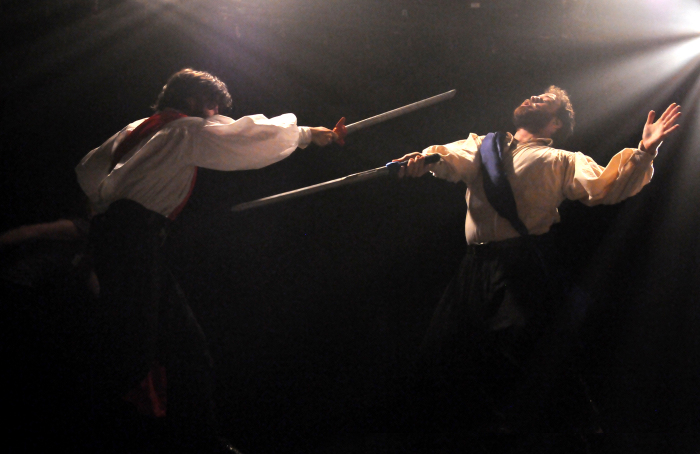
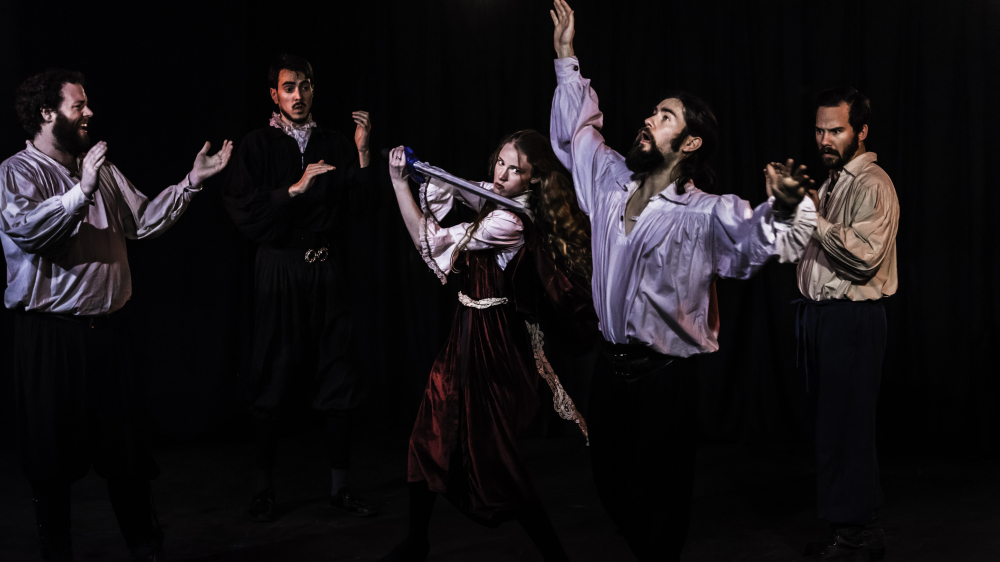
The group came together during their time at George Brown back in 2007-2008. Many elements of theatre school didn’t resonate with the actors but when they got together in stage combat class, then things really came alive. “It’s a triumvirate of violence really,” director Alec Toller jokes about the history of Sex T-Rex shows. “All of our action shows are centred around violence,” performer and producer Kaitlin Morrow adds. “Callaghan! was a lot of punching, Watch Out Wildkat is shooting and then Swordplay, which was loosely inspired by Princess Bride, has to do with, well, swords!”

Photo Credit: Cindy Lopez

Photo Credit: Cindy Lopez

This double bill features Watch Out Wildkat! and Swordplay: a play of swords. “Even though we have done Wildkat in 4 cities and Swordplay in 2, we’re still riffing, especially in rehearsals,” Morrow says. “You can always feel when it happens,” Bradbury adds. “There’s this unspoken ‘keep it’ feeling when someone makes a good joke.” Toller says that the group strives for clarity above all else, “We do so much mime, and fake action movie stuff that we’re always fighting to be so precise.”

Toller directs the group’s scripted shows (they also do improv shows) which are written plays with a sketch origin. “It’s very collaborative,” Toller says. “It functions more like a collective, so basically I’m the person not on stage… where I belong… but my job is to manage what everyone wants to get out of it. This show is a remount, so we’re trying to improve as we go, punch things up, and that can be challenging because we have an existing structure but we don’t have an audience.”

Photo Credit: John Gundy

Photo Credit: John Gundy

Writer, producer and performer Seann Murray speaks to the group dynamic saying, “It’s very rare that we have camp A and camp B disagreements. Instead, we usually have eight ideas with each person having three and a half small ideas each.” Bradbury adds, “It’s almost like we’ll have one person who is camp A and one who is camp B, and everyone else just isn’t helping. But it always works out for the best. To have a bit of argument in the room means people care about the product.” Morrow adds, deadpanned, “So we just punch each other in the face until someone gives in.”

Photo Credit: John Gundy

Photo Credit: John Gundy

Murray writes the scripts for the group and describes the process:

“The first step is we identify the genre we want to work in. Then we watch movies and chat about the tropes we want to hit, what we want to see [in the show] from the genre. So it’s not just regurgitation, we want to honour the genre. Once we’ve consumed a bunch of media and batted ideas around, I write the script and we workshop it throughout the process. We often wind up with a small chunk of the script left, we stay true to the character and story more or less, but as Alec [Toller] said, there’s lots of really funny improvisers on the team so we’ll take a scene, work through it and put it back into the script.”

The group considers audience feedback invaluable. They often take their shows to Montreal Fringe before performing at Toronto Fringe. Montreal Fringe offers them the opportunity to try out new material and improve their work. “We change something after basically every show, we find something else we’ve never done before,” Bradbury says.

Photo Credit: Sharon Murray

Photo Credit: Sharon Murray

Morrow, the only female performer of the troupe, tells me how that for years she dealt with crippling nightmares centred around improv. Subconsciously, she wanted to get up and perform but she was terrified. Now, with 19 shows under her belt, she has realized that a bad set isn’t the end of the world and that the joy she feels from performing far outweighs the fear. “The first time I went up to improvise was for Shane Adamczak’s secret show Captain Spaceship in Montreal Fringe,” Morrow remembers. “He just assumed I was in the show because I was a part of Sex T-Rex, and when I tried to back out, he told me I couldn’t because there were no other women in the show. So I didn’t sleep for about a week, and then somehow I was backstage and then I was onstage and I did it. The relief was amazing, and you know, it wasn’t even bad!”

Watch Out Wildkat! & Swordplay: A Play of Swords

12733973_1287592624601107_2756752568443821603_n

Presented by Sex T-Rex
When: March 11th -­ March 27th, Wed­-Sun
Watch Out Wildkat! @ 7:30 PM & Swordplay @ 9:00 PM
Sundays @ 2:00 PM
Where: The Storefront Theatre, 955 Bloor Street West
Tickets: $20 for single show, $30 for both shows
Available at http://thestorefronttheatre.com/events/swordplaywatchout-wildcat/
Connect: sextrexcomedy.com

In Conversation with Julia Krauss of “Orpheus and Eurydice”

by Bailey Green

The tale has been told for centuries in many ways but in basic terms the story of Orpheus and Eurydice goes something like this: Eurydice and Orpheus fall in love. One day Eurydice enters the forest and is bitten by a snake. She succumbs to poison and dies. Orpheus enters the Underworld to find his love and with his beautiful singing, charms Hades. Hades permits Orpheus to lead Eurydice out of the underworld on one condition – that Orpheus must not look back at her. Not once. But as they walk, Orpheus cannot contain his fear. He looks back and Eurydice is lost to him forever.

Four years ago, co-directors Julia Krauss and Nicholas Walsh were living in Kitchener. After seeing a version of Orpheus and Eurydice at Ghost River Theatre in Calgary, they were intrigued by the imagery of this myth. Walsh at the time was running a youth company, and so Krauss and Walsh decided to work with teens using the myth as a jumping off point. What emerged was a story of youth and first love, pain and loss.

The piece toured for two years to high schools in Southern Ontario. “Last year, when we moved to Toronto,” Krauss says, “we wondered how and if the show would change if we worked with adult performers on it. Once you’re older, there’s a different kind of life experience.” Krauss and Walsh assembled a collective of twenty performers—young professionals who have finished their education in dance, theatre or physical theatre. “We were intrigued by what breaks a relationship apart, what will break that deal between two people,” Krauss says. “And the bodies are older, so they tell a different story.”

Walsh and Krauss are partners in life and in theatre. “We see ourselves as context keepers, the people who put the ends together,” Krauss says of their work in devised theatre. “We’re interested in collective collaboration work that shows the final product. Everyone is passionate about it, and that shows in the final project.” Walsh, a drummer with a love for basketball, has a great sense of organization on stage and a strong awareness of sound and music. Krauss describes herself as a visual person, finding imagery in bodies and their shapes. “We balance each other out in that regard,” Krauss says of Walsh. “When we first did the piece, it was a celebration of our partnership. And so it’s been really lovely to revisit it. Being in a committed relationship is not always roses and sunshine, which we can explore with an older cast because they have had similar experience.”

Julia Krauss was born and raised in Germany and left when she was 19. Two years later she came to Canada and discovered that her accent created barriers for her to get involved with theatre. “I felt reminded that I am different,” Krauss said, “and it became something I was aware of because of casting directors. But when I worked with Majdi Bou-Matar at the MT space, he is all about celebrating cultural background. The work [we were doing] was created through improv and for the first time I felt free. That was my personal entry to devised work. Suddenly I fit in and was recognized for what Majdi called my ‘German expressionism’.”

Krauss feels grateful and inspired to work with a large ensemble of courageous and open artists. “One of my mentors when I first went into devised work told me why would you rely on your own brain when you have twenty to twenty-five people in the room?” Krauss remembers. “Everyone has a voice and story, and we, as directors, keep the bigger picture in mind […] but I love the rehearsal process. It’s a beautiful thing to watch people share and offer something really vulnerable.” Krauss hopes the piece asks audiences to consider what it takes to stay in a “functioning, fluid human relationship with another person,” and consider what may hold us back from truly embracing another person.

Orpheus and Eurydice

O&E-10_10_10 ad (1)

Who:
Presented by Theatre TOnight

performed by
/ rhiannon bronnimann
/ cheryl chan
/ roberto ercoli
/ mateo galindo torres
/ vivek hariharan
/ marion henkelmann
/ julia hussey
/ sarah ignaczewski
/ mamito kukwikila
/ diana luong
/ brittany miranda
/ damian norman
/ brian postalian
/ amanda pye
/ hugh ritchie
/ shakeil rollock
/ kyle shields
/ dylan shumka-white
/ elizabeth stuart-morris
/ kathia wittenborn

directed by
/ julia krauss
/ nicholas walsh”

What:
“two people meet.
they fall in love. and it is thrilling. it is soft.
but it is also consuming and exhausting.

orpheus & eurydice
is an invitation to reflect on past and current relationships,
to wonder what could have been,
and to embrace what is now.

through the context of the myth, it presents
an emotionally raw and
physically captivating
exploration of our desire
for connection.

Where:
The Berkeley Street Rehearsal Hall, 26 Berkeley Street, Toronto

When:
March 16 – 20, 2016
Wed Mar 16, 9pm
Thurs Mar 17, 9pm
Fri Mar 18, 9pm
Sat Mar 19, 8pm
Sun Mar 20, 8pm

Tickets:
20 adult / $15 student, senior, or artsworker

For more information, visit their website here.