Skip to content

Posts tagged ‘Brittany Kay’

Artist Profile: Sara Farb, Playwright & Performer of personal piece R-E-B-E-C-C-A at Theatre Passe Muraille

Interview by Brittany Kay

I had the utmost pleasure of sitting down with long time friend, Sara Farb, to discuss her new play, R-E-B-E-C-C-A, which opened this week at Theatre Passe Muraille. We shared our “somewhat” fondness of our suburban bubble and the journey into realizing that theatre is the fundamental lifeline that keeps us going.

Throughout the laughter and reminiscences, I couldn’t help but marvel at this woman. She is one of wit, talent and has created a truly remarkable play that shares a one of a kind story.

Brittany: How did you get to where you are now?

Sara: I’m originally from North York, so technically I’m from Toronto but my entire childhood was in Thornhill. A huge part of my childhood was spent at a community theatre program called Charactors Theatre Troupe. I went to Earl Haig Secondary School in the Claude Watson arts program as a drama major and then decided to go to the University of Toronto to get a normal person degree, because I’d been working as an actor and didn’t want to remove myself for too long. University was a constant struggle. I ended up doing really well, but it took me six years to finish. I don’t regret it for a second. It was a really good balance to exercise, especially entering a life where you know multitasking is sort of essential if you want to remain sane. 

For a while, I was working as an editor for on an online publication and the acting wasn’t really happening. At the age of 24, I made a decision to leave the business. 

Brittany: What made you come to that choice?

Sara: It was mostly musical theatre that I was doing and that’s already such a marginalized part of the arts community. What I offered was too astray from the norm that the musical theatre arts community is so devoted to here in this country. You know, not necessarily to its detriment, but very few risks are taken in casting. It was really hard to establish myself in any real momentous way. In like bits and pieces sure. It was just too much of a struggle… too frustrating.

I’ve always had an affinity for words and for literature and I had dabbled in online journalism. I decided that if I’m going to be unsatisfied in a profession, it might as well be one that is more lucrative, yields better results and where the competition isn’t as ferocious. I made the promise to myself that after I had a show in Halifax, that was going to be it. I enrolled in these courses to be an editor and my entire life perspective was going to be flipped after the show. This new re-focus would be in the middle and theatre would be its orbit. That’s the way it looked.

Brittany: That must have been an incredibly hard moment in your life.

Sara: I remember having this watershed conversation with my boyfriend where I felt like I was getting a divorce. I needed a clean break. It was such a huge decision and so monumental in my life. But the second I let it go, it just all came at me like I was a magnet. It was so crazy, but also very informative. I’m not an avid believer in cosmic anything but that’s the closest thing I can think of, of any universal involvement in ones’ life, it seemed. It’s inexplicable. So I decided to ride the wave, but I still didn’t take my foot out of the writing door.

It was evident that I obviously wasn’t ready to let go entirely. Eventually, it led to being asked to come in to audition for Stratford because they needed an immediate replacement. I got the part and that was sort of a no brainer.

Brittany: Well…obviously.

Sara: And so now I’m an actor. The feeling that this isn’t permanent never goes away. This always feels like a temporary fix and that’s why I still write and that’s why I’m very keen on exercising other skills. I am not delusional and I don’t in any way, shape or form think that this is going to stay as good as it’s been forever. That’s simply not realistic.

It’s important to pour everything you have into what you’re doing, but if that’s all you got then I think that’s a serious problem in this industry.

Sara Farb in R-E-B-E-C-C-A. Photo Credit: Michael Cooper

Sara Farb in R-E-B-E-C-C-A. Photo Credit: Michael Cooper

Brittany: Let’s switch gears and talk about the play. How did this play come to be? What was the development process? 

Sara: The last possible year I could participate in the Paprika Festival, I decided to submit. I had sort of been musing about what a play about my sister would even look like because I didn’t really want it to just be a family drama. That wasn’t it. I was kind of more interested in people’s perceptions of people with disabilities and how they might be wrong, especially in my very specific experience with my sister. I know that it’s easy to look at someone like her and feel an overwhelming sense of pity, but in reality she’s actually probably the happier of the two because she’s not aware of the minutia of day-to-day struggle. It just sort of felt like a really interesting place to start. It developed into a 20-minute piece that examined her day-to-day existence. It built a foundation for the development and growth of the play to where it exists now – with a Rebecca that is portrayed in the present and a hypothetical Rebecca.

Rebecca was born prematurely and there’s been speculation in her life that her developmental delay has to do with that. It’s a theory. That sort of coincided with the big question of what you do with legal adulthood even though there’s no comprehension of what that is or any real way of manifesting that with someone who is a perpetual child. What would a hypothetical Rebecca, who was brought fully to term, look like if she were turning eighteen? The play looks at both of those worlds on each of their respective birthdays.

Brittany: How did it come to Theatre Passe Muraille?

Sara: Rob Kempson, who ran Paprika at the time, invited me to participate in the “Old Spice” program, which invites Paprika alumni to further develop their work with a mentor of their choice. Until then, there were a couple years where the development of the play was kind of dead and I didn’t really know what to do with it. This program really sort of kicked me in the ass and it was more due to Rob’s insistence that I applied because I was on the fence about it. It’s just been a really long line of very supportive people, encouraging me to do something about it. So I had my pick of mentors and Richard Greenblatt had been very interested in the play back when I was first doing it with Paprika, so I invited him to be my mentor and dramaturg. It was a really great match. I really owe this to Rob, who brought it to the attention of Andy McKim. It’s been very much on his radar for a very long time.

Brittany: Talk to me about you relationship with your sister.

Sara: It’s very very close in the way that it is. There are few people that she feels comfortable showing all of her colours to, a part from my mom. I may be the next person in line who knows as much about the parts of Rebecca. Her life and my life will really be fused for our entire lives. I adore her to no end. It’s very protective.

Brittany: Like any other older sister would be.

Sara: Pretty much. Obviously there are significant parts of sisterhood missing. It’s like having a four-year-old sister forever. That has its benefits and its costs, but I’ve never wished her to be anything else. I’m pretty aware that I’d probably be a different person if I had an ally in my sister. That’s sort of fodder for why one writes a play like this.

Sara Farb in R-E-B-E-C-C-A. Photo Credit: Michael Cooper

Sara Farb in R-E-B-E-C-C-A. Photo Credit: Michael Cooper

Brittany: You play two Rebeccas in this play. Can you speak a bit about the two of them?

Sara: The characters’ names in the script are May and July. May is the Rebecca that exists and July is the hypothetical one if she were brought to full term. May is a pretty true to life representation that I’ve been able to master after all the time spent with my sister. It’s a little more articulate than she actually is, but it communicates what I perceive to be her thoughts and feelings. July Rebecca comes from the question of what someone would do if they had the deep feeling that they weren’t supposed to exist. The kind of person July is, is the direct opposite of May who’s fully unaware of her existence. Time is not a concept to May. July’s existence is constant. It is not supposed to have happened to her and therefore it’s always there.

Brittany: What has it been like being both playwright and actor?

Sara: It’s been extremely challenging. Richard gave me a week grace period of allowing the playwright into the room and then the playwright had to leave. It had to just be about performing the play. It’s mostly now about getting 80 minutes of theatre from beginning to end without worrying too much. Being able to treat the words like someone else wrote them is strange. Every now and then I’ll come across something and think, “I can’t believe I wrote that.” I’m trying to shelve those opinions. Not having an opinion on the writing has been a really difficult thing. 

Brittany: Richard Greenblatt has been a part of so much of this process. How has it been having him as your director?

Sara: It’s been outstanding. He’s such a champion of thought-provoking, unusual stories and his commitment to this one is humbling. Anytime my confidence has waivered, he’s there to slap me out of it. He’s just got such a keen eye for developing new work and his dramaturgy skills are unbelievable. I just feel so lucky. The whole team are masters in their field and the fact that they assembled because I wrote this play is a really gratifying thing to feel.

Brittany: Who does this play speak to? Speak for?

Sara: It’s an examination of our experience with people with developmental delay and what we project onto them. How we try to fit them into our world when they necessarily might not want to fit into it. The way they operate may be preferable or more natural. It’s sort of a look at everyone’s struggle of the idea and less about what somebody who is disabled struggles with. They could be the happiest people in life but because we know what they can’t do, that’s immediately a reason for pity.

As well as I know Rebecca this is all largely hypothesized. I’ll never truly know exactly how she feels about certain things because there’s a huge lack in ability of communicating. Even for me to impose all of this on her is sort of the point of what I’m trying to get across.

Brittany: What do you want audiences walking away with?

Sara: All I want is for them to be affected. I want them to like the play. I want it to not suck (she laughs).

It’s important to come to terms with these things and how we approach certain ideas and how much we force ourselves onto everything. How something isn’t necessarily a certain way because you feel a certain way about it.

The notion of the ease with which any one of us could have ended up with a genetic disorder. How easy it is for all of that to not go according to plan. If it does go according to plan is that necessarily better?

Rapid Fire Questions:

What is your favourite…

Book: Of Human Bondage.

Movie: Recently, Whiplash.

Place to write: Revel Caffe in Stratford.

Place in Toronto: I really like walking along Bloor Street.

Food: Lately it’s been Korean food. I cannot get enough kimchi into my mouth.

Best advice you’ve ever gotten: Don’t give up, get ready.

R-E-B-E-C-C-A

Written and performed by Sara Farb. Directed and dramaturged by Richard Greenblatt. A Theatre Passe Muraille production.

RBC TPM Cover Photo

Tickets: PWYC-$33  – Buy here.
Where: Theatre Passe Muraille Backspace (16 Ryerson Avenue)
Length: 80 min
When: On now until March 1st.

Connect: Sara Farb @SaraFarb
Theatre Passe Muraille @beyondwallsTPM
Brittany Kay @brittanylkay

In Conversation with Michael Ross Albert, Playwright of “For a Good Time, Call Kathy Blanchard” at the NSTF

Interview by Brittany Kay

Like a long distance pen pal, I had the pleasure of corresponding with the talented and compassionate playwright, Michael Ross Albert, whose show, For a Good Time, Call Kathy Blanchard, is playing at the Next Stage Theatre Festival. We spoke of hockey, where and what we call home, and our constant quest to find out where we belong. 

BK: Tell me a bit about yourself. Where you’re from? Your journey to where you are now? 

MRA: I’m from Toronto originally and I started writing plays when I was in high school. I was a participant in one of the first iterations of the Paprika Festival many many years ago. I also used to act, and did that a bunch in university, which hammered home the feeling that I really preferred to be on the other side of the footlights. I was accepted into an MFA Playwriting program at the Actors Studio Drama School in New York, so I moved to the city and started training alongside some wicked talented Method actors. I kept writing plays and putting them on. When I graduated, my friends and I co-founded Outside Inside and started producing under that banner in a bunch of different festivals. And then, my Visa expired and instead of hiring a lawyer, I moved back to Toronto and started re-discovering the city as an adult for the first time. Now, it’s a real joy to be able to produce a play of mine in this particular festival with a cast and creative team who I’m proud to call friends.

BK: What inspired this play? 

MRA: In the summer of 2012, I was very interested in the idea of home. I was in the process of moving back to Canada, but was putting on a show in New York at the same time. So, I was sleeping on people’s floors, either in my mom’s basement or my old roommate’s living room. I didn’t really know where I belonged; I was unclear as to where “home” was (which is something customs agent ask you a lot when you cross the border fairly regularly and don’t have a job).

One night, in Queens, I happened to run into an old friend of mine. We started nostalgically rehashing these minute details about our shared past, like the time this funny thing happened to so-and-so, this piece of graffiti that had stuck in both our minds. Those small but very clear memories had become almost like personal talismans against… something. Adulthood, maybe. There we were, so far removed from our youth, so completely unsure of what was going to happen next in our lives, so far away from this place we hardly even thought about anymore. And those small details were the ones that still, somehow, burned very brightly. As directionless as we were at the time, these very personal but, otherwise, forgettable memories were quite comforting. I thought it was sad, but I also thought it was pretty funny. And that’s how the play was born.

Also, after years of crafting “well-made plays” at school, I wanted to rip a kitchen sink out of the wall.

Geoffrey Pounsett & Daniel Pagett in For A Good Time, Call Kathy Blanchard

Geoffrey Pounsett & Daniel Pagett in For A Good Time, Call Kathy Blanchard

BK: Are there familial ties from your own life to this play? 

MRA: Not really, but there are shadows of myself in each of the characters, and aspects of my own family members and our dynamics that must have influenced the relationships in the play. But not in any glaringly autobiographical way. It’s fiction for sure.

BK: After watching the show, I assume you’re a huge hockey fan? How did hockey influence your life and this play? 

MRA: I like hockey a lot. I can’t help getting swept up in it, especially if the stakes are high, like during a playoff game. What Jim Warren’s production of this play does very well, I think, is that it sets up the characters themselves as the opposing teams in a hockey game. They’re members of a family pit against one another in this very fast-paced, high-stakes competition. But, unlike hockey, even in this combative family, there’s no clear winner. In fact, probably, everyone in this play is a bit of a loser. But that’s because they don’t want to be pitted against each other. In fact, they really really love one another.

BK: What’s your favourite team? 

MRA: The Leafs.

BK: Why do you think the NSTF is important for the Toronto arts community and Toronto as a whole?

MRA: The festival is curated and they program new works that appeal to various demographics. Their programming is diverse, which brings people who wouldn’t necessarily see theatre into that tent. Each show is completely different from the others. Tickets are inexpensive, so for the same price as a movie, audiences can see really high quality indie theatre, or dance, or comedy. And, the festival literally brings arts-minded people closer together, huddled in that very cozy beer tent. January can be a very depressing month in a cold city and, if nothing else, NSTF gives you an excuse to tear yourself away from Netflix vortexes and be part of a community.

BK: What is your favourite part about the NSTF tent? 

MRA: It’s not the beer. It’s meeting, getting to know, and commiserating with all of the other NSTF artists, whose excellent work I’ve gotten to experience in the festival. The beer is pretty good, too.

BK: What inspires your stories? Where does your inspiration come from when you write?

MRA: I think, first and foremost, I want to write characters that actors would like to play. I think that’s the constant. Apart from that, I have no idea where the inspiration comes from most of the time. Overheard dialogue on the street, stories I’ve been told, phrases, songs, memories. Anything that surprises me.

BK: Do you have a favourite place to write?

MRA: Anywhere private with a window.

BK: What do you want audiences to walk away with?

MRA: I hope they’re able to see themselves and their loved ones in these characters. And I hope they know that, even in those moments when life sucks, they’ve got worth and they mean something to someone else.

Rapid Fire Question Round:

Best show you saw in 2014: Jesus Hopped the ‘A’ Train at Unit 102

Favourite play: Either Three Sisters by Anton Chekhov or A Delicate Balance by Edward Albee

Favourite actor: Phillip Seymour Hoffman comes to mind

Major influence: Edward Allan Baker

Best advice you’ve ever gotten: From a writing standpoint: “Cut into the action as close to the conflict as possible.” From a producing standpoint: “If it’s not fun, it’s not worth doing in the first place.”

For a Good Time, Call Kathy Blanchard

by Michael Ross Albert, presented by Outside Inside as part of the Next Stage Theatre Festival

Entire-Cast

Game Four, Stanley Cup finals. Lawrence is having a breakdown. Sky’s been kicked out of his house. Amanda’s career is going nowhere. Mary won’t leave the living room until someone wins the Stanley Cup. And they’re all preparing for a devastating loss, both on the ice and at home. But, Lawrence has a plan to fix his family for good. A tragic comedy about heartbreak, hockey, and the places we used to call home.

Tickets – $15

Connect: Outside Inside @OutsideInsideCo

Where: Factory Theatre Mainspace (125 Bathurst St.)
Length: 75 mins

Playwright Michael Ross Albert
Director Jim Warren
Featuring Jennifer Dzialoszynski, Daniel Pagett, Geoffrey Pounsett, Caroline Toal

When:

Wed Jan 7 – 8:15pm
Fri Jan 9 – 10:00pm
Sat Jan 10 – 4:45pm
Sun Jan 11 – 4:30pm – followed by a Talkback at The Hoxton
Mon Jan 12 – 9:30pm
Thurs Jan 15 – 7:30pm
Fri Jan 16 – 7:00pm
Sat Jan 17 – 2:30pm
Sun Jan 18 – 6:15pm

Romeo and (her) Juliet – An interview with Leslie McBay

Interview by Brittany Kay

I chat with the lovely Leslie McBay about the necessity in creating your own work, the need for fascinating female characters, and of course the fresh take on a classic in the show Romeo and (her) Juliet.

Brittany Kay: Tell me a little bit about Romeo and (her) Juliet? 

Leslie: Romeo and (her) Juliet is a queer take on the classic love story, featuring women in the title roles. The characters have been reimagined for contemporary Toronto, which allows us to open up opportunities for female-identified, LGBTQ and culturally diverse performers and audiences. We edited the play down to a 90 minute running time, and staged it throughout the sanctuary of Bloor Street United Church, creating an immersive experience for the audience.

BK: Where did the inspiration for the interpretation of the show come from?

LMB: Out of frustration, largely, and a longing to have more opportunities for interesting female characters, particularly in classical theatre. Melanie Hrymak (my wonderful co-adaptor, co-producer and Tybalt) and I decided to create the work that we wished we were auditioning for, in this case, classical theatre that centres women and a queer story. Which is pretty hard to come by, even in contemporary theatre. Repurposing some of the traditional male roles as female allows the women to be much more active in the story, and telling queer stories has personal importance. What better love story to tell (and to queer) than the quintessential Western love story?

Romeo & (her) Juliet: Leslie McBay & Krystina Bojanowski

Romeo & (her) Juliet: Leslie McBay & Krystina Bojanowski

BK: Talk to me about the Bloor United Church as a space. I know Urban Bard likes to do site specific classical work, so how is the church used in conjunction with the play?

LMB: The church is a big part of our story. It is Friar Laurence’s church, and the play is framed as part of a service after the kids (Tybalt, Mercutio, Romeo and Juliet) have died. The audience arrives to find memorial tables for Tybalt and Mercutio, before heading into the sanctuary. Part-way through the prologue spoken by the Friar (played by the incredible Lisa Karen Cox), her memories come barging in and play out the action.

BK: As this show is being co-produced, how did these two groups come together?

LMB: Melanie had worked with Urban Bard and director Scott Moyle before, and Urban Bard frequently casts women in very active, traditionally male roles. Scott has feminist sensibilities, a ridiculous knowledge of Shakespeare and a lot of experience staging site-specific work. It made a lot of sense to team up and pool our resources and skills to make this production happen.

BK: I see that composer, Stephen Joffe, is on your production team. How is music used as an element in the show?

LMB: Stevie composed a lot of cool music inspired by the show, and we hope to have a music night at some point where we can feature the music, because we weren’t able to incorporate all of it into the show. He wrote an awesome song for Juliet (the lovely Krystina Bojanowski) which she performs at the Capulet’s party, instead of the traditional group choreographed dance. It’s a song gives us a glimpse into Juliet and how stifled she feels by the roles she’s forced into by her family.

BK: What do you want audiences walking away with?

LMB: I want people who have never seen themselves onstage in classical theatre to see themselves represented, particularly queer women. I want the audience to feel personally involved in the community that failed these kids and consider why the suicide rate among LGBTQ youth is still so high. And I want the audience to look at the classics in a new way, with an eye for subverting the traditional.

BK: You are clearly not a one trick pony, how do you divide your time between creating, acting, and producing?

LMB: Well, producing has sort of become one of my jobs out of necessity. Performing is where my heart is, and to do the work I want to be doing, that often means creating it. The last 18 months have mostly been focused on creating, producing and performing a couple of projects, and trying to compartmentalize acting and producing roles, so they don’t interfere with each other. I am super lucky to be collaborating with Melanie on R&J, because she took over most of the producer duties during the rehearsal process, which allowed me to focus on acting.

BK: Where does your inspiration come from when you create/write?

LMB: Lately, I’ve been working on reimagining classics with Romeo and (her) Juliet, and Honest Aesop’s Fables, which was a collective creation adapting Aesop’s Fables for a young, modern audience. I love subverting expectations about what a classic story should be. (Hint: It shouldn’t be limited to stories about/for straight, old, white men.) Mostly, my inspiration comes from a place of frustration about being told what I can and should do as a woman and an actor, and saying, “Screw that!”

BK: Do you have  a favourite place to write?

LMB: Anywhere I can wear giant, fuzzy socks, drink tea and wrap myself up in a blanket. So, my apartment. Preferably not in the sweltering summer months.

BK: Where did you grow up? How did you get to where you are now?

LMB: I grew up in Sault Ste. Marie, in Northern Ontario. I co-founded a youth theatre company as a teenager, under the well-established Sault Theatre Workshop, and was able to access free rehearsal and performance space. To say our group was prolific is an understatement. We were constantly rehearsing original and classical works, hosting classes and experimenting. That group of people had a huge impact on who I am and where I am today.

BK: Any advice for emerging artists?

LMB: If you aren’t doing the work you want to be doing, create it!

And take time to invest in yourself, outside of all those acting class. Take care of your body, go to therapy, build fulfilling relationships, and be kind to yourself.

10624872_10102795214594622_4922677227688579621_n

Presented by: Headstrong Collective, in association with Urban Bard

Where: Bloor Street United Church

When:
Wednesday September 17th at 7:30pm
Friday September 19th at 1:00pm and 7:30pm
Saturday September 20th at 7:30pm

Tickets: http://www.brownpapertickets.com/event/827954

Connect:

Romeo and (her) Julietwww.RandJTO.com

#RandJTO

Urban Bard:

https://www.facebook.com/UrbanBardTO

@Urban_Bard

Leslie McBay:

@LeslieMcBabe

ITGR Writer – Brittany Kay:

@brittanylkay

2014 SummerWorks Preview – And Now The End

Interview by Brittany Kay

What started out as a classroom project became something “much bigger than anyone could have ever conceived.” A team of five artists spent more than a year creating a dramatic musical that is sure to be a must-see at this year’s SummerWorks Performance Festival. I sat down with creators, Victoria Houser, Emily Nixon, Drew O’Hara, Zach Parkhurst, and Jake Vanderham to discuss their upcoming show, And Now the End

Brittany: Talk to me about the show? What are some of the major themes or messages that come out of the story?

Drew: The show asks the question, “What would you do with the time you had left, if you knew how much it was?” A definite major theme, which we didn’t intend on having, was love. There’s also hope and survival, as you see these characters under this magnifying glass that is the end of the world and you just watch how they deal with it.

Emily: You never see the outside world. You only see the characters indoors referring to how the world is disintegrating, outside, how it’s completely falling apart. What you are actually seeing on stage, is the relationships between the characters contained away from that. You see how the world disintegrating has affected them and their relationships.

Drew: One of the primary questions that the play asks is “What is it that keeps us going? Why do we keep going?” One of the major answers that we found is each other. That’s why relationships and love became such a big part of the show.

Victoria: Another important question that it asks is, “What would we become at the end of the world? What would humanity become and also what is revealed about the people you thought you knew?”

Brittany: What was the spark that ignited the inspiration for the story?

Victoria: It started as a class project at Ryerson Theatre School. As a class we came to a consensus that we were going to go away and write something about the end of the world. We left with our separate ideas and came back to present. At the end of it all, there were five of us left and it just so happened that the five of us were all working on two characters each, aside from Drew and Zach who wrote their characters together.

Drew: It was also partly because of our creative performance teacher, Sheldon Rosen, who noticed that there was an unusually high amount of musical people in our class – not musical theatre people – but people who have an aptitude for music. He proposed the idea of trying to write a musical, which is not typically done at Ryerson. We’re an acting school. It’s not our main focus.

Zach: It certainly became that way!

Drew: You start with a book of course, and then the music… Yeah… It’s a musical!

Victoria: Is it? Did you know that yet? Do you need to write that down?

(Chuckles table round)

Photo Credit: David Leyes

Photo Credit: David Leyes. Featured here: Amir Haidar

Brittany: I mean having a strong foundation of a dramatic story with real characters underlining the music is such a positive feature and is sometimes missing in musical theatre.

Zach: Exactly. The fact that we’re all actors is something that’s really benefitted us in that way. We’ve been able to write for actors. Especially having great casts in the room and in every step of the process has been helpful because we can go away and think about what works and what doesn’t. Having been on stage, we know what’s helpful to them and hopefully we can write better scenes because of it.

Emily: When we were inviting people onto the project, they were presented with the book and the first decision, on whether they wanted to be part of it or not, was off of whether they connected to the book or not and then they heard the music and went “Oh My God, this is amazing!” As writers, it’s nice to know that the book is strong in its own right and is what in fact opened the doors for us.

Drew: Let me also toot Jake’s horn for a minute because we are blessed to have him with us. He is not only an incredible dramatic writer but also an incredible composer. Something really special about how the show was created was Jake’s involvement in the writing of the book and then shifting into the composing. All of the music comes directly from the page and directly from the characters that he knows so well.

Brittany: So much of this show is the music. Jake, as composer and lyricist, talk to me about the development of the music.

Jake: In order for the music to be effective, it has to come directly from the book, from the story and from the character’s dialogue. A lot of the lyrics are word for word some of the text that the characters say. What’s amazing, is how much of our speech and conversation is musical in its essence – it has music to it. When you can find those moments in the script and then fill it with more music, it makes it so affective. The music heightens the moment. It elevates the mood. It’s essentially a fast track to the heart.

Drew: What a quote.

Jake: Sometimes you don’t need words. Sometimes I can see the musical underscore hit the actor and open them up completely.

Brittany: So there has been a lot of development of this show. I just want to talk about the process that has gone into it.

Jake: So it started with a book. Once we knew we wanted to make it a musical (which was a choice that we knew all along) as the composer, I waited as long as I could for the book to come together. We knew we really wanted the book as a strong foundation. I took it and identified what places could be better expressed or heightened through music. Songs replaced text. There’s a lot of back and forth between that. Then we put it into other peoples’ hands and voices and it’s been very valuable having the actors that we’ve had in this process. With two different casts, we’ve been able to have a lot of voices and a lot of opinions and feedback…and so it’s been very…what’s the word…

Zach: Interesting?

(Table round laughter)

Jake: It’s been involved.

Victoria: There also came a point where we couldn’t finish it until we had bodies and actors to play these roles.

Drew: Not that it’s finished…

Victoria: No, it’s not finished by any means. We couldn’t really go any further until we had people there because… I don’t know… after working on a project for so long you get trapped in this voice that you’ve created in your head of these people, and it was so helpful to have other people come in and give a completely different take on what you’ve put on the page.

Jake: We brought on our director, Esther Jun during the workshop process that was the Ryerson New Voices Festival. And as dramaturge as well.

Zach: Esther has been instrumental. Before, when we were writing this, the five of us would just dramaturge each other, but that would take five hours. Having one person who became super familiar with the script and music was really beneficial. She was really a key player in the development of our show to where it is now.

Drew: Absolutely

Emily: Absolutely.

Victoria: She still is. We’re still doing rewrites as they come.

Jake: The average musical takes ten years of workshops and productions and the only way it gets better, is by doing it. We’ve been very fortunate in the stretch of six months to have had the opportunity to do the show twice.

Drew: What’s really special is that it came from the collective brain of five people and that has been really amazing to be part of, because it’s much bigger than any one of us could have conceived. I think that development goes back years and years because we all came from a really strong bond of friendship and years of knowing each other… bizarrely intimately.

Emily: Theatre school.

Drew: (Shrugs shoulders) Theatre School. Having all of that behind us, made it easier and in some ways harder for us to discover a collective vision.

Victoria: Having a diverse group of people working together has made for such unique voices because, naturally, we’re all five different people and there’s no way we could sound the same on paper.

Emily: Something that has been really special for me about this process, is that we’re in this absolutely wonderful position where we’re working with people like Tamara Bernier Evans and Troy Adams and Esther Jun. I just remember so much of this process was us between classes, sitting in the hallway, trading and editing scripts and sharing things whenever we could.

Photo Credit: David Leyes

Photo Credit: David Leyes. Featured here: Ruth Goodwin

Brittany: To state the obvious, there are five of you. What were some of the challenges of working and creating with such a large group?

Drew: I don’t talk to Victoria anymore.

Drew: We all fight all the time.

Emily: It’s true!

Victoria: We’re all friends and we’re all friends still. We all know each other so well that when we get into an argument, we know it’s going to be okay.

Drew: It’s almost like family getting together at Christmas and your uncle is being an asshole and you all fight and say terrible things to each other.

Zach: And you’re sister’s drunk.

Drew: And someone needs to put her to bed. You’re at each other’s throats, but it’s all rooted in love. We fight all the time, but it’s always been in the interest of the project.

Zach: In the words of Drew, everyone’s been on Team Good Show.

Emily: We all love the project so much. We’re tied together by it.

Victoria: It’s what’s expected when you work with five people, but the project wouldn’t be what it is without them.

Brittany: What’s the future for And Now the End? Any further development?

Jake: Having a chance to workshop it without the pressure of a final product – without as much of a high stake deadline. It would be really lovely just to have another fantastic group of people getting together to hammer out the mechanics and see what’s not working. It is more complicated because it’s a musical – you’re telling the story in more than one way. We’ve been workshopping it and also mounting a show at the same time.

Brittany: How has it been being a part of SummerWorks?

Drew: It’s been a very fast maturation for us, from being in theatre school to entering the professional world. SummerWorks has been the craziest part of that because all of a sudden we’ve had this show we’ve been writing for two years, and we get into this festival, and realize that it’s too big for us right now and we need help. We’ve been fortunate to have our dream team of professional artists that we’ve looked up to for years jump aboard. What’s amazing about SummerWorks, is that the Toronto theatre community loves this festival and people of the highest caliber in Canadian theatre want to do shows in it.

Zach: It’s also been a wonderful learning experience for all of us getting into the producing side of things. A lot of this is still very new to us. Being able to work so closely with the creative team in a way that’s not acting, has been an incredible learning experience I would say for everyone. It’s helped us establish ourselves as emerging artists and what creating art, as artists, becomes.

Jake: It really is the Toronto theatre community that brought this to life. We all have poured our hearts and souls into it and countless hours. We’ve all made our sacrifices to go the extra mile for the show. That’s the wonderful thing about our theatre community, people are willing to make those sacrifices for theatre’s sake. No SummerWorks show has a Mirvish budget…it’s a lot of people making a lot of sacrifices and working extremely hard just to support it.

Emily: The professionals in the community have truly embraced and welcomed us. Everyone is just so eager and willing to help us with this project. It’s incredibly inspiring.

Brittany: What do you want audiences to walk away with after seeing this show?

Zach: Tears. Tears everywhere.

Emily: I want people to feel like they need to live more fully. I want them to feel the pressure of time in some way and through that, kind of wake up and stop fucking around… if that’s what they’re doing… and really just try and be more present.

Victoria: I hope they leave asking the questions we have asked.

Drew: I hope they go home and hug somebody they love.

Zack: I just want them to cry a lot…and then want to see it six more times during the run (laughs). In all honesty good theatre makes me think. I would want someone to go away really examining and thinking, “what would I truly do?” A really incredible line that Jake wrote is, “What will our legacy be?” I want people to think “all the living that I’ve done, what does it amount to it and how can I know that I’ve made it worth while for myself and die knowingly.” It’s a huge question for someone to ask.

Emily: And who do you live for?

Jake: And now…the end.

And Now The End

14663680475_809d9265d8_o

Photo Credit: David Leyes. Featured here: Ruth Goodwin

A NEW MUSICAL by Victoria Houser, Emily Nixon, Drew O’Hara, Zach Parkhurst and Jake Vanderham presented as part of the 2014 SummerWorks Festival

Directed by: Esther Jun

Cast: Troy Adams, Tamara Bernier Evans, Ruth Goodwin, Kaleigh Gorka, Amir Haidar, Zach Parkhurst, Hugh Ritchie, Paolo Santalucia, Jeff Yung

Where: Theatre Passe Muraille Mainspace

When: Thursday, August 7, 9:30 PM

Saturday, August 9, 5:00 PM

Monday, August 11, 4:30 PM

Wednesday, August 13, 9:30 PM

Friday, August 15, 7:00 PM

Saturday, August 16. 10:00 PM

Sunday, August 17, 5:00 PM

Website: andnowtheend.com

Artist Profiles: 2014 Fringe Edition: Fabulous Female Fringe Performer/Playwrights – Melanie Hrymak of Licking Knives and Rebecca Perry of Confessions of a Redheaded Coffeeshop Girl

2014 Fringe Artist Profile: Melanie Hrymak of Licking Knives

by Brittany Kay

Melanie Hrymak is no ordinary gal when you get in a room with her.

She exhibits a fierce confidence while radiating the warmest of hearts. That is why it was my pleasure to talk about her latest show, Licking Knives, which premiers at the 2014 Toronto Fringe Festival. 

BK: Can you talk a little about your show? And what were your inspirations behind it?

MH: Licking Knives was inspired by the ideas of identity and self-determination. It’s loosely based on the lives of my Ukrainian family members, and it’s a story about how a young woman travels from a farm in rural Ukraine to Paris over the course of World War II. I am very interested in how we become the people that we become: are we shaped by circumstance? Do we decide our own fate? What happens when you are forced to become someone you never thought you would have to be? Maybe it has something to do with being in my mid-20s and watching friends and colleagues really start to define their lives by going back to school, getting married, having kids, or none of the above.

BK: We’ve known each other for many years and I never knew you were a playwright!? When did this start? Can you talk to me about when and why you became a playwright?

MH: I think I am a playwright by necessity. I used to do a lot of creative writing as a child. During theatre school, where we met, I started to do some writing for various projects and a little bit for fun. I just always seem to have 2 or 3 half-finished plays on my hard-drive, and this year I decided the time had come to take the plunge and put my work out there. Also, I needed an acting job.

Artistically though, I think I became a playwright because I am often so bored by the female roles out there. I have been lucky enough to play a few really awesome male roles, which put the situation into high relief for me. There are some wonderful roles out there for women, but not enough, and certainly not enough for the number of incredibly talented actresses out there.

BK: Describe your process of creating a piece?

MH: I am a percolator. I think about the questions that I want the play to ask (which is something my very first acting teacher taught me to look for), and what the spine of the play is. I think for a long time about the characters. I walk around like them for awhile and see how it changes my view of the world. I muddle obsessively over the arc of the play. I research endlessly, particularly for this play, which is set in a historical reality that most people don’t know too much about. After I have procrastinated in every possible way, I sit down and write the thing in a relatively short period of time.

BK: What have the challenges been being both playwright and actor?

MH: Honestly, I like both roles very much. The hard part has been putting my playwright hat down and saying, okay, this is the script. I remember the first time I read the script with my actor hat on, and all I could think was “why did I do this to myself?!” Then I put on my producer hat and told everybody to get back to work.

BK: What do you want audiences walking away with after seeing your play?

MH: I hope people learn something new about this time and place. I think most people know a lot about World War II from a very Western perspective, and I hope people become interested in learning more about the other side of the war. I hope people start to wonder where women’s voices are in our history, because we don’t get to hear a lot about the female experience. But mostly, I hope people look at their own lives and question whether they are living the life they want or the one they think they have to. I think we are always growing and changing and adapting, and I think it’s really important to ask yourself if you are happy. If you’re not, no one is going to fix it but you.

Licking Knives playwright & performer: Melanie Hrymak

Licking Knives playwright & performer: Melanie Hrymak. Photo Credit: “The Story is Mostly True” by Lauren Vanderbrook of LV Imagery

BK: What are the best aspects of this show, for yourself and for the audience?

MH: I find this show really inspiring. Yes, it deals with very dark subject matter at times, but it is a story of survival and finding your true strength. I have tried to find the humour of the situation as well, because that’s how human beings roll. We have to lift ourselves up, it’s the only way to keep going!

There is also a goat joke that I think is hilarious. I really hope someone laughs.

BK: Now about you! Where did you grow up and when did you move to the city?

MH: I am from Hamilton, Ontario. I moved to Toronto four years ago, after completing my degree at Sheridan College and the University of Toronto in Theatre and Drama.

BK: What are some of your favourite spots in the city? Places to go eat, drink, bike ride?

MH: Oh goodness. So many. I have become a true Torontonian, I am obsessed with brunch. My favourite spots are Emma’s Country Kitchen, Sadie’s, and Rose & Sons. I really love craft beer, so I tend to drink at places like Bar Hop, the Victory Cafe, and Grapefruit Moon. I am one of those people who hang out a lot in parks like St. James Park, High Park, and obviously Bellwoods. And I ride my bike everywhere. I really like biking in my neighbourhood, around St. Clair and Bathurst, but I am just so happy biking anywhere (except on Adelaide – what a deathtrap).

BK: What are you currently obsessed with? Any blogs, pod casts, films or artists? 

MH: I have been so obsessed by the show that everything else has pretty much been on hold. However, I adore Orange is the New Black and House of Cards. Who ever thought some of the best TV would eventually come out of Netflix?! I love binge-listening to This American Life and I have recently realized how much I admire Tilda Swinton in every single possible way (artist, filmmaker, actor, activist, human being).

BK: Who is your role model, and why?

MH: I don’t really have one. Is that terrible? I admire so many people in so many different ways. I think my grandmother was the strongest person I know. I think my dad is the hardest working person I know. I think my mother is the kindest person I know. I think Oscar Wilde was the cleverest person of all time. I wish I could be some kind of hybrid of those people.

BK: What’s your superpower?

MH: I can usually tell when someone is lying. I have learned that people generally don’t like it when you call them on this.

BK: What is some of the best advice ever given to you?

MH: Not to be an actor. No, really. It’s the hardest thing ever, and if you are bull-headed enough to ignore it, you might be bull-headed enough to succeed in the industry.

BK: Any advice for aspiring playwrights or actors?

MH: Make stuff. Go to museums. Read books. Go to art galleries. Put your phone down and talk to people. Travel. Make friends who are not playwrights or actors. Be fearless.

RAPID FIRE QUESTION ROUND:

Favourite Play: The Importance of Being Earnest by Oscar Wilde

Favourite Book: Pride and Prejudice by Jane Austen

Favourite Food: Fresh bread and brie

Favourite TV Show: Firefly

Guilty Pleasure: Butter pecan ice cream

Licking Knives

by Melanie Hrymak, presented by Headstrong Collective as part of the 2014 Toronto Fringe Festival

lickingknives_image2

“Paris Streets” Melanie Hrymak. Photo Credit: Lauren Vanderbrook of LV Imagery

For more information on Melanie Hrymak and Headstrong Collective check out:

Websitewww.melaniehrymak.com | facebook: Melanie Hrymak | twitter: @melaniehrymak

Where?

Theatre Passe Muraille Backspace

When?

Performance Details:

Friday, July 4, 2014 – 10:00pm
Saturday, July 5, 2014 – 6:45pm
Sunday, July 6, 2014 – 9:45pm
Monday, July 7, 2014 – 5:45pm
Wednesday, July 9, 2014 – 1:15pm
Thursday, July 10, 2014 – 1:00pm
Saturday, July 12, 2014 – 2:45pm
Sunday, July 13, 2014 – 5:45pm

Who?

Headstrong Collective
Written by Melanie Hrymak
Starring Melanie Hrymak
Sound design by Tessa Springate
Stage managed by Sarah Niedoba

Tickets: Can be purchased via http://fringetix.ca/ or by calling 416-966-1062

2014 Fringe Artist Profile: Rebecca Perry of Confessions of a Redheaded Coffeeshop Girl

confessions3

by Hallie Seline

HS: Tell us a bit about your show & where it came from

Confessions of a Redheaded Coffeeshop Girl: It’s a story that comes from the real life experiences myself and other twenty-something graduates had while working at various coffee shops in Toronto. I interviewed a myriad of graduates to see what their most hilarious, poignant or upsetting moments were while working behind the counter. And that is what this show is about, it examines the customer/employee relationship in the most hilarious of ways.

So come on down to the Toronto Fringe and meet Joanie Little, an “adorkable” anthropology graduate who decides to make the most out of her barista day job by ‘reporting’ about the humans of her coffee shop as though she were Jane Goodall herself, bushwhacking through the African jungle to observe the chimps. A tour-de-force that makes you laugh one minute and cry the next. Complete with live music, hurricanes, co-worker showdowns and a gorilla for a boss.

HS: Not only are you presenting at the Toronto Fringe, but you are doing a whole Fringe tour. Tell us a bit about where you’ve been, where you’re going and, being a Fringe vet, what’s the benefit to doing a fringe tour.

RP: RCSG has toured to six other fringes throughout Canada and the US: Winnipeg, Edmonton, Victoria, New York City, Stratford & London – this year was particularly exciting because we got a lot of love from CBC and Audience Choice in New York City!

We couldn’t be happier to finally perform it in our hometown! That was one of our initial goals! And what better place to perform it then in the Annex, one of Toronto’s fantastic indie coffee hubs!  We are thrilled to be performing in The Annex Theatre, one of the two theatres at the Randolph Academy of Performing Arts – just behind the infamous fringe tent!

We really hope Toronto Fringe audiences like the show!  It’s something our creative team is proud of. We have dramaturged the show with the wonderful Canadian playwright and author Ron Fromstein and are excited to see where the “updated” version of the show will take us.  So far this summer we are touring to Saskatoon, Victoria, Seattle and New Orleans!  And we have been offered a spot in a solo festival in New York City for summer 2015!

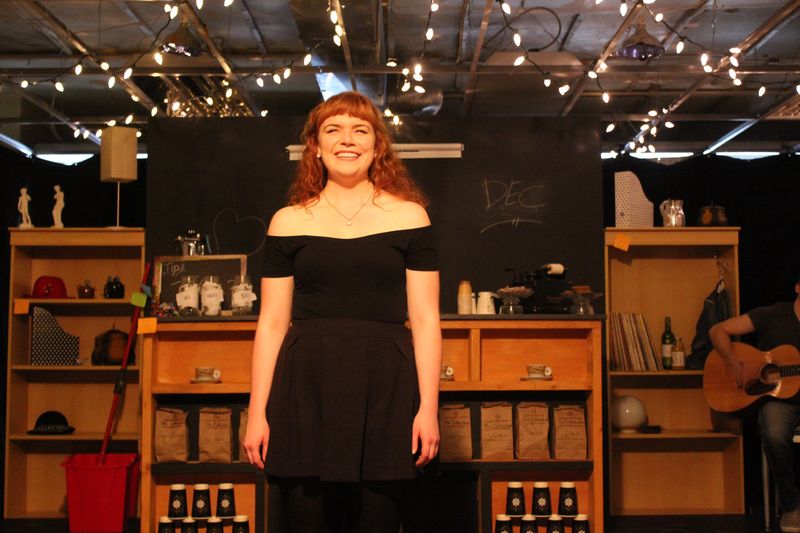
Confessions of a Redheaded Coffeeshop Girl playwright & performer: Rebecca Perry as Joanie Little. Photo Credit: Bryan Zilyuk

Confessions of a Redheaded Coffeeshop Girl playwright & performer: Rebecca Perry as Joanie Little. Photo Credit: Bryan Zilyuk

I’d say the benefits of doing a fringe tour are endless, you develop a Fringe touring family, lifelong friendships are forged and you start to develop a relationship with each city. You get to know the fringe staff, the media, the volunteers and what makes each city and fringe festival so special and original.

HS: What is the biggest thing you’ve learned so far touring your show to various fringe festivals?

RP: Always, always show your tech team some love. Holy cow do they have a crazy job!

HS: If you could give a new fringer or someone who is considering doing a fringe tour one piece of advice, what would it be?

RP: Be as organized as possible aka: plan in advance! The biggest thing is being ready before everyone else is. Get all your posters up and postcards out, be the person to flyer the first day of lines, know where every venue is and be a social butterfly.

HS: Why do you think festivals like the Toronto Fringe, and the Fringe festivals around Canada and the world, are so important? 

RP: I’ve seen some of the most ground breaking, heart-wrenching and fascinating theatre at the Fringe. It’s no wonder some filmmakers and fringe performers are finally making a documentary about it (shout outs to Nancy Kenny, Natalie, Cory and the rest of the “On The Fringe” documentary crew!) I know Fringe gets a bad rap for having “weird” or “inaccessible theatre” but honestly that just sounds like pretentious theatre-goers trying to pigeonhole the fringe into a certain category. For every “bad” show there are 15 amazing ones. I’ve seen so many mediums of theatre excel at Fringe festivals. I think that is the only way certain forms of theatre can exist what with the declining audiences of theatre these days. For some reason the Fringe just gets everyone out!

HS: If you could entice someone in 5-10 words to come see your show, what would they be?

RP: Challenge accepted!  I’ll make a little 10 word equation:

Hilarious (caffeinated) situations + indie music = my love letter to Toronto.

Short & Sweet Questions:

Favourite Coffee place in Toronto: Abbott of Parkdale

Go-to Fringe drink in the tents: CIDER!!!

What inspires you as an artist? When other artists around me are so brave. It inspires me to put my heart on the table like they do.

What’s your favourite thing about the Toronto theatre scene? That the indie scene is just as alive and kicking as the established groups.

What’s your artistic mantra?/Best advice you’ve ever gotten. “You won’t know until you try”

Confessions of a Redheaded Coffeeshop Girl

Written and Performed by Rebecca Perry as part of the 2014 Toronto Fringe Festival

RHCSG_FB_Timeline

Where – The Annex Theatre

When – July 3rd-13th, 2014
Thursday, July 3 – 7:00pm
Saturday, July 5 – 11:00pm
Monday, July 7 – 1:30pm
Wednesday, July 9 – 7:30pm
Friday, July 11 – 5:45pm
Saturday, July 12 – 12:30pm
Sunday, July 13 – 4:00pm

How can people connect with you online

www.redheadedcsg.com

instagram: @redheaded_coffeeshop_girl

twitter: @redheaded_csg

tumblr: http://coffeeshopgirl21.tumblr.com

facebook: Confessions of a Redheaded Coffeeshop Girl

bandcamp: www.redheadedcsg.bandcamp.com