Skip to content

Posts tagged ‘comedy’

In Conversation with Sex T-Rex – Presenting their Double Bill at the Storefront until March 27

by Bailey Green

I had the pleasure of speaking with Sex T-Rex performers Seann Murray, Kaitlin Morrow, Conor Bradbury and director Alec Toller about their double bill, on now at the Storefront Theatre (Danny Pagett and Julian Frid were unable to stay for the interview but are also performing.)

It began with a quote from the movie Predator, “this stuff [chewing tobacco] will make you a goddamn sexual tyrannosaurus.” And then one night, before an improv set, the announcer shortened the improv troupe’s name from Sexual Tyrannosaurus to Sex T-Rex, and it stuck. Performer Conor Bradbury laughs at the memory, “Hey, when someone’s right they’re right! There’s no need to be precious about your comedy.”

The group came together during their time at George Brown back in 2007-2008. Many elements of theatre school didn’t resonate with the actors but when they got together in stage combat class, then things really came alive. “It’s a triumvirate of violence really,” director Alec Toller jokes about the history of Sex T-Rex shows. “All of our action shows are centred around violence,” performer and producer Kaitlin Morrow adds. “Callaghan! was a lot of punching, Watch Out Wildkat is shooting and then Swordplay, which was loosely inspired by Princess Bride, has to do with, well, swords!”
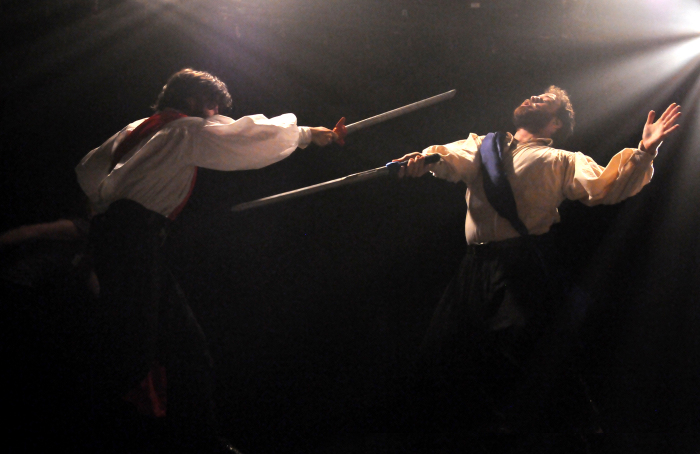
Photo Credit: Cindy Lopez

Photo Credit: Cindy Lopez

This double bill features Watch Out Wildkat! and Swordplay: a play of swords. “Even though we have done Wildkat in 4 cities and Swordplay in 2, we’re still riffing, especially in rehearsals,” Morrow says. “You can always feel when it happens,” Bradbury adds. “There’s this unspoken ‘keep it’ feeling when someone makes a good joke.” Toller says that the group strives for clarity above all else, “We do so much mime, and fake action movie stuff that we’re always fighting to be so precise.”

Toller directs the group’s scripted shows (they also do improv shows) which are written plays with a sketch origin. “It’s very collaborative,” Toller says. “It functions more like a collective, so basically I’m the person not on stage… where I belong… but my job is to manage what everyone wants to get out of it. This show is a remount, so we’re trying to improve as we go, punch things up, and that can be challenging because we have an existing structure but we don’t have an audience.”

Photo Credit: John Gundy

Photo Credit: John Gundy

Writer, producer and performer Seann Murray speaks to the group dynamic saying, “It’s very rare that we have camp A and camp B disagreements. Instead, we usually have eight ideas with each person having three and a half small ideas each.” Bradbury adds, “It’s almost like we’ll have one person who is camp A and one who is camp B, and everyone else just isn’t helping. But it always works out for the best. To have a bit of argument in the room means people care about the product.” Morrow adds, deadpanned, “So we just punch each other in the face until someone gives in.”
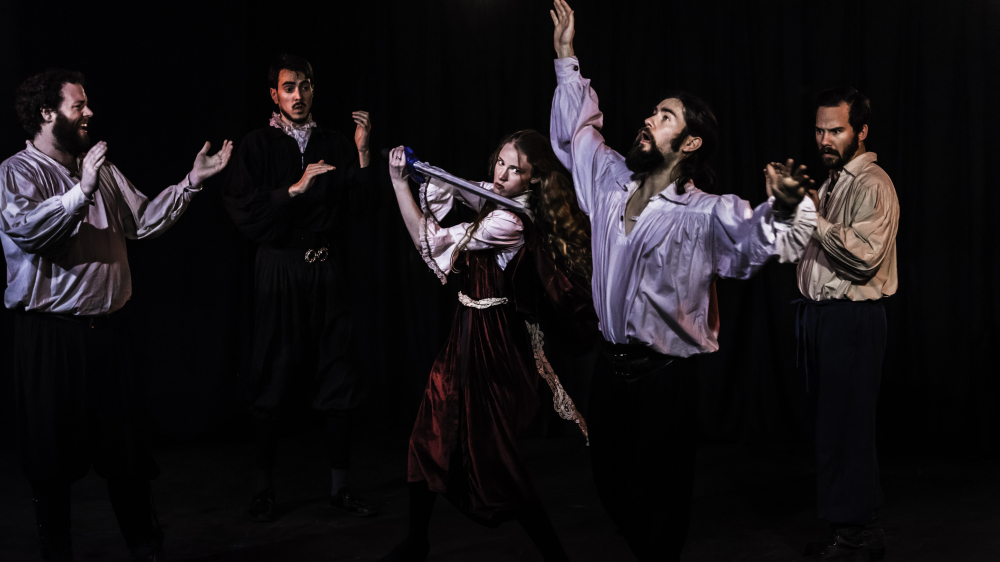
Photo Credit: John Gundy

Photo Credit: John Gundy

Murray writes the scripts for the group and describes the process:

“The first step is we identify the genre we want to work in. Then we watch movies and chat about the tropes we want to hit, what we want to see [in the show] from the genre. So it’s not just regurgitation, we want to honour the genre. Once we’ve consumed a bunch of media and batted ideas around, I write the script and we workshop it throughout the process. We often wind up with a small chunk of the script left, we stay true to the character and story more or less, but as Alec [Toller] said, there’s lots of really funny improvisers on the team so we’ll take a scene, work through it and put it back into the script.”

The group considers audience feedback invaluable. They often take their shows to Montreal Fringe before performing at Toronto Fringe. Montreal Fringe offers them the opportunity to try out new material and improve their work. “We change something after basically every show, we find something else we’ve never done before,” Bradbury says.

Photo Credit: Sharon Murray

Photo Credit: Sharon Murray

Morrow, the only female performer of the troupe, tells me how that for years she dealt with crippling nightmares centred around improv. Subconsciously, she wanted to get up and perform but she was terrified. Now, with 19 shows under her belt, she has realized that a bad set isn’t the end of the world and that the joy she feels from performing far outweighs the fear. “The first time I went up to improvise was for Shane Adamczak’s secret show Captain Spaceship in Montreal Fringe,” Morrow remembers. “He just assumed I was in the show because I was a part of Sex T-Rex, and when I tried to back out, he told me I couldn’t because there were no other women in the show. So I didn’t sleep for about a week, and then somehow I was backstage and then I was onstage and I did it. The relief was amazing, and you know, it wasn’t even bad!”

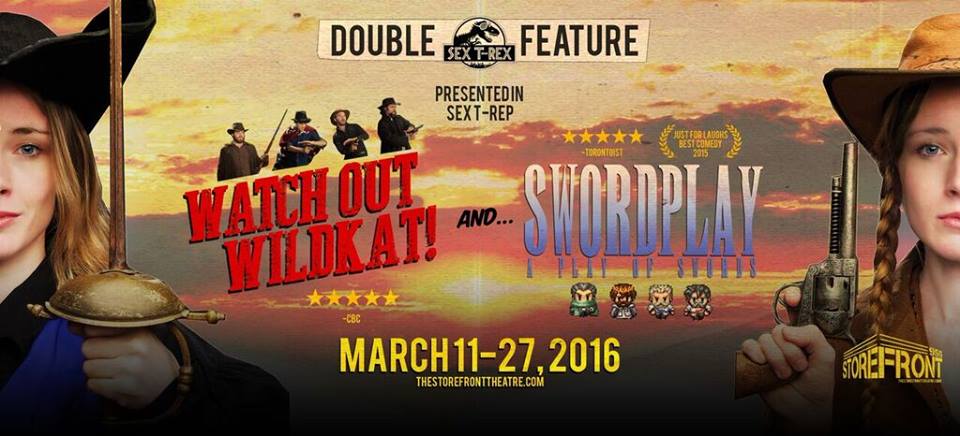
Watch Out Wildkat! & Swordplay: A Play of Swords
12733973_1287592624601107_2756752568443821603_n

Presented by Sex T-Rex
When: March 11th -­ March 27th, Wed­-Sun
Watch Out Wildkat! @ 7:30 PM & Swordplay @ 9:00 PM
Sundays @ 2:00 PM
Where: The Storefront Theatre, 955 Bloor Street West
Tickets: $20 for single show, $30 for both shows
Available at http://thestorefronttheatre.com/events/swordplaywatchout-wildcat/
Connect: sextrexcomedy.com

A Chat with Ryan Robertson & Peter Hodgins of Two Chips Theatre’s “Copy”

Interview by Ryan Quinn

We sat down with Ryan Robertson and Peter Hodgins of Two Chips Theatre Group to discuss their current production of Copy.

RQ: Tell me a bit about the show!

RR: Sure! It’s a workplace show, a comedy/drama. It has a few themes. Firstly, it’s about people who are frustrated about their job, who are not achieving what they want to achieve. The tension between men and women, and between generations of people. So, it’s a comedy, but with a lot of darkness in it as well. We see these characters superficially at the beginning, and then they reveal a bit more about themselves and open up.

RQ: So, you wrote this piece, you’re directing it, and you’re performing in it as well.

RR: Yes. By default, essentially. When you’re a new theatre company in Toronto, it is difficult. I wanted to start from scratch because, as a writer, if you want to put a play up you normally have to go about it certain ways and work with different companies; and you end up with so many oars in the water that your play can be something totally different than what you started with. I also really wanted to have the final say on my cast and whatnot, I mean, for example, Peter is absolutely perfect for his role, and everyone else is fantastic as well. I find that better than the collegiate approach where you have a lot of people involved. These guys are as much a part of it as I am, but I never feel compromised.

PH: (laughs) Yeah, there’s not much in the way of food at rehearsal.

RR: I mean, we got a lot out of it. We do find that there are no egos at this level in the game, when you’re starting at the bottom and working with people who are like-minded.

PH: It’s been a lot of fun, and it’s going to be more fun as time goes on.

RR: Yeah, we have plans to keep going with some of this same core group and with the same kind of mentality. We really want to go back to the idea of the independent repertory company. We don’t do it for money, though I know a lot of people don’t, but we really want to do our own plays, I find that really interesting.

RQ: Do you feel like new original Canadian work is something the independent scene needs more of?

PH: For sure, I mean, Shakespeare is great. Don’t get me wrong. But, I see casting notices for it all the time and I can’t help but think “Who’s going to see that? They must have already seen it three or four times”. Part of it is that there’s no royalties. These plays are all free, and so young companies don’t have to pay a writer. So, it’s good to find new original stuff, which, for the most part, you have to write and create and perform yourself.

RR: When you come forward with something original, some people want to come forward and try to change it, to say “this isn’t right, that isn’t right, etc.”. Okay, we have to put up a few bucks ourselves, but if people really want to support new plays, they have to go to them. I hear a lot of people complaining about the same shows being done over and over, but then they don’t go out and see original plays.

PH: Yeah, we really need this stuff. And I’ve spoken to Ryan about making this into a film because we’ll all be ready for it, and we all love it.

RR: The thing about original plays is, as well, that because you are the creator, it’s a journey. I saw it on the page, I’ve seen the characters brought to life. There’s no need to put a “new spin” on a character because they’re completely new. What’s also important to me is that everything should be natural. We didn’t want to fall into the trap of being a wee bit pretentious. It’s a workplace play, so it has to be kind of earthy. I don’t mean to use the word pretentious, that has a negative connotation, but I mean that as well as depicting higher class things, it should reflect ordinary life. Even in the plays about ordinary people, there’s probably a bit too much wordiness at times. This is a much more down-to-earth workplace show.

RQ: That’s something else I wanted to touch on. This show deals with the minimum wage. So, because of that, it’s inherently political, as well as being comedy. Is that true?

RR: When I spoke to other writers when I was younger, they’d say “never preach”. You find a way to explain big issues with humour or in a way that doesn’t condescend. I’ve tried to do that with all the characters. Characters are more interesting that way, I think, when they don’t have these grand speeches planned.

PH: As long as it’s real. If you accurately portray a segment of society, it’s going to be political.

RQ: What do you want people to be discussing on the way home? What do you hope it leaves an audience with?

RR: I would hope people would get from it that in a way we’re all divided by our employers, and we’re all slaves to our mortgages and our dreams, but we’re fragmenting as a society. If we all got together and understood each others’ pain, we could do a lot better. We are divided, and we do worry about ourselves too much, and that hurts society. After the show, we’d like to talk to the audience, see what they got out of it, right?

PH: Yeah. I agree.

RR: But I do agree that when we attack these things, we have to do it with humour, with a little seriousness thrown in.

RQ: I think it was Shaw that said “If you want to tell people the truth, you’d better make them laugh or they’ll kill you”.

RR: Exactly. That’s perfect.

RQ: And Peter, as a veteran performer, how did this project come about for you?

PH: I believe I found it on Mandy, actually. So I sent in my application and I erroneously asked if I could read the whole script. I guess that was a bad thing to do. So I didn’t hear anything for a while.

RR: So I went back to Peter after a couple cast changes, I wanted Peter from the start, and I sent him the script, and I guess he liked it. I tried to write something where everyone’s involved and has something to do, and consequently everyone in it seems to really enjoy doing it, so I hope that translates to the audience.

RQ: What’s exciting about this show for you, Peter?

PH: Well, this is my first time on a live stage, actually. I’ve done mostly acting in film and directing film, so that’s what’s exciting for me. Mail Room John is a very misunderstood guy, and I feel like that myself pretty often.

RQ: So both of you must have had an interesting time with approaching the work on day one. Peter, with it being your first time doing live theatre; and, Ryan with putting up your own work. How did you approach that?

RR: Well, I try to be a benign dictator. Every member of the cast has ideas and I wanted to avoid ego as much as possible. So, it’s been a real collaboration. We’ve had a lot of fun and I think that’s going to show through when we do it. It’s worked out exactly the way I wanted it to.

RQ: Going forward, what are your hopes for this company?

RR: Well, if people show up to this one, there will be more shows. I think it’ll be good because we don’t plan to stick to a certain group of actors, and everyone feels like a part of it. PH: Now that we have a great location, we can just keep doing it.

RR: It’s important that people come out because we ain’t made of money. We back it as much as we can, but we’re not a professional comedy. We’re just tailoring it to entertainment, not money.

RQ: Well, that’s become the new standard, hasn’t it? Independent companies doing professional-level work?

RR: Right, and you need to get dedication out of people because they are giving their time, so it has to count.

PH: I think it’s guaranteed we won’t make any money.

RR: If we break even, we’ll keep doing shows.


Copy

Written by Ryan Robinson, presented by Two Chips Theatre Group
Directed by Ryan Robinson
Featuring Alene Degian, Brian Stapf, Madryn McCabe, Peter Hodgins and Ryan Robinson
poster1.51123805_std
Where: Sterling Studio Theatre, 163 Sterling Road, Toronto, Ontario, M6P 0A1
When: March 18-22 8pm, doors open at 7:30pm
Tickets: Advance tickets $15+service fee, At-the-door tickets $15 cash only
Concessions available, cash only
For more information:
www.sterlingstudiotheatre.com
www.twochipstheatre.com

Morro and Jasp on the Nature of Relationships

Article by: Morro and Jasp
Photos by: Jackson Klie
Styled by: Mahro Anfield
http://www.morroandjasp.com

On the interpretation of ‘feelings’ as they pertain to the understanding of being ‘involved’ in, as, or with a society upon which the dependence of ‘another’ is debated and discussed OR How many licks does it take to get to the centre of a Tootsie Pop?

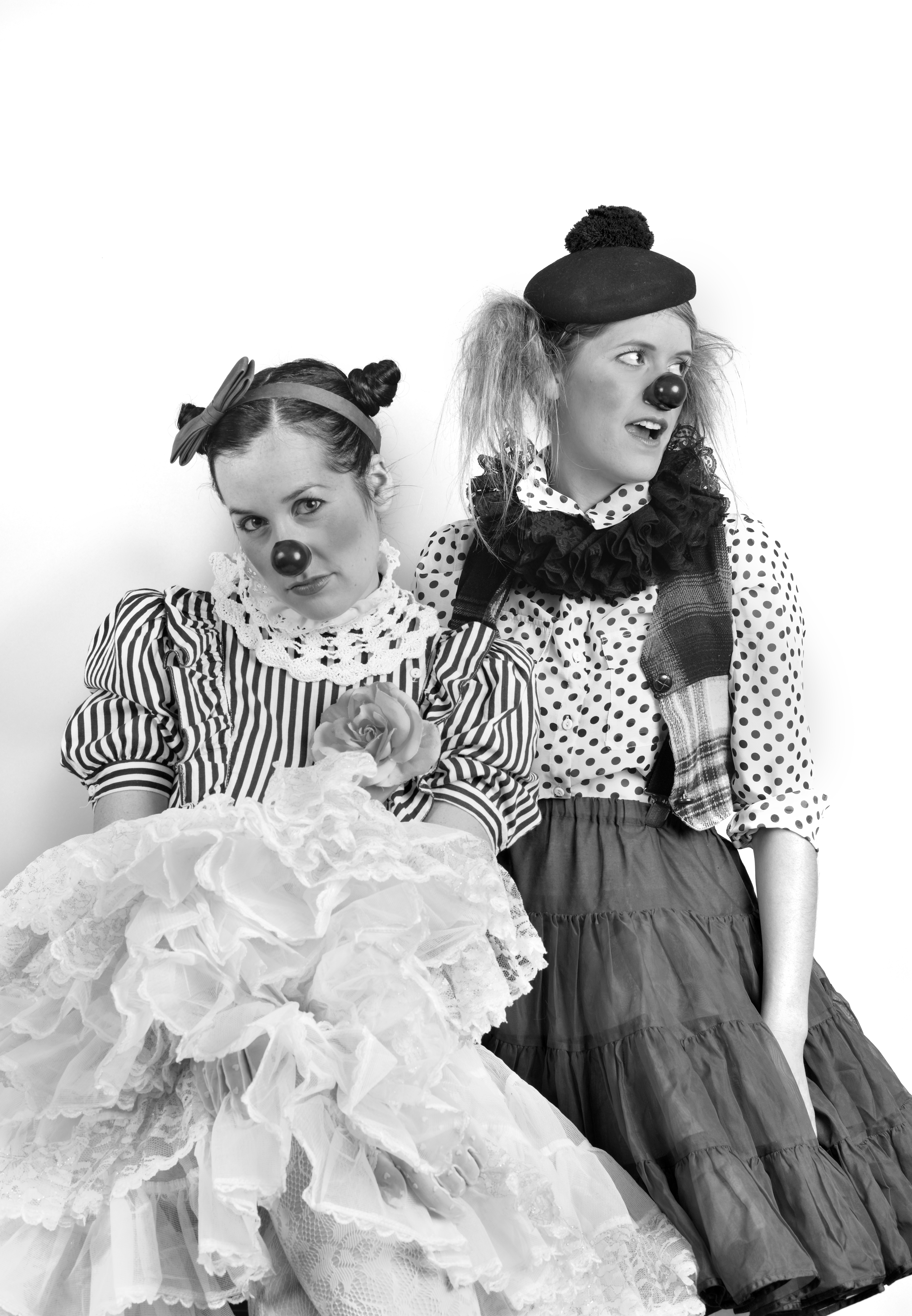
Morro and Jasp sit, sisterly, pondering the nature of relationships – theatrical, theoretical and thematic.  They often sigh before speaking, and pause before pronouncing their opinions.  They are very much, as the French say, “a la carte”.
JASP: Morro, tell me the honest truth – how do you feel about me?
MORRO: Without you I am not a thing, I am no thing, I am a lone tree in the forest and therefore not really there. Je suis la tristess!!!! Je suis la pizza without la sauce.
JASP: Really?
MORRO: Or maybe I’d be really excited to finally not have to report to anyone but secretly I’m too chicken-shit to find out if that could be true- the risk is too great. Take cover troops. Stay protected!!!
JASP: I see.
MORRO: And what about you Jasp? What are your feelings on this subject?
JASP: I think feelings are one of, nay, the most important things we have. They’re the only thing we have really. Every morning I wake up and write a journal entry about how I feel; from the dreams I had the night before; how my day is going to go; how hungry I am (hunger is after all, a feeling), etc.
MORRO: (sarcastically) Fascinating.
JASP: (ignoring her) Sometimes I think my sister is the only one who really knows me, yet she doesn’t know me. We share the same blood but different souls. I yearn for the day I will find the one who shares a soul with mine and we can lick to the centre of the proverbial Tootsie Pop together (No offense, Morro).
MORRO: None taken.
JASP: What are your thoughts Morro?
MORRO: I was pondering the other fortnight and upon my musings I imagined a world in which there were no farms. How horrible an utterance was this that a tear I did shed from my left eye. My right eye does not release fluids so readily. Imagine a city without a farm. Don’t’ actually imagine it , that was a rhetorical question. But think of it, what would we eat? I once sat under a tree at Riverdale Farm with my tootsie pop and let two drops of said liquid fall from mine eye (still the left one). Without a farm never can one indulge in such a delight. What was the question again? Jasp, it’s your turn.
JASP: My feeling about the actual topic, not about farms, is that relationships are so impossible because people place the importance of logic over feelings and emotion. People think logic is important, but it’s an illusion. There is no logic, our feelings are really all that guide us. That’s the only reason I don’t have a boyfriend. Boys want to think they can be independent and resist my charms. But the reality is that I am so romantic that it’s hard for people to handle.
MORRO: Boys are not the topic either Jasp.
JASP: (with conviction) I believe in romance films and novels. They are my religion, if you will, and people are intimidated by the feelings I bring out in them so they run away. Their logic tells them it’s not “normal” or “practical” to feel such strong romance in this day and age. An age of course cyber-dating and cheap pornography. But old-timey romance is alive and it burns like a fire within me. (You can find my profile on Plentyoffish.com)
MORRO: Oh I get it, you’re like a chicken with it’s feet cut off.
JASP: No.
MORRO: Your life is like the sound of two hands clapping, loud but lonely, and without me you’d be —
JASP: No, you’re not listening.
MORRO: I see, I see. What you’re saying is you can’t judge a book by its colour, that life is like rolling moss, it gathers, and then gets stoned.
JASP: MORRO!
MORRO: I know Jasp, It’s always darkest after the dawn.
JASP: Whatever.
MORRO: (singing) Feeeeeelings!  Nothing more than feeeeelings!!!
Jasp gets up and leaves. Morro continues to sing until she notices Jasp has left, then is silent, with no one to hear her, she becomes still.

– fin