Skip to content

Posts tagged ‘Greg MacArthur’

In Search of Truth (Whatever That May Be) with Craig Hall, Director of Faith Healer

Interview by Bailey Green

Acclaimed director Craig Hall called me from Alberta to talk about his experience directing Faith Healer at the Shaw Festival this season. Written by Irish playwright Brian Friel, Faith Healer is the story of a man, his love, his manager and his gift (to skim the surface). The text is elusive, complex and haunting. I spoke with Craig about direct address, rehearsal process and personal truth.

“Friel sent us a letter at the very beginning. It was waiting for me in my mailbox: written with an old manual typewriter with little cross outs in pen. You could only get in touch with him by fax. I fax-ed him saying I had a lot of questions. He faxed me back and said I don’t have any answers,” Craig laughs as we begin our conversation.

Craig got involved with the Shaw Festival a few summers ago. He was festival attendee for a few years before the offer to direct came at the right time as he was considering transitioning out a job. It was a great opportunity to take the summer to take stock and “really see where my career was going”. I asked Craig how similar or different Faith Healer was to his prior body of work, “Oddly it was kind of right of my alley. For some reason I have done a lot of solo shows with a lot of direct address”. He had worked on Greg MacArthur pieces which involve hindsight and memory as dramatic devices. “Stylistically, there’s a kinship. Direct address storytelling with this show is where the events have transpired but they are still living in the immediacy of it” he adds, “But once we got into the density of it none of us were prepared for how complex the piece ended up being.”

Shaw_FAITH_WebGallery_7

The structure of the show is deceptively simple: four sections, three characters, direct address and pure storytelling. It was the simplicity of one actor and an audience that drew Craig in to the piece. That and the complicated overlapping narrative structure. And though Craig had recently taken over a theatre company in Calgary, the fantastic writing helped make his decision.

With such an intense script, I inquired about the rehearsal process.

“It was pretty straightforward. And yet there’s no interactions between the actors [on stage] yet they have lived twenty years together. I had a lot of ideas in my mind about a complex rehearsal process but the actual structure of the rehearsal process didn’t work with that. We went through [the script] and scheduled in such a way that we touched on them [Jim Mezon, Corrine Koslo and Peter Krantz] all individually and kept them at the same pace. We let them have their own individual process but we wanted them to be moving through the piece at a similar speed.

Over the course of a month and a half, I would bring them every seven days into the room together to run through the whole piece so they could hear each other’s stories. You never wanted them to forget that their truth wasn’t the truth of the others. They embraced it and railed against it based on what their experience was. They wanted to love each other and be together [as a cast] but still it [the show] was so individual.

We went in there thinking it was a simple thing and were floored by how complex it really was. It was so complete unto itself. Every time we tried to add something it felt wrong. We became very happy with that fact.”
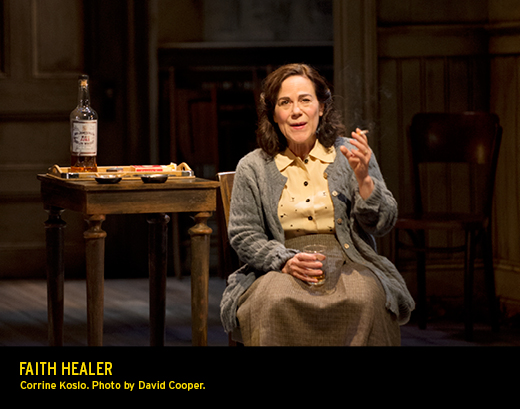
Shaw_FAITH_WebGallery_2

There are many challenges in a monologue play and we discussed the fine line between directorial and playwright decisions for staging. The play often had been produced on a mostly bare stage with perhaps the addition of a curtain at the back. Craig wanted to “put the story in a place that was charged with their history. Some people liked it, some didn’t. Jim [Mezon] said I get it, it’s a bare bones version of where they spent their lives while the other two [Corrine and Peter] were more literal. [The set] is a place for remembering.” He praised lighting designer Bonnie Beecher’s talents. She crafted a beautiful sequence at the top of the play of sunlight traveling from morning to night, spilling in the windows and marking the passage of time. She drew inspiration from Edward Hopper’s painting.

In his director notes, Craig spoke about truth. I asked if him and the cast had a found a solid truth beneath the tangled stories of this play or if they found everyone’s truth to be valid for themselves. He spoke to the latter:

“I think that’s where we landed. We rigorously went down this road. There were times when we thought this guy [Frank] was full of shit. These characters have their own individual truth. That and there is no way to play a lie like that on stage. If any one of these characters is consciously lying what does that mean? It would undercut the power of what they were talking about. There were so many things we didn’t reconcile ourselves with but let it go. Each of the characters is telling the truth as they see it. I think people are doing that constantly. There are people who know they are pulling the wool over someone else’s eyes. And some people keep telling the same lie until it becomes a sort of truth. If we play him [Frank] as a liar, the audience writes him off, but if you play it truthfully you leave it up to the audience.”

And how was it working at the Shaw Festival? “It was an exciting experience to me to work with this amazing talent and have the time and resources that we don’t normally have in the theatre world.”

Faith Healer puts the audience in limbo as we experience three characters’ individual re-experiencing of the traumatic and marvelous experiences from their shared past. And as their stories collide and contrast we debate and wonder what is true and false. But in life, as in the theatre, “we recreate history to benefit ourselves. If you can’t deal with something you paint it a different way in your mind so it is more palatable.”
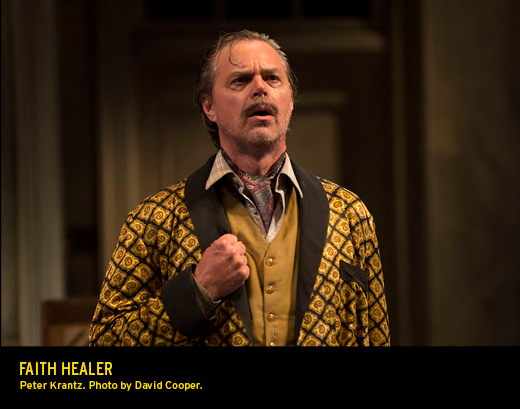
Shaw_FAITH_WebGallery_9

Faith Healer

by Brian Friel
Directed by Craig Hall
Where: The Shaw Festival, Royal George Theatre
When: June 13th-October 6th
For more information and tickets, check out the Shaw Festival Website.

Artist Profile: We Chat with Dynamic Duo Donna Marie Baratta & Jessica Carmichael on their Upcoming SummerWorks Show with Present Danger Productions girls! girls! girls!

Interview by: Brittany Kay

I sat down with dynamic duo Donna Marie Baratta and Jessica Carmichael to discuss first time co-directing, life in Toronto and of course their upcoming show girls! girls! girls!

DSC_4661 cyan cropped

BK: Tell me about your show at SummerWorks?

DMB: The play was inspired by the murder of Reena Virk in Victoria in 1997, who was lured by a group of teenagers to a bridge and beaten to death. One girl stood up and said this is enough but two individuals, a girl and a guy went back and ultimately killed her. Both ended up in jail and the girl is still in jail.

JC: It explores themes of isolation, a sense that there is no way out of a small town, friendship, sense of loneliness in family relationships and marginalization. Reoccurrence of these types of stories keep coming up in the news and in society. I can speak to it as a mom as well. My daughter will be a teen one day and there’s no easy solution to these issues.

DMB: It’s not just a message play. It is certainly a play where you hopefully won’t be sedated, but instead explore and ask questions of why there is this banding together amongst the characters? There’s something in this banding together of friends.

BK: How did you find the play?

JC: We met Greg MacArthur at UofAlberta when he was doing his residency there. DM and I were completing our MFA in directing. Greg is wild and wonderful and fun. When DM and I were talking about going on a journey together in terms of creating a company, we were saying what do we want to do? What kind of work? We wanted to explore new Canadian work – that’s something which is very important to us. In reality, people don’t return to Canadian work. A new work will be workshopped and then there’s no life after that.

DMB: Greg hasn’t had a work produced in Toronto in ten years – he grew up in Lindsay ON, went to Ryerson theatre school, has been in Montreal for the last fifteen years and Edmonton for two. After reading his plays we were trying to figure out WHY they haven’t been looked at in this city. So many amazing Canadian plays get lost and forgotten.

JC: We approached him. We were in love with this play. It was about complicated female voices and there’s a lack of that in playwrighting. Even when there are strong female playwrights it’s not often a female voice.

DMB: Both of our energies and passion throughout our MFA were focused on looking at female voices. What is that voice and the complications around that, which are so fascinating.

JC: Greg’s story in and of itself is about that female voice that’s disillusioned. Reena, Amada Todd, Rehtaeh Parsons-they were disillusioned by society, they didn’t have the proper kind of help and that’s something that we’re interested in exploring as female directors. Why is that? Why is female violence on the rise and why is it taboo to talk about?

DSC_4518 white

DMB: The play’s issues are inundated right now in the media. There are so many things in the media right now that just said this is the right play to do now. This is the right play to bring out and have more questions asked.

BK: It is so relevant to the younger generation right now. I feel that there will be so much understanding from young audiences. Our lives are so wrapped up with social media and the lack of privacy and empathy.

DMB: The characters are all true victims in this. You are going to side with the perpetrators. They all are marginalized in their lives. They clearly needed someone in their lives to say I love you. I’m here for you. You realize they don’t have that and they only have each other. They’ve created some kind of bond around their own pain. That’s scary.

JC: They have to ‘other’ that pain around someone else.

DMB: They have to numb their pain in various ways, for example, like blasting music in their ears. They numb themselves from what is going on in society.

JC: In every play you ask questions, you get more questions coming back at you.

BK:  Your advertising is mysterious and doesn’t really give us any clues as to what the play is about. Can you speak to the ambiguity in your promos?

Promo Video 1 for girls! girls! girls!: https://www.facebook.com/photo.php?v=10151793347946031&set=o.133383070204277&type=2&theater

DMB: We wanted to create some interest in the world of these teens and their characters. We wanted the audience to see their lives together as friends before the play and the world they inhabit. We wanted to peak their interest making them ask questions. “What is this play about?” “I don’t know Reena Virk but there seems to be much more to it than that”.

JC: We don’t want people to see a message play. It is a play about an issue, but we didn’t want to promote it in that way. We wanted it to feel more like a character piece in which audience can relate to them. You’re dealing with human beings and fully formed creatures. Youtube is an outlet for these characters to speak, and for a lot of teens in this day and age. We wanted to hook into that. That’s their lives and that’s how they promote themselves.

DMB: We wanted an invitation. The video is good way to invite people into their world. The show can be quite heavy and we wanted to show that these are teens and these are their group of friends. See their playful interaction before you are exposed to the dark aspect of the play. You see that it is also about friendship as well, which is important. We all know how important our friends are, which is a big theme throughout the play, the extent of that friendship.

BK: Did filming these videos help the actors with character development?

JC: Yes, of course. The process is so important, not just the product. It was an exploration that we used with the actors so that they could develop their characters.

DMB: They explored their lives outside the rehearsal space. These videos were created during rehearsals in order to create a deeper character life.

Promo Video 2 for girls! girls! girls! https://www.facebook.com/photo.php?v=10151793351766031&set=o.133383070204277&type=2&theater

BK: Now about you both. Why the name Present Danger Productions?

DMB: One day I woke up, called Jess and said what about Present Danger? Can we use that? I had this image of traffic signs in my head – “caution” and “tread softly”.  We want to be on the edge. We want to be able to push the boundaries in what we can talk about and what we can show and explore.

JC: There’s not a lot of present danger in Canadian theatre. There’s not a lot of risk being taken. We want to be bold in our choices and not be afraid. We want to be present in being dangerous. It’s also a bit cheeky.

BK: So you guys met at the University of Alberta in the MFA program for directing?

JC: It’s funny because we were told on day one that we weren’t going to be friends – “You probably won’t get along, you don’t need to”. It’s intense in that it’s only two people in your year. We didn’t get to interact very often, so it’s very ironic that we in fact did get along so well.

DMB: We feel fortunate to have gone through it together. We have both come from different backgrounds. We see through different lenses.

JC: It’s very complimentary.

DMB: We would talk about our work together, bounce ideas off each other, and now have come together to start a theatre company.

BK: And where are you from originally?

JC: I lived in Toronto 10 years ago. I’m not originally from Edmonton but I grew up in Edmonton. Went to The National Theatre School in Montreal and RADA in London.

DMB: I was born in Thunder Bay, came to Toronto for a while to do a show, went back to Thunder Bay for University and moved back to Toronto in 2005.

BK: Now you’re here in the T.Dot. How do you feel about the theatre community in Toronto?

DMB: People are so friendly and open in the community.

JC: There’s more opportunity. There are so many artists here to collaborate with. The audiences here, especially for SummerWorks, are so much larger and of all different ages and interests. We’re really looking forward to meeting people. That’s the beauty of these festivals in the summer.

BK: Why SummerWorks as the launch for your company?

JC: There are a lot of theatre artists that will come to this, that’s who we wanted to expose our work to. Because it is the beginning for us in Toronto, we wanted to meet other artists and this festival will enable us to do that.

DMB: It opens up so many avenues and opportunities. It’s a place where artists go, where you can have discussions about the work being produced. We really want people to talk to us about the play. Whether they love it or hate it, we really want to hear it! Theatre for us is about talking, discussion and opening up the channels for communication.

JC: And we know it’s not going to be perfect. It’s nice to talk to other artists to hear those opinions, to allow us to grow as artists.

Jessica Carmichael and Donna Marie Baratta, Co-directors of girls! girls! girls!

Jessica Carmichael and Donna Marie Baratta, Co-directors of girls! girls! girls!

BK: Is there a future for Present Danger?

DMB: Yes, of course! We don’t want to rush what our next production will be. We both have projects we love. We need to sit and discuss what direction we want to go, and also what other avenues that can be produced, that wont cost us an arm and a leg!

JC: And after we’ve gone through this experience, we can have discussions about how we can move forward from what we’ve learned. This is the career. There’s no going back. It’s a love affair.

BK: What do you hope for audiences to gain from girls! girls! girls! ?

DMB: We want them to be asking questions. We are really thrilled with our actors. We hope audiences see how hard they’ve worked. We hope that this is a great platform for them and for their career as they’ve been such a true pleasure to work with. Hopefully audiences don’t want to leave their chair because they want more.

JC: I hope they laugh out loud at the show and are equally disturbed by their laughter. I hope they have an opportunity to reflect on the issues that need to be discussed and not overlooked. We want people to keep talking about the play once they’ve left, be challenged by the piece and be affected by it. We want them to think about it days after.

BK: What is the strongest advice you’ve ever gotten as an artist and how has it affected your work?

JC: You don’t need to be so polite in your work. You need to believe in your work. Don’t pussyfoot around the big issues that you want. Don’t be afraid to be passionate or to be a passionate woman at that!

DMB: Be bold. You can ask for what you want. You can really be bold and brave in the choices you make. Ultimately, be true to yourself. Being a director can be isolating as you are on your own. You’re constantly discovering your voice. Sometimes you need someone to say “yes, that’s okay”, that there is a right or wrong way to direct, that there is a system, but ultimately there is no system. Don’t be too polite and challenge yourself. Give yourself permission to do some crazy things.

JC: Pina Bausch once said “You just have to get crazier,” which is beautiful. You have to constantly ask why? Why this story right now? You have to keep going back to the root of that in rehearsal. That’s not often asked these days. When people just randomly choose the same shows across the country…for what purpose? Why are you choosing this show… because it is going to be a big sale? ? Just to ask yourself that question of ‘why this story’ as an artist, makes the work much more personal.

DSC_4784 enhanced contrast

girls! girls! girls!

by Greg MacArthur, presented by Present Danger Productions as part of the SummerWorks 2013 Festival

Where: The Scotiabank Studio Theatre, Pia Bouman, 6 Noble St. (at Queen and Dufferin)

When: August 8th-17th, 2013

Thursday August 8, 7:00 pm
Saturday August 10, 9:30 pm
Monday August 12, 7:00 pm
Tuesday August 13, 2:00 pm
Wednesday August 14, 4:30 pm
Thursday August 15, 2:00 pm
Saturday August 17, 9:30 pm

Tickets:  $15
Book tickets online – http://ticketwise.ca/
By phone: Lower Ossington Box Office at 416-915-6747