I spoke with Matthew Gorman, writer of Western, a play with music, at the Next Stage Festival, to discuss exploring the Western genre in the theatre, using music as a driving force in storytelling and the excitement of watching the NSTF grow over the years.
Matthew Gorman:Western started as a retelling of a Johnny Cash song. It’s actually written by Sting, but Johnny’s version is the good one. It’s a song about a boy accidentally shooting a man and being hanged for it. I had initially intended it to be a solo piece and just follow along with the plot from the song but as I got going, I started to like the people around that story more and more. After trying a few versions of the script, we hit on the idea of a theatrical campfire, where a story was shared between the characters and the audience rather than having it presented in a more traditional fashion. This gave us more space to breathe and see what parts of the story needed telling and what needed showing.
HS: What drew you to explore the Western genre in a theatrical setting with this piece?
MG: I like archetypes. You know a bad guy is a bad guy because he’s the bad guy. People have expectations of characters in a western, so you don’t need to spend time explaining who everyone is. The sheriff is the sheriff. You’re playing with the form those characters take.
HS: The show is described as being “a play with music”. What kind of role does the music play in the show and why was it important in the creation of the piece?
MG: Any good campfire has music playing. You pass around instruments and people take turns sharing a song. When we initially approached Gord (Bolan) about providing some music for an early staged reading, we thought he’d maybe play a few Hank Williams songs between scenes. When he showed up, he’d scored the whole thing and written a few originals. His presence in that reading showed us that he could be a featured part of the story, a driving force that influences the characters, rather than just accompaniment. We called it a play with music because it wasn’t a traditional musical, it’s a play where people sing sometimes.
HS: What are you most looking forward to this Next Stage Festival? (aside from the presentation of your piece, of course.)
MG: I was a bartender at the first couple Next Stage Festivals, so I’m always looking forward to how the feel of the whole festival grows every year and things change.
HS: If your audience could listen to a song, album or playlist before coming to see Western, what would you recommend?
MG: People should listen to lots of John Fahey, Leo Kottke, Bonnie Prince Billy, Neko Case, some Gillian Welch. Any country music that isn’t about football.
Rapid Fire Question Round:
Favourite Western Film: The Proposition. Nick Cave wrote all the music, it’s great.
What are you watching these days? I’ve been on tour most of the fall, so a lot of Netflix. I watched a bunch of Penny Dreadful. It was amazing and terrible and cheesy and great and Simon Russel Beale is always delightful.
Where do you look for inspiration? Art galleries, always.
Favourite place in the city? We’ve been members at the zoo for years. We almost got married there. It’s the best.
Best advice you’ve ever gotten? Write whatever you want, let someone else worry about how to stage it.
Describe Western in 5 words: A campfire where people die.
Western, a play with music
Photo by Tanja Tiziana
Who:
Presented by The Harvey Dunn Campfire
Text by Matthew Gorman
Music by Gordon Bolan
Director Geoffrey Pounsett
Featuring Mairi Babb, Gordon Bolan, Brendan Murray, and Caroline Toal
What:
Part myth, part campfire song, this show is a reckless chase through an imagined western landscape. Nance wants a son, Reach wants a home, Dirt wants release, Jenet wants her brother, and Rabbit just wants to run. Join these acclaimed indie theatre artists ‘round the fire for a story about family, blood, and claiming what’s yours.
Where:
Factory Theatre Studio (125 Bathurst St.)
When:
January 05 at 06:30 PM
January 06 at 05:15 PM
January 07 at 07:30 PM
January 08 at 04:15 PM
January 10 at 06:30 PM
January 12 at 07:15 PM
January 13 at 08:45 PM
January 14 at 02:15 PM
January 15 at 03:30 PM
It’s a complete joy to connect with Anika Johnson and Barbara Johnston of Johnson & Johnston, the power duo boss ladies behind Blood Ties at the Next Stage Theatre Festival. We spoke about where the inspiration for their horror musical came from, why they keep coming back to their flagship show after 10 years, and why the Next Stage Festival is like a big community party.
Hallie Seline: This is your flagship show as Johnson & Johnston. How did the two of you meet and start creating together?
Anika Johnson & Barbara Johnston: We met as acting students at Ryerson Theatre school and wrote the first draft of this show for a festival of student work in our fourth year.
HS: So Blood Ties is based on a true story? How did you come across it?
J&J: One time Barb was stuck on a long car-trip with her family and her mom talking about this crazy day when her uncle shot himself in his bathroom and she and her friends had to clean up the mess.
HS: And what made you think “This has to be a musical!”?
J&J: Duh.
HS: This will be the fourth time presenting Blood Ties, right? The Next Stage Festival is all about bringing the work to the next level. What are you hoping for/exploring with this run of the show?
J&J: The first draft of Blood Tieswas the first thing we ever wrote together, almost 10 years ago. Since then, we’ve written a whole bunch of other things, but for some reason we keep coming back to this one. In some ways, it’s the work that most unabashedly represents our taste – it’s funny, it’s feminist, it’s a horror musical, it’s a sexy thriller – and we’re excited to revisit it now as more seasoned writers and share a work that’s had some time to develop and grow.
HS: The festival is celebrating its 10th Anniversary and it’s been growing every year! Why do you think it’s so important for the theatre community and for the city for festivals like this to exist and be supported?
J&J: New work needs an audience, both for exposure and development. It’s hard for theaters to risk programming or developing a new show, especially a new musical, which takes years to finish. In a festival like Next Stage, we get the opportunity to fully realize an idea and then try it out in front of an audience – and audiences get the opportunity to see professional work from artists who may not otherwise have a platform. Plus, a festival is an event – like a giant family reunion. It brings the city together and builds community, which is so important. It’s a party. And we love to party.
HS: If your audience could listen to a song, album or playlist before coming to see Blood Ties, what would you recommend?
J&J: Maybe the soundtrack to The Virgin Suicides’? But actually.
Rapid Fire Question Round:
Favourite Horror Film: Scream and Fatal Attraction. Favourite Musical: Sweeney Todd. What you’re listening to right now: Current faves that made their way into Blood Ties somehow: Kimbra ‘Settle Down’, The Rolling Stones ‘Miss You’, Martha Wainwright ‘I am a Diamond’. Where do you look for inspiration? For this show, classic 90’s sexy thrillers and the lives of ourselves and our friends. Favourite place in the city? This month, we’re really into karaoke at the Duke on Queen East. Best advice you’ve ever gotten? It’s not going to look the way you thought it would. Describe Blood Ties in 5 words: The things we never mention.
Blood Ties
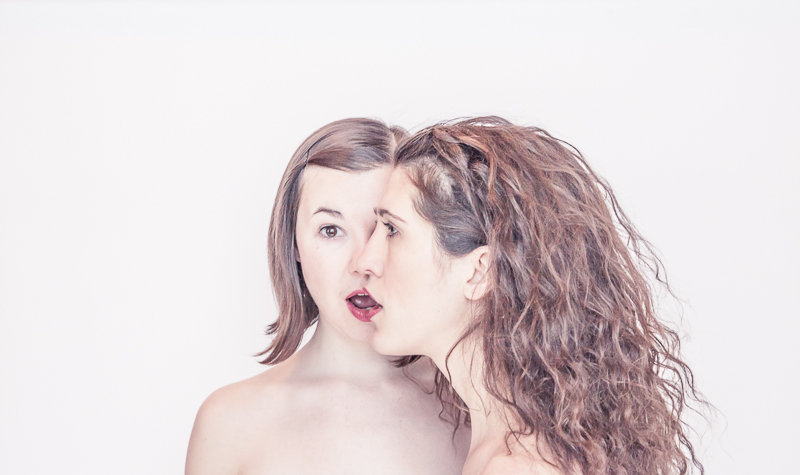
Photo of Anika Johnson & Barbara Johnston by Tanja Tiziana
Who:
Presented by Edge of the Sky
Playwrights Johnson & Johnston
Director Ann Merriam
Featuring Anika Johnson, Barbara Johnston, Jeremy Lapalme, Carter Hayden and Kent Sheridan
Musical Director Jeffrey Newberry
What:
Sheila’s uncle shoots himself in his bathroom on the eve of her wedding, and when her three best friends arrive in town to celebrate they are instead faced with the task of cleaning up the considerable mess left behind. This flagship musical show by Dora-nominated team Anika Johnson and Barbara Johnston has previously been a hit at SummerWorks, the Edinburgh Fringe, and on BBC America’s ‘Orphan Black.’ Based on true events.
When:
January 04 at 08:15 PM
January 05 at 07:00 PM
January 07 at 04:15 PM
January 08 at 06:30 PM
January 10 at 08:45 PM
January 12 at 05:15 PM
January 13 at 10:00 PM
January 14 at 02:00 PM
January 15 at 07:00 PM
I had the pleasure of chatting with the fierce artists of Quote Unquote Collective, Norah Sadava & Amy Nostbakken, the creators and performers of MOUTHPIECE. We spoke about the necessity of precision, time and digging deeper in their creation process, the importance of touring and continuing the conversation nation-wide, and finally… #traininglikebeyoncé.
MOUTHPIECE is on stage now to November 6th at Buddies in Bad Times Theatre, presented by Nightwood Theatre as a double bill with Anna Chatterton’s QUIVER (Keep posted for our interview with Anna).
Hallie: I was floored when I first saw MOUTHPIECE, so I’m thrilled Toronto audiences are getting another chance to see this! Can you speak about what sparked the creation of the show?
Norah Sadava: The spark that ignited Mouthpiece happened midway through making an entirely different play. Amy and I had begun working together on a piece about female relationships, but we couldn’t quite get at the heart of it without looking deeply at ourselves, and once we did that some major lightbulbs turned on for us. Once we started to dig inward we suddenly recognized our own hypocrisy, our own contributions to the oppressive heteronormative-white-supremacist-capitalist-patriarchy, our own confusion and inner conflict regarding where and how our generation fit into the ‘women’s movement’, and how we personally could rail against the stereotypes that have been fed to us through every portrayal of women we’ve seen since the moment we were born. So we decided that we had to make a show about that instead.
Photo by Brooke Wedlock
Hallie: How did you develop the piece into what it is today?
Amy Nostbakken:Mouthpiecewas developed over a period of three years. That may seem like a long time but it is a drawn-out creative process that allowed us to insist on every moment being charged with multiple layers of meaning. It’s not an exaggeration to say that every breath and swallow and shrug in this show has been thought about and has a purpose.
Hallie:I’d believe it! You two are so precise in the show. It’s incredible to watch a piece with that much detail, intention and precision. It packs a punch!
Amy: When we decided to tell this utterly personal and extremely necessary story of what it is like to be inside one woman’s head, thus tackling the theme of what it is like to be a woman today, we did not take it on lightly. And it’s complex, you know? It’s subtle and non-linear and messy and also terrifying. So a lot of time was spent going over a piece of text or movement or music and asking – “Is this honest? No, but really? Have I censored this, or molded it to fit into my pre-existing ideas of what is ‘good’ which have inherently been crafted by some dead, white man?” For us it was just too damn important a subject to rush into production.
So to answer this question technically: we developed this piece through years of research, years of digging deep and then deeper, then needling right into our very cores, years of examining our own hypocrisy and privilege, years of stripping away, and countless hours of repetition in front of a mirror.
Amy Nostbakken and Norah Sadava. Photo by Joel Clifton.
HS: I see you’ve been touring the show across Canada. Can you speak a bit about your experience bringing this show on the road and how it has affected you as performers and creators, and this piece?
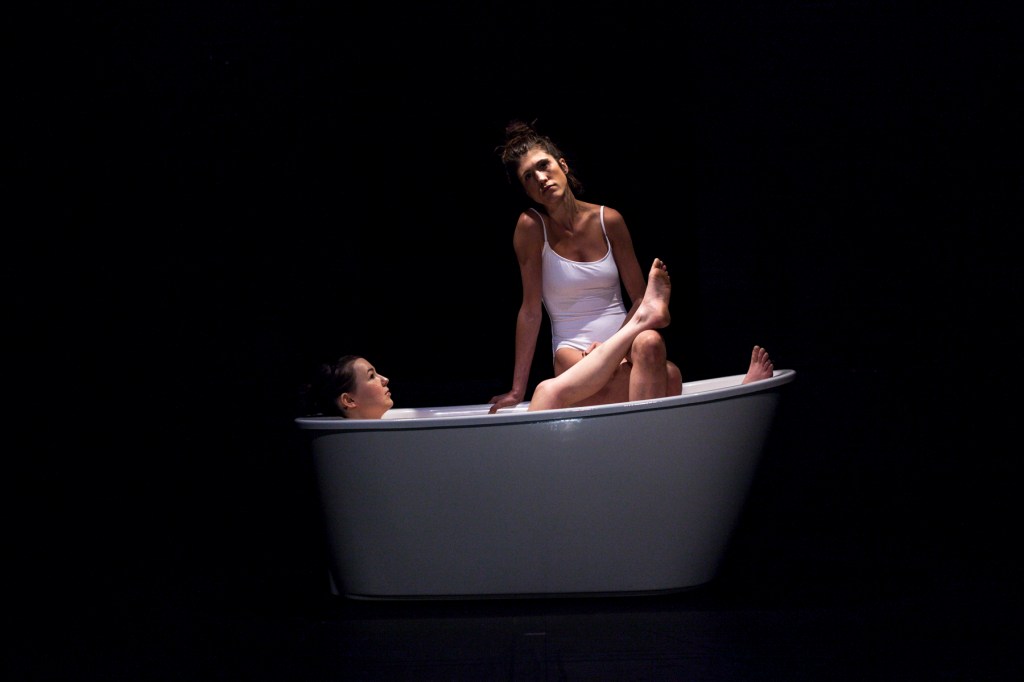
Norah: Taking Mouthpiece on the road has revealed to us that this conversation must be national. We can’t solely exist in our own little liberal-west-Toronto-artist bubble and preach to the choir forever. It is important to us to have our work challenged by other perspectives, other communities, other geographies, and hear responses from people from all sorts of different backgrounds. Feminism has to be intersectional or it’s not really progress at all. Of course we acknowledge that a theatre audience is already inherently biased based on the fact that they are at the theatre (have the money, time and interest to expose themselves to experimental art) no matter what town we are in. But having played this piece across the country, we can say that there are some truths that are a national (and international) matter. We’ve also learned that a bathtub can travel, and how to get the most possible free snacks on airplanes.
Norah Sadava and Amy Nostbakken. Photo by Joel Clifton.
Hallie: I’ve been seeing these incredible “training” videos of you both getting yourself ready to perform the show. It’s a huge feat watching you both do this show. Can you speak about doing this training, why you’ve found it’s important and where the idea for this came about?
Norah: Performing Mouthpiece is a bit like running a marathon and singing an opera simultaneously. When we haven’t done the show for a while it takes a lot of juice to get back into shape; this show requires a great deal of breath control and cardiovascular fitness to carry out movement and vocals simultaneously for an hour straight. So in preparation for this run at Buddies we were trying to think of the very best regimen possible. Then we remembered something that Beyoncé said…
“My father, who was also my manager, made me run a mile while singing so I would be able to perform on stage without becoming exhausted.”
Apparently he would make Destiny’s Child wake up early every morning and jog around a track while singing their whole set. So we bought a cheap treadmill and upright bike off kijiji and started doing the whole show while switching back and forth between running and biking in the front room of my house (without our fathers forcing us into it, luckily). Sometimes we sing 90’s hits instead of the show, and in honour of the source of inspiration, Destiny’s Child is on high rotation. It seems to work. We still get tired, but because of Queen B we never lose our breath completely.
Norah Sadava and Amy Nostbakken. Photo by Joel Clifton.
Hallie: If you could have your audience listen to one song or playlist before coming to see the show, what would it be/consist of?
Amy: The idea behind the music in the show is that you are taken on a journey through an abridged history of the female voice in popular music (so inherently, the female voice filtered through a male lens…). The compositions are inspired by southern hymns, opera arias, Bulgarian choirs, the Andrew Sisters, Billie Holiday, Tina, Janis, Joni, Beyoncé…
So I would pick any female artist that you love and while you’re listening to her sing, appreciate all the hoops she’s had to jump through for you to be able to hear her. Or you could just go for Billie Holiday or Nina Simone, can’t lose.
Norah: I’d also add Millie Jackson – Go out and Get Some. She always puts me in the mood for action.
Hallie: Describe the show in 5-10 words.
Amy: Woman wakes to find: mom dead, voice lost, womankind still under thumb of patriarchy.
(That was 14 words, but I generally try to take an extra 28% whenever I can to make up for the 28% less I make as a Canadian woman compared to my fellow Canadian men.)
Quick Answer Round:
Favourite line or moment in MOUTHPIECE: Amy/Norah: The opening harmony in the dark.
Favourite place in the city: Norah: Tie between Sunnyside beach and my kitchen table with a record playing. Amy: Tie between Kensington Market and my bed.
What you’re currently listening to on repeat: Norah: The new Leonard Cohen and the new Angel Olsen. Amy: Solange
Where do you look for inspiration: Norah/Amy: Lake Ontario, poetry
Best advice you’ve ever gotten: Amy: It’s a tie between: “Only make good work” and from my grandmother: “Don’t hide your light under a bushel.” Norah: “Use it or lose it.”
Any advice for young emerging artists: Amy: Only make good work and don’t hide your light under a bushel. Norah: Only make work that you feel is absolutely necessary. Have a reason, something that you are burning to say, and the rest is just logistics and hard labour.
MOUTHPIECE
Norah Sadava and Amy Nostbakken. Photo by Brooke Wedlock.
Who:
Created and performed by Norah Sadava & Amy Nostbakken
Directed and Composed by Amy Nostbakken
A Nightwood Theatre presentation of a Quote Unquote Collective production
Presented as a double bill with Quiver
What:
WINNER, Dora Mavor Moore Award for Outstanding Performance by an Ensemble
WINNER, Dora Mavor Moore Award for Outstanding Sound Design/Composition
A harrowing, humorous and heart-wrenching journey into the female psyche. In the wake of her mother’s death, Mouthpiece follows one woman, for one day, as she tries to find her voice. Interweaving a cappella harmonies, dissonance, text and physicality, two performers express the inner conflict that exists within a modern woman’s head: the push and the pull, the past and the present, the progress and the regression.
Where:
Buddies in Bad Times Theatre
12 Alexander Street, Toronto ON, M4Y 1B4
We spoke with the lovely Erin Vandenberg, playwright of Salt, about her curiosity in exploring how we experience and express tragedy, the impact of telling a story through the theatre, and the necessity to talk about mental health and addiction. You can catch the world premiere of Salt, on now until September 28th, at Alumnae Theatre (show details below).
Hallie Seline: Tell me a bit about the play and what inspired the piece?
Erin Vandenberg: Salt explores the impact of mental illness and addiction on two teenage sisters and their alcoholic mother.
I was re-reading several translations of Euripides and thinking about how we experience and express tragedy – whether that be intense personal tragedy or horrific societal injustice (or both at once, as is often the case). The elegance of the classical Greek play doesn’t feel right for today somehow, but still grabs me personally. In the middle of that, I came across a headline about two sisters who committed a crime as a response to a lifetime of coping with their mother’s alcoholism. From the outside, the fact that they would take such desperate action is shocking, but I didn’t feel shocked. I felt the opposite, that in the face of certain circumstances the sisters’ response was all too understandable, and that was part of the tragedy of it all for me. We don’t talk enough about mental illness and addiction. We would rather simply be shocked when someone dealing with those issues acts out and then move on.
I started Salt from there. I didn’t have a lot of details about the girls involved (they were young offenders and thus protected). I also decided not to research the real story, which I believe involved co-conspirators and a social media element. I was more interested in what might it be like for two girls to grow up with an alcoholic mother, what was happening day-to-day in the home. What was happening for the mother too – alcoholism is a disease. I placed them in a situation with limited access to resources as well. How do you cope through that? Every character is in pain in the play and fumbling to deal with that, particularly when it becomes obvious that the pain is unrelenting. I have some insight into what that feels like from my own experience with depression.
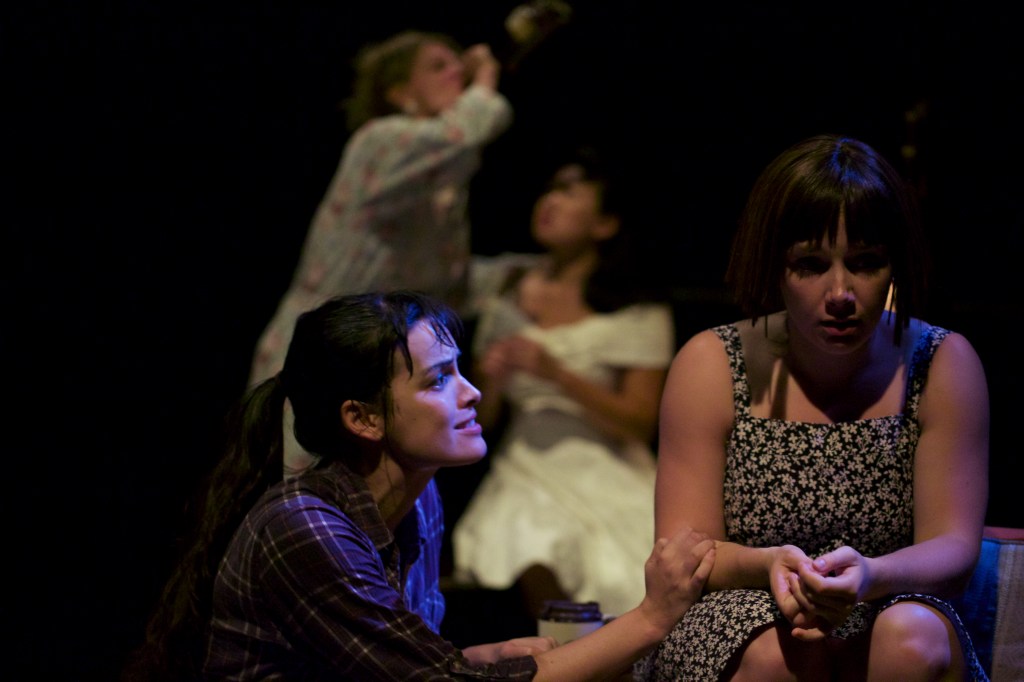
From left: Cosette Derome and Lucy Hill in a scene from Salt. In the bg from left: Philippa Domville and Stephanie Jung. Photo by Robert Harding.
HS: Why were you drawn to present this story in the theatre?
EV: I’m drawn to theatre in general because there’s something so visceral when you have a real live human being in front of you, enacting a story. You don’t have a screen between you. You don’t have to conjure the story up from words alone.
For Salt specifically, there’s an element of storytelling inherent in the piece – all the characters tell each other and themselves stories in order to cope. But the stories alone cannot sustain them and they begin to fail as coping mechanisms. And there’s such an opportunity to show that breakdown in the theatre. In the play, one of the characters makes landscape scenes out of construction paper as her way of telling herself stories, and we have the opportunity to get to see those creations in the production in a deeply theatrical, larger than life way; seeing them like that adds to the impact. Design brings so much and can carry so much of the narrative, and that is really interesting to me as a writer. That words alone don’t have to do all the work.
Lucy Hill as Petal in “Salt”. Photo by Robert Harding.
HS: Can you speak about the development of this piece and how your mentors have influenced your work?
EV: This piece would not be where it is without Briana Brown, my director and dramaturge. Before her, I had been writing mostly on my own, with some sporadic, one-off workshop readings sprinkled through the process. Workshop readings are definitely helpful, but it’s different when you can get someone’s sustained support. It becomes an ongoing conversation, and to be able to have that with someone who not only understands the territory the play explores but who is perched just outside of my process is really illuminating. She also gets me really well, and the relationship we’ve established (really quickly too) makes me feel not so lonely, the way so much of the writing process necessarily is. Briana and all of our cast and design team ask really sharp questions and finding my way to answering them has brought a new clarity to the piece. They are all downright heroic, and it’s wonderful to be able to work with so many other artists. Writers in other forms don’t get that in the same way as playwrights.
HS: What is the best advice you have ever gotten?
EV:Find out who you are without the depression. The psychiatrist who diagnosed me with clinical depression told me that. That was tough. It’s not necessarily related to my artistic practice, but it opened something up for me – I am not the disease. When you are inside it, it’s so easy to get lost. I’m still figuring out who I am without the depression.
Also, always be yourself. Unless you can be a unicorn. Then, always be a unicorn. I think that’s pretty solid. (The internet tells me this can be attributed to Elle Lothlorien from her book Alice in Wonderland, which appears to be a romance novel…)
HS: What is your favourite place in the city?
EV: My bed. Especially when I’m reading or napping there with my cats. I made my peace with the fact that I am not cool long ago.
HS: Where do you look for inspiration?
EV: Books. Conversations. Paintings. History. Nature. Anything that both gets me out of my own head and resonates with me on a gut level.
I also find that I find inspiration through the work – the act of writing, forcing myself to sit there with a piece and think through it, breeds inspiration. I find I often can’t answer questions about my work in person, I can only do it through the next round of re-writes.
HS: If your audience could listen to one song before the show, what would it be?
EV:Asking for Flowers by Kathleen Edwards. I’ve been listening to it every time I sit down to work on the play. Part of the chorus is “Don’t tell me you’re too tired, 10 years I’ve been working nights.” Which pretty much sums up how I feel about living with depression, how frustrating and exhausting it can be. I am not the disease, but it’s something that I wrestle with every day, just like the characters in the play.
Salt
Presented by Lark & Whimsy Theatre Collective
Who:
Written by Erin Vandenberg
Directed by Briana Brown
Featuring: Philippa Domville, Cosette Derome, Lucy Hill, Geoffrey Armour and Stephanie Jung
Set & Costume Design by Anna Treusch
Lighting Design & Production Manager – Gabriel Cropley
Sound Design by Lyon Smith
Stage Manager – Laurie Merredew
Assistant Stage Manager – Deanna Galati
Publicity Consultant – Katie Saunoris
Consulting Producer – Lisa Li
Assistant Producer – Brittany Kay
Produced by Chris Baker and Erin Vandenberg
What:
When Lilias returns home after a year at school, she finds her mother Vivian increasingly fixated on Great Aunt Rose ‐ a figure Lilias believes never existed ‐ and her sister Petal virtually engrossed in a construction-paper fantasy world. Faced with an ever‐deteriorating family situation, Lilias struggles to chart a course that protects herself and Petal from Vivian’s abuse. But as tensions run high, the roles of abuser and victim become blurred.
Thomas McKechnie:4 1/2 (ig)noble truths is a performance lecture on clinical depression. It’s more fun than that sounds. It’s my attempt to take the swirling incoherent masses of feelings, perspective and physical and emotional sensations of depression and give it form. To name it. If you know the true name of a thing it doesn’t make it less significant but it allows you to reach your arms all the way around it. To make it a thing that you can manipulate, contend with. Instead of being this overwhelming weight that lies on top of you in your bed, or chews on your joie de vivre among friends, it becomes like a pet you inherited, you don’t necessarily like it and it doesn’t necessarily like you but so long as you feed it and treat it ok the relationship is mostly peaceful.
Hallie: Where did you get the inspiration to create it?
Thomas: I started working on it the Soulpepper Academy under the direction of Guillermo Verdecchia. He encouraged the writers to write something personal for our first piece and really pushed me to not hide in my words or my ideas.
Hallie: Tell me about the format of the performance.
Thomas: It’s a performance lecture. Which can be sort of imagined as if that one teacher you had in high school who always got really invested in telling you about the War of 1812 or whatever, making gunshot noises and singing Rule Britannia etc, was let off the leash. It’s an attempt to use the lecture format of direct address with the poetry and metaphorical action of a play.
Hallie: Can you speak to what you are currently interested in exploring in your work in the experience of going to the theatre? This question is inspired by the following from your description: “Because we are walking around polishing silverware or running schools or arresting jaywalkers, and we’re dying all the time and no one is saying anything. We aren’t talking because we don’t have words. Or we have those words but to say them could be worse. If he howls will you howl back? If we howl together will we be healed?”
Thomas: In reference to the quoted passage I’d say: localization and liveness. By localization I mean recognizing how the theatrical ecology has changed in 100 years. When folks did three-night-runs of touring productions of Shakespeare to 1000 people, the event had very little localization. You couldn’t be speaking to those people in that place specifically. You could speak to all people generally and the people would find specificity for themselves. By doing small plays in small theatres for small audiences we have a chance to speak to them specifically, locally, like a congregation at a church.
“This is for you if you come. I made it for you. I didn’t make it for the sold-out run in four major Canadian cities on a major tour that is not going to get specifically. I made it for you, here, now.“
Which ties into the liveness. I’m so fucking tired of having performances pretend I’m not there, pretend that we’re not doing a thing together.
“When I go to a good punk show I feel like I’m included. I’m allowed/encouraged/impelled to scream along, it isn’t just the performers doing their things and me watching it. The band opens a space where I can scream, where the person next to me can scream, where we can all scream. Where we are all there, having more and more fun, together. This is what I want for theatre.“
Down with the fourth wall. Speak to me.
Does that mean every show should be a solo show in direct address? No. What it means is that if I wanted a dead, abstracted, though very moving, performance I’d watch a movie.
Why are we doing this live? It’s hard and expensive and an ineffective means of communication. Given that, there should be a really, really good reason to make it live.
Hallie: What music would you recommend your audience listen to before the show?
Thomas: Titus Andronicus – The Monitor. It’s a devastating album that weaves the history of the American Civil War as a metaphor for the lead singer’s turbulent (and sometimes violent) relationship to mental illness. It was one of those bands that saved my life.
Hallie: What inspires you as an artist?
Thomas: I came up in the church and I still have so much of that mythos and ceremony and ritual in my bones, that pursuit of a holy thing.
“I’m not one of the faithful anymore but you find that transcendence in all sorts of places, in all sorts of music, in the way light lands on streetcar tracks.“
Hallie: If you could have written one album, which one would it be and why?
Thomas: Nana Grizol – Love It, Love It. It’s strange and bright and kind and SO SO SO wise. It’s like a strange man who hitchhiked into your town and he seemed cool and so you invited him to have a beer and instead of hearing his story you find yourself telling him your whole life and he listens carefully and has the exact right words to heal, to inspire, to make you laugh. It’s wonderful.
Hallie: Where is your favourite place in the city?
Thomas: Bathurst and Dundas at dusk.
Hallie: Best advice you’ve ever gotten?
Thomas: Lots of shit my mom says. Not advice per-se but more of leading by example, “We’ll make it work.” “This too shall pass.” “Is this the hill you want to die on?” Things like this.
Hallie: Describe the show in 5-10 words.
Thomas:
“Shitty punk kid tries to find the words you need.“
4 1/2 (ig)noble truths
Who:
Company: zeitpunktheatre
Written and Performed by Thomas McKechnie; Directed by Michael Reinhart; Assistant Directed by Julia Matias; Scenography by Claire Hill; Produced by Kelly Read.
What:
Let’s pretend for a second that we’re OK. What does that feel like? A lot of things are not OK with Thomas but he’s got a ten-pound sledge hammer and is pretty sure that could solve at least one of his problems. This is a show that he wrote. It’s for/from those times when you can’t get out of bed. When you’ve only been eating breakfast cereal for days. When if someone asks you how you are you’ll say great – and then smash your face into their face. Thomas has 4 ½ totally useful pieces of advice for battling depression. He has an hour-long anarchic expression of depression that must be passed through first. Because we are walking around polishing silverware or running schools or arresting jaywalkers, and we’re dying all the time and no one is saying anything. We aren’t talking because we don’t have words. Or we have those words but to say them could be worse. If he howls will you howl back? If we howl together will we be healed?
Curator’s Note
“‘The Buddha laid it out a long time ago:
All life is conditioned by suffering
Suffering has its causes
Put an end to the causes, and
Cultivate the path.’
My favourite young anarchist playwright wrestles with mental suffering and clears his own path, which might be yours as well.”
– Guillermo Verdecchia
Where:
Scotiabank Studio Theatre, Pia Bouman
6 Noble Street
Toronto
When:
Thursday August 4th 5:00 PM – 6:00 PM
Sunday August 7th 7:45 PM – 8:45 PM
Wednesday August 10th 7:00 PM – 8:00 PM
Sunday August 14th 3:00 PM – 4:00 PM










 inthegreenroom