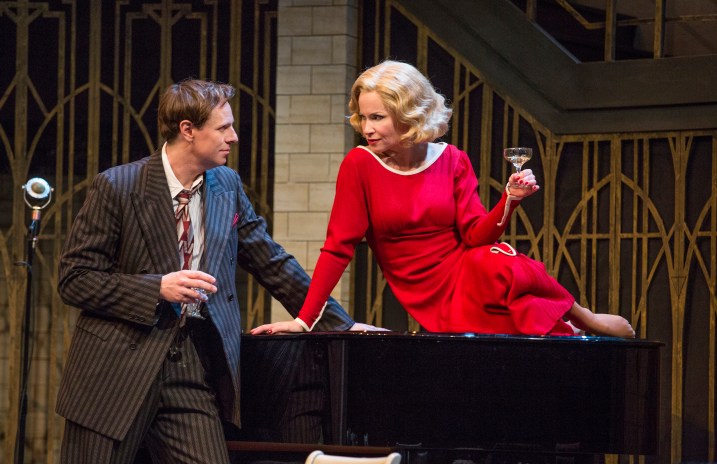
Skip to content

Posts tagged ‘hallie seline’

2014 Fringe Preview – Love’s Labour’s Lost – Shakespeare BASH’d

Interview by Bailey Green

As I entered the rehearsal hall for Love’s Labour’s Lost (presented by Shakespeare BASH’d) I was struck by the amount of people in the room. With no role double cast, the cast of 16 generated such an exuberant atmosphere that I couldn’t believe they had just finished a run. Their attitude as an ensemble reflected the youthful energy of the play.

In Love’s Labour’s Lost, the King of Navarre and his three men swear an oath to remain celibate so that they can focus on academic pursuits. Unfortunately the day after the men swear this oath, the Princess of France and her three ladies—a group of fierce, grounded, intelligent women—arrive on a political mission. Passion, poetry and chaos ensue. I sat down with the four—that’s right, four—pairs of lovers to chat about their character’s relationships, their own quirks and the upcoming Fringe production.

Love's Labour's Lost - Hallie Seline & Jesse Nerenburg - Photo Credit: Jesse Griffiths & Kyle Purcell

Love’s Labour’s Lost – Hallie Seline & Jesse Nerenberg – Photo Credit: Jesse Griffiths & Kyle Purcell

Princess of France (Hallie Seline) and the King of Navarre (Jesse Nerenberg)

Hallie’s Pet Peeve: Slow walkers.
Jesse’s Fave Rehearsal Snack: The vietnamese steamed buns from Banh Mi Boyz
Post-Show Drink of Choice: “Wine wine wine” (Hallie), Hawaiian Pale Ale (Jesse).
Describe your characters’ relationship:
Hallie: We’re both people in power. We like to outwit each other, top each other. We don’t want to admit that we’re into each other but we are. We totally are.
Jesse: We’re both the leaders of our kingdoms so that definitely plays a part. But why I’m attracted to her is because she’s not afraid to push back. I don’t see her for many pages after the first meeting, but when I do, I am really in love with her. I’ve written all of these poems about her. Once you’re in, you’re in.

Love's Labour's Lost - Suzette McCanny and Jeff Hanson - Photo Credit: Jesse Griffiths & Kyle Purcell

Love’s Labour’s Lost – Suzette McCanny and Jeff Hanson – Photo Credit: Jesse Griffiths & Kyle Purcell

Rosaline (Suzette McCanny) and Berowne (Jeff Hanson)

Suzette’s Pet Peeve: Bus windshield wipers.
Jeff’s Favourite Rehearsal Snack: Chocolate chip cookies.
Post show drink of choice: Apricot beer (Suzette), “Any drink anyone will buy for me” (Jeff)
Describe your character’s relationship:
Suzette: They have such a love/hate relationship, as in they love to get the best of one another. Rosaline would like to pretend she doesn’t love him or that she’s better than that. But she’s very intrigued by his wit. She thinks he’s smart and he can hold his own next to her. She also sees his cons and can be open about that. She can be herself with him.
Jeff: They had met before at the same party [as Longaville and Maria] and for Berowne he doubts the oath the men all swear to right from the beginning. He doesn’t really think it is going to work. Berowne’s always had control over his emotions and has never fallen madly in love. When they first meet, what Rosaline says to him, how she uses her wit and beats him at his own game, it really intrigues him. He doesn’t really get it, being in love, he’s taken aback. He almost goes through the seven stages of grief, but more like the seven stages of love. He doesn’t understand why but he does truly love her.

Love's Labour's Lost - Catherine Rainville & Joshua Browne - Photo Credit: Jesse Griffiths & Kyle Purcell

Love’s Labour’s Lost – Catherine Rainville & Joshua Browne – Photo Credit: Jesse Griffiths & Kyle Purcell

Katherine (Catherine Rainville) and Dumaine (Joshua Browne)

Catherine’s Pet Peeve: People chatting in the background while she’s rehearsing a scene
Josh’s Rehearsal Snack: Cigarettes. If he could eat ’em, he would.
Post show drink of choice: A glass of Scotch (both).
Describe your character’s relationship:
Catherine: It’s so instantaneous for everyone, but Dumaine and Katherine have moments of looking at each other and trying to figure each other out. It’s really playful. I get to be aggressive which is fun. We all tease the boys, which for Katherine is her way of playing hard to get. But she’s so obvious when she’s around him.
Joshua: We don’t have a lot of text together, or any really. But we have built this aspect of Katherine being the aggressor. I catch her checking me out at the beginning and I’m a bit more timid. I’m sort of shocked she likes me. Similarly [to the Princess and the King] we have many pages where we don’t see each other at all yet I’m madly in love and have written horrible poetry about her. She’s also pretty sassy. I like that.
10403653_847988535228940_2276093921829860528_n-1

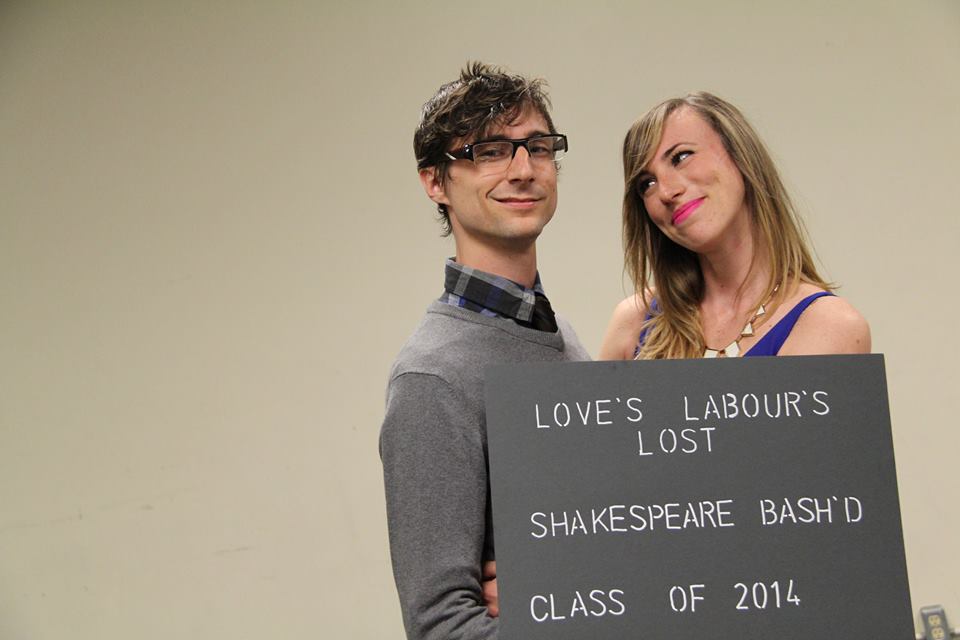
Love’s Labour’s Lost – Andrew Gaboury & Sheelagh Darling – Photo Credit: Jesse Griffiths & Kyle Purcell

Maria (Sheelagh Darling) and Longaville (Andrew Gaboury)

Sheelagh’s Pet Peeve: People who stand really close to you for no reason. Also, toe shoes.
Andrew’s Favourite Rehearsal Snack: Nuts, specifically almonds.
Post show drink of choice: Oatmeal Stout (Andrew), St. Ambroise Apricot Beer (Sheelagh)
Describe your character’s relationship:
Sheelagh: We really like each other right from the beginning. There’s no qualms, we know we’re going to get together. I play along with the Princess but whenever Longaville’s around I’m just making googly eyes and waving. Even when the rest of the girls are berating and chiding the boys, I’m just still waving at Longaville.
Andrew: We kind of met before, it seems we were at the same party. I’m the most serious in terms of the oath the men swear [to stay away from women]. And then I see Maria and I throw it all away. It’s funny watching how I try to logically get around the oath in my poetry.

This slideshow requires JavaScript.

Bailey: What makes this production stand out? What will an audience member experience coming to see your show at the Fringe?

Jesse (King): Love’s Labour’s Lost is a very youthful play, it’s one of Shakespeare’s earlier work and it has a rhyming structure which is really unique. The women hold their own. And it’s not a play that is done very often. People are going to be coming out to see a show where they can have a beer and experience a classic that they may have never seen on stage before.

Josh (Dumaine): It’s zany. The men are writing really bad poetry and dressing up as “Russians”. The show is going to be fast, snappy, fun and silly, but it also has vulnerable moments. It’s really relatable.

Hallie (Princess): James [Wallis], our director, said at the beginning that the best way into this story is through yourself. These characters come alive through the energy of the people doing them. And in this cast you have a bunch of really interesting, funny, weird and smart people who come out through the words of these characters. That’s what makes it fun. I hope that will stand out to our audiences.

Suzette (Rosaline): The characters play the whole time! Let’s play this game, let’s play that game. Whenever I see a BASH’d show I feel like I’m part of the team as an audience member, that I’m part of how the story unfolds. Each time we run the show there’s new surprises. And it’s so refreshing to be in a play where my character doesn’t have to be a lost puppy who only cares about being in love. It’s a love story, for sure, but there’s an edge. My goal in life is not just “to be loved by another person.” I still feel that’s very rare.

Jeff (Berowne): People will get a sense of [director] James’ respect for the text, but there’s also a joy and a sense of ensemble and the fun that this rehearsal room has been that I feel will be evident for anyone watching. The audience hopefully should go through the journey with us.

Andrew (Longaville): There’s a real sense of great respect for the text, but also using it as a blueprint. There’s a balance of not bulldozing the words, but really using them and at the same time using yourself in the text.

Hallie (Princess): All pomp is taken out of it with a BASH’d show. It has that “Fringe” energy. You go to the Victory Cafe just a step away from the tents and everything that’s going on in the Mirvish alley. You can sit down and have a beer and listen to a classic tale that is so clear and fresh and fun and full of energy. It’s enjoyable, which is sometimes exactly how you want to spend your time. There’s also wonderful dance that happens that I cannot WAIT for each audience to experience.

Bailey: Well I for one can’t wait for the dance number.

Love’s Labour’s Lost

by William Shakespeare, presented by Shakespeare BASH’d

Love's Labour's Lost - Photo by Jesse Griffiths and Kyle Purcell

Love’s Labour’s Lost – Photo by Jesse Griffiths and Kyle Purcell

Directed by James Wallis

Where? The Victory Cafe, 581 Markham St.
When? Thursday, July 3 @7:00pm
Friday, July 4 @ 7:00pm
Saturday, July 5 @9:00pm
Sunday, July 6 @5:00pm
Tuesday, July 8 @7:00pm
Thursday, July 10 @7:00pm
Friday July, 11 @7:00pm
Saturday, July 12 @7:00pm
Sunday, July 13 @5:00pm
Tickets are $12 and can be purchased via the Toronto Fringe website: https://www.fringetix.ca/

10440657_845760552118405_7235464256632023655_n

Follow this wild bunch on Twitter:

Shakespeare Bash’d@ShakesBASHd
Hallie Seline (Princess) – @HallieSeline
Joshua Browne@joshu_ashua
Andrew Gaboury (Longaville) – @afieldofcrowns
Jeff Hanson (Berowne) – @The_Hanman
Suzette McCanny (Rosaline) – @suzettemccanny

In the Greenroom Writer Bailey Green: @_baileygreen

** Want In the Greenroom to catch your Fringe show or have an interesting idea for an interview? Email us at inthegreenroom.ca@gmail.com! **

Artist Profile: James Wallis & Julia Nish-Lapidus – The LaBute Cycle – This Week Only at Unit 102 Theatre – “We are who we are inside… The rest is unimportant.”

Interview by Hallie Seline

I had a chat with one of my favourite couples in Toronto Theatre, James Wallis and Julia Nish-Lapidus, to discuss their most recent project – The LaBute Cycle, going from Shakespeare (known most notably from Shakespeare BASH’d sold-out Toronto Fringe shows and their most recent production of Romeo and Juliet last fall) to LaBute, working professionally as a couple and their favourite places in Toronto. reasons to be pretty runs for one week only (April 8th-13th) with a special PWYC staged reading of Fat Pig on Sunday April 13th.

HS: Tell me a little about yourselves and about the show. 

JNL: We are doing reasons to be pretty, by Neil LaBute and a staged reading of his other play, Fat Pig. Originally we were presenting full productions of both plays in rep, but unfortunately, one of the actors was badly injured earlier this week, and is no longer able to do the show. James Wallis, our director, has stepped in to play his role in reasons to be pretty, but we are not going to be presenting a full production of Fat Pig at this time. We will be doing a staged reading of Fat Pig on Sunday, April 13 at 2pm, with another amazing actor, Jesse Griffiths, stepping into the role of Tom.

JW: Both of these shows examine how we value female beauty. We’ve worked with a lot of the team doing The LaBute Cycle while working with my other company, Shakespeare BASH’d, doing classical work. The LaBute Cycle is a passion project for myself and all those involved.

HS: Why LaBute?

JW: LaBute to me is a fantastic playwright, as he is very honest and focused with his characters’ worldviews. In reasons to be pretty, he tackles a very sensitive issue with the way we value beauty in the modern world. He doesn’t pull any punches and, in my opinion, writes with a great gusto about what he knows and doesn’t try to be politically correct. Also, I love his text; it’s extremely conversational and it’s a complete 180 from what I’m used to with Shakespeare’s work.

JNL: It’s a really interesting and sensitive subject matter to explore. And it’s fascinating to explore it so publicly. The issue of beauty and how we value it is pretty prominent in our world today and I think this play offers many different perspectives, and asks a lot of questions about the subject.

8442768

Original Cast: Milan Malistic (TL), Elisabeth Lagerlöf (TR) Julia Nish-Lapidus (BL), Steve Boleantu (BR)

HS: What have you found interesting about working on something so different together. You normally work on Shakespeare together, this is quite a change. 

JW: It is! It’s been really great to get to explore these new characters, but bring a lot of the basics we use with our Shakespeare work into approaching these roles. I like the role of Kent for sure, he’s a malicious person, a person who is very selfish, but I think that he’s his own person and fights for what he thinks is his, regardless of who he hurts along the way. It’s not pretty but it’s honest. He’s verbose and nasty at times, which isn’t such a stretch for me but it is not where I live most of the time when it comes to acting. I’m excited for the challenge.

JNL: It’s really great to get to work with James on something contemporary for a change, and now I get to work with him as both a director and fellow actor! Being a married couple who works together so often (yes, James is my husband) is really great and it’s interesting to be exploring this sort of subject matter together. For me to be doing a big fight scene with Steve, who plays my boyfriend in the show, and have James be directing it is really cool, because he knows me so well and for material like this that sits in such a natural world, he can really help me bring a lot of myself to it, since he obviously knows me so well.

429146_10151405502180701_196929419_n

Power Couple: Julia Nish-Lapidus & James Wallis

HS:This is being performed in Unit 102 theatre. Tell me about working in the space.

JW: In my opinion, it’s one of the most amazing spaces in the city. It is a complete blank slate that I have seen transformed in so many ways. I really like the enthusiasm of the guys who run the place. They want to see great theatre come out of their space and I admire their tenacity for finding it.

JNL: It’s a really great space. There’s a lot of flexibility to use it however you want and the team of people who run it are awesome! It’s so important to have small, flexible spaces like that in the city.

HS: If you could entice people to come see the show in five to ten words, what would they be?

JW: We are who we are inside. The rest is unimportant.

JNL: Hilarious, heart breaking, and oozing with talent.

HS: What inspires you as artists?

JNL: James, my husband? Is that super cheesy? This is really a passion project for him, and he’s pushed me to take risks artistically that I don’t think I would have without that push from him.

482243_10151567059200701_1277760830_n

JW: The people I am fortunate to be surrounded by. The constant creativity that they exude is without equal. Also, my wife, Julia, whom I am completely enthralled by, her grace under pressure, her faculties with producing a play and her wonderful intelligence when it comes to any work she does.

JW: He just said that because of what I said. He felt like he had to…

HS: Best advice you’ve ever gotten.

JW: It’s just a play.

JNL: Act better.

HS: What are your favourite places in the city?

JW: Victory Café, my home, the Dank and any used book store.

JNL: Home! And Bar + Karaoke (the best karaoke place to drink your face off and sing 90’s pop songs)

reasons to be pretty

by Neil LaBute
The LaBute Cyclelabutecycle_postcard_front

WhereUnit 102 Theatre (376 Dufferin Street)
When: April 8th-13th *Special staged reading of LaBute’s Fat Pig will be presented at 2pm on Sunday April 13th
Tickets: $17 – Available at www.labute-cycle.com and at the door. The staged reading of Fat Pig on April 13th is PWYC at the door

Artist Profile: Courtney Ch’ng Lancaster & Paolo Santalucia – From Academy to Company in Soulpepper Theatre’s “Idiot’s Delight”

Interview by Hallie Seline

I sat down with Courtney Ch’ng Lancaster and Paolo Santalucia to discuss their journey from the Soulpepper Academy, to graduation, their ongoing involvement in the Soulpepper Company and their current show Idiot’s Delight on now at the Young Centre for the Performing Arts.

HS: Tell me a bit about yourself and your relationship with Soulpepper and the Academy.

PS: My name is Paolo Santalucia and I’m a 2012 graduate of the Soulpepper Academy. Before that I trained at the University of Toronto Mississauga and Sheridan College’s joint Theatre and Drama Studies program and after training at the Academy for a year and a half, I started working with the Soulpepper company.

CCL: I’m Courtney Ch’ng Lancaster. I’m originally from Nova Scotia, did my undergraduate at UBC in Vancouver and after that I did the Citadel/Banff Professional Theatre program and then the Soulpepper Academy with Paolo. We are also both part of the founding members of The Howland Company.

HS: So tell me a bit about your experience in the Soulpepper Academy and your relationship with Soulpepper since graduating. 

PS: Well, the Academy was amazing for so many reasons. I think, for me, in retrospect, what it promoted in me and what took me by surprise the most is the fact that at the end of the day what the Academy was doing was… of course it was focused on theatre and of course it was really rigorous, but at the end of the day it felt like what they wanted was to instil sort of a larger sense of what it meant to be an artist. It showed me the potential responsibility of artistry and the ways to contribute as an artist beyond my work on stage, that there is a bigger picture. This company was founded to contribute to the arts in Canada and at the end of the day it is something that I, as a Canadian Artist, can also continue to contribute to. They did things like take us to the AGO (Art Gallery of Ontario), the movies, seeing plays elsewhere as a group. They weren’t afraid to take us out of the Soulpepper context. What it did was allow me to realize the larger things at work and the amazing arts community there is in this city. In retrospect, for me, that was the most significant part of the training – learning about just how much goes into becoming a ‘good actor’ and how much being a good artist is about being someone who appreciates, understands and has love for so many different art forms even beyond the theatre in the city and Canada.

HS: So that was part of the Academy training? Taking you outside of Soulpepper to art galleries, films, different plays…

CCL: Yeah, to expose you to as many different artistic stimulants, including people too, bringing in fantastic Canadian artists to spend some time with us.

PS: I am so thankful for the encouragement that we got in the Academy to explore other aspects of our artistic selves. I’ve never been in a situation where that’s been as encouraged and not only encouraged but it’s been necessary. It’s what will make myself as an artist, and what will make our contribution that much more sustainable… if they come from a place of appreciation for the millions of aspects that go into the arts in this country.

CCL: Well from a practical point of view, there’s no place else in the country, I think I can say, where you would have the opportunity to be in rehearsal and practice the same way that dancers and musicians are in practice all of the time. I mean you don’t meet a professional pianist who doesn’t practice for hours a day to keep himself in shape. But when you’re an actor, you’ll have periods of time where you’ll be working on a contract, working on that one show, which is one kind of practice, one kind of rehearsal, but the rest of the time you’re very often stumbling to try to pay your rent and working your ‘joe’ job while still trying to read plays and stimulate yourself. While we were in the Academy, we had a living wage for the whole time we were here and we were told to focus on art and your craft and develop yourself. It’s a very rare thing, that kind of opportunity.

HS: Idiot’s Delight marks the professional debut of this year’s Soulpepper Academy actors. Can you talk of the benefits of being both taught and working along side Soulpepper Company members?

CCL: It’s great to be in the rehearsal hall with the current Academy actors because this is also being treated as a learning experience for them and they are also, brave souls that they are, they are also still taking Academy classes in the mornings, rehearsing the show in the afternoon… so they are resilient! But because it’s a learning experience for them, I find Albert [Schultz] who is directing, is taking his time with things. We have a slightly more extended rehearsal process so he can take his time and explain the mechanics as we go. Therefore with his decisions as a director, he’s taking the time to explain them, allowing everyone more of an opportunity to learn. So we get to take advantage of this learning opportunity just as much as the Academy does!

Courtney Ch'ng Lancaster, Hailey Gillis, Gregory Prest & Dan Chameroy. Photo Credit: Cylla von Tiedemann

PS: It’s amazing to watch people in process. I love that. When the process is, as Courtney was saying, this exposed and part of the rehearsal is actually part of exposing that process as a learning exercise, everyone in the room benefits. I feel like that’s really exciting. There’s such a strong sense of company here. Albert said on the first day of rehearsal, “This marks the first show where the number of Academy involvement (post-graduate and current Academy members) actually outnumbers the other members of the company.”

CCL: Not just in the acting department but in the design, the assistant stage management etc.

PS: It’s the first time that that’s happened and I can only imagine what that means for him but for us what’s incredible is that it just sort of promotes that stronger sense of company. It makes you feel like you’re supported and a part of something that is just a little bit bigger than just the play. It’s really exciting because, again, it doesn’t really happen that much. To continue to support these kinds of programs and to continue to bring these generations of programs back in contact with one another, we’re very lucky here to get to be a part of, learn from and see that kind of evolution. It’s a really cool place to rehearse from.

HS: It seems like there is a lot of multi-generational collaboration and support within the company, the Academy grads and current Academy members.

CCL: And there’s a common working language that has been developed through the shared training. Part of the Academy is that you have founding members of the company coming in to teach you, so already they have a shared language, which they then impart on the students as well as the different artists who are coming in and out. When you get into the rehearsal hall, you already have a level of understanding and intimacy that usually takes weeks to develop when you’re starting a new project.

PS: That common language is actually a huge benefit. It’s amazing listening to when you see senior members of the company trying to piece through something, the specificity of how they work together, you can connect it to the broader common language that you’ve been taught in the academy and watch it work in such intricate, specific ways. You feel like you can engage with these actors who have so much more experience, which can seem sometimes quite intimidating I can imagine coming in fresh, not knowing them and not having worked with them before, but in this situation it’s really cool because you feel like you can go up to someone like Albert [Schultz] or Diego [Matamoros] and tell them about a part in the work you’re having an issue with and they can either teach you or speak to you through an established common language. That’s really exciting to have that multi-generational connection through your working relationship I think.

Raquel Duffy, Paolo Santalucia & Diego Matamoros. Photo Credit: Cylla von Tiedemann

HS: What is the best advice you have ever gotten?

CCL: Albert will always say, “Listen” and he’ll say “Big thoughts. Bigger thoughts” and it’s almost too simplistic but that’s kind of what it boils down to. And “It’s not about you. It’s always about the other person”. And those are the kind of things that you always forget, the simplest things. It’s not about me, it’s about the other person…

PS: “Think on the line”…

CCL: Yes! Exactly. And then when you’re having a moment where you think “I’m terrible today” you stop and think, “Why am I terrible today? Oh it’s because I’m obsessed with myself today”. (laughs) It’s not about me. Instead I need to be listening to the other person because it’s about them.

PS: I think it was the first huge thing that I remember hearing in the Academy, in our first week, and I don’t think I’ll ever forget it. We were doing scene study and our teacher at the time said, “My favourite actors, and what I think are really good actors… a good actor never lies on stage.” And I don’t think that I had ever really heard that said in that way before. I had never heard of acting being spoken of with that much truth before. And the amount of work that goes into communicating that much truth. It really struck a chord with me at that moment in this place.

CCL: I think for a long time, when I first started, I had a perhaps romantic idea that being an artist and being an actor required a certain amount of constant self-flagellation and it took people, in the Academy, saying “You’re really hard on yourself. That’s not very useful,” to learn to let that go and just focus on the work and the other person and listen and keep going. I think as actors we think that there is very little in our control and sometimes that turns inward and we think “What am I doing wrong? I need to be better. I look silly when I stand like this. Etc” But all of that just gets in the way. That was a big lesson for me. Learning to let go of always trying to fix yourself and just focus on the work.

PS: Again, to add on to that, I learned to go through a checklist. When I’m stuck I’m either not having big thoughts, I’m either not thinking on my line, I’m either not listening or I’m not trying to affect my scene partner. I go through that checklist and usually I’ll find out where my problem is.

CCL: And it’s like a muscle, to build it you have to practice and that’s what the Academy offered to us. A place to practice and practice and practice.

HS: What’s your favourite place in Toronto?

PS: Just by Lakeshore, out past what’s called Mystic Point, there is a lighthouse. You can only get there by biking west of the Humber river. You bike over this path that curves around the island and right at the tip of the island is the lighthouse. I found it one day by accident when I was trying out a new bike path and it was stormy and the wind was blowing over lake Ontario. And it’s the only place that I’ve found where the lake looks as big as it is to me. It’s one of my favourite spots in Toronto.

CCL: When I moved here from Vancouver, I guess two and a half years ago now, gosh, I struggled with the lack of the obvious natural beauty in Toronto because Vancouver is like, ostentatiously beautiful in places, so it took me a little while to discover that Toronto has some really beautiful pockets and they are all the more charming for being a little harder to find. So there’s a new park I’m loathed to tell people about, but it will be overrun soon enough anyway, just by the DVP called Corktown Commons, which is just south of King by the DVP, south of Eastern I guess, and it’s a beautiful new little park. They’ve tried to include the indigenous plants and swamps, incorporate them into this beautiful park that also has paths, trails and playground equipment that I totally play on. So I’d say that place and the Riverdale Farm are my two current favourites. Beautiful, hidden spots.

HS: If you could entice someone to come see Idiot’s Delight in five to ten words, what would they be?

CCL: I’ll go first. Showgirls in sequins, singing, sexy-sex-sex, poignant, funny, sad and beautiful.

PS: It’s a sexy, beautiful, topical, war-play you’ve never heard of.

CCL: And it has a cast of twenty-four which you rarely see! We look forward to seeing you there.

Idiot’s Delight

Dan Chameroy & Raquel Duffy. Photo Credit: Cylla von Tiedemann

By Robert E. Sherwood
Presented by Soulpepper Theatre

What: A cast of wonderfully eccentric and international guests – countesses, arms dealers, showgirls, revolutionaries, charlatans and lovers – spend a fateful weekend in a resort hotel in the Italian Alps. While songs are sung and dances danced and loves rekindled, the dark clouds of war come rolling in.
Sherwood’s mad-cap romance won the Pulitzer Prize for Drama in 1936.
Where: Young Centre for the Performing Arts
When: January 29th – March 1st
Ticketshttp://soulpepper.ca/performances/14_season/Idiot’s_Delight.aspx

For more on the Soulpepper Academy, check out their website: http://www.soulpepper.ca/artist_training.aspx

Artist Profile: Sam S. Mullins – Storyteller of Fatherly at the Next Stage Theatre Festival

Interview by Hallie Seline

HS: We hear you wear many hats (Comedy, Radio, Playwright, Performer etc). Tell us a bit about yourself and what draws you to the playwright/performer medium with stories like Weaksauce andFatherly?

SM: So many silly hats.

I spend the largest portion of my creative time writing sketch comedy for CBC’s The Irrelevant Show. This is my first year as a full time writer on that show, and it’s been a really terrific experience. Also radio-wise, I’m a regular contributor to the CBC storytelling program Definitely Not the Opera, and I was fortunate enough to get a story on NPR’s The Moth Radio Hour recentlywhich was always a dream of mine.

So. I work in radio, I suppose, which is really exciting for my Grandmother. She tells me that radio used to be a thing.

In the summers, I tour my one-man comedy monologues on the Canadian Fringe circuit. This will be my 4th summer doing the Fringe, and I’m currently trying to decide whether or not I’ll be touring with a version of this current show. I might want to write something new, but then of course, I’d have to go through the agonizing process of premiering a brand new show all over again – which is not for the faint of heart.

So simply, I write sketch comedy and am a storyteller.

What draws me to storytelling? Hm.

I guess I love the simplicity of it. I like the idea of taking something completely stripped of all artifice and theatricality and mounting it in a theatrical space. Of watching something that doesn’t feel like theatre as if it were theatre. I like that I can be funny or poignant or dark or light all at the same time. It doesn’t have to be heavy handed. It doesn’t have to be hilarious. It just has to be true. Theatre is very much a pursuit of truth, so what makes me love going to see a storytelling show, is that it isn’t even a pursuit of truth. It can just be the truth. That will always be captivating to me.

Also. I wasn’t a great actor. And in storytelling, I don’t have to act.

sam-final

HS: Can you speak about Fatherly and where you found the inspiration to write it.

SM: The main story around which I built the show has been my favourite “over beers” story to tell people for a few years now, and it was only a matter of time before I wrote it into a show. It’s a crazy story. Also, I’m a big fan of real-life characters, and the man who raised me is one of those real-life character with whom I knew that audiences would want to be acquainted.

HS: If you could give me 5 words to entice someone to come see Fatherly, what would they be?

SM: You must meet Bill Mullins

HS: What song should someone listen to before coming to see Fatherly?

SM: Yikes. Maybe “The Greatest” by Kenny Rogers. My mother recommended it to be my curtain call song, and thematically, it’s pretty perfect. Maybe too perfect.

HS: Where do you look to find inspiration?

SM: My heroes: Ira Glass, Marc Maron, Woody Allen, Judd Apatow, Mike Birbiglia and David Sedaris.

HS: What’s the best advice you have ever received? 

SM: I used to work in this busy restaurant in Vancouver, and our staff mantra was “Keep doing things. Keep doing things.” The theory behind it is that there’s always something to do in a restaurant. Polish cutlery. Sweep. Clear some plates. But now I’ve kind of extended that mantra into my creative life. Theoretically, if I keep doing things, everything will run more efficiently in my career. It helps me kick myself in the ass.

Aw shit. I’m watching hockey highlights again.  I should be doing a “thing” instead.

Also, I’m a fan of this Louis CK quote:

“Everything you do should be better than everything you’ve done before. That, to me, is a guiding principle.”

HS: What’s your favourite place in Toronto/in Canada and why?

SM: Favourite place in Toronto is the outdoor skating rink by Bathurst and Dundas.  I love playing shinny, and with the city skyline as the backdrop, it’s just stunning.

My favourite place in Canada is the lake on which I grew up – Kalamalka in the Okanagan. Google it. You’ll never see a more beautiful place.

HS: What is you favourite beer in the Next Stage Festival beer tent?

SM: When I’m at a theatre festival, I’m all about the Apricot St Ambroise.  I only drink it in the context of a theatre beer tent, so it tastes like I’m having the time of my life.

Fatherly

Sam_0152

Written and performed by Sam S. Mullins
Where: Factory Theatre Antechamber
When:
Mon Jan 13 8.30pm
Wed Jan 15 8.15pm
Thu Jan 16 6.15pm
Fri Jan 17 6.15pm
Sat Jan 18 8.15pm
Sun Jan 19 6.45pm
Tickets: $10 www.fringetoronto.com/next-stage-festival/

Follow Sam’s blog: http://samsmullins.com/

A Wake For Lost Time – A 24-hour Durational Piece January 10-11th at Theatre Passe Muraille Backspace

Interview by Hallie Seline

I met with the fine folks of the Elephants in the Room collective in the TPM backspace this week as they were in the throws of refining their first ever 24-hour durational performance piece experiment A Wake For Lost Time, running Friday January 10th-Saturday January 11th, with a live-stream component. 

HS: Hi friends. Care to introduce yourselves and what you do? 

MS: Moez Surani, Poet. (he laughs)

MR: … I wish I could introduce myself as “Poet”. Hello, I’m Michael Reinhart, and I guess I would say I’m a Theatre Creator.

HS: So tell me about the Elephants in the Room collective and how you started.

MR: We’re a group of artists who wanted to find new ways of working, integrating other forms and to find ways to create some synthesis between our different artistic forms. Many of us had been inspired by companies in Europe and New York who had found ways to create that synthesis, like the Wooster Group and She She Pop for example, and many of us hadn’t been satisfied in the past with the opportunities or lack of opportunities we had to explore these kinds of creation methods. We all auditioned in various ways in response to a posting done by Theatre Passe Muraille and here we are.
Our hope over the past few months has been to come into the experience with our different backgrounds and influences, whether we were performers, performance artists, playwrights, dancers or poets for example, and try to figure out a way of working and creating together in a unique and hopefully interesting way.

1545007_10153681038910051_302855343_n

In Rehearsal and Creation: Michael Reinhart and Kanika Ambrose

HS: This is the second session that you are meeting and creating since your first session where you initially met one another and began working together. What are some of the benefits you’ve discovered that comes with working as a group of 8-13 artists of various artistic backgrounds?

MS: Material gets generated very quickly. We go from concept to product very quickly. Because there is so much man/woman-power and being a group of individuals with access to a variety of strengths and materials, whether it’s creative material or physical prop or set material, we benefit from the diversity of our artistic backgrounds.

MR: Things can also move slower because we have so many bodies, in terms of decision making, however the benefit to working in the way that we do with the artists that we do, is that we’re working in more of a layering fashion rather than from a linear, traditional narrative perspective. We develop ideology, concept and discipline on top of each other so it makes kind of a tapestry rather than something more traditionally linear. It’s been quite interesting to explore working in that way. You have to compromise or else the work doesn’t happen but with everyone being dedicated to the work, with this group of artists, you can develop some extraordinary things.

1005922_10152755660602662_1922828602_n

From left: Michael Reinhart, Karen Hawes, Kanika Ambrose

HS: Tell me a bit about the structure of your developing working model.

MR: We’ll we require a lot of time working together because we really are starting from scratch, trying things out. We’re still in a very early stage of working as a group, even though we’ve done it off and on for almost a year, it’s still quite early, and we’re still trying to figure out an exact working model that we can call our own, being a unique set-up of artists.

I’m really interested in System’s Theory, which is another story all together (he laughs), but the idea of disparate elements working where links of communication are made and are strengthened over time and so by working and working and working, even when things like concept or narrative are not completely clear, by the act of building, all of a sudden a narrative or a theme or a concept emerges. For example, an apartment building starts off as a hole in the ground and a bunch of pieces of metal and then by work and time, all of a sudden an apartment building emerges out of all of that effort, instruction, architechture and ideas. I think we work in a similar way, albeit we work in something ephemeral like theatre. We develop a couple of parameters or start with the spark of an idea and we take some stabs at it. From that, a critique is made or another image is presented and then we work with that in relation to the first idea. We add another and another and then over time and work, all of a sudden something builds and eventually something emerges which could be a concept or as on Friday, it could be a show!

HS: Tell me about A Wake for Lost Time.

MR: A Wake for Lost Time is a 24-hour ritual to time, for time and for the things that were lost in time. Largely it’s an expression. For example, as in a wake for the dead, you have a corpse in the room and you have people who are mourning and a party occurs eventually. People move the corpse, or push the corpse or deal with the corpse throughout the wake but there’s this party happening as well. What is that party? Well yes, it’s a party and yes, it’s a celebration of the person who died but not exactly because people are getting drunk and having sex in the other room and they are fighting and doing performances and all of it kind of has nothing to do with the person who died, exactly, but it has everything to do with death. Because what these people are doing is expressing their life and vitality face to face with death. They are creating, if only for a moment, a profound stalemate with death, which they know can’t last, but that’s what humanity does. Our death is rather at one end of time, you know? Time’s the container or the avenue, perhaps, and death is at the end of it… or at least that’s one way to think of it. What we’re doing is we’re bringing time here, using that kind of ritual event. We’re not just representing it but we’re physically letting it be real by having it act on us as performers and the performance itself for 24 hours.

1522102_10152755658007662_1249348038_n

Michael Reinhart

MS: I think one aspect that I’m excited about with this show is that it’s going to recur in two hour cycles but there are parts in each cycle that once they’ve been performed, physically they will impede future performance. Things will stay on stage, take up space and the subsequent cycle will try to be redone as faithfully and as intensely as possible but there will be the residue of the previous time it was done and then the time before that and so on. Also, not only will you have the residue of the prior cycles building up, but at the same time, we’re going to be up all night and either degrading or getting better as the hours accumulate. One of the main tensions I see is going to be with the physical space and how we’re going to work with or around it.

HS: If you could entice someone to see A Wake For Lost Time in 5-10 words, what would they be?

MR: That’s tough… You get to participate in something trying not to break…

MS: Oh god… give me a second.

MR: They get to experience time. There are many ways in which, we think, people don’t really experience time as much any more. It just slips by. One of our invitations for this is “For a little while, maybe try to get it back for a bit with us”.

MS: I’ve got it. Fishes, Norad, feast, string theory.

HS: Intriguing! Last question, if you could recommend a song to listen to before coming to see the show, what would it be?

MS: Tom Waits – Time

MR: The Sinking of the Titanic by Gavin Bryars.

A Wake For Lost Time

by the Elephants in the Room collective

1509896_10200875106073692_2067966304_n

What: A 24-hour performance experiment that explores how time passes through bodies. It’s a disquieting party, an ardent ritual and an ode to what’s happening and what’s to come. This interdisciplinary theatre collective combines performance art, poetry, classical and post-dramatic theatre to create a show where the typical patterns break, clocks are flung aside and time, steady and relentless, conquers and is conquered by the stage debut from the Elephants in the Room collective.

The Collective: Kanika Ambrose, Donna Marie Baratta, Kathleen Goodleaf, Jenna Harris, Karen Hawes, Thomas McKechnie, Michael Reinhart, Tanya Rintoul, Moez Surani

Stage Managed by Kristina Abbondanza

Performance Times:
‘A Wake for Lost Time’ is a one-time only 24-hour performance experiment. To attend, audiences can purchase tickets to any number of the three public performance periods within the ritual (scheduled at the beginning, middle and end of the 24 hours)

People can leave at any time during the ritual, but there will be only one scheduled intermission (and time for re-entry into the space) which will occur during the halfway point of a given public performance.

Friday January 10th 2014: 7:30pm -10:45pm ($10.00)
Saturday January 11th 2014: 11:30am -1:45pm (PWYC)
Saturday January 11th 2014: 3:30pm -7:30pm ($10.00)

http://www.passemuraille.on.ca/elephants-in-the-room-creation-group/

‘A Wake for Lost Time’ will include a live stream of the entire 24-Hour performance. The streaming will begin on January 10th at 7:30pm.
Please click the link below for more information and to watch the performance:
http://www.ustream.tv/channel/a-wake-for-lost-time-a-performance-experiment-by-elephants-in-the-room