

2014 Fringe Interview – Tarrare – Suspicious Moustache Theatre
Interview by Ryan Quinn
RQ: So, I’m here with an assortment of the cast and crew of Tarrare, being mounted by Suspicious Moustache Theatre as part of 2014 Fringe. Director Darcy Stoop is here.
DS: Hello!
RQ: Would you like to introduce the rest of these fantastic people?
DS: Of course! We have playwright Liam Volke, actor John Fray, who plays the man himself, and a set, costume, and props designer, as well as script consultant, Cat Haywood. And myself, directing and producing the whole business.
RQ: So, do you want to tell me a bit about the show? What can people expect when they come see Tarrare?
DS: For sure. It’s the story of France’s most notorious glutton. Tarrare was a real guy who lived in the last days of the revolution in France. And he probably had what we call polyphagia in modern terms, an extreme case of hunger. He could and would eat anything he could get his hands on: stones, corks, bones, at a certain point, corpses, live animals as well. His parents couldn’t feed him, so he was kicked out of his house, and he joined a travelling side show as a geek, and he was a spy for a little while. He was led around by this strange affliction that he had, and this is sort of his struggle of who he is versus what he does, and figuring out what his place is in the world. We have some really fun stuff coming onto the stage, we have a shadowbox, there are swords involved, there’s lots of live eating, of course. He was a real guy, but we only know five or six things about his life, so we’ve had to take these sparse facts and really elaborate and create the world he inhabits with all of these other characters he would have met along the way in his journey toward his ultimate end. I don’t want to say too much about that, we’ll leave some mystery behind it.

Photo Credit: Dahlia Katz, Costumes: Cat Haywood
RQ: Liam, as a playwright, what drew you to this story?
LV: Darcy and Cat had been talking about making a play about this guy’s life for a while now, and we decided to have a go at it. I’m really interested in historical figures, lesser-known ones especially. I love the idea of someone who is, and I know this isn’t the right analogy to draw, but who is possessed by this hunger. It’s almost supernatural that way. Also, I realized in writing the play that there is so much about our language, in the metaphors and similes that we use, that is related to hunger and eating. Like when you see a puppy or a cute baby and you say “Oh, I could eat you up”. These are things we don’t think about, but they’re there in the water we swim in, they’re all around us. So, that’s something I became more aware of in writing the play. The material was so rich, even though we know so little about him. Everything we do know about him is pretty weird and brilliant. He had a short life, but the material is all there, you know?
RQ: He sounds almost mythic.
CH: Yeah, there’s a touch of Candide, definitely, in his lifespan. He always just goes from misadventure to misadventure, and he tumbles though these different cycles. So it’s fun to see together as a story. All of a sudden he decides to be a spy, and we get to take that leap with him.
DS: Yeah, it seems to be a journey of putting a person into strange circumstances and seeing what happens. It’s not exactly what’s happening here, but he’s such a strange figure, such an odd personality and remarkable individual that any situation he did find himself in became that much more fascinating and stageworthy because of the sheer fact of who he is. Even if we had his diary of, you know, “went to the market today, nothing else to report,” the sheer fact of who he is and the really fascinating historical period he lived in is enough to put up a really interesting show. One of the struggles we’ve had is having too much we want to say about this guy. We’ve had to nip and tuck and find the best bits.
RQ: So speaking of stage-worthy, Darcy, you’ve been involved in this production from its inception. It wasn’t text that you were going into blind, but it’s something you were thinking of conceptually and visually before it was put on paper, right?
DS: Yeah, especially between Cat and I. Cat’s my fiancee as well as my creative partner, so we had a lot of discussions about the fact that it’s this guy, and it’s on stage. Those are the two catalyst components. We’d work with Liam when we had a basic outline and we’d come in one scene at a time and say “How can we figure out a way to have him do this?”, or “what’s the connector pin between him being in the sideshow and him being in the army?”. There needs to be a reason for that to happen. So, it all came together like putting together a nice puzzle. We had these strong images, and we had to decide how to sew them together in a kind of Frankenstein-ish mix of bits and pieces. The company’s done original work before, but this was the first time where we had so much that’s just coming from ourselves, that we had to play and mold and shape. So, we didn’t sit down and write the beginning, then write the middle, then write the end. It was very much an episodic, piecemeal affair that fit together very nicely. I’m astonished and so grateful to everyone involved that so many of the images that floated into my head when I was thinking about this are actually on stage, and they look and feel wonderful. I’m excited to share that with people. It’s not often that you get this nice idea in your head of how something would look, then all of a sudden it’s there.
RQ: And as a performer, John, how do you approach work like this that’s more episodic, and it sounds a bit multidisciplinary as well.
JF: Well, it’s been interesting. I found that Tarrare’s voice in his head, or his drive, sort of changes as the play goes on. Certainly, he is narrating from his death, and there’s a distinct point of view he’s narrating from versus the one that he begins the play with when he’s alive. In my mind, he definitely develops in a concrete way as the play goes along, and that’s there in the writing. He matures, but he also gets worn down and beaten down and seems to disintegrate. It’s been a lot of fun, I just have to let myself disintegrate as the play goes on, haha.
RQ: Cat, when you’re designing a show like this, that takes place during the French Revolution, but that’s also a bit vaudevillian, a bit freak show…
CH: There’s definitely a touch of circus to it. It definitely starts that way and becomes a bit more militaristic as he grows up. I think that as Tarrare matures, so does, perhaps, the imagery that comes into his life. The major thing for me was creating the shadowbox as a script convention. I don’t think we could have done some of the eating tricks without it. We wanted to have a bit of mystery in the creepy but also intriguing things he’s doing behind this shadowbox. Making him a silhouette is also a great metaphor for what’s going on during the piece as well. Tarrare himself, the fact that he’s insatiable, and he’s always desiring more, and it hurts him but he can’t stop himself; it’s a great metaphor for what’s happening in the country at the time. The face of the revolution is this kind of downtrodden everyman trying to get some food. I think from the beginning, we knew that this character who’s from the lower rungs of society, who is just trying to eat, there’s a symbol there.
RQ: He has the hunger of an entire people.
CH: Yeah, I’ve often thought that that’s a way of thinking about scale. He is one guy, and it is something that really happened, but artistically, it serves to show what’s going on for an entire society. We’ve always established that as being a part of it.
LV: Something I’ve always found funny, is that he’s this outsider, this freak on the fringes of society and yet during this time period, he becomes the standard. He fits into this mob of hungry people, and the difference is that it’s an actual medical condition.
CH: Well, this is the point where we started to care about the downtrodden, and the dispossessed, and the people who’ve been disregarded. Of course, they are totally forgettable, they’re the peasantry, why would you care about whether they eat or not? And then you get to this revolution, where people finally say: “Maybe we should be eating. Maybe we shouldn’t be starving. Maybe there’s another solution”. And as Tarrare tries on these different hats, it’s almost like the country is trying them on too. France became a threat to neighbouring countries, if they can rise up and overthrow the government, will they inspire people here to do the same? I mean, the class system there is breaking apart.
DS: In theory.
CH: In theory, yes. The success he gets in being a performer, then being a spy, I think is the success that the people in general were striving for.
DS: I make this comparison without a whole lot of weight, but it’s similar to Midnight’s Children which takes the struggle of an entire nation and turns it into a very personal story. That’s the same thing that happens when you take the French Revolution and transpose Tarrare. You have a country personified by this one person whose actions don’t have a whole lot of consequence outside his personal circle, but there’s a synecdoche of what’s happening on a larger scale. There’s two stories we’re telling at the same time, though this remarkable man.
LV: This is all stuff we’re thinking about and hoping to communicate in the play, but it’s not something the audience needs to pick up on to enjoy the story, I think it’s a good story on its own.
CH: Yeah, even if you were to just look at it in terms of what we do know about him, without the historical parallels, and without our embellishments, I think it’s a story people will be really interested to see.
DS: I think one of the most encouraging parts of the process was before we had the script fully written, when we were just showing it to our actor friends and asking them what they thought about certain moments or scenes, and they were excited by the story, it’s a great story. And in terms of gathering resources, that’s worked really well in my favour! It’s a weird show that has the historical/political meaning for those that are looking for it, it has the interpersonal relationships, and it explores the idea of “come see the freak show because he’s different from you”. That’s the hook for something like this, but it’s also something I’ve always been personally interested in, trying to find why exactly we can’t turn away from car crashes and beached whales. They’re captivating. We want to see that side of the human experience.
LV: We need to admit to ourselves that we do like to do that?
DS: Yeah, we’re not above gawking.
RQ: I think that also, for people looking for it, there’s a real contemporary cultural relevance. Maybe now more than ever, there’s a culture of consumption. I was wondering if you could speak to that.
CH: I think we’re a little less ashamed now, as a society, to talk about our appetites and our needs. Humans have always been creatures of need, but now we’re actually vocalizing what we want and what we’re craving. Ambition, for example, is a hunger that’s really celebrated. That’s shown in some of the other characters in this show, Tarrare isn’t the only one who’s really hungry for something. While he has a physical hunger, others have hungers that are a little tougher to immediately diagnose. I think a lot of the characters in his world draw parallels to the types of people you’d see today.
DS: Social climbers, business climbers, people who’ll do anything to increase their status in some way.
CH: And we describe ourselves by what we consume and what we go through every day.
LV: One little tidbit of history that I found really fascinating is that when the French Revolution began, after the French populace stormed the Bastille fortress, people were quick to capitalize from it. They’d sell jewelry made from stones and metal from the Bastille and sell it on the street, sort of to say “Oh yes, I was there”. So even then, people were trying to establish the street cred of being at the French Revolution, of being a part of it.
RQ: So that’s their relationship to history in the making. They’re performing their history as you, as a company, are performing history.
LV: I think that’s what interests me in history, and it may be cliche to say this, but if you want to understand the present, you have to understand the past. That’s the great thing about Tarrare, is that it’s a lesser-known story, but it’s no less enthralling.
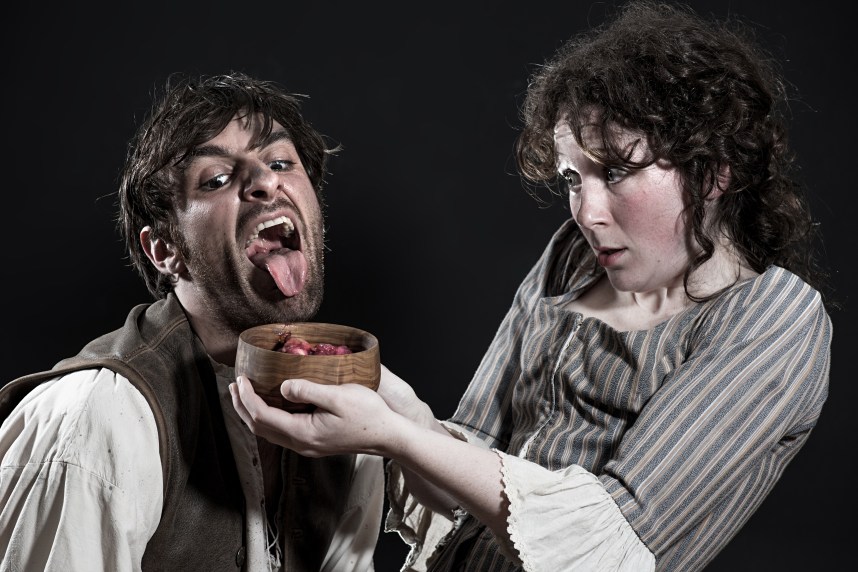
Photo Credit: Dahlia Katz, Costumes: Cat Haywood
RQ: What’s the conversation you want people to be having after the show? What do you want people to argue about?
CH: I think there will probably be a dissonance in rooting for Tarrare. He transgresses a lot of moral boundaries, but he does it for a very human, understandable reason. An audience is supposed to judge the actions of a protagonist when it gets into a murky area, but I would also like them to be compelled to feel empathetic toward Tarrare at the same time. I think that’s what I’d like people to wonder about, is “Can I imagine a scenario where I’d be him?” Would I behave differently?
DS: What hungers do I have that could drive me to extremes like his, and what right do I have to judge him. How would I judge myself? We do ask identity questions as well, what you’re doing versus who you are. How we’re somewhat ruled by different appetites and desires, and how that plays into your identity or search for that. Tarrare’s opinion of himself changes drastically and repeatedly throughout the show. His condition doesn’t change, it’s all based on his attitudes toward himself. The hunger is always innately there, it’s always a matter of circumstance how it plays out.
JF: I have this image in my head throughout the play of his hunger being a beast. Sometimes he rides the beast and sometimes the beast rides him.
Tarrare
Presented by Suspicious Moustache Theatre as part of the 2014 Toronto Fringe Festival

Where: Theatre Passe Muraille Mainspace, 16 Ryerson Ave, Toronto
When:
Fri. July 4 @ 1:45pm
Sun. July 6 @ 7:00pm
Mon. July 7 @ 4:45pm
Tue. July 8 @ 2:45pm
Thu. July 10 @ 11:30pm
Fri. July 11 @ 9:45pm
Sun. July 13 @ 4:30pm
Tickets:
$10 at the door (cash only) or $12 in advance (Visa or MasterCard, service charge included) beginning June 12 via http://www.fringetoronto.com, by telephone at 416-966-1062 (ext.1), or at the door.
Running time is 60 minutes.


 inthegreenroom