I had the chance to talk to Susan Freedman, performer and creator of her one woman show, Spilling Family Secrets, an intimate retelling of her parents’ 80 year love story.
MM: Why don’t you tell me a little bit about your show?
SF: It’s a show about my parents 80 year old love letters and their love story. I also talk about my own marital misadventures and about my daughter’s marriage too. Family secrets are revealed!
MM: Why do you want your audiences to hear and see such personal stories?
SF: If people relate my stories to themselves and their lives in some way, then they feel connected to what’s happening onstage. The hope is that they will feel connected to my story. This is my fourth Fringe show and all of them have been filled with personal stories. I’m not a particularly forthcoming person in “real life” but I don’t find it difficult to be open on stage. And, of course, any personal issues or revelations onstage have been resolved long-ago in my real life.
MM: You tell your parents’ love story while intermingling yours’ and your daughter’s love stories as well. Why not just tell your parents’ story? Why was it important to include three generations?
SF: We are all affected by our parents so greatly and I was certainly affected by how easy my parents made marriage look. My daughter’s caution was, in large part, due to how difficult I made marriage look. I could have made the show just about my parents but I felt it showed how we’re shaped by our parents to do it this way. And – there are only so many letters you can read onstage!
MM: Why do you think your mother gave you these love letters after so many decades?
SF: She gave me the letters because she thought I had already read them. And she knew I was very interested in them. I had really just read a couple of them. I tell myself she was aware of what I might do with them. But I’m not at all sure of that.
MM: Have you edited or fictionalized any parts of the letters or stories?
SF: I edited the letters a great deal. When I transcribed them they filled 75 pages – single spaced type. Not great for a Fringe show – or for theatre at all. I fictionalized absolutely nothing. All stories and letters are completely true.
MM: Have you learned anything new about your parents after reading all their love letters? What surprised you? How has it affected you?
SF: I learned so much from reading the letters. They were written mostly when my parents were from 19 to 25 years old. What a joy to get to know your parents before they were your parents! I was surprised by what an incredible romantic my father was. The love letters made me laugh and cry. They still do.
MM: What has been the reaction from your family members?
SF: The family members who have seen it are very, very happy with it. My sister will have seen it five times during my Toronto run! My brother hasn’t seen it yet, but will when it gets to Winnipeg.
MM: What kinds of reactions have you been getting from your audiences?
SF: They seem to be completely engaged in the show and very touched by the story. They laugh throughout the show and many people tell me they are teary at the end.
MM: Anything else you’d like us to know?
SF: I love doing this show. I’m the only one, other than my parents, who has read the letters so I feel privileged to be able to share parts of them. I’ll send my family the transcriptions at the end of this Fringe season.
Spilling Family Secrets
Presented by GoodSide Productions as part of the 2014 Toronto Fringe Festival
Picture of Susan Freedman by Dina Goldstein
Where: The Tarragon Solo Room
When:
July 02 at 06:30 PM
July 04 at 04:45 PM
July 05 at 06:45 PM
July 06 at 02:45 PM
July 08 at 03:15 PM
July 09 at 04:45 PM
July 11 at 03:30 PM
July 12 at 08:00 PM
Show length: 45min.
Genre(s): Comedy
This performance isnotaccessible for non-English speakers
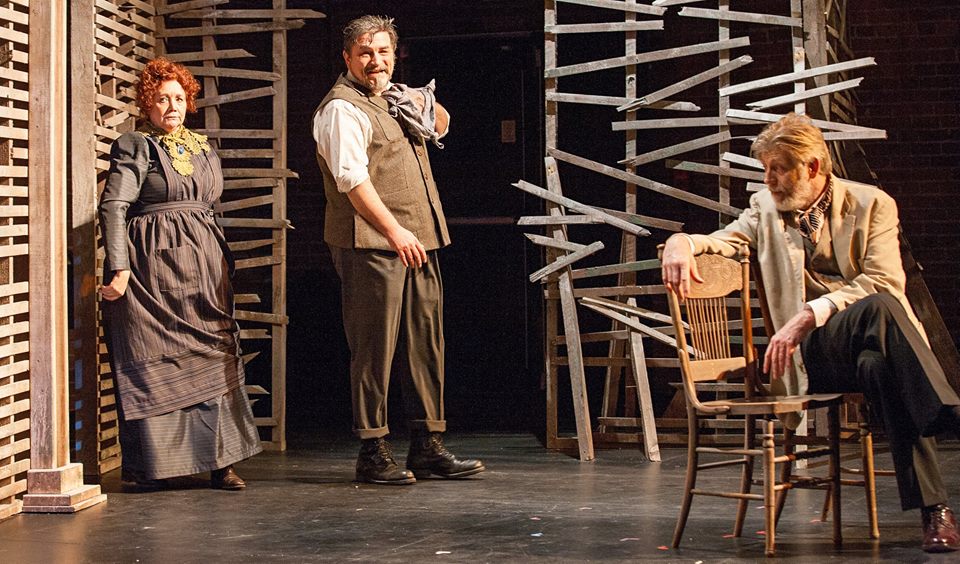
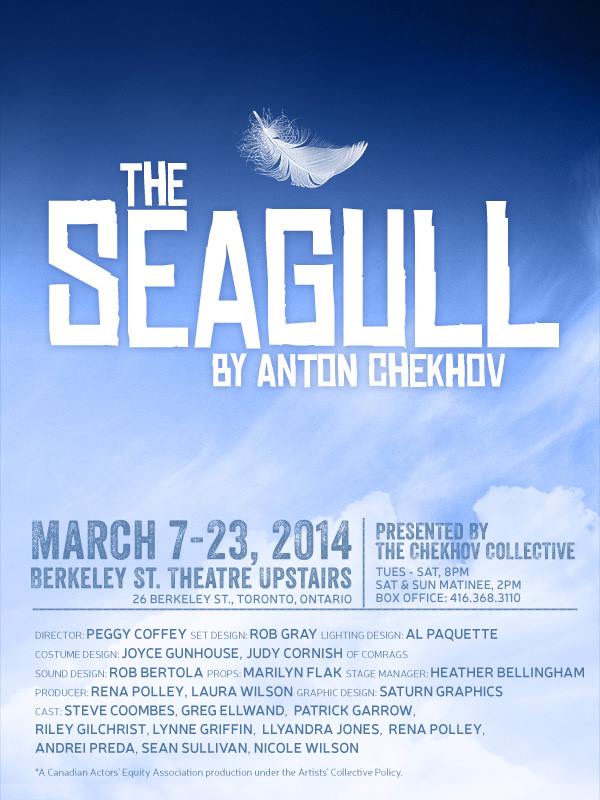
We sat down with Rena Polley, producer and actor of The Chekhov Collective’s The Seagull, to discuss the Michael Chekhov technique, theatre in Toronto and what makes The Seagull so special.
MM: The production part of The Seagull is incredible.
RP: The support team was made up of brilliant people, they’re all award winning, but they had never done theatre before. I got them involved because they’re friends of mine. Rob Gray has won Genies and Geminis. He literally finished filming two weeks ago, came home, pulled in every favour to get the set built, even painted it himself (and it’s been years since he’s done that) and he leaves tomorrow to go to Bucharest for six months, so he very kindly did all this. And it was a learning curve for him. The first time he built the set, it was flat. And Peggy [the director] said, “oh no, it has to be like a W, and this way” so they all learned something because it’s different in film. So, he built this beautiful set. He had it go from something very formal, until it moves across the stage and eventually it disintegrates. Kind of like the play. And the music! Rob [Bertola, Music and Sound Design] is an Emmy and multi award winning sound designer for film, he just finished David Cronenberg’s film, and he’d never really done theatre before either. He came up with the song that’s the theme song. It’s based on an old Russian theme song, but it was rerecorded in the 60’s by The Seekers, and it became this huge popular hit. It’s called “The Carnival is Over”. So he did the reverse; it starts deconstructed and then moves the opposite, so that by the curtain call, the song is sung with full song and lyrics. And Oh Susanna did the music. So it starts deconstructed and ends up full, and the set does the opposite, it starts full and ends up deconstructed as you go across. The lighting designer is Blue Rodeo’s lighting designer. He’d never done theatre before. He finished the Blue Rodeo tour Monday night and was in the theatre Tuesday morning. He’d only seen a run through once. But he’s so brilliant! And Comrags were friends of mine too.
MM: Your costumes are works of art!
RP: Comrags had an army of people building all this! Judy [Cornish, Comrags] said, “do you mind if I do the costumes?” I said, “Of course!” and then Joyce [Gunhouse] her partner in the company got involved, and then Joyce’s sister Judy and sewers and interns, and when we all saw the level of the costumes we thought “Uh oh. We’d better up our game!” Everybody felt that. Everybody came with an extraordinary level of work. And it made us up our game as well. And then Peggy came so prepared. She dreamt two ideas. And that was 1) The play within the play. Using the frame, using this kind of deconstructed way of telling a story. Peggy and I did teacher training in New York and our flight got canceled. So we ended up sin Manhattan for two days, and we went to the Museum of Modern Art. There was a show on all these artists that used deconstruction, and we kept seeing references to the frame. Peggy said, “that’s what I want to do at the beginning”. We tried it at a weekend workshop, and she knew it was going to work. We brought in Ellie Hyman from New York, who is a Chekhov person, but also a Viewpoints person, so she did this stuff with us, and we transferred the actors over from Ellie to Peggy. It’s hard as a director to come in to an ensemble that has been working together for a year. She only had three weeks to shape this play. It’s a big play, an epic play. The final image that she came with is when Konstantin rips the papers. Everybody always has him throw the pieces in the air, and she had him stuff them into his clothes, so that he leaves nothing behind. He takes all his writings with him. And it’s such a beautiful, poetic image. So she came with these two very strong ideas that bookend the piece. And she kept hearing rhythms. She could tell when vocally we’d drop the beat and then come up again. She’d say, “Push it. Keep driving it. There’s a pause coming, and you have to earn it.” And you can see these quiet moments in the production. She could really hear the rhythm of the piece, and wanted to honour that. She used Viewpoints from Ellie. She didn’t call it blocking, she called it composition. There are ten actors. There’s a lot to do!
MM: When you said it was an epic play it really made me think of the number of actors in the play. The nature of the way theatre in Toronto gets produced these days means that ten actors are unheard of.
RP: Ten big personality characters, and ten big personality actors, that I had empowered, for better or for worse, so everybody had an opinion. Peggy had to really set up a very strong structure for the rehearsal process. We had done all of this Chekhov work and it was all sort of loose and game playing and improv and playing with text, but not making choices about text because that’s directorial. Creating the world of the characters and then when we got to the rehearsal space, it was very traditional. I thought we could continue this process more, but I realized Peggy was right. There’s a three week rehearsal process, there’s a story to tell, and you have to get through each act. We got through each act quite quickly in a big sweep because of the work we had done, and then Peggy went in a worked smaller sections. There was more of a traditional work space. We looked at beats, we looked at text, and objectives. But she would bring in Chekhov vocabulary of “what’s the Atmosphere of this act?” We could get to it quickly because we had been training in that philosophy.
MM: How did this group of people all come together?
RP: I keep saying that we all worked for a year together, but we really didn’t. Every two or three months we did a three day intensive workshop. So that allowed us to do a lot of stuff, but then let things simmer during that time. And people have lives and shows and lots of stuff going on. So we maybe met three or four times for three or four days each time. In the last month we met every Monday. I knew I wanted to look at this play, and I wanted to see how far I could take the Michael Chekhov technique. Having studied it, I thought, “Okay, I’ve got to put my money where my mouth is”. What this process allowed us to do was to keep expanding and asking questions, instead of contracting and making choices quickly. That was the gift of this process. And even if you look at the program, Peggy talks about how it starts in expansion and ends in contraction. We can use the words of Chekhov. It’s been a really extraordinary process. The question I posed to myself at the beginning was “how far can I take this?” and what I learned is that you can use it all the way through to the end, but you’d better bring along other things as well. There’s a reason the Stanislavski technique is still surviving. It needs to be expanded, and other things looked at, but the ideas of beats, objectives, text analysis is really important, and you need to combine it with the Chekhov work. At some point in the process, you’ve got to throw out the head and let the body speak because it has a bigger vocabulary, but then bring the head back in.
MM: What I found really interesting is that they play is over 150 years old, but it’s still so relevant.
RP: Every time someone reads this play, they say to me, “It reminds me of Facebook” or we had an athlete in the audience, and she said that Trigoren’s speech about loving the writing process but hating it when it’s published is how every athlete feels when they train. So it speaks to everyone. What we’ve discovered about this play is that there’s no bottom. We could explore this for five more years. For a nanosecond, I thought about modernizing it, but I thought, no, let’s make the audience do a bit of the work. Let them make the leap, put the dots together. Because it’s all there. It’s a story about desire, art, the heart, human nature, relationships, and family. All these things are universal. They’re timeless. We agreed it was best to tell this story simply, and through the heart. Let the play speak for itself. We tried not to add things or colour it.
MM: I see the program that you have adapted the play.
RP: I knew I wanted to cut the play, so I looked at about seven different translations. I wanted to make the language accessible, but not too modern. Some of the formality of the language is from the play, but I didn’t want it to be archaic either. I wanted to keep the names simple so that we’re not calling each other by three different names. I trimmed.
MM: There’s also a very strong feeling of the ensemble.
RP: We did that over time, but I also think the Chekhov work can speed that up in a rehearsal. I really want to put this process into the rehearsal process. I’d like to offer myself to directors and say “give me an hour of your day, every day, and I can really help you move this process along. I can help the ensemble, I can help the atmosphere, I can help actors drop into characters”. But rehearsals are short, directors don’t know what it is. I’ve offered a few times and heard no. I understand that, but I think the Chekhov technique can make that happen faster. We had the luxury of time, and I had them do all kinds of things. In the first intensive weekend, I had them read the play and write down images of the play. I collected them, we played with them. We came up with themes, we came up with the set design, I had them come up with one line describing the play, because I wanted them to think about more than their character. I wanted them to take ownership of the play. Sometimes as actors, we just highlight our lines and look at our part in reference to the play. It’s safer. We want to protect ourselves. So I wanted to blow that away, and give responsibility for the play to the actors. We did build the ensemble over time, but I think it could have happened much faster if all we had was the three week rehearsal process. I really want to encourage people to look to the Michael Chekhov technique because I think there’s something in it that every actor, director, designer can use.
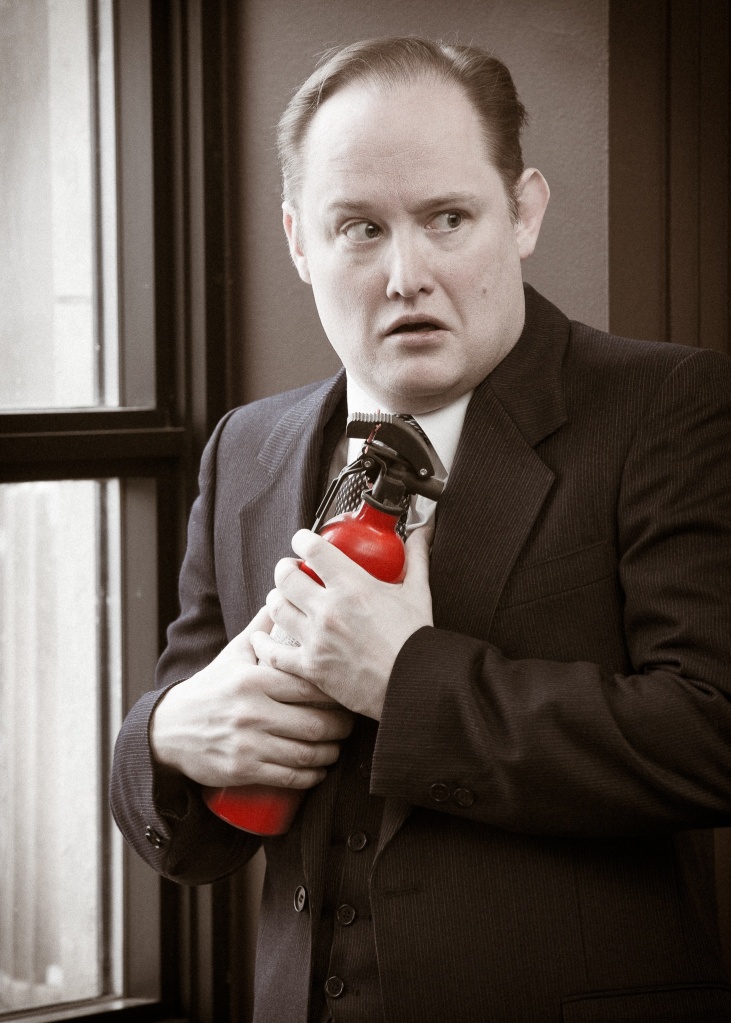
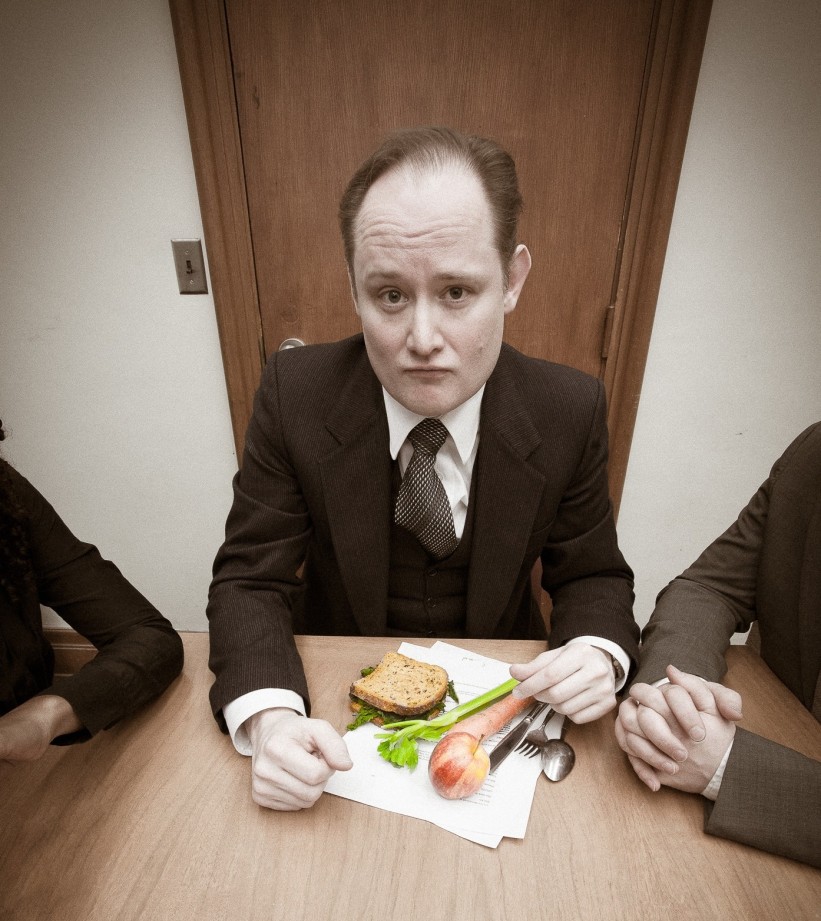
I interviewed Tyler Seguin, director, and Helen Juvonen, producer and actor, of Thought for Food’s “The Memo” to talk about the show and their intriguing Kickstarter campaign.
MM: Why don’t you tell me a little bit about The Memo?
HJ: The Memo is a play by Vaclav Havel and we are presenting the Canadian premiere of a translation by Paul Wilson, who is also Canadian. I call it a satire of bureaucracy. What do you call it?
TS: A workplace comedy.
HJ: A workplace comedy! Plot wise, it’s in this nameless organization, which is probably a government agency of some kind, but we never actually find out what they do or what their function is. The main character, Andrew Gross, receives this memo, written in Ptydepe, which is an artificial language that has been introduced into the organization to streamline office communication and he spends the rest of the show trying to get it translated because he doesn’t understand it.
MM: And that’s the irony of the situation and he can’t read the memo and it’s supposed to streamline communication.
TS: Exactly! And very few people in the organization know the language, and those who do know it are under mounds of red tape, so that they can’t actually do any translations for anyone.
MM: What was it about this play that made you want to produce it?
HJ: I produced a previous translation in 1999. Then, when CanStage was doing Rock and Roll, Paul Wilson was consulting on it.
TS: Rock and Roll was partially about a Czech rock band called The Plastic People of the Universe. Paul Wilson was the lead singer and guitarist for this rock band for a number of years during the 70s. Because he’s Canadian, he was deported for being seditious. This rock band became sort of a focal movement, and focal point of the dissident movement of the anti-Communist uprising. And that’s how he met Havel.
HJ: So Paul Wilson was a consultant on the production at CanStage, and in his bio, it said that he was currently working on a translation of this play. And went “Gasp! I have to do this play! I have to get my hands on this play!” And Tyler tracked down an email and said that we’d like to do the translation and he put us in touch with Havel’s literary agent in the Czech Republic and we got a copy of the new translation.
MM: Do you know if this play has been produced anywhere? I know you said it was the Canadian premiere.
TS: It’s been done once before that we know of, that Paul knows of, and that was as part of a Havel festival in New York.
MM: That’s an exciting thing, that you are one of the first to produce this play. Do you feel like there’s any responsibility to that?
(They pause.)
TS: Yes.
(They laugh.)
HJ: It’s a little nerve wracking. This is the first time we’ve worked on a published play where we’re actually in contact with the translator. I feel like we owe him something. We owe him a good production at the end of the day.
TS: We’ve been in touch with Paul quite a lot. He’s been very supportive. We’ve talked to him about issues in the play, and ways we want to approach it and things like that, and he’s been great, he’s been really on board. But it does put a bit of pressure on us to do justice.
MM: So you’ve been getting some extra insight from the translator then?
HJ: It’s really interesting because he was friends with Havel. So we feel like we have an inside track.
TS: There was one thing we really had to talk to him about. We were like, “Well, we really want to make this little change…”
HJ: Ha! Little change!
TS: And he said, “Hmm. Well, I think Havel would approve!”
HJ: And that was the stamp of approval we needed. And the other reason that we wanted to do this play was a place we were working for… I don’t think we should say where. (She laughs)
TS: Shall we say a branch of the Ontario government?
HJ: Yes, a branch of the Ontario government. And we were going through some rather grotesque bureaucratic nightmares with them and at that time I told Tyler he should read the previous translation. “You’ll love this, this will totally make sense” and he read it and was like, “This is what’s going on in my life right now!” so when we had the opportunity to work on this new translation, we now have an inside track on what it’s trying to say because we’ve gone through something emotionally similar. There’s an emotional resonance in this play that we actually lived through ourselves. And we wanted to do this play several years ago now. As we were trying to get the script and figure out if we had the money to do it, Havel passed away. He passed away in 2011. And all the rights were put on hold. They froze his estate. So we couldn’t perform the play. And it was about a year ago that the agent called and said “You can do it now!”
MM: That’s ironic that just as you’re getting ready to do this play, you end up with bureaucratic red tape in your way.
HJ: Exactly! It’s thematic at least. And now we’ve got the time and we were able to pay the up front costs.
MM: How long ago was the play first written?
HJ: It was first performed in 1965.
MM: Do you think something that isn’t modern or a new play still has a resonance for an audience today?
HJ: It’s kind of creepy that the play was written about Communist Czechoslovakia and it’s like it could have been written today. Part of that is the translation, because Paul is Canadian. But the language doesn’t feel old, and he uses Canadian idioms as well, so it feels modern.
TS: It feels very “of the now”, but what’s fascinating is that the themes of the play, the characters, and bureaucracy hasn’t changed in at least fifty years, probably longer. So, when I read it, I recognized the characters, I’ve worked with these people, and I’ve had to go through these weird situations. Corporate culture is corporate culture. And apparently it’s always been like that. There are arbitrary rules and people who adapt to strange social norms without really thinking about it. Trying to do anything you can to appear busy without actually doing any work is such a running theme in this show, and is very much a theme of the place where I was working at the time. It definitely says something to a modern audience.
HJ: Any time I explain the show to someone, they go “Oh I get that”. I talk about this new language that’s supposed to make things more efficient, and they go “Oh yeah I get that!” I talk to people that were at their place of business when things moved over into computers, and it sounds like the exact same thing. “This is supposed to make your life more efficient” but it ends up causing more problems.
TS: Even the idea of a new language. Havel was in a lot of ways pointing at the Communist party’s corporation of language into propaganda at the time. But you see it today, you see it in corporate culture all the time. I can’t say the word “innovation” anymore without irony to it.
MM: My favourite one is “connectitude”.
TS: And does that mean anything?
MM: It does not!
TS: Exactly! Corporate speak and jargon.
HJ: We’re also seeing it in our government right now with the Fair Elections Act. Is it really about fair elections? And that twist of language.
TS: Or any time a Conservative minister gets up and says, “I’d like to provide some clarity” and you know they’re going to talk about something else. Words don’t mean what they mean anymore. They just use them as noise to confuse everyone and obfuscate and that’s very much in the play. They literally bring in a whole new language that they say is supposed to be more efficient but actually just confuses everyone and causes total chaos.
MM: Why don’t you tell me about your Kickstarter project?
HJ: We call it the “Give Us an Hour of Your Time” campaign because we’re asking people to donate the equivalent of one hour of their wages. That actually came about as an idea related to a Pay What You Can Performance. People are always confused about how much to pay for PWYC. “I don’t know how much to give you. Is $10 okay?” And now there are signs that state a recommended donation, and I thought, well what is a fair amount to pay? I suppose an hour of my time. I’m going to see a show for an hour or two, so an hour of my time for an hour of entertainment. And then I started joking that it would be great if a CEO came to the show and gave us an hour of his time, because then he’d pay for the whole show. We thought it was an appropriate theme because it’s set in a workplace, so a great thematic tie-in.
TS: Also Havel was a very political author, and there’s a lot of talk right now about the income gap and wage equality and the whole minimum wage debate that went on and is still going on. And we thought, we’re doing a show about workers that is inherently political at a time when that is a resonant thing, so we might as well make a statement with it, in a way that I think Havel would have liked.
MM: I thought your reward levels on your Kickstarter campaign were interesting.
TS: As part of the “Give Us an Hour of Your Time”, we looked at what an hour of different people’s time is worth using some Stats Canada and other publicly available information.
HJ: We had to do some massaging a little bit because there’s no clear hourly wage for say, a lawyer, but it’s all pretty accurate. We started at $10, which is as close to our minimum wage as Kickstarter would let us get (they don’t like decimal points), and then the next step up is average Canadian, who apparently makes $23/hr and then senator at $65, and the 1% threshold, which is shockingly low. Yes, $92/hr is still impressive…
MM: But to think that the people who run our country are making less than $100/hr. makes you think.
HJ: And maybe that’s just in Canada. We don’t have a super wide disparity of wealth and non-wealth.
TS: I think it’s amazing just how big the swath of the 1% is in Canada. ‘Because you do have people who are making like, 30 billion dollars a year, some really obscene figures like that, but you could be one of the top income earners in Canada with less than $100/hr.
HJ: And we have Prime Minister, who makes $154/hr. All these are averaged on a 40 hour work week and a 52 week year, but I know that people work more or less than that.
TS: There’s average lawyer, $301/hr and average CEO who apparently makes $631/hr and the top CEO is something like $7200/hr.
HJ: An hour! AN HOUR! So if just one of those top earner CEOs were to give us an hour of their time, they would give us our Kickstarter goal twice over.
TS: When we were setting our target, we thought, well what do we need to put the show up? And we decided it was about $3500. And when we saw that the top CEO was $7281, we thought, close enough; we’ll just make it half of that, so 30 minutes of a CEOs time will pay for our goal.
HJ: We’re doing this show as an Equity collective, which means that no one is getting paid up front. People only get paid if we cover our expenses and make a profit. And with all the actors and the people behind the scenes, there are 17 people involved. We haven’t done it yet, but I really want to sit down and find out how many hours work hours have gone into this show, so that people can see how much people have already donated of their time to make the show happen. It’s going to be astronomical because we’re looking at over 100 rehearsal hours, multiple people per rehearsal, and then all the time that’s already been put into it. So it’s not unreasonable to ask for an hour of your time considering everything that goes into it.
TS: People seem to be overwhelmed by all the different things that are going on. There are some great projects and ideas on Kickstarter and Indiegogo and GoFundMe and people don’t know what to donate to or don’t know what an appropriate amount is. So we’ve tried to make it simple and maybe fun. If you make $14/hr, then $14 is an appropriate donation.
HJ: It’s funny to see how literally some people are taking it. Some odd dollar amounts are being given to us, and I love it! I love that somebody actually figured out how much they made and decided to contribute. And someone was like, “Well, I’m not a senator, but I like the title, so I’m going to donate at that level”. People are having fun with it, and that’s great.
TS: This is an exciting opportunity to bring to a Toronto stage an author who is so rarely done and in a fresh new translation by a Canadian, so we’re really enthusiastic about the production and hope that people can donate.
The Memo
Written by Václav Havel, translated by Paul Wilson, presented by Thought for Food Productions
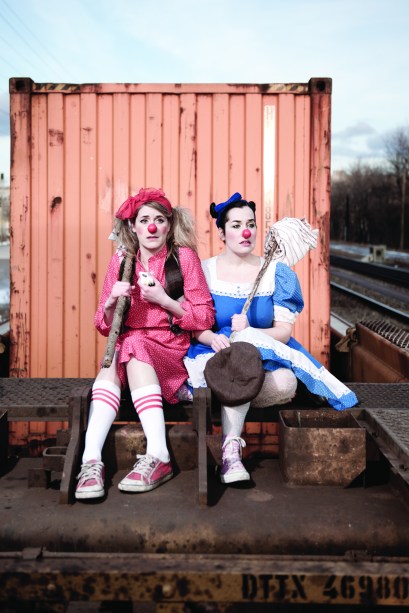
I had tea on a frigid evening with the talented and wonderful Heather Marie Annis and Amy Lee of Morro and Jasp as they finished each others’ sentences and laughed about their upcoming show, “Of Mice and Morro and Jasp” playing now at the Factory Studio Theatre, January 28th to February 8th.
MM: Why don’t you tell us a little bit about Morro and Jasp?
HMA: Morro and Jasp are clown sisters. Jasp is older.
AL: Yes, she certainly is.
HML: And more bossy. And more particular. And they have been sisters…
AL: And Morro is younger. And more unruly. And flies by the seat of her pants. But loving and free spirited. (Indicates Annis) She plays Morro. We both said a nice thing and a not so nice thing about each others’ character.
HMA: They can’t live with each other or without each other.
AL: Absolutely. They have been growing up over the years. This is our… I can’t really keep track anymore. This is show… maybe eight, nine?
HMA: They’ve gone on a series of adventures. We started out with them performing. Morro and Jasp are the ones writing the plays and putting on the plays.
AL: We help sometimes.
HML: And they’ve grown up through the series of shows that we’ve done since we started. We had three…?
AL: Three shows for young audiences and then they went through puberty, which was awkward and exciting and then they went on different vacations, then they did a cooking show and now they’re tackling a tragedy with Of Mice and Morro and Jasp.
MM: So in doing Of Mice and Morro and Jasp, do we see their growing maturity through the progression of them growing up?
HMA: Yes. And they’re at a stage in their lives where they’re struggling financially, and they’re trying to find their place in the world with jobs and how they’re accepted by society, or not accepted by society.
AL: Figuring out how to make life work. (Looks at Annis) I guess you said that.
HMA: You said it in a different way.
MM: It sounds incredibly relatable. I don’t know anyone who doesn’t say, “What’s my place in the world? How do I figure this out? I need a job!”
AL: And similarly, just how George and Lenny are figuring out where to go and how to make their dream work. The first thing that jumped out for us was that it was such a great pairing. Their relationship is so similar to our relationship and then just figuring out their similarities. George and Lenny’s journey and Morro and Jasp’s journey and how they fit.
HMA: And also to explore the sadness in their lives. The tragic elements, beyond comedy, what else there is.
AL: There are always elements of tragedy in our shows, of course, there has to be both, but we wanted to try and adapt a full on tragedy to see what would happen.
MM: Is this because the two of you sit down and say “This is what we’re going to do”? What is your process of developing your shows? I’ve heard of some performers who say “There is me, and then there is my clown” and others who say “It’s all me”.
HMA: (laughs) That is an interesting question!
AL: We are IN our clowns, but our clowns…because we’ve been doing them for so long, they really have minds of their own. And a lot of the time, we’ll think something will be a good idea, and when we rehearse as Morro and Jasp, they will let us know. A lot of the time, we’ll try to solve the problem, and we’ll say “Let’s let Morro and Jasp solve it” and they do.
HMA: At the end of the day, your clown character is coming from you and your own individual personality, which is why clown is so specific. With some characters, you can try to replicate them and perform this other person as an actor. I find it’s a little more challenging with clown because it is so specific to your person. So, we are our clowns, but once we get into character and start exploring ideas, we have totally different ideas that will come out in different ways.
AL: It’s about impulses!
HMA: Right. We might not have those as Heather and Amy sitting at a computer coming up with ideas. Theirs will be more! Theirs will be bigger and more exciting and more extreme.
AL: We write our shows in combination with them. We do it, and then we do it in clown, and we go back and forth to figure out what works and what doesn’t.
MM: I want to hear about your cookbook. How did that come to be?
AL: We were doing a show called Morro and Jasp: Go Bake Yourself and it’s our show about cooking. Someone came to see it, and he worked in publishing and said, “Make a book, and we’ll publish it”. Those were our guidelines! We didn’t really have any!
HMA: He totally came to us with the idea. We had said, “Maybe we should make a book, that would be so much fun”. Maybe we just put it out into the universe! He gave us so much freedom. The idea was to make a cookbook combined with other things, because it came out of our cooking show.
AL: We had never planned to make a cookbook, but it was a fun match. And we both love cooking and making food, and food in general and it felt like a good fit. It was a lot of work! We had no idea how much work a cookbook would be!
HMA: The fact that he gave us so much freedom is why it worked for us. We got to discover what form and what content, and everything it would be based on our process and how we went along with it and what discoveries we made along the way. Which isn’t always what you set out to do when you make a book, because I would assume the publisher would dictate it, especially when he came to us with the idea. We didn’t know how long it was going to be either.
AL: Initially, it was supposed to be 60-80 pages, and it ended up being about 235! We just kept getting excited about all the different recipes we could put in!
MM: Are they all your own recipes?
HMA: It’s a combination of some recipes we made up, recipes that we have that we’ve used and loved, a lot of recipes from our families and friends, and some fans.
AL: Some fans wrote in and submitted recipes, which is fun.
HMA: Each of the recipes says who it’s from.
AL: It was exciting to see what we would get. And we tested everything.
HMA: Morro and Jasp tested them! (laughs)
AL: Well, we were there to guide the process.
HMA: There are also some recipes from our show, Go Bake Yourself. So it’s connected back to the show.
MM: It’s an extension of the show? A new medium?
AL: Yeah! It doesn’t run the same storyline as the show, but it’s connected.
HMA: There are similar themes about emotion and eating and those are connected. And love, and how food is a way of expressing love.
MM: Now I want to see a Morro and Jasp cooking show on TV.
HMA: So do we! That would be great!
AL: A few people have mentioned that. So we’ll see. We’d be up for it. And I think Morro and Jasp would be too. Jasp would feel like all her dreams came true.
MM: Of Mice and Morro and Jasp is a remount. Has it developed at all since the last time you performed it?
HMA: We’re developing it now! (laughs)
AL: We’re still developing it.
HMA: That’s where we just came from. It’s not that the story of it is changing, there aren’t dramatic rewrites, but we’re fine tuning it. We have more space to play now. At the Toronto Fringe you have a timeline. So now we have more room to breathe, and give the moments more detail. We can infuse a little more energy or breath into them.
AL: We’re coming back and going, “I think we can make this moment better. How can we do that?” “This monologue can be better”. So it’s really nice to be able to fix all the things that we wanted to fix and didn’t have time to. There are a few new elements as well, production elements that we can have.
MM: Like pyrotechnics?
HMA: (laughs)
AL: That would be fun!
HMA: The idea of the show is that times are tough. They’re on a strict budget and they’ve spent their last dollars on their set. No pyrotechnics, unfortunately. Not this time around anyway.
AL: But that is a good idea.
MM: Do you have anything else in the works? What’s next for Morro and Jasp?
AL: Morro and Jasp are in residence at Factory Theatre this season, developing their newest show, Morro and Jasp: 9 to 5, which is about them actually getting jobs. This show [Of Mice and Morro and Jasp] is about them not being able to, and the next show is about them figuring out how to actually make that happen.
HMA: Hold down a job.
AL: So that’s in process. We’re writing that right now. And also right after this show closes, we have a few days, and then we go to Ottawa to the GCTC for the Undercurrents Festival, and we’re performing Morro and Jasp Do Puberty there. Which is exciting because that’s the first in our series of adult shows, so it’s nice to give Ottawa audiences an introduction to us with that one.
MM: In going back to these other shows, are you finding out more and more about Morro and Jasp? Are Morro and Jasp discovering more about themselves?
AL: We always discover more. Every time we do a show, we change things about it. Because we’ve learned a lot about ourselves, we’ve learned a lot about Morro and Jasp, we learn so much more about who they are every time we do a show. That does inform us. We can add more detail and new things.
HMA: And also sometimes we have references or comments about things that are very timely. They’re happening now. So we’ll change them when we go back to a show. And always we’re interacting so much with the audience and the space that we’re in. Storytelling has to be alive and based on that audience and that thing and what they’re saying to you.
MM: Do you prefer that freedom of development of character and story versus an established play and character written by a playwright? Do you need both?
AL: It’s nice to have both.
HMA: They’re so different.
AL: It’s a totally different challenge. It’s nice to be able to practice both. Doing a play with a script written by someone else, whether it be a famous great playwright or someone new, always teaches us as artists a lot. So it’s nice to have the two inform each other constantly. How to bring what you know about making new work into a script that’s written and how to bridge that other kind of work into what we’re making.
HMA: And it’s a completely different exercise in that, with someone else’s script, you’re trying to interpret it and learn what’s already there and what’s hiding underneath and between the lines. With our stuff, it feels like such a rare opportunity to have a character that you enjoy and play with for so long. For, what? Ten years?
AL: Almost ten years, yeah.
HMA: And they’re so close to us because we created them. It’s a very special thing to be able to play with.
AL: We get to keep coming back to the same character and get to see what they will do in new circumstances, a new adventure, but keeping them, them. The nice thing is that there are no limits in terms of what we want to explore, but there are limits in terms of who those characters are and their relationship. That informs everything that happens.
MM: Are there certain things that Morro and Jasp would never do or say?
HMA: Never say never! (laughs) But there are certain things that they aren’t likely to do. They have their boundaries too. And those change and evolve just like anyone else. They’ve become these very dynamic people because they’ve existed for so long.
AL: I really hate it when actors say, “My character would never do that”. A lot of the time I think, “Just make it work”, but with this, Jasp, say, wouldn’t be happy wearing a pair of baggy pants. But it might be fun to see what happens when you put her in a pair of baggy pants.
HMA: So with those boundaries, it helps us put them into situations that they hate, which is funny. That’s what good theatre is, dynamics. So the more that we found out what they hate or love, the more we can play with the dynamic.
MM: To wrap up, in three words, why should people come to see Of Mice and Morro and Jasp?
(whispered consultation)
AL: Steinbeck meets clown. You’ve got to find out what that means!
Of Mice and Morro and Jasp
Created and performed by Heather Marie Annis and Amy Lee
Directed by Byron Laviolette
Presented by Up your Nose and In your Toes (U.N.I.T.) Productions & Factory Theatre
When: January 28th – February 8th, Tues-Sat 8pm, Thurs 1pm, Sat 2pm
I sat down with Morgan Norwich and Johnnie Walker, director and writer, in a busy café to discuss their latest production, Scheherazade playing now as part of the Next Stage Theatre Festival.
MM: So why don’t you tell me a little bit about Sceherazade?
MN: Sure! It’s an adaptation of 1001 Nights, with the twist that the story is more from the perspective of the character of Scheherazade, who, while she is the teller of the original 1001 Nights, we don’t get to know too much about her. So we created a world where she lives in this crazy, totalitarian society where they’re killing a young woman every morning at dawn, and with a weird anachronistic, modern spin on it with lots of sex, which is also inherent to The Nights, and lots of pop cultural references. That’s about it, wouldn’t you say?
JW: Yeah. In a way I feel like we’re just unearthing the sex and violence that were totally there all along. The Nights have really been sanitized and ‘Disneyfied’ over the years. Sometimes certain bits of the stories go by so fast that you don’t take the time to think about them. But even the whole setup for the story, that there’s this king that marries a different woman every day, sleeps with her, has her killed and marries another one the next day… It’s sex, and violence and sexual violence that are so at the core of the whole thing. But if you say it quickly enough, you sort of skip them somehow. So it’s not like we’re shoving all this new sex and violence into it. It’s already there. I think we’re giving it room to breathe and say “Look at all the stuff that was here this whole time that you missed”.
MM: So was this a story that you had always wanted to tell, or was it that you set out to find a show that was the untold story? Why this story?
JW: That’s a good question. It’s been so long…
MM: How long have you been working on it?
MN: Over two years now.
JW: Yeah that would have been about fall of 2010.
MN: So even longer than that.
JW: And that was a very short, early version of the very beginning of the play that was like a little workshop. And then we came back to it the year after that a bit more seriously.
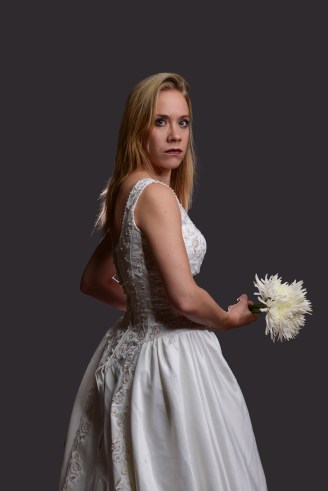
Lindsey Clark in Scheherazade. Photo Credit: Greg Wong
MN: We did a workshop of it with just two actors, just focusing on the characters of Scheherazade and Dunyazade, the sisters, and out of that workshop came this idea for the world of the play being this dystopian, but also very familiar, wedding-obsessed culture, and all the ideas of consumerism layered into the existing narrative. That came out of that workshop.
JW: I’ve always been into the character of Scheherazade, even just the name I like.
MM: So what about Scheherazade is appealing to you?
JW: Just the idea that there is this totally brutal regime that she’s living in, this insane tyrant running the country, and that her plan to take him down is all through art. And it’s totally pacifist. She’s just smart. She’s smarter than everyone, a really good storyteller, and she doesn’t need to come up with some… It’s a very genre show in a lot of ways, it feels very genre-ish, where it has this dystopian, almost science fiction without the science feel to it. I’m kind of a nerdy guy in a lot of ways. I like seeing a superhero movie, or we’re both fans of Buffy the Vampire Slayer and things like that, and in the last couple of years I have noticed seeing a lot of this stuff that, even though those shows or movies are really smart and have a lot of sophisticated things to say, it ultimately comes down to people punching each other. And that usually is the only way to solve problems. I love how that is not what Scheherazade is about. Never in part of her plan is “Oh I’ll trick him with this story, and then I’ll shoot him in the face”. That’s not what her deal is. And in the show I think we’re trying to examine “Is it possible to have that? Is that kind of resistance possible? Where does it work and where doesn’t it work? Where can a plan like that really succeed? And where can it really fail?”
MM: So is it possible to change the world through creative, non-violent means?
JW: Exactly.
MM: Is this the kind of play you guys are always looking to do? These strong female-centred shows?
MN: For the most part. I consider Johnnie to be one of the best feminist playwrights, of the male feminist playwrights for sure.
JW: Oh that’s so nice! I like that!
MN: Well I do. I always have. So another really large show that we did a few years ago was called Eight Girls Without Boyfriends which, I don’t think Johnnie realized this when he wrote it, was sort of a witte-fem inspired, cabaret piece that was also about these empowered female characters. So I don’t know if it’s something that’s always been conscious, but it’s been the kind of thing we’ve always done just because of who we are.
JW: I think both of us are really interested in feminism and gender and also sexuality.
MN: One of the other things that Johnnie and I do when we’re not doing shows is we work with an all-male burlesque troupe called Boylesque T.O. so we’ve been in the last few years exposed to the burlesque community and the gender play on it because, with the exception of me, it’s all guys in the troupe. I feel like probably a lot of my experience with both the male burlesque troupe and other female burlesque troupes that I’ve hosted with since we started doing that has informed a lot of certainly the staging of sexuality that’s gone into the show, but also, when you’re around sex-positive people all the time you get a good attitude about that kind of thing and you want to express it onstage.
MM: After having seen the show last night, I can say there’s a lot of sex in the show, but it’s funny, a lot of it is very light.
MN: Except when it’s not! And then it’s not.
MM: Right. And for the most part, when there’s sex in other plays, you can see it coming and you feel like “oh there’s going to be sex and I’m going to be uncomfortable seeing this with all these other people” and you guys just put it out there. It’s very “it is what it is” and then you move on to the next part.
MN: And so you didn’t feel uncomfortable? Oh good!
MM: And the audience loved it. They thought it was really funny. Especially, I would say, the older members of the audience. So do you usually get a good reception from people for this kind of work?
JW: Some people have actually said that this show is a departure for us in a lot of ways. That level of sexuality is not in our previous shows.
MM: So why make such a departure?
JW: We wanted to tell this story. We both came at it from different angles, and it was important to the both of us in different ways. And in the same ways also. So I think you need it for the story. When I was writing it, I didn’t throw in any orgies that aren’t in the original plot and aren’t integral to the plot.
MM: It’s funny that you say that because going into the show I thought “Oh we all know the story of Scheherazade” but apparently we DON’T really know the story. You had said earlier that it’s really the untold story. It’s been so ‘Disneyfied’, and we really know more about the stories that she tells versus the story of her.
Lindsey Clark in Scheherazade. Photo Credit: Greg Wong
JW: Aladdin, Ali Baba, Sinbad are the ones that all rise to the top. And ironically, those are the stories that are in 1001 Nights where no original has been found. They were all translated in the 1800s into French by this guy Guillaume, and those three stories, which have become the most popular, no one has found the original that he translated from. So there’s a lot of speculation that he actually wrote them himself, inspired by the tales. It’s kind of hilarious that those have become the iconic stories. When you read the tales, almost every story are as good as those, as good as Aladdin. There are so many amazing ones that we don’t know. And in the show itself we have these moments. Like, right before the first orgy scene, they come on and do this sort of tasteful sexuality.They’re sort of posed in a silly way and she says, “slaves let us bathe and let us lie together” which, in the translation that we’re working from, is directly in the text. But I thought that was so sanitized. It’s a translation of a translation of a translation. Somebody has put their 20th century, prudish, Westernized idea of what that means. But really, think about that for a minute. What does ‘let us bathe and let us lie together’ mean? It doesn’t mean ‘scrub my arm and let’s have a nap’. It’s a big orgy. That’s what that means. There are these details that came out and it’s very explicit in the story that Scheherazade’s whole plan can’t start until she and the king have sex. It has to happen to complete their marriage. And it’s specific about the fact that her younger sister is in the room while that happens. In the original, she’s actually under the bed.
MN: We didn’t go that far!
JW: We even toned it down from that! But it’s one of those things that people just glide past in the text. “Oh yeah, Dunyazade was lying under the bed, then she came out with a plate of food”. No! Wait! Give that a moment. She’s in the same room as her sister while she is sort of raped by this tyrant. It’s a huge deal. And you need to give that its time. So it was about unearthing these bits. If this happened in real life, it would be a big deal. And the narrative isn’t quite letting it be.
MN: One of the things, right off the bat in rehearsal that we talked to the actors about was checking their own assumptions about the story and the world because of all of our ‘over-Disneyfied’ childhoods. We literally got to a point where everyone got one Disney’s Aladdin reference per rehearsal and then we had to shelve it and put it away. As much as so much of the play has ended up being cartoonish, which works for the kind of satire we’re doing, it didn’t help to go back to images in our heads of the Disney movie.
JW: Would you say that we’re dealing with A Whole New World?
MN: I would, but I can only say that once today! That’s the rule.
Director – Morgan Norwich and Writer – Johnnie Walker of Scheherazade
MM: Are you able to do this show because it’s part of the Next Stage Theatre Festival?
MN: Yes. Next Stage provides a lot of resources in terms of giving us the space, the box office, the technicians, stuff that’s really difficult to afford for even a small show. But when you’re dealing with a cast of eleven, plus three designers, plus stage manager, plus producer, the cost just grows and grows. Having the context of the festival is actually what has made it possible.
JW: And the cache too.
MM: So because it’s part of THIS festival, you can put on THIS play? Would you have been able to find the support, not just financially, somewhere else? Do you think you could have done this play without being a part of this festival?
MN: I don’t think something like this, even at the Toronto Fringe, we could have pulled off in the same way. Because it’s a smaller festival, we get a little bit of extra support, in terms of media stuff in particular.
JW: We were successful in some of our grant applications, and I think that’s partly because we were part of this festival. It’s a known entity. Even though it’s not that old as a festival, I think it has a great reputation. It’s a kind of risky show in a way for the performers, so to be able to hand them the script and say “we’re doing it here” is nicer than “here’s this crazy show with orgies and stuff, and we’re going to do it in a garage”.
MN: There’s a safety net, for sure.
MM: Do you have anything else in the works? Maybe want to give us a preview?
MN: This show has been so all consuming! We’ve got burlesque stuff happening immediately after, and I’ve got something in the Rhubarb Festival. But it’s going to be very weird for this to be over.
JW: We also do our show Redheaded Stepchild, that’s coming up. We have a show that we did in Edmonton last year called Amusement that we’re hoping to do in Toronto at some point. We don’t have an exact plan for that yet, but hopefully we’ll get something together.
MM: So to wrap up, in three words, why should people go see Scheherazade?
MN: Natasha [Greenblatt] in the show sent a really good email inviting someone to come that said “There are three orgies and a knife fight” so I’m going to say Three Orgies, Knife-fight. I can hyphenate that, right?
JW: I was just going to say Butts, Butts, Butts. When we got into the costumes, I realized there are a lot of butts in this play. So there’s a butt for everyone!
Scheherazade
Presented by Nobody’s Business theatre Written by: Johnnie Walker Directed by: Morgan Norwich Where: Factory Theatre When:
Monday, January 13th, 2014 at 7:00 p.m.
Thursday, January 16th, 2014 at 5:15 p.m.
Friday, January 17th, 2014 at 9:15 p.m.
Saturday, January 18th, 2014 at 6:45 p.m.
Sunday, January 19th, 2014 at 9:15 p.m. Tickets: $15 . For online sales, go to www.fringetoronto.com. Tickets can be purchased by phone at 416-966-1062, or in person at the venue. For more information, go to www.nobodysbusiness.ca.










 inthegreenroom