Skip to content

Posts tagged ‘Megan Robinson’

“Annie Baker, Creating Theatre for Right Now & Reading People’s Minds” In Conversation with Mitchell Cushman, Director of THE ALIENS

Interview by Megan Robinson

The space at The Coal Mine Theatre has undergone yet another transformation for their upcoming production of The Aliens. Directed by Mitchell Cushman, who is well-known for his creative use of space, the black box theatre is unrecognizable as a Vermont alleyway.

“It takes place outside, which felt like a real fundamental challenge at first,” Cushman let me know from our seats in the audience, where we sat taking in the details of the set, which received some exciting final touches the day before.

Around us, the theatre’s walls were plastered with exposed brick, a handmade picnic table took center stage, and a graffitied image of half of Bernie Sanders’ face was spray painted just above our heads. With a single row of chairs lining the two walls, the length of the playing space called to mind a runway at a fashion show.

“I think it serves the naturalism of what Annie Baker is writing because the audience are really flies on the wall as opposed to feeling like they are being played to in any way.”

For the next thirty minutes, I talk to director Mitchell Cushman about Annie Baker, creating relevant theatre, and reading people’s minds.

MR: You just worked on Treasure Island at Stratford – has this been a breath of fresh air?

MC: They’re both very different. I had a great time with Treasure Island, but they couldn’t be more different. Treasure Island is a huge proscenium, thousand-seat theatre and large budget show, largely for kids.

Annie Baker writes in this kind of hyper-naturalism where everything is sort of sacrificed for the pursuit of trying to get something real on stage. That means it rejects a lot of what we expect about conventional drama. Working on this show makes me realize how much artifice goes into most theatre. Because we expect it. We expect things to be curated into something that is easily recognizable as dramatic whereas there is drama and construction to Annie Baker’s writing but in a way that is so invisible.

MR: What did you think of the play the first time you read it?

MC: I read it like 3 or 4 years ago. Honestly, I don’t know if I knew what to make of it when I first read it. I thought parts of it were interesting. But I’ve had this experience reading a couple of her other plays. They feel very thin. You get to the end, and you’re like – where was the play?

Then I had the chance to see some of her plays. I saw The Flick, and I saw a production of John with The Company Theatre. Both of those were really impactful experiences for me as an audience member, and it was after I saw John that Ted (Dykstra) wrote to me about The Aliens. When I did go back to read it with an understanding of the wavelength that she calibrated on, I found much more in it. Also, I’m now at the exact age of two of the three characters that are at the center of the play, and I think that has had an impact as well.

Photo Credit: Tim Leyes

MR: Which character do you think you most relate to? 

MC: (laughs) Probably the guy that is not my age. There are three characters KJ and Jasper and Evan.

KJ and Jasper are 30-31, they haven’t really left their hometown, and they spend their time kind of vegging around and reading poetry or sort of writing music. One of them wants to be a novelist, but they have not really done anything. But even though they haven’t done anything, they’ve had real deep life experiences, and a lot of that is based on living on the margins of society and loss and complicated family life and problems with drugs.

Evan works in the cafe… beyond that “wall”. He’s a seventeen-year-old kid working a summer job and he’s got a comfortable home life but feels at 17 that he hasn’t had a lot of experiences and maybe couldn’t be an artist, a writer, a tortured soul, or musician because he doesn’t have what he perceives to be their pain and suffering. I’m more like him. I think I said that on the first day of rehearsal. I worked in a cafe, I come from a comfortable middle-class background, and I haven’t ever felt fundamentally alone in the way I think the other characters feel in the show.

MR: So you’ve never felt like an alien?

MC: Well I don’t know that… I wouldn’t say I’ve never felt like an alien. But I’ve never really felt that society wasn’t built for me which is the way that KJ and Jasper feel, and maybe Evan feels that in a different way.

MR: Why this show right now? 

MC: The play was written in 2010, and one of the decisions we had to make was, do we set it then or now? The characters have cell phones in the show, and there are lots of stage directions of them flipping them open and closed, and that felt like by doing that we’d immediately be playing something that felt like a period piece. But the phenomenon of disenfranchisement that she writes about is only more pronounced now than it was seven years ago.

The play is set in Vermont, and I was trying to think what do I know about Vermont or what does Vermont mean to me? And you can see right here, we are sitting under a big graffiti thing of half of Bernie Sanders’ face.

Bernie Sanders is a Senator from Vermont who played such a large role in the last American presidential election and epitomizes this part of America. Vermont is very liberal and left-wing in a lot of ways, but it’s also the whitest state… I think it’s like 95 % white. Very little diversity and, among other things, the play looks at what happens when you have a very homogeneous population of people and how do their thoughts develop and how do thoughts about othering occur, and all those things feel very relevant. In its own way, the play has a lot to say about the opioid crisis and things that have only become, you know, more pronounced and tragic.

In some ways, I think she was writing something prophetic. The world around us has grown into the play
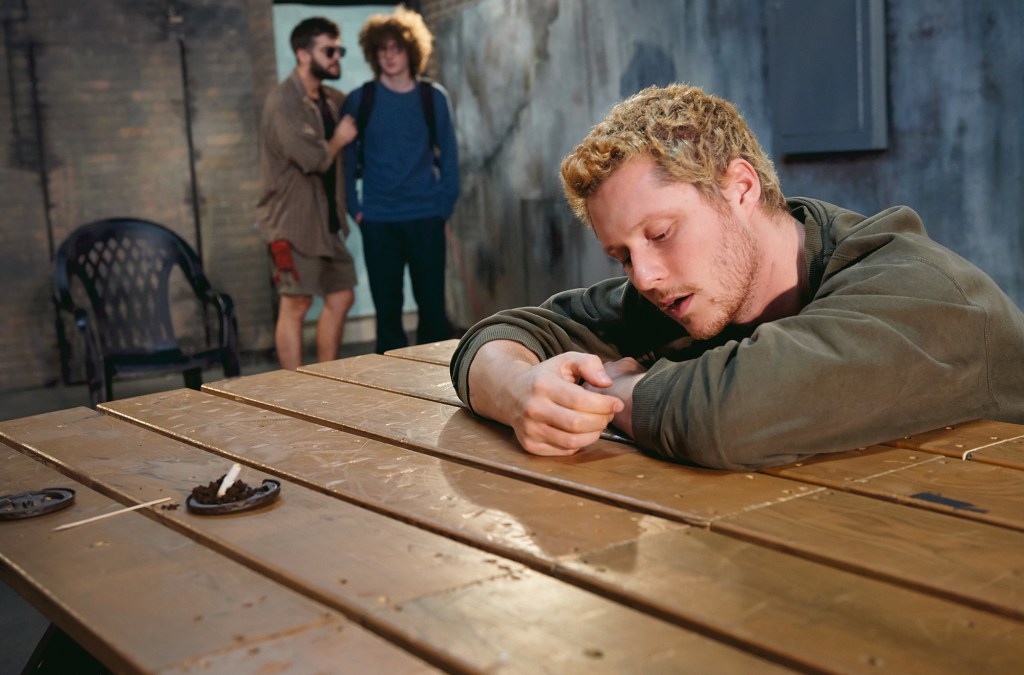
Photo Credit: Tim Leyes

MR: I did wonder why the cast was three white males…

MC: That’s interesting. As we were casting it we were trying to be conscious of that. I definitely believe theatre should be a place for diverse voices. And we like to create the most eclectic, artistic ensembles as possible. I think this play is specifically about the fact that all three of them are white. So to have cast it more racially diverse would have been to silence the themes of the play. This play was written about specific people in a specific place, and I think in doing it, it’s engaging in the conversation about the need for diversity in our communities. If you just, like, photoshop in diversity into a community where it doesn’t exist I think you’re wallpapering over some of the profound things at the center of her writing. We’ve got quite a diverse artistic team working on the show. It’s not represented in the cast of characters but I think for this piece it was the right choice.

MR: Your big thing is innovative staging, immersive theatre. I read an interview where you said it’s important to do something different because there is so much theatre going on. How do you come up with these new ideas?

MC: I think it can be kind of a trap, despite what I said in other interviews, to think about doing things that are different for the sake of being different. Almost every project I’ve worked on, the script is first and out of the script you try to find a way to tell that story. I think if instead you begin with a desire to do something different then you’re doing something to a play instead of figuring out the best way to tell a story. So I found in my practice, especially running Outside the March, but the other work I’ve done, there’s a broader canvas of ways to tell a story in a live theatre experience than the traditional framework necessarily allows for. So I try to start from a place of zero preconceptions of what the experience will be. So when I think about how to tell a story, I’m not thinking of people sitting in a proscenium space watching. I’m not picturing the experience akin to watching a movie.

MR: This show explores the idea that we can’t ever really know another person and what they are thinking. If you had the opportunity to read another person’s mind would you take it? 

MC: A specific person or telepathy in general?

MR: Let’s go with for a day, you can read everyone’s mind.

MC: I would take it because I’d be very curious but I would go somewhere where I was surrounded by nobody I knew. Because then you’d be able to answer that sort of eternal mystery of what are people thinking and what are they thinking about me as I interact with them, but you wouldn’t fundamentally destroy all of your relationships.

MR: You think it would destroy your relationships if you really knew a person?

MC: Ya.

MR: So you think it’s good that we don’t actually know the truth? Are filters important? 

MC: I think relationships are about striving to get to know someone so if you had the answer manual at the beginning then you would actually feel less close to those people. It’s about the experience of trying to break through those barriers even though, eternally, you’ll never get to the bottom of it.

MR: But isn’t that a sad pursuit? 

MC: I don’t think so. I think that’s what forges history and connection with people. It’s certainly frustrating and disarming and difficult at times, but I think that breathes the need for human connection. If we all knew what everyone thought all the time we’d be robbed of conversation. And art! Theatre comes out of that same impulse of trying to strive to get to know people and things about existence that you can’t just read in someone’s brain, so I think it’s good there are those filters. But I think we should still strive to listen better.
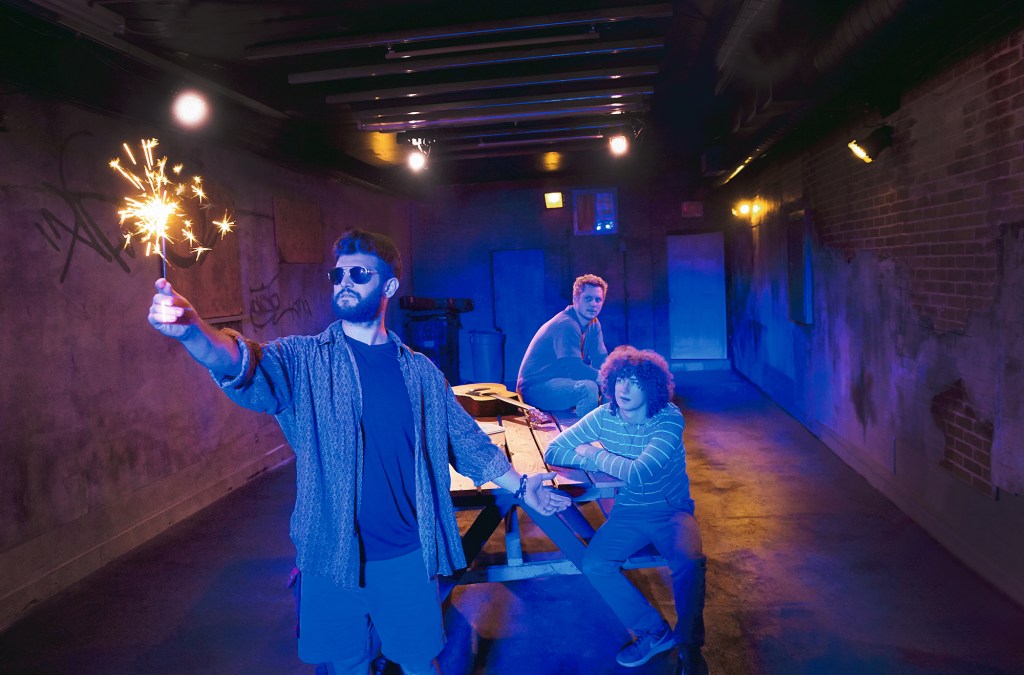
Photo Credit: Tim Leyes

MR: Do you think this is a hopeful story? 

MC: I wouldn’t say that it is entirely hopeful, but within the construction of it, there is something quite life-affirming.

MR: If you could talk to the characters in the show and give them advice what would you say?

MC: Don’t kick the audience.

MR: Is that advice for the actors?

MC: (He laughs) Life advice?

MR: Yes. You’re very ambitious and it seems these characters are lacking that.

MC: Well, I would say that they should try to breathe and take the pressure off themselves. Because I think it’s the pressure to accomplish great things that is kind of stunting them from accomplishing much of anything.

MR: Too scared?

MC: Too scared or because, to me, one of the big themes of the show is they idolize these great writers, but genius is a hard thing to emulate so instead they just emulate their destructive tendencies. I think that hero-worship can be dangerous in that capacity because I think the things that are easiest to copy are not the things connected with hard work and perseverance… they are more the trappings of it.

The Aliens

Who:
Written by Annie Baker
Directed by Mitchell Cushman
Starring Maxwell Haynes, Will Greenblatt and Noah Reid
Set and Costume design by Anahita Dehbonehie
Lighting design by Nick Blais
Sound Design by Sam Sholdice
Production Manager Charissa Wilcox
Produced by Diana Bentley and Sehar Bhojani

What:
Coal Mine Theatre launches the 17/18 season with Pulitzer Prize Award-winning playwright Annie Bakers THE ALIENS. Sharing the Obie Award for Best New American Play in 2010 with another Baker script, Circle Mirror Transformation, THE ALIENS, a finalist for the Susan Smith Blackburn Prize, premiered Off-Broadway in April 2009 and the West End in September of the same year.

Jasper (Noah Reid) and KJ (William Greenblatt) are two misfit souls who have made the out-back of a Vermont coffee shop their private sanctuary and refuge from the real world. Here they can indulge in their dreams and delusions of being a brilliant writer and a divine healer. Seventeen-year-old Evan (Maxwell Haynes) is eking out his summer working at the café and is irresistibly drawn to their world of magic mushrooms, philosophical musings and rock bands that never-were. THE ALIENS is both a cruel and compassionate examination of a lost generation and modern-day America.

Where:
Coal Mine Theatre
1454 Danforth Avenue, Toronto ON M4J 1N4

When:
Wednesday, September 20 – Sunday, October 8 at 2pm
Tuesday to Saturday 7:30pm (Mondays Dark)
Matinees are Sunday at 2pm.
No intermission. No latecomers.

Tickets:
Regular price $42.50 (plus HST)
Rush tickets $25 (cash only, at the door, 30 minutes before performance starts, subject to availability. No phone reservations).
coalminetheatre.com

Connect:
t: @coalminetheatre
f: /coalminetheatre

“A Vaudeville of Ionesco meets 30 Rock” In Conversation with David Bernstein on creating “surrealist hoedown” NASHVILLE STORIES at SummerWorks

Article by Megan Robinson

David Bernstein is sitting across from me in my living room and being delightfully self-deprecating and candid about his current production Nashville Stories at SummerWorks. “Oh, you’ve never heard of me? Well here is my original 75 minute, ten person musical! […] I’ve had to really interrogate my desire to make things this big.” He is joking but also not. He considers the production his “cold open” to the Toronto theatre scene, which is a lot for someone taking on the roles of writer, director and actor. As the opening was creeping up and nerves were beginning to take over, David lets me know he is seriously considering his therapist’s recommendation that he get Beta Blockers.

“What are those?” I ask.

“They slow down the heart,” he says.

Having studied at NYU, David is now working in Toronto where he is building his reputation for making bold and out-of-the-box choices, despite the fact that networking is not what he considers his strong suit. A performance artist, his first Canadian production Cherry Corsage was an original piece co-presented by Videofag. He is also a creative associate for the dance company Rock Bottom Movement, where he works closely and collaboratively with choreographer Alyssa Martin.

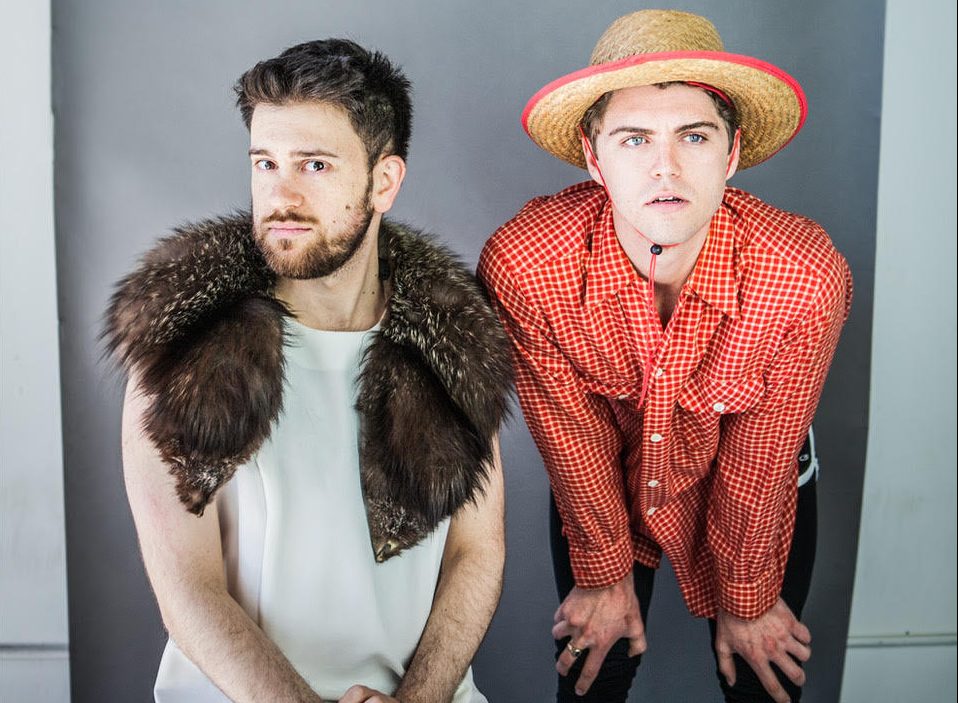
His newest beast Nashville Stories is what he describes as a “surrealist hoedown”, and is the result of seven months of work starting back in December when he and Jake Vanderham (co-writer, producer and actor) pitched it to Summerworks.

The show is inspired by Garth Brooks’ strange turn into Chris Gaines back in 1999, an event David says he knew nothing about at the time. “I liked country music but like… Shania Twain.” When Liza Kelly, costume designer, posted an article about the phenomenon on Facebook, David took the click bait and discovered his newest show.

As we discuss the event, David puts real emphasis on the incredulity of Garth’s choice. “He was the biggest selling artist of that time and he decided he was going to make himself into this weird sleazy rock star character. We use one of the songs from that album in this show and it sounds like Boyz II Men. Not only is it not what people paid to see from him, historically, it also calls into question the sort of constructed aspect of the rest of what he’d done.”

Pop culture and celebrity has been a staple in all of David’s original work so far, “Every time I find something that I want to make something about, it’s always about a real person, a celebrity, and it usually involves something about how they make their art.

His first show, which was created while he was living in New York, centered around Lena Dunham. The show was inspired by the strange results of Dunham’s rise to fame, which put a unique stamp on “the millennial creative woman trying to figure out her shit”. This archetype became its own cliché that then trapped a lot of the women he knew who were trying to make art from their own lives. And so birthed the show, Too Many Lenas.

Next up: Cherry Corsage, about Isaac Mizrahi on the shopping channel, and the very real segment where he argues about whether the moon is a star or a planet. David was a sales person, himself, when he saw the clip and was fascinated with the showmanship of sales, “Sales is just this weird extemporaneous monologue with this thing at the end where you try to get people’s money. So I was watching this person perform in this mode that I was performing in and I was thinking, “Great! I’m going to do that.”

So how does a country singer creating an alter ego as a rock star with a made up back story hit a personal chord in David’s life?

Well, the show is trying to grapple with that tension of creative fulfilment and success with that romantic, social side. David was going through a breakup, himself, and used the creative process to bolster where he was in his own life.

“When you hear about Garth’s story and you get that Wikipedia epiphany of “Oh! Chris Gaines is what he did after he got a divorce,” you get this sense, and it’s the one we end with in the show, of this bittersweet moment of somebody fixing what they thought was an inadequacy in them based on a romantic failing, with a creative change that forces them to leave something behind. Where I was socially, romantically, I could feel all those holes he was trying to fill. And feel what he would have had to push out to fill them.”

This, David says, is what’s underneath all the colourful flourishes “if you really are sinking your teeth into it.” But most of the time, the nonsense and the fun is what prevails. David’s work leaves people with questions. Mooney on Theatre reviewed Cherry Corsage and said “Despite the research, and having no clue about what on earth I just witnessed, I still enjoyed myself, and the show. It was really funny.”

Which makes sense to me even more as David unravels his creative process of scriptwriting, which starts out with a point and ends in a joke: “A lot of the script is found material. There’s a Bette Midler stand-up special, then three lines I’ve written and an inside joke from rehearsal. We stage it, then I’ll cut what was the heart of the piece, and the inside joke might stay. And then it becomes a transition for the next scene.” As a result, the final script was really only solidified a week and a half ago. “There are just too many options,” David says, about creating his own script.

Nashville Stories is ambitious and in the interview it’s almost like David is struggling to get a baby tiger to cuddle with him, as he explores the various elements of this fun and fluffy but wild-spirited piece.

There is a lot at stake, and to trust in your own vision can be hard, though David is getting better at that. “I’m not afraid of people being like “WHAT THE FUCK?” I’m afraid of bored, polite digestion.” There’s also apprehension of making those final leaps in rehearsal in order to sew it all together, “I trust the cast to get there, but it requires a real acrobatic ability from the performers. I think it’s pretty close.” Then there’s the weight of bringing in the audience: “I feel such a responsibility throwing the cast out there in front of people, so what I’m creating and the structure of the piece has to serve them. I can’t let them go out there with something I know I should’ve cut or put in a different spot. “

When I ask David a final time to give me a sense of the show or to describe it (which I’ve done a lot already and it is probably annoying) he leaves me with, “A Vaudeville of Ionesco meets 30 Rock.”

Nashville Stories

Who:
Written by David Bernstein and Jake Vanderham
Directed by David Bernstein
Produced by Jake Vanderham
Performed by Cynthia Ashperger, David Bernstein, Stephanie Cozzette, Kaleigh Gorka, Brendan Flynn, Teresa Labriola, and Jake Vanderham
Choreographed by Alyssa Martin
Costumes by Liza Kelly
Lighting Design by Eric Bartnes
Stage Managed by Scott Phyper

What:
Garth Brooks is sad. His divorce is final, his album is not. With the help of his famous friends, Garth tries to make himself disappear. But nobody is prepared for who replaces him. Based on the infamous 1999 album The Life of Chris Gaines, performance artist David Bernstein and writer-performer Jake Vanderham conjure a surreal hoedown featuring a live bluegrass band. Surf’s up!

Where:
The Theatre Centre – Franco Boni Theatre
1115 Queen Street West, Toronto, ON

When:
Thursday August 10th 8:30pm – 9:45pm
Friday August 11th 4:00pm – 5:15pm
Saturday August 12th 8:15pm – 9:30pm

Tickets:
summerworks.ca

“It’s Mad Max meets The Good, the Bad and the Ugly” Performers Amanda Cordner, Christina Bryson & Director Claire Burns on DIVINE at SummerWorks

Interview by Megan Robinson

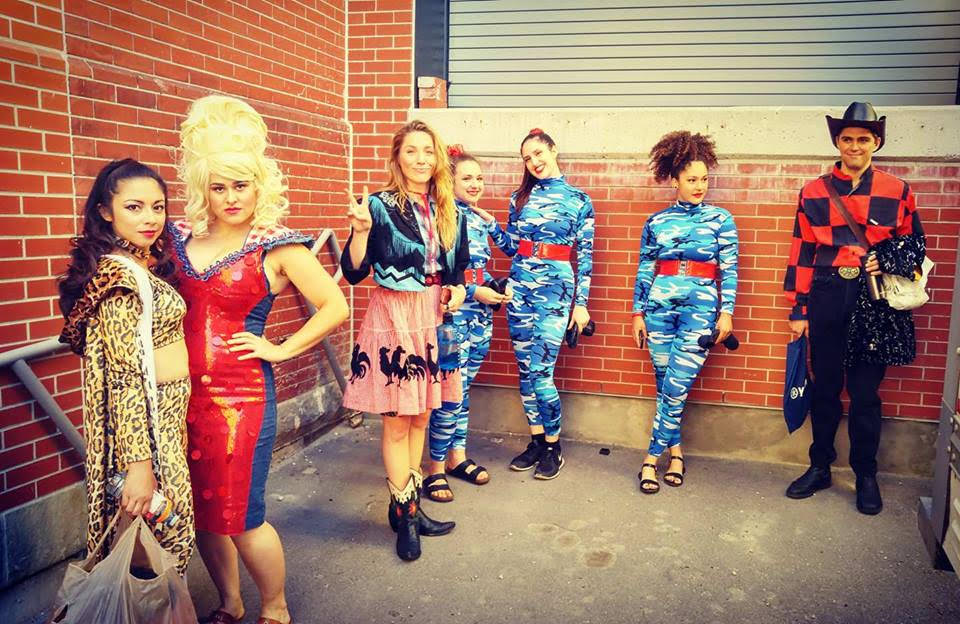
When I walked into the rehearsal space for DIVINE, the women of the cast were already in costume. I caught sight of holsters and cow hide wrapped around their waists. Two actors were clasping plastic bottles molded into the shape of guns. It’s a hot room, and the cast was dressed head to toe. The women, a powerful group, sauntered across the stage and stood ready to begin.

DIVINE is a Western set in a post-apocalyptic Ontario where water has disappeared. Playwright Natalie Frijia, who is currently pursuing her PhD in environmental studies and theatre, first conceived of DIVINE during Storefront Theatre’s first playwrights unit.

The play portrays characters finding strength in a desperate situation. I can’t help but reflect on how the themes of the piece mirrored real life for the cast and crew. Days before rehearsals were set to start, Storefront Theatre was evicted from its space last December. DIVINE, and half the season, was cancelled.

After the run, I sat outside with cast members Christina Bryson and Amanda Cordner as well as director Claire Burns, who tried to remember the exact timeline: “We’d booked off work for rehearsals and everything,” Cordner said of the challenges that face artists who work in indie theatre; more often than not the people involved are also navigating their day jobs (or night jobs…Hi bartenders!)

But the show has landed on its feet and has a new home at SummerWorks. The changes that were made to fit festival needs have also opened up new possibilities. With a set that needs to be easily torn down, and a trimmed version of the original two-hour script, the show is perfect for touring and Burns went on to mention plans to share the show beyond the festival.

The idea of an Ontario in drought might be terrifying, but DIVINE is surprisingly playful in its telling of the story. However, keeping it light took some work. Bryson and Cordner explained that once they delved into the reality of their characters’ despairing situation, they had to be reminded one day in rehearsal that it was a comedy. Cordner, who plays Penn, rolled her eyes at herself and laughed, “I was bringing all the drama.”

Photo Credit: John Gundy

“The play itself isn’t an issue play. It’s a kind of fantastical adventure story but underneath it is that message of conservation and sustainability. We don’t want to get to a place where we don’t have water,” said director Claire Burns. There’s a sweet spot in this work of marrying activism and theatre, but Burns is clear on her approach, “You catch more bees with honey.” “People never learn when you point fingers at them,” Cordner added. Burns nods, “It’s like subliminal messaging.”

The show itself may not hit you over the head with its message but by forging relationships last fall with the World Wildlife Fund and Wellington Water Watchers, DIVINE is a show supported by those who are actively working towards the preservation of water. “It was important to me that we had partnerships with legitimate environmental organizations,” said Burns.

Originally written with male roles, Claire made the decision to work with an all-female cast. Her reasoning? “The women were legitimately the best people for the roles.” I asked if they ever played around with women playing men, using fake moustaches or other costume devices, but Cordner and Bryson just laughed as Cordner explained, “Claire made it very clear from the beginning that we were not going to do that.”

Burns shook her head, “I hate that shit.” And she’s had plenty of experience with it. “The guys who played women were always making everyone laugh and then I’d get on stage with my fake moustache and it would just be dumb. We didn’t want to do that. We’re not trying to fool anybody that we’re not women.”

Photo Credit: John Gundy

The choice to go with a female cast and crew has clearly paid off. When I asked the women to speak to the community they’ve created in DIVINE they didn’t hold back:

Claire Burns: “What I think is special is that I’m given the opportunity to get to know and get to work with so many powerful and smart women. With every show you work on you create these bonds with people and in this show in particular – I think it’s like 17 women working on this show – everyone is pulling their weight and so it’s such an easy process. I’m having such a good time. I’m really enjoying my community right now. I’m also enjoying that my community is being so generous letting me take this role and I’m so grateful that I’m allowed to shape this story in the way that I want. I’m also part of the                     queer community so I’ve put that into this, very much so…”

Amanda Cordner: (imitating Claire) “There will be a kiss. I don’t know where but there will be a kiss!”

Claire Burns: (laughing) “I’m very grateful it’s so fun.”

Christina Bryson: “It’s fun to get to kick-ass! How often, as women, do you get to do all this stage combat with like ten of you kicking ass at the same time?! That’s my favourite part.”

DIVINE

Photo Credit: John Gundy

Who:
Presented by Red One Theatre Collective with the generous support of The Storefront Theatre
Written by Natalie Frijia
Directed by Claire Burns
Assistant Director Molison Farmer
Dramaturgy Emma Mackenzie Hillier
Performed by Amanda Cordner, Aviva Armour-Ostroff, Christina Bryson, Sarah Naomi Campbell, Haley Garnett and Rehaset; Ensemble Annie Yao, Sabah Haque, Kathleen O’Reilly, Khadijah
Producer Sedina Fiati
Associate Producer Olivia Marshman
Set Design by Christine Urquhart
Lighting Design by Imogen Wilson
Costume Design by Sage Paul
Sound Design by Suzie Balogh
Fight Director Louisa Zhu
Assistant Fight Director Erin Eldershaw
Stage Managed by Lin-Mei Lay

What:
Ontario is out of water and a pair of bandits search for their last hope – a water diviner by the name of Penn. Stories say she can crack the world like a coconut and make water bubble to the surface with nothing but her hands. But the bandits aren’t the only ones hunting her down. And what if there’s nothing left for Penn to divine?

An all woman cast in Natalie Frijia’s post-apocalyptic wild west asks how we would survive in world without water. Would we turn to community… or to revenge?

Join the creative team of DIVINE for some post-show discussions – August 5 in the Factory Courtyard with Paul Baines from the Great Lakes Common and August 12 at The Paddock with guests from Wellington Water Watchers, the World Wildlife Fund and Surf the Greats.

Where:
Factory Theatre Mainspace
125 Bathurst Street, Toronto, ON

When:
Tuesday August 8th 9:45pm – 11:00pm
Wednesday August 9th 8:00pm – 9:15pm
Saturday August 12th 7:00pm – 8:15pm
Sunday August 13th 1:30pm – 2:45pm

Tickets:
summerworks.ca


A Chat with James Graham on LEMONS LEMONS LEMONS LEMONS LEMONS at the 2017 Toronto Fringe

Article by Megan Robinson

James Graham, of the Toronto-based ensemble The Howland Company, enjoys wandering through bookstores and letting play titles and covers jump out at him. And when they do, they get added to a list. It was in March of 2016, in London, England, that the catchy and memorably titled Lemons Lemons Lemons Lemons Lemons by British playwright Sam Steiner caught his eye on a bookshelf in the National Theatre bookstore.

When The Howland Company was approached by Slow Blue Lions to work together on a Fringe show, he pulled out the list where he had noted Lemons as a possibility for future productions. The script fit the sort of criteria that the practical company looks for when choosing a play; the right length, about young people, the right amount of characters for the particular project. Plus, the rights were available.

“It’s always exciting when one of those plays that intrigues you finds its way to the front of the line,” he told me, in reference to Lemons making it off the list and onto the stage at this year’s Fringe Festival [and recently announced as PATRON’S PICK!] (And when life gives you Lemons… you put it on at the Fringe…. Sorry, I had to.)

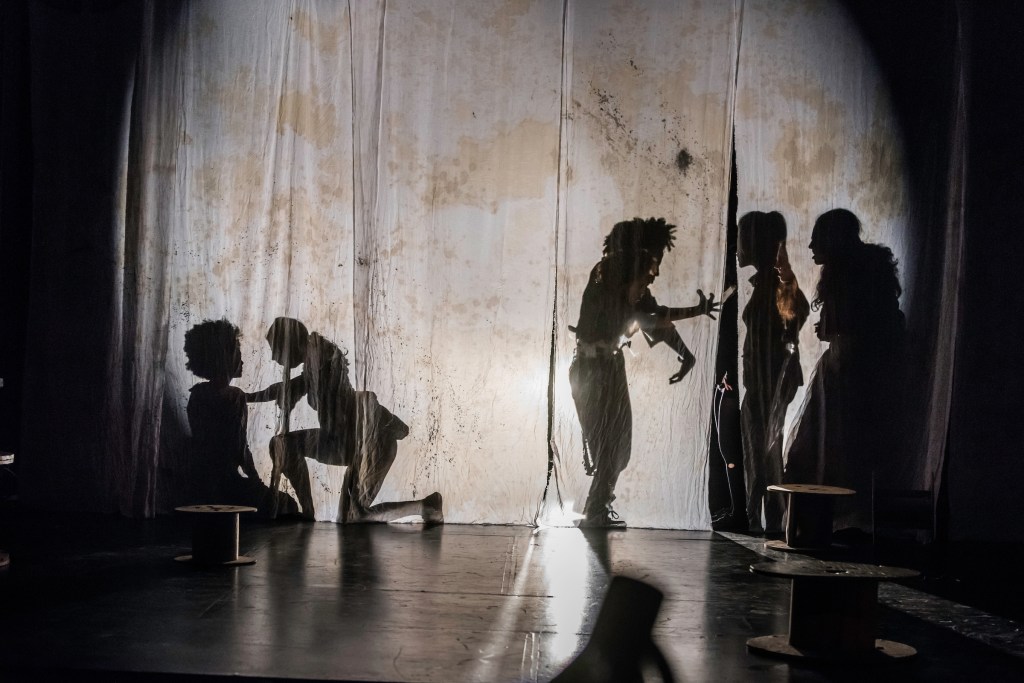
The ambitious 60 minute show, with north of 200 lighting cues, follows Bernadette and Oliver as they navigate their relationship under the newly imposed law that restricts every individual to a daily limit of 140 words. There was a lot to cover in my interview with James Graham, who plays Oliver in Lemons Lemons Lemons Lemons Lemons. In way more than 140 words, we spoke about working with director Harveen Sandhu, how language shapes relationships, and the importance of silence.

Photos of Ruth Goodwin and James Graham by Dan Abramovici

Meg Robinson : Tell me your favourite line from the show.

James Graham: I have tons of favourite lines. It’s so well-written. (he thinks for a while) At the end of one of the fights in the first half, Bernadette, Ruth [Goodwin]’s character, is kind of trying to explain to Oliver why this law might not be a bad thing and she tells him, “You can’t pigeon-hole me, I’m a million different things.” And I say to her, “How are you going to explain all those things in a hundred and forty words?” And she says, “I don’t know, maybe I’m not going to explain them.”

And I say, “Then nobody is going to know who you are.”

If there’s one part of the play that really speaks to me it’s that one. Because for all of the questions the show brings up (How do we know who we are or who someone else is? Are we defined by our language? Are we defined by the words we are able to use to describe ourselves or are we something regardless of language?) That exchange really encapsulates them for me.

And I remember when I first read the script, that was an exchange that really rang true for me.

MR: What were your thoughts when you first read the script?

JG: I loved the form and how Sam Steiner, the playwright, wanted to structure that journey of before the bill and after, and the differences between those two worlds.

What was intriguing to me was exploring how we talk to one another and how we take language for granted. How we use it to lie to each other and to actually walk around the truth, sometimes, as opposed to using it to speak as honestly and potently as we can. I think the premise of Lemons and the removal of that language forces these people to live in silence and in that silence you’re forced to really talk to one another and I thought that was a really powerful thing to explore.

MR: What moves you about the relationship between these two characters? 

JG: What moves me is watching a couple lose each other and find each other again. One of the themes of the play is how can you know someone else? Is it even possible to know someone? Does love exist without words?

I think the dynamic in the middle of the play is two people who lose touch with why they connected in the first place. And it’s painful. They have all the words in the world and they don’t communicate with each other.

And then this devastating law gets passed and it’s beautiful to watch them find each other again. And listen and communicate. And when they have to really choose something to say to each other, the stuff they choose really means something. At the end, there’s a lot of uncertainty, but it ends with a reveal of something that’s been left unspoken for some time.

Whether it means that their relationship is going to survive, well, the play leaves that open, but at the very least there’s an offer made; that I’m going to be honest with you. I’m going to share this thing. And I think that’s a really beautiful journey. And as a result that’s something that I’ve been curious about and exploring in my own relationships.

MR: When you are immersed in a show it can start to, like, tint your everyday life. You start to see things through a show-lens. How has being in the show shifted your own perspectives?

JG: I’ve been more curious about relationships – the language of relationships and how we talk to one another. I’ve gone on a few dates over the course of the process and have noticed the way that new couples or people who have just met each other talk, what things they choose to reveal to one another, what rhythms develop between two people. That’s been interesting.

Silence and the power of silence versus the need to articulate everything has been something I’ve noticed a lot more. And I think part of the play, part of Oliver’s journey, is towards acceptance and not a passive acceptance but a kind of presence. And I think silence is that state. It’s the state of acceptance of the world. And language sometimes can be the means to fill a void. That distinction has made itself more clear in my life.

So whether I’m a better communicator now than I was at the beginning of the process is probably not the case…

MR: But there’s an awareness?

JG: There’s an awareness, which I find kind of great.

MR: How did your director, Harveen Sandhu, get involved?

JG: I’ve been a huge fan of Harveen’s work as an actress for a long time. You see her once on stage and you know immediately how extraordinary of an artist she is; her intelligence, her emotional intelligence, her clarity, her discipline and dedication is all there in her work.

When Ruth and I we were brainstorming directors, I had a thought that maybe this would be something she would be interested in.

And I think one of the things that The Howland Company strives to do is to give space for talented people to step into a number of different roles. I think Harveen should do this. Canadian theatre would be in really extraordinary hands if she continued to explore directing as another form of expression. Because she really has a gift for it. We’re very lucky.

MR: If you could give the show another title what would it be? 

JG: I like the title! The first thing that comes to mind is 140. But I think that’s too on the nose. I don’t know.

MR: One last question – do swear words make the cut?

JG: Mhm… but then they disappear.

MR: They realize it’s not worth it?

JG: Well that touches on a point that the play tangentially gets to, which is that while the law does allow people to communicate more clearly with one another, what you lose is the joy of language – the expressiveness of swear words. You get down to a kind of bare essentials but I think you lose a great degree of expression and warmth and joy that we take in word play.

MR: Did you come up with a title yet? 

JG: I think maybe I would just call it Fewer Lemons? The citrus play… Lemons X 5

MR: Titles are hard.

JG: Let’s stick with what we have. It’s pretty great.

Lemons Lemons Lemons Lemons Lemons

Who:
A Co-Production with Slow Blue Lions & The Howland Company
Written by Sam Steiner
Director – Harveen Sandhu
Cast – Ruth Goodwin, James Graham
Stage Manager – Sam Hale

What:
A new law will limit the number of words you can say in a day: max 140. Soon you will have to speak without words, ‘say it all’ with no language; the ‘inarticulate speech of the heart’ is no longer just a song. The young Bernadette and Oliver meet just as the law is about to be enacted. Now their love must grow within its limits. They struggle with its rules, with obedience, with themselves, and with how they are going to live. They must make words count, and yet learn to talk without them. Political change becomes very personal.

Where:
THE THEATRE CENTRE – FRANCO BONI THEATRE
1115 Queen St W
Toronto

When:
14th July – 9:15pm – Sold out
16th July – 1:00pm
16th July – 8:30pm *PATRON’S PICK*

Tickets:
fringetoronto.com

Connect:
t: @TheHowlandCo
f: /TheHowlandCompanyTheatre
i: @thehowlandcompany
#LemonsLemonsLemonsLemonsLemons

Inside Fringe: In Conversation with Sam Mullins on creating & re-visiting “Weaksauce” at the 2017 Toronto Fringe

Article by Megan Robinson

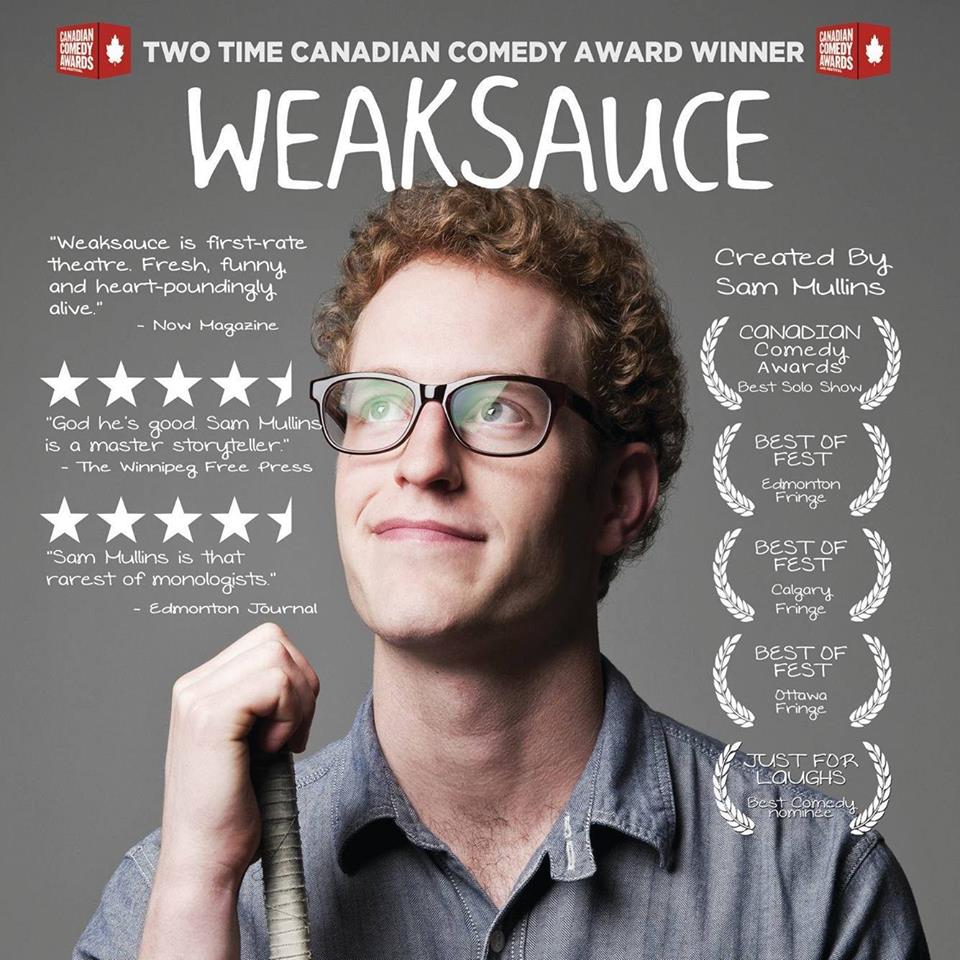
Sam Mullins, writer and performer of Weaksauce, has come a long way since his first solo-show, Tinfoil Dinosaur, which opened at the Winnipeg Fringe in 2011. “I’ve never vomited from nerves except for that day […] I tried to drop out of the festival. I wanted to just go home. I was like, I can’t do it.” Mullins relives the memory as he sits across from me at the Theatre Centre, the day after opening Weaksauce at the 2017 Toronto Fringe. “It’s one thing to be running your show in your living room and it’s another thing when the whole city shuts down for the Fringe.”

Though Mullins is much more comfortable as a writer and would like nothing more than to stop performing (for all the enjoyment, there is so much anxiety) he assures me he is not about to quit. Instead, he spins it into a positive. “Nervous energy is a good thing for me on stage. It’s really easy to be vulnerable on stage when you feel really vulnerable. I don’t have to pretend.”

Weaksauce is the story of firsts in Mullins’ life: first time away from home, first love and first love triangle. It’s his contribution to his favourite genre; romantic coming-of-age. And the goal for the show? Storytelling that is efficient while still being as fun as possible. Drawing from influences like Mike Birbiglia and Tig Notaro, Mullins says, “If you can make people laugh for 45 minutes and have a couple moments of poignance, like Tig and Mike can do—I just feel like there’s such great power in it. It lifts it above standup and storytelling, it’s like this hybrid.”

The show, which played at the Toronto Fringe in 2013, remains about 90% the same as the script Mullins wrote “in like a weekend” after a busy summer touring a show with his good friends, Peter and Chris. Faced with only a week to create a whole new show for the final festival of the tour, they all headed to Sam’s family home in Vernon BC. “It was like a writers colony,” Sam recalls, grinning. “Peter and Chris in one room working on their show and me in another.”

This is where Weaksauce came to be, under the guidance of “guru” Elizabeth Blue who was also in attendance of this retreat. “She was like drinking and floating on a tube in the lake and we’d go out on the dock and be like “Lizzy! I need to read you a new draft! […] She was the biggest help ever. She gave me so many great notes. Her fingerprints are all over the show.”

With no formal director for Weaksauce, Mullins tends to ask friends for help when he thinks he needs it. On opening day of Weaksauce, he brought in Johnnie Walker (playwright of Redheaded Stepchild) to help clean up the staging a bit (after offering Walker a hundred bucks for the favour). “Johnnie has a real nose and eye for staging and blocking and character choices, and all those things are after-thoughts for me. I’m just obsessed with what the piece of paper is.” An obsession that means after Mullins has spent his time enjoying the little breakthroughs and finding the perfect line, he often hands the script off to his performer self at the last minute.

From reading through Mullins’ website, it’s clear he some good thoughts for writers. He holds true to advice from his friend and performer James Gangl that what you write about should scare the shit out of you. Mullins writes about loaded topics, stories of angst and embarrassment are where he has found his best stuff. So though there is an importance to first processing an experience, Mullins says, “you can’t be fully over it […] I love going back and working through these things. It’s fun revisiting these old times and places and people and seeing it through your eyes now, and seeing how it is different.”

What’s different for Mullins and for Weaksauce this time around? With more standup experience, he’s better at recognizing opportunities for jokes. He is in a larger venue this year than he was in 2013. Oh, and he’s engaged (!!).

When I ask if there is a connection between getting married this summer and bringing back Weaksauce he nods. “Yeah, when we got engaged and I wanted to remount one of my old shows, I was like it would be really fun to revisit falling in love for the first time in the context of me getting married. And Weaksauce was always my favourite,” Mullins says. “As I’m thinking about my vows and thinking about our journeys to each other this was a really fun thing to think about and immerse myself in […] To remember what it was like the first time that you thought you found your person. And, you know, how all of the failed relationships along the way… they weren’t failures, they were what lead us to each other.”

Weaksauce

Who: Sam Mullins (Writer/Performer)

What: A coming-of-age comedy of first times, second chances and third wheels. ★★Canadian Comedy Award Winner for Best One-Person Show★★ “Weaksauce is first-rate theatre. Fresh, funny, and heart-poundingly alive.” – NOW

Where: Helen Gardiner Phelan Playhouse, 79A Saint George Street.

When:
July 11th 6pm
July 13th 9:15pm
July 14th 12pm
July 15th 3:30pm

Tickets:
fringetoronto.com

Connect:
t: @SamSMullins
f: /sammullinscomedy
w: samsmullins.com