Skip to content

Posts tagged ‘Next Stage Theatre Festival’

In Conversation with Chloé Hung, from All Our Yesterdays at the Next Stage Theatre Festival

by Bailey Green

In the spring of 2014, Boko Haram kidnapped 276 female students from their school in Chibok, Nigeria. The abduction caught the attention of the world media, celebrities, first lady Michelle Obama and playwright Chloé Hung. The popular hashtag #BringBackOurGirls swept across social media. In October 2014, Hung came across an article marking six months since the kidnapping. To her chagrin, she realized that she had forgotten about the girls whose story had outraged her in April. She wrote an idea on a Post-It, “two sisters kidnapped by Boko Haram” and promised herself she would not let their memory slip away again.

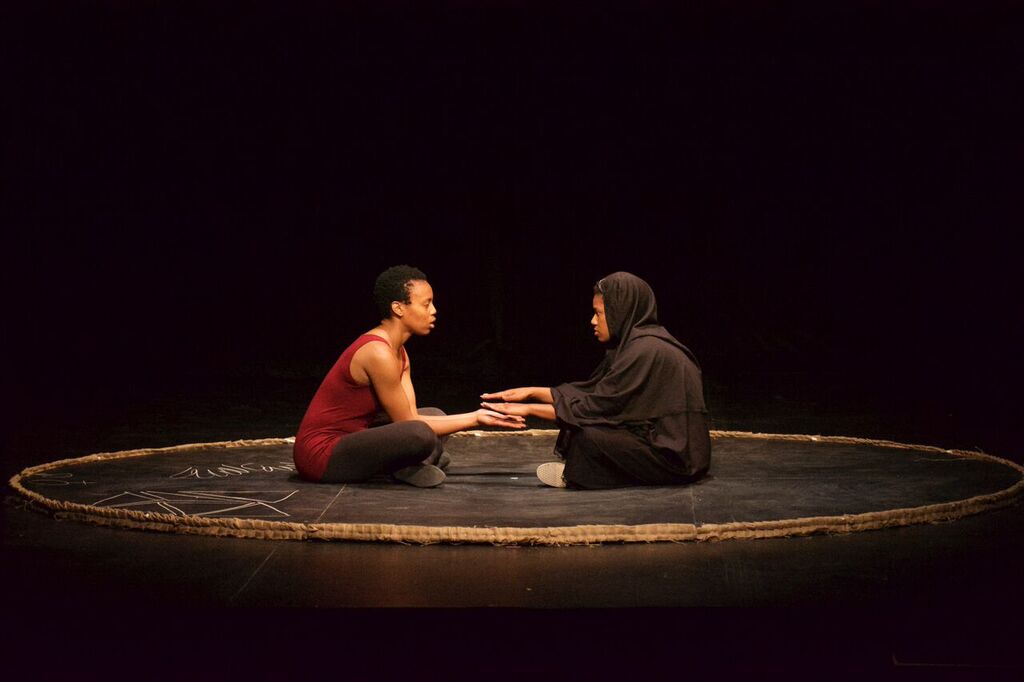
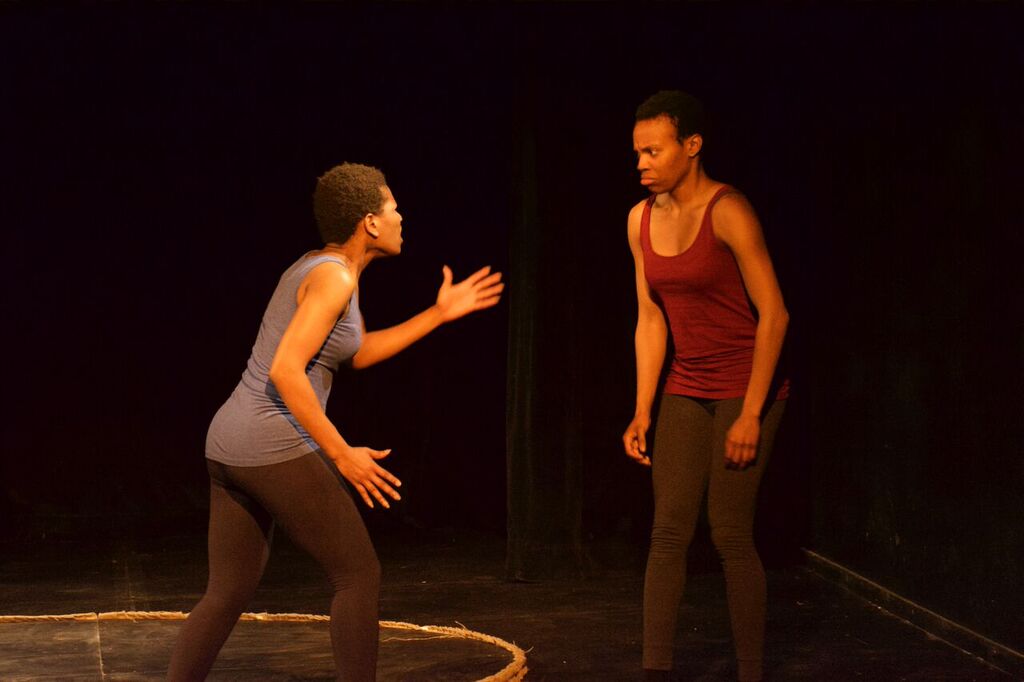
All Our Yesterdays grew out of a two scene assignment that Hung wrote for a class at NYU where she is currently completing her MFA in dramatic writing. In the spring of 2015 she began writing the play in earnest—the story of fictional sisters Ladi and Hasana who have been kidnapped by Boko Haram. Their parents cannot afford for both daughters to attend school, and so the older sister Ladi is sent to school while the younger, Hasana, is kept home. “There was never a draft where Hasana wasn’t on the autism spectrum,” Hung remembers. “In Hasana we see how much she does need school, and how that would give her an amazing opportunity for a life she would never be able to have without education. Hasana has also allowed me to talk candidly about some of the issues in this story.” As part of her research, Hung discovered the lack of support for autistic children outside of urban centres in Nigeria.

AllOurYesterdays

Photo Credit: Rick Bartram

When asked about the challenges of this piece, Hung describes the extensive research involved in the writing process. She credits York University professor Pablo Idahosa with providing her with a thorough crash course in Nigerian history and politics. Another key moment was when her step father, Michael Kaufman, who co-founded the White Ribbon Campaign, helped put Hung in contact with Hadiza Aminu in Nigeria. Hadiza Aminu were part of the creators of #BringBackOurGirls and spoke with Hung extensively about the situation in Nigeria, how the parents were coping and how the people in the community rallied and protested. “So it was challenging to distill all of that information into a story that felt relatable,” Hung says, “and the way I wanted to approach that was using a story of two sisters and the injuries that siblings can do to each other.”

In the transition from playwright to director, Hung adapted and learned to adjust pauses or movements that no longer served their purpose. “There were chances to do re-writing on our feet, and I have two amazing actors, Chiamaka Umeh and Amanda Weise, who brought it all to life,” Hung says.

AllOurYesterdays2

Photo Credit: Rick Bartram

All Our Yesterdays is partnering with Save the Children Canada for this run at Next Stage (during Fringe 2015 they partnered with Because I am a Girl). “It was really important to me that there was an outreach aspect to this show,” Hung emphasizes. “It’s all well and good for me to sit at home with my computer ranting and raving about the world, but what am I actually doing? What can I do from here?”

Short Answers:

Currently Reading: Room, by Emma Donoghue. It’s terrifying, but so good.

Favourite City: Toronto! Bloor/Ossington wasn’t so cool back when I was growing up, but now it’s pretty awesome.

Next Stage Show You Can’t Wait to See: All of them! But I didn’t get to see Rebecca Perry and Rachel Blair’s shows at Fringe this past July so I’m really looking forward to those.

All Our Yesterdays

All-Our-Yesterdays-650x843

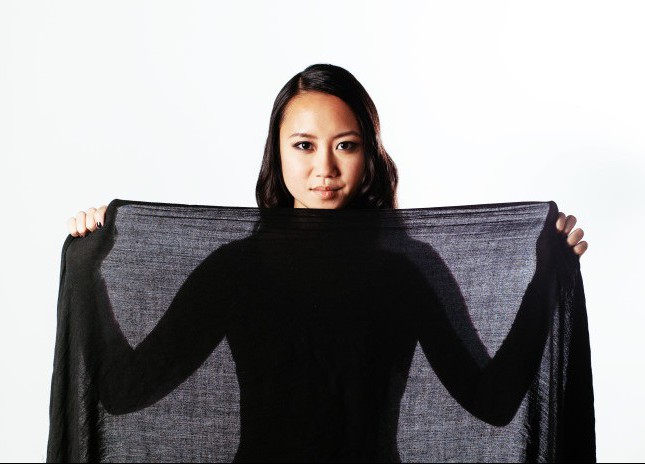
Photo of Chloé Hung by Tanja Tiziana

Presented by AnOther Theatre as part of the Next Stage Theatre Festival

Who:
Playwright/Director: Chloe Hung
Featuring: Chiamaka Umeh, Amanda Weise
Stage Manager/Producer: Elizabeth Wilson

What: Sisters Ladi and Hasana have been kidnapped by Boko Haram. Through memory we journey through their captivity as they wrestle with autism, the need to escape and their past. When one makes a selfish decision, the effects reverberate to their present.
2015 Toronto Fringe Patron’s Pick

Where: Factory Theatre Studio (125 Bathurst St)

When:
January 14 09:15 PM  buy tickets
January 15 08:45 PM  buy tickets
January 16 05:45 PM  buy tickets
January 17 08:00 PM  buy tickets

* Talk Back after the show

Tickets: $15.00

www.anothertheatrecompany.com

In Conversation with The Three Men – Matt Pilipiak, Victor Pokinko, and Scott Garland of Three Men in a Boat at the Next Stage Theatre Festival

Interview by Ryan Quinn

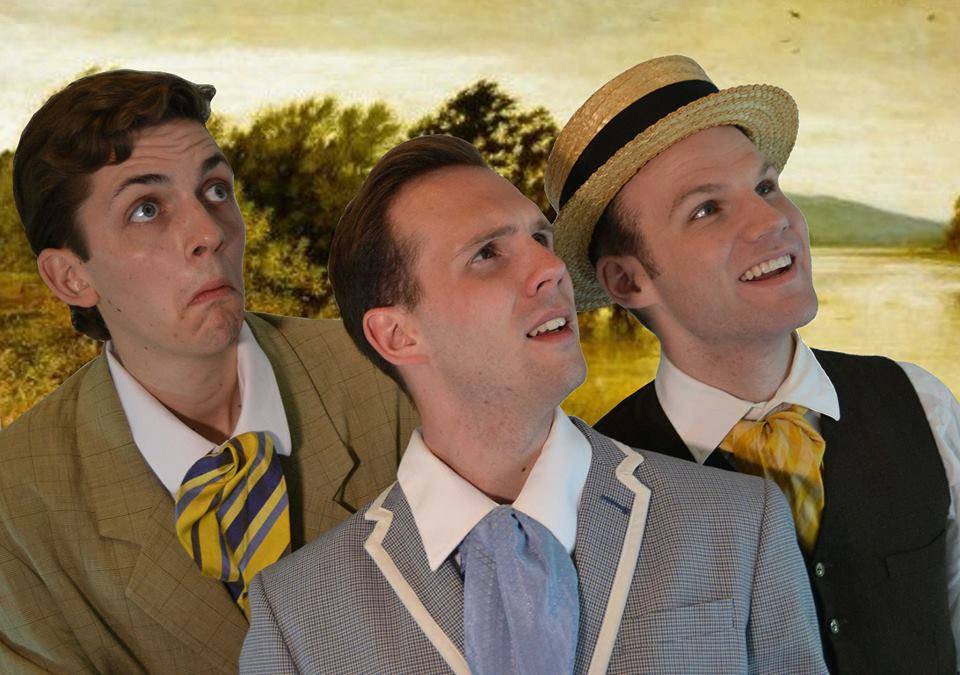
RQ: I’m here with Matt Pilipiak, Victor Pokinko, and Scott Garland; the three men of Three Men in a Boat. Written by Mark Brownell and directed by Sue Miner, it’s currently running as part of the Next Stage Theatre Festival, presented by Pea Green Theatre. The show is based on the travelogue by Jerome K. Jerome. Can you tell me a little more about the show?

MP: Yeah! So it’s about three bachelors living in London around the turn of the century, it was published in 1889. They’re all upper middle-class, and as the play opens they’re discussing all of the maladies they’re sure they’re ailing with. This leads them to decide to get away from the city and go take a boating trip up the river Thames. From there, it’s a series of bad camping stories, which is a kind of universal thing we can all relate to.

VP: It’s interesting because it’s around the same time as the birth of the middle class in England. So it’s around the time people start having free time. They’re no longer working non-stop, they have days off. They have a little extra money, so they start going on these vacations. What the travelogue comes out of is that the author, Jerome K. Jerome, was publishing weekly travel tips. “How to Travel,” “How to Row the River Thames With Your Friends,” that kind of thing. So he was writing these and people were coming up to him and telling him that it was hilarious. That’s when he realized that it was funny. But it started as a serious thing.

Now, we’ve taken this and made it into this play. Mark has adapted it and we’ve just run with it. We always say that it’s like a Canadian camping story. It’s set in England in 1889, but it’s such a Canadian “escape into nature” story. But, of course, they don’t know anything. So they try new things and they don’t work out.

MP: Mark adapted the piece so well. It’s not a dialogue-based book. He’s made it so active and so theatrical. With Sue’s direction, it really comes to life in an exciting way.

RQ: This is the author’s most famous work. What do you think makes it so enduring?

MP: It’s really funny, and the humour still works today. There’s something so inherently funny because everyone’s been camping at least once, especially in Canada. You think it’s going to be so beautiful and you’re going to connect with nature, and then, of course, you realize that you’re sleeping on the ground. Weather gets involved, and the food is never what you want it to be. Everyone can relate to watching these three bumbling men deal with that.

VP: Sue Miner made a comment the other day that there’s something so joyful and triumphant about doing something civilized in nature. I think the piece really plays with the bumbling and the bad times, but there are these civilized moments, like eating pie together. These few moments of civilization within the wilderness. It’s written in a way that never keeps you in one place for very long.

SG: It’s unassuming in how it presents these things. It’s not trying to preach, it’s not trying to make too many large, grand gestures. It’s very easy to relate to, and it’s very inoffensive in terms of its relation to the audience. We’ve all slept on the ground and thought, “This seemed more novel in my brain when I was in a bed. Now there’s a root in my back, one of my friends is drunk, the other one is squirmy, and the dog won’t behave”.

MP: It doesn’t pretend to be anything it’s not. It starts with us acknowledging that it’s a silly re-telling of events that happened, and that’s all it is. If you’re looking for something else, you’re not going to find it here. We’re just going to have fun.

3men1

RQ: It sounds like it really skews that late-1800s pastoral genre of literature.

VP: Yes, but in some ways it’s still very pastoral. Matt’s character definitely speaks that way, but we achieve this sort of idyllic world with very little. But I agree that it goes against it in that there’s no real moral to this play. There’s no twist. You just get to live in this world for a little bit with these people.

SG: In the way that Sue and Mark have created it, it’s this lovely little time capsule. The minimalist set, the way the language describes so much of the action and the setting. You get this vivid idea of what punting up the river Thames would have been like at the time. It’s hilarious but it’s also very sentimentally sweet. It’s a beautiful love letter to a time and a place.

VP: He actually wrote this based on his honeymoon. Him and his new wife went rowing up the river Thames, but he decided people wouldn’t relate to her so it had to be him and his friends. And he invented a dog… (laughs) I mean, everyone can relate to the dog.

RQ: Tell me a bit about the costumes and the music. These other elements that drop us into the world.

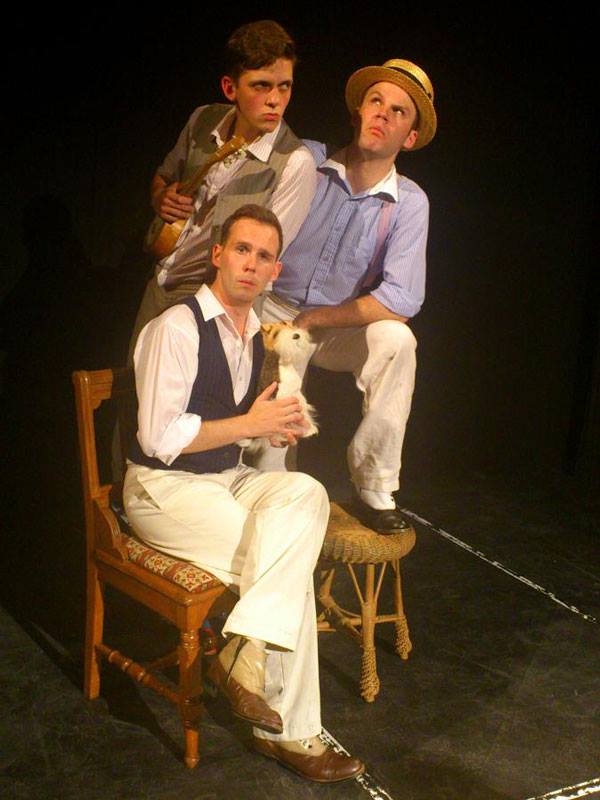
MP: Nina Oken, who is our costume designer, put together three really incredible costumes. They’re simple but very elegant. You look at us and you’re right there in the 1800s. However, by the end, they’re starting to fall apart, they really tell a story of their own. Sleeves are rolled up, pant legs are rolled up, there’s some wear and tear.

For music, our music director Rigzin Tute arranged two songs into beautiful three-part harmonies. It uses a musical motif throughout the play.

VP: That really helps to build this trio. It really feels like guys who went to school together, who learned these songs. We have very little in terms of set, so the costumes and music definitely help flavour the world.

SG: It’s amazing how each element on its own tells such a story. From the direction, to the music, to the costumes. They really enhance and highlight the piece individually, but they also mesh together perfectly.

VP: Also the shoes! The shoes definitely do a lot.

SG: And the handkerchiefs. The handkerchiefs are a necessity.

RQ: This show already has a bit of a production history. How long have you been working on it?

VP: A long time! In July of 2014, we opened at the Toronto Fringe, at the Annex theatre. After that, we did the Best of Fringe up in North York. Then in November we ended up getting whisked away to Mumbai, India for a festival called Tata Lit Live. Apparently in India, they know the book very well, so they wanted a performance of this story at their literature festival. This past summer, we traveled to Ottawa, Bobcaygeon, and Winnipeg with it.

MP: This will be the eighth theatre we put this show up in. It’s very exciting.

VP: It’s starting to feel like home to come back to this piece every five or six months. We love to bring it to new people.

MP: It’s a hard show to do, so we can’t really get lazy with it. It’s a very non-stop, physically devised piece. We create the world with our bodies. So, it’s my gym membership.

VP: Then in August, we’re headed to the Edmonton Fringe.

SG: It’s such a blessing to be a part of a show that keeps returning to the stage. We’re all still relatively fresh from theatre school, and there you get into the mindset that you’ll do a standard production. You get three weeks of rehearsal, four weeks on stage, you’re done. Within that time you have such a journey as a performer, and by the end of it you always feel that you want more. Every time we come back to this, we discover so much more. I still have the same old script, and I can’t even understand some of my notes in it anymore.

RQ: At this point, you’re all very well-acquainted with the Fringe theatre festivals in Canada. What do you think the importance of these festivals is, and how can that be supported or enhanced?

MP: One of the things I love the most about Fringe festivals is that, at their core, they support bold, new work. To take a risk, and to potentially fail or potentially find something really great. It also gives you access to an audience that as an independent theatre artist is hard to tap into. Audiences go into it knowing they’re seeing new theatre, something that’s possibly still in development. It encourages people to take bold theatrical risks. I love going out and seeing a mixture of incredible shows and awful shows. It’s Kat Sandler who calls it the “Fringe Theatre Christmas”.

VP: My favourite thing about Fringe is also my least-favourite thing: it makes a big event out of theatre-going. For people who don’t see theatre throughout the year, it gives them a hundred and fifty shows to choose from in two weeks. They can explore and visit that. The flip side of that is that I wish people didn’t need a big event to go see theatre. The Fringe is a great thing, but I wish we had something like it every month. Then people would go see more of the variety of shows Toronto has to offer.

SG: I got into theatre because of the Fringe festivals that I attended. For Matt and I, the Edmonton Fringe was some of our formative theatre-seeing. We’re blessed enough to have been touring, but I love that even if you don’t tour, if you’re doing a Fringe, you’re not just dealing with Toronto artists. You’re not just dealing with the GTA. You’re meeting touring artists. You’re encountering creators from around the world, in some cases. The United States, Australia, Europe, Japan! We’ve met all kinds of crazy characters, but there’s a real sense of connectivity. You’re all trying to create theatre, which is a cultural exchange in many ways.

My biggest frustration isn’t with the festivals, but with everything around them. Next Stage is a great example of what to do next, because the hardest thing for me is going to a festival and seeing great theatre that doesn’t end up going anywhere. It hits a ceiling. This play, Mark was always saying, is something that could only be developed at a Fringe festival. No mandate would fit this particular project, and there are a lot of projects like that. People have an idea or concept they want to flesh out and in a Fringe, all the risk is on you. Beautiful things come from that, but some of those beautiful works die too soon, or they get forgotten.

Some people think that once Fringe is over, there’s not a lot going on. There is. All the time. There was somewhere around thirty openings in November. So Fringe is on the right track, but I feel like we have to pull up our bootstraps and work the rest of the time, as well. Because it’s great work of the purest form: people with nothing to lose going by their raw creativity. That’s when you see the most challenging and important work. You don’t have backers to please, and you don’t have a mandate to submit to. You just have pure creativity. That’s the starting point of a great theatrical movement. What’s next?

Three Men in a Boat

Presented by Pea Green Theatre as part of the Next Stage Theatre Festival

3men2

Who:
Playwright: Mark Brownell
Director: Sue Miner
Featuring: Matt Pilipiak, Victor Pokinko, Scott Garland
Musical Director: Rigzin Tute
Costume Designer: Nina Oken
Stage Manager: Hilary Unger

What: Venture alongside three intrepid bachelors (and their dog) as they spend a disastrous week punting up the River Thames.
A stage adaptation of the 1889 British travelogue by Jerome K Jerome

Where: Factory Theatre Studio (125 Bathurst St.)

When:
January 13 07:00 PM  buy tickets
January 15 05:15 PM  buy tickets
January 16 04:00 PM  buy tickets
January 16 09:15 PM  buy tickets
January 17 02:30 PM  buy tickets

* Talk Back after the show

Tickets: $15.00

Connect:

#TheeMenInABoat

www.peagreentheatre.com

@getPokinky

@PilipYacks

@MrRyanQuinn

@intheGreenRoom_


In Conversation with Wesley Colford & Nicole Power – Playwright & Performer of Heart of Steel at the Next Stage Theatre Festival

Interview by Ryan Quinn

RQ: I’m here with Wesley Colford, producer, as well as writer of book and lyrics for Heart of Steel on now at the Next Stage Theatre Festival; as well as Nicole Power, who is playing Amelia in the production. The show is directed by Luke Brown and presented by Aim For the Tangent Theatre. So, do you want to tell me a little bit about the show?

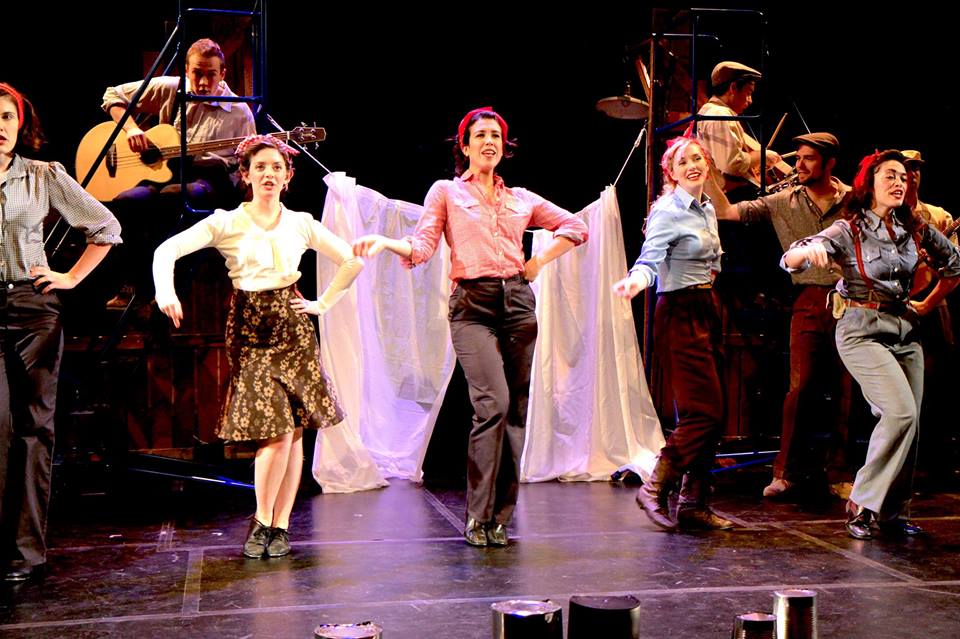
WC: Sure! The show deals with a group of women working at the Sydney Steel Plant in Cape Breton during World War II. Sydney was the biggest steel plant in Canada at the time, it produced more than fifty percent of Canada’s steel during the war, and this was the first time women were allowed to work in these conditions, working in industrial labor. They were working in all sorts of positions in the plant. And it’s presented as a full musical comedy! So if that doesn’t get your toes tappin’…

The story deals with Nicole’s character Amelia who is a young lady who has grown up in Cape Breton and desperately wants to leave the small town and spread her wings a little, but is forced to stay and work at the plant in order to support her family and save their house. She goes through a huge journey, meets several other ladies who she forms a bond with and we get to see all of them grow. We see the effect of them getting more independence. We see how the war affects not just the people who’ve left, but also those who’ve stayed behind. Everything changes.

How World War II was a catalyst for change is something that’s been addressed in a lot of literature and film, but I think that from a musical theatre standpoint, this is a story that’s never been told. I think the form of the musical is a way to present that’s quite exciting. There’s a lot of fun to be had with it. The music certainly plays on the heartstrings as well as leaving a lot of room for comedy and dance.

HEART3

RQ: It’s a big show with a huge cast. You’ve got a lot of musical numbers. It’s very visually expansive and exciting. What do you think is the benefit doing this for a story that wouldn’t normally get told about women in Canadian history, about the working class in Canadian history, about the Maritimes in Canadian history, or about Canadian history in general! These stories aren’t normally told in a form like this.

WC: I think it’s something that I both love and am frustrated by about Canadians is that we’re so humble. All of our achievements, all of our heroes are very understated. And I do love that, as a human. However, as a nationalist, I wish we had a little more of what the Americans are so good at. That kind of propaganda, beating the drum and waving the flag. Of course, that’s an exaggeration, but I think there are so many things in our history that we don’t celebrate or know about outside of a heritage minute. So, being able to tell this story is a privilege and it’s a way to show this great history in a format that’s more palatable than an essay. It’s very accessible and fun, but there’s a lot of details that soak through.

NP: Wes, Hillary Scott, and Sam White (who were all also a part of the original production) would talk about doing the show in Sydney and having women come and speak to them who had worked at the steel plant. They were in their eighties and they never dreamed that their story would be told on any platform. So, when it’s done in such a way that celebrates women, and the work force, and the East Coast lifestyle, it’s so rewarding to be a part of. I’m from Newfoundland. I’m an East-Coaster myself and I feel that it’s a hard thing to capture, the essence of East Coast culture and mentality, the welcoming vibe. The music in this show has such an East Coast feel to it. It feels like the folk songs that everybody knows.

HEART2

RQ: Yes! I wanted to ask you about the music in this show being “kitchen music”, the kind of music you’d play at a party in someone’s kitchen out East. What do you think is the importance of that in Maritime culture, to these people?

WC: Music, culture, and community are so intertwined there, that they’re the same thing. That’s something I definitely tried to do with this show.

NP: Music goes hand in hand with everybody from the East Coast, I feel. When I moved to Toronto, and I’d tell people I was from Newfoundland, they’d ask me if I played seventeen instruments, and I don’t, unfortunately!

WC: Only fifteen.

NP: Exactly. And luckily this cast is full of people who are so musically talented; who can play accordion, Rosie Dykstra can play a fiddle by ear and she’s twelve! Music at that time was so important to help people get through tough situations, and I think Wes really uses that in the show. Before the soldiers ship off to war, we have a big ol’ kitchen party. What I love about it is that it’s not a traditional musical in the sense that everything pauses and there’s a dance number, it’s more organic. It comes out of the characters, and there’s no apologizing for it, and there’s no sense of perfection in the movement. It’s very free, and I feel like it really resembles East Coast life.

WC: There really aren’t many moments where everyone is doing the same thing. At one point we’ve got twenty people onstage, but everyone exists in their own ecosystem. We’ve got highland in this corner, and there are other people doing a polka over here, there’s a chain weaving through the middle. Amanda Nuttall, our choreographer, has done an amazing job of capturing those different styles and making it very personal for each character.

I think that’s why it works to tell this story as a musical, because everything is so inseparable. The music, the lifestyle, they just make sense together.

RQ: Nicole, what can you tell me about your character, Amelia?

NP: Amelia is the oldest of four kids. Her father passed away a few years ago, and he worked at the steel plant in Sydney. We see Amelia at the beginning of the play expressing that she needs to get out of the small town. There must be something more than going to school and becoming a mother and wife. She longs for something else. But then she gets the news that she has to stay and help her family, which she’s happy to do, and working at the steel plant helps her find a new love for her home. She meets women who inspire her, shock her, who are nothing like she’s ever encountered before. I think that her journey is fueled by love: love for adventure, love for her family, love for friendships, love for experience. That’s what pulls her in so many different directions. Eventually, she decides that she does love home. It’s not the small-minded town that she thought it was. The experience propels her forward in life, but keeps her rooted at home.

RQ: This show was first produced in Sydney, where the actual steel plant is. Do you want to tell me a bit about that process?

WC: About a year and a half ago, I moved back home to Sydney to take over as Artistic Director of a brand new theatre space that was previously a church. I thought I was going back for one show, but we’ve done nineteen major productions in the last year and a half. So, when I was home and looking for ways to engage people and showcase theatre to this community that had never had a professional theatre, this was a story I stumbled on in my research. I was amazed that nobody had talked about this major social development where women came and took over for a few years. It was a very fast writing process, I put pen to paper for the first time on January 1st of last year and we opened the first production at the Highland Arts theatre on March 23rd. That was all the music being written, the book, all the rehearsals, all with community theatre performers. I was very lucky with all the talent out on the East Coast. It ended up being extremely well-received and sold out once it opened, so we brought it back through the summer, which was wonderful. Again, it was so great to see this whole community excited about something in their past that nobody was talking about. These women in their eighties were coming up to us after the show saying that they never thought they’d be acknowledged. It was very moving.

Although it was a great experience within that community, I didn’t know if it could necessarily stretch beyond that, because it is so personal. However, I was looking to do something in Toronto again, so I submitted to Next Stage, and it was accepted! I called them to make sure they knew what the show was, a two-hour musical with a forty-person cast! I was certainly scared, but very quickly we got Luke Brown on board to direct, we got a team around the project that I knew could handle it, and we got an incredible cast, a mere twenty-one actors this time. Because of my responsibilities out East, I’ve been out there most of the Fall, but I knew this show was in great hands.

I’ve known Nicole since 2007. We were in the same class in the musical theatre performance programme at Sheridan. I’m so excited to have her on board. The whole cast is amazing, and it’s been so great to have more time to work on it, and with really wonderful people: EJ Scott, Jan Smith, people who have been at Shaw, Stratford, Mirvish, Soulpepper, Charlottetown. It baffles my mind. We’ve really worked on tightening up the show. The script has benefited hugely from getting this second production, and from these people.

HEART1

RQ: What are your hopes for the new year, theatre-wise?

WC: (laughs) More funding!

NP: I’m really excited to get involved in more productions of new Canadian work. I’ve really enjoyed that in the last year.

WC: I’m very privileged in my position, to have an outlet in Cape Breton to promote theatre in my hometown. I get to help people there see things they’ve not been able to see. Though it’s been great to be back in Toronto for this show. I hope to continue to be back for projects, and I’d love to travel to other parts of Canada, for that matter.

I’d love for something else to happen with this show, beyond Next Stage. I know it’s much easier in a festival setting where people will work on something just because they believe in it, but I’d love if someone else decided to work on it.

I spoke earlier about Canadians being timid to tell our own stories, and I think that’s especially true in musical theatre. Americans use that art form as a way to champion their own history, and their heroes. Canada does that in smaller ways, for example with Billy Bishop Goes to War, but we need to continue to do that or else these stories will get lost. We’ll end up consumed by Netflix, American cinema, even European cinema; and we’ll lose track of who we are. That’s something I believe in.

RQ: Thanks so much, and congratulations on the show!

WC: Thank you!


Heart of Steel

Presented as part of the Next Stage Theatre Festival
12509103_441485602722951_3707607531228518249_n

Who:
Presented by: Aim for the Tangent Theatre
Book, Music, Lyrics: Wesley Colford
Director: Luke Brown
Musical Director: Marion Abbott
Choreographer: Amanda Nuttall
Featuring: Nicole Power, Jan Alexandra Smith, Eliza Jane Scott, Mercedes Morris, Rose Napoli, Greg Campbell, Hilary Scott, Richard Lam, Sam White, Amy Marie Wallace, Vicktoria Adam, Dan Abrahamson, Kenton Blythe, Hilary June Hart, Toshi Murohashi, Rosie Dykstra, Ducolon Banville, Geoff Whynot, David DiFrancesco, Benjamin Camenzuli, Courtney Fiddis
Set/Lighting Designer: Joe Pagnan

What: 1943: the boys are overseas and it’s up to Cape Breton’s female force to hold the fort! Hear the tale of the Sydney Steel Plant told through a blend of traditional East Coast Folk and ’40’s swingin boogie woogie.

Where: Factory Theatre Mainspace (125 Bathurst St.)

When:
January 12 06:45 PM*  buy tickets
January 13 08:45 PM  buy tickets
January 15 09:45 PM  buy tickets
January 16 06:15 PM  buy tickets
January 17 06:45 PM  buy tickets

* Talk Back after the show

Tickets: $15.00

Connect:

www.aimforthetangent.com

@AimForTheTan

@MrRyanQuinn


In Conversation with Sarah Kitz – Director of Agamemnon at the Next Stage Theatre Festival

Interview by Ryan Quinn

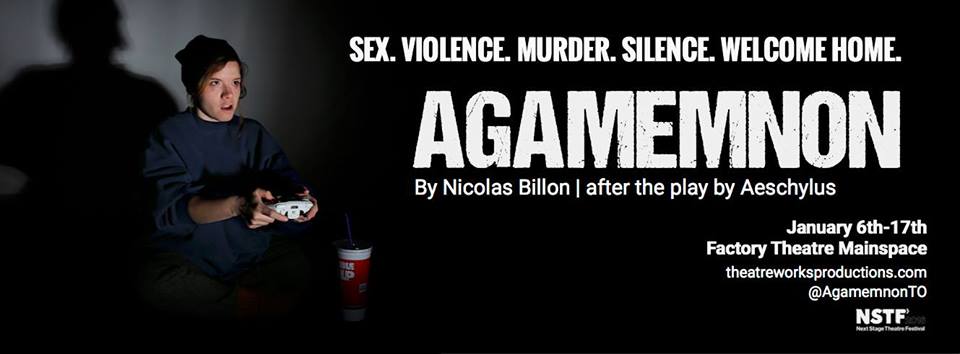
RQ: Hello! I’m speaking with Sarah Kitz, director of Agamemnon. It’s premiering at the Next Stage Theatre Festival, presented by Theatreworks and the Agamemnon Collective.

SK: Hello!

RQ: So this is a new adaptation and translation by Nicolas Billon of the ancient Greek play by Aeschylus. For those unfamiliar with the original story of Agamemnon, do you want to tell me a bit about it?

SK: For sure. The back story is really important. What happens ten years previous is that Agamemnon agrees to sacrifice his eldest daughter, Iphigenia, in order to get a win from the gods to sail to Troy, to sack Troy, to bring back Helen. So that’s what happens at the end of the play Iphigenia. Now we flash forward ten years, it’s been a ten year war in Troy. Troy has now fallen and the men are coming home. So Agamemnon is coming back to his home and, of course, the men coming home from war are expecting to enter a soft, domestic, female space. They’re expecting to leave the war zone behind and instead they enter a different kind of war zone.

My entrance to the play, my vision of the play is that the sacrificing of this young woman is a thing that breaks the world. They are doomed from that moment. All of the soldiers die in that moment, before their bodies are actually blown up and all of the people in the community that are left behind are in a kind of death, as well. All of the things that we value like the body and life and youth and the future and the feminine, all of those things are immediately upended and devalued in the sacrifice of this young girl. So the men return from war to a broken world. That’s where we are now, and Clytemnestra, Agamemnon’s wife and mother of Iphigenia has been plotting revenge for ten years, waiting for this moment.

RQ: So history was written at that moment ten years ago, and now Agamemnon is reaping what he’s sown.

SK: Now it’s comeuppance time, yeah.

RQ: Do you want to tell me a bit about the adaptation?

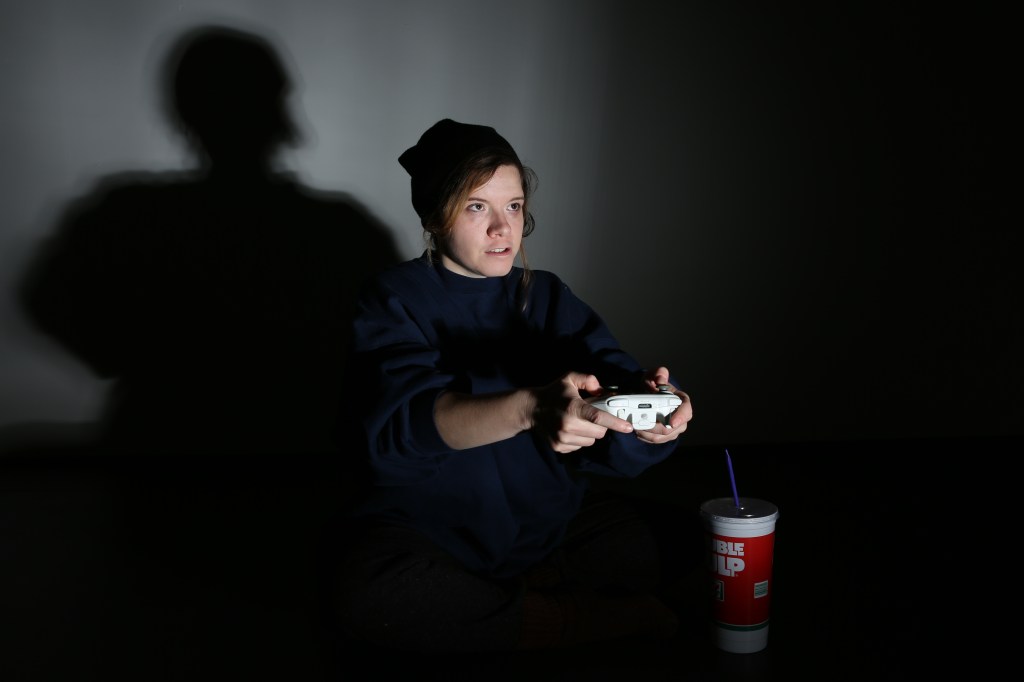
SK: Yes! So Nicolas has updated it to now, even a few years in the future. We’ve taken this classical structure and we’ve perverted it into the vulgar, base, funny, uncomfortable world of reality TV, let’s say. So, to hit on these themes we live with now, but have turned up the volume on even more so. The level of sex and violence we accept as the normal baseline in our culture is even higher. And that, again, is because of the sacrifice of this young girl, things that we value have become devalued. So, violence and extreme sexuality are everyday and not noteworthy until we see people come back into the community and register the horror show that is normality.

RQ: So with reality TV, the second we embrace that vulgarity, there’s no way to take it back in the future.

SK: Exactly. It becomes the new normal, and we just keep building up from there.

RQ: I want to know how this came about. You’ve got this great playwright. You’ve got a great cast including, but not entirely limited to, Nigel Shawn Williams, Brigit Wilson, Earl Pastko. What was the genesis of the show?

SK: Nicolas was commissioned to write Agamemnon for Theatreworks. After Theatreworks saw Iphigenia, which he did at Summerworks years ago, they approached him and asked him what he’d like to do next and he said he’d like to write this companion piece. So, he wrote it for them and they workshopped it a few years back. Then, nothing happened with it and he really wanted to put it on. He and I have been friends for quite a while and are always looking for opportunities to work together. So, when I was out in Winnipeg this summer directing Antony and Cleopatra, he called me up and said he wanted to submit Agamemnon for Next Stage, and he wanted me to direct it. He sent me the script, I read it and I was captivated. I called him back and said yes, and we immediately started excitedly planning.

Agamemmnon 11

Photo of Amy Keating by Robert Harding

RQ: A lot of Agamemnon has to do with myth-making, and the myths we create of ourselves, our culture, our history. I was wondering where those parallels are between the way myths were created by the Ancient Greeks, and the myths we create for ourselves now.

SK: There is a myth that is at the center of this show, which is unfortunately valid still. That myth is that you can purchase peace with war. Or you can purchase forgiveness with violence. That this war will be the last war. That hasn’t changed, and that is one of the central arguments of this play both in its classical original form, and in the contemporary form; and the fact that it is updated only underlines that point. It’s the idea that people who go to war are heroes. In this play, we have people who come back from war, who have seen and partaken in atrocity, and they know different. It’s the people who haven’t gone to war who treat them like heroes in some aspects. We have one character say to a returning soldier “You are a hero,” and he says “No, miss”. He’s been, and he’s seen, and he’s done.

RQ: The original myth that we bought into.

SK: And we’re still buying into it. The only way to stop that myth and stop that history is to refuse to go to war and have everyone in the world refuse to go to war. That is the only way to break that myth. Otherwise, when these warring tribes in this far away country are fighting each other, we will still feel entitled to involve ourselves in that, we’ll make an incursion into another country, blow it up, and create a vacuum of power. Then some other insurgency will step in.

RQ: When we think of war in terms of results instead of the act itself.

SK: I’d say that’s one of the other central points of this play – that in war time, violence doesn’t stay at the site of conflict. It affects all of the communities that have sent people to war. We are then living in a culture of war, and violence and sexuality reach a kind of fevered height, both at home and at the site of conflict. All adrenaline becomes the same adrenaline at that point. If you’re not fighting, then you’re playing violent video games or watching porn, because all of those things are the same. The body has no value, and there’s no intimacy, there’s only getting off.

RQ: One of the things we spoke about when you were directing Three More Sleepless Nights by Caryl Churchill was about the class divide at the center of that piece. Do you feel that’s present in this piece as well?

SK: There is a strong sense of class in a way that may be invisible, but is definitely noteworthy. In the classical Agamemnon, they’re royalty; but in this updated version we’re doing, they’ve moved way down in the world. The people we send to war now aren’t kings and presidents. The people with power, money, and status are at home or at a far, safe distance pushing a button. The people we send into physical contact are poor, dispossessed, and working class. So the family we’re looking at, the house of Atreus, were royalty ten years before the Trojan war. Now they’re blue collar at best.

RQ: What draws you toward a project?

SK: Danger excites me. Laughter excites me. People living large excites me. Words excite me. If I don’t get that physical rush reading a script, that’s a good indication that I shouldn’t do it. I’ve started to say “no” a lot, which is interesting to me. And that doesn’t mean a show shouldn’t be done, it means I’m not the person to do that show. I want a show that has something to say to us. Pure escapism is not for me. It has its place, absolutely, but I’m not the director or the actor for it. I’m also interested in politics, but I don’t want people to come to the threatre and think they’re being lectured at. However, I do believe that theatre can be a revolution. If you get people breathing in a room together, and you’re presenting an argument, it’s a challenge to the way we live our lives. That’s revolutionary ground. It’s an opening for dialogue, and it’s a dialogue that’s happening inside of a community.

RQ: As we start 2016, what would you like to see in the world of theatre this year? For yourself personally, or for the community as a whole?

SK: I would like to see more diverse voices being programmed, and that not be something specialized. That needs to be the new normal. We need to stop talking about it already and just be doing it everywhere. Diversity isn’t a genre. A show about a family is a show about a family. Whether they’re a Greek family or a Chinese immigrant family, or a family run by a mixed-race lesbian couple. It’s a family story, and that’s what we want to see. So, I’d like to see a greater diversity of voices happen.

Also, I’m really excited by what’s happening in the indie theatre scene in Toronto a lot. I love watching our generation step up and start producing the work that they want to make without waiting to be invited into larger institutions because there aren’t always enough places for everyone to be. It’s very exciting and sometimes creating outside of those boxes is the best way because you have the most control. Then when you get to move in to more institutionalized places, you’ve probably worked out kinks in your own process and in your own aesthetics, and you have a good idea of what it is you want to do, how you want to say it, and who you’re really great working with. That makes me really excited to watch happening. And they’re breaking structures of plays, too. What is a play? Do we need to follow the classical structures? I think the idea of dramaturgy can be shattered.

12359852_10102491341069901_8518236175247524543_n

Presented by Theatreworks Productions and The Agamemnon Collective

What: After a ten year siege, the city of Troy finally lies in ruin. Clytemnestra waits for Agamemnon with murder in her heart. A visceral, contemporized re-imagining of the opening chapter of Aeschylus’ Oresteia by Governor General award winning playwright Nicolas Billon.

Where: Factory Theatre Mainspace (125 Bathurst St)

Length: 75 minutes

Who:
Playwright: Nicolas Billon (after the play by Aeschylus)
Director: Sarah Kitz
Featuring: Nigel Shawn Williams, Brigit Wilson, Earl Pastko, Susanna Fournier, Ron Kennell, Amy Keating, Zita Nyarady, Marcel Stewart, Samantha Brown

Tickets: $15.00

When:

January 06 05:45 PM  buy tickets
January 07 09:30 PM  buy tickets
January 09 04:15 PM  buy tickets
January 10 06:30 PM*  buy tickets
January 11 08:45 PM  buy tickets
January 14 05:30 PM  buy tickets
January 15 07:30 PM  buy tickets
January 16 08:45 PM  buy tickets
January 17 02:00 PM  buy tickets

* Talk Back after the show

Connect with us:

www.theatreworksproductions.com
@AgamemnonTO
#Agamemnon

Sarah Kitz: @Sarah_Kitz

Ryan Quinn: @MrRyanQuinn

In the Greenroom: @intheGreenRoom_

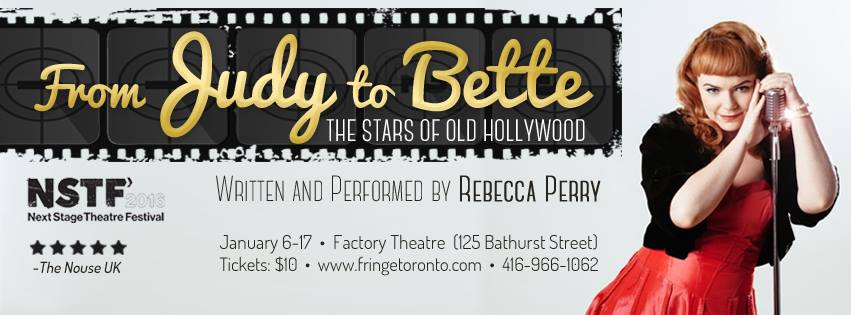
In Conversation with Rebecca Perry – Creator & Performer of “From Judy to Bette: The Old Stars of Hollywood” at the NSTF

Interview by Brittany Kay

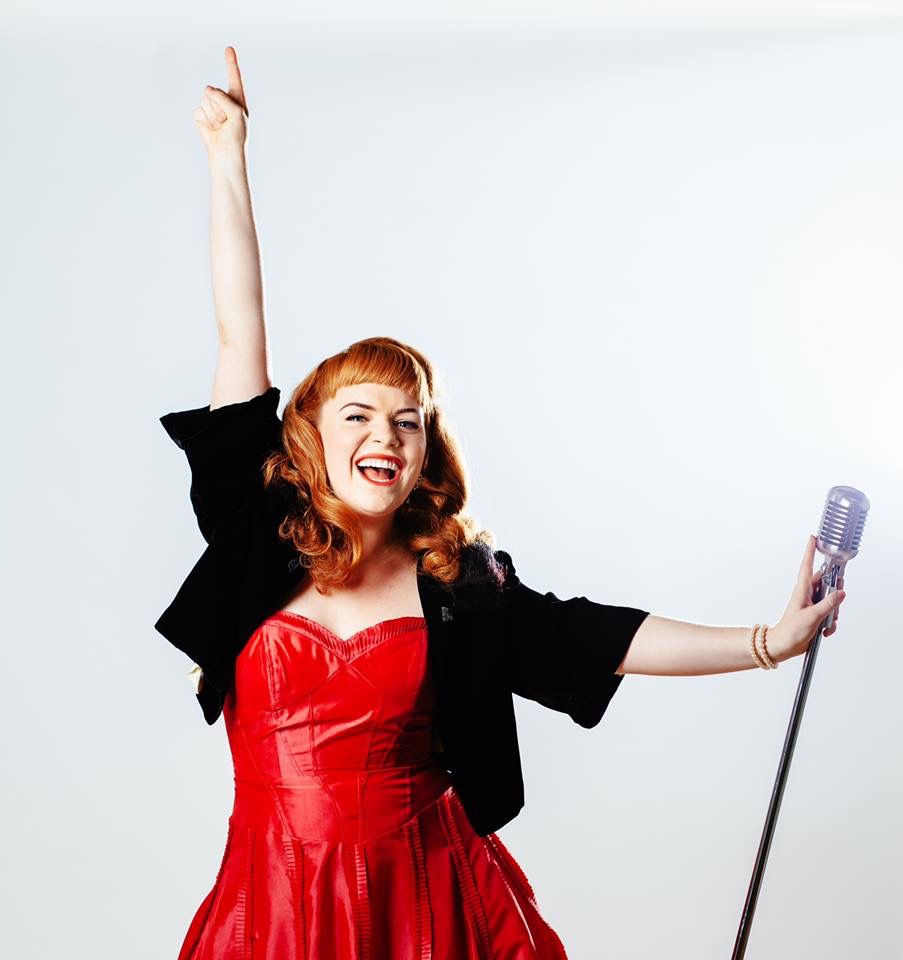
Rebecca Perry is back and at it again with her new solo show that will surely steal your hearts and sell out seats. She is best known for her sold out runs in the Toronto Fringe and Edinburgh Fringe for Confessions of a Redheaded Coffeeshop Girl. Her newest creation, From Judy to Bette: The Old Stars of Hollywood will be presented at this year’s Next Stage Festival from January 6th-17th and I’m thinking that it will no doubt be a crowd favourite.

Perry’s strength lies in the creation and presentation of solo shows. She is able to seamlessly transform from one character to the next by her stunning physicality and vocal manipulation. Her performances have always been incredibly engaging to watch as each new character introduced. 

Through holiday correspondence, I was able to talk creation process, inspiration and girl power.

Brittany Kay: What is this show about? How does this show differ from your other shows? How is it similar?

Rebecca Perry: From Judy To Bette: The Stars Of Old Hollywood is a power-punch of cabaret style entertainment that chronicles the life and times of Bette Davis, Judy Garland, Betty Hutton and Lucille Ball: four stars from the Golden Age of cinema who refused to be just another ingénue. They were trailblazers, who saw their value before anyone else did and fought for the roles that made them famous… and infamous. It’s an evening of marvellous melodies and scandalous headlines.

This is quite a departure from my previous work in that From Judy To Bette: The Stars of Old Hollywood explores the life and times of four real ladies from the last century and the positive effects that they had on their industry. The Redheaded Coffeeshop Girl shows, while based in real life experiences (at least the first one) and with much research into Jane Goodall and her work, are still fictional stories about a fictional character. However, there are two small similarities: From Judy To Bette shares: the upbeat and humorous tone of the RCSG shows and both of these shows look at strong women and their drive to better their situation. Empowerment and breaking the mold will always be themes in my solo shows.

BK: What is so attractive about one woman shows for you?

RP: I think because I can pick a major theme and run with it! I’ve seen (or acted in) shows where I don’t agree with how the women are being portrayed, or the message isn’t clear. I still very much believe theatre can be used for positive change. With solo shows, you are given the luxury of sharing your point of view and how you see the world. It’s heart-warming when somebody relates to a message you’ve hand-picked. It’s also quite fun to play multiple characters who sing and act and have lots of sass and brass, but when you get down to it, I hope people leave the theatre feeling like they can take on the world.

Photo of Rebecca Perry by Tanja Tiziana

Photo of Rebecca Perry by Tanja Tiziana

BK: What is your creation process when devising your solo shows?

RP: All three of my shows have a lot of improv moments because I like to connect with the audience, but I find that the bulk of the core script starts to write itself once I’ve decided what subject I am most passionate about (ex: women empowering themselves) and what elements of it are worth sharing on a stage, then making it into an active story. Anything I do is full of songs and various characters that illustrate what is important and fun about the message or major theme.

BK: Where does your inspiration come from? 

RP: Honestly, these women. I grew up idolizing them when I felt like I couldn’t relate to the role models in my generation.  Don’t get me wrong, there were some great ones… Spice Girls forever!… but something resonated with me in regards to that Old Hollywood charm that Bette, Judy, Betty and Lucille possessed. They paved the path for women of talent and drive, making it okay for women of Hollywood to have comedic chops or character acting skills, essentially making it okay to be more than just a pretty face. While many people today continue this message, I appreciate it from the source.

BK: Is there a major theme or message that the show centres on?

RP: Absolutely: that these four women wouldn’t take no for an answer – and look where it got them!  They knew their value before anyone else did and kept soldiering on. We could all take a page from them.

Photo of Rebecca Perry by Tanja Tiziana

Photo of Rebecca Perry by Tanja Tiziana

BK: Do you plan on touring this piece?

RP: Absolutely! We already have an expanded version that runs at 70 minutes. This is the cocktail hour version – a power punch of entertainment!

BK: You have a new director – Michael Rubinstein. Can you talk to me about his directorial style and approach to your show?

RP: Michael loves these women and what they stand for just as much as I do, so my script and his directorial ideas are collaborating seamlessly. It’s always a treat to have a director who is as passionate about the topic as you are. In rehearsal we basically nerd out together about how awesome these four women are and then channel that into the show so that we can pay tribute to them in the best way possible. We spent forever even debating over which Judy Garland songs to keep and cut from the script because we love them all!

BK: What do you want audiences walking away with?

RP: That they should stick to their guns. That’s what these women did. They were unapologetically themselves and 80 years later their legacies live on. So go ahead: embrace your inner Lucy, Judy, Betty or Bette.

10603314_10153837684979894_8894948713486133180_n

Who:
Featuring: Rebecca Perry with Quinton Naughton on keys
Director: Michael Rubinstein
Dramaturg: David Kingsmill
Lighting Designer: Chin Palipane
Stage Manager: Natalie Frijia
Co-Producer: Jennifer Walls

Where: Factory Theatre Antechamber

When: January 6 – 17, 2016 as part of the Next Stage Theatre Festival

January 06 07:10 PM  buy tickets
January 07 06:10 PM  buy tickets
January 08 08:40 PM  buy tickets
January 09 05:40 PM  buy tickets
January 10 05:40 PM  buy tickets
January 11 07:55 PM  buy tickets
January 12 05:55 PM  buy tickets
January 13 05:55 PM  buy tickets
January 14 06:55 PM  buy tickets
January 15 08:55 PM  buy tickets
January 16 05:25 PM  buy tickets
January 17 03:25 PM  buy tickets

Connect:

Twitter: @Redheaded_CSG or @rebeccaperry21
Facebook: Redheaded Coffeeshop Girl
Instagram: @Redheaded_Coffeeshop_Girl
Web: www.redheadedcsg.com

Brittany Kay: @brittanylkay
In the Greenroom: @intheGreenRoom_