Skip to content

Posts tagged ‘ryan quinn’

A Few Words with Sarah Kitz – Director of Caryl Churchill’s Three Sleepless Nights – 2014 Playwright Project

Interview by Ryan Quinn

RQ: So, Sarah Kitz! You are directing Three Sleepless Nights by Caryl Churchill with Bad Joe Theatre for the 2014 Playwright Project.

SK: I am!

RQ: And this show takes place around the beginning of Margaret Thatcher’s government.

SK: It’s early in her reign of terror.

RQ: Yeah! I was wondering if you could speak to the point of view the show takes on her. She was the first female British prime minister, but she didn’t leave a fantastic legacy.

SK: Well, it’s interesting because Churchill stridently doesn’t talk about her shows. Other people talk about them, but she doesn’t do interviews. So, you’re forced to just go to the text. She is such an overt feminist, and Margaret Thatcher obviously was no feminist, even though she was holding the highest office in the land, it was all about pulling yourself up by your bootstraps. Women did not do better under her government, and minorities didn’t do better, and underprivileged people didn’t do better. It’s a political play because of the context, but we don’t hear people discussing much politics. What we get instead is people in tenuous circumstances that are getting increasingly dangerous and just the traps closing around them. We understand because of the framing of the show that that’s largely, but not totally, Thatcher’s doing.

RQ: A society or a community in flux, and how it affects the people in it.

SK: Yeah, and not so dissimilar from now, with the economic divide widening dramatically. The people on the bottom end of that are going from a hand-to-mouth situation that’s bearable into a really precarious place.

RQ: Well that’s something I wanted to ask you about, how the world of this show parallels our own, but you just touched on it, how social classes are becoming further apart.

SK: When I chose this show, I realized that with some of her work, you can get away with not doing a British accent very easily, but I don’t think this is one of them. It’s very “London working class”, so we decided to keep that, but the resonances in people with economic hardship is so unfortunately similar to what’s happening right now that I think that will reverberate very strongly.

RQ: How do you approach something like this that’s so similar to our world now, but also so firmly planted in a certain era?

SK: I think, fortunately, with someone like Churchill, she’s so clever in her writing that you can just serve the text and know that it will resonate. The actors are really, really good, and the scenes are stand-alone but interrelated so we get a few different viewpoints going on and that’s helpful as well. It’s not just one bedroom with two people for the entire show. One of the couples has a bit more money and resources than another, so you do see some change. I don’t think it’s ultimately a very optimistic play, but I think that making art is overtly an optimistic venture, so they balance out.

RQ: What is it about Caryl Churchill that you think makes her great for a festival like this?

SK: She’s so political, and the politics in our country are so in-your-face right now that we need to have more politics in our theatre. And her political discourses are very palatable in how theatrical they are. So you can come see a political show and it will be entertaining, not didactic, though there is a lot of substance in there. Plus, since she doesn’t talk about it, as artists working on the show, you can kind of do whatever you want in the realm of working with the script you have. She hasn’t said, like Shaw, the table must go here beside the french door. You can imagine it fresh every time and that’s really exciting. I don’t know what the other directors are doing with their shows, but I imagine we’ll see four drastically different, ambitious theatrical adventures, that’s really exciting.

Playwright of 2014 The Playwright Project- Caryl Churchill

Playwright of 2014 The Playwright Project- Caryl Churchill

RQ: What do you think the place is of these small festivals in a city with a few large festivals every year?

SK: I think it’s fabulous. With the Playwright Project in particular, we get to focus in on a particular writer, one who has a broad body of work to choose from. It’s incredible immersion. Plus I think the selection body is very interesting, why we choose these shows. Part of it is practicality, what we can do on a small budget in a small space. A lot of her shows are gigantic, and nobody in this festival is doing a show with a cast of fifty. Also, though, there’s not a lot of Caryl Churchill done in this city, and what is done is put on at a very high level like Alisa Palmer did Top Girls for Soulpepper, and then she did Cloud Nine for Mirvish. If you want to talk politics, that’s a different price bracket, those tickets. So there are a lot of people in this city that don’t have access to those shows just by virtue of how much they cost. And they have to cost that much because it costs so much to put them on.

10155049_674841159245160_1461255070_n

RQ: So she’s a playwright that’s speaking directly to the hardship of the lower half of society, and yet most people in that lower half can’t afford to see it.

SK: I mean she doesn’t always put her words in the mouth of the lower class, but she does have a focus on the vulnerable, the disadvantaged, the politically under-served. She is very populist in that way.

RQ: What do you hope people discuss, or think about, or argue about on the way home?

SK: I hope people argue about what the traps are, because I think there is more than one in my show. And also how familiar the refrains are that we get ourselves into in relationships. How much fine negotiation it takes to get out. Fine negotiation or revolution, explosions of the status quo.

RQ: In some senses, is the explosion ever justified, or is it ever essential?

SK: Exactly. If they’re justified, how they’re justified, and the disparity between the lip service and the execution. And if the execution ever happens, or if we stay trapped and talk about it and do nothing. If silent revolution is possible, or if that’s a lot of tongue wagging and a lot of sitting around.

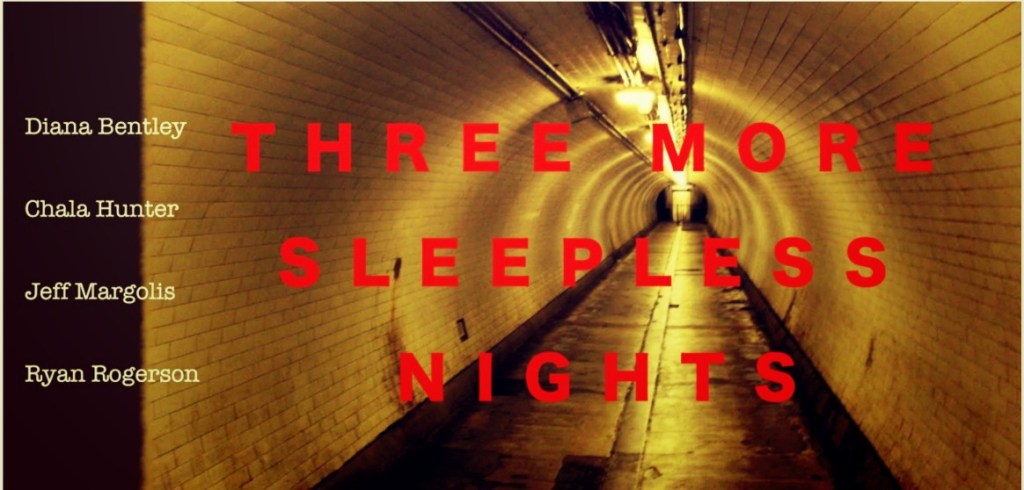
Three More Sleepless Nights

by Caryl Churchill, presented by Bad Joe as part of the 2014 Playwright Project
kitz-bright

London, 1980. Thatcher is newly in office. It’s the end of an era; it’s a new age. Late night communication breakdown. In the close quarters of the bedroom, enter people on the brink.

Directed by: Sara Kitz
Starring: Diana Bentley, Chala Hunter, Jeff Margolis, Ryan Rogerson,
Where: The Downstage (798 Danforth Avenue)
Tickets: Available  HERE
Single Tickets: Weeknight Single Ticket: $10.00, Weekend Single Ticket: $15.00 

Project Passes: Weeknight 2-Show Pass: $15.00 (see both shows playing on a weeknight), Weekend 4 Show-Pass: $45.00 (see all four shows playing on a Saturday or Sunday)

About Sarah Kitz:
A Toronto writer, director and actor, Sarah recently directed the hit show Savage in Limbo for Bob Kills Theatre, which extended its run at The Downstage. She has assistant directed Long Days Journey Into Night at Soulpepper (dir. Diana Leblanc); associate directed This Wide Night at Summerworks (dir. Kelli Fox), and has directed for Fringe, Summerworks, Here Is My Hand, Leah Posluns Theatre, One Night Stand, My Livingroom’s New Art Night, and Birmingham Readings at The Stratford Festival.
 
As an actor Sarah has been a member of the Stratford Festival Company and a graduate of the Birmingham Conservatory for Classical Theatre, where she played Eliza in Pygmalion (dir. Chris Newton) and Fool in Lear (dir. Martha Henry). Sarah has played Olivia in Twelfth Night (Dream North); Hali in The Sicilian (Fringe); Portia in The Merchant of Venice (St Lawrence Shakespeare Company); One Woman Freak Show (Buddies/Cheap Queers).
 
Upcoming Sarah is directing a new play by Nicolas Billon. This fall Sarah will play Edna St Vincent Millay in With Individual Desire, currently in development with Lady Parts Theatre and Nightwood Theatre, to be presented at Groundswell.

A Chat with Ryan Robertson & Peter Hodgins of Two Chips Theatre’s “Copy”

Interview by Ryan Quinn

We sat down with Ryan Robertson and Peter Hodgins of Two Chips Theatre Group to discuss their current production of Copy.

RQ: Tell me a bit about the show!

RR: Sure! It’s a workplace show, a comedy/drama. It has a few themes. Firstly, it’s about people who are frustrated about their job, who are not achieving what they want to achieve. The tension between men and women, and between generations of people. So, it’s a comedy, but with a lot of darkness in it as well. We see these characters superficially at the beginning, and then they reveal a bit more about themselves and open up.

RQ: So, you wrote this piece, you’re directing it, and you’re performing in it as well.

RR: Yes. By default, essentially. When you’re a new theatre company in Toronto, it is difficult. I wanted to start from scratch because, as a writer, if you want to put a play up you normally have to go about it certain ways and work with different companies; and you end up with so many oars in the water that your play can be something totally different than what you started with. I also really wanted to have the final say on my cast and whatnot, I mean, for example, Peter is absolutely perfect for his role, and everyone else is fantastic as well. I find that better than the collegiate approach where you have a lot of people involved. These guys are as much a part of it as I am, but I never feel compromised.

PH: (laughs) Yeah, there’s not much in the way of food at rehearsal.

RR: I mean, we got a lot out of it. We do find that there are no egos at this level in the game, when you’re starting at the bottom and working with people who are like-minded.

PH: It’s been a lot of fun, and it’s going to be more fun as time goes on.

RR: Yeah, we have plans to keep going with some of this same core group and with the same kind of mentality. We really want to go back to the idea of the independent repertory company. We don’t do it for money, though I know a lot of people don’t, but we really want to do our own plays, I find that really interesting.

RQ: Do you feel like new original Canadian work is something the independent scene needs more of?

PH: For sure, I mean, Shakespeare is great. Don’t get me wrong. But, I see casting notices for it all the time and I can’t help but think “Who’s going to see that? They must have already seen it three or four times”. Part of it is that there’s no royalties. These plays are all free, and so young companies don’t have to pay a writer. So, it’s good to find new original stuff, which, for the most part, you have to write and create and perform yourself.

RR: When you come forward with something original, some people want to come forward and try to change it, to say “this isn’t right, that isn’t right, etc.”. Okay, we have to put up a few bucks ourselves, but if people really want to support new plays, they have to go to them. I hear a lot of people complaining about the same shows being done over and over, but then they don’t go out and see original plays.

PH: Yeah, we really need this stuff. And I’ve spoken to Ryan about making this into a film because we’ll all be ready for it, and we all love it.

RR: The thing about original plays is, as well, that because you are the creator, it’s a journey. I saw it on the page, I’ve seen the characters brought to life. There’s no need to put a “new spin” on a character because they’re completely new. What’s also important to me is that everything should be natural. We didn’t want to fall into the trap of being a wee bit pretentious. It’s a workplace play, so it has to be kind of earthy. I don’t mean to use the word pretentious, that has a negative connotation, but I mean that as well as depicting higher class things, it should reflect ordinary life. Even in the plays about ordinary people, there’s probably a bit too much wordiness at times. This is a much more down-to-earth workplace show.

RQ: That’s something else I wanted to touch on. This show deals with the minimum wage. So, because of that, it’s inherently political, as well as being comedy. Is that true?

RR: When I spoke to other writers when I was younger, they’d say “never preach”. You find a way to explain big issues with humour or in a way that doesn’t condescend. I’ve tried to do that with all the characters. Characters are more interesting that way, I think, when they don’t have these grand speeches planned.

PH: As long as it’s real. If you accurately portray a segment of society, it’s going to be political.

RQ: What do you want people to be discussing on the way home? What do you hope it leaves an audience with?

RR: I would hope people would get from it that in a way we’re all divided by our employers, and we’re all slaves to our mortgages and our dreams, but we’re fragmenting as a society. If we all got together and understood each others’ pain, we could do a lot better. We are divided, and we do worry about ourselves too much, and that hurts society. After the show, we’d like to talk to the audience, see what they got out of it, right?

PH: Yeah. I agree.

RR: But I do agree that when we attack these things, we have to do it with humour, with a little seriousness thrown in.

RQ: I think it was Shaw that said “If you want to tell people the truth, you’d better make them laugh or they’ll kill you”.

RR: Exactly. That’s perfect.

RQ: And Peter, as a veteran performer, how did this project come about for you?

PH: I believe I found it on Mandy, actually. So I sent in my application and I erroneously asked if I could read the whole script. I guess that was a bad thing to do. So I didn’t hear anything for a while.

RR: So I went back to Peter after a couple cast changes, I wanted Peter from the start, and I sent him the script, and I guess he liked it. I tried to write something where everyone’s involved and has something to do, and consequently everyone in it seems to really enjoy doing it, so I hope that translates to the audience.

RQ: What’s exciting about this show for you, Peter?

PH: Well, this is my first time on a live stage, actually. I’ve done mostly acting in film and directing film, so that’s what’s exciting for me. Mail Room John is a very misunderstood guy, and I feel like that myself pretty often.

RQ: So both of you must have had an interesting time with approaching the work on day one. Peter, with it being your first time doing live theatre; and, Ryan with putting up your own work. How did you approach that?

RR: Well, I try to be a benign dictator. Every member of the cast has ideas and I wanted to avoid ego as much as possible. So, it’s been a real collaboration. We’ve had a lot of fun and I think that’s going to show through when we do it. It’s worked out exactly the way I wanted it to.

RQ: Going forward, what are your hopes for this company?

RR: Well, if people show up to this one, there will be more shows. I think it’ll be good because we don’t plan to stick to a certain group of actors, and everyone feels like a part of it. PH: Now that we have a great location, we can just keep doing it.

RR: It’s important that people come out because we ain’t made of money. We back it as much as we can, but we’re not a professional comedy. We’re just tailoring it to entertainment, not money.

RQ: Well, that’s become the new standard, hasn’t it? Independent companies doing professional-level work?

RR: Right, and you need to get dedication out of people because they are giving their time, so it has to count.

PH: I think it’s guaranteed we won’t make any money.

RR: If we break even, we’ll keep doing shows.


Copy

Written by Ryan Robinson, presented by Two Chips Theatre Group
Directed by Ryan Robinson
Featuring Alene Degian, Brian Stapf, Madryn McCabe, Peter Hodgins and Ryan Robinson
poster1.51123805_std
Where: Sterling Studio Theatre, 163 Sterling Road, Toronto, Ontario, M6P 0A1
When: March 18-22 8pm, doors open at 7:30pm
Tickets: Advance tickets $15+service fee, At-the-door tickets $15 cash only
Concessions available, cash only
For more information:
www.sterlingstudiotheatre.com
www.twochipstheatre.com

A Few Words with Eric Regimbald on “Blackbird” by Adam Rapp

Interview by: Ryan Quinn

We sat down with Eric Regimbald of Pinchback Productions to discuss their upcoming production of Blackbird by Adam Rapp and his thoughts about the Toronto theatre scene and about the healthy opportunity for growth when taking the plunge with a bold, strong play choice.

RQ: Can you tell me a little bit about Blackbird?

ER: It’s a play by Adam Rapp, a two-hander. It takes place in the dead of winter, at Christmas Eve on Canal Street. It follows two “losers”. He’s a Gulf War vet, she’s an ex-stripper, and he’s trying to wean her off heroin. It’s a really dirty world that has cast them aside. What’s their place in society? But they realize more-so now than ever that they’ve found each other and they need each other to survive. I should mention that when I bring up this play, a lot of people think of the David Harrower play of the same name, which is also a two-hander that’s quite dark.

RQ: What draws you to this play?

ER: Well, I’ve always wanted to do a two-hander. Especially after doing my touring job as a children’s performer, which is fun but not very character-satisfying. I just wanted to sink my teeth into something visceral. Something real and exciting. So, my producing parter and acting partner Alona Metzer and I read a few plays, including One Night Stand by Carol Bolt, which would have been a really fun character to play, but this one is a little further out of my range and a little scarier. I also feel like a lot of people who put up theatre, especially Shakespeare, don’t seem to look into the last time a show was put up. The same shows seem to be done by different people all the time. So, we wanted to do one that hasn’t been done in around ten years, and this fit the bill. We wouldn’t put this up if it was done last year. Even if you might have something different to say with it, I couldn’t bring myself to do it.

RQ: How did this come about?

ER: I met Alona doing class simulations at Ryerson. I heard that she’s a producer and I’m always looking for new people to work with. We started by trying to write something, but I found that that wasn’t what I was really into, so we ended up deciding on doing a published play instead.

RQ: Do you think this show has importance now in Toronto? Do these characters resonate somehow culturally?

ER: The love story is the key thing we’re really trying to flesh out. Anyone can relate to a love story, and I think that’s relevant. I mean, it’s also relevant in that I hope it’s still snowing out in March. People can really feel that isolation, that cold. It would be different if we did this show in the summer, it would resonate a lot differently. It’s such a dark, winter show.

DSC_7021

(L to R) Alona Metzer and Eric Regimbald

RQ: You have these really ugly, grimy characters, and this really beautiful love story. What’s your approach for getting to the heart of the show when the surface is so dirty?

ER: Adam Rapp’s language really juxtaposes all this swearing and talk of heroin with this really clear dialogue that they need each other. There’s a reason you come into the story at this point in the lives of these characters. So, the struggle is clearly there, and the need, and you just tell the love story around that. It’s exactly what you were saying, it’s that they can’t live without each other, and why not. They don’t want to be in their situation. If they were up on stage doing heroin and swearing and loving it, the story would be totally lost. He’s struggling to recover, and she just broke up with a violent, shady dealer, so they’re really trying to salvage a life together. It’s about finding the humanity.

RQ: What are your goals this year as an artist?

ER: I wanted to get a play done early in the year. I put up a play last year in Fringe, but I wanted to get one up early, especially since I’m on the road a lot. It’s that time to do something and not sit around. I’m hoping to work on some other projects later in the year. It feels good to put something up this early in the year, then there’s the hunger for “what’s next”, you know?

RQ: I want to go back on something for a second. Why do you think so many plays are done so often in this city, and do you believe there’s a shortage of original work while young companies tend to do British and American classic work?

ER: A lot of people seem to be afraid to buy rights to shows. They’ll go to Shakespeare right away because it’s free and the problem is that sometimes they don’t have anything to say, or they don’t have the training to bring them to the level that other local companies are doing the work at. What I’m passionate about is contemporary theatre, and a lot of the modern work I see falls toward doing theatre exercises on stage. It doesn’t make sense. I’m disappointed, and don’t get me wrong, I see amazing modern shows that use movement work as well; but a lot of the stuff I see just doesn’t live up to what it could be. It is an accomplishment to put up a show, but that shouldn’t be enough for you. I mean, obviously we’re doing this show partly for ourselves as well, but it can’t be just about that.

RQ: Do you feel that the theatre community is afraid to critique itself?

ER: I think so. I think people are really polite, and we’re not helping each other. I would love to have someone come up to me after this show and tell me why they didn’t like it. It’s better than hearing nothing. We’re trying to be strong in our voice, and we’re prepared for some people to have negative reactions to it.

Blackbird

Presented by Pinchback Productions
When: March 14th to 23rd
Where: Hub14 theatre.
Tickets: Available at the door or at http://blackbird.brownpapertickets.com.

In Conversation with Carly Chamberlain & Susan Bond of Hart House Theatre’s “Goodnight Desdemona (Good Morning Juliet)”

Interview by Ryan Quinn

RQ: Hello! So I’m here with Carly Chamberlain, director, and Susan Bond, dramaturge, of Hart House Theatre’s production of Ann-Marie MacDonald’s Goodnight Desdemona (Good Morning Juliet). Tell me a bit about the show? 

CC: Essentially, it centres around a women who is an overlooked, often taken-advatage-of academic who is working on her thesis and she has a theory about some of Shakespeare’s plays that nobody believes in. That’s sort of the setup.

SB: So she’s come to a crisis about her work and her treatment in this academic model that she’s working through.

CC: In a larger sense, it’s her crisis of identity in general. So that’s the crisis, then she falls in a garbage can… as you do. There’s a magical element to the play where a choral moment initiates her falling into a garbage can, and falling into her subconscious, which takes form as a Shakespearean-like world.

SB: Right, she falls into a very specific Shakespearean world, as you could guess from the title. She falls into the worlds of Othello and Romeo and Juliet.

6gUQX4gOZB4g7X1TW4895JOI709KUuA1Wc7mIKpLQhY

Photo Credit: Scott Gorman. (LtoR) – Nathan Bitton as Romeo, Lesley Robertson as Constance, Katie Ribout as Juliet

CC: She meets two of her heroines, and it’s a journey set around finding her way out and solving her thesis question, but it’s really about meeting the so-called “real” versions of them and also finding her own identity. It’s really a journey of self-discovery, especially since it’s her subconscious, they’re all elements of her.

SB: At the same time, she’s helping solve their problems of mortality.

CC: She’s searching for her real identity by assisting them.

SB: I think it’s also worth mentioning for people who aren’t already familiar with the play and perhaps not familiar with the fact that Ann-Marie MacDonald is Canadian, and that she is a struggling academic at Queen’s University in Kingston.

CC: That being said, I think it’s important to note that while the play is very clever, and it references a lot of Shakespeare, I don’t think you have to be intimately familiar with the plays to enjoy it. It’s a human story of loving yourself.

SB: You’ll certainly get more out of it if you’re familiar with those two plays and the rest of Shakespeare’s work. You’ll see more of the layers in it if you do, but it’s not essential.

RQ: There’s a few things I want to touch on there. Constance is very much a modern protagonist. She’s an iconic character of Canadian theatre. Is there a calling for more strong, modern female protagonists?

CC: Yes! But I don’t think “strong” is the right word to describe her, necessarily. She has strength and she discovers her strength, but I think what makes her a good example of a female character in Canadian theatre is that she’s complex.

SB: Most of her problems aren’t “woman problems”. She has career problems and self-discovery problems, which are things that everyone has. She’s an important female character in that she’s a great role for female actors because she’s also more complex.

CC: The whole thing is about her finding her strength, but there’s a problem with the writing of female characters in general where if they aren’t someone’s girlfriend or wife or talking about their romances, the other extreme is that they’re superheroes; which is another sexualized, objectified version of a woman, as well.

RQ: So it looks at the concept of strength beyond the male-centric idea of what a strong woman looks like.

CC: Yeah. I think there’s something to it even beyond a male-centric idea. I mean, patriarchy is everywhere, so we’re all viewing through those goggles, but what’s really special to me about this play (and part of it is that you view whatever you’re working on through whatever you’re processing yourself) is that it’s not about male or female but about saying, “Hey, things are complicated, nothing’s black and white, and the mess of life is okay, and I’m still awesome even if I’m a mess”. That’s something we all need to readjust to as far as what strength is.

MSo86dxC3mJlISuboRbew9RaCFuzjb1UqpaYqFXjAL8

Photo Credit: Scott Gorman. (LtoR) – Cydney Penner as Desdemona , Nathan Bitton as Iago, Lesley Robertson as Constance

SB: “You shouldn’t need to be above the mess. Strength is living in the mess and working through it.”

CC: But yes, to come back to the question, I do think there’s a real lack of complex female roles in film and TV, obviously in classical theatre, but also in Canadian theatre. We spoke about finding other Canadian plays with complex women in them and it’s actually a struggle.

RQ: In pop culture in general. In the zeitgeist, there are very few of them.

CC: Yeah, and then, when there is, it’s a big thing. Look at the reaction to HBO’s Girls.

RQ: Because there’s that thing where people look at it and say “But these characters are kind of shitty sometimes. How are they supposed to be female role models?”

CC: I read a really interesting article recently that compared Hannah from Girls to Llewyn Davis from Inside Llewyn Davis, and it was showing that that’s a perfect example of the flaws in innate sexism. We look at Llewyn Davis and we’re like, “Man, he’s fucked up. He’s talented, but he’s fucked up and he makes fucked up decisions. He’s a tragic hero,” but with Hannah we’re like “You’re a brat. Get over yourself”. I would argue that the Coen Brothers do romanticize Llewyn Davis more than Lena Dunham romanticizes her character, but it’s the same thing, she’s a self-indulgent, talented person and so is he, but she is the one who gets ragged on.

SB: Also, I think that because there’s a relative dearth of complex female characters like that, she winds up standing in for not just self-indulgent talented people but also “ladies”, or “girls” in general. That’s just a problem of underrepresentation.

CC: Since there’s a lack in general, every female character has to live up to the standard of not being any stereotype, which is pretty impossible.

RQ: As soon as someone becomes iconic in that sense, they have to be everything to everyone all the time.

CC: Exactly, which is impossible. But, as much as I’m all about more roles for women, I don’t think anyone that champions that wants to watch plays about perfect people, because why would you watch it?

RQ: So what you’re talking about is that female characters are allowed to have conflict. They don’t have to be the side character but they also don’t have to be above all conflict and completely inscrutable.

CC: Essentially.

Kf2qX94A1f5ZyAfTojn1ItvbQzkQZr-8l_h7c_mcog0

Photo Credit: Scott Gorman. (LtoR) – Katie Ribout as Juliet, Lesley Robertson as Constance, Cydney Penner as Desdemona

RQ: So, Susan, as a dramaturge, there are several different worlds in this play. How do you go about investigating the different worlds and how they interconnect?

SB: My speciality as a dramaturge is working with Shakespeare, so the knowledge I bring to the table at a production is going to be actually stronger than the Canadian academic world, despite being a Canadian graduate student, though not in the 80’s. You referred to Constance as a “modern” female character, but she’s not actually that modern, she’s set in the 1980’s and it’s surprising how much that world lives in the play. Because we’re not actually in Verona or Cyprus, we’re in Constance’s imagination, it’s amazing how her world kind of emerges in them in strange ways.

CC: And we’re definitely trying to highlight that. I think sometimes people go for an interpretation where we’re actually there in stereotype-land. Our set doesn’t change, other than through light and sound, and that’s on purpose. The office is onstage the whole time. Something we talked about from the very beginning is the idea that she’s in “Cyprus”, not Cyprus. Because of that, the dramaturgy becomes complex. The first step is saying “this is what it was in the original play”, and making a conscious choice if it’s going to be different.

SB: “This is what the coastline in Cyprus was. These are the places it would be appropriate for Desdemona to be. This is where a historical Desdemona would be. This is where Shakespeare’s Desdemona would be.” But, MacDonald’s Desdemona is in a different place altogether.

CC: The layers of references in the play are astounding. For example, there are a lot of references to alchemy; but there’s a difference between Renaissance alchemy, which is transmuting base metals to gold; but there’s a very intentional layer on top which is Jung’s idea that they were being metaphorical and alchemy is actually about self-actualization. So, all that stuff is layered in.

SB: There’s a lot of dramaturgy in this show.

RQ: And all the layers inform each other, right?

CC: Yup, real easy, super easy.

SB: Yeah, I just know what the words mean.

CC: But that’s something about Shakespearean dramaturgy in general, is that the actors or I might have a question about what some little thing means and we might find out it’s a reference to some obscure thing.

SB: Like the Gustav manuscript. It’s an 18th Century German novel about someone searching for a manuscript that was lost, so in a way, it sets up the premise for Constance’s entire academic career.

CC: Yeah, then you go, “This is all interesting, but to the character, it means nothing”. You don’t know these things, it’s outside of the world.

SB: But then some elements are conscious references, so it all ties into itself.

RQ: And how has it been working with Hart House on this show?

CC: It’s good. We both have histories with them, though Susan’s is longer.

SB: I’m the Resident Dramaturge.

RQ: How did you start there?

SB: I started as a dramaturge for Canopy Theatre, which is associated with Hart House and so I worked with Jeremy [Hutton], when he was acting in a show I was dramaturge for, and he saw what I brought to the table.

CC: When I was an actor, earlier in my career, I was in Julius Caesar and A Midsummer Night’s Dream at Hart House. So I had a bit of a relationship with them, then Jeremy and I worked together at Shakespeare By the Sea as well, and we had a good working relationship. And I assistant-directed there last year for Robin Hood: The Musical, which is another Hart House/Shakespeare by the Sea crossover. It’s been pretty awesome working with them. As far as the management goes, they’re very supportive and trusting.

g6i70KlVRcyhkTK-Y48NZE5eDsajFsksvzsSqQzbWpo

Photo Credit: Scott Gorman. (LtoR) Lesley Robertson as Constance, Nicholas Porteous as Professor Claude Knight

RQ: What would you say your goals are this year?

CC: In life?

RQ: In life!

SB: In 2014?

RQ: In 2014!

CC: I think for me, it’s two things. On the one hand, I’m still trying to figure out what directing means and how to be good at it in a thoughtful way. I want to continue to develop because you can only learn it by doing. On the other hand, Susan and I work together separately [with Neoteny theatre] and I think we both want to make a positive and significant contribution to the theatre scene, particularly as it relates to classical-adjacent work and roles for women, so this falls right in line with that. We want to be thoughtful instead of making work for work’s sake. That’s really hard because we all want to be working all the time. When we did Overruled and Romance last year, it went really well and people wanted to know what we were doing next, but we’re trying to resist the urge to just do something for its own sake. You know, “put on a show and put my friends in it”, because that’s tempting.

RQ: Vanity project theatre.

CC: Right, and that’s such a murky area because to some degree, everything you do is a vanity project because even if you’re getting paid, you’re not getting as much as you should, so you have to be getting something else out of it. I think that sums it up nicely.

SB: Yeah! I think we’re trying to reconcile the intersection of classical work with women’s roles in general. A, let’s just say it, feminist model, to some extent.

CC: I think what we’re dancing around is that we’re interested in feminist work that’s not feminist for its own sake, but feminist for that basic definition of equal rights for all people. It’s one of those things that once you start seeing things through that lens, and you’re a creator of any kind, you have a responsibility to make sure that work continues. That being said, we’re not entirely humourless. So that, plus joy in the work. That’s the other thing with me directing is that I’m trying to find that line where everything is falling into place, but that sense of play and joy and ensemble is there too. That’s really important, as an audience member. I want to find that balance where they’re in an environment where they can live in the moment.

SB: If there’s no play in the play, then it’s entirely joyless.

RQ: It’s moral responsibility theatre, which can be pretty boring.

CC: I think about this stuff all the time because I’m kind of a cynical person and when people say things like “Oh, when this show closes, I’m going to miss this cast so much!”, I’m the one that’s like “You’re doing a job”. Navigating the line where there’s a sense of joy in the ensemble and the bond you form with the other members comes from working toward the same goal, that’s huge and important. All the other stuff, drinking together and whatever, that’s cool if you have that social vibe, but the vibe in the room is so much more exciting and important.

Goodnight Desdemona (Good Morning Juliet)

By Ann-Marie MacDonald, presented by Hart House Theatre

1780906_595738803838906_627533721_n

Where: Hart House Theatre, University of Toronto, 7 Hart House Circle
When: February 28th – March 8th, 2014 8pm, Saturday Matinee 2pm
Tickets: $15-$28 http://uofttix.ca/view.php?id=1000

For more information on the show: http://www.harthousetheatre.ca/

Rarely Pure Theatre’s “As You Like It” at The Storefront Theatre until January 26th

Interview by Ryan Quinn

I had breakfast with three of the wonderful collaborators of Rarely Pure Theatre, all three of whom are working on the current mount of As You Like It being shown at The Storefront Theatre. I spoke with Spencer Robson, who is playing Orlando; Christina Bryson, playing Rosalind; and Monique Renaud, one of the company’s Artistic Directors. All three are also involved in the production of the show.

When deciding on a show after the success of their previous productions of The Pillowman, We’re Lovers, and Until Our Paths Cross Again, they decided to focus on doing classical text. “We’ve wanted to do a Shakespeare for a while, because a lot of us have worked together with this text and we had access to a lot of great resources and actors for Shakespeare”, Robson said. Bryson explained why As You Like It was the perfect choice for them commenting that “It’s a fun, high-paced show. And you need a light comedy in the middle of January”. Though, it’s not just out of love for the show itself, but it was also a matter of feasibility, explained Renaud: “Part of it is, as a non-union company, we couldn’t get any older, union actors, so this youthful show is one of the best Shakespeare plays to go for.”

There is also a kind of magic in the lack of magical elements in this Shakespeare show. For one of the light summer comedies, there are no ethereal forces at work in As You Like It. “Some of the characters are pretty extreme and big, but it’s still real. There are no faeries, or magic. It’s focused on these human beings and what they want. It’s not the forest that changes them, it’s their experiences. It’s about driving your own narrative, which is very similar to what we’re focusing on as a company.”

Christina Bryson and Katie Ribout in "As You Like It" Photo Credit: Dahlia Katz Photography

Christina Bryson and Katie Ribout in “As You Like It” Photo Credit: Dahlia Katz Photography

As far as concept, the team decided to keep it fairly simple, while flipping the usual setting of the show to make it take place in the winter. “There are actually more references to winter than summer. We added some of the songs back in. There are a lot of winter references in those especially”, Bryson explained, while Robson added: “We thought it would be a nice subtle thing we could do without it being overbearing. Also, it’s really supported by the text. A lot of the pivotal moments of character realization are described in kind of wintery terms. I mean, we’re not going to have snow falling on the audience or anything like that. It was more of a subtle atmosphere choice.”

The show is being directed by Rosanna Saracino, an experienced director who has worked with young casts many times. “It was also important for us to get an established director on board, someone to help guide us. I still feel like we’re learning a lot, but I don’t feel spoken down to”, Bryson told me. “She works with young actors all the time, so she knows about a lot of the struggles we have,” Robson elaborated. In fact, Rarely Pure populated their production with people who specialize in those different areas of production instead of letting friends and acquaintances handle offstage duties, as many young companies tend to do. “There’s a reason people have different jobs, because they’re good at it”.

Michael Hogan, Gaby Grice, Scott Garland in "As You Like It". Photo Credit: Dahlia Katz Photography

Michael Hogan, Gaby Grice, Scott Garland in “As You Like It”. Photo Credit: Dahlia Katz Photography

The company isn’t content to just get lost in the shuffle, though, as they’re looking to help unite some of the disparate parts of the culture in Toronto. Robson told me that he “was talking to Caleb McMullen from Mnemonic Theatre, and he said that there are a lot of small upstart companies right now, and if we could just pool our resources and work together, we’d make some amazing work. This is kind of proof that we’re all on the same level. If you’re putting something on and people are showing up, and you’re proud of it, that puts you on even ground with the whole community. You’re all contributing to the same cause. Nobody is above each other, we’re all just doing different shows.”

For the new year, Rarely Pure is taking a bit of a paradoxical move, by both zeroing in on what they’re best at, while also expanding the scope of what the company is capable of. While still maintaining a bit of the company’s original motive that “if you have a good idea, and you want to execute it, we can help you get it off the ground,” the company is also looking into new and innovative ways to experiment with performance and theatre: “We have a Fringe spot, and a playwright to write for us, which is great. I’m hoping to start Rarely Pure Productions to do things with webseries and short films, so we’re really doing some exciting things.” Renaud asserted that while this many seem like the company is going off on a few tangents, they’re not going to lose their focus: “When we started, our mandate was a lot looser, but now we’re finding exactly what we can bring to an audience. So, next year, as a company, we’re going to be more specific and organized in our focus. We have to be more picky with what we put on because there is a lot of theatre in this city and nobody wants to see crap.”

Christina Bryson, Spencer Robson and Katie Ribout in "As You Like It". Photo Credit: Dahlia Katz Photography

Christina Bryson, Spencer Robson and Katie Ribout in “As You Like It”. Photo Credit: Dahlia Katz Photography

As You Like It

By William Shakespeare, presented by Rarely Pure Theatre

1489247_678192682231520_696662109_n

When: Thursday-Sunday January 9th-26th

Where: The Storefront Theatre, 955 Bloor Street West

Tickets$20 General Admission / $15 (students/arts workers/seniors 55+) / PWYC Saturday Matinee www.secureaseat.com

Specific times can be found on Rarely Pure Theatre‘s page on Facebook.

http://www.youtube.com/watch?v=4zkN2JoqGM4