Skip to content

Posts tagged ‘ryan quinn’

A Chat with Sochi Fried on “Stencilboy and Other Portraits” at the Next Stage Theatre Festival

Interview by Ryan Quinn

I had a cup of coffee with Sochi Fried during our lovely Toronto deep freeze to talk about Stencilboy and Other Portraits.

RQ: Would you like to tell me a little bit about the show?

SF: Sure! It’s a new play written by a woman named Susanna Fournier. She’s worked in this city as an actor, she went to National Theatre School as an actor, but she’s also been a playwright for a number of years. This is actually her first play that she started writing in high school. So it’s been a progression of ten years for this play, having it evolve and be influenced by different actors and dramaturgs. It’s the first full production of any of her work, which is really exciting. The play itself has three characters, I play a young woman named Lily who comes from the country to the city (in this world there is only the country and the city). There’s been an economic collapse, and so she’s coming to the city looking to find a very specific painter. He’s the most famous painter in this city and he’s the only state-sanctioned artist due to government cutbacks. She desperately wants to be immortalized in painting, which is what bring her there, but the first guy she meets happens to be a guy named Stencilboy. He’s an underground graffiti artist whose day job is to paint over his own graffiti that he does at night. It’s sort of a triangle between the three of them, and it goes into notions of a young generation pushing an older one out, and what traditional art is, and the value of more transient art.

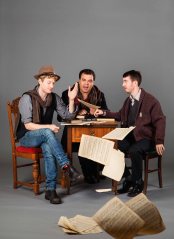
STENCILBOY_BRANDON-COFFEY-L-SOCHI-FRIED-C-RICHARD-CLARKIN-R-2

Brandon Coffey, Sochi Fried, Richard Clarkin of Stencilboy and Other Portraits

RQ: So it’s this kind of self-reflective “art about art”. What do you think is so important about this kind of theatre?

SF: With any piece of theatre, there’s a certain amount of reflecting of the world around us, and this playwright is writing about what she knows, which makes it vital and energetic. Also, the gender politics of the play are very exciting. It can be really controversial, whether it’s just another old story of a young woman trying to define herself through men. Hopefully that’s not what people take from it, but then again, the question is whether or not we need to see more stories like that. So I guess why it’s important for it to be done is that it raises a lot of questions and goes into some murky, complicated territory in an interesting way. I don’t think it’s perfect in any sense, which is wonderful. It’s gritty, and strange, and it requires something of an audience. That’s always good.

RQ: What do you hope people are thinking about or discussing on the way home?

SF: I hope that they’re discussing the journey of an artist into becoming. Also the rights of an artist, what kind of stories can they appropriate, and who says what you can paint. I hope that they’re discussing what it is that would drive this woman so much to want to be desired in that way and her eventual realization that she doesn’t need that.

Playwright Susanna Fournier

Playwright Susanna Fournier

RQ: Is that what’s so attractive to you about the character of Lily? This desire and this drive?

SF: Totally. She’s aggressive in her energy. She’s very funny. She’s adventurous, ballsy, she has a lot of moxie. She calls people out on their bullshit, but she also has a lot of her own emotional baggage that she’s trying to run away from and it keeps catching up with her. She doesn’t have the skills to deal with that but as the play progresses, the experience she has allows her to grow up.

RQ: Switching gears, for the new year, what are your hopes as an artist or for the artistic community? What would you like to see in Toronto.

SF: I’d like to see more plays by women. I really would. I’d love the independent scene to support more new Canadian work. I find it surprising and frustrating the number of older American plays that keep getting put on. As an artist, I’d love to do more film. I’m also still on the hunt, I think everyone is, for collaborative partners; more really interesting, strong directors, and writers, and actors.
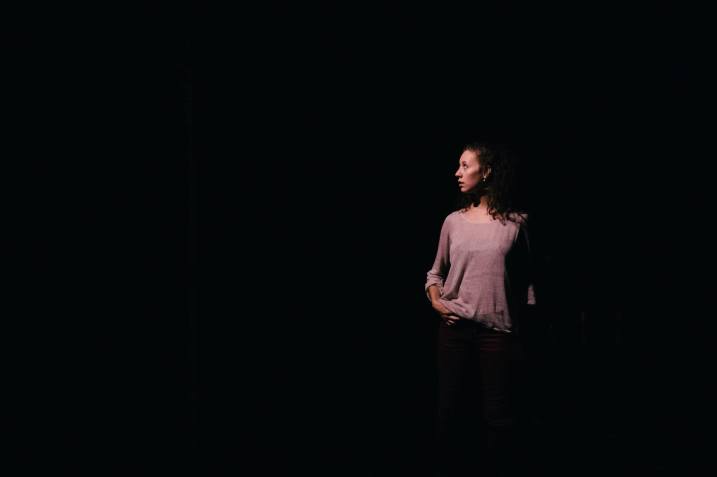
1492276_649486761781306_787164663_o

Sochi Fried as Lily in Stencilboy and Other Portraits

RQ: So this is going on at the Next Stage Theatre Festival. What do you think the importance of festivals are as opposed to singular mounts in this city?

SF: Well, there’s a lot of really interesting work that I’m excited to see at Next Stage this year. A whole array. But, more in general, I think the festivals have become platforms through which plays can be seen by members of the community that have clout or the wherewithal to give them a second life or a third life. So, I think that’s the great advantage. Also it’s in January, where there’s not a lot of work for theatre artists. And there are some strange time restraints to festivals in general which are not conducive to whatever the imagination wants to create, but the restraints can be interesting and force people to get their stories out there.

1526120_10152185697340746_1062068310_n

Stencilboy and Other Portraits

Written by Susanna Fournier
Directed by Jonathan Seinen
Presented by Paradigm Productions www.paradigmtheatre.com

Where: Factory Studio Theatre
When:
Thu Jan 16 7.45pm
Fri Jan 17 4.45pm
Sat Jan 18 9.15pm
Sun Jan 19 2:45pm
Tickets: 15$ http://fringetoronto.com/next-stage-festival/.

A Misfortune – Presented by Common Descent as part of the Next Stage Festival

Interview by Ryan Quinn

I had the good fortune to speak with Paige Lansky, associate producer of Common Descent’s production of A Misfortune, an original musical based on a story by Anton Chekhov.

Without revealing too much, the plot follows two people after going for a walk in the woods who have to reevaluate the nature of their relationship to each other. “This is about a pivotal time in the lives of these characters”. The show stars Trish Lindström, Jordan Till, Réjean Cournoyer, Kaylee Harwood, and Adam Brazier. It was written by the team of Scott Christian, Wade Bogert-O’Brien and Kevin Michael Shea, and directed by Evan Tsitsias.

“It has a really unique, beautiful musical voice,” Paige told me, ““It’s incredibly poignant and thoughtful. So much is exciting me about this show.” She told me that the strength of the voice in this show, and how confident it is in its characters and message has been nothing short of amazing to see in process.

1385143979

Paige Lansky – Associate Producer of Common Descent’s “A Misfortune”

Paige is a student of Drama Studies and Cinema Studies at University of Toronto, and it’s no exaggeration to say that she jumped into associate producing headfirst: “I sort of knew what it was about, but I had never done anything like this before. Producing is pretty much a 24-hour job, which maybe I didn’t realize.” Paige’s main job was to create and manage the KickStarter, which involved coordinating with a videographer, creating perks, and making very frequent changes to the page as new needs and ideas arose.

misfortune-final

WADE BOGERT O’BRIEN | Lyricist, SCOTT CHRISTIAN | Composer, KEVIN MICHAEL SHEA | Book & Lyrics

Though, after all the hard work, Paige is thankful for the Next Stage Festival for giving her this opportunity to work on a skill she had never put herself to before: “If it wasn’t for the Next Stage Festival, I would never have gotten this opportunity. These festivals are a great way to integrate young artists into the community. It’s fast-paced and accelerated, but when it’s over, you have this whole new toolbox of skills you can use. I think that in Toronto, it’s important to diversify your skills. I’ve never met anyone who just does one thing.”

A Misfortune

Presented by Common Descent
Where: Factory Studio Theatre
When: The 2014 Next Stage Theatre Festival schedule
can be found at www.fringetoronto.com/next-stage-festival.

The Tin Drum presented by UnSpun Theatre, December 5th-14th

Interview by: Ryan Quinn

Last week, I was fortunate enough to speak to director Chris Hanratty and actor Shira Leuchter, who also act as Artistic Director and Creative Director of the company, about UnSpun Theatre‘s incredibly exciting upcoming adaptation of The Tin Drum by Günter Grass.

The Tin Drum, says Hanratty, “is the story of Oskar Matzerath, who is retelling his life from a mental institution. In our adaptation, he’s trying to figure out if he should be there or not. Oskar wills himself to stop growing at age three, so he’s the eternal child, the eternal innocent.” It’s also known as one of the seminal works of magic realism, which lends itself beautifully to the stage. “There’s a lot more suspension of disbelief in theatre than in film,” Hanratty explains.

You may recognize the name, the 1979 film version is now considered a classic piece of German cinema. “The film was quite well received critically, it co-won the Palm D’Or with Apocalypse Now, it won the best Foreign Language Oscar, but some people really hated it because of the character of Oskar.” The controversy stemmed from the fact that Oskar, a mature adult in a child’s body, has romantic relationships in the course of the film. This led to some groups deeming it child pornography, and the film was banned in several places (of course only later to be reversed).

This project began six years ago, and has always been a passion project for Leuchter, who co-adapted the novel with Hanratty and performs in the piece. “When Shira came to me about The Tin Drum, I had heard a little bit about it just because it had been banned in Ontario. Shira came to the novel a long time before I did. She brought me to it.” Leuchter’s long been a fan, and has sought to turn it into an English-language theatrical piece for quite some time: “As I read it, there’s so much magic in the novel that I just kept seeing stage imagery in my mind. You know, the breaking of glass onstage, or trying to stage something where the main character is so small.”

This has been a huge learning experience for the couple, who have seen this piece change and take shape over the past six years. “We were lucky enough to get some time to work on the first third of the book in the Equity showcase, and neither of us had ever adapted something before,” Leuchter told me, and that first adaptation, though overly faithful to the text, became the seed of this project. “We needed to tell the story we want to tell. That meant adding things and changing things and it took us a long time to get comfortable with that, especially knowing that Günter Grass would be reading the piece.” “We wanted to make sure we got it right, for us too. It’s been six years and now we’re in rehearsals with two weeks to go. The essence is there, the characters are there, but I mean, it’s a 600-page novel cut down into a 90-page script. You have to cut something,” Hanratty added.

In the end, it’s the power of perseverance that’s made this project feel so satisfying for the pair, whose lives have changed a lot since the beginning of the process, as evidenced by the picture of their son that Hanratty proudly keeps pinned to his shirt. “For this project, it’s been incredibly important for us to just keep at it. We started this six years ago, and there have been peaks and valleys. It’s nice to let something breathe and grow,” Hanratty told me.

As to the contemporary importance of this piece, Leuchter replied, “I’m Jewish, and when I got out of theatre school, I did a lot of Holocaust pieces, and those are very important, but I’ve always been looking for other voices. We don’t often ask questions to people on the quote-unquote “wrong side” of history, but I think those stories are very important.”

It’s also about the act of viewing, Leuchter told me, and the culpability of the bystander: “This story explores how witnesses to history enabled it. Are we responsible, are we not? When we just observe what our culture is from the sidelines, how culpable are we? It’s really easy for me to extricate myself from the actions by my country. It’s easy to remove myself as an active participant in what my country does”. This is true more than ever with new technology, Hanratty believes: “The internet makes us witnesses to so many things, but do we have responsibilities as witnesses? Or is it okay to have just seen something?”

The Tin Drum

An original adaptation based on the novel by Günter Grass.
Adapted by Chris Hanratty & Shira Leuchter, presented by UnSpun Theatre

1457726_183091328563781_673522783_n

When: December 5th to the 14th

Where: AKI Studio at 585 Dundas Street East.

Tickets: Available by phone (1-800-204-0855), in person at the box office, or online, and group rates are available.

The Empty Room Collective’s “Journey’s End”

Interview by Ryan Quinn

I spoke to Jesse Nerenberg and Andrew Petker about The Empty Room Collective’s production of R.C. Sherriff’s Journey’s End. We sat in the living room of my apartment, sipping coffee as the sun shone warmly through the windows. It could not have been more antithetical to the topic of the show.

Journey’s End is a war drama, but there’s something skewed about it: “It’s not really about the action,” Jesse tells me, “it’s about what happens in between. It’s about a group of men that are waiting for orders at the bottom of a foxhole. Most of the violence happens offstage. This is about the mental toll that war takes on these men.” Petker sums it up by calling it “a kind of limbo where death hasn’t happened yet, but you know it’s on the horizon.” The action of the play happens in the officer’s dugout of the British infantry over four days in 1918. Sherriff himself was a serving captain in the war, and he sought to share his experiences with the show.

Petker plays Captain Stanhope, the highest ranking officer in the foxhole, a role originated by Sir Laurence Olivier. “He’s numbing himself and coping with the war in a way that’s really unhealthy.” Andrew explains, “He’s been down there for a long time, and he’s a different person than he was when he was deployed.”

Nerenberg plays Raleigh, a younger soldier who has always revered Stanhope. “In the town they’re from, Stanhope was the equivalent of the high school quarterback, you know, he was incredibly popular, and they still think of him that way back home. So, Raleigh goes to serve, and Stanhope has completely changed. The war has really taken something away from him.” It’s the shocking discrepancy between how the war is being portrayed at home and the reality that drives the show, they tell me.

“They say that in war, everybody loses a brother, and that’s so true. These people you’re stationed with, they really do become your brothers, and not all of you are going home. So when the higher-ups call a raid ‘successful’ because there was a minimum number of casualties, that’s still a loss. Someone still lost a brother.”

This is the first big production for The Empty Room Collective, and everyone on board is contributing in any way they can. Nerenberg, for example, has taken on the duties of producer. “You don’t realize how many jobs there are to do because it’s so easy to overlook the little ones. If you need to get a certain kind of pencils for the show, that’s a real job that someone has to do. If you need to get food to eat onstage, that’s a real job that someone has to do.”

Beyond the production itself, the team is also working on outreach efforts. Nerenberg explained why the proceeds of one performance of the show (November 10th) are going to the Poppy Appeal: “We wanted to give back in a way that wasn’t just symbolic, we wanted to contribute to something, and we’ve been working with the Royal Canadian Legion Branch 344: The Queen’s Own Rifles. In fact,” he says, “Andrew’s a member of the Legion now.”

“Yeah, you can find me down there quite a bit, volunteering. It’s amazing because it’s something I never would have thought to do before this show. It’s a completely new experience and I have Journey’s End to thank for it.”

I ask them what they hope people will be considering and talking about when they leave the show, and Petker answers that he hopes it snaps people into realizing that “war isn’t just this far-away conflict, it’s full of real people, and these are their real lives.” In much the same way that Raleigh comes to see the reality of Stanhope’s condition beyond how he’s being romanticized in his hometown, Petker really hopes we can look past the symbolism and see the humanity in those who have fought and will fight.

Nerenberg shares a similar thought: “I’ve been thinking about it a lot, and if I was born in, say, 1890, this would have been me and my friends; and I would have lost some of them to it. We are so incredibly fortunate to live in the time and place that we do.”

Journey’s End

by R. C. Sherriff, presented by The Empty Room Collective

When: November 7th-24th

Where: Artisan Factory, 116 Geary Ave. north of Bloorcourt Village.

Tickets: Can be bought at https://journeysend.eventbrite.ca/

JE-poster_LargeREDUX2

Bound to Create Theatre presents “Dirty Butterfly” as part of Obsidian Theatre’s 2013/14 Presentation Series

by Ryan Quinn

I sat down with director Jack Grinhaus and actor Lauren Brotman, Co-Artistic Directors of Bound To Create Theatre to discuss their upcoming production of Debbie Tucker Green’s Dirty Butterfly, being presented as part of Obsidian Theatre’s 2013-14 Presentation Series. We were also joined by their adorable ten-week-old Ethan, who the staff of the Artegelato cafe, where we were meeting, have been eagerly watching grow since he was born.

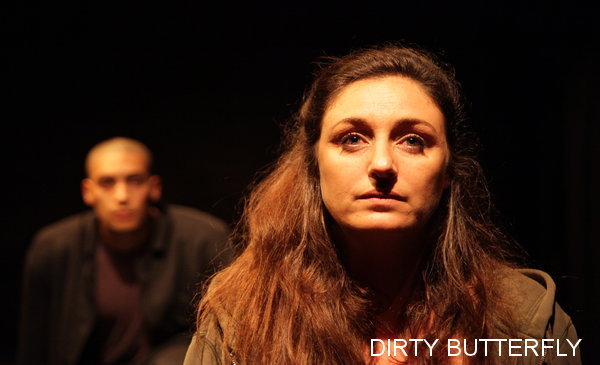
Dirty Butterfly is the story of an abused woman in a lower-class housing complex in Britain whose neighbours on either side have very different reactions to the sound of domestic violence coming through their walls. One neighbour actively avoids the entire situation, deluding herself into denying what’s happening, while the other becomes almost obsessed with it and completely drawn in. The show first ran at the 2012 Toronto Fringe, which, to Grinhaus, was a testing ground to see if the material could work as a full run. Of course, going from the Fringe Festival to being a part of a larger season at Obsidian has its own challenges, which have more to do with budget and promotion.

dbrotate

The pair first became interested in this show when they found themselves both working on different projects about domestic violence at the same time. “The statistics are frightening, on the rise, and damning,” they discuss. So, the pair went off in search of shows that deal with that topic, and Dirty Butterfly was so perfect for what they wanted to accomplish and explore, that they say they had no other choice. Bound to Create reached out to the White Ribbon campaign, and other local groups focused on this topic, and is happy to be working with them on this project.

Grinhaus and Brotman are incredibly excited to introduce Debbie Tucker Green’s work to the Canadian stage, as they see the power that British works can have on this side of the ocean: “There is a facility with language that even the lower classes have, that makes British theatre so different. Not only is the language fluid and precise, but Green writes in a cadence that the cast really has to tap into”. Grinhaus describes working on a scene where the character work was spot-on, then having to go back and speed up the pace to make the rhythm of the text work. “Trancelike is actually a really good word for it. The beat draws us into the action and really makes us feel complicit in what’s happening. The result is an audience that either identifies with one of the two neighbours, or falls somewhere in-between, on the spectrum of fear to obsession. What do we do on the other side of the wall?”

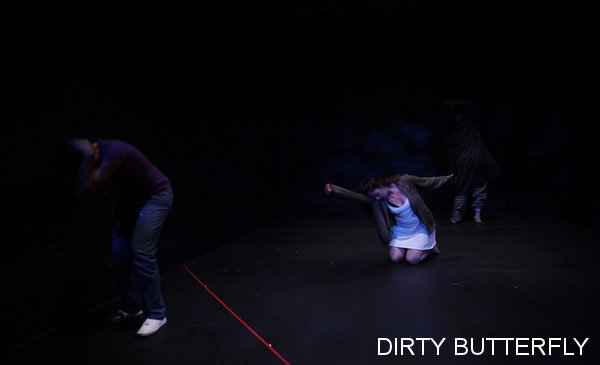
db4new

What makes this show leagues away from being a feel-good morality tale, though, is the complexity of the characters involved. “Green has made the main character, right from the top, do and say some things that are really…unlikeable,” Brotman tells me, “The audience probably won’t like this woman.” Also, there are no big acts of physical violence in this show, which separates Green from the fellow playwright to whom her work is most often compared, the late Sarah Kane. Brotman explains, “Jack’s done something smart where the little moments of violence in the play are closer to metaphors, leaving a play that strongly focuses more on the reactions and the repercussions of the violence.”

It’s also the smaller character moments that speak so much about the class culture in Britain and across the world. Grinhaus tells me about a small piece of text from a character who is a cleaner in a cafe, whose only dream is to someday be a barista. “It’s this tiny moment that happens too fast, but it really hits me”.

Luckily, the rehearsal space was one of the best she’s ever been in, Brotman explains. “It was very zen, you know. I was there with my husband, and my son was there in the room with me, it felt like a very safe place.”

When asked if he has any advice for young companies looking to produce important work, Grinhaus immediately replies “David Mamet is no longer relevant”. He explains that, sure, Mamet’s plays are full of angry conflicts, and that’s where young actors tend to be most comfortable at that stage of their lives, but his plays just are not the right kind of shows to be putting up right now.

His more direct advice, though, was that to be in the business, you have to be in the business. “When I was working at a restaurant in New York, I had to drop an audition because I couldn’t risk losing a shift. I never made that mistake again”. Grinhaus recommends working in any area of the theatre you can get into: “I got more acting jobs from being the guy sitting beside the director of another show in a different capacity than I did from auditioning”.

Bound to Create Theatre is also doing a cross-promotion with Paint Box Bistro for Dirty Butterfly. Paint Box is a restaurant and culinary school that teaches young people in Regent Park the skills they need to work in restaurants, or open their own. Their infrastructure supports establishing kitchens and allows use of the space to Regent Park start-ups. Paint Box is offering 10% off pre-show meals with proof of ticket purchase.

Dirty Butterfly

Dirty-Butterfly-web-618x337

by Debbie Tucker Green

Presented by Bound to Create Theatre as part of Obsidian Theatre’s 13/14 Presentation Series

When: October 30th to November 17th

Where: Aki Studio Theatre, 585 Dundas Street East.

Tickets: www.boundtocreate.com, or by calling 1-800-204-0855.