Skip to content

Posts tagged ‘theatre’

In Conversation with Severn Thompson, playwright and performer of ELLE, on stage now at TPM


by Bailey Green

When Severn Thompson read the novel Elle four years ago she had no idea that this story would capture her imagination for years to come. The Governor General’s Award-winning novel written by Douglas Glover is based on the true story of Marguerite de Roberval. Marguerite, along with her lover and nurse, were marooned by her uncle the Sieur de Roberval on the Isle of Demons in the Gulf of the St. Lawrence. Thompson spent the last three years adapting and workshopping Elle before bringing it to Theatre Passe Muraille. “It struck me as so refreshing to find a female voice from a time I had heard very little about, in the very early days of the explorers in the mid 1500’s,” says Thompson. “I felt very close to her [the character]. The story crossed 500 years very easily for me. It brought the past to the present.”

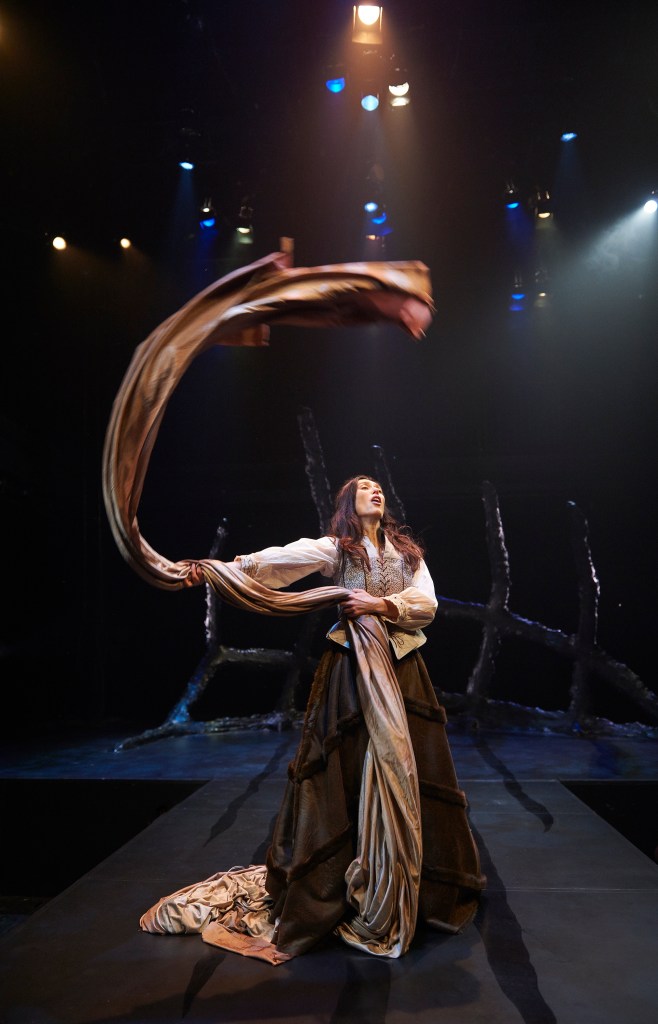
Severn Thompson in ELLE at TPM. Photo Credit: Michael Cooper

Severn Thompson in ELLE at TPM. Photo Credit: Michael Cooper

Adapting a 200 page book into a 24 page script is no easy feat, and Thompson had to set deadlines to make the hard choices. From the beginning, Thompson knew that she wanted simple props and set, and that the staging would be essential in creating the world of the play. “You want to still make it as rich an experience as you can,” Thompson says, “and assume that the audience coming in may not have the same background with the story that you have.”

As the project grew, so did the team involved. Thompson participated in the Banff Playwrights Colony where she worked with dramaturg and Program Director Brian Quirt and then Andy McKim, Artistic Director and dramaturg of Theatre Passe Muraille, who “has been guiding me through from an early stage. He [McKim] brings a lot of experience to the work, so that has been so useful” says Thompson. Two and a half years ago, director Christine Brubaker joined the project and became Thompson’s main partner in developing Elle. “We see things in a very similar way, so it’s been great to have eyes from the outside. She’s been really invaluable in pointing to aspects that need more and areas that need less. It’s been a great discovery, seeing how the audience relates to the play.”

Severn Thompson in ELLE at TPM. Photo Credit: Michael Cooper

Severn Thompson in ELLE at TPM. Photo Credit: Michael Cooper

Author Douglas Glover has connected with Thompson throughout the development process, but Thompson notes that he has been very supportive from a distance, recognizing the differences in form between a play and a novel. Glover has seen drafts throughout the process and a short workshop performance at the Lab Cab Festival, but TPM is his first experience of the fully realized production. When asked about the greatest joy Thompson has experienced working on Elle she says:

“To share this story. It’s one that gives a very strong female voice to a point in history where we have heard so little. And she’s not just strong, because bad things happen to her but she doesn’t play the victim and yet she isn’t the perfect hero either. She has faults and quirks and it’s wonderful and exciting to share this character that Douglas has created.”

Thompson also notes that Elle reminds us of the history of our land and how easy it is to forget about the ground we stand on. “Elle reminds us about the power of this land, and the complications that have evolved from colonialism,” Thompson says. “The nature of that history is still in play today, whether we are aware of it or not.”

Jonathan Fisher and Severn Thompson in ELLE at TPM. Photo Credit: Michael Cooper

Jonathan Fisher and Severn Thompson in ELLE at TPM. Photo Credit: Michael Cooper

ELLE

A Theatre Passe Muraille Production

Who:
Adapted by Severn Thompson from the Governor General’s Award-winning novel by Douglas Glover
Directed by Christine Brubaker
Starring Jonathan Fisher & Severn Thompson
Dramaturgy by Christine Brubaker & Andy McKim
Stage Manager: Laura Baxter
Production Design: Jennifer Goodman
Sound Design & Original Music: Lyon Smith
Movement: Viv Moore

What:
“Headstrong. What do you do with a headstrong girl? Maroon her on a deserted island lest she spread the contagion of discontent. Forget her.”

It’s 1542 at the time of France’s ill-fated third attempt to colonize Canada. The Sieur de Roberval abandons his unruly young niece, her lover, and her nurse on the Isle of Demons just off the coast of Labrador. With real bears, spirit bears, and perhaps hallucinated bears, Elle brilliantly reinvents the beginnings of this country’s national narrative.

Where: Theatre Passe Muraille Mainspace, 16 Ryerson Ave. Toronto

When: January 14-31, 2016, Tuesday-Saturday at 7:30pm & Saturday & Sunday at 2pm.

ASL-Interpreted Performances: Thursday January 21 at 7:30pm & Saturday January 30th at 2pm.
Relaxed Performance: Saturday January 23rd at 2pm.

Tickets: $17 Under 30, $20 Artsworker, $33 Seniors, $38 General Admission, Pay-What-You-Can Saturday & Sunday 2pm Matinees. Purchase here. 

Connect:
passemuraille.ca/elle/
@beyondwallsTPM
@severnthompson

#ElleTO

@_BaileyGreen
@intheGreenRoom_

In Conversation with Deanne Kearney – Creator of Urban Myth at the Next Stage Theatre Festival

By Bailey Green

Deanne “Dee” Kearney studied ballet and contemporary for years but had never felt completely at home. When she discovered hip hop everything changed. “Hip hop very quickly became my whole life, and identity, as soon as I found it,” Kearney remembers. “It changed everything, even the way I look at things. I write on urban dance and I produce. Hip hop is such a lifestyle, and it’s an amazing, supportive culture.” Kearney teaches dance and is part of the Toronto B-Girl Movement, dedicated to bringing more women to the forefront of a largely male-dominated style.

Kearney set out to create Urban Myth with the goal of bringing popular styles to new audiences, “I completely fell in love [with hip hop], I wanted to show the world how amazing it is.” She chose the styles featured in the show (breaking, krump, house, waacking, to name a few) based on the current, standout styles in Toronto.

Urban Myth is a show geared towards an audience who may not be familiar with this genre. Each style is announced before the dance. When asked about the biggest difference between a theatre show as opposed to a battle, Kearney says, “The audiences are much quieter! You can take pictures and tweet. The performers love to hear the audience yell and respond so it can be odd for them to adjust to the different setting.”

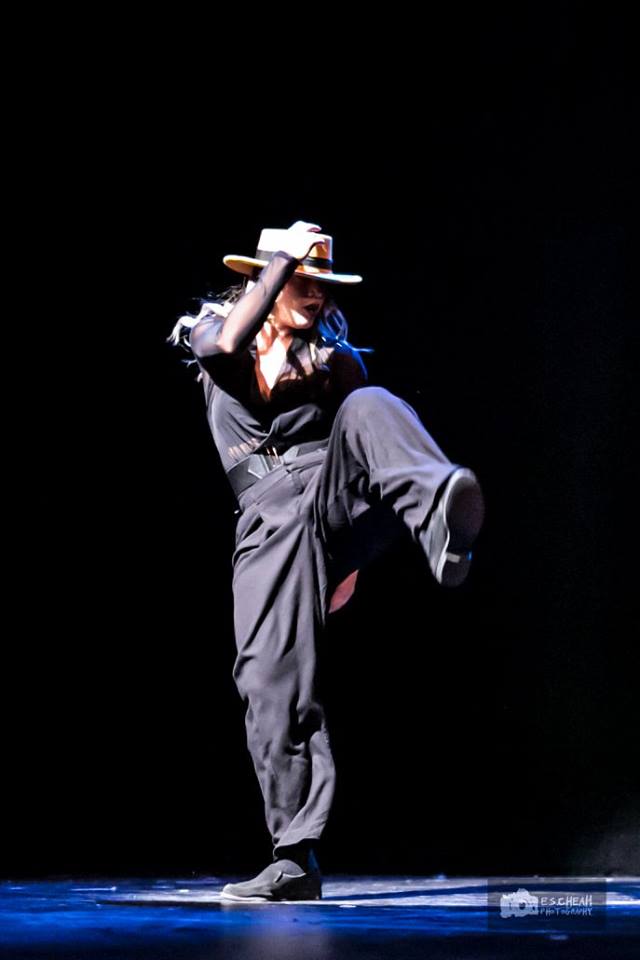
Photo Credit: E.S.Cheah Photography

Photo Credit: E.S.Cheah Photography

Kearney brought in choreographers “at the top of their game” in each style and gave them free rein to create. All she asked was that they each find ways to challenge themselves to choreograph pieces with a story. No themes were given, but as the pieces took shape a variety of stories emerged. One piece, performed by Raoul “Jin” Wilke and The Moon Runners crew, is an apocalyptic future based on the film “I am Legend.” Another dance is 12 minute long krump piece, choreographed by Amadeus “Primal” Marquez, about domestic abuse choreographed. The choreographers worked with their own dancers from their crews and came together to create the opening number of the show.

The challenges of this show came from the volume of people on stage. With about 30 people involved plus Kearney’s own people, it was no small feat to organize everyone involved. “The most rewarding is just seeing the pieces, the whole cast was watching the show just entirely in awe of each other,” Kearney says. “Many of these dancers don’t do theatre shows. They just battle.”

Photo Credit: E.S.Cheah Photography

Photo Credit: E.S.Cheah Photography

When asked about her inspirations, Kearney shouts out her friend and collaborator Anthony “Illz” Put. Illz is a b-boy who travels the world to battle. “He has amazing movement qualities and is so easy to work with,” Kearney says. “He just doesn’t know how good he is yet.”

Urban Myth is a hard-hitting, intricate and visceral show. If you catch it this weekend, be sure to make some noise.

Urban Myth

Presented by BreakinGround as part of the Next Stage Theatre Festival

12227809_430472613824754_5068180142720918499_n

Who:
Creator: Deanne Kearney
Choreographers: Amadeus “Primal” Marquez, Anthony “Illz” Put, Mariano “Glizzi” Abarca, Caroline “Lady C” Fraser, Caitlin “Caddy” Superville, Deanne “Dee” Kearney
Featuring: Dancers from Northbuck, Lions of Zion, Footnotes Dance, Ground Illusions, Twisted Ankles and The WaaquettesPresented by: BreakinGround

What:

Krump. Breaking. Popping. Locking. House. Waacking. Bringing raw urban dance from the street to the stage, created by Canada’s top urban dancers and choreographers.

Where: Factory Theatre Mainspace (125 Bathurst St)

When:
January 17 09:00 PM  buy tickets

Tickets: $15.00

Connect:

@breakingroundto
www.breakinground.ca


In Conversation with Holger Syme – Adaptor & Director of The Howland Company’s upcoming workshop production of “Casimir and Caroline”

Interview by Ryan Quinn

I got the chance to speak with Holger Syme, director of Casimir and Caroline at The Luella Massey Studio Theatre, presented as part of The Howland Company’s four-day workshop weekend. Syme translated the work and adapted it with the company, and this public workshop production will run from November 19th-22nd, with talkback sessions for audience feedback.

RQ: Tell me a bit about Casimir and Caroline, which you’re directing for The Howland Company.

HS: Ah, where to start… a German director said in the 1970s that “To summarize the plot of his plays is mostly fruitless,” and I think that’s right. Casimir and Caroline, as a “story,” is about a whole bunch of people at a party: some hit on each other, some break up with each other, one has a major health disaster, one ends up in jail. But within that kind of banal, kind of mundane scenario, Horváth examines an incredibly rich cluster of questions: what does love mean in a culture in which it’s increasingly difficult to distinguish commercial and emotional relationships? What happens to desire in a consumer culture? What do you do with feelings if you have no words to give them proper expression? And, really, most broadly, how can you live a life that’s in any way ethically justifiable in a world in which everything has become consumable?

RQ: You’ve translated and adapted this text from Ödön von Horváth, and you’re directing it as well. What draws you to this particular text?

HS: Well, first of all, how astonishingly contemporary it feels. I mean, what I just said the play is “about” applies a little bit more to our adaptation than to Horváth’s original, but really only a bit — all of those themes are in the 1932 text as well, although the kind of commodity culture Horváth experienced was of course quite different from ours. He was also writing on the eve of the Nazi’s first major election victory in Germany, and that’s obviously not our political climate. But the broader economic and social picture he’s drawing on — that’s very comparable, with the unspeakable divide between rich and poor, with the widespread condition of living on the brink of social deprivation, in an existence where losing your job can mean losing everything that you think of as “your life,” and so on. So that was the text’s primary appeal: that it seemed to speak so clearly, from the 1930s, to our own moment.

But I also find Horváth’s dramaturgy extremely interesting, and his dramatic language. His plays aren’t really structured as linear narratives — they are panoramic, and that’s a very appealing structure to me. It allows for a sharp focus on character and situation, both of which make, I think, for exciting challenges for actors and directors alike; the “story” is so simple and straightforward that it forces us (makers and audiences alike) to think about the issues that are being negotiated, and it really allows for a focus on the theatrical moment: what someone is doing right now, in front of you. How they’re moving their body, how they’re acting vis-a-vis another person, what they’re saying, how they’re occupying the space. It allows the audience to watch moment by moment without having to think too hard about what happened before and what’s going to happen next.

Screen Shot 2015-11-18 at 2.39.43 PM

RQ: How was the process of adapting this text different from translating it?

HS: That’s where the language bit from earlier becomes relevant: Horváth writes in a really, really odd German. His plays read a lot like Sean O’Casey re-scripted by Pinter, if you can imagine such a thing. They’re extremely idiomatic — some dialect bits, tons of clichés, lots of 1930s pop-culture quotations, literary allusions of a not especially sophisticated kind, etc. If you translate that straightforwardly, it’ll sound awfully stilted — and partly, that stiltedness is absolutely necessary. Very few of Horváth’s characters have access to an “authentic” language: especially when they’re trying to express their deepest feelings, they sound like a Hallmark card or a self-help book. So the big challenge is not making the text sound “natural,” but finding precisely the right kind of stiltedness.

I had a first stab at that in my original translation, and then we worked very intensively, with lots of improv exercises, on finding those lines. We also felt that the gender politics of Horváth’s play were the one aspect that needed updating — his broader political perspective felt current, but his women slipped too easily into victim roles. So we made a lot of changes there, including turning two pretty marginal part-time prostitutes into corporate employees with a good deal more dramatic life. And we transformed the two older wealthy establishment figures in the original into two young overprivileged guys working in the tech industry — partly because of the Howland Company’s mandate, but also because it allowed us to focus on economic privilege more sharply, without having to negotiate generational conflicts as well.

Strictly in terms of process, the difference was that between sitting alone at home, translating the text; and spending many hours in rehearsal rooms, recording totally free and more guided improvisations, and then turning those into scenes by picking and choosing lines (alone at home). What’s really important to me, though, is that while we “adapted” Horváth’s text in the sense that we found contemporary equivalents for his own historically situated language, we are very faithfully following the original play’s dramaturgical structure. His first stage direction says that the play is set “now,” and that’s been my guiding principle: you can’t be “true” to this play if you set it in 1932 and in Munich. It’s not a history play.

Screen Shot 2015-11-18 at 2.45.56 PM

RQ: You’ve done a lot of travel, and taken in theatre in many different cultural and historical contexts. How does that inform your process as a director?

HS: That’s an incredibly difficult question. Partly, this is a research project for me: I wanted to see what happens when you bring theatrical texts and practices from other cultures into contact with actors who are trained to work in the context of our own, Canadian assumptions about theatre. But of course I’m usually “just” an audience member outside of Canada — and what you see on stage relates only in a very complicated way to what happens in the rehearsal room!

It’s definitely true that because I see so much theatre elsewhere, especially in Germany, there are things I just don’t care about that others might consider very important. And there are things that I find totally crucial that others might find silly or negligible.

RQ: Do you find that you find yourself mixing elements of world theatre with Canadian theatre practices? What would you say any uniquely Canadian theatre practices are?

HS: OK, specifics? Er… “world theatre” doesn’t really exist, as far as I’m concerned. And what I find important keeps shifting as well. But here’s a few things: there’s a kind of spontaneity in German performance that I desperately want to see more of — the ability to move while speaking, to respond immediately to anything and anyone around you (in a way that’s going to be different, often radically different, from night to night), the freedom to mess with the text quite a bit, and so on. So I’ve been pushing hard for that. I’ve tried my best to reassure my cast that whatever they think might “make sense” probably does, in that moment — and that my role really is just to tell them if it doesn’t. The impulses should come from them, and they should be empowered to offer whatever they can think of. On the other hand, I also really care about stage images — spatial relations between bodies in particular. So some moments have to be very strictly blocked. There’s a tension between those two directorial impulses.

Uniquely Canadian? I’m not sure. Certainly a focus on story — though that’s a general Anglo theatre preoccupation. A general grounding of everything in psychology, rather than, say, politics. That’s for “straight” theatre such as this — there are other, very powerful “Canadian” theatre practices, in the fields of devised theatre or movement-based theatre, but that’s not really what we’re doing.

The big challenge for me, but also the really exhilarating aspect of the work, has been to put the show on stage in a way that allows the actors to play to their strengths without giving up on my own desire to keep the project focused on politics and dramatic situation. Things like allowing a moment to keep going past what the “story” might require, because it’s interesting, or entertaining, or compelling as a theatrical moment — that’s not something I see very often around here, and it’s something I really love in German theatre. But I think it’s pretty counterintuitive to Canadian actors; I suspect it feels a bit self-indulgent to be so uneconomical. But I don’t think it is. I think it’s exciting.
Screen Shot 2015-11-18 at 2.47.28 PM

RQ: What do you think is the importance of companies like The Howland Company? Is there an eventual reshaping of the Canadian theatre landscape happening?

HS: Companies like Howland are all about creating opportunities for young actors to put thrilling, fresh work on stage — and I thinks that’s crucial if we want our theatre to remain as anything other than a social occasion (or obligation) for well-to-do people above a certain age. If I’m honest, I wish companies like this didn’t need to exist as independent outfits: I wish our larger, established institutions would make more room for this kind of work, and for these kinds of actors. There’s nothing more exciting to me in the theatre than to see actors who are still growing on stage; though it’s even more thrilling to see such actors work with very experienced colleagues, and to see those older actors having to respond to someone who’s doing things in a very different way than they’re used to. But in our current system, that’s very rare, because the young people mostly make their own work and opportunities (and can’t pay well enough to attract many more established figures), whereas actors that survive in the theatre industry for long enough to become established mostly work in a different world. There are exceptions, of course (David Ferry comes to mind as someone who frequently crosses that divide, and Soulpepper has been exemplary at integrating young performers in major roles), but it’s a real problem, and a real limitation. I hope we can figure out a way of changing that.

RQ: What do you hope people are discussing on their way back home after seeing this show?

HS: How to live. How to love. Whether to have a donut, a popsicle, or a rotisserie chicken.

RQ: As we’re heading toward the new year, what changes would you like to see happen in the Toronto theatre community next year? What would you like to see continue?

HS: Ha! See above. I always say the same thing, boringly. I want to see fewer new plays and more classics done in a new way. I want us to stop seeking inspiration on Broadway — because, seriously, why? When has thrilling art ever been inspired by rank commercialism? If we need to look for inspiration in the English-speaking world, look to London (but not the West End). Look to the Almeida and the Young Vic, and occasionally the National Theatre. Continue? To let our actors take all the risks they want. (Or would that be a new thing?) Believe more in performers and less in storytellers.

RQ: You’re the the Associate Professor of English and Chair of the Department of English and Drama at the University of Toronto Mississauga; as well as being a Harvard Graduate. What is the relationship between the academic landscape of theatre and the performance community? Is there enough of a conversation?

HS: In short, no. But that really is a HUGE conversation topic! I’m worried about the anti-intellectual climate in many parts of the theatre world — not just here, but everywhere, really. I’m troubled by a certain kind of aloofness towards theatre people on the part of quite a few academics. I find it really unhelpful how many theatre people and academics think they know right from wrong, and think that the “others” don’t. On the other hand, I’m also always baffled by how similar some academics and some theatre makers are, in a bad way: take Shakespeare. With any given performance, you’ll have plenty of disappointed academics and theatre people who object to performance choices because they don’t reflect their own understanding of the play — but that’s not what they say. They’ll say those choices were bad, or ill-conceived, or stupid, or just “wrong.” There’s too little willingness to let a show speak for itself, to see it as simply an intriguing theatrical event that is valid and compelling in its own right, not because it “interprets” a text. And that’s true for many academics and for theatre makers and critics alike. In general, I think both academics and theatre people should take theatre itself more seriously. (And again, I could name many exceptions to all of this!)

RQ: Any parting thoughts?

HS: Brecht said that theatre had to be entertaining before it could be political. I think we’ve tried to be true to that in Casimir and Caroline — entertaining, exciting, moving, all of those things. But then, political. Or at least I hope so…

C&C

Casimir and Caroline

A workshop production

By Ödön von Horváth
Translated, Adapted, and Directed by Holger Syme
Presented by The Howland Company
Featuring: Alexander Crowther, Sophia Fabiilli, Ruth Goodwin, Courtney Ch’ng Lancaster, Cameron Laurie, Michael Man, Jesse Nerenberg, Hallie Seline, Mishka Thébaud, Kristen Zaza.
Lighting Design: Jareth Li
Sound Design: Samuel Sholdice
Stage Manager: Jordana Weiss
Producer: James Graham

When: Thursday Nov. 19 – Sunday Nov. 22 at 8pm

Where: Luella Massey Studio Theatre, 4 Glen Morris Street, Toronto
(One block North and one block East of the Spadina/Harbord intersection)

Events: Talkbalk sessions to follow each night. All are welcome.

Tickets: $15. Buy here.

Website: howlandcompanytheatre.com


Casimir and Caroline from The Howland Company on Vimeo.

*On Sunday, November 22, presented with Casimir and Caroline as part of The Howland Company’s four-day workshop weekend , at 2pm there will also be a reading of take rimbaud, a new performance text in development by Toronto playwright Susanna Fournier, workshopped by The Howland Company.

take rimbaud

Admission will be free for this reading.

“We are all terrifying creatures these days. The Restless ones. What do the Restless seek? Comfort? Or, oblivion”

By Susanna Fournier
Presented by The Howland Company
Time: Sunday November 22nd, 2015 at 2pm
Location: Luella Massey Studio Theatre, 4 Glen Morris Street, Toronto
(One block North and one block East of the Spadina/Harbord intersection)
Tickets: Free admission

Legends, Myths and Remounts: In Conversation with Sarah Thorpe – Writer, Co-Director & Solo actor of Soup Can Theatre’s “Heretic”

Interview by Madryn McCabe

I sat down with Sarah Thorpe, writer, co-director and solo actor of Heretic, to talk about legends, myths, and doing it all over again. 

Madryn McCabe: Tell me a bit about Heretic?

Sarah Thorpe: Heretic is essentially Joan of Arc in this afterlife space, looking back on her life and the decisions she made, and questioning whether it was worth it in the end. Should she have made the decisions that she did? I wanted to frame it in that way because, obviously, Joan was killed when she was nineteen because of what she did, so every account of her story is from someone else’s perspective, someone else’s opinion… so with some artistic license, it’s her side of the story – what she was feeling, thinking, going through… I wanted to present her in a way that takes down the saintly persona that surrounds her. She’s always depicted that way in plays and in literature, and I just thought that I wanted to explore her as a regular, vulnerable human being.

MM: What inspired Heretic? Where did the idea come from?

ST: It came from a monologue from Shaw’s Saint Joan that I had done for auditions before, and I found that it really hit an emotional note with me. I thought it would be interesting to explore this emotional connection further, and explore this person. I realized that I had all these questions… What was she thinking before her execution? What was she thinking when she stepped onto the battlefield for the first time? What was going through her mind? Was she terrified? Or thinking ‘No, I’ve got this!’

MM: How much research did you have to do into Joan’s life?

ST: A fair amount of research, but I’ve certainly taken a lot of artistic license as well. Not much of Joan is known before she joined the French army and started fighting in the 100 Years War.

MM: We seem to only know about Joan of Arc the Warrior, who heard voices from God, and only just the very brief period of time when she was fighting in the war.

ST: Right! So, we know about that, and we know that she was captured and executed. But, not a whole lot is known about her life before that. We do touch on that and how she was living this life on a farm with her parents and had a simple, medieval farming existence. The 100 Years War started in the 1330s, so she was born into a period of war going on around her, born into this environment where that was sort of what they were used to. It had gone on for so long. How I interpreted the aspect of her hearing voices was her wanting so much to say ‘No, we shouldn’t put up with this. This isn’t right. We’re being occupied, and it shouldn’t be an English king on the throne. We should do something about it.’

Photo of Sarah Thorpe by Justin Haigh

Photo of Sarah Thorpe by Justin Haigh

MM: Do you have a writing partner, or did you tackle this story on your own?

ST: I wrote it on my own. Justin Haigh did the dramaturgy on this remount. I re-wrote the script from the original version that we did in April.

MM: I was just about to ask, how much of an overhaul has this version gotten? Is there a lot of new stuff going on? What might bring people back who have already seen it?

ST: It’s not a huge overhaul. Some scenes were rewritten, some scenes were cut completely. In doing the remount, I thought that I could write some stuff better, and go into more depth of what I could interpret into what she was thinking and feeling and going through. So, for people who saw the April production and want to come back, I would say that there’s more emotional depth, and a bit more action. It also looks completely different. We have a whole new design team. The look of the show is totally different, yet still keeps with my vision. The way I always pictured it was people coming into a space resembling a medieval tomb. It’s kept with that same idea, but in a totally different way.

MM: Did you find that things changed much in the rehearsal room as well?

ST: Rehearsal was, again, a bit different. We have the same stage manager as last year, which is great. Directing-wise-Matt Bernard directed the April production, and this time around Scott Dermody and I are co-directing. Matt and Scott have different directing styles, so it’s been different rehearsing just because of the different approaches. I feel like I’m working harder this time around! It’s not that I wasn’t into it the first time around, and I don’t know how or why, but I feel extra committed now.

Photo of Sarah Thorpe by Justin Haigh

Photo of Sarah Thorpe by Justin Haigh

MM: Do you find that you can easily separate all your roles as writer, director, actor, or does each one influence what the other does?

ST: I’ve gotten better at knowing when to turn off the producer brain and turn on the actor brain, or the writer brain. Certainly when I was doing the rewrites, it was really just writer brain. I wasn’t thinking about anything else. But once we started rehearsals and looked at the script from an acting perspective, I’d sometimes think ‘Why the hell would I write something that way? What was I thinking?!’ I’ve gotten better at differentiating, and what helps me is making that bit of time to focus on the different things. I have to write a little schedule… so it’s 12-1 I’ll run lines, 1-2 I’ll do a bunch of social media and post things, then I’ll look at the design that’s just been sent, and look from that perspective. And luckily, I’m sharing the directing responsibilities. I wanted to have a hand in the directing this time, as well, to have a say in the design concept but Scott really is the eyes that are making sure I’m delivering a good performance.

MM: Do you prefer this avenue of creating your own show and having so much say in the producing versus the more traditional auditioning for another company and being directed in a specific part?

ST: As an actor, this is the first time I’ve done anything like this. I hadn’t written anything outside of theatre school. I have to say that it’s really satisfying to create my own work from the ground up. As an artist, overall I’ve really enjoyed that process. I do also enjoy the more traditional process, though. There are some scripts that I’d love to tackle as a director too.

MM: What do you want people to know coming into the show?

ST: What I find exciting and compelling is that we’re introducing people to a person who is always portrayed as higher than other humans. She’s a saint, she’s holy, she’s perfect, a saviour. I find her way more interesting when we see that she screwed up sometimes and made mistakes and bad decisions and maybe she shouldn’t have done some of what she did. I find her, and I hope everyone else does, compelling to see as a vulnerable, flawed being just trying to do what she feels is right.

Heretic

Presented by Soup Can Theatre

Photo of Sarah Thorpe by Justin Haigh

Photo of Sarah Thorpe by Justin Haigh

Written and Performed by Sarah Thorpe
Co-Directed by Sarah Thorpe & Scott Dermody
Scenography – Alyksandra Ackerman
Lighting Designer – Randy Lee
Sound Designer/Production Manager – Wesley McKenzie
Dramaturge – Justin Haigh
Stage Manager – Kathleen Hemsworth

When: November 11 – 22, 2015

Where: Theatre Passe Muraille Backspace, 16 Ryerson Ave.

Tickets: $15-22, online: soupcantheatre.com phone: 416-504-7529, in person: 16 Ryerson Ave.

Connect: 

Soup Can Theatre: @SoupCanTheatre

Sarah Thorpe: @thorpe_s

In the Greenroom: @intheGreenRoom_

Madryn McCabe: @FuriousMAD


In Conversation with Michael Ross Albert, Playwright of “For a Good Time, Call Kathy Blanchard” at the NSTF

Interview by Brittany Kay

Like a long distance pen pal, I had the pleasure of corresponding with the talented and compassionate playwright, Michael Ross Albert, whose show, For a Good Time, Call Kathy Blanchard, is playing at the Next Stage Theatre Festival. We spoke of hockey, where and what we call home, and our constant quest to find out where we belong. 

BK: Tell me a bit about yourself. Where you’re from? Your journey to where you are now? 

MRA: I’m from Toronto originally and I started writing plays when I was in high school. I was a participant in one of the first iterations of the Paprika Festival many many years ago. I also used to act, and did that a bunch in university, which hammered home the feeling that I really preferred to be on the other side of the footlights. I was accepted into an MFA Playwriting program at the Actors Studio Drama School in New York, so I moved to the city and started training alongside some wicked talented Method actors. I kept writing plays and putting them on. When I graduated, my friends and I co-founded Outside Inside and started producing under that banner in a bunch of different festivals. And then, my Visa expired and instead of hiring a lawyer, I moved back to Toronto and started re-discovering the city as an adult for the first time. Now, it’s a real joy to be able to produce a play of mine in this particular festival with a cast and creative team who I’m proud to call friends.

BK: What inspired this play? 

MRA: In the summer of 2012, I was very interested in the idea of home. I was in the process of moving back to Canada, but was putting on a show in New York at the same time. So, I was sleeping on people’s floors, either in my mom’s basement or my old roommate’s living room. I didn’t really know where I belonged; I was unclear as to where “home” was (which is something customs agent ask you a lot when you cross the border fairly regularly and don’t have a job).

One night, in Queens, I happened to run into an old friend of mine. We started nostalgically rehashing these minute details about our shared past, like the time this funny thing happened to so-and-so, this piece of graffiti that had stuck in both our minds. Those small but very clear memories had become almost like personal talismans against… something. Adulthood, maybe. There we were, so far removed from our youth, so completely unsure of what was going to happen next in our lives, so far away from this place we hardly even thought about anymore. And those small details were the ones that still, somehow, burned very brightly. As directionless as we were at the time, these very personal but, otherwise, forgettable memories were quite comforting. I thought it was sad, but I also thought it was pretty funny. And that’s how the play was born.

Also, after years of crafting “well-made plays” at school, I wanted to rip a kitchen sink out of the wall.

Geoffrey Pounsett & Daniel Pagett in For A Good Time, Call Kathy Blanchard

Geoffrey Pounsett & Daniel Pagett in For A Good Time, Call Kathy Blanchard

BK: Are there familial ties from your own life to this play? 

MRA: Not really, but there are shadows of myself in each of the characters, and aspects of my own family members and our dynamics that must have influenced the relationships in the play. But not in any glaringly autobiographical way. It’s fiction for sure.

BK: After watching the show, I assume you’re a huge hockey fan? How did hockey influence your life and this play? 

MRA: I like hockey a lot. I can’t help getting swept up in it, especially if the stakes are high, like during a playoff game. What Jim Warren’s production of this play does very well, I think, is that it sets up the characters themselves as the opposing teams in a hockey game. They’re members of a family pit against one another in this very fast-paced, high-stakes competition. But, unlike hockey, even in this combative family, there’s no clear winner. In fact, probably, everyone in this play is a bit of a loser. But that’s because they don’t want to be pitted against each other. In fact, they really really love one another.

BK: What’s your favourite team? 

MRA: The Leafs.

BK: Why do you think the NSTF is important for the Toronto arts community and Toronto as a whole?

MRA: The festival is curated and they program new works that appeal to various demographics. Their programming is diverse, which brings people who wouldn’t necessarily see theatre into that tent. Each show is completely different from the others. Tickets are inexpensive, so for the same price as a movie, audiences can see really high quality indie theatre, or dance, or comedy. And, the festival literally brings arts-minded people closer together, huddled in that very cozy beer tent. January can be a very depressing month in a cold city and, if nothing else, NSTF gives you an excuse to tear yourself away from Netflix vortexes and be part of a community.

BK: What is your favourite part about the NSTF tent? 

MRA: It’s not the beer. It’s meeting, getting to know, and commiserating with all of the other NSTF artists, whose excellent work I’ve gotten to experience in the festival. The beer is pretty good, too.

BK: What inspires your stories? Where does your inspiration come from when you write?

MRA: I think, first and foremost, I want to write characters that actors would like to play. I think that’s the constant. Apart from that, I have no idea where the inspiration comes from most of the time. Overheard dialogue on the street, stories I’ve been told, phrases, songs, memories. Anything that surprises me.

BK: Do you have a favourite place to write?

MRA: Anywhere private with a window.

BK: What do you want audiences to walk away with?

MRA: I hope they’re able to see themselves and their loved ones in these characters. And I hope they know that, even in those moments when life sucks, they’ve got worth and they mean something to someone else.

Rapid Fire Question Round:

Best show you saw in 2014: Jesus Hopped the ‘A’ Train at Unit 102

Favourite play: Either Three Sisters by Anton Chekhov or A Delicate Balance by Edward Albee

Favourite actor: Phillip Seymour Hoffman comes to mind

Major influence: Edward Allan Baker

Best advice you’ve ever gotten: From a writing standpoint: “Cut into the action as close to the conflict as possible.” From a producing standpoint: “If it’s not fun, it’s not worth doing in the first place.”

For a Good Time, Call Kathy Blanchard

by Michael Ross Albert, presented by Outside Inside as part of the Next Stage Theatre Festival

Entire-Cast

Game Four, Stanley Cup finals. Lawrence is having a breakdown. Sky’s been kicked out of his house. Amanda’s career is going nowhere. Mary won’t leave the living room until someone wins the Stanley Cup. And they’re all preparing for a devastating loss, both on the ice and at home. But, Lawrence has a plan to fix his family for good. A tragic comedy about heartbreak, hockey, and the places we used to call home.

Tickets – $15

Connect: Outside Inside @OutsideInsideCo

Where: Factory Theatre Mainspace (125 Bathurst St.)
Length: 75 mins

Playwright Michael Ross Albert
Director Jim Warren
Featuring Jennifer Dzialoszynski, Daniel Pagett, Geoffrey Pounsett, Caroline Toal

When:

Wed Jan 7 – 8:15pm
Fri Jan 9 – 10:00pm
Sat Jan 10 – 4:45pm
Sun Jan 11 – 4:30pm – followed by a Talkback at The Hoxton
Mon Jan 12 – 9:30pm
Thurs Jan 15 – 7:30pm
Fri Jan 16 – 7:00pm
Sat Jan 17 – 2:30pm
Sun Jan 18 – 6:15pm