Interview by: Hallie Seline

Soulpepper’s Alligator Pie in Rehearsal – Raquel Duffy, Mike Ross, Gregory Prest Photo credit – Nathan Kelly
Hallie Seline: Why Alligator Pie? Why Dennis Lee? How did this all come about?
Gregory Prest: Well, Soulpepper already had a working connection to Dennis through Mike Ross, another member of the Ensemble. Mike grew up writing a bunch of music to his adult poetry and children’s poetry. A few years ago he met Dennis through Soulpepper and put together a show called Civil Elegies, a one-man show that Mike wrote the music for. Dennis Lee is also a resident artist of the Young Centre so he’s around the building. It kind of seemed like an obvious choice. He was very gracious to give us the rights for us to do it.
HS: Beyond that, was there something specific about his work that made you, as the Ensemble, want to play with it?
Raquel Duffy: It was actually presented to the five of us, called the Creative Ensemble (Ins Choi, Raquel Duffy, Ken MacKenzie, Gregory Prest and Mike Ross) as a suggestion. They just sort of said, how about Alligator Pie as an option to create a show? We were left with all of his books and children’s poems and started workshopping it. So although it was kind of given to us as an idea instead of us generating that idea, we just sort of took off with it! It was so fun and easy creating work with it that it just seemed natural to us. It didn’t feel forced or difficult to generate material at all. It started to flow so organically.
GP: The material itself is just so fun. I mean ‘fun’ is such a stupid word but it’s true! What I love about it is, and maybe Dennis would disagree, but it doesn’t try to teach kids anything more than just sort of reveling in the present. From the feeling of playing in a puddle to being with your sister or moments that are just fun and exciting, it’s about word play and nothing else. It’s hard to say, I just really like it. Some of [the poems] are emotional, deep and quite complicated but they’re not trying ‘to teach’.
RD: Yeah, that’s the one thing about a lot of children’s material. They really push to try and teach a lesson, at least in North America. I don’t think that’s the same in Europe at all. But it’s nice and really refreshing to be given material that you can see going a million ways.
And we are not trying to, in any way, be kids or put on that kind of character, because the voice of the text is already so present. Dennis’ voice is very clear so we’re just trying to find our own way through his poetry.
GP: That’s the big challenge: Trying to create a show for families from people five years old to the grandparents that will take them, trying to find what it is that we want to do with it and not aim too low while trying to bridge that gap. We’re not trying to create very general children’s theatre, but at the same time we want to make something accessible. It’s really trial and error. We’ll see when we get our first audience of kids.
HS: Describe a bit of your creative process and the role of ‘play’. I saw your rehearsal photos with the big glasses, the props, etc. It just looks like fun and the element of ‘play’ seems so present. Can you discuss that a bit?
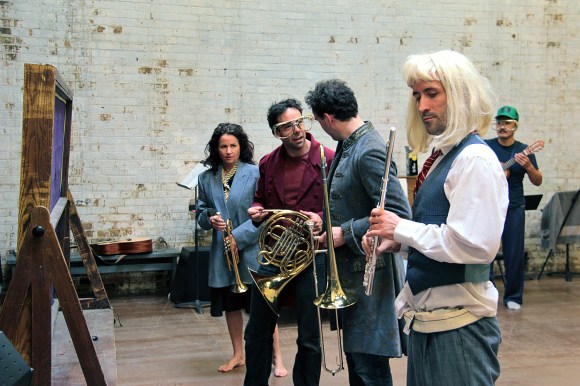
Soulpepper’s Alligator Pie in Rehearsal – Raquel Duffy, Mike Ross, Gregory Prest, Ken Mackenzie and Ins Choi. Photo Credit – Nathan Kelly
RD: One of our first days in rehearsals we went to the Dollar Store, we all went our different ways and came back with these bags of, essentially crap. These became our main tools that we used. We’d start the day just by playing and run games that we would initiate ourselves.
GP: We dressed up too! It sounds ridiculous but Ken, who is a designer in the Ensemble as well, managed to put together this rack of clothes equipped with wigs and shoes and hats. So really, we just sort of played!
RD: In a lot of ways there’s no structure to it, but there is structure in the sense that someone in the group, usually guided by a poem or a song, will initiate an idea and the rest of us will play along.
GP: We’d call it ‘the kernel’. We’d bring in a kernel and say, “This is the poem, this is the kind of melody that I wrote” and people would just sort of jump on it. So initially it starts from the poem, then it gets developed through the connection to the individual, then the group plays with it, which was more exciting than five people trying to figure out what to do all at once. It gave each of the individuals of the Ensemble the space to be able to find pieces that they personally connected with amongst Dennis’ large amount of work.
RD: We would always use the phrase “follow your bliss” when going through the material to find a poem that you really connected with and have a vision for. This is so nerdy, but we’d say that we have ‘a kernel’ and once it breaks out and we’d develop it into something, we’d say “Oh the kernel popped!”
HS: What was Dennis Lee’s involvement in the collective?
GP: When we first started, we sat around with him in the room and read all of his work for children, all taking turns to read. Just hearing him read his own work was so valuable. He takes away the sort of reverence for the author that there is with theatre where often the author has long since passed. He’s more like ‘Do what you want to do. If it doesn’t work, make up a new verse.’ He’s very encouraging. We showed him two mini presentations and then he gave us notes, asking us to question certain things a little further or consider other variations. He’s been really hands-on, really supportive and has given us a lot of room, as well!
RD: Exactly. He makes suggestions but by no means is he asking us to implement them. Obviously he knows his own work really well and he’s seen a lot of different productions using his pieces so he has a lot of experience knowing what might work and what doesn’t.
HS: What stood out the most while working with his poetry as the core creative text as opposed to something from a classical repertoire like a Molière or Shakespeare?
RD: That’s a good question. I can’t separate it from us working together as a group. This is the first time it has been the five of us working specifically together in a room, though we’ve all worked together in some fashion before on different projects. I’ll just speak for myself with this one in that being able to come into a room with such an amazing group of people, being given text that holds such room for play, because it’s poetry and because Dennis has encouraged us to approach it with as much freedom as we’d like, I can’t wait to come into the room and work every day. I never feel that there is someone saying, “No, that won’t work”. Ideas are always approached with so much give. I just find it hard to comment on the experience of the creative process without connecting it to the people in the room who I’m working with. It’s been such a pleasure.
HS: A true collective.
RD: Yes! Exactly.
GP: What’s challenging and interesting about working with the poems as text is that it’s not a Molière, Shakespeare, or Eugene O’Neill, and it really is a challenge trying to connect with it as an actor and as an adult, being who we are in our lives right now. I’m also the only one out of the five who doesn’t have children all under the age of three, so that adds another aspect of your creative approach. The question is how do you keep honest about the material as an adult so you ensure that you’re not doing that bad kind of children’s theatre acting? The challenge is to stay who you are and yet be open to that child-like mentality. As an actor, it’s really interesting to make a puddle, for example, the most important thing in your world, but to not dumb it down and be an idiot. It’s really challenging to keep everything you’ve got but then reach way, way back to find that honest outlook.
HS: You had mentioned before that you are hoping to reach anyone from children from the age of five to their grandparents with this show. With such a broad target audience, how have you been working to bridge that interest gap?
GP: Well, trusting your instincts is a big thing. We perform for each other so if it’s interesting and funny for us then hopefully that will translate. It’s really tricky, to be honest. The target audience is families, which is a little generic. I was a member of the Dora jury for TYA and I saw a lot of kids’ shows. Some were amazing and some were just awful. Having one of those painful experiences sitting in the audience and seeing parents who had brought their children and were so bored was just awful. You hope to not put your own audience in that kind of position.
RD: This may not be the best analogy but my son watches a lot of Sesame Street right now and when Alicia Keys comes on and sings a song with Elmo, well my son is really into music and loves watching Elmo, but as an adult, I like sitting and listening to Alicia Keys sing and play the piano. In these skits the adults might say things that the kids are getting on a totally different level, I wouldn’t say simpler level, but I’d just say that sometimes there’s a larger, more mature joke going on that isn’t cleverer necessarily, but includes everyone. Again, as you can see, our main goal is that we don’t want to ‘dumb down’ for the kids. Both my son and I can sit, watch and enjoy everything being done because it’s creative and smart. That’s the goal.
GP: We’ve been working with actual games on stage, as well. It adds an element of ‘event’. We are actually playing a game of badminton in front of you and we are really going to try and win while we do it or we’ll do poems with a metronome and see how fast we can go. If you screw up you have to start again. There is a ‘liveness’ to it that will hopefully keep the audience engaged.
HS: With past productions like (re)Birth: E.E. Cummings in Song/Window on Toronto, Dirt and this production, there seems to be a growing presence of Collective work in the Soulpepper season. Is this a new initiative of Soulpepper and something that the company is trying to explore?
RD: Yes. I think it’s something that Albert has a lot of interest in. That and I think there is a growing interest for bringing in new works, like with Kim’s Convenience. It’s an area he really wants to explore, which is why I think he put together this Creative Ensemble.
GP: He was very frank and open in saying to us that this is an area the company would like to go in. With the experience and resources of the founding members, they weren’t really sure how to do it. This is part of the reason he has us here, to teach them how to expand. The goal would be to get projects going and then begin to get the founding members of the company involved so we are all creating work together.
HS: Have you started incorporating the founding members?
RD: We’re all really busy right now but we’ve started to do some nights where someone from the company brings in a piece of work and we help explore it. It may not go anywhere, but it’s just to open people up to different ways of looking at material and creating. For example, Nancy Palk brought in a Dickens’ piece for the Word Festival in December that she’s adapting. She brought it into the room and we spent a night with her and some other company members that had experience with collective work maybe twenty years ago that wanted to get their mind back into it. We’d love to have more nights like that.
GP: Definitely.
HS: So what can your audience expect from Alligator Pie when they come to see the show?
GP: Well the poetry is amazing. To hear Dennis Lee’s poetry is fantastic on its own. My hope is that it’ll be really fun! We have really great music so I’m hoping they will have an enjoyable time all around.
RD: I’m really proud of where we are right now. I mean we don’t have a completely finished show right now, but just what we’ve been doing with the music and the pieces we’re developing, it’s all very exciting. I think people will have a really fun time and leave feeling energized and excited.
GP: Lastly, I hope we leave our audience members inspired. Part of the design element for the show, by using odds and ends from the Dollar Store, was that we wanted to create this theatrical magic out of everyday objects. We wanted to make it accessible, creating using everyday materials, so that a kid in the audience could think, “That’s just a sheet and a garbage can. I can do that myself, at home!”

Alligator Pie – Credit: Brian Rea




 inthegreenroom