Skip to content

Posts tagged ‘toronto fringe festival’

2014 Fringe Preview – 52 PICK-UP with The Howland Company

Interview by Bailey Green

I interviewed Paolo Santalucia, James Graham and Ruth Goodwin about The Howland Company’s inaugural show for the Toronto Fringe, 52 PICK-UP written by TJ Dawe and Rita Bozi. The show tells the story of a relationship, from coming together to falling apart. The Howland Company chose to have a rotating cast of four different couples (two male/female couples, one male/male and one female/female) who each perform two shows over the run.

Bailey: Tell me about the show in simplest terms, what is it about? What’s unique about it?

James: Well it’s about the whole duration of a relationship from beginning to end. The story is told in 52 scenes, some are three pages and some are ten seconds long. Each scene is written on a playing card. At the beginning of every show the actors throw the cards up into the air and then they play out the show in the order that they pick up the cards. If it was a standard production of this show, with two actors for the whole run, each show would still be unique because scenes would be highlighted in a different way with each different order. But The Howland Company is doing something a little different with this piece.

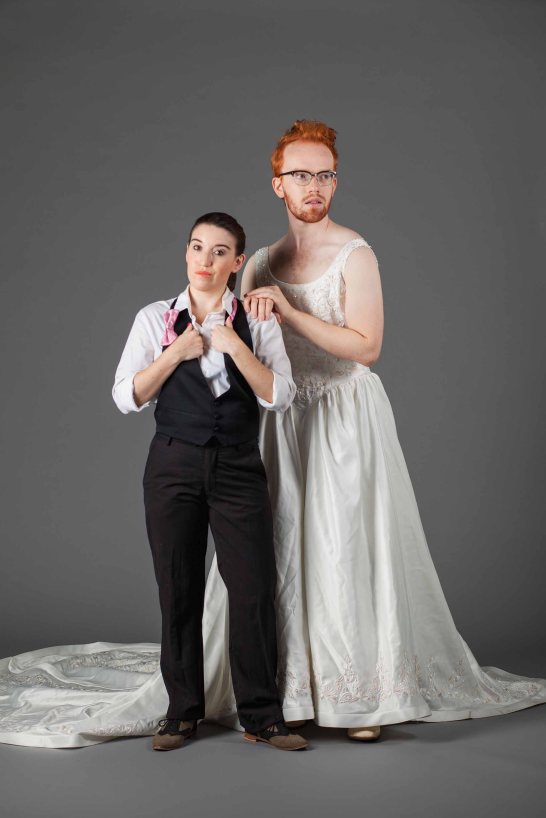
Courtney Ch'ng Lancaster & Ruth Goodwin

52 PICK-UP: Courtney Ch’ng Lancaster & Ruth Goodwin

Ruth: 52 PICK-UP is about falling in and out of love. The structure of it is unique (being in a different order every night) but the play stands out because of how relatable it is. Each scene is written like a conversation that any of us could have had with a significant other. TJ Dawe and Rita Bozi have really touched on the universal moments (good and bad) that many couples face. And for that reason, its random order makes so much sense. It’s almost like playing back your memories of a relationship. They come to you in moments or flashes – sometimes when you least expect them to and that’s kind of how 52 PICK-UP works.

Paolo: For co-director Courtney [Ch’ng Lancaster] and I, part of what we wanted to do with this piece is heighten the super-changeable aspect of each relationship. Each night would already be so different and so we thought why not push that further in a theatrical way? Each relationship in and of itself is different, so we thought let’s embrace that and cast multiple groups of people to highlight some different kinds of relationships. The scenes range from the first meeting to the first fight to the first time sleeping together. So what does that mean when it’s two men who just slept together for the first time, what does it mean when you’re actually watching a couple in real life act out a version of their relationship onstage together and what do these scenes mean for two women? It takes the play out of a context of “this is how men and women are in relationships.” It removes that aspect from the production and doesn’t allow the audience to make universal assumptions of how men and women behave. The play itself doesn’t actually go there, it remains open-ended while highlighting the reasons why people come together and fall apart. TJ and Rita, the playwrights of 52 PICK-UP, actually said that no one has done this to the play before and they were excited about that exploration.

Bailey: What has the experience of the rehearsal been like?

James: Well I just get to parachute in and have a blast every week or so and just try to keep my head above water. I think Paolo can speak more to that.

Paolo: It’s been really exciting and very scary for lots of reasons. Each person brings to the table their own set of experiences and absolute truths about relationships. Everyone in the company has a relationship to relationships. [For example] some people are talking about financing a home for the first time, or people are in the midst of moving in together or people are coming out of a relationship or beginning a new one. There’s a variety of experiences that people can speak to with this play.

Ruth: The process has been scary. Scary. And also… scary! There’s a lot to cover…and no order. It’s also been a lot of self-reflection on relationships in general. It’s kind of hard not to put yourself in your character’s shoes. We jump around in the story so much. Some scenes are so short that you really have to define what each moment means to you. Luckily we have really supportive directors who are patient with us.

Ruth Goodwin & Alex Crowther

52 PICK-UP: Ruth Goodwin & Alex Crowther

James: One of the great things about this project is that the actors can all jump into these scenes and this world very easily. We can identify very clearly with this subject matter. On some level that is one of the reasons the Howland Company was formed, for a group of young actors to find plays and projects that spoke to experiences that as artists in our mid-to-late twenties we can step in and offer something (without always having to tear our hair out.)

Paolo: Yet at the same time it is incredibly challenging. The only thing Courtney and I can attribute it to is studying for an exam. On the day you know there’s a task you’re going to have to complete and the variables on that task are going to be something you can prep for. You’re going to know what the questions might be about just as you’re going to know what the scenes are. But the way they’re presented to you and what your emotional response will be in the moment? There’s no way to prep for that. All we can do is help the actors and in turn help ourselves.

Some scenes have one line in them and they’re only spoken by one character. But that doesn’t mean the inner life for the other character is any less intense. For example there’s one scene where the woman calls the man, he picks up the phone and she hangs up. With each couple we’ve explored what that scene means at different moments in the show. We spent a lot of time on text work. Each couple created a timeline for themselves so they had a linear progression of this play for themselves. Each group is different, some scenes that people have at the beginning of the relationships others have at the end. What James and I have as our storyline, and what it’s based on for two men, is completely different than what for example Ruth and Alex are finding as a man and a woman coming together. A man and a woman have had many relationships of this kind and this is just one along the way that really sticks out for them whereas for us [James and I], and with Courtney and Kristen, we’re exploring that it’s the first time for one of the lovers that they have been in a same sex partnership. The text lends itself to that. Rehearsal has been really like four different plays.

James: It makes the run an experience. One of the things we discussed is how are people going to review this play, because of the way that it is structured? It didn’t bother us because one of the challenges is that we’re offering a whole experience, as opposed to each individual show or couple being self-contained. The experience of the whole seven shows is the experience of 52 PICK-UP. Whether you see one, two or all four couples if you’re a Fringe all-star, you will get your own experience of the show. That’s where our focus is and we hope, for those that do come more than once, to hear about their experiences!

1972477_486955604739103_9098784248676815771_n

Full cast of 52 PICK-UP featured in their YouTube campaign. Click here to watch.

Bailey: Tell me about The Howland Company, how you came together and for what purpose?

Ruth: James and I met in high school doing awkward tween theatre. When we both moved back to the city after school we decided to start something that we both wanted to be a part of. That’s how The Howland Company’s Reading Group got started. Then James brought Paolo in—who he met doing slightly more sophisticated tween theatre—and we each approached actors in the city that we wanted to work with to invite them to join us.

James: We began to recruit people and each of us went off and looked for people of a similar mind, people who wanted a chance to work, work together, a chance to make theatre about our generation, which spoke to us more, and hopefully contribute to a new generation of Canadian stories. And what does that mean? Not that we’ve figured it out, by any means, but to join the conversation. Most of all we wanted people who were willing to be patient. We wanted to create something with long-term aspirations. The idea was that we would take our time to build an ensemble and establish a relationship with the community. We wanted to start a dialogue between the next generation of theatre companies and hosting the play reading series every two weeks was part of that. We had no idea what we were going to do for our first show and then this show just fell into our laps. That patience has really paid off.

Paolo: How do we as a group of young actors take these artistic tools and keep working without always saying what’s the next production? What’s the next thing? It’s not about the production, it’s about how do you contribute to the community and use your artistic voice to further the conversation. 52 PICK-UP is absolutely about hopes and fears for the future.

James: What happens from here remains to be seen. On the simplest level, we’re a group of young actors who wanted to make work together, to find a community where we could practice our craft, take risks and contribute our voice.

52 PICK-UP

Presented by The Howland Company as part of The Toronto Fringe

IMG_4490

52 PICK-UP: Cameron Laurie & Hallie Seline

Directed by Courtney Ch’ng Lancaster & Paolo Santalucia

Where? Tarragon Extra Space

When? July 3rd-13th, 2014

Tickets: Can be purchased via http://fringetix.ca/ or by calling 416-966-1062


Follow The Howland Company:

Twitter:
#52PickUpHC @TheHowlandCo
Facebook:TheHowlandCompanyTheatre
Website: http://howlandcompanytheatre.com/
Youtube: The Howland Company


Follow In the Greenroom writer Bailey Green:

@_BaileyGreen


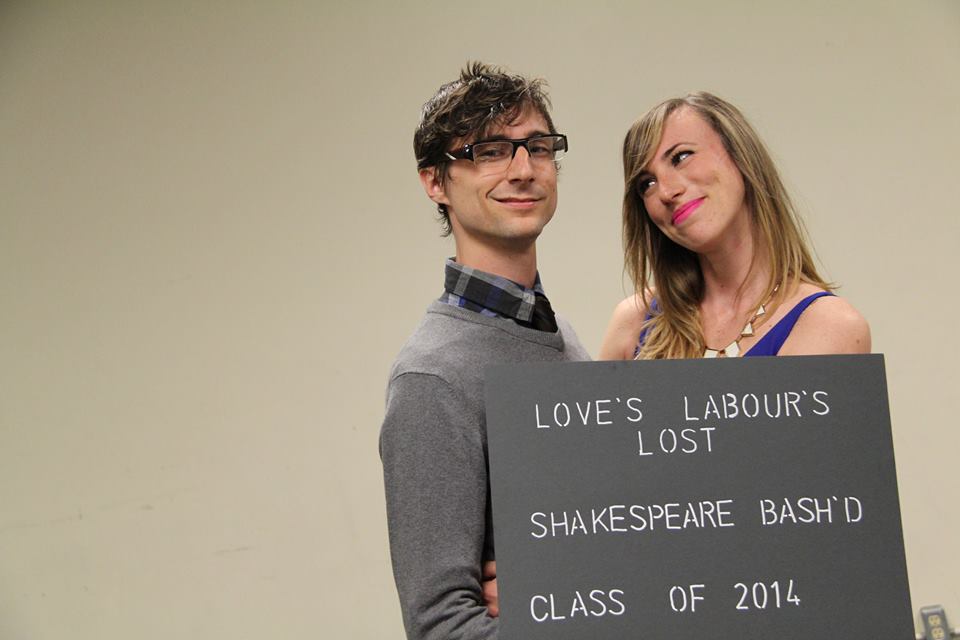
2014 Fringe Preview – Love’s Labour’s Lost – Shakespeare BASH’d

Interview by Bailey Green

As I entered the rehearsal hall for Love’s Labour’s Lost (presented by Shakespeare BASH’d) I was struck by the amount of people in the room. With no role double cast, the cast of 16 generated such an exuberant atmosphere that I couldn’t believe they had just finished a run. Their attitude as an ensemble reflected the youthful energy of the play.

In Love’s Labour’s Lost, the King of Navarre and his three men swear an oath to remain celibate so that they can focus on academic pursuits. Unfortunately the day after the men swear this oath, the Princess of France and her three ladies—a group of fierce, grounded, intelligent women—arrive on a political mission. Passion, poetry and chaos ensue. I sat down with the four—that’s right, four—pairs of lovers to chat about their character’s relationships, their own quirks and the upcoming Fringe production.

Love's Labour's Lost - Hallie Seline & Jesse Nerenburg - Photo Credit: Jesse Griffiths & Kyle Purcell

Love’s Labour’s Lost – Hallie Seline & Jesse Nerenberg – Photo Credit: Jesse Griffiths & Kyle Purcell

Princess of France (Hallie Seline) and the King of Navarre (Jesse Nerenberg)

Hallie’s Pet Peeve: Slow walkers.
Jesse’s Fave Rehearsal Snack: The vietnamese steamed buns from Banh Mi Boyz
Post-Show Drink of Choice: “Wine wine wine” (Hallie), Hawaiian Pale Ale (Jesse).
Describe your characters’ relationship:
Hallie: We’re both people in power. We like to outwit each other, top each other. We don’t want to admit that we’re into each other but we are. We totally are.
Jesse: We’re both the leaders of our kingdoms so that definitely plays a part. But why I’m attracted to her is because she’s not afraid to push back. I don’t see her for many pages after the first meeting, but when I do, I am really in love with her. I’ve written all of these poems about her. Once you’re in, you’re in.

Love's Labour's Lost - Suzette McCanny and Jeff Hanson - Photo Credit: Jesse Griffiths & Kyle Purcell

Love’s Labour’s Lost – Suzette McCanny and Jeff Hanson – Photo Credit: Jesse Griffiths & Kyle Purcell

Rosaline (Suzette McCanny) and Berowne (Jeff Hanson)

Suzette’s Pet Peeve: Bus windshield wipers.
Jeff’s Favourite Rehearsal Snack: Chocolate chip cookies.
Post show drink of choice: Apricot beer (Suzette), “Any drink anyone will buy for me” (Jeff)
Describe your character’s relationship:
Suzette: They have such a love/hate relationship, as in they love to get the best of one another. Rosaline would like to pretend she doesn’t love him or that she’s better than that. But she’s very intrigued by his wit. She thinks he’s smart and he can hold his own next to her. She also sees his cons and can be open about that. She can be herself with him.
Jeff: They had met before at the same party [as Longaville and Maria] and for Berowne he doubts the oath the men all swear to right from the beginning. He doesn’t really think it is going to work. Berowne’s always had control over his emotions and has never fallen madly in love. When they first meet, what Rosaline says to him, how she uses her wit and beats him at his own game, it really intrigues him. He doesn’t really get it, being in love, he’s taken aback. He almost goes through the seven stages of grief, but more like the seven stages of love. He doesn’t understand why but he does truly love her.

Love's Labour's Lost - Catherine Rainville & Joshua Browne - Photo Credit: Jesse Griffiths & Kyle Purcell

Love’s Labour’s Lost – Catherine Rainville & Joshua Browne – Photo Credit: Jesse Griffiths & Kyle Purcell

Katherine (Catherine Rainville) and Dumaine (Joshua Browne)

Catherine’s Pet Peeve: People chatting in the background while she’s rehearsing a scene
Josh’s Rehearsal Snack: Cigarettes. If he could eat ’em, he would.
Post show drink of choice: A glass of Scotch (both).
Describe your character’s relationship:
Catherine: It’s so instantaneous for everyone, but Dumaine and Katherine have moments of looking at each other and trying to figure each other out. It’s really playful. I get to be aggressive which is fun. We all tease the boys, which for Katherine is her way of playing hard to get. But she’s so obvious when she’s around him.
Joshua: We don’t have a lot of text together, or any really. But we have built this aspect of Katherine being the aggressor. I catch her checking me out at the beginning and I’m a bit more timid. I’m sort of shocked she likes me. Similarly [to the Princess and the King] we have many pages where we don’t see each other at all yet I’m madly in love and have written horrible poetry about her. She’s also pretty sassy. I like that.

10403653_847988535228940_2276093921829860528_n-1

Love’s Labour’s Lost – Andrew Gaboury & Sheelagh Darling – Photo Credit: Jesse Griffiths & Kyle Purcell

Maria (Sheelagh Darling) and Longaville (Andrew Gaboury)

Sheelagh’s Pet Peeve: People who stand really close to you for no reason. Also, toe shoes.
Andrew’s Favourite Rehearsal Snack: Nuts, specifically almonds.
Post show drink of choice: Oatmeal Stout (Andrew), St. Ambroise Apricot Beer (Sheelagh)
Describe your character’s relationship:
Sheelagh: We really like each other right from the beginning. There’s no qualms, we know we’re going to get together. I play along with the Princess but whenever Longaville’s around I’m just making googly eyes and waving. Even when the rest of the girls are berating and chiding the boys, I’m just still waving at Longaville.
Andrew: We kind of met before, it seems we were at the same party. I’m the most serious in terms of the oath the men swear [to stay away from women]. And then I see Maria and I throw it all away. It’s funny watching how I try to logically get around the oath in my poetry.

This slideshow requires JavaScript.

Bailey: What makes this production stand out? What will an audience member experience coming to see your show at the Fringe?

Jesse (King): Love’s Labour’s Lost is a very youthful play, it’s one of Shakespeare’s earlier work and it has a rhyming structure which is really unique. The women hold their own. And it’s not a play that is done very often. People are going to be coming out to see a show where they can have a beer and experience a classic that they may have never seen on stage before.

Josh (Dumaine): It’s zany. The men are writing really bad poetry and dressing up as “Russians”. The show is going to be fast, snappy, fun and silly, but it also has vulnerable moments. It’s really relatable.

Hallie (Princess): James [Wallis], our director, said at the beginning that the best way into this story is through yourself. These characters come alive through the energy of the people doing them. And in this cast you have a bunch of really interesting, funny, weird and smart people who come out through the words of these characters. That’s what makes it fun. I hope that will stand out to our audiences.

Suzette (Rosaline): The characters play the whole time! Let’s play this game, let’s play that game. Whenever I see a BASH’d show I feel like I’m part of the team as an audience member, that I’m part of how the story unfolds. Each time we run the show there’s new surprises. And it’s so refreshing to be in a play where my character doesn’t have to be a lost puppy who only cares about being in love. It’s a love story, for sure, but there’s an edge. My goal in life is not just “to be loved by another person.” I still feel that’s very rare.

Jeff (Berowne): People will get a sense of [director] James’ respect for the text, but there’s also a joy and a sense of ensemble and the fun that this rehearsal room has been that I feel will be evident for anyone watching. The audience hopefully should go through the journey with us.

Andrew (Longaville): There’s a real sense of great respect for the text, but also using it as a blueprint. There’s a balance of not bulldozing the words, but really using them and at the same time using yourself in the text.

Hallie (Princess): All pomp is taken out of it with a BASH’d show. It has that “Fringe” energy. You go to the Victory Cafe just a step away from the tents and everything that’s going on in the Mirvish alley. You can sit down and have a beer and listen to a classic tale that is so clear and fresh and fun and full of energy. It’s enjoyable, which is sometimes exactly how you want to spend your time. There’s also wonderful dance that happens that I cannot WAIT for each audience to experience.

Bailey: Well I for one can’t wait for the dance number.

Love’s Labour’s Lost

by William Shakespeare, presented by Shakespeare BASH’d

Love's Labour's Lost - Photo by Jesse Griffiths and Kyle Purcell

Love’s Labour’s Lost – Photo by Jesse Griffiths and Kyle Purcell

Directed by James Wallis

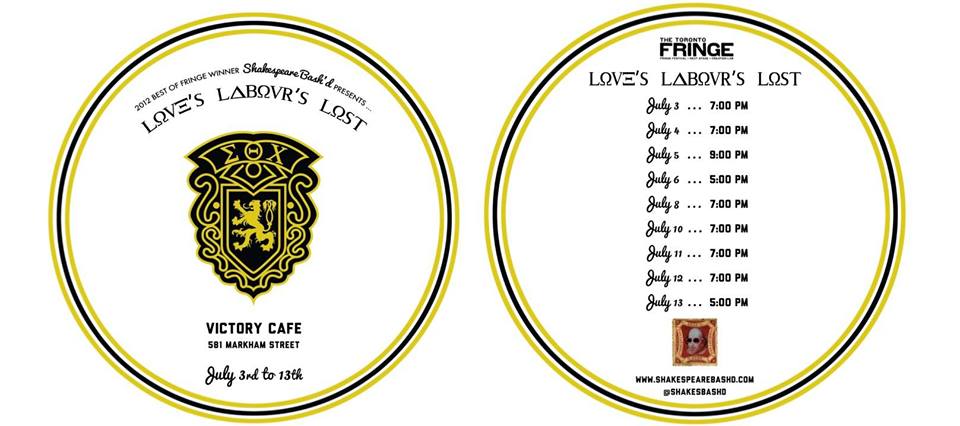
Where? The Victory Cafe, 581 Markham St.
When? Thursday, July 3 @7:00pm
Friday, July 4 @ 7:00pm
Saturday, July 5 @9:00pm
Sunday, July 6 @5:00pm
Tuesday, July 8 @7:00pm
Thursday, July 10 @7:00pm
Friday July, 11 @7:00pm
Saturday, July 12 @7:00pm
Sunday, July 13 @5:00pm
Tickets are $12 and can be purchased via the Toronto Fringe website: https://www.fringetix.ca/

10440657_845760552118405_7235464256632023655_n

Follow this wild bunch on Twitter:

Shakespeare Bash’d@ShakesBASHd
Hallie Seline (Princess) – @HallieSeline
Joshua Browne@joshu_ashua
Andrew Gaboury (Longaville) – @afieldofcrowns
Jeff Hanson (Berowne) – @The_Hanman
Suzette McCanny (Rosaline) – @suzettemccanny

In the Greenroom Writer Bailey Green: @_baileygreen

** Want In the Greenroom to catch your Fringe show or have an interesting idea for an interview? Email us at inthegreenroom.ca@gmail.com! **

Steinbeck meets Clown in “Of Mice and Morro and Jasp” – A Chat over Tea with Co-Creators & Performers Heather Marie Annis and Amy Lee

Interview by Madryn McCabe

I had tea on a frigid evening with the talented and wonderful Heather Marie Annis and Amy Lee of Morro and Jasp as they finished each others’ sentences and laughed about their upcoming show, “Of Mice and Morro and Jasp” playing now at the Factory Studio Theatre, January 28th to February 8th.

MM: Why don’t you tell us a little bit about Morro and Jasp?

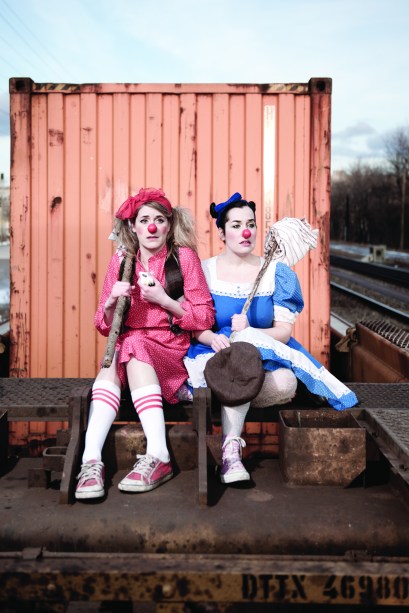
HMA: Morro and Jasp are clown sisters. Jasp is older.

AL: Yes, she certainly is.

HML: And more bossy. And more particular. And they have been sisters…

AL: And Morro is younger. And more unruly. And flies by the seat of her pants. But loving and free spirited. (Indicates Annis) She plays Morro. We both said a nice thing and a not so nice thing about each others’ character.

HMA: They can’t live with each other or without each other.

AL: Absolutely. They have been growing up over the years. This is our… I can’t really keep track anymore. This is show… maybe eight, nine?

HMA: They’ve gone on a series of adventures. We started out with them performing. Morro and Jasp are the ones writing the plays and putting on the plays.

AL: We help sometimes.

HML: And they’ve grown up through the series of shows that we’ve done since we started. We had three…?

AL: Three shows for young audiences and then they went through puberty, which was awkward and exciting and then they went on different vacations, then they did a cooking show and now they’re tackling a tragedy with Of Mice and Morro and Jasp.

MM: So in doing Of Mice and Morro and Jasp, do we see their growing maturity through the progression of them growing up?

HMA: Yes. And they’re at a stage in their lives where they’re struggling financially, and they’re trying to find their place in the world with jobs and how they’re accepted by society, or not accepted by society.

AL: Figuring out how to make life work. (Looks at Annis) I guess you said that.

HMA: You said it in a different way.

MM: It sounds incredibly relatable. I don’t know anyone who doesn’t say, “What’s my place in the world? How do I figure this out? I need a job!”

AL: And similarly, just how George and Lenny are figuring out where to go and how to make their dream work. The first thing that jumped out for us was that it was such a great pairing. Their relationship is so similar to our relationship and then just figuring out their similarities. George and Lenny’s journey and Morro and Jasp’s journey and how they fit.

HMA: And also to explore the sadness in their lives. The tragic elements, beyond comedy, what else there is.

AL: There are always elements of tragedy in our shows, of course, there has to be both, but we wanted to try and adapt a full on tragedy to see what would happen.

20120219-_DSC0977_2

MM: Is this because the two of you sit down and say “This is what we’re going to do”? What is your process of developing your shows? I’ve heard of some performers who say “There is me, and then there is my clown” and others who say “It’s all me”.

HMA: (laughs) That is an interesting question!

AL: We are IN our clowns, but our clowns…because we’ve been doing them for so long, they really have minds of their own. And a lot of the time, we’ll think something will be a good idea, and when we rehearse as Morro and Jasp, they will let us know. A lot of the time, we’ll try to solve the problem, and we’ll say “Let’s let Morro and Jasp solve it” and they do.

HMA: At the end of the day, your clown character is coming from you and your own individual personality, which is why clown is so specific. With some characters, you can try to replicate them and perform this other person as an actor. I find it’s a little more challenging with clown because it is so specific to your person. So, we are our clowns, but once we get into character and start exploring ideas, we have totally different ideas that will come out in different ways.

AL: It’s about impulses!

HMA: Right. We might not have those as Heather and Amy sitting at a computer coming up with ideas. Theirs will be more! Theirs will be bigger and more exciting and more extreme.

AL: We write our shows in combination with them. We do it, and then we do it in clown, and we go back and forth to figure out what works and what doesn’t.

MM: I want to hear about your cookbook. How did that come to be?

AL: We were doing a show called Morro and Jasp: Go Bake Yourself and it’s our show about cooking. Someone came to see it, and he worked in publishing and said, “Make a book, and we’ll publish it”. Those were our guidelines! We didn’t really have any!

HMA: He totally came to us with the idea. We had said, “Maybe we should make a book, that would be so much fun”. Maybe we just put it out into the universe! He gave us so much freedom. The idea was to make a cookbook combined with other things, because it came out of our cooking show.

AL: We had never planned to make a cookbook, but it was a fun match. And we both love cooking and making food, and food in general and it felt like a good fit. It was a lot of work! We had no idea how much work a cookbook would be!

HMA: The fact that he gave us so much freedom is why it worked for us. We got to discover what form and what content, and everything it would be based on our process and how we went along with it and what discoveries we made along the way. Which isn’t always what you set out to do when you make a book, because I would assume the publisher would dictate it, especially when he came to us with the idea. We didn’t know how long it was going to be either.

AL: Initially, it was supposed to be 60-80 pages, and it ended up being about 235! We just kept getting excited about all the different recipes we could put in!

MM: Are they all your own recipes?

HMA: It’s a combination of some recipes we made up, recipes that we have that we’ve used and loved, a lot of recipes from our families and friends, and some fans.

WxL-es1O

AL: Some fans wrote in and submitted recipes, which is fun.

HMA: Each of the recipes says who it’s from.

AL: It was exciting to see what we would get. And we tested everything.

HMA: Morro and Jasp tested them! (laughs)

AL: Well, we were there to guide the process.

HMA: There are also some recipes from our show, Go Bake Yourself. So it’s connected back to the show.

MM: It’s an extension of the show? A new medium?

AL: Yeah! It doesn’t run the same storyline as the show, but it’s connected.

HMA: There are similar themes about emotion and eating and those are connected. And love, and how food is a way of expressing love.

MM: Now I want to see a Morro and Jasp cooking show on TV.

HMA: So do we! That would be great!

AL: A few people have mentioned that. So we’ll see. We’d be up for it. And I think Morro and Jasp would be too. Jasp would feel like all her dreams came true.

OF MICE

MM: Of Mice and Morro and Jasp is a remount. Has it developed at all since the last time you performed it?

HMA: We’re developing it now! (laughs)

AL: We’re still developing it.

HMA: That’s where we just came from. It’s not that the story of it is changing, there aren’t dramatic rewrites, but we’re fine tuning it. We have more space to play now. At the Toronto Fringe you have a timeline. So now we have more room to breathe, and give the moments more detail. We can infuse a little more energy or breath into them.

AL: We’re coming back and going, “I think we can make this moment better. How can we do that?” “This monologue can be better”. So it’s really nice to be able to fix all the things that we wanted to fix and didn’t have time to. There are a few new elements as well, production elements that we can have.

MM: Like pyrotechnics?

HMA: (laughs)

AL: That would be fun!

HMA: The idea of the show is that times are tough. They’re on a strict budget and they’ve spent their last dollars on their set. No pyrotechnics, unfortunately. Not this time around anyway.

AL: But that is a good idea.

MM: Do you have anything else in the works? What’s next for Morro and Jasp?

AL: Morro and Jasp are in residence at Factory Theatre this season, developing their newest show, Morro and Jasp: 9 to 5, which is about them actually getting jobs. This show [Of Mice and Morro and Jasp] is about them not being able to, and the next show is about them figuring out how to actually make that happen.

HMA: Hold down a job.

AL: So that’s in process. We’re writing that right now. And also right after this show closes, we have a few days, and then we go to Ottawa to the GCTC for the Undercurrents Festival, and we’re performing Morro and Jasp Do Puberty there. Which is exciting because that’s the first in our series of adult shows, so it’s nice to give Ottawa audiences an introduction to us with that one.

MM: In going back to these other shows, are you finding out more and more about Morro and Jasp? Are Morro and Jasp discovering more about themselves?

AL: We always discover more. Every time we do a show, we change things about it. Because we’ve learned a lot about ourselves, we’ve learned a lot about Morro and Jasp, we learn so much more about who they are every time we do a show. That does inform us. We can add more detail and new things.

HMA: And also sometimes we have references or comments about things that are very timely. They’re happening now. So we’ll change them when we go back to a show. And always we’re interacting so much with the audience and the space that we’re in. Storytelling has to be alive and based on that audience and that thing and what they’re saying to you.

MM: Do you prefer that freedom of development of character and story versus an established play and character written by a playwright? Do you need both?

AL: It’s nice to have both.

HMA: They’re so different.

AL: It’s a totally different challenge. It’s nice to be able to practice both. Doing a play with a script written by someone else, whether it be a famous great playwright or someone new, always teaches us as artists a lot. So it’s nice to have the two inform each other constantly. How to bring what you know about making new work into a script that’s written and how to bridge that other kind of work into what we’re making.

HMA: And it’s a completely different exercise in that, with someone else’s script, you’re trying to interpret it and learn what’s already there and what’s hiding underneath and between the lines. With our stuff, it feels like such a rare opportunity to have a character that you enjoy and play with for so long. For, what? Ten years?

AL: Almost ten years, yeah.

HMA: And they’re so close to us because we created them. It’s a very special thing to be able to play with.

AL: We get to keep coming back to the same character and get to see what they will do in new circumstances, a new adventure, but keeping them, them. The nice thing is that there are no limits in terms of what we want to explore, but there are limits in terms of who those characters are and their relationship. That informs everything that happens.

MM: Are there certain things that Morro and Jasp would never do or say?

HMA: Never say never! (laughs) But there are certain things that they aren’t likely to do. They have their boundaries too. And those change and evolve just like anyone else. They’ve become these very dynamic people because they’ve existed for so long.

AL: I really hate it when actors say, “My character would never do that”. A lot of the time I think, “Just make it work”, but with this, Jasp, say, wouldn’t be happy wearing a pair of baggy pants. But it might be fun to see what happens when you put her in a pair of baggy pants.

HMA: So with those boundaries, it helps us put them into situations that they hate, which is funny. That’s what good theatre is, dynamics. So the more that we found out what they hate or love, the more we can play with the dynamic.

MM: To wrap up, in three words, why should people come to see Of Mice and Morro and Jasp?

(whispered consultation)

AL: Steinbeck meets clown. You’ve got to find out what that means!

Of Mice and Morro and Jasp
20120219-_DSC0953

Created and performed by Heather Marie Annis and Amy Lee
Directed by Byron Laviolette
Presented by Up your Nose and In your Toes (U.N.I.T.) Productions & Factory Theatre

When: January 28th – February 8th, Tues-Sat 8pm, Thurs 1pm, Sat 2pm

Where: Factory Studio Theatre

Tickets: $25 Regular Price, $20 Student, Senior, Arts Worker
http://www.factorytheatre.ca/what-s-on/of-mice-and-morro-and-jasp/


In Conversation with Morgan Norwich and Johnnie Walker – “Scheherazade” at the Next Stage Theatre Festival

Interview by Madryn McCabe

I sat down with Morgan Norwich and Johnnie Walker, director and writer, in a busy café to discuss their latest production, Scheherazade playing now as part of the Next Stage Theatre Festival.

MM: So why don’t you tell me a little bit about Sceherazade?

MN: Sure! It’s an adaptation of 1001 Nights, with the twist that the story is more from the perspective of the character of Scheherazade, who, while she is the teller of the original 1001 Nights, we don’t get to know too much about her. So we created a world where she lives in this crazy, totalitarian society where they’re killing a young woman every morning at dawn, and with a weird anachronistic, modern spin on it with lots of sex, which is also inherent to The Nights, and lots of pop cultural references. That’s about it, wouldn’t you say?

JW: Yeah. In a way I feel like we’re just unearthing the sex and violence that were totally there all along. The Nights have really been sanitized and ‘Disneyfied’ over the years. Sometimes certain bits of the stories go by so fast that you don’t take the time to think about them. But even the whole setup for the story, that there’s this king that marries a different woman every day, sleeps with her, has her killed and marries another one the next day… It’s sex, and violence and sexual violence that are so at the core of the whole thing. But if you say it quickly enough, you sort of skip them somehow. So it’s not like we’re shoving all this new sex and violence into it. It’s already there. I think we’re giving it room to breathe and say “Look at all the stuff that was here this whole time that you missed”.

MM: So was this a story that you had always wanted to tell, or was it that you set out to find a show that was the untold story? Why this story?

JW: That’s a good question. It’s been so long…

MM: How long have you been working on it?

MN: Over two years now.

JW: Yeah that would have been about fall of 2010.

MN: So even longer than that.

JW: And that was a very short, early version of the very beginning of the play that was like a little workshop. And then we came back to it the year after that a bit more seriously.

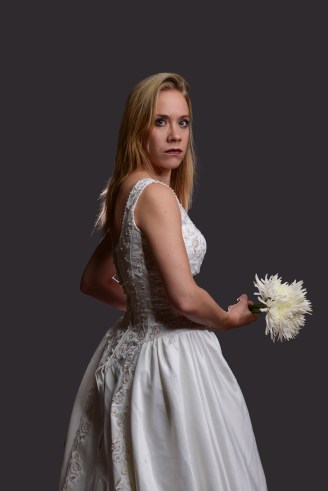
Lindsey Clark in Scheherazade. Photo Credit: Greg Wong

Lindsey Clark in Scheherazade. Photo Credit: Greg Wong

MN: We did a workshop of it with just two actors, just focusing on the characters of Scheherazade and Dunyazade, the sisters, and out of that workshop came this idea for the world of the play being this dystopian, but also very familiar, wedding-obsessed culture, and all the ideas of consumerism layered into the existing narrative. That came out of that workshop.

JW: I’ve always been into the character of Scheherazade, even just the name I like.

MM: So what about Scheherazade is appealing to you?

JW: Just the idea that there is this totally brutal regime that she’s living in, this insane tyrant running the country, and that her plan to take him down is all through art. And it’s totally pacifist. She’s just smart. She’s smarter than everyone, a really good storyteller, and she doesn’t need to come up with some… It’s a very genre show in a lot of ways, it feels very genre-ish, where it has this dystopian, almost science fiction without the science feel to it. I’m kind of a nerdy guy in a lot of ways. I like seeing a superhero movie, or we’re both fans of Buffy the Vampire Slayer and things like that, and in the last couple of years I have noticed seeing a lot of this stuff that, even though those shows or movies are really smart and have a lot of sophisticated things to say, it ultimately comes down to people punching each other. And that usually is the only way to solve problems. I love how that is not what Scheherazade is about. Never in part of her plan is “Oh I’ll trick him with this story, and then I’ll shoot him in the face”. That’s not what her deal is. And in the show I think we’re trying to examine “Is it possible to have that? Is that kind of resistance possible? Where does it work and where doesn’t it work? Where can a plan like that really succeed? And where can it really fail?”

MM: So is it possible to change the world through creative, non-violent means?

JW: Exactly.

MM: Is this the kind of play you guys are always looking to do? These strong female-centred shows?

MN: For the most part. I consider Johnnie to be one of the best feminist playwrights, of the male feminist playwrights for sure.

JW: Oh that’s so nice! I like that!

MN: Well I do. I always have. So another really large show that we did a few years ago was called Eight Girls Without Boyfriends which, I don’t think Johnnie realized this when he wrote it, was sort of a witte-fem inspired, cabaret piece that was also about these empowered female characters. So I don’t know if it’s something that’s always been conscious, but it’s been the kind of thing we’ve always done just because of who we are.

JW: I think both of us are really interested in feminism and gender and also sexuality.

MN: One of the other things that Johnnie and I do when we’re not doing shows is we work with an all-male burlesque troupe called Boylesque T.O. so we’ve been in the last few years exposed to the burlesque community and the gender play on it because, with the exception of me, it’s all guys in the troupe. I feel like probably a lot of my experience with both the male burlesque troupe and other female burlesque troupes that I’ve hosted with since we started doing that has informed a lot of certainly the staging of sexuality that’s gone into the show, but also, when you’re around sex-positive people all the time you get a good attitude about that kind of thing and you want to express it onstage.

MM: After having seen the show last night, I can say there’s a lot of sex in the show, but it’s funny, a lot of it is very light.

MN: Except when it’s not! And then it’s not.

MM: Right. And for the most part, when there’s sex in other plays, you can see it coming and you feel like “oh there’s going to be sex and I’m going to be uncomfortable seeing this with all these other people” and you guys just put it out there. It’s very “it is what it is” and then you move on to the next part.

MN: And so you didn’t feel uncomfortable? Oh good!

MM: And the audience loved it. They thought it was really funny. Especially, I would say, the older members of the audience. So do you usually get a good reception from people for this kind of work?

JW: Some people have actually said that this show is a departure for us in a lot of ways. That level of sexuality is not in our previous shows.

MM: So why make such a departure?

JW: We wanted to tell this story. We both came at it from different angles, and it was important to the both of us in different ways. And in the same ways also. So I think you need it for the story. When I was writing it, I didn’t throw in any orgies that aren’t in the original plot and aren’t integral to the plot.

MM: It’s funny that you say that because going into the show I thought “Oh we all know the story of Scheherazade” but apparently we DON’T really know the story. You had said earlier that it’s really the untold story. It’s been so ‘Disneyfied’, and we really know more about the stories that she tells versus the story of her.

Lindsey Clark in Scheherazade. Photo Credit: Greg Wong

Lindsey Clark in Scheherazade. Photo Credit: Greg Wong

JW: Aladdin, Ali Baba, Sinbad are the ones that all rise to the top. And ironically, those are the stories that are in 1001 Nights where no original has been found. They were all translated in the 1800s into French by this guy Guillaume, and those three stories, which have become the most popular, no one has found the original that he translated from. So there’s a lot of speculation that he actually wrote them himself, inspired by the tales. It’s kind of hilarious that those have become the iconic stories. When you read the tales, almost every story are as good as those, as good as Aladdin. There are so many amazing ones that we don’t know. And in the show itself we have these moments. Like, right before the first orgy scene, they come on and do this sort of tasteful sexuality.They’re sort of posed in a silly way and she says, “slaves let us bathe and let us lie together” which, in the translation that we’re working from, is directly in the text. But I thought that was so sanitized. It’s a translation of a translation of a translation. Somebody has put their 20th century, prudish, Westernized idea of what that means. But really, think about that for a minute. What does ‘let us bathe and let us lie together’ mean? It doesn’t mean ‘scrub my arm and let’s have a nap’. It’s a big orgy. That’s what that means. There are these details that came out and it’s very explicit in the story that Scheherazade’s whole plan can’t start until she and the king have sex. It has to happen to complete their marriage. And it’s specific about the fact that her younger sister is in the room while that happens. In the original, she’s actually under the bed.

MN: We didn’t go that far!

JW: We even toned it down from that! But it’s one of those things that people just glide past in the text. “Oh yeah, Dunyazade was lying under the bed, then she came out with a plate of food”. No! Wait! Give that a moment. She’s in the same room as her sister while she is sort of raped by this tyrant. It’s a huge deal. And you need to give that its time. So it was about unearthing these bits. If this happened in real life, it would be a big deal. And the narrative isn’t quite letting it be.

MN: One of the things, right off the bat in rehearsal that we talked to the actors about was checking their own assumptions about the story and the world because of all of our ‘over-Disneyfied’ childhoods. We literally got to a point where everyone got one Disney’s Aladdin reference per rehearsal and then we had to shelve it and put it away. As much as so much of the play has ended up being cartoonish, which works for the kind of satire we’re doing, it didn’t help to go back to images in our heads of the Disney movie.

JW: Would you say that we’re dealing with A Whole New World?

MN: I would, but I can only say that once today! That’s the rule.

Director - Morgan Norwich and Writer - Johnnie Walker of Scheherazade

Director – Morgan Norwich and Writer – Johnnie Walker of Scheherazade

MM: Are you able to do this show because it’s part of the Next Stage Theatre Festival?

MN: Yes. Next Stage provides a lot of resources in terms of giving us the space, the box office, the technicians, stuff that’s really difficult to afford for even a small show. But when you’re dealing with a cast of eleven, plus three designers, plus stage manager, plus producer, the cost just grows and grows. Having the context of the festival is actually what has made it possible.

JW: And the cache too.

MM: So because it’s part of THIS festival, you can put on THIS play? Would you have been able to find the support, not just financially, somewhere else? Do you think you could have done this play without being a part of this festival?

MN: I don’t think something like this, even at the Toronto Fringe, we could have pulled off in the same way. Because it’s a smaller festival, we get a little bit of extra support, in terms of media stuff in particular.

JW: We were successful in some of our grant applications, and I think that’s partly because we were part of this festival. It’s a known entity. Even though it’s not that old as a festival, I think it has a great reputation. It’s a kind of risky show in a way for the performers, so to be able to hand them the script and say “we’re doing it here” is nicer than “here’s this crazy show with orgies and stuff, and we’re going to do it in a garage”.

MN: There’s a safety net, for sure.

MM: Do you have anything else in the works? Maybe want to give us a preview?

MN: This show has been so all consuming! We’ve got burlesque stuff happening immediately after, and I’ve got something in the Rhubarb Festival. But it’s going to be very weird for this to be over.

JW: We also do our show Redheaded Stepchild, that’s coming up. We have a show that we did in Edmonton last year called Amusement that we’re hoping to do in Toronto at some point. We don’t have an exact plan for that yet, but hopefully we’ll get something together.

MM: So to wrap up, in three words, why should people go see Scheherazade?

MN: Natasha [Greenblatt] in the show sent a really good email inviting someone to come that said “There are three orgies and a knife fight” so I’m going to say Three Orgies, Knife-fight. I can hyphenate that, right?

JW: I was just going to say Butts, Butts, Butts. When we got into the costumes, I realized there are a lot of butts in this play. So there’s a butt for everyone!

Scheherazade

Presented by Nobody’s Business theatre
Written by: Johnnie Walker
Directed by: Morgan Norwich
Where: Factory Theatre
When:
Monday, January 13th, 2014 at 7:00 p.m.
Thursday, January 16th, 2014 at 5:15 p.m.
Friday, January 17th, 2014 at 9:15 p.m.
Saturday, January 18th, 2014 at 6:45 p.m.
Sunday, January 19th, 2014 at 9:15 p.m.
Tickets: $15 . For online sales, go to www.fringetoronto.com. Tickets can be purchased by phone at 416-966-1062, or in person at the venue. For more information, go to www.nobodysbusiness.ca.

Bound to Create Theatre presents “Dirty Butterfly” as part of Obsidian Theatre’s 2013/14 Presentation Series

by Ryan Quinn

I sat down with director Jack Grinhaus and actor Lauren Brotman, Co-Artistic Directors of Bound To Create Theatre to discuss their upcoming production of Debbie Tucker Green’s Dirty Butterfly, being presented as part of Obsidian Theatre’s 2013-14 Presentation Series. We were also joined by their adorable ten-week-old Ethan, who the staff of the Artegelato cafe, where we were meeting, have been eagerly watching grow since he was born.

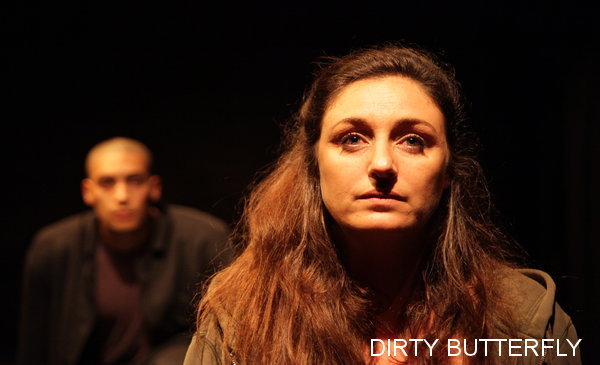
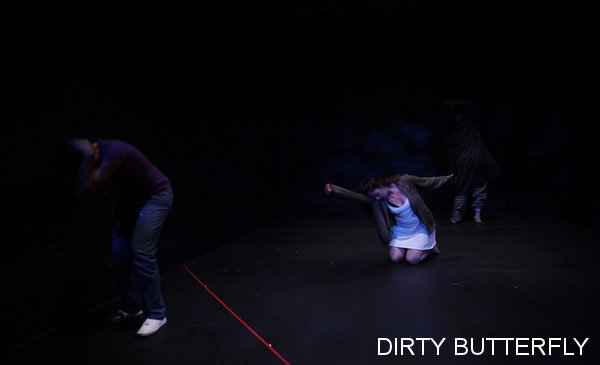
Dirty Butterfly is the story of an abused woman in a lower-class housing complex in Britain whose neighbours on either side have very different reactions to the sound of domestic violence coming through their walls. One neighbour actively avoids the entire situation, deluding herself into denying what’s happening, while the other becomes almost obsessed with it and completely drawn in. The show first ran at the 2012 Toronto Fringe, which, to Grinhaus, was a testing ground to see if the material could work as a full run. Of course, going from the Fringe Festival to being a part of a larger season at Obsidian has its own challenges, which have more to do with budget and promotion.

dbrotate

The pair first became interested in this show when they found themselves both working on different projects about domestic violence at the same time. “The statistics are frightening, on the rise, and damning,” they discuss. So, the pair went off in search of shows that deal with that topic, and Dirty Butterfly was so perfect for what they wanted to accomplish and explore, that they say they had no other choice. Bound to Create reached out to the White Ribbon campaign, and other local groups focused on this topic, and is happy to be working with them on this project.

Grinhaus and Brotman are incredibly excited to introduce Debbie Tucker Green’s work to the Canadian stage, as they see the power that British works can have on this side of the ocean: “There is a facility with language that even the lower classes have, that makes British theatre so different. Not only is the language fluid and precise, but Green writes in a cadence that the cast really has to tap into”. Grinhaus describes working on a scene where the character work was spot-on, then having to go back and speed up the pace to make the rhythm of the text work. “Trancelike is actually a really good word for it. The beat draws us into the action and really makes us feel complicit in what’s happening. The result is an audience that either identifies with one of the two neighbours, or falls somewhere in-between, on the spectrum of fear to obsession. What do we do on the other side of the wall?”

db4new

What makes this show leagues away from being a feel-good morality tale, though, is the complexity of the characters involved. “Green has made the main character, right from the top, do and say some things that are really…unlikeable,” Brotman tells me, “The audience probably won’t like this woman.” Also, there are no big acts of physical violence in this show, which separates Green from the fellow playwright to whom her work is most often compared, the late Sarah Kane. Brotman explains, “Jack’s done something smart where the little moments of violence in the play are closer to metaphors, leaving a play that strongly focuses more on the reactions and the repercussions of the violence.”

It’s also the smaller character moments that speak so much about the class culture in Britain and across the world. Grinhaus tells me about a small piece of text from a character who is a cleaner in a cafe, whose only dream is to someday be a barista. “It’s this tiny moment that happens too fast, but it really hits me”.

Luckily, the rehearsal space was one of the best she’s ever been in, Brotman explains. “It was very zen, you know. I was there with my husband, and my son was there in the room with me, it felt like a very safe place.”

When asked if he has any advice for young companies looking to produce important work, Grinhaus immediately replies “David Mamet is no longer relevant”. He explains that, sure, Mamet’s plays are full of angry conflicts, and that’s where young actors tend to be most comfortable at that stage of their lives, but his plays just are not the right kind of shows to be putting up right now.

His more direct advice, though, was that to be in the business, you have to be in the business. “When I was working at a restaurant in New York, I had to drop an audition because I couldn’t risk losing a shift. I never made that mistake again”. Grinhaus recommends working in any area of the theatre you can get into: “I got more acting jobs from being the guy sitting beside the director of another show in a different capacity than I did from auditioning”.

Bound to Create Theatre is also doing a cross-promotion with Paint Box Bistro for Dirty Butterfly. Paint Box is a restaurant and culinary school that teaches young people in Regent Park the skills they need to work in restaurants, or open their own. Their infrastructure supports establishing kitchens and allows use of the space to Regent Park start-ups. Paint Box is offering 10% off pre-show meals with proof of ticket purchase.

Dirty Butterfly

Dirty-Butterfly-web-618x337

by Debbie Tucker Green

Presented by Bound to Create Theatre as part of Obsidian Theatre’s 13/14 Presentation Series

When: October 30th to November 17th

Where: Aki Studio Theatre, 585 Dundas Street East.

Tickets: www.boundtocreate.com, or by calling 1-800-204-0855.