Skip to content

Posts tagged ‘Toronto Theatre’

Creating the Ultimate Shakespeare/Horror Mashups & the Necessity of Taking Risks at the Fringe & Beyond – In Conversation with “Romeo and Juliet Chainsaw Massacre” on now at the 2016 Toronto Fringe

Interview by Ryan Quinn

RQ: I’m here with three members of the team from Romeo and Juliet Chainsaw Massacre – Scott Emerson Moyle, fight director and Lord Capulet; David Kingsmill, playing Escalus and the Chorus as well as being the production manager; and Matt Bernard, the writer and director. Do you want to tell me a bit about the show?

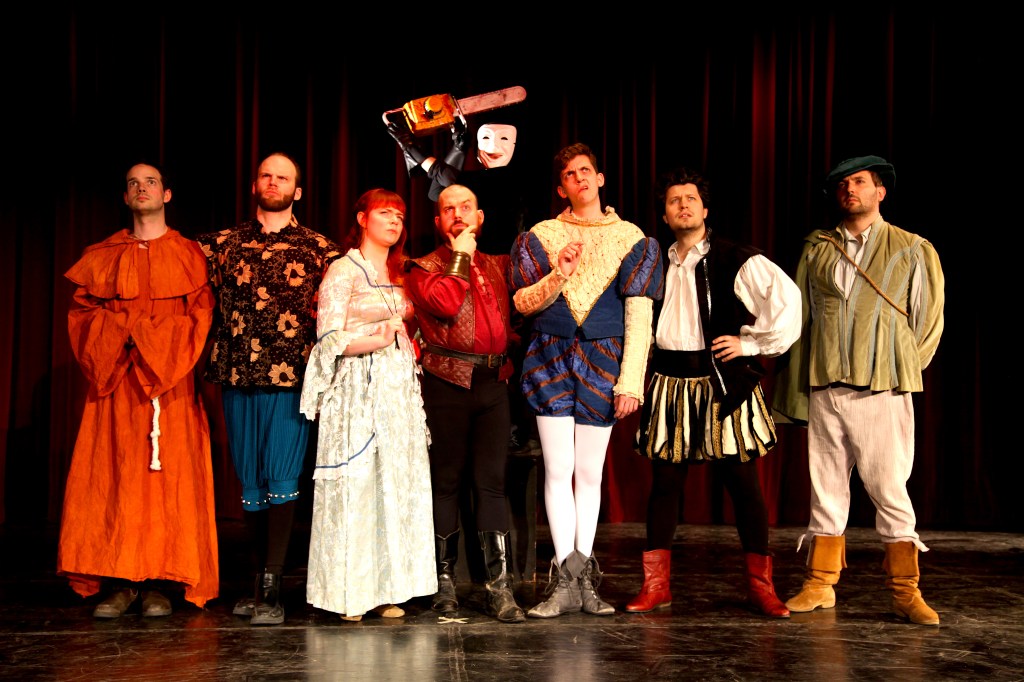
MB: Yes! So the tag line is that it’s a comedic-horror mash-up of Romeo and Juliet. It’s the tale of two star-crossed lovers with the added element of a chainsaw-wielding maniac, kind of taken from old horror movies. So that’s thrown in to see how the story would change, and how it would alter the fates of Romeo and Juliet.

RQ: How did this come about? What was the process?

MB: My comedy troupe Bain and Bernard did shows for the St. Lawrence Shakespeare festival, it was part of their Sunday series, and we would always parody whatever Shakespeare show they were doing. So, we’ve done Sherlock Holmes and the Case of Hamlet, A Midsummer’s Nightmare (Or, How I Learned to Stop Worrying and Love Desdemona Anyway). So, when we were heading back in the car from our last one, the question came up of what to do next. After doing Hamlet, I thought there’s nothing else you can do after that, but we realized we hadn’t done arguably the most known Shakespeare show, Romeo and Juliet. So the idea came up of doing Romeo and Juliet Chainsaw Massacre, and we talked about it for a while, threw some ideas out there, and that was two years ago. We were sitting on it for a while, not sure how to approach the project, but we eventually had to pull the trigger on it, do it for Fringe, and see what we could create.

RQ: What do you think it is about Shakespeare and campy horror that makes them fit together so well?

SEM: The pitch I’ve been using is that the show I’m doing for Fringe is Romeo and Juliet Chainsaw Massacre is exactly what you’re picturing when I say the title. They are two really iconic sets of visuals, and two very iconic story archetypes. They’re so incredibly different that jamming them together seems to not make sense, yet somehow you can completely picture it.

MB: It’s like Snakes on a Plane in that way. Everything you need to know is in the title.

DK: Also, I think when you say “star-crossed lovers”, Romeo and Juliet is the first thing you think of. When you say “chainsaw”, Leatherface probably pops into their head immediately. So it’s two incredibly iconic things featured in the same room at the same time.
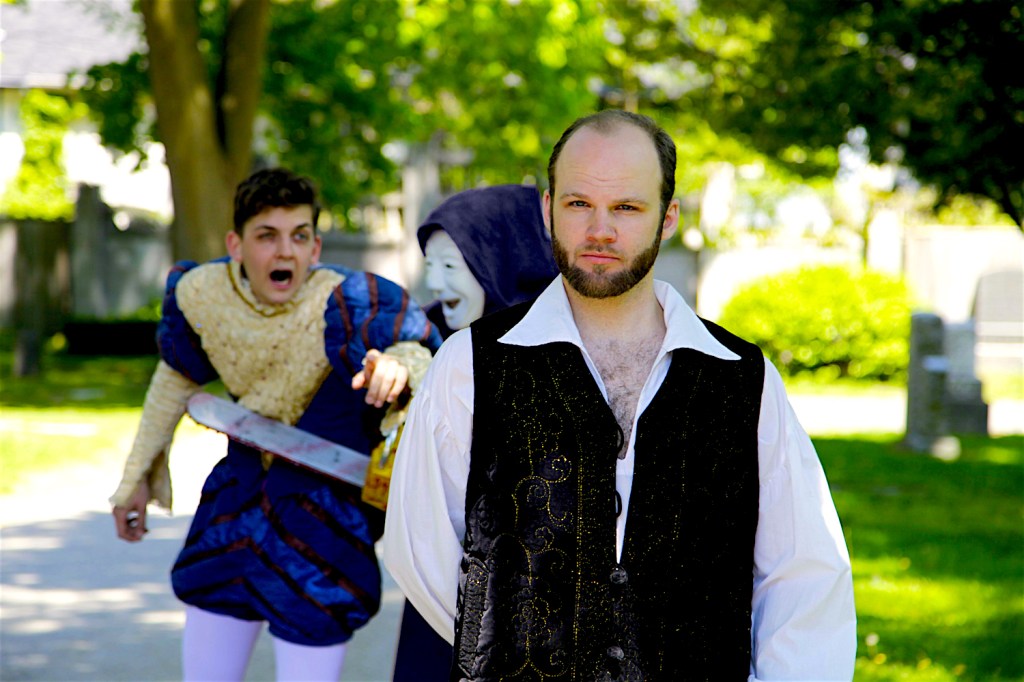
R&J Press Photo 3

RQ: I feel like there’s a certain reverence for 80s horror that we often casually dismiss.

MB: Well, yeah, the 80s is when horror films kind of came into themselves. There was a horror movement in the 60s, but then in the 70s and 80s, that’s when the slasher flicks came in. They started getting really gory, so that’s the prime time for it. We’re taking prime horror and prime Shakespeare, and it actually fits really well.

DK: It was a time when horror was based around being horrifying, not around being a shock spectacle. These days, I think if you look at something like Saw, yes it’s horrifying but the film exists to shock you by killing people in the most brutal ways we can think of. It loses some of the actual horror element and I think it goes beyond horror into something totally different. Something like Hostel takes that further still.

RQ: Suspense and disgust?

DK: Yeah, and I think suspense is certainly a part of horror, but disgust doesn’t have to be. I mean, look at Psycho. What was it, eighty-three stabbings of Janet Leigh in the shower and you never see one connect? It’s all the mind’s image filling in blanks. I think that’s something seminal of that time, as well.

RQ: Do you think horror films from the 80s said something about us in the same way that Romeo and Juliet said something about us when it was written?

MB: There was certainly a lot of chasing in those movies, everyone was chasing someone or something. I mean, I’m not sure because those movies do scare the hell out of me. They do their job.

SEM: Actually?

MB: Oh yeah. For inspiration, I had to watch all these horror movies and I was hiding my face behind my hands! I was terrified! I’d take notes and shut it right off at the end. They really work on me. So this was a very terrifying show to write.

SEM: It might not even be a very period-specific thing. I mean, Romeo and Juliet comes out of 16th Century dueling culture and people actually looking for ways to be idiots for love. But, the reason we still do it is because it’s enduring. We all know what it is to be in love and not have circumstances support that. It’s complicated. The horror thing might be pretty enduring as well. We’re scared of isolation, and a lot of horror movies are about being alone. We’re scared of the unknown, and that’s what horror gives us.

RQ: Is there also a connection when it comes to fate? Just by virtue of being a character in a horror movie, or a character in a Shakespearean tragedy…

SEM: You are on notice. You’re not getting out alive.

DK: I read once that people write fiction as a means to experience things they normally don’t. We don’t normally experience duels. We don’t normally get chased around by a psychotic killer. We don’t normally fly a rocket to Mars. Whatever it happens to be, it’s a way to experience something beyond the normal. So, I think the manifestation of a story is the product of its time, but at the center is a wish for vicarious experience.

RQ: What do you think makes Fringe perfect for a show like this?

MB: Fringe is all about the entire community coming together in one spot. Seeing the tents go up, seeing shows all around, it’s a whole two-week celebration of throwing together a show. I think this show is perfect for Fringe because we’ve got a large team on this and everyone is bringing everything they can to the table. So for two weeks everyone works on this together, and then we all go away.

DK: It’s a space that gives you permission to try something a little crazy. The professional theatre world is becoming more and more of a place where audience members aren’t willing to take risks. Producers and companies aren’t willing to take on the risk of a show that isn’t a proven commodity, that’s doing something really different. Fringe is all about embracing that risk. You just do a thing, whatever that thing is. It can be an improvised musical, it can be a mash-up of Shakespeare and horror…

SEM: Wasn’t there someone reading a phone book last year?

DK: Something slightly crazy like that, yeah. It’s great. Normally you can only get away with that if you have a level of, I suppose, celebrity.

SEM: Yeah, major theatres would have a hard time marketing this as part of their season, but because it’s Fringe, everyone is getting really excited about it. It’s a space to get weird.
R&J Press Photo 1 (1)

RQ: Is there a way to support this kind of work for the rest of the year?

SEM: (laughs) Canadian Stage should pick us up.

MB: There’s kind of a rise in “geek chic”, or an appreciation of it. There’s a theatre company in Washington that sent an email saying “We do this kind of pop culture stuff, and we’d like to do the show”, so I’d like to see more of that in Toronto. Instead of doing classic theatre all the time, doing more fun, pop culture things to address millennials. They’re the future audiences, and they grew up with video games.

DK: There needs to be a place for things like this, otherwise theatre is going to stagnate. I saw a production of Pippin in London five or six years ago that was entirely set within a video game world. After about a third of the show, he leveled up and became more powerful before going back into the dungeon… things like this. It was so spectacularly nerdy. And they got away with it because it’s a well-known, already accepted musical. I think what I’m looking for in the theatre world is for me to be able to write a video game piece or something like that with absolutely no ties to an existing license, and still have it looked at. I think that needs to happen. We need to get to a point where popular culture merges with theatre, not just in the sense of being avant-garde but by wrapping the two things together.

MB: I think when non-theatre people hear the word “theatre”, they picture someone holding a skull, or the masks. So, there’s always going to be a sense of traditional theatre, and people exploring ways to change it. Hamlet done in the post-apocalypse… things like that. Switches on the classics. But I think there will be a rise of new material that doesn’t take on classical theatre elements.

SEM: We’re starting to see genre stuff come into its own in theatre. At Storefront a couple of years ago, they did Dark Matter. It was a hard sci-fi, Battlestar Galactica take on Joseph Conrad’s Heart of Darkness. This year at the Humber River Shakespeare’s sonnet show, where you direct a new short play in a day, I was handed a science fiction play about three martians coming to Earth. People are writing genre fiction for theatre now.

MB: It’s hard to do in theatre.

SEM: So hard!

MB: This is actually the first Fringe show in the “horror” category. It wasn’t in the pull-down list. Just things like dramatic, comedic, physical theatre, dance, and so forth.

SEM: We should have marketed this as a dance show.

DK: I think part of the problem with it being such a niche type of theatre at the moment, is that when something succeeds well at it, then it can become an accepted type of theatre. Like, look at The Woman in Black in London. It’s probably a little less scary now than when it opened, but it’s still terrifying. If you say “horror theatre” in London, everyone immediately thinks of that. It’s the only horror show, as far as I’m aware, that has run for any length of time on the London stage. I mean, I’m British, so I do have the most experience in London, but I think that’s something that happens here, as well. When something niche succeeds, it becomes the poster boy for it a little too hard, so we can only hope it will trickle down. Sometimes it does. I mean, who would have written a science fiction play before something like War of the Worlds or Journey to the Center of the Earth came along in fiction? I think fiction tends to precede theatre by a bit, and speculative science fiction, as we know it, hasn’t been around long. A hundred and thirty years? We’ve always had mythology, but until you get to H.G. Wells and his kind, you don’t get that kind of fiction. Theatre just needs to catch up with them a little bit, and maybe we’ll see more of it.

MB: It is hard to do genre fiction like horror or sci-fi onstage because so many of the elements are done in post, or with a lot of dedicated time. Though, isn’t that kind of the fun of live theatre? Recently, I was watching Total Recall. You see the new one with Colin Farrell and it’s all bullshit. It’s all CGI. So I went back to the Arnold Schwarzenegger one and there’s some great prop work! That’s fun to do in theatre as well! Our costume designer Gwyneth Barton should really also be credited for special effects. She created gore rigged into the costumes. We can’t use liquids because it’s a Fringe show, but it’s so thrilling to see actual spines and ribs and stuff. Practical effects are really thrilling, and a huge part of the puzzle of bringing genre-based stories to the stage. I really wish we could have used blood. Next time you see this show, there will be much more blood.

SEM: Can I just say, as the fight captain and guy who would have had to help clean up all that blood, I’m grateful for the “no blood” rule. Not only selfishly, but because limitations breed creativity. The scariest horror movie you’ll see is The Changeling, and they did it by never letting you see the horror. It’s this tiny, low-budget Canadian horror film. Their big special effect is a wheelchair that can roll down the stairs by itself. They blew their budget on that thing. And yet it’s terrifying because you never see the monster. Or, look at Jaws. If they had shot it as planned with an animatronic shark, it would suck. It’s awesome because their shark broke.

RQ: You just see the barrels coming across the water.

SEM: Yeah, and lots of shark-cam. All that… It’s so iconic and it’s bred from that limitation. I think in terms of how the fights in our show work, that lack of blood made us focus more on storytelling in those violent moments. That’s always the challenge. You can choreograph spectacular fights all day and night, but it’s easy to lose track of the story in that violence.

DK: The deaths in this are spectacular, but it’s not spectacle for its own sake. It’s the end of someone’s story in the show.

MB: (laughs) Regardless, blood next time.

R&J Press Photo 2

RQ: Before we finish up, this show is a mash-up of Romeo and Juliet and The Texas Chainsaw Massacre. I wanted to name some other Shakespeare shows and see what horror movies you’d mash them up with, now that you’ve done your research.

SEM: I love this game.

RQ: Let’s start with Hamlet.

DK: Scream.

RQ: Why?

DK: When I think of horror and a play where everybody dies, that mask is the first thing that pops into my head.

SEM: I’d say Psycho because it’s an isolated dude with a really weird relationship with his mom.

RQ: That is…uncanny. What about A Midsummer Night’s Dream?

DK: Cabin in the Woods, possibly.

SEM: Or Sleepaway Camp.

DK: Actually, I change my vote to Tucker and Dale Vs. Evil. Those fit together really well.

SEM: Oh yeah, people only seeing half the story, and conflict coming from the dissonance. And they play the horror in it really straight, that’s what makes it funny.

MB: Or Friday the 13th, in the woods. The lake, the summer camp, that atmosphere. I’d like to mirror some of the deaths from that. Isn’t there a drill through Kevin Bacon’s neck? That would be great for the lovers.

RQ: Julius Caesar.

MB: I’d say something with zombies for that.

SEM: It is a play about an uprising where the people in power lose control and it all goes to shit.

DK: 28 Days Later.

SEM: The first half of Julius Caesar is kind of Dawn of the Dead where the power structure is crumbling and the second half is Day of the Dead where it’s all gone to shit and they’re hiding out and trying to keep it together.

RQ: There’s been a major paradigm shift and now everyone’s zombies. Alright, last one, The Winter’s Tale.

DK: What has a zombie bear in it?

SEM: Isn’t The Winter’s Tale kind of a genre mashup on its own? It’s kind of magic and kind of not. It’s kind of self-aware storytelling but there’s a point where things get real. You know what? Cabin in the Woods. That idea that there’s a sort of magic, and a higher power pulling all the strings behind it. Cabin in the Woods has the shadowy organization, The Winter’s Tale has Time come out halfway through and say “Hope you’re enjoying it! It’s been all me so far, it’s all me for the rest of the show. You’re not going to see me again but it’s all me. We’re moving the play ahead sixteen years, see you later”. Such a small amount of screen time for such a big power player in the story.

RQ: Thanks so much for your time, and have a blast with the show!

MB: Thanks!

Romeo and Juliet Chainsaw Massacre

Presented by Bain and Bernard Comedy as part of the 2016 Toronto Fringe Festival

R&J Chainsaw banner header w- Fringe

Who:
By: Matt Bernard and William Shakespeare
Director: Matt Bernard
Cast: Warren Bain, Scott Garland, Sarite Harris, Michael Iliadis, Brittany Kay, David Kingsmill, Scott Emerson Moyle, Rylan O’Reilly, Rebecca Perry, Victor Pokinko, Nicholas Porteous, Jeremy Lepalme
Creative team:
Matt Bernard – Writer/Director, Rebecca Perry – Producer, Edward de Vere, Earl of Oxford – Dramaturge, Scott Emerson Moyle – Fight Choreographer, Kayla Brattan – Stage Manager, David Kingsmill – Production Manager, Andrew Clemens – Lighting/Sound Design, Gwyneth Barton – Costume Design, Akiva Romer-Segal – Graphic Design, Kayla Brattan – Assistant Stage Manager, Caitlin Cooke and Lacey Juk – Assistant Stage Managers

What:
Nothing is more terrifying than love. When a chainsaw-wielding maniac is added into Shakespeare’s classic tragedy, it turns Verona upside-down! Find out who is (literally!) tearing our star-crossed lovers apart in this comedic horror mash-up. “Bain & Bernard have become a favourite feature at the [St. Lawrence Shakespeare] Festival.”- Ian Farthing

Where:
Randolph Academy

When:
July 3rd at 7:00 PM
July 5th at 3:15 PM
July 7th at 9:15 PM
July 8th at 2:15 PM
July 9th at 11:30 PM
July 10th at 5:15 PM

Tickets:
fringetoronto.com

Connect:
Facebook: rjmassacre
Twitter: @RJMassacre

In Conversation with David Yee about “Walk the Walk”, fu-Gen’s National Festival of Asian Canadian Women

by Bailey Green

During a fu-GEN theatre planning meeting in 2010, former general manager Carin Lowerison remarked on the lack of plays produced by the company that were written by Asian women. It was an off the cuff comment but the weight behind the statement hit home. “I really wanted to do something,” says fu-GEN artistic director David Yee. “Stats were coming out about the percentages of women directors and writers across the country, and reality is a fraction of those [directors and writers] are women of colour. Theatres were called out and they would say that they believe in women and women of colour, but they just don’t know any, or everyone’s busy, or we don’t have access. And then the initiatives by theatre companies weren’t about engaging with communities or putting a focus on the work.”

Walk the Walk is a national festival presented by fu-GEN theatre and six partner theatres from across the country. The format for the festival was inspired by a conference the company had mounted in 2010 called GENesis. The conference had staged readings, panels and paper presentations from academics in the field of Asian Canadian theatre. It was fu-GEN’s first foray into something large scale and was a week geared towards meshing art and academia. But with Walk the Walk the focus will be on new work by Asian Canadian women from across the country.

“The plan with Walk the Walk was to partner with organizations who had historically not done very well supporting women of colour, even if that was now taking an upswing,” Yee says of the new festival. “We sent out our offer to a lot of theatres. Some of them just didn’t respond, some responded that they didn’t have the time or the money, but some of them really engaged with us. Manitoba Theatre Centre really engaged with us and worked to find a candidate, and to make up the money they were missing from their budget. We found six theatre companies who would go the distance and were invested in changing the landscape.” Yee mentions 2B theatre and Theatre New Brunswick who searched tirelessly to find a candidate. fu-GEN held on for a month before they had to move on. At a national panel at GENesis in 2010, there was an empty chair to represent Atlantic Canada.

The goal of Walk the Walk is to connect artists with theatre companies that may not have had the opportunity to engage with their work. Walk the Walk seeks to create routes of access for women of colour. Mel Hague is facilitating the KXIII this year and the playwright unit is comprised of four emerging Asian Canadian women. “We’re partnering them with the more established creators in the main event for mentorship opportunities and celebrating the work that is out there,” say Yee, “ and it’s exceptional work.”

The week includes four new play readings, a panel, a cabaret and the annual Potluck Festival.

The festival opens with the funny and touching Burning Mom. Written by Mieko Ouchi from Edmonton, Burning Mom tells the true story of the author’s mother and her decision to go to Burning Man after the death of her husband. Tuesday night presents Chinoiserie by Marjorie Chan, “Marjorie engages with history in such an intersting way,” says Yee. “She deals with epic, complex human emotions and roots them in these sort of grand mysteries.” Wednesday night is a panel on the link between nostalgia and colonization, and the friction between them. The panel is facilitated by cognitive psychologist, neurologist and artist Dr Shanti Ganesh from the Netherlands.

Thursday night is Da Jia by Sophie Gee from Montreal. Da Jia is an Asian Canadian meditation on Arthur Miller’s All My Sons and is a multilingual play told in English, Mandarin and Cantonese (with surtitles.) And Friday night is Chinese Vaginies, a performance installation presented by Natalie Gan (one third of Vancouver group Hong Kong Exile). Yee doesn’t reveal the content of the piece, but shares that it is an interactive one on one, that somehow Drake’s involved and that the performance is an investigation of food, labour, racism, violence and the human body. The weekend closes the festival with a cabaret and the Potluck Festival and KXIII.

“It’s stunning, exciting work,” Yee says. “These communities have been under-served for so long and the strength of the theatre community has always been determined by its women. All of the mentors I have had in building fu-GEN were women and women of colour. So when I compare it to my personal history, I find it so strange that that isn’t the work that is celebrated or lauded nationally. They have been the ones driving artistic innovation to a greater degree than anyone.”

Walk-the-Walk-1b-revised-2

When: June 13th – 29th

Where: Factory Studio Theatre, 125 Bathurst Street

Tickets: fu-gen.org

For the full festival schedule and more information, visit: fu-gen.org

In Conversation with Will King on Eugene Ionesco’s “Rhinoceros”

Interview by Ryan Quinn

Ryan Quinn: So, you are directing Eugene Ionesco’s Rhinoceros for Seven Siblings Theatre Company. It’s an adaptation by Derek Prowse. Is it a new adaptation?

Will King: No. So what we’re trying to do is find as many contemporary hooks into the play as possible. A lot of that has been in the staging of it, making it very minimalist instead of its traditional setting. We were rather looking for locations we might find ourselves in in Toronto. The first quarter takes place in a beer garden, something you might see as a semi-interior in one of the breweries in the city. It has a local and very communal feel. So, for a show like Rhinoceros about the spread of populism and sensationalism, it has to start in a very public location. We thought it would be nice if people felt very comfortable and immersed in the setting. It feels very similar to the actual location the performers are in.

From there, it gets more private and the characters get more distant from the audience. So we see it go from public, to a semi-private office, to two different houses, one of which is a terrarium.

RQ: Why this show, right now?

WK: I think we are in an era that deals with sensationalism possibly more strongly than ever on an individual level. We know that this play was written in response to fascism and Naziism in the Second World War, but now we live in an age of facebook, and buzzfeed, a sense of self-propaganda. It’s important that we look at ourselves, and our own sense of what otherness is, and how we deal with constant sensationalism and populism.

I think there are many reasons the last Canadian election went the way it did, but one of the biggest pulls for Trudeau and the liberals was that he was the one with traditionally Canadian values. He was the everyman that we thought shared our same moral compass. So there’s definitely a sense of how politics and new ideas are sold, for better or worse.

But it’s important to me that this play doesn’t become just about the politics. I think it would be easy to slap on something about the Trump campaign and make it about that. I mean, I think people will still make connections to that extraordinary and horrifying bout of sensationalism happening in the States. But I didn’t want that to be what it was about. It’s about intersection in any kind of area, in belief, race, gender, sexuality, politics. Whatever that otherness is for the audience, it’s that otherness for the characters in the play.

RQ: This show deals with the allure of mob mentality…

WK: For sure! We’re trying to play with that theme in our physicality a lot.

RQ: So how do we reconcile that idea with the current idea that the “outsider” is more morally genuine than everyone else? Trudeau, Trump, and Sanders are all sold as outsiders. Not to say that their politics are in any way similar, but that seems to be the campaign that works.

WK: I think in this play we can eventually sympathize with the outsider, while at the same time we see them as (literally in this case, since it’s a rhinoceros) tools of chaos and destruction. I mean, for the people who join the rhinoceros, suddenly their way of living is beautiful and wonderful. I want the audience to question, you know, “why not join the rhinoceros?”. You get to roll around in the grass and be comfortable. We totally understand why it’s so easy for people to want to join them, and I think that happens politically, as well.

RQ: Tell me a bit about the rehearsal process.

WK: This was done as a ten-day intensive. That was inherently challenging and difficult. We go through a lot of work with the Michael Chekhov technique, getting on our feet and finding centers, archetypes, character bodies. We’re trying to break through the text analysis in a physical way, so we’re not banging our heads against the wall. It’s helped us find a really visceral and accessible clarity. Our next step is going to be to really focus on creating an atmosphere in a set that’s constantly being created and destroyed by the actors. We’re using chalkboard paint and different color schemes for individual worlds to really highlight that this is a world that’s constantly changing and shifting.

We also have ten challenges that were assigned to the actors, things like creating a physical rhinoceros from two or more people, or an immediate breaking into tears, things that we’ve used as tools to tell the story. I’m there to make sure the story is clear and everything fits together, but those goalposts, as it were, are there to help the actors work toward a kind of structure on their own as well.

RQ: What can you tell me about Seven Siblings and your mandate?

WK: The company was founded by Madryn McCabe, Erika Downie, and myself. The three of us started the company through the teaching certification program at the Michael Chekhov consortium in Ohio. As a company, we like to do work that sits in the realm of fantastical realism, things that are larger than life. I’d say it’s playful and visceral, and grand, but also very true to life. There’s a lot of work that can still be truthful while really going to strange and conceptual places. For us, the most important thing is joy, that’s the focus even in times of exhaustion and duress. We find that frees performers up to stop worrying about a final performance, to focus instead on the playfulness and discovery.

We want people to be able to look outside themselves and see their lives through metaphor for a while. To take something very personal from an idea that’s absurd or strange. I think we’re lucky that we can do that in the theatre.

We’ve also been trying to extend that sense of play to our promotional campaign as well, doing street-level things that lend themselves to word-of-mouth promotion.

RQ: What do you want people to talk about on the way home from this show?

WK: I hope it elicits a conversation about positive political discourse. Often when we see someone with different political views from our own, we dismiss them, but it’s valuable to have an honest debate about their views. I think that would benefit our society.

I mean, I hope they have fun, too! Without all the allegory, if you saw this show as a farce, it’s very entertaining! There’s something important at the heart of it, but something really fun and alive on the surface.

RQ: Congratulations on the show!

WK: Thanks, Ryan!


Seven Siblings Theatre presents:

Rhinoceros

Smoke Rhinoceros

A play by Eugene Ionesco
Adapted by Derek Prouse
Directed by Will King
Featuring Veronica Baron, Jim Armstrong, John Lovett, Andrew Gaunce, Erika Downie, Liz Bragg, Margaret Hild, Amrit Kaur, Mardi O’Conner
Assistant Directed by: Erika Downie
Produced by: Madryn McCabe
Production Manager: Kate McArthur
Stage Manager: Jocelyn Levadoux
Lighting Design: Parker Nowlan
Front of House: Gwendolyn Hodgson

Run Time: 90 minutes

When: June 2-5, 8pm, doors open at 7:30

Where: The Rhino Bar & Grille (1249 Queen St W).Our performance venue is on the 2nd floor.

Tickets: Artsworkers $15, General $19, At the door $20 cash http://www.sevensiblingstheatre.ca/rhinoceros/

Connect:

Twitter: @SevenSiblingsCo

Facebook: sevensiblingstheatreco

Instagram: @sevensiblingstheatre

Performed with Permission by Samuel French Inc.

“Picasso & Einstein walk into a bar…” – In Conversation with Will King & Dylan Evans of “Picasso at the Lapin Agile”

Interview by Ryan Quinn

RQ: Tell me a little about the show itself and your production of it.

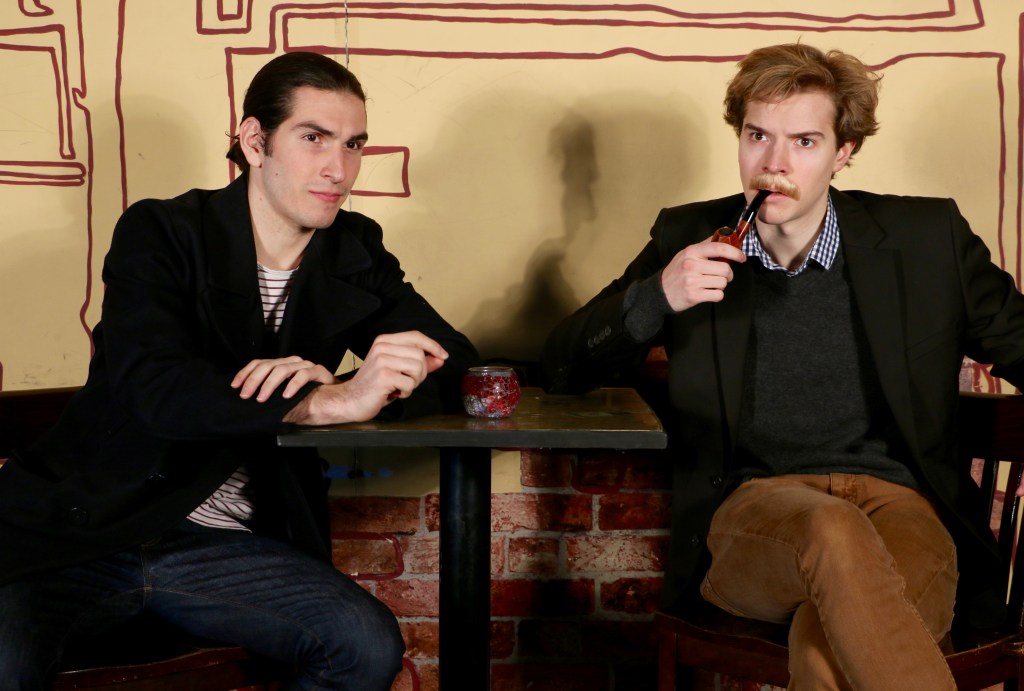
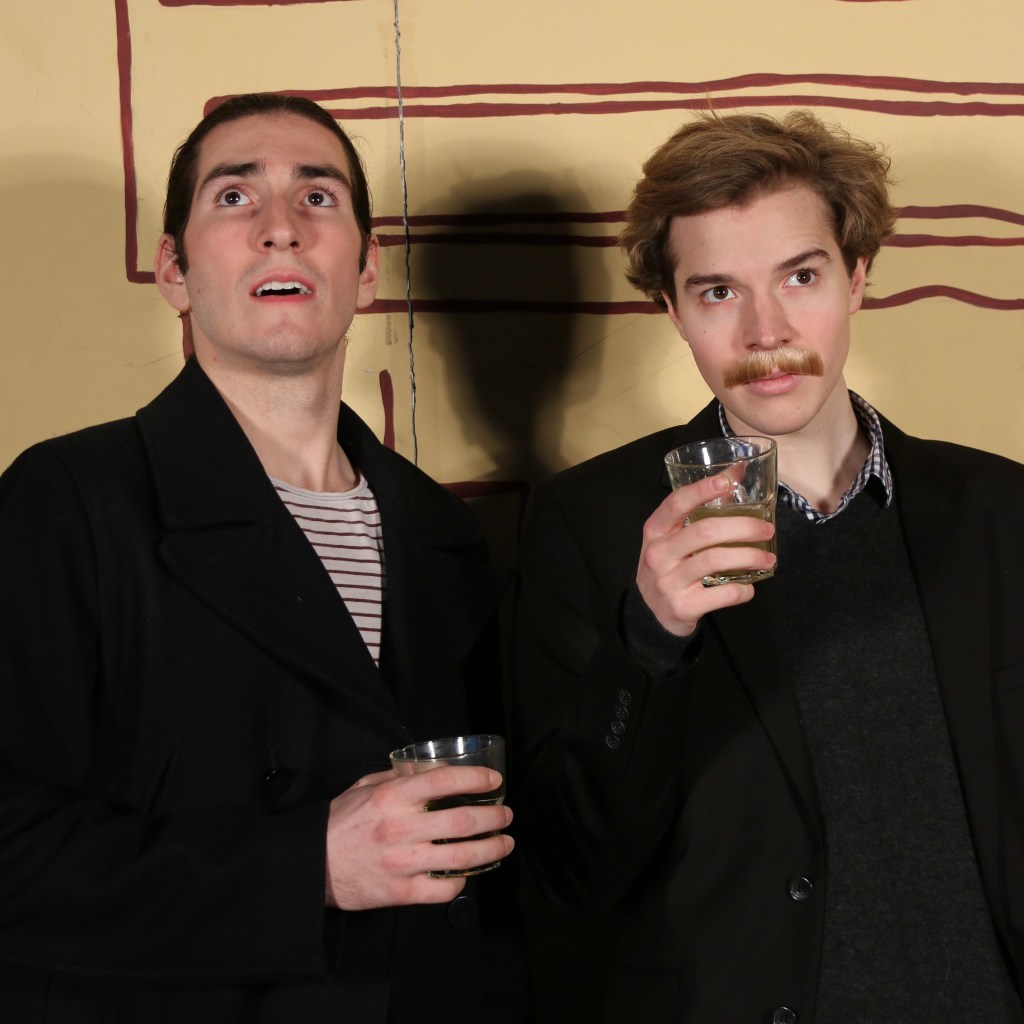
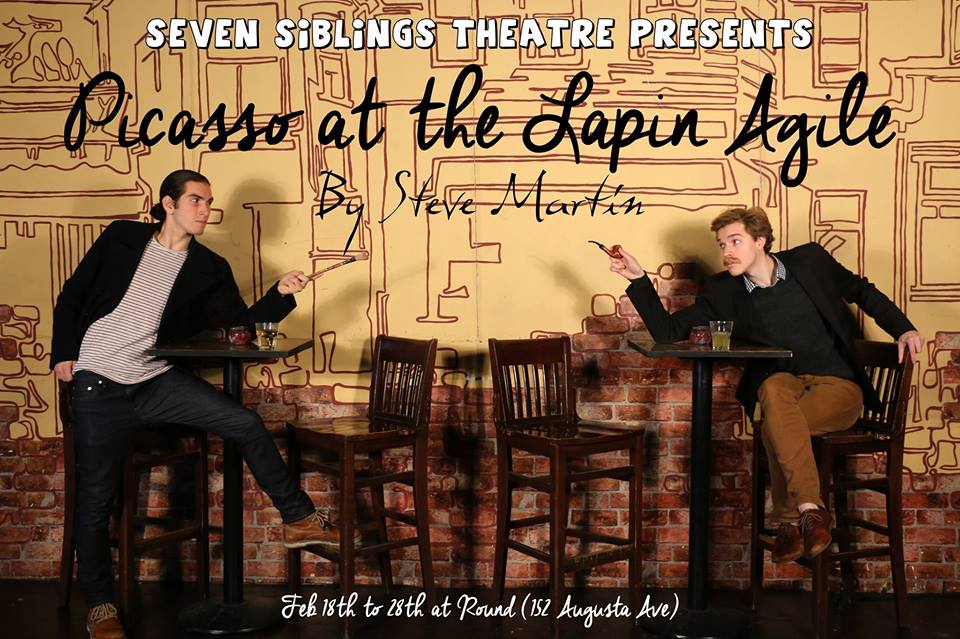
WK: Steve Martin (the established comedian, actor, writer, banjo aficionado) has written a play that features a young Pablo Picasso and Albert Einstein at the tipping point of their careers. It takes place at the Lapin Agile, a fictional bar in 1904 Paris, where notable intellectuals and visionaries go to talk about their manifestos. It also features a wide range of characters that gravitate to that space. It expertly deconstructs the intersection between art and science, and somehow manages to remain brilliantly funny.

We’re doing it site-specific at an event space in Kensington Market called Round. When we decided to produce it, we knew we wanted to get away from a traditional performance space. We wanted our audience to see the sparks fly between the actors, and really feel immersed in their revelations. We also thought they might like a beer!

IMG_1484

RQ: In what ways do you think this show questions how we look at art or innovation?

DE: This play challenges anyone’s personal definition of art. Einstein argues that his scientific discoveries are art, whereas Picasso dismisses these as mere equations. Steve Martin tells us that science is more than numbers: it’s a vision, it’s imagination, and then it’s trying to capture that and turn it into something calculable. We can’t dive into a black hole, or travel to other solar systems, but we can dream it. And then we can take that dream and see if we can prove it.

RQ: How do you think your choice of site-specific theatre informs or enhances the piece?

WK: I love the intimacy. Performing in the round (pun intended) just feels right.

DE: I had a very clear image in my mind of what I envisioned the space looking like. When we walked into The Round for our photo shoot I was blown away by how much the space looked like what I had imagined. I had no trouble believing that I had just entered a bohemian Paris bar circa 1904. It makes a huge difference as a performer, and hopefully for the audience too. You’re right there in the bar with us. You can grab a drink and be a fellow patron in the Lapin Agile with a host of eccentric characters. So it is definitely an engaging performance and the wonderful venue is a big part of that.

RQ: What can you tell me about Seven Siblings theatre?

WK: Madryn, Erika, and I founded Seven Siblings Theatre while gaining our teacher certification at the Great Lakes Michael Chekhov Consortium in Kent, Ohio. We shared the same ideals of theatre, a similar process, and wanted to bring more Fantastic Realism into Toronto’s indie theatre community. We aim to help artists develop their psychophysical connection, and dig deeply into the atmospheres of each production. By the end of each process, our artists have a range of tools and exercises from the Michael Chekhov work to play with.

IMG_1645 (1)

RQ: Why did you choose this piece as your next production?

WK: I am adamant that everything we work on needs to present a new challenge. We’ve played with malleable classical text, highly dangerous subject matter, explosive absurdist and visual performance styles, and now we’re tapping into an immersive experience. This is one of the most playful pieces I’ve ever worked on, and the incredible duality between farce and intelligence made it a no-brainer.

RQ: If you were going to set this show in 2016, which people would be the closest parallels to the way this show characterizes Picasso and Einstein?

WK: That’s a tough one. A lot of the charm in this piece is that they’re diamonds in the rough.

DE: [In terms of banter] Stephen Hawking and John Oliver (because that first interview was too good not to have a sequel). Bill Nye and Bob Ross. Spock and Han Solo.

WK: Yeah. Einstein’s definitely the Han Solo of this show.

RQ: If you could give this show a soundtrack, what three songs would be must-haves?

DE:
The Scientist – Coldplay
The Life of Pablo (the entire album) – Kanye West (Tidal required)
Blue (Da Ba Dee) – Eiffel 65

WK:
Bistro Fada – Stephane Wrembel (watch Midnight in Paris for context)
Space Oddity – David Bowie
Sounds of Science – Beastie Boys

DE & WK:
*Bonus Track* Tubthumping – Chumbawamba


Picasso at the Lapin Agile

Presented by Seven Siblings Theatre

12494796_409711225904049_4751960345749307790_n

A play by Steve Martin

Who:
Directed by Erika Downie
Featuring Dylan Mawson, Jamie Johnson, Madryn McCabe, Will King, Erin Burley, Erik Helle, Dylan Evans, Andrew Gaunce and Maxwell LeBoeuf
Stage Manager Jocelyn Levadoux
Production Manager Kate MacArthur
Lighting Designer Parker Nowlan
Dialect Coach Margaret Hild

Run Time: 90 minutes

When:
February 25 at 7:30pm
February 26 at 7:30pm
February 27 at 2:00pm (Matinee)
February 28 at 7:30pm

Tickets:
February 25-28 $25

Where:
Round, 152A Augusta Avenue, Kensington Market, Toronto, Ontario

Tickets: http://www.sevensiblingstheatre.ca/picassoatthelapinagile/

In Conversation with Miranda Calderon, performer/producer of Taking Care of Baby

by Bailey Green

Taking Care of Baby is a verbatim/documentary style play focusing on the story of Donna McAuliffe—a woman accused of murdering her two infants. The play uses testimony from those closest to McAuliffe to dig deeper in search of the truth. There’s just one catch—Donna doesn’t exist. It’s all fake.

Miranda Calderon takes on the role of Donna at the Storefront Theatre in Taking Care of Baby, a fake documentary play written by Dennis Kelly. Director Birgit Schreyer Duarte read the script years ago and shared it with Calderon as part of another project they were collaborating on at the time that focused on the victims and perpetrators of domestic violence. “Birgit and I worked together for the first time years ago when we did a SummerWorks show that was an adaptation of a novel,” Calderon recalls. “We both found that we really enjoyed the collaborative process of working together. In the years since, she has had so much more experience directing shows, assisting at Stratford and Canadian Stage where she works as a dramaturge and translator. We’ve both grown, and of course we benefit from being close friends. It’s a treat, and we feel incredibly lucky to be working on this project. And everyone involved is so incredibly wonderful and professional.”

Photo of Dylan Trowbridge by John Gundy.

Photo of Dylan Trowbridge by John Gundy.

By the time we meet Donna McAuliffe, she has already endured a brutal life. She lost two babies and suspicion surrounded the circumstances of their death. She was convicted of murder, sentenced to life and then eventually exonerated with the help of her mother. And now, estranged from her husband, childless, and reeling from 14 months in prison, Donna is living at home trying to put her fractured life back together.

Photo of Miranda Calderon & Astrid Van Wieren by John Gundy.

Photo of Miranda Calderon & Astrid Van Wieren by John Gundy.

Calderon approached the role with a desire to understand the intense experiences her character has been through. She researched prison life and reached out to a friend who works as a defence attorney to better understand the process of a murder trial. Calderon also has a very personal tie to the subject matter of the play. “I’m pregnant for the first time, so when I found out [about the baby] this summer and then when the project was selected by Storefront for their season, I was just wow-ed by the odd timing,” Calderon says. “I wondered whether it was a good idea to put myself in this world while I’m pregnant. But at the same time there was something so exciting and interesting about that coincidence. It’s only added to the process.”

McAuliffe is surrounded by a varied cast of characters, all with their own opinions about whether she did or did not murder her children. The actors often play multiple roles, some of which include: Donna’s mother the politician (Astrid Van Wieren), the estranged husband (Dylan Trowbridge) and more. Donna’s defence hangs on a new diagnosis by a psychologist named Dr. Millard (played by Richard Clarkin). Millard has diagnosed Donna with Leeman-Keatley Syndrome (a fictional disease) where a mother is so overwhelmed by the empathy she feels for the world’s suffering that she turns on the source of her pain, namely her children.

Photo of Richard Clarkin by John Gundy

Photo of Richard Clarkin by John Gundy

“A big part of this process has been the struggle to determine what’s true, what’s not true, who can I trust […] it’s part of what the audience is going through at the same time,” Calderon says when asked about how the style and format of the play affect the story. “When we realize that we were wrong about people, it can be so unsettling. It happens with people we are intimate with, with colleagues, and then public figures as well. The characters in the play operate on all three of those levels and so the audience goes through this questioning with us.”

Taking Care of Baby

Presented by The Care Takers at The Storefront Theatre

TCOB-web-banner-3-862x319

Who:
Featuring: Miranda Calderon, Richard Clarkin, Caroline Gillis, Craig Lauzon, Dylan Trowbridge, Astrid Van Wieren
Written By: Dennis Kelly
Directed By: Birgit Schreyer Duarte
Set Design: Michelle Tracey
Lighting Design: Steve Lucas
Costume Design: Amanda Wong
Sound Design: Matthew Pencer
Video Design: Remington North
Producers: Miranda Calderon & Adam Paolozza

When: January 29th to February 14th, Wednesday through Saturday @ 8pm, Sunday Matinee @ 2pm

Where: The Storefront Theatre – 955 Bloor St. W, Toronto

Tickets: $20-$25, Advance tickets available here.

Connect: http://thestorefronttheatre.com/events/taking-care-of-baby/

‪#‎INDIEUNITE‬ ‪#‎BabySFT‬

#TheresMoreThanOneTruth #BabySFT