Skip to content

Posts tagged ‘Toronto Theatre’

In Conversation with Michael Ross Albert, Playwright of “For a Good Time, Call Kathy Blanchard” at the NSTF

Interview by Brittany Kay

Like a long distance pen pal, I had the pleasure of corresponding with the talented and compassionate playwright, Michael Ross Albert, whose show, For a Good Time, Call Kathy Blanchard, is playing at the Next Stage Theatre Festival. We spoke of hockey, where and what we call home, and our constant quest to find out where we belong. 

BK: Tell me a bit about yourself. Where you’re from? Your journey to where you are now? 

MRA: I’m from Toronto originally and I started writing plays when I was in high school. I was a participant in one of the first iterations of the Paprika Festival many many years ago. I also used to act, and did that a bunch in university, which hammered home the feeling that I really preferred to be on the other side of the footlights. I was accepted into an MFA Playwriting program at the Actors Studio Drama School in New York, so I moved to the city and started training alongside some wicked talented Method actors. I kept writing plays and putting them on. When I graduated, my friends and I co-founded Outside Inside and started producing under that banner in a bunch of different festivals. And then, my Visa expired and instead of hiring a lawyer, I moved back to Toronto and started re-discovering the city as an adult for the first time. Now, it’s a real joy to be able to produce a play of mine in this particular festival with a cast and creative team who I’m proud to call friends.

BK: What inspired this play? 

MRA: In the summer of 2012, I was very interested in the idea of home. I was in the process of moving back to Canada, but was putting on a show in New York at the same time. So, I was sleeping on people’s floors, either in my mom’s basement or my old roommate’s living room. I didn’t really know where I belonged; I was unclear as to where “home” was (which is something customs agent ask you a lot when you cross the border fairly regularly and don’t have a job).

One night, in Queens, I happened to run into an old friend of mine. We started nostalgically rehashing these minute details about our shared past, like the time this funny thing happened to so-and-so, this piece of graffiti that had stuck in both our minds. Those small but very clear memories had become almost like personal talismans against… something. Adulthood, maybe. There we were, so far removed from our youth, so completely unsure of what was going to happen next in our lives, so far away from this place we hardly even thought about anymore. And those small details were the ones that still, somehow, burned very brightly. As directionless as we were at the time, these very personal but, otherwise, forgettable memories were quite comforting. I thought it was sad, but I also thought it was pretty funny. And that’s how the play was born.

Also, after years of crafting “well-made plays” at school, I wanted to rip a kitchen sink out of the wall.

Geoffrey Pounsett & Daniel Pagett in For A Good Time, Call Kathy Blanchard

Geoffrey Pounsett & Daniel Pagett in For A Good Time, Call Kathy Blanchard

BK: Are there familial ties from your own life to this play? 

MRA: Not really, but there are shadows of myself in each of the characters, and aspects of my own family members and our dynamics that must have influenced the relationships in the play. But not in any glaringly autobiographical way. It’s fiction for sure.

BK: After watching the show, I assume you’re a huge hockey fan? How did hockey influence your life and this play? 

MRA: I like hockey a lot. I can’t help getting swept up in it, especially if the stakes are high, like during a playoff game. What Jim Warren’s production of this play does very well, I think, is that it sets up the characters themselves as the opposing teams in a hockey game. They’re members of a family pit against one another in this very fast-paced, high-stakes competition. But, unlike hockey, even in this combative family, there’s no clear winner. In fact, probably, everyone in this play is a bit of a loser. But that’s because they don’t want to be pitted against each other. In fact, they really really love one another.

BK: What’s your favourite team? 

MRA: The Leafs.

BK: Why do you think the NSTF is important for the Toronto arts community and Toronto as a whole?

MRA: The festival is curated and they program new works that appeal to various demographics. Their programming is diverse, which brings people who wouldn’t necessarily see theatre into that tent. Each show is completely different from the others. Tickets are inexpensive, so for the same price as a movie, audiences can see really high quality indie theatre, or dance, or comedy. And, the festival literally brings arts-minded people closer together, huddled in that very cozy beer tent. January can be a very depressing month in a cold city and, if nothing else, NSTF gives you an excuse to tear yourself away from Netflix vortexes and be part of a community.

BK: What is your favourite part about the NSTF tent? 

MRA: It’s not the beer. It’s meeting, getting to know, and commiserating with all of the other NSTF artists, whose excellent work I’ve gotten to experience in the festival. The beer is pretty good, too.

BK: What inspires your stories? Where does your inspiration come from when you write?

MRA: I think, first and foremost, I want to write characters that actors would like to play. I think that’s the constant. Apart from that, I have no idea where the inspiration comes from most of the time. Overheard dialogue on the street, stories I’ve been told, phrases, songs, memories. Anything that surprises me.

BK: Do you have a favourite place to write?

MRA: Anywhere private with a window.

BK: What do you want audiences to walk away with?

MRA: I hope they’re able to see themselves and their loved ones in these characters. And I hope they know that, even in those moments when life sucks, they’ve got worth and they mean something to someone else.

Rapid Fire Question Round:

Best show you saw in 2014: Jesus Hopped the ‘A’ Train at Unit 102

Favourite play: Either Three Sisters by Anton Chekhov or A Delicate Balance by Edward Albee

Favourite actor: Phillip Seymour Hoffman comes to mind

Major influence: Edward Allan Baker

Best advice you’ve ever gotten: From a writing standpoint: “Cut into the action as close to the conflict as possible.” From a producing standpoint: “If it’s not fun, it’s not worth doing in the first place.”

For a Good Time, Call Kathy Blanchard

by Michael Ross Albert, presented by Outside Inside as part of the Next Stage Theatre Festival

Entire-Cast

Game Four, Stanley Cup finals. Lawrence is having a breakdown. Sky’s been kicked out of his house. Amanda’s career is going nowhere. Mary won’t leave the living room until someone wins the Stanley Cup. And they’re all preparing for a devastating loss, both on the ice and at home. But, Lawrence has a plan to fix his family for good. A tragic comedy about heartbreak, hockey, and the places we used to call home.

Tickets – $15

Connect: Outside Inside @OutsideInsideCo

Where: Factory Theatre Mainspace (125 Bathurst St.)
Length: 75 mins

Playwright Michael Ross Albert
Director Jim Warren
Featuring Jennifer Dzialoszynski, Daniel Pagett, Geoffrey Pounsett, Caroline Toal

When:

Wed Jan 7 – 8:15pm
Fri Jan 9 – 10:00pm
Sat Jan 10 – 4:45pm
Sun Jan 11 – 4:30pm – followed by a Talkback at The Hoxton
Mon Jan 12 – 9:30pm
Thurs Jan 15 – 7:30pm
Fri Jan 16 – 7:00pm
Sat Jan 17 – 2:30pm
Sun Jan 18 – 6:15pm

Artist Profile: Gwynne Phillips & Briana Templeton of The Templeton Philharmonic’s “Unbridled & Unstable” at the NSTF

Interview by Hallie Seline

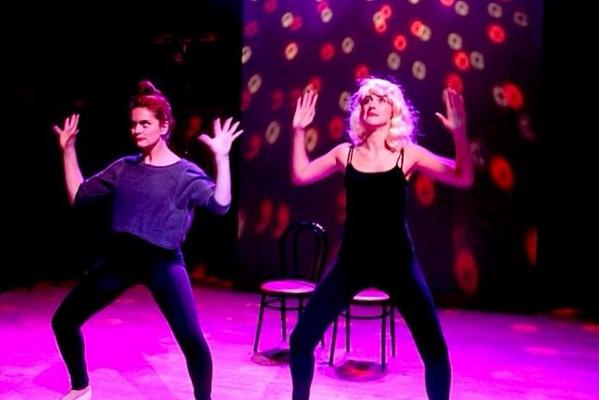
I had the pleasure of chatting with two hugely-talented, intelligent and down-right hilarious performers – Gwynne Phillips and Briana Templeton of The Templeton Philharmonic about their current sketch show, Unbridled & Unstable, a good-time-havin’ must-see at the Next Stage Theatre Festival (NSTF). 

We discussed the importance of taking risks, the freedom of making your own work, a remixed Downton Abbey theme song, inspiring artists, The Comedy Bar and putting the focus on the work.

HS: Tell us about yourselves.

B: I grew up in Kitchener, ON.

G: And I grew up in the country, near Orangeville, ON.

B: Both of us studied drama at the University of Toronto, where we met. We ended up doing a play together at Il Piccolo Teatro in Milan through the program, which needless to say was very, VERY fun. Since then, I’ve done a lot of theatre and worked behind the scenes for film companies. Right now, in addition to acting, I work as a writer and producer for advertising. It’s very fun and beneficial to infuse whatever comedy I can into my work in that arena, as well.

G: When I’m not performing with The Templeton Philharmonic, I work for a charity called A Ticket Forward as their Social Media Manager. Briana and I have also worked for TIFF doing various jobs. As far as other acting gigs go, I also starred as Barbra in Night Of The Living Dead Live! directed by Christopher Bond last year, which was an incredible experience and probably the most fun I’ve had on stage other than doing sketch.

HS: What sparked The Templeton Philharmonic to get started? 

B: We wanted to create something together as writers and performers, so we applied to the Montreal Fringe back in 2011. Thus, we were forced to create something and ended up making a comedy show. Nothing helps bring art to life like a solid deadline.

G: We were also never cast in anything together at U of T and wanted to create our own work where we could have the freedom to play any type of character we wanted… for instance… two monks in a monastery.

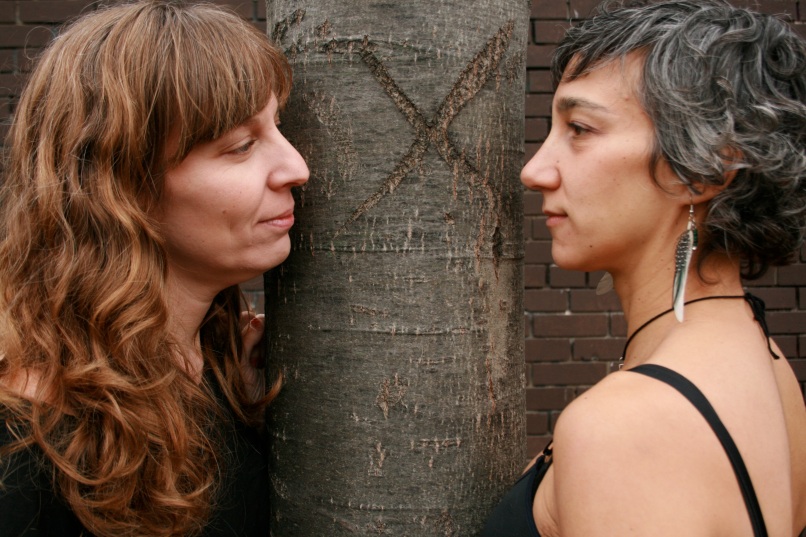
Briana Templeton & Gwynne Phillips

Briana Templeton & Gwynne Phillips

HS: Tell us a bit about Unbridled & Unstable at the NSTF.

B: It’s a comedy show that features a lot of surreal, strange and silly sketches. It’s a lot of fun to perform, and to watch as well (so we hear).

G: U&U (no one calls it that) is a loosely equestrian-themed sketch comedy show with a variety of characters who are all, in some way, either unbridled or unstable.

HS: We are thrilled at how many female artists are representing at the NSTF this year. As artists who hang out in the comedy circuit as well, is that somewhere you see the same vibrancy of female talent being recognized? We’d love to hear your thoughts. 

B: Yup, it’s great. We feel lucky to be a part of both the theatre AND comedy scenes in Toronto – which are home to some awesome talent (of all genders).

G: The calibre of talented ladies in the Toronto comedy scene is exceptional. We are very fortunate to have such a supportive comedy community.

To state the obvious: the entertainment industry is a tough one. And in many ways: it can be even more brutal if you’re female. I think that it’s important for the genders of creators and characters to be more evenly represented in media (the The Geena Davis Institute on Gender in Media has some great stats if you feel like being depressed). And that includes comedy. I think it’s important to acknowledge the disparity and try and actively change that state of affairs.

B: That said… we get asked A LOT about what it’s like to be female comedians. I suppose it’s because humour can be a very powerful thing to wield and/or master… you sink or swim. And there’s that myth that women aren’t as funny, due to our lady brains and all. As such, we’ve had interviewers focus on whether or not we cry after we bomb a set. Somehow, I doubt that’s something they would ask a male comedian…

Of course, our viewpoints as feminists and females does inform our work. It has to, and that’s a good thing. But, I don’t think that’s the ONLY thing we can focus on in our writing, either. We want to be good comedians, period. Not good for comedians that get their period (see what I did there? A pun!). What I’m saying is: we’re very grateful for being recognized as artists, and that people like and/or connect with our work. That’s marvellous. But I hope we don’t get extra kudos just because of our chromosomes, but because we’re doing interesting work. Ya dig?

HS: Totally. Great answer!  Why do you think the NSTF is important for the Toronto arts community and Toronto as a whole? 

B: It helps artists reach a bigger audience, and it helps us to access venues that would be difficult for us to afford otherwise (without jacking up our ticket prices). Getting to perform at the Factory Theatre, for example, is such a pleasure for us.

G: NSTF is great for creating a supportive community of artists gathered in one place to see each other’s work and inspire one another. It’s also refreshing to see so many people lined up outside at the coldest time of year to see some theatre!

Briana Templeton & Gwynne Phillips

Briana Templeton & Gwynne Phillips

HS: Who inspires you?

B: We both really like offbeat, old movies. We recently watched The Innocents (1961) together which is delightfully creepy. And of course, other writers and performers and comedians. I really love Maria Bamford and Key & Peele. In terms of fellow Canadians, I’d say: Tony Ho, Peter ‘n Chris, Kathleen Phillips, Mark Little and Dan Beirne (especially their recent “Space Riders” and “Dad Drives”), we could go on and on.

G: Obviously love Tina Fey, Amy Poehler, Kristen Wiig, and Sarah Silverman, among others. But if you just pop into Comedy Bar here in TO, you are surrounded by talented and inspiring folks from stand-ups to sketch comedians who are going out and performing almost every night of the week and just trying stuff out. That’s inspiring.

HS: What is your favourite part of Toronto and why?

B: I love Toronto Island. Probably because of the insane 50-100 year wait list to live there. It makes it that much more appealing because it’ll never happen. Also, name wise: I like Baby Point and Crestfallen Lane.

G: I really love biking in Toronto in the summer and going through all the different neighbourhoods. Seems like it’s becoming a really cool place to live all of a sudden. Maybe too cool…

HS: I would love to hear the best advice you’ve ever gotten. 

B: “Those pants look terrible”. KIDDING. That’s one of the not-so-helpful pieces of advice I’ve gotten. Hmm… a theatre teacher once said “Don’t move unless you need to move, don’t speak unless you need to speak” in regards to being on stage. The point is not to be hesitant on stage but to find your intension and have stakes. Everything you write as a writer and everything you do as an actor should serve a purpose. And, don’t be afraid to streamline your work and distill it. Zero in on what you’re trying to get across, and/or how you are moving the action.

G: Take risks. This is a hard one because it is easy to fall into a pattern that is comfortable – whether it’s in comedy or in life. Just do things that scare you. Don’t fall into old habits or repeat yourself too often. Shake things up!

HS: Favourite part about the NSTF tent? 

B: The heaters. Also, the people huddling around them.

G: The twinkly lights. And one year they had stew. I hope they have stew again.

HS: If you could have your audience listen to a song or playlist before seeing the show, what would it be? 

G: “The Downton Abbey Opening Theme Song” immediately interrupted by “Pump Up The Jam”.

(For your remixing purposes:)

HS: Describe Unbridled and Unstable in 5-10 words.

G: A fast-paced, energetic, comedy/variety show featuring hobby horses.

HS: What’s another NSTF show that you are most excited about?

B: I’m excited to see Dink! Kris Siddiqi makes a voiceover cameo in our show, and Jasmine Chen guest starred in our CBC Punchline web series, “Womanish”. Also, Graham Clark Reads The Phone Book and For A Good Time, Call Kathy Blanchard seem very promising.

G: I would love to see all the shows if I get the chance! They all look intriguing to me. That being said, Graham Clark Reads The Phonebook seems right up my alley.

Unbridled & Unstable

by Gwynne Phillips and Briana Templeton of The Templeton Philharmonic, presented as part of the Next Stage Theatre Festival

Horse-Photoshoot

Playing everything from upper crust Edwardian snobs to unhinged modern suburbanites, Briana Templeton and Gwynne Phillips have created a show loaded with surreal humour, outrageous dance sequences, and biting social commentary. Unbridled & Unstable will feature best-loved sketches from the duo’s repertoire alongside plenty of daring new material. Expect the unexpected.

Tickets: $15 – Buy here.

Connect: The Templeton Philharmonic

http://templetonphilharmonic.com/
@TempletonPhil 

Where: Factory Theatre Studio (125 Bathurst St.)
Length: 60 min

Created by Gwynne Phillips and Briana Templeton
Featuring Gwynne Phillips and Briana Templeton
Stage Manager Vanessa K. Purdy

When:

Wed Jan 7 – 8:30pm
Fri Jan 9 – 5:15pm
Sat Jan 10 – 2:45pm
Sun Jan 11 – 7:00pm – followed by a Talkback at The Hoxton
Mon Jan 12 – 9:15pm
Wed Jan 14 – 6:45pm
Thu Jan 15 – 7:15pm
Sat Jan 17 – 9:00pm
Sun Jan 18 – 6:00pm

In Conversation with Jenna Harris – Playwright & Performer of “Mine” at the NSTF

Interview by Hallie Seline

It’s January. It’s cold. But if there is one thing to make this bleary month bearable, it is the excitement for The Next Stage Theatre Festival, a curated festival from The Toronto Fringe which provides past participants the opportunity to take their work “to the next level”. It is a great chance for artists to dig deeper into their projects and for audiences to see a variety of indie work and be introduced to new artists in between trips to the heated beer tent where you can connect with friends old and new and discuss the work over a local brew.

I had the pleasure of chatting with Jenna Harris, playwright/performer of Mine playing in the Factory Theatre Studio Space. We discussed the benefits of wearing many hats in the theatre world, playing with form and poetry, where she looks for inspiration, and the need to produce more work featuring the lesbian voice and authentic female sexuality. 

HS: Tell us a bit about yourself.

JH: I am an actor, writer/creator, arts educator and dancer (although formerly!), and the Founder and Artistic Director of Discord and Din Theatre. I am also a member of the [elephants] collective, a devised theatre collective. Originally from Kingston, Ontario, I went to acting school at The American Academy of Dramatic Arts (NY) before moving to Toronto.

HS: You wear a lot of hats in the theatre world. Can you speak about the benefits of this and what you’ve learned because of your experience?

JH: Absolutely! I am currently the Interim General Manager of Studio 180 Theatre, and was once the Assistant Box Office Manager at Buddies in Bad Times Theatre. These two jobs, have been invaluable in teaching me the skills required, as well as the confidence, to self-produce.

Producing was not something that was taught to us or even spoken about when I went to acting school, so I never thought that would be something I would end up doing. But after moving to Toronto and seeing what a vibrant indie theatre scene existed here, and that it was possible to self-produce if you have the knowledge and skills to do so, I really wanted to learn as much as I could to create opportunities for myself and to get my work out there.

HS: Talk to us about Mine and why you wanted to put this story out in the world? 

JH: Mine is the story of the relationship between Bea and Abigail who meet when Bea is an undergrad and Abigail is her T.A. It is a story of joy, laughter, desire, miscommunication, sex, sadness, vulnerability, anger, lust, humour, growth, fear and love.

There are sort of three components to the story that, when I first started writing it, I wanted to tackle. The first one was that I was interested in musing on relationships: why they work, why they don’t, what it feels like to be in them…love, conflicts, power dynamics… And with this, the second one was, more specifically, that I wanted the relationship to be a lesbian one; not about being in a lesbian relationship, but simply about one. It’s a mystery to me why lesbian voices are not as numerous on Toronto stages as I feel they should be, given the strong lesbian presence in the theatre community and in the city as a whole. Lastly, I was interested in writing a play that paid homage in some small way to female sexuality – something that I also feel is lacking in theatre in an authentic and relatable way.

Michelle Polak and Jenna Harris in Mine

Michelle Polak and Jenna Harris in Mine

HS: Can you speak about your use of poetry in Mine and a bit about the play’s structure?  

JH: The role of poetry in this play is interesting, for me at least, because it wasn’t anything that I had planned to do. I didn’t start out by saying, “I would like to feature poetry in this piece”. It more just happened.

I am very interested in language and how we use language, particularly patterns of speech – the poetic rhythms of natural and not-so-natural speech. So this is where I first started. But then I guess I moved on to questions such as: What makes poetry/a poem? What is it about certain words or the way in which they are strung together that makes us feel things versus times when we don’t? And what does it mean when we can say things in a structured format like poetry or playwriting for that matter that we can’t in real life?

And so it was these questions as a playwright, coupled with the fact that Mine isn’t linear that I was interested to see how the theme of poetry, as well as poetry itself, could tie this play together and help to extenuate the journey of this relationship.

HS: Why do you think festivals like the NSTF are important for the Toronto arts community and Toronto as a whole?

JH: I think that festivals like NSTF provide an opportunity for artists to put their work out there in an extremely supportive environment where, not only is there the opportunity to continue to gain skills in self-producing, but also, because of the support of the Toronto Fringe, you are able to really focus attention on the art being created. This is a huge luxury.

Furthermore, NSTF creates a physical space, a hub, for artists to be able to come together and meet one another, and share and get excited about what is being created in our city, whether that’s a NSTF show or something else. Having this space and opportunity to interact with one another, and in solidarity brave the freezing winter to do so really bonds us as a community.

In terms of Toronto as a whole, I think NSTF is a chance to see work that might not be seen otherwise, or if it is, may go under the radar. Also, with the festival setting, I think people are more likely to come to one show and then maybe stay for another, see something they might not see otherwise, again exposing them to new work and artists.

Jenna Harris and Michelle Polak from Mine.

Jenna Harris and Michelle Polak from Mine.

HS: Where do you look for inspiration? 

JH: Hmmm… I think content inspiration for me usually comes from things that I find fascinating in the world or that I have questions about. I am particularly interested in the personal and the interpersonal; what makes us tick as people, as well as the ways in which we as people interact with each other and the world around us.

As for aesthetic and writing style/structure, inspiration for this has come from constantly reading plays from all over the world, but also going out and seeing theatre and other types of performance. I love being inspired by the work of others, whether that inspires me to try something new in my writing, or pushes me to risk more.

HS: What is your favourite part about the NSTF tent? 

JH: My favourite part of the NSTF tent is the atmosphere. There is so much energy and excitement in one place, you can’t help but be swept up by it. Even on our opening when it was -30, people were in the tent chatting with one another and getting revved-up to see shows. As a theatre artist, this is essentially heaven!

HS: If you could have your audience listen to a song or playlist before seeing the show, what would it be? 

JH: Oooo…good question! Well, a song that our Director Clinton Walker had us listen to was Pentatonix’s Run to You. Although I would maybe say listen to it after the show as opposed to prior to. I would say listen to something before that you love and that makes you want to get up and dance because who doesn’t love to dance?

**No cheating… listen to this after you see the show:

HS: Describe Mine in 5-10 words.

JH: Mine is about what it means to love someone.

HS: What’s another NSTF show that you are most excited about?

JH: Okay, so I’m going to be that person who answers this way: I’m excited to see all of them!

I am, actually. I’m looking forward to seeing what the other companies have been working on the past few months as we’ve been working on Mine, how diverse the shows are, and the passion with which these companies are putting their works out there.

Mine

by Jenna Harris, presented by Discord and Din Theatre as part of the Toronto Fringe’s Next Stage Theatre Festival

Mine

A bar, two strangers and a Fuzzy Navel. Mine is a rhapsodic odyssey of love, loss, laughter and the lives of two women as they build a relationship together. Composed within a haunting and sensual rhythm, this is a play that speaks to our desire and desperation to be understood, valued and loved. Our human need to belong.

Tickets: $15 – Buy here.

Connect: Discord and Din Theatre @DiscordandDin

Where: Factory Theatre Studio (125 Bathurst St.)

Length: 60 mins

Playwright Jenna Harris
Director Clinton Walker
Featuring Jenna Harris, Michelle Polak
Sound Designer Lyon Smith
Lighting Designer Adrien Whan
Dramaturge Clinton Walker
Producer Emma Mackenzie Hillier
Stage Manager Christopher Douglas

When:

Wed Jan 7 – 6:30pm
Thu Jan 8 – 9:00pm
Sat Jan 10 – 8:45pm
Sun Jan 11 – 5:00pm
Mon Jan 12 – 7:15pm – followed by a Talkback at The Hoxton
Wed Jan 14 – 8:30pm
Fri Jan 16 – 4:45pm
Sat Jan 17 – 2:45pm
Sun Jan 18 – 4:00pm


Artist Profile: Something Wicked This Way Comes… Q&A with the Macbeths – Amelia Sargisson & David Ross

Interview by Bailey Green

I interviewed actors Amelia Sargisson and David Ross who play the Macbeths in Shakespeare Bash’d upcoming production of the Scottish play. We discuss working with Bash’d, focusing on storytelling and taking on the title roles. 

About the actors:

Amelia was born and raised in Montreal, she moved to Toronto to attend Ryerson Theatre School under the direction Perry Schniederman. Post graduation she decided to stay in Toronto to pursue her career. Her love of the city was a “slow burn” and she finds the city’s openness to new, and international, ideas and methodologies inspirational.

David is originally from New Hamburg, a menonnite town, and didn’t start out as an actor. He actually left a career as an engineer to attend the University of Windsor’s Acting program. Both actors share a healthy list of theatre credits to their name with companies across the province and the country.

Bash’d does Macbeth, how will it be different from other productions?

AMELIA: There isn’t a concept per-se. Bash’d built their reputation on a bare bones approach to the text which highlights the characters with their relationships and scenes above all. The action isn’t transposed, it’s just letting the words do the storytelling.

DAVID: I get questions from people all the time, what’s your concept? Are you doing Elizabethan? But our goal is just to be clear with the storytelling. For example, we fight with Bowie knives and there are garments that distinguish people as military or non-military, but there’s no time period. The story telling is clear and our main focus.

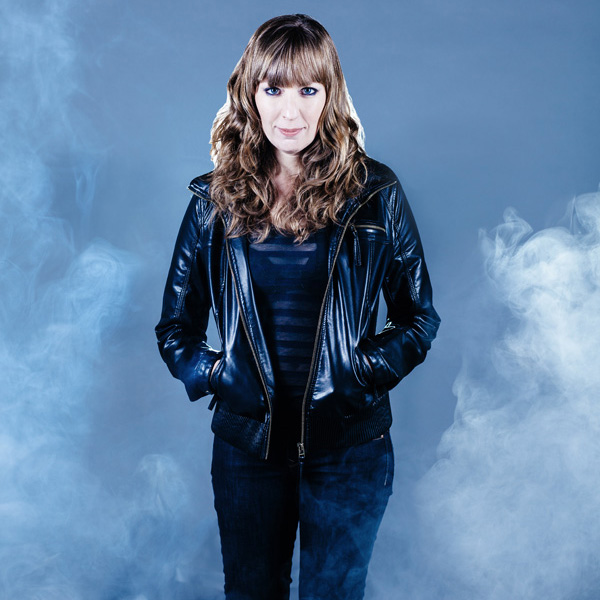
Julia Nish-Lapidus, Maggie Blake and Hallie Seline. Photo by Kyle Purcell

Julia Nish-Lapidus, Maggie Blake and Hallie Seline. Photo by Kyle Purcell

On the challenges of these well-known roles: 

AMELIA: Director James Wallis has insisted several times in rehearsal that there is no “Lady Macbeth,” there is only you. In some ways I agree with him, I only have myself to bring to the part. I can only trust that the words and language of this character will be the gateway into her soul, heart and thoughts. Her ambition is fierce in a way that is kind of frightening. I would call myself fierce, but I would never consider murder to achieve my objective, thankfully, so trying to make that leap is where I have to fill in the blanks.

DAVID: The expectations of people are astounding and if I think that for a second I get a little panicked. People love this show. When people say they can’t wait, the outside part of me smiles and the inside says what the bleep. I am what I am. I draw on my life experience; I’ve had a scrap at a hockey game but I’ve never dissected humans on the battlefield and been lauded and given medals for it. I’m an urban dweller that grew up in the country. Growing up, I knew men that were honourable and noble, warriors and athletes. It’s been wonderful getting him [Macbeth] to walk when I wanted him to run. I lost a lot of sleep, but even that gave me insight into the show.

On building the marriage of the Macbeths:

DAVID: When I first found out about Amelia’s casting I was thrilled. But then I laughed a lot because the woman playing the love of my life is actually the wife of my mortal enemy onstage (Macduff, played by Kyle Purcell) and they got married during the rehearsal process! Amelia is amazing, as attested I think by how busy she’s been in the theatre world. It’s such a terrifying relationship, and she plays a character that convinces me that one of the worst sins in the world is a-okay. It’s exciting for me to be convinced by her and it’s tough to put up obstacles. The relationship, for me, is the crux of the play. When it starts to fall apart, the plays goes to hell.

AMELIA: James [Wallis] identified that we have good chemistry onstage and we didn’t have to work for that. The privilege of working with Dave is that he’s game to try it every way, preposterous or silly or wrong and in doing that we’ve discovered textures and layers in all forms. There’s only so much you can learn by talking about it [which we did] but sometimes you just have to get in the muck of it. It’s important for me to have esteem and love and admiration for this man, for his courage and nobleness. I have found that easy to access because he is all of those things, lovable with a true heart. 

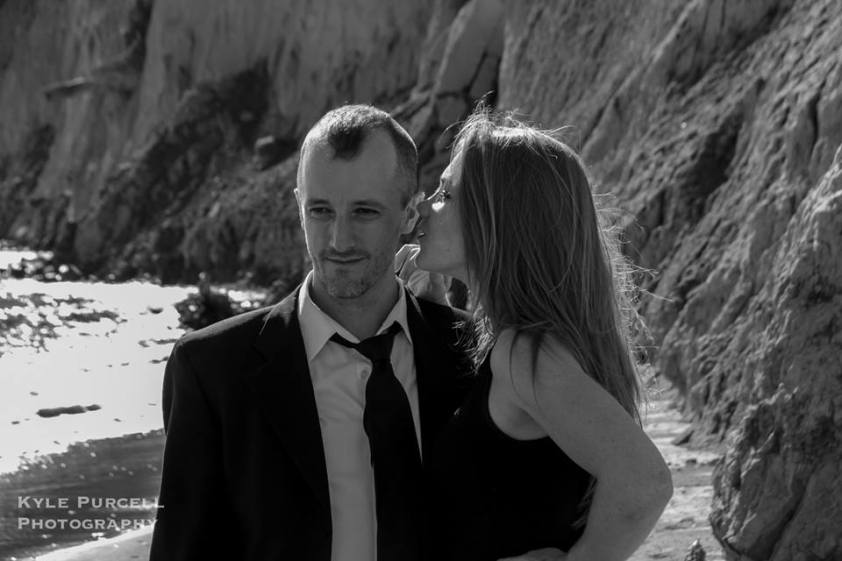
David Ross and Amelia Sargisson - Photo by Kyle Purcell

David Ross and Amelia Sargisson – Photo by Kyle Purcell

On working with Bash’d:

Amelia met Artistic Director James Wallis at Ryerson, and Amelia and David met when they were cast as the Capulets in Wallis’ staged reading of Romeo and Juliet, which was Bash’d first theatrical endeavor.

AMELIA: Beyond the first two staged readings, this is only the second full production I’ve done with Bash’d but it’s the first time James has directed me. It’s a privilege for me to work with him. His ability to illuminate the text is unmatched. The company is less practiced in doing tragedies, focusing on lighter content in the Fringe Festival. But last year they did R & J, and [Macbeth] is one of Shakespeare’s more mature tragedies. The company is continuing to grow and taking on more ambitious projects.

DAVID: Many things are different and the same. The same is James’ knowledge of Shakespeare. Before the show he has mined every source for context, meaning, double meaning, triple meaning, historical basis and he’s done that for every word of the play. What is different is I have never been a part of the rehearsal process this much. It’s my first crack at a title character. James and I have discussed things over drinks, through text and email, in moments passing each other in the hall. I have to say the process of building my character hasn’t been much different, but the journey is just a bit longer.

AMELIA: And the result will surely be different. 

Why theatre?

AMELIA: I believe in the power of a well-told story to affect people in different ways […] and to inspire them to make changes in their own lives. I love and appreciate the opportunity theatre creates for communion, to be in a room of sentient beings with a shared life and away from the solipsism of our glowing screens. The power of live theatre is very unique.


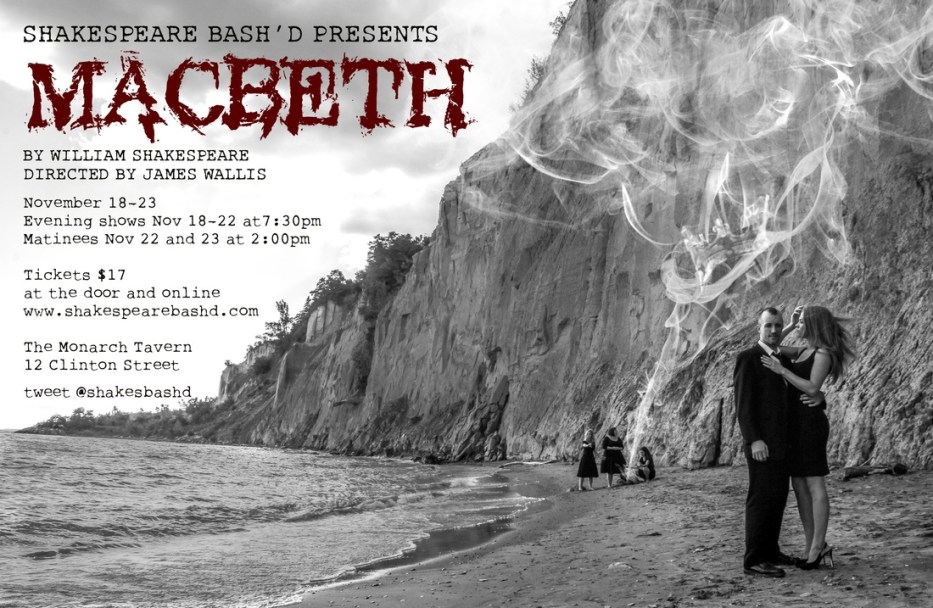
macbethcover

One week only, Macbeth runs at the Monarch Tavern (12 Clinton Street, just south of College) until Sunday November 23rd.

Tickets: $17 http://www.shakespearebashd.com/tickets.html

Follow Bash’d: @ShakesBASHd
Follow In the Greenroom writer Bailey Green: @_BaileyGreen
Follow In the Greenroom: @intheGreenRoom_

Tarragon Theatre’s Playwrights Unit: Playwright Profile – Evan Webber

by Bailey Green

I connected with Evan Webber to ask him a few questions about working with the current Tarragon Playwrights Unit. The upcoming Play Reading Week runs from Tuesday November 18th to Saturday November 29th in the Near Studio in the Tarragon Theatre. Each reading is at 8pm. Other Jesus, the play Webber workshopped in the Unit, will be read on Friday November 21st.

BG: Tell me a bit about yourself, where you’re from and where you live now.

EW: I’m from Ottawa, or at least I mostly grew up there. I came to Toronto when I was still young enough to do some growing up here too. But I was old enough that I only have one layer of association on things. No nostalgia.

BG: When did you start writing? Did it begin with plays or have you experimented with different forms?

EW: I always wrote things as a sort of game with myself, from when I was very young. I couldn’t read or write until I was pretty old so I listened to things and got my mom to help me write things down.

Later, writing plays became a way of expanding that game to include other people, so I started doing that when I was in high school. It gave some form to the socializing, helped me to understand the dynamics of people, so I guess I liked that. I always felt drawn more to other forms of writing, but I liked the way that reading and writing plays always implied or assumed some other collective action to come, one set in motion by the text. Most of the writing I’ve done in the last five or ten years has been with other people, collaborative writing of one kind or another.

BG: Tell me about the play you’ve written with the Unit this year.

EW: I’d had this very schematic idea to make a pageant play about the life of Jesus for non-performers, a kind of allegory about virtuosity for presumably non-virtuosic people. It’s about the life of a teacher in ancient Judea who starts performing miracles and how that changes him and his friends, and about how he takes on that identity as a miracle-performer. I guess it’s about leadership in cultural projects. 

14563

BG: What was the experience of working with the Playwrights Unit like?

EW: It’s nice to realize that everyone has a different idea about what makes something good. Like I don’t think anyone agrees. That’s really cool. That’s evident all the time.

BG: How has the Unit helped with the creation process of this play?

EW: I wanted to produce something out of the constraints of the theatre and the Playwrights Unit. There was no other good reason for me to be there or for me to take part. I don’t mean to say that you’re only supposed to do one thing in the Playwrights Unit, I just mean that there are a number of assumptions that a conventional theatre company like Tarragon holds, it’s in the walls and the floor, it affects everyone there. So I thought, maybe I can exaggerate these particular institutional assumptions into a kind of system and make something out of that. So the play is all about the Unit from that perspective. Every part of the play reflects the conditions of the Unit.

BG: What has been the most challenging aspect of this play? What themes does it deal with?

EW: Sticking with the approach. The play sketches some people who grapple with their fundamental interchangeability. So I didn’t want to write something I recognized as my own: I wanted the language of the play and its structure to come to terms with interchangeability too, to be just barely acceptable or competent. It was a challenge to stay committed to that, to not make it more clever or polished, to stick to my constraints, even when they seem to deflate the drama.

BG: What advice has helped you the most in your creative career?

EW: I don’t know. I had a dream once where I went to a Japanese restaurant with an artist I really respect and this artist told me, “Okay Evan, you’re an okay writer, you work hard and you’re thoughtful but you don’t have any vision for feelings, and without that your work is meaningless, you’re in the wrong business…”

But that was just a dream.


Some Favourites:

Playwright(s): Heiner Müller’s and Gertrude Stein’s plays always surprise me. Richard Maxwell

Author(s): Lately, I keep going back to Kathy Acker and Roberto Bolaño

Time to write: Whenever

Coffee shop: Oh, huh

Website or Blog: Facebook or maybe Bomb magazine


More information on the Tarragon Playwrights Unit and the playwrights involved can be found on their website


Past In the Greenroom Playwrights Profiles:

Playwright Alexandria Haber: https://inthegreenroom.ca/2014/09/16/tarragon-playwright-profile-alexandria-haber/

Dramaturg Andrea Romaldi: https://inthegreenroom.ca/2014/06/19/tarragon-theatres-playwright-unit-an-introduction-with-dramaturg-andrea-romaldi/


Follow our writer Bailey on Twitter: @_BaileyGreen