Skip to content

Posts tagged ‘Toronto Theatre’

2014 Fringe Preview – Three Men in a Boat – Pea Green Theatre Group

Interview by Charlotte Cattell

On a warm Friday afternoon I entered a very warm rehearsal hall. But even in the stifling heat I entered a room of extremely happy and exceedingly warm-hearted artists. Having just completed a run, this generous team agreed to sit down with me and talk a little bit about their upcoming production in the Fringe, Three men in a Boat. I had the privilege of speaking with Adaptor: Mark Brownell, Director: Sue Miner, Stage Manager: Hilary Unger, and the Cast members including: Scott Garland, Matt Pilipiak, and Victor Pokinko.

Charlotte: Sue, tell me a little bit about the show. How did this group and project come together?

Sue: Well, the show is Mark’s adaptation of an old book by Jerome K. Jerome. The book was published in 1889, and it’s known all over the world, it’s a very very famous book. There have been a lot of different interpretations, but this story actually came into Mark and my life years and years ago. We actually… well, he’s been wanting to do a play on it since the nineties, hey?

Mark: (Nodding yes.)

Sue: We’ve done the Fringe for a very long time, the Pea Green Group, and Mark was actually a theatre history teacher of both Scott and Matt. So, he said, let’s do “Three Men” with these guys, and I had just worked with Victor. So this is how we all came together.

Mark: We got too old to do it ourselves, we needed some young bodies.

Charlotte: And Mark, what drew you initially to this piece?

Mark: It has a really strange lasting appeal because it’s never been out of print. And the reason is, I think, is because bad camping experiences are kind of universal and eternal, and Canadians understand that really well. That’s why it goes well in Canada. It just never falls out of fashion. This story has a freshness to it, even though it’s Victorian and the language is very old fashioned, for some reason it strikes a chord with us to this day.

Sue: And also, the fact that these three guys are stressed out and have to get away from it all. And we think it’s new to us. You know, it’s like, I have to get off Facebook, I have to get away, but these guys are feeling the same things that we do and they have to get away. So that’s what they try to do.

Charlotte: How has the overall rehearsal process been?

Matt: It’s been great! It’s been a whirlwind. This is our day nine of twelve, but it’s great because, although it’s a short amount of time, it’s the only thing we’ve been focusing on and we’ve been able to constantly live in this world for the last week and a half. It’s been a lot all at once. Sweaty and fun, but it’s been really good.

Scott: The virtue of such a shortened intense rehearsal process is that we as actors are given a chance to practice efficiency in process. We love playing, we still play in the room. However, this has been a wonderful opportunity to show up, do your job, and then have fun doing it. I wish we had more time, but with the time we’ve been given it’s one of the most awesome experiences I’ve had, and that’s due also in part to the professionalism of the actors and the trust of our wonderful director and the wonderful material to play with. And also, Mark has made cuts throughout to make it even more efficient. There’s something very refreshing about being able to zero in and harness the core of those entertaining bits.

Mark: It is a new script so we are cutting and chopping away. Putting stuff in to make it work.

Charlotte: Has the pressure of a short rehearsal process caused you to make rash decisions in terms of cutting or changing scenes in the script?

Mark: I wouldn’t say rash but we are well aware of the pace. The fact that it’s a journey, it has to be paced well. You can’t just have frantic action. You need the little nooks and crannies where they have pauses so the audience can take a breath as well. It’s quite a different experience were we to take it on further, which is of course what we want to do, but we’d have to expand it into ninety minutes and two acts and then the pace would be quite different.

Scott: Also, the minimalism of props and sets, the world is very much created mostly through our three combined efforts.

Matt: We have a stool, a chair, a stuffed dog and a banjolele. That’s it! And somehow we take the audience on an entire journey down the river.

Victor: I think what Scott said was bang on. The fact that we can play and that we can find play because there is a certain level of chemistry between me and these two that I can kind of harness and tap into and work off of. I think the reason we are able to get as much work done as we are is simply because the chemistry is flying constantly. And even if one of us is having an off day or an off run the other two are very ready to pull up and work a little harder to get things rolling.

Matt: Yes, even though I narrate a majority of the piece, it is impossible without the three. You need three to carry the story and you can’t have any part of the story happen without one of them.

three men

Charlotte: And Mark, as the writer, are you seeing what you expected to see while you were creating the piece?

Mark: Yes absolutely. I mean, I wrote the original text so long ago, that I obviously had three other people in mind, but when we reopened the text and had a look at it again I knew I wanted three very distinctive actors that stand out individually but can come together. And that’s the unique thing about these guys. They fit like a glove, from day one. They’re still close to their theatre school training so they haven’t gotten lazy like me. You know, you get far enough away from school that you lose that kind of edge, that sharpness and these guys have it in spades. I’m exceedingly happy with these guys.

Charlotte: I noticed that Rigzin Tute is noted as being in charge of music. Was the music created specifically for this piece?

Matt: Rigzin, who is the Music Director of this piece, didn’t write the music but he took an old song, it’s called the Eton Boating Song, and he arranged it into an a-cappella, three part harmony, barber shop sort of thing. That we use as a motif throughout the journey.

Scott: Would you like to hear the song?

Charlotte: Absolutely!

Victor: Do you have the pitch pipe?

Matt: Yeah!

Matt proceeds to blow into the pitch pipe. All of the gentlemen hum, and Matt counts them in with a rigorous and British “1,2,3,1,2,3”. They proceed to serenade me with one verse of an old fashioned and very upbeat song that put me right into their world and onto the boat with them.

Charlotte: Wow! That was so amazing thank you! It’s like a free concert! In the 1800s! Even from that I can get a sense of that chemistry you all spoke of earlier, which leads me to my next question. Sue, how has it been to take on this project with just a three person cast?

Sue: Three’s the perfect cast! Three is the perfect amount of people in a show because a one person show that’s a whole different animal, and two people you feel like you’ll be stuck with these two people, but three you’re never bored! Some of them sort of play other characters too and it’s so lovely.

Charlotte: And how has it been for you guys? How has it established the relationship dynamic between the characters?

Scott: To echo Victor, it’s wonderful to be in rehearsal with a cohesive unit. But the characters in the script are done in a way that each one is different enough to be interesting on their own but they’re similar enough that when they’re together they act as a unit. It’s three pillars holding up a show and it’s the perfect balance.

Victor: When you’re blitzing into a Fringe, if you have a ten person cast, the chance of you getting to know nine other people is difficult. If you have a two person cast it’s very easy to get sick of them. But with three it becomes a nice dynamic.

Matt: You have the dynamic of each individual. Then you have the relationship between two and the relationship between the other two, and finally all three together. So then there are a lot of different microcosms, and all of that you can kind of rest on.

Charlotte: What has been your favourite thing to rehearse for this show?

Victor: I don’t want to give too much away, but we have a spectacular pineapple war. And that is my favourite part.

Matt: We go to war with a tin of pineapple. Umm…

Scott: It’s…It’s intense.

Victor: Possibly the most intense thing I’ve ever done.

Matt: Uh, yeah actually, I think that would have to be my favourite bit too.

Scott: Yeah, it’s unanimous. I love that sequence so much.

Charlotte: Kind of a silly question, what would you say, for each of you, is your character’s favourite and least favourite trait about your two counter parts?

Victor: Oh God!

Scott: There’s so many!

Mark: All they do is complain about each other.

Victor: I think Jay (Matt Pilipiak) takes things too personally and I think Harris (Scott Garland) drinks too much. What I like about Harris is that he always makes me laugh, always, always, always. And, what I like about Jay is that he is so poised and so elegant. He’s so idealistic. The beautiful things in the world, he just wants to grab them and put them into his philosophical brain and muse and muse.

Matt: I like that George (Victor Pokinko) has all these facts. He’s a very factual man, regardless of whether or not they are correct facts. I go to him for the facts. He’s like Wikipedia before it existed. But I don’t like when he tries to steal my spotlight. That hurts my feelings. I like what a wild card Harris is, that I never know what he’s going to do. I find that very entertaining. And I don’t like that he drinks.

Scott: I like that George is very willing to be my partner in crime for anything. Let’s go swimming! Okay! I like that Jay clearly holds us as part of his team. He’s very selfless in that way, very loyal and I appreciate that. What I don’t like about George is that he thinks he can play the banjolele. You cannot play the banjolele. And what I don’t like about Jay is he’s less willing to do something stupid with me.

Charlotte: Any final thoughts?

Sue: I’m really excited to share it with an audience because I sit here and I am grinning from ear to ear watching it. It’s so much fun and it’s going to be great to see it in that space because the Annex has that wood. In fact we’ve incorporated the wood of the theatre into the play. And our little set such as it is matches the theatre so it’s just going to be really wonderful to be there. And the thing that always blows me away is watching them, and I know how it goes, but to see them travel so far and always wherever they are I’m there. If they’re sitting out on a grassy bank looking up at the stars, I’m there. If they’re in the middle of a busy walk, if they’re in a thunder storm, I’m there. I think that’s really special.

menthreeboat

I for one cannot wait to be charmed by this cast and its production team once again during the Fringe. Bon voyage, see you on the waters!


Three Men in a Boat

Presented by Pea Green Theatre Group as part of The Toronto Fringe

Three Men in a Boat Cast from left to right: Victor Pokinko, Matt Pilipiak, Scott Garland

Three Men in a Boat Cast from left to right: Victor Pokinko, Matt Pilipiak, Scott Garland

Directed by: Sue Miner

Original Story by: Jerome K. Jerome

Adapted by: Mark Brownell

Musical Arrangement by: Rigzin Tute

Period Costumes by: Nina Okens

Stage Managed by: Hilary Unger

Starring: Victor Pokinko, Matt Pilipiak, and Scott Garland

Where?  The Annex Theatre (730 Bathurst Street)

When?  July 2-13
July 02 at 6:30pm

July 04 at 1:15pm

July 06 at 4:00pm

July 09 at 9:15pm

July 10 at 11:00pm

July 12 at 7:30pm

July 13 at 12:00pm

Tickets: Can be purchased via http://fringetix.ca/ or by calling 416-966-1062

And for further information on the Pea Green Theatre Group you can visit their website at: peagreentheatre.com

Trailer:

2014 Fringe Preview – 52 PICK-UP with The Howland Company

Interview by Bailey Green

I interviewed Paolo Santalucia, James Graham and Ruth Goodwin about The Howland Company’s inaugural show for the Toronto Fringe, 52 PICK-UP written by TJ Dawe and Rita Bozi. The show tells the story of a relationship, from coming together to falling apart. The Howland Company chose to have a rotating cast of four different couples (two male/female couples, one male/male and one female/female) who each perform two shows over the run.

Bailey: Tell me about the show in simplest terms, what is it about? What’s unique about it?

James: Well it’s about the whole duration of a relationship from beginning to end. The story is told in 52 scenes, some are three pages and some are ten seconds long. Each scene is written on a playing card. At the beginning of every show the actors throw the cards up into the air and then they play out the show in the order that they pick up the cards. If it was a standard production of this show, with two actors for the whole run, each show would still be unique because scenes would be highlighted in a different way with each different order. But The Howland Company is doing something a little different with this piece.

Courtney Ch'ng Lancaster & Ruth Goodwin

52 PICK-UP: Courtney Ch’ng Lancaster & Ruth Goodwin

Ruth: 52 PICK-UP is about falling in and out of love. The structure of it is unique (being in a different order every night) but the play stands out because of how relatable it is. Each scene is written like a conversation that any of us could have had with a significant other. TJ Dawe and Rita Bozi have really touched on the universal moments (good and bad) that many couples face. And for that reason, its random order makes so much sense. It’s almost like playing back your memories of a relationship. They come to you in moments or flashes – sometimes when you least expect them to and that’s kind of how 52 PICK-UP works.

Paolo: For co-director Courtney [Ch’ng Lancaster] and I, part of what we wanted to do with this piece is heighten the super-changeable aspect of each relationship. Each night would already be so different and so we thought why not push that further in a theatrical way? Each relationship in and of itself is different, so we thought let’s embrace that and cast multiple groups of people to highlight some different kinds of relationships. The scenes range from the first meeting to the first fight to the first time sleeping together. So what does that mean when it’s two men who just slept together for the first time, what does it mean when you’re actually watching a couple in real life act out a version of their relationship onstage together and what do these scenes mean for two women? It takes the play out of a context of “this is how men and women are in relationships.” It removes that aspect from the production and doesn’t allow the audience to make universal assumptions of how men and women behave. The play itself doesn’t actually go there, it remains open-ended while highlighting the reasons why people come together and fall apart. TJ and Rita, the playwrights of 52 PICK-UP, actually said that no one has done this to the play before and they were excited about that exploration.

Bailey: What has the experience of the rehearsal been like?

James: Well I just get to parachute in and have a blast every week or so and just try to keep my head above water. I think Paolo can speak more to that.

Paolo: It’s been really exciting and very scary for lots of reasons. Each person brings to the table their own set of experiences and absolute truths about relationships. Everyone in the company has a relationship to relationships. [For example] some people are talking about financing a home for the first time, or people are in the midst of moving in together or people are coming out of a relationship or beginning a new one. There’s a variety of experiences that people can speak to with this play.

Ruth: The process has been scary. Scary. And also… scary! There’s a lot to cover…and no order. It’s also been a lot of self-reflection on relationships in general. It’s kind of hard not to put yourself in your character’s shoes. We jump around in the story so much. Some scenes are so short that you really have to define what each moment means to you. Luckily we have really supportive directors who are patient with us.

Ruth Goodwin & Alex Crowther

52 PICK-UP: Ruth Goodwin & Alex Crowther

James: One of the great things about this project is that the actors can all jump into these scenes and this world very easily. We can identify very clearly with this subject matter. On some level that is one of the reasons the Howland Company was formed, for a group of young actors to find plays and projects that spoke to experiences that as artists in our mid-to-late twenties we can step in and offer something (without always having to tear our hair out.)

Paolo: Yet at the same time it is incredibly challenging. The only thing Courtney and I can attribute it to is studying for an exam. On the day you know there’s a task you’re going to have to complete and the variables on that task are going to be something you can prep for. You’re going to know what the questions might be about just as you’re going to know what the scenes are. But the way they’re presented to you and what your emotional response will be in the moment? There’s no way to prep for that. All we can do is help the actors and in turn help ourselves.

Some scenes have one line in them and they’re only spoken by one character. But that doesn’t mean the inner life for the other character is any less intense. For example there’s one scene where the woman calls the man, he picks up the phone and she hangs up. With each couple we’ve explored what that scene means at different moments in the show. We spent a lot of time on text work. Each couple created a timeline for themselves so they had a linear progression of this play for themselves. Each group is different, some scenes that people have at the beginning of the relationships others have at the end. What James and I have as our storyline, and what it’s based on for two men, is completely different than what for example Ruth and Alex are finding as a man and a woman coming together. A man and a woman have had many relationships of this kind and this is just one along the way that really sticks out for them whereas for us [James and I], and with Courtney and Kristen, we’re exploring that it’s the first time for one of the lovers that they have been in a same sex partnership. The text lends itself to that. Rehearsal has been really like four different plays.

James: It makes the run an experience. One of the things we discussed is how are people going to review this play, because of the way that it is structured? It didn’t bother us because one of the challenges is that we’re offering a whole experience, as opposed to each individual show or couple being self-contained. The experience of the whole seven shows is the experience of 52 PICK-UP. Whether you see one, two or all four couples if you’re a Fringe all-star, you will get your own experience of the show. That’s where our focus is and we hope, for those that do come more than once, to hear about their experiences!

1972477_486955604739103_9098784248676815771_n

Full cast of 52 PICK-UP featured in their YouTube campaign. Click here to watch.

Bailey: Tell me about The Howland Company, how you came together and for what purpose?

Ruth: James and I met in high school doing awkward tween theatre. When we both moved back to the city after school we decided to start something that we both wanted to be a part of. That’s how The Howland Company’s Reading Group got started. Then James brought Paolo in—who he met doing slightly more sophisticated tween theatre—and we each approached actors in the city that we wanted to work with to invite them to join us.

James: We began to recruit people and each of us went off and looked for people of a similar mind, people who wanted a chance to work, work together, a chance to make theatre about our generation, which spoke to us more, and hopefully contribute to a new generation of Canadian stories. And what does that mean? Not that we’ve figured it out, by any means, but to join the conversation. Most of all we wanted people who were willing to be patient. We wanted to create something with long-term aspirations. The idea was that we would take our time to build an ensemble and establish a relationship with the community. We wanted to start a dialogue between the next generation of theatre companies and hosting the play reading series every two weeks was part of that. We had no idea what we were going to do for our first show and then this show just fell into our laps. That patience has really paid off.

Paolo: How do we as a group of young actors take these artistic tools and keep working without always saying what’s the next production? What’s the next thing? It’s not about the production, it’s about how do you contribute to the community and use your artistic voice to further the conversation. 52 PICK-UP is absolutely about hopes and fears for the future.

James: What happens from here remains to be seen. On the simplest level, we’re a group of young actors who wanted to make work together, to find a community where we could practice our craft, take risks and contribute our voice.

52 PICK-UP

Presented by The Howland Company as part of The Toronto Fringe

IMG_4490

52 PICK-UP: Cameron Laurie & Hallie Seline

Directed by Courtney Ch’ng Lancaster & Paolo Santalucia

Where? Tarragon Extra Space

When? July 3rd-13th, 2014

Tickets: Can be purchased via http://fringetix.ca/ or by calling 416-966-1062


Follow The Howland Company:

Twitter:
#52PickUpHC @TheHowlandCo
Facebook:TheHowlandCompanyTheatre
Website: http://howlandcompanytheatre.com/
Youtube: The Howland Company


Follow In the Greenroom writer Bailey Green:

@_BaileyGreen


2014 Fringe Preview – Love’s Labour’s Lost – Shakespeare BASH’d

Interview by Bailey Green

As I entered the rehearsal hall for Love’s Labour’s Lost (presented by Shakespeare BASH’d) I was struck by the amount of people in the room. With no role double cast, the cast of 16 generated such an exuberant atmosphere that I couldn’t believe they had just finished a run. Their attitude as an ensemble reflected the youthful energy of the play.

In Love’s Labour’s Lost, the King of Navarre and his three men swear an oath to remain celibate so that they can focus on academic pursuits. Unfortunately the day after the men swear this oath, the Princess of France and her three ladies—a group of fierce, grounded, intelligent women—arrive on a political mission. Passion, poetry and chaos ensue. I sat down with the four—that’s right, four—pairs of lovers to chat about their character’s relationships, their own quirks and the upcoming Fringe production.

Love's Labour's Lost - Hallie Seline & Jesse Nerenburg - Photo Credit: Jesse Griffiths & Kyle Purcell

Love’s Labour’s Lost – Hallie Seline & Jesse Nerenberg – Photo Credit: Jesse Griffiths & Kyle Purcell

Princess of France (Hallie Seline) and the King of Navarre (Jesse Nerenberg)

Hallie’s Pet Peeve: Slow walkers.
Jesse’s Fave Rehearsal Snack: The vietnamese steamed buns from Banh Mi Boyz
Post-Show Drink of Choice: “Wine wine wine” (Hallie), Hawaiian Pale Ale (Jesse).
Describe your characters’ relationship:
Hallie: We’re both people in power. We like to outwit each other, top each other. We don’t want to admit that we’re into each other but we are. We totally are.
Jesse: We’re both the leaders of our kingdoms so that definitely plays a part. But why I’m attracted to her is because she’s not afraid to push back. I don’t see her for many pages after the first meeting, but when I do, I am really in love with her. I’ve written all of these poems about her. Once you’re in, you’re in.

Love's Labour's Lost - Suzette McCanny and Jeff Hanson - Photo Credit: Jesse Griffiths & Kyle Purcell

Love’s Labour’s Lost – Suzette McCanny and Jeff Hanson – Photo Credit: Jesse Griffiths & Kyle Purcell

Rosaline (Suzette McCanny) and Berowne (Jeff Hanson)

Suzette’s Pet Peeve: Bus windshield wipers.
Jeff’s Favourite Rehearsal Snack: Chocolate chip cookies.
Post show drink of choice: Apricot beer (Suzette), “Any drink anyone will buy for me” (Jeff)
Describe your character’s relationship:
Suzette: They have such a love/hate relationship, as in they love to get the best of one another. Rosaline would like to pretend she doesn’t love him or that she’s better than that. But she’s very intrigued by his wit. She thinks he’s smart and he can hold his own next to her. She also sees his cons and can be open about that. She can be herself with him.
Jeff: They had met before at the same party [as Longaville and Maria] and for Berowne he doubts the oath the men all swear to right from the beginning. He doesn’t really think it is going to work. Berowne’s always had control over his emotions and has never fallen madly in love. When they first meet, what Rosaline says to him, how she uses her wit and beats him at his own game, it really intrigues him. He doesn’t really get it, being in love, he’s taken aback. He almost goes through the seven stages of grief, but more like the seven stages of love. He doesn’t understand why but he does truly love her.

Love's Labour's Lost - Catherine Rainville & Joshua Browne - Photo Credit: Jesse Griffiths & Kyle Purcell

Love’s Labour’s Lost – Catherine Rainville & Joshua Browne – Photo Credit: Jesse Griffiths & Kyle Purcell

Katherine (Catherine Rainville) and Dumaine (Joshua Browne)

Catherine’s Pet Peeve: People chatting in the background while she’s rehearsing a scene
Josh’s Rehearsal Snack: Cigarettes. If he could eat ’em, he would.
Post show drink of choice: A glass of Scotch (both).
Describe your character’s relationship:
Catherine: It’s so instantaneous for everyone, but Dumaine and Katherine have moments of looking at each other and trying to figure each other out. It’s really playful. I get to be aggressive which is fun. We all tease the boys, which for Katherine is her way of playing hard to get. But she’s so obvious when she’s around him.
Joshua: We don’t have a lot of text together, or any really. But we have built this aspect of Katherine being the aggressor. I catch her checking me out at the beginning and I’m a bit more timid. I’m sort of shocked she likes me. Similarly [to the Princess and the King] we have many pages where we don’t see each other at all yet I’m madly in love and have written horrible poetry about her. She’s also pretty sassy. I like that.

10403653_847988535228940_2276093921829860528_n-1

Love’s Labour’s Lost – Andrew Gaboury & Sheelagh Darling – Photo Credit: Jesse Griffiths & Kyle Purcell

Maria (Sheelagh Darling) and Longaville (Andrew Gaboury)

Sheelagh’s Pet Peeve: People who stand really close to you for no reason. Also, toe shoes.
Andrew’s Favourite Rehearsal Snack: Nuts, specifically almonds.
Post show drink of choice: Oatmeal Stout (Andrew), St. Ambroise Apricot Beer (Sheelagh)
Describe your character’s relationship:
Sheelagh: We really like each other right from the beginning. There’s no qualms, we know we’re going to get together. I play along with the Princess but whenever Longaville’s around I’m just making googly eyes and waving. Even when the rest of the girls are berating and chiding the boys, I’m just still waving at Longaville.
Andrew: We kind of met before, it seems we were at the same party. I’m the most serious in terms of the oath the men swear [to stay away from women]. And then I see Maria and I throw it all away. It’s funny watching how I try to logically get around the oath in my poetry.

This slideshow requires JavaScript.

Bailey: What makes this production stand out? What will an audience member experience coming to see your show at the Fringe?

Jesse (King): Love’s Labour’s Lost is a very youthful play, it’s one of Shakespeare’s earlier work and it has a rhyming structure which is really unique. The women hold their own. And it’s not a play that is done very often. People are going to be coming out to see a show where they can have a beer and experience a classic that they may have never seen on stage before.

Josh (Dumaine): It’s zany. The men are writing really bad poetry and dressing up as “Russians”. The show is going to be fast, snappy, fun and silly, but it also has vulnerable moments. It’s really relatable.

Hallie (Princess): James [Wallis], our director, said at the beginning that the best way into this story is through yourself. These characters come alive through the energy of the people doing them. And in this cast you have a bunch of really interesting, funny, weird and smart people who come out through the words of these characters. That’s what makes it fun. I hope that will stand out to our audiences.

Suzette (Rosaline): The characters play the whole time! Let’s play this game, let’s play that game. Whenever I see a BASH’d show I feel like I’m part of the team as an audience member, that I’m part of how the story unfolds. Each time we run the show there’s new surprises. And it’s so refreshing to be in a play where my character doesn’t have to be a lost puppy who only cares about being in love. It’s a love story, for sure, but there’s an edge. My goal in life is not just “to be loved by another person.” I still feel that’s very rare.

Jeff (Berowne): People will get a sense of [director] James’ respect for the text, but there’s also a joy and a sense of ensemble and the fun that this rehearsal room has been that I feel will be evident for anyone watching. The audience hopefully should go through the journey with us.

Andrew (Longaville): There’s a real sense of great respect for the text, but also using it as a blueprint. There’s a balance of not bulldozing the words, but really using them and at the same time using yourself in the text.

Hallie (Princess): All pomp is taken out of it with a BASH’d show. It has that “Fringe” energy. You go to the Victory Cafe just a step away from the tents and everything that’s going on in the Mirvish alley. You can sit down and have a beer and listen to a classic tale that is so clear and fresh and fun and full of energy. It’s enjoyable, which is sometimes exactly how you want to spend your time. There’s also wonderful dance that happens that I cannot WAIT for each audience to experience.

Bailey: Well I for one can’t wait for the dance number.

Love’s Labour’s Lost

by William Shakespeare, presented by Shakespeare BASH’d

Love's Labour's Lost - Photo by Jesse Griffiths and Kyle Purcell

Love’s Labour’s Lost – Photo by Jesse Griffiths and Kyle Purcell

Directed by James Wallis

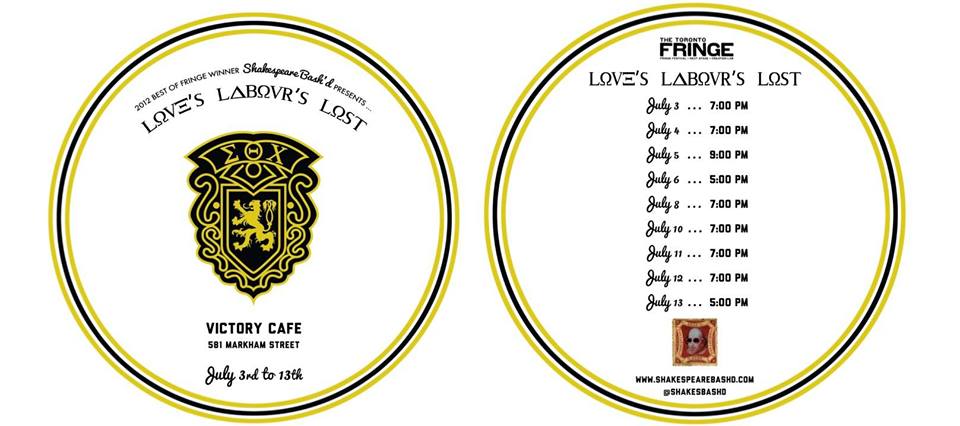
Where? The Victory Cafe, 581 Markham St.
When? Thursday, July 3 @7:00pm
Friday, July 4 @ 7:00pm
Saturday, July 5 @9:00pm
Sunday, July 6 @5:00pm
Tuesday, July 8 @7:00pm
Thursday, July 10 @7:00pm
Friday July, 11 @7:00pm
Saturday, July 12 @7:00pm
Sunday, July 13 @5:00pm
Tickets are $12 and can be purchased via the Toronto Fringe website: https://www.fringetix.ca/

10440657_845760552118405_7235464256632023655_n

Follow this wild bunch on Twitter:

Shakespeare Bash’d@ShakesBASHd
Hallie Seline (Princess) – @HallieSeline
Joshua Browne@joshu_ashua
Andrew Gaboury (Longaville) – @afieldofcrowns
Jeff Hanson (Berowne) – @The_Hanman
Suzette McCanny (Rosaline) – @suzettemccanny

In the Greenroom Writer Bailey Green: @_baileygreen

** Want In the Greenroom to catch your Fringe show or have an interesting idea for an interview? Email us at inthegreenroom.ca@gmail.com! **

Tarragon Theatre’s Playwrights Unit: An Introduction with Dramaturg Andrea Romaldi

by Bailey Green

I sat down with Andrea Romaldi, Literary Manager at the Tarragon, to discuss the 2014 Playwrights Unit. This piece is the first of an ongoing series of profiles on the members of the Unit. A playwright profile will be launched each month leading up to the play reading week at the Tarragon in November.

The Tarragon Playwrights Unit 2014 announcement arrived in my email inbox earlier this year. The playwrights? Rachel Blair, Alexandria Haber, Jessica Moss, Kat Sandler and Evan Webber. These five talented individuals will spend a year working on one of their own projects in collaboration with dramaturg Andrea Romaldi. But what exactly is this unit and how does it function? I contacted Andrea Romaldi to learn more about the process. All five playwrights generously agreed to participate in this series of features. I hope other writers or artists will find connection in these pieces. The writer’s profession is a solitary one. But the Playwrights Unit, just like In the Greenroom, encourages community.

The Unit has been in existence since 1982. The last four units have been primarily under the dramaturgical care of Andrea Romaldi. Artistic Director Richard Rose passed the reins a few years ago as demands of Tarragon’s season became more insistent. Rose returns to the process in November to direct the play reading week. Andrea Romaldi began working at Tarragon in October 2007 after completing internships with Maureen Labonté at Shaw Festival and Brian Quirt of Nightswimming. Romaldi was part of the inaugural Festival of Ideas and Creation at CanStage and worked with the Alumnae Theatre’s New Ideas Festival for a several years. And her joe job? Teaching as an artist in schools and working at the ROM’s summer camps.

The Unit meets in January, May and September with a day or half day dedicated to each play. The playwrights attend each meeting and give feedback to each other on their work. After the meetings, the writers return to their drafts until the next meeting. “Writing is a very lonely profession and so when people have the opportunity to work with others, they don’t take it lightly,” Romaldi says of the dedication of playwrights to the unit.

14563

In between Unit meetings, writers have the opportunity to meet with Romaldi who dramaturges their work. She offers feedback, suggests new avenues to explore or requests revisions. Romaldi adapts to each writer’s process, “some people take me up on meetings, some don’t. Part of that is how people create. Some glean what they need from the readings or discussion and some people require constant checking in to feel supported. Everyone’s process is unique.” In her many years of experience, Romaldi recognizes the sensitivity required in dealing with artists and the varied challenges each playwright faces. In the past, Romaldi has worked with a variety of challenges such as writing a play in real time or writing a play out of chronological order. Many plays require the challenge of an extensive research process. This can stunt the writer when they come to actually putting words to paper. Breaking out of the comfort zone is also a common challenge, “many playwrights cut their teeth doing a certain kind of play, for example a one person show or an episodic play,” says Romaldi. “When playwrights challenges themselves it will always challenge their process.” Other playwrights struggle with their material and fears of what others might think of them if they create unlikeable characters or tackle difficult subject matter. “Write the play you need to write,” Romaldi encourages.

The selection process is very challenging for Romaldi. She invites six playwrights a year to join the Unit. “People who are brand new to writing want to work at the Tarragon, however they often don’t have enough experience,” Romaldi says of many writers who contact her through the Tarragon website. “I direct them to places or institutions where they can develop their skills.” Romaldi says she often comes across new writers typically at festivals like SummerWorks, Fringe and occasionally Rhubarb (Rhubarb shows are often more performance art/creation based). Romaldi also draws from Tarragon’s RBC Playwriting Competition and the Theatre Creators Reserve. The Unit is open to working with alternative creators however, “the unit has a very specific infrastructure which is geared towards playwright-driven, text-based plays,” Romaldi says. The budget often can’t accommodate paying creators for the extended rehearsal period required with a collective creation or movement-based performance. “We do make offers to people who work in a less conventional way than I think people perceive of Tarragon,” Romaldi says, “they [the creators] just have to be more flexible with their needs.”

When asked what she looks for in selecting the playwrights for the unit Romaldi replied: “At Tarragon we’re looking for plays whose primary focus is exploring the human condition. We’re not looking for plays with a single perspective, an easy hero and an easy villain. Our plays ask people to look at themselves and others with complexity and compassion. No matter how good a character tries to be there’s always something that eats at them. It can cause them to do thing we may not admire, but that we are forced to understand.”

Romaldi also listed several basic qualities: strong dialogue, a clear understanding of drama and above all that scripts are written for the theatre (as opposed to the mediums of film or poetry).

The level of experience varies within the unit. Romaldi looks for playwrights who have put a play through the production process, whether it was at a small indie venue or at the Fringe. The experience of putting original work through rehearsals with actors, meetings with designers and performances with audiences is crucial to growing as a playwright. Romaldi looks for a diverse group in terms of age, skills, and experience, “some people are well beyond the minimum, some have experience in film and television want to return to theatre, some have had experience in cities outside Toronto and so perhaps Tarragon isn’t familiar with their work.” Each playwright comes into the unit at a different stage in their plays’ development. Some plays may have been in the works for years while others may have only gained an ending the night before.

Romaldi’s advice for young writers and emerging artists? “Read and see as many plays as possible.” Be analytical, but generous, and always speak about plays in compassionate terms and “respect the integrity of the creators.” Romaldi notices that writers commonly have a lot of talent but are afraid to claim their confidence. Romaldi searched for the right words to describe what she feels is essential for life as an artist, “I am allowed to be a writer. It doesn’t make me inferior or superior, it just makes me who I am. Building up the idea of the ‘nobility of the artist’ won’t help. Part of what artists are offering people is a piece of themselves. It’s complicated and it’s not easy. But at some point you just have to accept that this is who you are and this is what you are meant to do.”

Be sure to check back over the next few months to follow our Tarragon Playwrights Unit Feature as we meet with each of the playwrights.

Follow our writer Bailey on Twitter: @_BaileyGreen


Artist Profile: James Wallis & Julia Nish-Lapidus – The LaBute Cycle – This Week Only at Unit 102 Theatre – “We are who we are inside… The rest is unimportant.”

Interview by Hallie Seline

I had a chat with one of my favourite couples in Toronto Theatre, James Wallis and Julia Nish-Lapidus, to discuss their most recent project – The LaBute Cycle, going from Shakespeare (known most notably from Shakespeare BASH’d sold-out Toronto Fringe shows and their most recent production of Romeo and Juliet last fall) to LaBute, working professionally as a couple and their favourite places in Toronto. reasons to be pretty runs for one week only (April 8th-13th) with a special PWYC staged reading of Fat Pig on Sunday April 13th.

HS: Tell me a little about yourselves and about the show. 

JNL: We are doing reasons to be pretty, by Neil LaBute and a staged reading of his other play, Fat Pig. Originally we were presenting full productions of both plays in rep, but unfortunately, one of the actors was badly injured earlier this week, and is no longer able to do the show. James Wallis, our director, has stepped in to play his role in reasons to be pretty, but we are not going to be presenting a full production of Fat Pig at this time. We will be doing a staged reading of Fat Pig on Sunday, April 13 at 2pm, with another amazing actor, Jesse Griffiths, stepping into the role of Tom.

JW: Both of these shows examine how we value female beauty. We’ve worked with a lot of the team doing The LaBute Cycle while working with my other company, Shakespeare BASH’d, doing classical work. The LaBute Cycle is a passion project for myself and all those involved.

HS: Why LaBute?

JW: LaBute to me is a fantastic playwright, as he is very honest and focused with his characters’ worldviews. In reasons to be pretty, he tackles a very sensitive issue with the way we value beauty in the modern world. He doesn’t pull any punches and, in my opinion, writes with a great gusto about what he knows and doesn’t try to be politically correct. Also, I love his text; it’s extremely conversational and it’s a complete 180 from what I’m used to with Shakespeare’s work.

JNL: It’s a really interesting and sensitive subject matter to explore. And it’s fascinating to explore it so publicly. The issue of beauty and how we value it is pretty prominent in our world today and I think this play offers many different perspectives, and asks a lot of questions about the subject.

8442768

Original Cast: Milan Malistic (TL), Elisabeth Lagerlöf (TR) Julia Nish-Lapidus (BL), Steve Boleantu (BR)

HS: What have you found interesting about working on something so different together. You normally work on Shakespeare together, this is quite a change. 

JW: It is! It’s been really great to get to explore these new characters, but bring a lot of the basics we use with our Shakespeare work into approaching these roles. I like the role of Kent for sure, he’s a malicious person, a person who is very selfish, but I think that he’s his own person and fights for what he thinks is his, regardless of who he hurts along the way. It’s not pretty but it’s honest. He’s verbose and nasty at times, which isn’t such a stretch for me but it is not where I live most of the time when it comes to acting. I’m excited for the challenge.

JNL: It’s really great to get to work with James on something contemporary for a change, and now I get to work with him as both a director and fellow actor! Being a married couple who works together so often (yes, James is my husband) is really great and it’s interesting to be exploring this sort of subject matter together. For me to be doing a big fight scene with Steve, who plays my boyfriend in the show, and have James be directing it is really cool, because he knows me so well and for material like this that sits in such a natural world, he can really help me bring a lot of myself to it, since he obviously knows me so well.

429146_10151405502180701_196929419_n

Power Couple: Julia Nish-Lapidus & James Wallis

HS:This is being performed in Unit 102 theatre. Tell me about working in the space.

JW: In my opinion, it’s one of the most amazing spaces in the city. It is a complete blank slate that I have seen transformed in so many ways. I really like the enthusiasm of the guys who run the place. They want to see great theatre come out of their space and I admire their tenacity for finding it.

JNL: It’s a really great space. There’s a lot of flexibility to use it however you want and the team of people who run it are awesome! It’s so important to have small, flexible spaces like that in the city.

HS: If you could entice people to come see the show in five to ten words, what would they be?

JW: We are who we are inside. The rest is unimportant.

JNL: Hilarious, heart breaking, and oozing with talent.

HS: What inspires you as artists?

JNL: James, my husband? Is that super cheesy? This is really a passion project for him, and he’s pushed me to take risks artistically that I don’t think I would have without that push from him.

482243_10151567059200701_1277760830_n

JW: The people I am fortunate to be surrounded by. The constant creativity that they exude is without equal. Also, my wife, Julia, whom I am completely enthralled by, her grace under pressure, her faculties with producing a play and her wonderful intelligence when it comes to any work she does.

JW: He just said that because of what I said. He felt like he had to…

HS: Best advice you’ve ever gotten.

JW: It’s just a play.

JNL: Act better.

HS: What are your favourite places in the city?

JW: Victory Café, my home, the Dank and any used book store.

JNL: Home! And Bar + Karaoke (the best karaoke place to drink your face off and sing 90’s pop songs)

reasons to be pretty

by Neil LaBute
The LaBute Cyclelabutecycle_postcard_front

WhereUnit 102 Theatre (376 Dufferin Street)
When: April 8th-13th *Special staged reading of LaBute’s Fat Pig will be presented at 2pm on Sunday April 13th
Tickets: $17 – Available at www.labute-cycle.com and at the door. The staged reading of Fat Pig on April 13th is PWYC at the door