Skip to content

Posts tagged ‘Toronto Theatre’

A Chat with Ryan Robertson & Peter Hodgins of Two Chips Theatre’s “Copy”

Interview by Ryan Quinn

We sat down with Ryan Robertson and Peter Hodgins of Two Chips Theatre Group to discuss their current production of Copy.

RQ: Tell me a bit about the show!

RR: Sure! It’s a workplace show, a comedy/drama. It has a few themes. Firstly, it’s about people who are frustrated about their job, who are not achieving what they want to achieve. The tension between men and women, and between generations of people. So, it’s a comedy, but with a lot of darkness in it as well. We see these characters superficially at the beginning, and then they reveal a bit more about themselves and open up.

RQ: So, you wrote this piece, you’re directing it, and you’re performing in it as well.

RR: Yes. By default, essentially. When you’re a new theatre company in Toronto, it is difficult. I wanted to start from scratch because, as a writer, if you want to put a play up you normally have to go about it certain ways and work with different companies; and you end up with so many oars in the water that your play can be something totally different than what you started with. I also really wanted to have the final say on my cast and whatnot, I mean, for example, Peter is absolutely perfect for his role, and everyone else is fantastic as well. I find that better than the collegiate approach where you have a lot of people involved. These guys are as much a part of it as I am, but I never feel compromised.

PH: (laughs) Yeah, there’s not much in the way of food at rehearsal.

RR: I mean, we got a lot out of it. We do find that there are no egos at this level in the game, when you’re starting at the bottom and working with people who are like-minded.

PH: It’s been a lot of fun, and it’s going to be more fun as time goes on.

RR: Yeah, we have plans to keep going with some of this same core group and with the same kind of mentality. We really want to go back to the idea of the independent repertory company. We don’t do it for money, though I know a lot of people don’t, but we really want to do our own plays, I find that really interesting.

RQ: Do you feel like new original Canadian work is something the independent scene needs more of?

PH: For sure, I mean, Shakespeare is great. Don’t get me wrong. But, I see casting notices for it all the time and I can’t help but think “Who’s going to see that? They must have already seen it three or four times”. Part of it is that there’s no royalties. These plays are all free, and so young companies don’t have to pay a writer. So, it’s good to find new original stuff, which, for the most part, you have to write and create and perform yourself.

RR: When you come forward with something original, some people want to come forward and try to change it, to say “this isn’t right, that isn’t right, etc.”. Okay, we have to put up a few bucks ourselves, but if people really want to support new plays, they have to go to them. I hear a lot of people complaining about the same shows being done over and over, but then they don’t go out and see original plays.

PH: Yeah, we really need this stuff. And I’ve spoken to Ryan about making this into a film because we’ll all be ready for it, and we all love it.

RR: The thing about original plays is, as well, that because you are the creator, it’s a journey. I saw it on the page, I’ve seen the characters brought to life. There’s no need to put a “new spin” on a character because they’re completely new. What’s also important to me is that everything should be natural. We didn’t want to fall into the trap of being a wee bit pretentious. It’s a workplace play, so it has to be kind of earthy. I don’t mean to use the word pretentious, that has a negative connotation, but I mean that as well as depicting higher class things, it should reflect ordinary life. Even in the plays about ordinary people, there’s probably a bit too much wordiness at times. This is a much more down-to-earth workplace show.

RQ: That’s something else I wanted to touch on. This show deals with the minimum wage. So, because of that, it’s inherently political, as well as being comedy. Is that true?

RR: When I spoke to other writers when I was younger, they’d say “never preach”. You find a way to explain big issues with humour or in a way that doesn’t condescend. I’ve tried to do that with all the characters. Characters are more interesting that way, I think, when they don’t have these grand speeches planned.

PH: As long as it’s real. If you accurately portray a segment of society, it’s going to be political.

RQ: What do you want people to be discussing on the way home? What do you hope it leaves an audience with?

RR: I would hope people would get from it that in a way we’re all divided by our employers, and we’re all slaves to our mortgages and our dreams, but we’re fragmenting as a society. If we all got together and understood each others’ pain, we could do a lot better. We are divided, and we do worry about ourselves too much, and that hurts society. After the show, we’d like to talk to the audience, see what they got out of it, right?

PH: Yeah. I agree.

RR: But I do agree that when we attack these things, we have to do it with humour, with a little seriousness thrown in.

RQ: I think it was Shaw that said “If you want to tell people the truth, you’d better make them laugh or they’ll kill you”.

RR: Exactly. That’s perfect.

RQ: And Peter, as a veteran performer, how did this project come about for you?

PH: I believe I found it on Mandy, actually. So I sent in my application and I erroneously asked if I could read the whole script. I guess that was a bad thing to do. So I didn’t hear anything for a while.

RR: So I went back to Peter after a couple cast changes, I wanted Peter from the start, and I sent him the script, and I guess he liked it. I tried to write something where everyone’s involved and has something to do, and consequently everyone in it seems to really enjoy doing it, so I hope that translates to the audience.

RQ: What’s exciting about this show for you, Peter?

PH: Well, this is my first time on a live stage, actually. I’ve done mostly acting in film and directing film, so that’s what’s exciting for me. Mail Room John is a very misunderstood guy, and I feel like that myself pretty often.

RQ: So both of you must have had an interesting time with approaching the work on day one. Peter, with it being your first time doing live theatre; and, Ryan with putting up your own work. How did you approach that?

RR: Well, I try to be a benign dictator. Every member of the cast has ideas and I wanted to avoid ego as much as possible. So, it’s been a real collaboration. We’ve had a lot of fun and I think that’s going to show through when we do it. It’s worked out exactly the way I wanted it to.

RQ: Going forward, what are your hopes for this company?

RR: Well, if people show up to this one, there will be more shows. I think it’ll be good because we don’t plan to stick to a certain group of actors, and everyone feels like a part of it. PH: Now that we have a great location, we can just keep doing it.

RR: It’s important that people come out because we ain’t made of money. We back it as much as we can, but we’re not a professional comedy. We’re just tailoring it to entertainment, not money.

RQ: Well, that’s become the new standard, hasn’t it? Independent companies doing professional-level work?

RR: Right, and you need to get dedication out of people because they are giving their time, so it has to count.

PH: I think it’s guaranteed we won’t make any money.

RR: If we break even, we’ll keep doing shows.


Copy

Written by Ryan Robinson, presented by Two Chips Theatre Group
Directed by Ryan Robinson
Featuring Alene Degian, Brian Stapf, Madryn McCabe, Peter Hodgins and Ryan Robinson
poster1.51123805_std
Where: Sterling Studio Theatre, 163 Sterling Road, Toronto, Ontario, M6P 0A1
When: March 18-22 8pm, doors open at 7:30pm
Tickets: Advance tickets $15+service fee, At-the-door tickets $15 cash only
Concessions available, cash only
For more information:
www.sterlingstudiotheatre.com
www.twochipstheatre.com

A Few Words with Rena Polley on The Chekhov Collective’s “The Seagull”

Interview by Madryn McCabe

We sat down with Rena Polley, producer and actor of The Chekhov Collective’s The Seagull, to discuss the Michael Chekhov technique, theatre in Toronto and what makes The Seagull so special.

MM: The production part of The Seagull is incredible. 

RP: The support team was made up of brilliant people, they’re all award winning, but they had never done theatre before. I got them involved because they’re friends of mine. Rob Gray has won Genies and Geminis. He literally finished filming two weeks ago, came home, pulled in every favour to get the set built, even painted it himself (and it’s been years since he’s done that) and he leaves tomorrow to go to Bucharest for six months, so he very kindly did all this. And it was a learning curve for him. The first time he built the set, it was flat. And Peggy [the director] said, “oh no, it has to be like a W, and this way” so they all learned something because it’s different in film. So, he built this beautiful set. He had it go from something very formal, until it moves across the stage and eventually it disintegrates. Kind of like the play. And the music! Rob [Bertola, Music and Sound Design] is an Emmy and multi award winning sound designer for film, he just finished David Cronenberg’s film, and he’d never really done theatre before either. He came up with the song that’s the theme song. It’s based on an old Russian theme song, but it was rerecorded in the 60’s by The Seekers, and it became this huge popular hit. It’s called “The Carnival is Over”. So he did the reverse; it starts deconstructed and then moves the opposite, so that by the curtain call, the song is sung with full song and lyrics. And Oh Susanna did the music. So it starts deconstructed and ends up full, and the set does the opposite, it starts full and ends up deconstructed as you go across. The lighting designer is Blue Rodeo’s lighting designer. He’d never done theatre before. He finished the Blue Rodeo tour Monday night and was in the theatre Tuesday morning. He’d only seen a run through once. But he’s so brilliant! And Comrags were friends of mine too.

1966802_549145408532794_1292794745_n

MM: Your costumes are works of art!

RP: Comrags had an army of people building all this! Judy [Cornish, Comrags] said, “do you mind if I do the costumes?” I said, “Of course!” and then Joyce [Gunhouse] her partner in the company got involved, and then Joyce’s sister Judy and sewers and interns, and when we all saw the level of the costumes we thought “Uh oh. We’d better up our game!” Everybody felt that. Everybody came with an extraordinary level of work. And it made us up our game as well. And then Peggy came so prepared. She dreamt two ideas. And that was 1) The play within the play. Using the frame, using this kind of deconstructed way of telling a story. Peggy and I did teacher training in New York and our flight got canceled. So we ended up sin Manhattan for two days, and we went to the Museum of Modern Art. There was a show on all these artists that used deconstruction, and we kept seeing references to the frame. Peggy said, “that’s what I want to do at the beginning”. We tried it at a weekend workshop, and she knew it was going to work. We brought in Ellie Hyman from New York, who is a Chekhov person, but also a Viewpoints person, so she did this stuff with us, and we transferred the actors over from Ellie to Peggy. It’s hard as a director to come in to an ensemble that has been working together for a year. She only had three weeks to shape this play. It’s a big play, an epic play. The final image that she came with is when Konstantin rips the papers. Everybody always has him throw the pieces in the air, and she had him stuff them into his clothes, so that he leaves nothing behind. He takes all his writings with him. And it’s such a beautiful, poetic image. So she came with these two very strong ideas that bookend the piece. And she kept hearing rhythms. She could tell when vocally we’d drop the beat and then come up again. She’d say, “Push it. Keep driving it. There’s a pause coming, and you have to earn it.” And you can see these quiet moments in the production. She could really hear the rhythm of the piece, and wanted to honour that. She used Viewpoints from Ellie. She didn’t call it blocking, she called it composition. There are ten actors. There’s a lot to do!

1743632_549145551866113_346019769_n

MM: When you said it was an epic play it really made me think of the number of actors in the play. The nature of the way theatre in Toronto gets produced these days means that ten actors are unheard of. 

RP: Ten big personality characters, and ten big personality actors, that I had empowered, for better or for worse, so everybody had an opinion. Peggy had to really set up a very strong structure for the rehearsal process. We had done all of this Chekhov work and it was all sort of loose and game playing and improv and playing with text, but not making choices about text because that’s directorial. Creating the world of the characters and then when we got to the rehearsal space, it was very traditional. I thought we could continue this process more, but I realized Peggy was right. There’s a three week rehearsal process, there’s a story to tell, and you have to get through each act. We got through each act quite quickly in a big sweep because of the work we had done, and then Peggy went in a worked smaller sections. There was more of a traditional work space. We looked at beats, we looked at text, and objectives. But she would bring in Chekhov vocabulary of “what’s the Atmosphere of this act?” We could get to it quickly because we had been training in that philosophy.

1932373_545819228865412_909286969_n

MM: How did this group of people all come together?

RP: I keep saying that we all worked for a year together, but we really didn’t. Every two or three months we did a three day intensive workshop. So that allowed us to do a lot of stuff, but then let things simmer during that time. And people have lives and shows and lots of stuff going on. So we maybe met three or four times for three or four days each time. In the last month we met every Monday. I knew I wanted to look at this play, and I wanted to see how far I could take the Michael Chekhov technique. Having studied it, I thought, “Okay, I’ve got to put my money where my mouth is”. What this process allowed us to do was to keep expanding and asking questions, instead of contracting and making choices quickly. That was the gift of this process. And even if you look at the program, Peggy talks about how it starts in expansion and ends in contraction. We can use the words of Chekhov. It’s been a really extraordinary process. The question I posed to myself at the beginning was “how far can I take this?” and what I learned is that you can use it all the way through to the end, but you’d better bring along other things as well. There’s a reason the Stanislavski technique is still surviving. It needs to be expanded, and other things looked at, but the ideas of beats, objectives, text analysis is really important, and you need to combine it with the Chekhov work. At some point in the process, you’ve got to throw out the head and let the body speak because it has a bigger vocabulary, but then bring the head back in.

MM: What I found really interesting is that they play is over 150 years old, but it’s still so relevant. 

RP: Every time someone reads this play, they say to me, “It reminds me of Facebook” or we had an athlete in the audience, and she said that Trigoren’s speech about loving the writing process but hating it when it’s published is how every athlete feels when they train. So it speaks to everyone. What we’ve discovered about this play is that there’s no bottom. We could explore this for five more years. For a nanosecond, I thought about modernizing it, but I thought, no, let’s make the audience do a bit of the work. Let them make the leap, put the dots together. Because it’s all there. It’s a story about desire, art, the heart, human nature, relationships, and family. All these things are universal. They’re timeless. We agreed it was best to tell this story simply, and through the heart. Let the play speak for itself. We tried not to add things or colour it.

1907954_549145718532763_1607372493_n

MM: I see the program that you have adapted the play.

RP: I knew I wanted to cut the play, so I looked at about seven different translations. I wanted to make the language accessible, but not too modern. Some of the formality of the language is from the play, but I didn’t want it to be archaic either. I wanted to keep the names simple so that we’re not calling each other by three different names. I trimmed.

MM: There’s also a very strong feeling of the ensemble.

RP: We did that over time, but I also think the Chekhov work can speed that up in a rehearsal. I really want to put this process into the rehearsal process. I’d like to offer myself to directors and say “give me an hour of your day, every day, and I can really help you move this process along. I can help the ensemble, I can help the atmosphere, I can help actors drop into characters”. But rehearsals are short, directors don’t know what it is. I’ve offered a few times and heard no. I understand that, but I think the Chekhov technique can make that happen faster. We had the luxury of time, and I had them do all kinds of things. In the first intensive weekend, I had them read the play and write down images of the play. I collected them, we played with them. We came up with themes, we came up with the set design, I had them come up with one line describing the play, because I wanted them to think about more than their character. I wanted them to take ownership of the play. Sometimes as actors, we just highlight our lines and look at our part in reference to the play. It’s safer. We want to protect ourselves. So I wanted to blow that away, and give responsibility for the play to the actors. We did build the ensemble over time, but I think it could have happened much faster if all we had was the three week rehearsal process. I really want to encourage people to look to the Michael Chekhov technique because I think there’s something in it that every actor, director, designer can use.

10007014_546792548768080_176468322_n

For more information about the Michael Chekhov Technique, visit michaelchekhovcanada.com

For tickets to The Seagull, visit thechekhovcollective.com

“Start, Stop, Continue” for 2014: A Conversation Starter for the Theatre Arts Community of Toronto

Our feature initiative “Start, Stop, Continue for 2014: A Conversation Starter for the Theatre Arts Community” is back featuring the following voices: D. Jeremy Smith of Driftwood Theatre, Tina Rasmussen of World Stage, Holger Schott Syme of dispositio.net, Claire Armstrong of Red One Theatre Collective, Nina Kaye of Unspoken Theatre and Drew O’Hara & Jade Douris of Everybody to the Theatre Company. Read more in our features!

A Note from Editor in Chief – Hallie Seline:

2013 was an exciting year and 2014 has started with no shortage of encouraging moments for the Toronto theatre/arts community. We saw small venues develop and prosper across the city with national recognition from the Globe and Mail, and we saw the community come together showing support and strength in numbers, whether it was to stand behind Buddies in Bad Times Theatredemanding more questions when their Rhubarb Festival was suddenly denied funding, or by getting down and dirty to help get indie venue The Storefront Theatre back on its feet after amajor flood. Amongst these exciting moments, there is no shortage of challenges we are also knocking up against. Be it funding, debating the relevance of theatre on CBC Radio, or the concern that with the growing number of independent theatre companies that we may be spreading ourselves too thin, thus generating the every person for themselves attitude, we believe that there is a lot of discussion to be had about where we stand as a theatre arts community and where we should hope to go next.

I feel like this is an exciting pivotal time in the Toronto theatre arts scene and after having received immense feedback from our first instalment, my hope is to continue to develop this dialogue with another group of theatre artists (from different theatrical backgrounds, emerging to more established etc.) about their thoughts on the state of theatre in Canada, specifically Toronto, right now.

This is a discussion starter in which our participants identify what they think the Toronto theatre scene should Start, Stop and Continue to help theatre in Toronto prosper. This is just the beginning of the conversation. Help us to make this conversation grow to involve as many diverse voices across our community as possible and hopefully this will help us all move forward in 2014 in a supportive and productive way.


Hallie Seline
Co-founder & Editor in Chief

In Conversation with Carly Chamberlain & Susan Bond of Hart House Theatre’s “Goodnight Desdemona (Good Morning Juliet)”

Interview by Ryan Quinn

RQ: Hello! So I’m here with Carly Chamberlain, director, and Susan Bond, dramaturge, of Hart House Theatre’s production of Ann-Marie MacDonald’s Goodnight Desdemona (Good Morning Juliet). Tell me a bit about the show? 

CC: Essentially, it centres around a women who is an overlooked, often taken-advatage-of academic who is working on her thesis and she has a theory about some of Shakespeare’s plays that nobody believes in. That’s sort of the setup.

SB: So she’s come to a crisis about her work and her treatment in this academic model that she’s working through.

CC: In a larger sense, it’s her crisis of identity in general. So that’s the crisis, then she falls in a garbage can… as you do. There’s a magical element to the play where a choral moment initiates her falling into a garbage can, and falling into her subconscious, which takes form as a Shakespearean-like world.

SB: Right, she falls into a very specific Shakespearean world, as you could guess from the title. She falls into the worlds of Othello and Romeo and Juliet.

6gUQX4gOZB4g7X1TW4895JOI709KUuA1Wc7mIKpLQhY

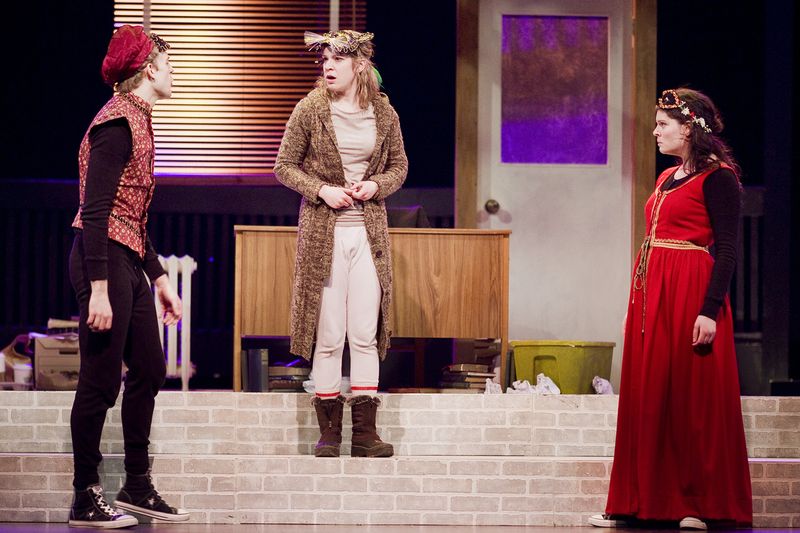
Photo Credit: Scott Gorman. (LtoR) – Nathan Bitton as Romeo, Lesley Robertson as Constance, Katie Ribout as Juliet

CC: She meets two of her heroines, and it’s a journey set around finding her way out and solving her thesis question, but it’s really about meeting the so-called “real” versions of them and also finding her own identity. It’s really a journey of self-discovery, especially since it’s her subconscious, they’re all elements of her.

SB: At the same time, she’s helping solve their problems of mortality.

CC: She’s searching for her real identity by assisting them.

SB: I think it’s also worth mentioning for people who aren’t already familiar with the play and perhaps not familiar with the fact that Ann-Marie MacDonald is Canadian, and that she is a struggling academic at Queen’s University in Kingston.

CC: That being said, I think it’s important to note that while the play is very clever, and it references a lot of Shakespeare, I don’t think you have to be intimately familiar with the plays to enjoy it. It’s a human story of loving yourself.

SB: You’ll certainly get more out of it if you’re familiar with those two plays and the rest of Shakespeare’s work. You’ll see more of the layers in it if you do, but it’s not essential.

RQ: There’s a few things I want to touch on there. Constance is very much a modern protagonist. She’s an iconic character of Canadian theatre. Is there a calling for more strong, modern female protagonists?

CC: Yes! But I don’t think “strong” is the right word to describe her, necessarily. She has strength and she discovers her strength, but I think what makes her a good example of a female character in Canadian theatre is that she’s complex.

SB: Most of her problems aren’t “woman problems”. She has career problems and self-discovery problems, which are things that everyone has. She’s an important female character in that she’s a great role for female actors because she’s also more complex.

CC: The whole thing is about her finding her strength, but there’s a problem with the writing of female characters in general where if they aren’t someone’s girlfriend or wife or talking about their romances, the other extreme is that they’re superheroes; which is another sexualized, objectified version of a woman, as well.

RQ: So it looks at the concept of strength beyond the male-centric idea of what a strong woman looks like.

CC: Yeah. I think there’s something to it even beyond a male-centric idea. I mean, patriarchy is everywhere, so we’re all viewing through those goggles, but what’s really special to me about this play (and part of it is that you view whatever you’re working on through whatever you’re processing yourself) is that it’s not about male or female but about saying, “Hey, things are complicated, nothing’s black and white, and the mess of life is okay, and I’m still awesome even if I’m a mess”. That’s something we all need to readjust to as far as what strength is.

MSo86dxC3mJlISuboRbew9RaCFuzjb1UqpaYqFXjAL8

Photo Credit: Scott Gorman. (LtoR) – Cydney Penner as Desdemona , Nathan Bitton as Iago, Lesley Robertson as Constance

SB: “You shouldn’t need to be above the mess. Strength is living in the mess and working through it.”

CC: But yes, to come back to the question, I do think there’s a real lack of complex female roles in film and TV, obviously in classical theatre, but also in Canadian theatre. We spoke about finding other Canadian plays with complex women in them and it’s actually a struggle.

RQ: In pop culture in general. In the zeitgeist, there are very few of them.

CC: Yeah, and then, when there is, it’s a big thing. Look at the reaction to HBO’s Girls.

RQ: Because there’s that thing where people look at it and say “But these characters are kind of shitty sometimes. How are they supposed to be female role models?”

CC: I read a really interesting article recently that compared Hannah from Girls to Llewyn Davis from Inside Llewyn Davis, and it was showing that that’s a perfect example of the flaws in innate sexism. We look at Llewyn Davis and we’re like, “Man, he’s fucked up. He’s talented, but he’s fucked up and he makes fucked up decisions. He’s a tragic hero,” but with Hannah we’re like “You’re a brat. Get over yourself”. I would argue that the Coen Brothers do romanticize Llewyn Davis more than Lena Dunham romanticizes her character, but it’s the same thing, she’s a self-indulgent, talented person and so is he, but she is the one who gets ragged on.

SB: Also, I think that because there’s a relative dearth of complex female characters like that, she winds up standing in for not just self-indulgent talented people but also “ladies”, or “girls” in general. That’s just a problem of underrepresentation.

CC: Since there’s a lack in general, every female character has to live up to the standard of not being any stereotype, which is pretty impossible.

RQ: As soon as someone becomes iconic in that sense, they have to be everything to everyone all the time.

CC: Exactly, which is impossible. But, as much as I’m all about more roles for women, I don’t think anyone that champions that wants to watch plays about perfect people, because why would you watch it?

RQ: So what you’re talking about is that female characters are allowed to have conflict. They don’t have to be the side character but they also don’t have to be above all conflict and completely inscrutable.

CC: Essentially.

Kf2qX94A1f5ZyAfTojn1ItvbQzkQZr-8l_h7c_mcog0

Photo Credit: Scott Gorman. (LtoR) – Katie Ribout as Juliet, Lesley Robertson as Constance, Cydney Penner as Desdemona

RQ: So, Susan, as a dramaturge, there are several different worlds in this play. How do you go about investigating the different worlds and how they interconnect?

SB: My speciality as a dramaturge is working with Shakespeare, so the knowledge I bring to the table at a production is going to be actually stronger than the Canadian academic world, despite being a Canadian graduate student, though not in the 80’s. You referred to Constance as a “modern” female character, but she’s not actually that modern, she’s set in the 1980’s and it’s surprising how much that world lives in the play. Because we’re not actually in Verona or Cyprus, we’re in Constance’s imagination, it’s amazing how her world kind of emerges in them in strange ways.

CC: And we’re definitely trying to highlight that. I think sometimes people go for an interpretation where we’re actually there in stereotype-land. Our set doesn’t change, other than through light and sound, and that’s on purpose. The office is onstage the whole time. Something we talked about from the very beginning is the idea that she’s in “Cyprus”, not Cyprus. Because of that, the dramaturgy becomes complex. The first step is saying “this is what it was in the original play”, and making a conscious choice if it’s going to be different.

SB: “This is what the coastline in Cyprus was. These are the places it would be appropriate for Desdemona to be. This is where a historical Desdemona would be. This is where Shakespeare’s Desdemona would be.” But, MacDonald’s Desdemona is in a different place altogether.

CC: The layers of references in the play are astounding. For example, there are a lot of references to alchemy; but there’s a difference between Renaissance alchemy, which is transmuting base metals to gold; but there’s a very intentional layer on top which is Jung’s idea that they were being metaphorical and alchemy is actually about self-actualization. So, all that stuff is layered in.

SB: There’s a lot of dramaturgy in this show.

RQ: And all the layers inform each other, right?

CC: Yup, real easy, super easy.

SB: Yeah, I just know what the words mean.

CC: But that’s something about Shakespearean dramaturgy in general, is that the actors or I might have a question about what some little thing means and we might find out it’s a reference to some obscure thing.

SB: Like the Gustav manuscript. It’s an 18th Century German novel about someone searching for a manuscript that was lost, so in a way, it sets up the premise for Constance’s entire academic career.

CC: Yeah, then you go, “This is all interesting, but to the character, it means nothing”. You don’t know these things, it’s outside of the world.

SB: But then some elements are conscious references, so it all ties into itself.

RQ: And how has it been working with Hart House on this show?

CC: It’s good. We both have histories with them, though Susan’s is longer.

SB: I’m the Resident Dramaturge.

RQ: How did you start there?

SB: I started as a dramaturge for Canopy Theatre, which is associated with Hart House and so I worked with Jeremy [Hutton], when he was acting in a show I was dramaturge for, and he saw what I brought to the table.

CC: When I was an actor, earlier in my career, I was in Julius Caesar and A Midsummer Night’s Dream at Hart House. So I had a bit of a relationship with them, then Jeremy and I worked together at Shakespeare By the Sea as well, and we had a good working relationship. And I assistant-directed there last year for Robin Hood: The Musical, which is another Hart House/Shakespeare by the Sea crossover. It’s been pretty awesome working with them. As far as the management goes, they’re very supportive and trusting.

g6i70KlVRcyhkTK-Y48NZE5eDsajFsksvzsSqQzbWpo

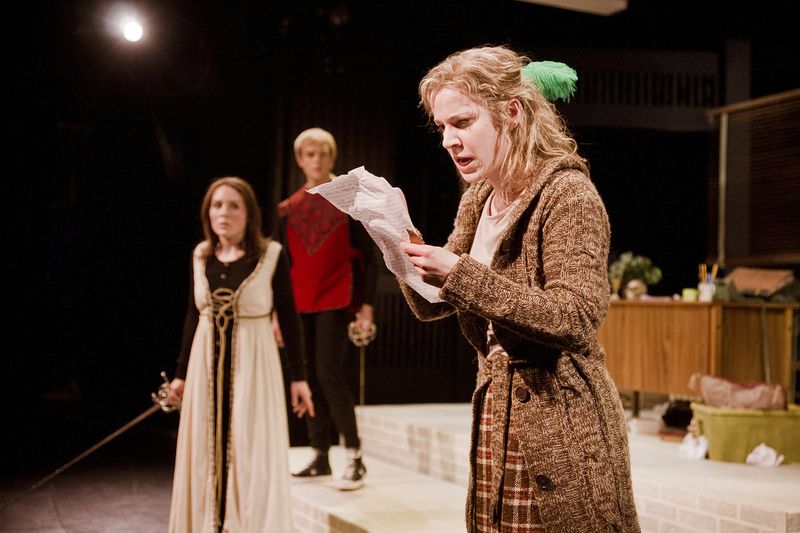
Photo Credit: Scott Gorman. (LtoR) Lesley Robertson as Constance, Nicholas Porteous as Professor Claude Knight

RQ: What would you say your goals are this year?

CC: In life?

RQ: In life!

SB: In 2014?

RQ: In 2014!

CC: I think for me, it’s two things. On the one hand, I’m still trying to figure out what directing means and how to be good at it in a thoughtful way. I want to continue to develop because you can only learn it by doing. On the other hand, Susan and I work together separately [with Neoteny theatre] and I think we both want to make a positive and significant contribution to the theatre scene, particularly as it relates to classical-adjacent work and roles for women, so this falls right in line with that. We want to be thoughtful instead of making work for work’s sake. That’s really hard because we all want to be working all the time. When we did Overruled and Romance last year, it went really well and people wanted to know what we were doing next, but we’re trying to resist the urge to just do something for its own sake. You know, “put on a show and put my friends in it”, because that’s tempting.

RQ: Vanity project theatre.

CC: Right, and that’s such a murky area because to some degree, everything you do is a vanity project because even if you’re getting paid, you’re not getting as much as you should, so you have to be getting something else out of it. I think that sums it up nicely.

SB: Yeah! I think we’re trying to reconcile the intersection of classical work with women’s roles in general. A, let’s just say it, feminist model, to some extent.

CC: I think what we’re dancing around is that we’re interested in feminist work that’s not feminist for its own sake, but feminist for that basic definition of equal rights for all people. It’s one of those things that once you start seeing things through that lens, and you’re a creator of any kind, you have a responsibility to make sure that work continues. That being said, we’re not entirely humourless. So that, plus joy in the work. That’s the other thing with me directing is that I’m trying to find that line where everything is falling into place, but that sense of play and joy and ensemble is there too. That’s really important, as an audience member. I want to find that balance where they’re in an environment where they can live in the moment.

SB: If there’s no play in the play, then it’s entirely joyless.

RQ: It’s moral responsibility theatre, which can be pretty boring.

CC: I think about this stuff all the time because I’m kind of a cynical person and when people say things like “Oh, when this show closes, I’m going to miss this cast so much!”, I’m the one that’s like “You’re doing a job”. Navigating the line where there’s a sense of joy in the ensemble and the bond you form with the other members comes from working toward the same goal, that’s huge and important. All the other stuff, drinking together and whatever, that’s cool if you have that social vibe, but the vibe in the room is so much more exciting and important.

Goodnight Desdemona (Good Morning Juliet)

By Ann-Marie MacDonald, presented by Hart House Theatre

1780906_595738803838906_627533721_n

Where: Hart House Theatre, University of Toronto, 7 Hart House Circle
When: February 28th – March 8th, 2014 8pm, Saturday Matinee 2pm
Tickets: $15-$28 http://uofttix.ca/view.php?id=1000

For more information on the show: http://www.harthousetheatre.ca/

Events We’re Crushin’ On: Everybody to the Theatre Company’s “Theatre on a Theme: Love” – Sunday February 23rd

Interview by Bailey Green

Everybody to the Theatre Company unintentionally greeted me with piano chords and harmonized voices as the cast rehearsed a musical interlude for their upcoming show, Theatre on a Theme: Love. This unique show is EtoTCompany’s second production, following the success of their first show Theatre on a Theme: Failure (September 2013).

“The interesting thing about the theme of love is how much it is related to pain. This show isn’t just a happy stroll through the park, under the stars,” director Drew O’Hara says of his cast. “The company have brought some really personal stuff to the work.” Artistic Director O’Hara founded Everybody to the Theatre Company with several members of his Ryerson acting class. The soon-to-be graduates were looking for a creative outlet and something they could call their own. O’Hara had conceived the idea of constructing a show called “Theatre on a Theme” where new, short plays would be woven into a whole, cohesive performance.

ToaT LOVE PR Photo 5

This winter the company put out its second call for submissions on the theme of “Love”. The plays have to be 5-10 minutes in length and use up to any of the three men and three women of the company (and of course be based around the selected theme). “When the audience watches through the lens of a theme, it allows them to make the connections for themselves,” said director Drew O’Hara. “It gives our audiences a more immediate connection to the actors and to the show. The experience of seeing Theatre on a Theme is more personal.”

Everybody to the Theatre wants to explore the theme of love in all its facets. Though many of the submissions were romantic, and that aspect is not ignored in the performance, O’Hara looked for plays that explored love in many forms. “The goal is that hopefully we’re going to find something for everybody,” said Artistic Producer Jade Douris. “But there are as many different kinds of love as there are people.“

Then something amazing happened when the call for new plays was posted for Theatre on a Theme: Love website. “The submission post went viral in the United States,” O’Hara said. None of the company knew how it had happened. Somehow the call for plays about love made its way into the right hands. Everybody to the Theatre Company was rewarded with almost two hundred plays from LA to New York, from Ohio and Michigan and from Halifax to Texas to Toronto.

Artistic director O’Hara selects the plays for each show by searching for the most unique perspectives, the variety of character or shows that may compliment and contrast each other. “We got so many submissions in the last ten days,” said producer Jade Douris. “Sometimes we just couldn’t cast the show, say a grandmother and grandchild scene, but for the most part it wasn’t easy. We read all of them.”

ToaT LOVE PR Photo 3

Everybody to the Theatre Company’s mandate reflects its name as they focus on bringing theatre to different audiences. Theatre on a Theme searches to find stories from as many different voices as possible. The playwrights range in age from 19-65 and include a past Dora nominee, a graduate of two masters programs, not to mention both experienced and amateur playwrights.

Two members of the company have their own work included in Love. “Owen and I both wrote for this show for the first time,” says Jade Douris pointing to founding member and actor Owen Stahn. Stahn smiles and admits, “Yeah, I’m still pretty self-conscious about that.” They laugh, grin and shift in their chairs.

Not to mention that the company still balances a full semester of theatre school. The collective process can be challenging and the company works hard to knit the plays into a cohesive whole. Honesty is key. “It requires you to bring a lot of passion and energy to rehearsal and risk getting completely rejected by your peers,” O’Hara says of the process. “Most of us learn to let go,” Jade Douris smiles as she teases Owen. Owen mourns for a vignette of his that was cut from Failure, the company’s first production. “By the end of the process, we learned that failure is an absolute part of life and a critical part of growing,” Owen says. “You can escape it, but you can also just embrace it.”

ToaT LOVE PR Photo 1

These intrepid artists have plans for future themes, but plan to adjust them depending on the social climate or what life throws at them. They hope to one day bring their shows to as many audiences as possible. After the performance in Toronto, Theatre on a Theme: Love is travelling to Peterborough to perform at the Theatre on King. Showtime is at 9:30pm, tickets are $15 or $10 if you see The Dumb Waiter, the show performing before theirs.

If you see an Everybody to the Theatre show and think of a theme you would love to see, visit their website and drop them an email. They are always open to hearing suggestions from their audiences.

Theatre on a Theme: Love

Presented by Everybody to the Theatre Company

1521276_648268825216817_631302206_n

When: Sunday February 23rd at 2pm and 8pm
Where: Unit 102 Theatre (376 Dufferin Street)
Tickets: Visit their website: www.everybodytotheatrecompany.com  $10 in advance, $15 at the door.

Everybody to the Theatre Company rehearses in the UCRC Studio. It’s a lovely studio space on Saint Clair West and has great, affordable rental prices, (http://www.uppercanadarep.com/#!rentals/cij8).