Skip to content

Posts tagged ‘Toronto Theatre’

Artist Profile: Sam S. Mullins – Storyteller of Fatherly at the Next Stage Theatre Festival

Interview by Hallie Seline

HS: We hear you wear many hats (Comedy, Radio, Playwright, Performer etc). Tell us a bit about yourself and what draws you to the playwright/performer medium with stories like Weaksauce andFatherly?

SM: So many silly hats.

I spend the largest portion of my creative time writing sketch comedy for CBC’s The Irrelevant Show. This is my first year as a full time writer on that show, and it’s been a really terrific experience. Also radio-wise, I’m a regular contributor to the CBC storytelling program Definitely Not the Opera, and I was fortunate enough to get a story on NPR’s The Moth Radio Hour recentlywhich was always a dream of mine.

So. I work in radio, I suppose, which is really exciting for my Grandmother. She tells me that radio used to be a thing.

In the summers, I tour my one-man comedy monologues on the Canadian Fringe circuit. This will be my 4th summer doing the Fringe, and I’m currently trying to decide whether or not I’ll be touring with a version of this current show. I might want to write something new, but then of course, I’d have to go through the agonizing process of premiering a brand new show all over again – which is not for the faint of heart.

So simply, I write sketch comedy and am a storyteller.

What draws me to storytelling? Hm.

I guess I love the simplicity of it. I like the idea of taking something completely stripped of all artifice and theatricality and mounting it in a theatrical space. Of watching something that doesn’t feel like theatre as if it were theatre. I like that I can be funny or poignant or dark or light all at the same time. It doesn’t have to be heavy handed. It doesn’t have to be hilarious. It just has to be true. Theatre is very much a pursuit of truth, so what makes me love going to see a storytelling show, is that it isn’t even a pursuit of truth. It can just be the truth. That will always be captivating to me.

Also. I wasn’t a great actor. And in storytelling, I don’t have to act.

sam-final

HS: Can you speak about Fatherly and where you found the inspiration to write it.

SM: The main story around which I built the show has been my favourite “over beers” story to tell people for a few years now, and it was only a matter of time before I wrote it into a show. It’s a crazy story. Also, I’m a big fan of real-life characters, and the man who raised me is one of those real-life character with whom I knew that audiences would want to be acquainted.

HS: If you could give me 5 words to entice someone to come see Fatherly, what would they be?

SM: You must meet Bill Mullins

HS: What song should someone listen to before coming to see Fatherly?

SM: Yikes. Maybe “The Greatest” by Kenny Rogers. My mother recommended it to be my curtain call song, and thematically, it’s pretty perfect. Maybe too perfect.

HS: Where do you look to find inspiration?

SM: My heroes: Ira Glass, Marc Maron, Woody Allen, Judd Apatow, Mike Birbiglia and David Sedaris.

HS: What’s the best advice you have ever received? 

SM: I used to work in this busy restaurant in Vancouver, and our staff mantra was “Keep doing things. Keep doing things.” The theory behind it is that there’s always something to do in a restaurant. Polish cutlery. Sweep. Clear some plates. But now I’ve kind of extended that mantra into my creative life. Theoretically, if I keep doing things, everything will run more efficiently in my career. It helps me kick myself in the ass.

Aw shit. I’m watching hockey highlights again.  I should be doing a “thing” instead.

Also, I’m a fan of this Louis CK quote:

“Everything you do should be better than everything you’ve done before. That, to me, is a guiding principle.”

HS: What’s your favourite place in Toronto/in Canada and why?

SM: Favourite place in Toronto is the outdoor skating rink by Bathurst and Dundas.  I love playing shinny, and with the city skyline as the backdrop, it’s just stunning.

My favourite place in Canada is the lake on which I grew up – Kalamalka in the Okanagan. Google it. You’ll never see a more beautiful place.

HS: What is you favourite beer in the Next Stage Festival beer tent?

SM: When I’m at a theatre festival, I’m all about the Apricot St Ambroise.  I only drink it in the context of a theatre beer tent, so it tastes like I’m having the time of my life.

Fatherly

Sam_0152

Written and performed by Sam S. Mullins
Where: Factory Theatre Antechamber
When:
Mon Jan 13 8.30pm
Wed Jan 15 8.15pm
Thu Jan 16 6.15pm
Fri Jan 17 6.15pm
Sat Jan 18 8.15pm
Sun Jan 19 6.45pm
Tickets: $10 www.fringetoronto.com/next-stage-festival/

Follow Sam’s blog: http://samsmullins.com/

In Conversation with Morgan Norwich and Johnnie Walker – “Scheherazade” at the Next Stage Theatre Festival

Interview by Madryn McCabe

I sat down with Morgan Norwich and Johnnie Walker, director and writer, in a busy café to discuss their latest production, Scheherazade playing now as part of the Next Stage Theatre Festival.

MM: So why don’t you tell me a little bit about Sceherazade?

MN: Sure! It’s an adaptation of 1001 Nights, with the twist that the story is more from the perspective of the character of Scheherazade, who, while she is the teller of the original 1001 Nights, we don’t get to know too much about her. So we created a world where she lives in this crazy, totalitarian society where they’re killing a young woman every morning at dawn, and with a weird anachronistic, modern spin on it with lots of sex, which is also inherent to The Nights, and lots of pop cultural references. That’s about it, wouldn’t you say?

JW: Yeah. In a way I feel like we’re just unearthing the sex and violence that were totally there all along. The Nights have really been sanitized and ‘Disneyfied’ over the years. Sometimes certain bits of the stories go by so fast that you don’t take the time to think about them. But even the whole setup for the story, that there’s this king that marries a different woman every day, sleeps with her, has her killed and marries another one the next day… It’s sex, and violence and sexual violence that are so at the core of the whole thing. But if you say it quickly enough, you sort of skip them somehow. So it’s not like we’re shoving all this new sex and violence into it. It’s already there. I think we’re giving it room to breathe and say “Look at all the stuff that was here this whole time that you missed”.

MM: So was this a story that you had always wanted to tell, or was it that you set out to find a show that was the untold story? Why this story?

JW: That’s a good question. It’s been so long…

MM: How long have you been working on it?

MN: Over two years now.

JW: Yeah that would have been about fall of 2010.

MN: So even longer than that.

JW: And that was a very short, early version of the very beginning of the play that was like a little workshop. And then we came back to it the year after that a bit more seriously.
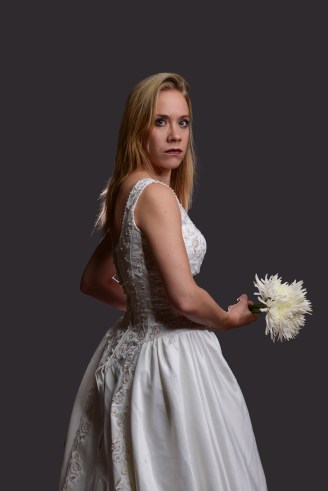
Lindsey Clark in Scheherazade. Photo Credit: Greg Wong

Lindsey Clark in Scheherazade. Photo Credit: Greg Wong

MN: We did a workshop of it with just two actors, just focusing on the characters of Scheherazade and Dunyazade, the sisters, and out of that workshop came this idea for the world of the play being this dystopian, but also very familiar, wedding-obsessed culture, and all the ideas of consumerism layered into the existing narrative. That came out of that workshop.

JW: I’ve always been into the character of Scheherazade, even just the name I like.

MM: So what about Scheherazade is appealing to you?

JW: Just the idea that there is this totally brutal regime that she’s living in, this insane tyrant running the country, and that her plan to take him down is all through art. And it’s totally pacifist. She’s just smart. She’s smarter than everyone, a really good storyteller, and she doesn’t need to come up with some… It’s a very genre show in a lot of ways, it feels very genre-ish, where it has this dystopian, almost science fiction without the science feel to it. I’m kind of a nerdy guy in a lot of ways. I like seeing a superhero movie, or we’re both fans of Buffy the Vampire Slayer and things like that, and in the last couple of years I have noticed seeing a lot of this stuff that, even though those shows or movies are really smart and have a lot of sophisticated things to say, it ultimately comes down to people punching each other. And that usually is the only way to solve problems. I love how that is not what Scheherazade is about. Never in part of her plan is “Oh I’ll trick him with this story, and then I’ll shoot him in the face”. That’s not what her deal is. And in the show I think we’re trying to examine “Is it possible to have that? Is that kind of resistance possible? Where does it work and where doesn’t it work? Where can a plan like that really succeed? And where can it really fail?”

MM: So is it possible to change the world through creative, non-violent means?

JW: Exactly.

MM: Is this the kind of play you guys are always looking to do? These strong female-centred shows?

MN: For the most part. I consider Johnnie to be one of the best feminist playwrights, of the male feminist playwrights for sure.

JW: Oh that’s so nice! I like that!

MN: Well I do. I always have. So another really large show that we did a few years ago was called Eight Girls Without Boyfriends which, I don’t think Johnnie realized this when he wrote it, was sort of a witte-fem inspired, cabaret piece that was also about these empowered female characters. So I don’t know if it’s something that’s always been conscious, but it’s been the kind of thing we’ve always done just because of who we are.

JW: I think both of us are really interested in feminism and gender and also sexuality.

MN: One of the other things that Johnnie and I do when we’re not doing shows is we work with an all-male burlesque troupe called Boylesque T.O. so we’ve been in the last few years exposed to the burlesque community and the gender play on it because, with the exception of me, it’s all guys in the troupe. I feel like probably a lot of my experience with both the male burlesque troupe and other female burlesque troupes that I’ve hosted with since we started doing that has informed a lot of certainly the staging of sexuality that’s gone into the show, but also, when you’re around sex-positive people all the time you get a good attitude about that kind of thing and you want to express it onstage.

MM: After having seen the show last night, I can say there’s a lot of sex in the show, but it’s funny, a lot of it is very light.

MN: Except when it’s not! And then it’s not.

MM: Right. And for the most part, when there’s sex in other plays, you can see it coming and you feel like “oh there’s going to be sex and I’m going to be uncomfortable seeing this with all these other people” and you guys just put it out there. It’s very “it is what it is” and then you move on to the next part.

MN: And so you didn’t feel uncomfortable? Oh good!

MM: And the audience loved it. They thought it was really funny. Especially, I would say, the older members of the audience. So do you usually get a good reception from people for this kind of work?

JW: Some people have actually said that this show is a departure for us in a lot of ways. That level of sexuality is not in our previous shows.

MM: So why make such a departure?

JW: We wanted to tell this story. We both came at it from different angles, and it was important to the both of us in different ways. And in the same ways also. So I think you need it for the story. When I was writing it, I didn’t throw in any orgies that aren’t in the original plot and aren’t integral to the plot.

MM: It’s funny that you say that because going into the show I thought “Oh we all know the story of Scheherazade” but apparently we DON’T really know the story. You had said earlier that it’s really the untold story. It’s been so ‘Disneyfied’, and we really know more about the stories that she tells versus the story of her.
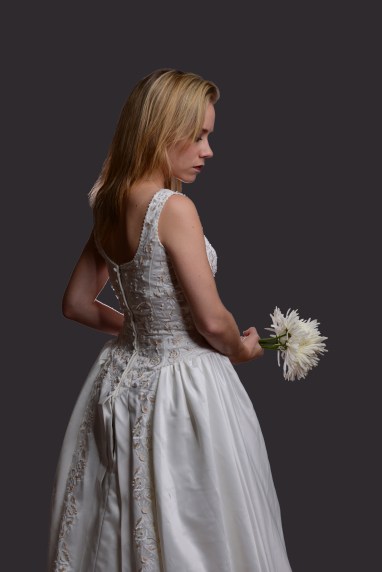
Lindsey Clark in Scheherazade. Photo Credit: Greg Wong

Lindsey Clark in Scheherazade. Photo Credit: Greg Wong

JW: Aladdin, Ali Baba, Sinbad are the ones that all rise to the top. And ironically, those are the stories that are in 1001 Nights where no original has been found. They were all translated in the 1800s into French by this guy Guillaume, and those three stories, which have become the most popular, no one has found the original that he translated from. So there’s a lot of speculation that he actually wrote them himself, inspired by the tales. It’s kind of hilarious that those have become the iconic stories. When you read the tales, almost every story are as good as those, as good as Aladdin. There are so many amazing ones that we don’t know. And in the show itself we have these moments. Like, right before the first orgy scene, they come on and do this sort of tasteful sexuality.They’re sort of posed in a silly way and she says, “slaves let us bathe and let us lie together” which, in the translation that we’re working from, is directly in the text. But I thought that was so sanitized. It’s a translation of a translation of a translation. Somebody has put their 20th century, prudish, Westernized idea of what that means. But really, think about that for a minute. What does ‘let us bathe and let us lie together’ mean? It doesn’t mean ‘scrub my arm and let’s have a nap’. It’s a big orgy. That’s what that means. There are these details that came out and it’s very explicit in the story that Scheherazade’s whole plan can’t start until she and the king have sex. It has to happen to complete their marriage. And it’s specific about the fact that her younger sister is in the room while that happens. In the original, she’s actually under the bed.

MN: We didn’t go that far!

JW: We even toned it down from that! But it’s one of those things that people just glide past in the text. “Oh yeah, Dunyazade was lying under the bed, then she came out with a plate of food”. No! Wait! Give that a moment. She’s in the same room as her sister while she is sort of raped by this tyrant. It’s a huge deal. And you need to give that its time. So it was about unearthing these bits. If this happened in real life, it would be a big deal. And the narrative isn’t quite letting it be.

MN: One of the things, right off the bat in rehearsal that we talked to the actors about was checking their own assumptions about the story and the world because of all of our ‘over-Disneyfied’ childhoods. We literally got to a point where everyone got one Disney’s Aladdin reference per rehearsal and then we had to shelve it and put it away. As much as so much of the play has ended up being cartoonish, which works for the kind of satire we’re doing, it didn’t help to go back to images in our heads of the Disney movie.

JW: Would you say that we’re dealing with A Whole New World?

MN: I would, but I can only say that once today! That’s the rule.
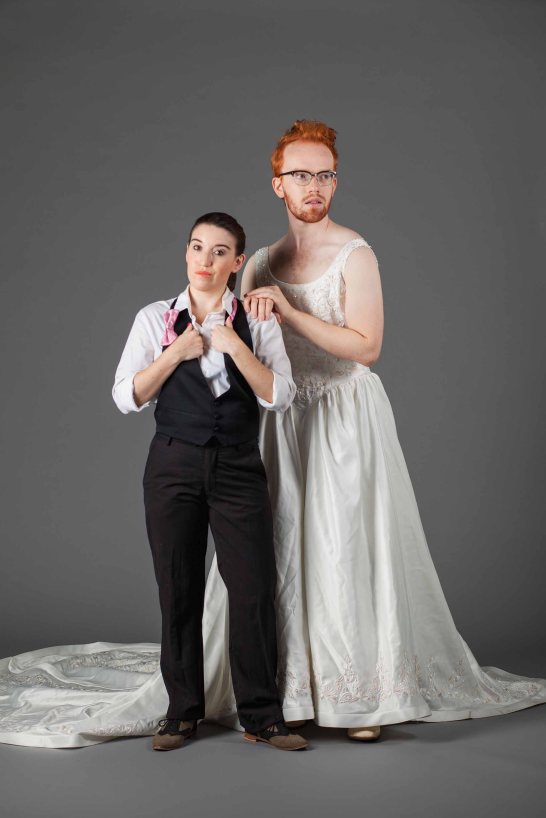
Director - Morgan Norwich and Writer - Johnnie Walker of Scheherazade

Director – Morgan Norwich and Writer – Johnnie Walker of Scheherazade

MM: Are you able to do this show because it’s part of the Next Stage Theatre Festival?

MN: Yes. Next Stage provides a lot of resources in terms of giving us the space, the box office, the technicians, stuff that’s really difficult to afford for even a small show. But when you’re dealing with a cast of eleven, plus three designers, plus stage manager, plus producer, the cost just grows and grows. Having the context of the festival is actually what has made it possible.

JW: And the cache too.

MM: So because it’s part of THIS festival, you can put on THIS play? Would you have been able to find the support, not just financially, somewhere else? Do you think you could have done this play without being a part of this festival?

MN: I don’t think something like this, even at the Toronto Fringe, we could have pulled off in the same way. Because it’s a smaller festival, we get a little bit of extra support, in terms of media stuff in particular.

JW: We were successful in some of our grant applications, and I think that’s partly because we were part of this festival. It’s a known entity. Even though it’s not that old as a festival, I think it has a great reputation. It’s a kind of risky show in a way for the performers, so to be able to hand them the script and say “we’re doing it here” is nicer than “here’s this crazy show with orgies and stuff, and we’re going to do it in a garage”.

MN: There’s a safety net, for sure.

MM: Do you have anything else in the works? Maybe want to give us a preview?

MN: This show has been so all consuming! We’ve got burlesque stuff happening immediately after, and I’ve got something in the Rhubarb Festival. But it’s going to be very weird for this to be over.

JW: We also do our show Redheaded Stepchild, that’s coming up. We have a show that we did in Edmonton last year called Amusement that we’re hoping to do in Toronto at some point. We don’t have an exact plan for that yet, but hopefully we’ll get something together.

MM: So to wrap up, in three words, why should people go see Scheherazade?

MN: Natasha [Greenblatt] in the show sent a really good email inviting someone to come that said “There are three orgies and a knife fight” so I’m going to say Three Orgies, Knife-fight. I can hyphenate that, right?

JW: I was just going to say Butts, Butts, Butts. When we got into the costumes, I realized there are a lot of butts in this play. So there’s a butt for everyone!

Scheherazade

Presented by Nobody’s Business theatre
Written by: Johnnie Walker
Directed by: Morgan Norwich
Where: Factory Theatre
When:
Monday, January 13th, 2014 at 7:00 p.m.
Thursday, January 16th, 2014 at 5:15 p.m.
Friday, January 17th, 2014 at 9:15 p.m.
Saturday, January 18th, 2014 at 6:45 p.m.
Sunday, January 19th, 2014 at 9:15 p.m.
Tickets: $15 . For online sales, go to www.fringetoronto.com. Tickets can be purchased by phone at 416-966-1062, or in person at the venue. For more information, go to www.nobodysbusiness.ca.

A Misfortune – Presented by Common Descent as part of the Next Stage Festival

Interview by Ryan Quinn

I had the good fortune to speak with Paige Lansky, associate producer of Common Descent’s production of A Misfortune, an original musical based on a story by Anton Chekhov.

Without revealing too much, the plot follows two people after going for a walk in the woods who have to reevaluate the nature of their relationship to each other. “This is about a pivotal time in the lives of these characters”. The show stars Trish Lindström, Jordan Till, Réjean Cournoyer, Kaylee Harwood, and Adam Brazier. It was written by the team of Scott Christian, Wade Bogert-O’Brien and Kevin Michael Shea, and directed by Evan Tsitsias.

“It has a really unique, beautiful musical voice,” Paige told me, ““It’s incredibly poignant and thoughtful. So much is exciting me about this show.” She told me that the strength of the voice in this show, and how confident it is in its characters and message has been nothing short of amazing to see in process.

1385143979

Paige Lansky – Associate Producer of Common Descent’s “A Misfortune”

Paige is a student of Drama Studies and Cinema Studies at University of Toronto, and it’s no exaggeration to say that she jumped into associate producing headfirst: “I sort of knew what it was about, but I had never done anything like this before. Producing is pretty much a 24-hour job, which maybe I didn’t realize.” Paige’s main job was to create and manage the KickStarter, which involved coordinating with a videographer, creating perks, and making very frequent changes to the page as new needs and ideas arose.

misfortune-final

WADE BOGERT O’BRIEN | Lyricist, SCOTT CHRISTIAN | Composer, KEVIN MICHAEL SHEA | Book & Lyrics

Though, after all the hard work, Paige is thankful for the Next Stage Festival for giving her this opportunity to work on a skill she had never put herself to before: “If it wasn’t for the Next Stage Festival, I would never have gotten this opportunity. These festivals are a great way to integrate young artists into the community. It’s fast-paced and accelerated, but when it’s over, you have this whole new toolbox of skills you can use. I think that in Toronto, it’s important to diversify your skills. I’ve never met anyone who just does one thing.”

A Misfortune

Presented by Common Descent
Where: Factory Studio Theatre
When: The 2014 Next Stage Theatre Festival schedule
can be found at www.fringetoronto.com/next-stage-festival.

A Wake For Lost Time – A 24-hour Durational Piece January 10-11th at Theatre Passe Muraille Backspace

Interview by Hallie Seline

I met with the fine folks of the Elephants in the Room collective in the TPM backspace this week as they were in the throws of refining their first ever 24-hour durational performance piece experiment A Wake For Lost Time, running Friday January 10th-Saturday January 11th, with a live-stream component. 

HS: Hi friends. Care to introduce yourselves and what you do? 

MS: Moez Surani, Poet. (he laughs)

MR: … I wish I could introduce myself as “Poet”. Hello, I’m Michael Reinhart, and I guess I would say I’m a Theatre Creator.

HS: So tell me about the Elephants in the Room collective and how you started.

MR: We’re a group of artists who wanted to find new ways of working, integrating other forms and to find ways to create some synthesis between our different artistic forms. Many of us had been inspired by companies in Europe and New York who had found ways to create that synthesis, like the Wooster Group and She She Pop for example, and many of us hadn’t been satisfied in the past with the opportunities or lack of opportunities we had to explore these kinds of creation methods. We all auditioned in various ways in response to a posting done by Theatre Passe Muraille and here we are.
Our hope over the past few months has been to come into the experience with our different backgrounds and influences, whether we were performers, performance artists, playwrights, dancers or poets for example, and try to figure out a way of working and creating together in a unique and hopefully interesting way.

1545007_10153681038910051_302855343_n

In Rehearsal and Creation: Michael Reinhart and Kanika Ambrose

HS: This is the second session that you are meeting and creating since your first session where you initially met one another and began working together. What are some of the benefits you’ve discovered that comes with working as a group of 8-13 artists of various artistic backgrounds?

MS: Material gets generated very quickly. We go from concept to product very quickly. Because there is so much man/woman-power and being a group of individuals with access to a variety of strengths and materials, whether it’s creative material or physical prop or set material, we benefit from the diversity of our artistic backgrounds.

MR: Things can also move slower because we have so many bodies, in terms of decision making, however the benefit to working in the way that we do with the artists that we do, is that we’re working in more of a layering fashion rather than from a linear, traditional narrative perspective. We develop ideology, concept and discipline on top of each other so it makes kind of a tapestry rather than something more traditionally linear. It’s been quite interesting to explore working in that way. You have to compromise or else the work doesn’t happen but with everyone being dedicated to the work, with this group of artists, you can develop some extraordinary things.

1005922_10152755660602662_1922828602_n

From left: Michael Reinhart, Karen Hawes, Kanika Ambrose

HS: Tell me a bit about the structure of your developing working model.

MR: We’ll we require a lot of time working together because we really are starting from scratch, trying things out. We’re still in a very early stage of working as a group, even though we’ve done it off and on for almost a year, it’s still quite early, and we’re still trying to figure out an exact working model that we can call our own, being a unique set-up of artists.

I’m really interested in System’s Theory, which is another story all together (he laughs), but the idea of disparate elements working where links of communication are made and are strengthened over time and so by working and working and working, even when things like concept or narrative are not completely clear, by the act of building, all of a sudden a narrative or a theme or a concept emerges. For example, an apartment building starts off as a hole in the ground and a bunch of pieces of metal and then by work and time, all of a sudden an apartment building emerges out of all of that effort, instruction, architechture and ideas. I think we work in a similar way, albeit we work in something ephemeral like theatre. We develop a couple of parameters or start with the spark of an idea and we take some stabs at it. From that, a critique is made or another image is presented and then we work with that in relation to the first idea. We add another and another and then over time and work, all of a sudden something builds and eventually something emerges which could be a concept or as on Friday, it could be a show!

HS: Tell me about A Wake for Lost Time.

MR: A Wake for Lost Time is a 24-hour ritual to time, for time and for the things that were lost in time. Largely it’s an expression. For example, as in a wake for the dead, you have a corpse in the room and you have people who are mourning and a party occurs eventually. People move the corpse, or push the corpse or deal with the corpse throughout the wake but there’s this party happening as well. What is that party? Well yes, it’s a party and yes, it’s a celebration of the person who died but not exactly because people are getting drunk and having sex in the other room and they are fighting and doing performances and all of it kind of has nothing to do with the person who died, exactly, but it has everything to do with death. Because what these people are doing is expressing their life and vitality face to face with death. They are creating, if only for a moment, a profound stalemate with death, which they know can’t last, but that’s what humanity does. Our death is rather at one end of time, you know? Time’s the container or the avenue, perhaps, and death is at the end of it… or at least that’s one way to think of it. What we’re doing is we’re bringing time here, using that kind of ritual event. We’re not just representing it but we’re physically letting it be real by having it act on us as performers and the performance itself for 24 hours.

1522102_10152755658007662_1249348038_n

Michael Reinhart

MS: I think one aspect that I’m excited about with this show is that it’s going to recur in two hour cycles but there are parts in each cycle that once they’ve been performed, physically they will impede future performance. Things will stay on stage, take up space and the subsequent cycle will try to be redone as faithfully and as intensely as possible but there will be the residue of the previous time it was done and then the time before that and so on. Also, not only will you have the residue of the prior cycles building up, but at the same time, we’re going to be up all night and either degrading or getting better as the hours accumulate. One of the main tensions I see is going to be with the physical space and how we’re going to work with or around it.

HS: If you could entice someone to see A Wake For Lost Time in 5-10 words, what would they be?

MR: That’s tough… You get to participate in something trying not to break…

MS: Oh god… give me a second.

MR: They get to experience time. There are many ways in which, we think, people don’t really experience time as much any more. It just slips by. One of our invitations for this is “For a little while, maybe try to get it back for a bit with us”.

MS: I’ve got it. Fishes, Norad, feast, string theory.

HS: Intriguing! Last question, if you could recommend a song to listen to before coming to see the show, what would it be?

MS: Tom Waits – Time

MR: The Sinking of the Titanic by Gavin Bryars.

A Wake For Lost Time

by the Elephants in the Room collective

1509896_10200875106073692_2067966304_n

What: A 24-hour performance experiment that explores how time passes through bodies. It’s a disquieting party, an ardent ritual and an ode to what’s happening and what’s to come. This interdisciplinary theatre collective combines performance art, poetry, classical and post-dramatic theatre to create a show where the typical patterns break, clocks are flung aside and time, steady and relentless, conquers and is conquered by the stage debut from the Elephants in the Room collective.

The Collective: Kanika Ambrose, Donna Marie Baratta, Kathleen Goodleaf, Jenna Harris, Karen Hawes, Thomas McKechnie, Michael Reinhart, Tanya Rintoul, Moez Surani

Stage Managed by Kristina Abbondanza

Performance Times:
‘A Wake for Lost Time’ is a one-time only 24-hour performance experiment. To attend, audiences can purchase tickets to any number of the three public performance periods within the ritual (scheduled at the beginning, middle and end of the 24 hours)

People can leave at any time during the ritual, but there will be only one scheduled intermission (and time for re-entry into the space) which will occur during the halfway point of a given public performance.

Friday January 10th 2014: 7:30pm -10:45pm ($10.00)
Saturday January 11th 2014: 11:30am -1:45pm (PWYC)
Saturday January 11th 2014: 3:30pm -7:30pm ($10.00)

http://www.passemuraille.on.ca/elephants-in-the-room-creation-group/

‘A Wake for Lost Time’ will include a live stream of the entire 24-Hour performance. The streaming will begin on January 10th at 7:30pm.
Please click the link below for more information and to watch the performance:
http://www.ustream.tv/channel/a-wake-for-lost-time-a-performance-experiment-by-elephants-in-the-room

Loss, Comedy and the Quaids: In Conversation with Amanda Barker & Daniel Krolik – Next Stage Theatre Festival’s Release the Stars: The Ballad of Randy and Evi Quaid

Interview by Shaina Silver-Baird

I had the pleasure of interviewing Daniel Krolik and Amanda Barker to discuss the upcoming run of their show “Release the Stars: The Ballad of Randy and Evi Quaid” appearing as part of the Next Stage Theatre Festival. Here they talk all things Quaid; the essentials for living on the run and creative inspiration. 

SSB: How do you think the piece has changed since your first, exceptionally successful run? 

Daniel Krolik: The thing I realized in rehearsals last week was that, more so than the numerous rewrites that we’ve made, the basic energy of the piece is what’s changed the most. In 2012, we were performing in an art gallery. No set, no lights, just us and our audience. We asked them a lot of questions directly and were basically in their laps for the show. Now it’s Amanda and me on a stage with all the trappings of a theatre piece. Even though much of our text is the same, the energy is more polished, more focused, more precise. It’s still as funny and sad and dangerous as it was at Fringe… just completely different at the same time.

Amanda Barker: It has grown in so many ways. There are undercurrented characters that run throughout the piece – they were always there, but we took the time to develop them and really examine who they were and what their journey was.  We make an appearance as ourselves as well, and we examine what it was like to meet the real Randy and Evi Quaid.

SSB: What inspired you to write this piece about the Quaids? 

DK: Amanda and I had both read the Vanity Fair article about Randy and Evi in 2010. We were trying to write something together, and we started experimenting with the idea of playing the Quaids. For me, the inspiration was twofold. First, Randy is a really good actor and has worked with most of the greats from the 1970s and 1980s. He was very close to a real comeback after his work in Brokeback Mountain, which got derailed with the events we cover in our show. I became intrigued with how this man, an established talent, was deprived (or deprived himself) of an artistic renaissance, and how devastating that would be for him. Then it was the Quaid’s experience with loss. Randy and Evi had lost a number of close friends in Hollywood – like Heath Ledger, Chris Penn, and David Carradine. How do you cope when the people in your life keep dying? How do you justify or process that? Beyond the outrageousness and the crazy Hollywood life, Randy and Evi’s story is about two people trying to stay connected in the face of terrible loss.

AB: Anyone who has heard even small pieces of their journey is fascinated. For me, it was a Vanity Fair article by Nancy Jo Sales (who also wrote the original Bling Ring article) that had me hooked. I think Daniel’s was with Esquire. He actually texted me from Montreal one night asking me what I thought about a show about the Quaids and I was like – YES! Let’s do this. For me, I was always interested in Evi. She was always labled as his crazy bitch wife and I wanted to know everything I could about her. Why did everyone think she was to blame? That’s something I wanted to examine. I wanted to know who she was. She’s a strong woman and an unabashed artist.

RELEASE-THE-STARS_DANIEL-KROLIK-AND-AMANDA-BARKER_PHOTO-BY-MARCO-TIMPANO

Release the Stars: The Ballad of Randy and Evi Quaid – Daniel Krolik and Amanda Barker. Photo by Marco Timpano

SSB: What was it like having the real life Quaids in the audience for your final performance in the Fringe? Did it change the show at all for you? 

DK: It was terrifying, because we didn’t know how they would respond to the show. We worked very hard to tell their story as objectively as possible, but we had no idea how they would react. Early on that night, I delivered a line of dialogue right to Randy, and he laughed. I relaxed and knew it would be ok from then on in. Amanda and I only had each other to rely on, and it’s probably the most exhilarated and connected I’ve ever felt in a show.

AB: It was insane….magical…..electric….terrifying. Daniel and I couldn’t talk once we were individually told before the show. That moment when our eyes met on stage will always be one of the single greatest moments that I will ever feel as a performer. We communicated everything in that moment – we both knew what we knew, and we both knew we were there to support each other, no matter the outcome. There may have been slight nuances that were different but for us in that performance but the show was always about their life through a media lense and so we made a safe structure knowing that they were there – we aren’t up on stage poking fun at the “Crazy Quaids”.  We never wanted the show to be that. That would have been easy and maybe funny but ultimately uninteresting for us as creators.

SSB: What was your process for creating this particular piece? 

DK: About two years of trial and error. Between our work with Jack Grinhaus, our director, and Megan Mooney, our dramaturg, scenes were reshaped, rewritten, added, taken out, cried over, put back in, ripped apart and put back together again. It’s been an extremely complicated and infinitely rewarding process.

AB: I have an English degree in addition to Theatre and have lots of experience in TV format as well but in the last decade I have also written a fair bit of sketch comedy and I think the sketch process is an easy format to get ideas and scenes generating. Being part of that world encouraged me to take risks as a writer and it taught me to generate material and to get out of self-editing. Daniel and I originally were just trying to motivate each other creatively so we challenged each other to write personal or character essays in various coffee shops in the annex.  Once possible ideas for a show started percolating, we wrote with Randy and Evi in mind as well as a shared grief experience that really affected both Daniel and me. Then it kind of followed a sketch format for a while. After about a year, what we had were a series of personal essays and sketches. We brought it to Jack Grinhaus who said – ‘yeah, I’ll play with you, but get a dramaturg!’  So we did, Megan Mooney. Both Jack and Megan have guided this piece in ways we couldn’t possibly imagine. I have so much gratitude for both of them.

IMG_6100

SSB: What are the 5 things you’d have to take with you if you were on the run like the Quaids? 

DK: A good book. An ipod with my entire music library. Cheese and crackers. My favourite orange hoodie. And a damn good bourbon.

AB:

  1. paraben free lip balm

  2. My ipad Mini with Netflix on it and tons of open disk space!

  3. All of my points cards. I am religious about them.

  4. A bathtub. I can’t live without one.

  5. Several bags of Smartfood popcorn

SSB: Are you afraid the Hollywood Star Whackers might accidentally come after you instead?! 

DK: I’d be honoured and humbled if the Star Whackers made the effort to track us down at Next Stage. I’d be thrilled. Who are the indie Toronto theatre Star Whackers? Names. I want names.

AB: Shit….now I am. I’ll take a career that people would love to kill me for, thank you very much.  I’ll take some residual cheques so big people want to murder me for them. These are the problems I want. Sign me up.

SSB: What inspires you as artists? 

DK: A billion things. Mostly it’s the amazing work of others. Right now, I’m in love with the late, lamented HBO series Enlightened, David Rakoff’s gorgeous final book “Love, Dishonor, Marry, Die, Cherish, Perish”, the insane and beautiful nightmare of a film Holy Motors, the food at the Whippoorwill Restaurant at Bloor and Landsdowne, and the How Was Your Week and Ronna and Beverly podcasts. And I’m giddy with anticipation at seeing all the amazing work by everyone at Next Stage.

AB: You know what inspires me? Doing shows where an interviewer asks me these kind of questions! I think I’ve done 60 interviews in the past year and most of them were about dildos (I was touring a parody of the 50 Shades of Grey Series). This is such an amazing change.

So, that said… My freedom inspires me, it always has. I love jumping into improv sets whenever I can, the freedom of it, the support of an ensemble – that is always inspiring to me. Shortly after the first Release the Stars ended, I went to Mexico City for work and had a day off. I went to Frida Kahlo’s house, the Casa Azul. I have never been so inspired as I was that day, standing in her studio. She had to create, there was no other option. It was not a question for her. Her energy still radiates from those walls and a world of colour poured from her. You feel it. I felt much the same a year ago – I was in Chicago and I came upon an exhibition of Vivan Maier. She was a nanny who took hundreds of photos her entire life. She took them because she had to, she loved to.  And they are haunting, some of the most articulate photos you’ll ever see. They were only found because she defaulted payment on her storage facility, she never did anything with them. It comes from a different place, that creative spirit that flies out of you in inspiration. Like a bird that wants to be set free and it is just up to you not to stand in its way – let it go, give it away. The female artists who fight to create inspire me, I suppose – I think that’s why I am so intrigued by Evi Quaid. I am most inspired when I am in a community of story tellers who fight to create – Next Stage is a thrill beyond thrill for me because that’s what all of us are and I can’t wait to experience the beautiful work that will surround us at the festival. It is beyond inspiring.

Release the Stars: The Ballad of Randy and Evi Quaid

1058936

Written and Performed by: Amanda Barker & Daniel Krolik
Directed by: Jack Grinhaus

Where: Factory Studio Theatre – 60 minutes

What: Comedy/Drama

WARNINGS: Adult themes

TicketsClick here

When:
Wed Jan 8, 9:00pm
Fri Jan 10, 5:15pm
Sat Jan 11, 7.30pm
Sun Jan 12, 9:30pm
Tue Jan 14, 9:00pm
Wed Jan 15, 6:45pm
Fri Jan 17, 7:15pm
Sat Jan 18, 2:45pm
Sun Jan 19 5:15pm

Watch their NSTF Teaser here: