Skip to content

Posts tagged ‘Toronto Theatre’

On Our Radar TO: Get Stoked for Theatre this Holiday Season


With the world slowing down a little for the holidays, now is the time to kick back, relax and spend some time with the ones you love. What better way to cap off 2013 than to enjoy one of these fine productions. They’re a little bit naughty and a little bit nice… just the right amount to spice up your holiday life. These shows are On Our Radar, Toronto, and we think you should get stoked for theatre this Holiday Season!


Venus in Fur

By David Ives, presented by Canadian Stage

venus480

“A young actress determined to land the lead plays a cat-and-mouse game with the play’s director.”

This is a remount of the production that ran in the fall and be glad it’s back! This is a production that you need to put at the top of your to-see list this holiday season and catch it before it goes again. Not only is this production sexy, smart and funny, Carly Street’s sharp, seamless performance is a marvel to watch. If that doesn’t convince you, we suppose you’ll just have to mosey on down to the theatre and let this production put you in the mood.

Where: Berkeley Street Theatre, 26 Berkeley

When: December 13th-29th, Tue-Sat 7pm, mat Sat-Sun 1pm (Dec 24th at 1pm; no shoes Dec 25-26)

Tickets: $24-$59, 416-368-3110, canadianstage.com

venus42-1

Weather the Weather or how we make it home together!

By Haley McGee, presented by Theatre Columbus

WeatherTheWeather-e1385772744920

“In an original fairy tale by Toronto playwright, Haley McGee, a young girl must outwit trolls and gnomes in this outdoor production for all ages.”

A perfect show for the whole family or to reconnect with your inner child, this outdoor play unfolds in the historic Evergreen Brickworks with magic, adventure, a great cast and enough charm to warm even the coldest winter-begrudging hearts. With that in mind, dress warmly and be sure to catch this lovely Canadian gem this holiday season.

Where: Evergreen Brick Works, 550 Bayview

When: December 11th-29th (no shows December 17th & 24th-26th) Tue-Sun 8pm, mat December 21st & 23rd 5pm

Tickets: $12.50-$32 416-504-7529, theatrecolumbus.ca

1524663_10100629689156401_1593518881_n

Elizabeth – Darcy: An Adaptation of Pride and Prejudice

By Hallie Burt and Kate Werneburg, presented by Burt and Werneburg

1468511_550389101714145_514685902_n

“In Regency England, Elizabeth Bennet, a bright, spirited, young woman, meets the wealthy and arrogant Mr. Darcy. Their first impressions are challenged and finally overturned, as over time, they come to respect, admiration, and true love. Join Burt and Werneburg as they create an exciting period piece that illuminates a universal human experience through immersion, humour, and investment.”

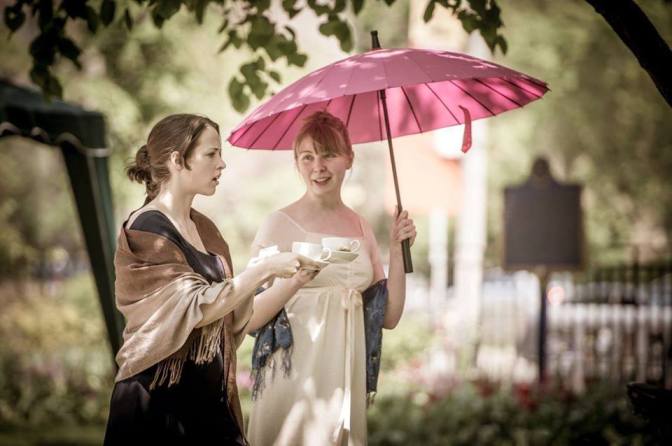
Clever and charming, this 2013 Toronto Fringe two-hander deserved this remount in the historic Campbell House Museum. This entertaining and inventive adaptation is definitely on our radar for the holidays, and of particular note is the sharp skill in which Burt and Werneburg flip between their cast of characters.

Where: The Campbell House Museum, 160 Queen Street West

When: December 14th – 29th 2pm & 8pm (check online for specific dates and times)

Tickets: $20, 416-597-0227×2 https://totix.ticketpro.ca/?lang=en#def_9536240

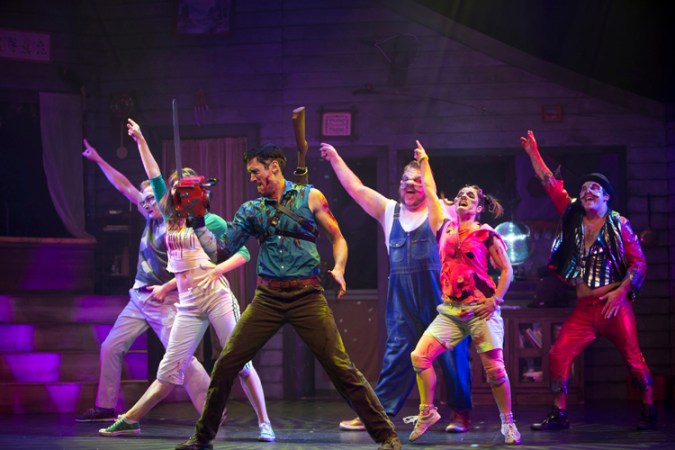
Evil Dead – The Musical

By Christopher Bond, George Reinblatt, Frank Cipolla and Melissa Morris, presented by Starvox Entertainment/Jeffrey Latimer Entertainment

Evil-Dead-The-Musical-cast.-Photo-by-David-Hou

“The musical based on the Evil Dead film franchise returns home for its 10th anniversary.”

On the flip side, if you’ve had enough of holiday cheer, why not fill your December with some horror, blood and gore with a mixture of song and dance, of course. You’re sure to have a bloody good time!

Where: Randolph Theatre, 736 Bathurst

When: October 29th– January 5th Tue-Thu 8pm, Fri-Sat 7pm and 10:30pm, Sun 3pm.

Tickets: $19.99-$79.99 evildeadthemusical.com

Ryan-Ward-and-Laura-Tremblay-in-Evil-Dead-The-Musical.-Photo-by-David-Hou

Parfumerie

By Miklós László, adapted by Adam Pettle & Brenda Robins, presented by Soulpepper

parfumerie-homepage-photo

“By great demand, the award-winning, heart-warming holiday hit returns! In this uproarious comedy for the whole family, that forms the basis for both The Shop Around the Corner and You’ve Got Mail, two shop clerks kindle a tender love affair through anonymous letters while they unwittingly squabble with one another in person.”

Between the lavish set, vivacious staging, live music elements and charming, smile-inducing performances, Parfumerie is a feel-good feast for the soul. If you’re looking to stay in the holiday mood, head on down to the Distillery District to catch this seamless performance.

Where: Young Centre for the Performing Arts, 55 Mill

When: November 28th – December 28th

Tickets: $32-$68, 416-866-8666, soulpepper.ca

The Tin Drum presented by UnSpun Theatre, December 5th-14th

Interview by: Ryan Quinn

Last week, I was fortunate enough to speak to director Chris Hanratty and actor Shira Leuchter, who also act as Artistic Director and Creative Director of the company, about UnSpun Theatre‘s incredibly exciting upcoming adaptation of The Tin Drum by Günter Grass.

The Tin Drum, says Hanratty, “is the story of Oskar Matzerath, who is retelling his life from a mental institution. In our adaptation, he’s trying to figure out if he should be there or not. Oskar wills himself to stop growing at age three, so he’s the eternal child, the eternal innocent.” It’s also known as one of the seminal works of magic realism, which lends itself beautifully to the stage. “There’s a lot more suspension of disbelief in theatre than in film,” Hanratty explains.

You may recognize the name, the 1979 film version is now considered a classic piece of German cinema. “The film was quite well received critically, it co-won the Palm D’Or with Apocalypse Now, it won the best Foreign Language Oscar, but some people really hated it because of the character of Oskar.” The controversy stemmed from the fact that Oskar, a mature adult in a child’s body, has romantic relationships in the course of the film. This led to some groups deeming it child pornography, and the film was banned in several places (of course only later to be reversed).

This project began six years ago, and has always been a passion project for Leuchter, who co-adapted the novel with Hanratty and performs in the piece. “When Shira came to me about The Tin Drum, I had heard a little bit about it just because it had been banned in Ontario. Shira came to the novel a long time before I did. She brought me to it.” Leuchter’s long been a fan, and has sought to turn it into an English-language theatrical piece for quite some time: “As I read it, there’s so much magic in the novel that I just kept seeing stage imagery in my mind. You know, the breaking of glass onstage, or trying to stage something where the main character is so small.”

This has been a huge learning experience for the couple, who have seen this piece change and take shape over the past six years. “We were lucky enough to get some time to work on the first third of the book in the Equity showcase, and neither of us had ever adapted something before,” Leuchter told me, and that first adaptation, though overly faithful to the text, became the seed of this project. “We needed to tell the story we want to tell. That meant adding things and changing things and it took us a long time to get comfortable with that, especially knowing that Günter Grass would be reading the piece.” “We wanted to make sure we got it right, for us too. It’s been six years and now we’re in rehearsals with two weeks to go. The essence is there, the characters are there, but I mean, it’s a 600-page novel cut down into a 90-page script. You have to cut something,” Hanratty added.

In the end, it’s the power of perseverance that’s made this project feel so satisfying for the pair, whose lives have changed a lot since the beginning of the process, as evidenced by the picture of their son that Hanratty proudly keeps pinned to his shirt. “For this project, it’s been incredibly important for us to just keep at it. We started this six years ago, and there have been peaks and valleys. It’s nice to let something breathe and grow,” Hanratty told me.

As to the contemporary importance of this piece, Leuchter replied, “I’m Jewish, and when I got out of theatre school, I did a lot of Holocaust pieces, and those are very important, but I’ve always been looking for other voices. We don’t often ask questions to people on the quote-unquote “wrong side” of history, but I think those stories are very important.”

It’s also about the act of viewing, Leuchter told me, and the culpability of the bystander: “This story explores how witnesses to history enabled it. Are we responsible, are we not? When we just observe what our culture is from the sidelines, how culpable are we? It’s really easy for me to extricate myself from the actions by my country. It’s easy to remove myself as an active participant in what my country does”. This is true more than ever with new technology, Hanratty believes: “The internet makes us witnesses to so many things, but do we have responsibilities as witnesses? Or is it okay to have just seen something?”

The Tin Drum

An original adaptation based on the novel by Günter Grass.
Adapted by Chris Hanratty & Shira Leuchter, presented by UnSpun Theatre

1457726_183091328563781_673522783_n

When: December 5th to the 14th

Where: AKI Studio at 585 Dundas Street East.

Tickets: Available by phone (1-800-204-0855), in person at the box office, or online, and group rates are available.

Artist Profile: Kelly Penner and Hallie Seline – Reconnecting with the Classic Tale of Love-at-First-Sight as the Title Roles in Shakespeare BASH’d Romeo and Juliet, November 19th-23rd

Interview by: Brittany Kay

We sat down with the smart and sexy duet, Hallie Seline and Kelly Penner, who play the title roles inShakespeare BASH’d upcoming Romeo and Juliet, running this week, for one week only, November 19th-23rd. We discussed what it’s like approaching such iconic roles, working with BASH’d, on-stage chemistry and their thoughts on Canadian Theatre and its utilization of young artisits.

BK: Are you feeling the pressure of filling such iconic roles, in arguably one of the most timeless tragedies?

KP: Well yeah, you do feel the pressure. There’s the iconic movie versions… and Leonardo Di Caprio played Romeo, and they just did it at the Stratford Festival… So yeah. It’s there, it’s big. But the first thing to do, is to forget all of that and approach it like any other part. You try to figure it out for yourself.

HS: I’m trying to be like EVERYONE in one performance. Watch out! (she laughs) Sure, I would say there’s a pressure, however James Wallis, our director, was really great in advising us to approach the text with fresh eyes. There are definite ways in which we have heard these iconic words being performed. We are trying not to fall into those familiar patterns. Instead, we’ve been focusing on telling the story, what you’re saying and who you’re saying them to. I’m trying to make choices for myself and for the story.

IMG_5549

BK: Have you looked to any other actor’s portrayal for inspiration?

KP: Sure, I’m inspired by other Romeos I’ve seen, but I’m trying to figure Romeo out as myself like any other part that I’ve read for the first time, which is difficult because it is one of those plays that we think we know, and have so many other portrayals that have kind of defined the characters for us.

HS: And everyone will have an opinion on how it should be said or what they think Romeo and Juliet should be like. All you can do is stay true to yourself and your interpretation of the characters and the story that you and your cast are trying to tell.

IMG_7332B

BK: Talk to me about your rehearsal process?

KP: Once a week for a month we’d get together by scene and we would literally just go through the lines to make sure we were all clear with interpretation and meaning. We didn’t work on intention at all during this text work. It was just strictly for clarity of meaning. James had done an enormous amount of background work on certain words and phrases as well, which was incredible to work with as a starting off point. It was good to have that table work behind us so we could go into our blocking rehearsals really knowing what we were saying, giving us more freedom to play.

HS: Afterwards we were all really prepared to focus on our arguments and our scene partners and the story as a whole. James thinks Shakespeare is best when it’s story based. No bells and whistles just clear storytelling, which was a great way to approach our rehearsal process.

IMG_5548

BK: You have to fall in love every night. How has it been working with each other?

HS: Look at him! I may throw up in my mouth every time I think of kissing him (she laughs) … but seriously, you can start with this one, Kelly.

KP: You don’t want to start? You started?

HS: Nope. You take the lead, Romeo.

KP: The chemistry is…. good! These two characters fall in love instantly. And they are intensely in love. I didn’t know Hallie at all before, other than a “hi, hello” in public. We just tried to get to know each other, become friends. It made the intimacy on stage a lot easier and helped it to develop a lot faster. Ultimately, the chemistry on stage comes from listening and playing off each other. The chemistry is also in the language, let alone in the heart and the body. Really listening and taking in what the other person is saying, using each other’s words, and creating poetry together is where it mainly stems from.

HS: Ditto.

KP: That’s all you’ve got? Ditto? (he laughs)

HS: Well, I’m into that answer! It all comes from trust and feeling comfortable in the scene and in rehearsal with your partner. It’s really about what Kelly said… becoming friends. We are completely playing off each other. You know basic scene principles are that you are trying to affect your partner and you are fighting for what you want from them. In our scenes, that is what it is. We have fun.

BK: How did you get involved with Shakespeare BASH’d?

HS: I had seen both of their past productions in the Toronto Fringe, which were hugely successful and just so enjoyable as a spectator. I took a liking to what the company looks for in Shakespeare, performance and theatre in general. It was fun and laid-back, and in a bar, so you could have a drink during it, which is always nice. It was great, thought-provoking, fun, quality work with so much young local talent. I contacted them when I found out they were auditioning for Juliet and it’s been an incredible experience working with them!

KP: When I was in second year at theatre school at Windsor, I was cast in a production of As You Like It in Brampton. In that production there were many of the cast members of this Romeo and Juliet.  Because of that production, I met James through this network of guys and gals. We’ve connected through our love of Shakespeare and I’ve been working with them ever since.

IMG_7192

Shakespeare BASH’d Mission Statement: To present Shakespeare’s plays as they were written: with simple staging, clear and specific language with an emphasis on the words and characters telling the story.

BK: So you’d say you connect with what the company represents and stands for?

KP: I do. James and Shakespeare BASH’d idea of the text and story being the primary point of focus is why we clicked in the first place. Staying true to it is so important. They always start with such an intense textual analysis of the words in these classic stories and this what I like about them the most. It is also a room that I love working in. It’s such a fun, playful, vibrant room filled with young talent. You get easy access to trying and experimenting and being wrong and trying something completely different.

HS: What’s interesting is our ages range from 20s to roughly 40s give or take. It’s not just a group of 24 year olds, which I feel makes a difference. The room is filled with an incredible group of giving and intelligent performers with a wealth of experience and such variety in process. We all learn from each other constantly. It’s a room where you have the ability to develop your own approach to the work. The cast and crew are incredibly supportive. I feel like I’m coming into my own as an artist in terms of my process because of influence of this group of people.

BK: You are both playing leading roles that are meant to be young in age, and for the Toronto standard, you could both be described as young performers. Going off of a recent article to surface in Toronto, from Holger Syme’s blog dispositio, do you think the Toronto theatre industry has a youth problem? From your experience, do you think there is enough opportunity being given to young performers?

HS: I think it depends on the production. If it’s a choice to utilize an actor that’s different than what is written in the text, then that’s a specific choice. Being in the rehearsal room with all these relatively young performers and theatre makers, and from what I’ve seen of the independent theatre community, I find that there’s a lot of strong, intelligent, bold, exciting, thought-provoking artists out there, who I think should be given the opportunity to show and share their work and who are just as valid in themselves as artists to be seen on the major Canadian theatre stages and in the spotlight, as many 30+ artists are. Beyond that, I think that when you are a young artist with an opportunity for a role of this scale, it is a huge learning opportunity for yourself as an artist and not at some cost to the production. Personally speaking, to have this role of this scale at this time, has been a huge benefit in my development as an artist. I think it’s doable and there should be more trust given to younger artists. Furthermore, I think there needs to be more opportunity for all ages to work together.

KP: I do wish for more of that. For some professional companies they want the sure-fire thing, and often times that means going with someone older that they know rather than take a chance on a more age-appropriate actor with a shorter resume. In terms of theatre and the story, if they have the right spirit or if you look younger than you are and it’s not noticeably distracting, then I don’t mind it. But sometimes I see productions and it dawns on me that this actor is a man, playing a boy but they’re doing things in a manly way which really just seems inappropriate for the character and it will draw me out. I do wish we could find a way to get more young people on stage.

HS: I’ve seen a 35 year old playing a 15 year old and if the essence is appropriate then power to you. Do it!

IMG_7333

BK: Is Shakespeare BASH’d production of Romeo and Juliet different in anyway? Any specific concepts or time periods?

HS: James has been really clear in not putting a time period or a concept to it. I mean… it’s already a tragedy being put on in a bar! There is definitely a lot of comedy to it, but that alone is quite unique and will be interesting. But mainly, he wanted to focus primarily on the story and the relationships of such a classic play.

KP: The costumes are neutral colours but there are jeans and running shoes, but then we have swords.

HS: … and the sword fights are awesome! They are sexy and exciting… Get excited for those!

KP: We really wanted it to be about the story and not have any kind of heavy concept distract from that. Just from the work I’ve seen in rehearsal, I think, and hope, people will really take to it.

Rapid-Fire Question Round

IMG_5547

BK: Favourite Movie:

KP: On the Waterfront
HS: Hook

BK: Favourite Play:

KP: Othello
HS: Vimy by Vern Thiessen

BK: Favourite Musical:

KP: Into the Woods
HS: Cats! Of course… (she laughs) or definitely Next to Normal

BK: Favourite Actor right now:

KP: Ben Whishaw
HS: Carey Mulligan

BK: Favourite food:

KP: Cannelloni
HS: Nachos

BK: Guilty Pleasure:

KP: My pink cardigan. I love it but I never wear it out!
HS: Candy, Real Housewives of Orange County or Beverly Hills… yup.

BK: Best advice you’ve ever gotten:

KP: BLT-Breathe, Listen, Trust
HS: Don’t take yourself out of the part. They hired you for a reason or they are seeing you for a reason. The more of yourself in the part, the better.

BK: Advice for other young artists:

KP: Let it go. There are so many factors out of your control. Leave it in the audition room. You’d go crazy if you try to figure out why you didn’t get cast. Have fun!
HS: Be true to yourself. Also, James said this to me in rehearsal when I was trying really hard to find the right arc to one of the scenes. He said “If you’re looking for perfection, it doesn’t exist, and if it does, it’s boring. It’s just a play… Put into it what you can and don’t beat yourself up over it. It will be interesting” I think that’s great, especially for younger artists to be reminded of coming out of theatre school training. And yes… like Kelly said, have fun!

Romeo and Juliet

by William Shakespeare, presented by Shakespeare BASH’d

994940_10151784665008952_1205445970_n

When: One week only, Tuesday, November 19th-Saturday, November 23rd, Tuesday-Friday at 7:30pm, Saturday (Closing) at 4pm
Thursday, November 21 includes an after-show dance party with Silent Shout’s DJ ARP 2600 – http://silentshout.ca/
Friday, November 22 includes an after-show dance party called “Much Ado About Mixing” with DJs Slamlet and Rockthello.

Where: 3030 Dundas West, in the Junction

Tickets: Tuesday, Wednesday, Saturday – $16, Thursday & Friday – $21 (including after-show dance party admission) http://www.shakespearebashd.com/tickets.html

In Conversation with Naomi Wright, Actor/Producer of Bloomsbury Collective’s A Room Of One’s Own, playing at the Campbell House Museum November 13th-24th

Interview by Madryn McCabe

MM: Why don’t you tell me a little bit about the show?

NW: We are doing an immersive production of Virginia Woolf’s A Room of One’s Own. So A Room of One’s Own is this beautiful book that Virginia Woolf compiled after she gave two speeches, to Girton College and Newton College in 1928-1929. And Patrick Garland, this wonderful director and writer in England, adapted that book for the stage in the 80’s. So, our idea for the show is that we want to try to recreate these speeches in a theatrical way. Our audience is invited to the Campbell House Museum, but the Campbell House Museum itself is playing a role as Girton College. So you arrive at the Campbell House Museum like you were arriving at Girton College in 1928, and we have this lovely improviser, Kayla Lorette, who is going to play the head of the society that invited Virginia Woolf to give the speech. They were part of the ODTAA Society, which stood for One Damn Thing After Another. So Kayla plays this girl who welcomes people, like it’s the night that Virginia Woolf delivers this speech, and you can have a drink at our bar, we’re going to set up the space like it’s Girton College, so there’s going to be lots of stuff to look at, there are going to be newspapers from November 1928, there’s going to be a whole library of all the books Virginia Woolf talks about in the essay, and then upstairs there’s going to be this bedroom that’s still kept historically accurate. So we’re saying that it’s where Virginia Woolf is staying while she delivers this speech, and so you can go into this room and open drawers and look through things, and we’ve chosen various pieces of writing, like letters and diary entries, that will give you insight into who Woolf was as a person, as a woman. And so you’re there to hear the speech. And, for me, it’s one of the most beautiful pieces of writing I’ve ever read. It’s a powerful piece of work about claiming your space in the world and not letting anybody tell you that you’re less than you are, and especially never telling yourself that you’re less than you are.

MM: Is the play written to be such an immersive experience, or is this something that you and the creative team have developed? Why is it so immersive?

NW: The way that A Room of One’s Own is written is Virginia Woolf is talking directly to you. So, automatically, it’s assumed that you’re at Girton College, at the time that she is delivering this. There are no stage directions in the script, it’s just words on 32 pages of paper. But, it reads like she is talking directly to you. So from that, we said, okay we’re at Girton College, and then when Sarah [Rodgers, AROOO director] and I were working on the scripts, we read through her letters, what was she doing at this time, and the more that we unearthed…Virginia Woolf is one of the most fascinating, complicated characters in literature, in history, and so while you can pull that nugget, put that thing, and say as an actor, “okay I’m going to digest that, I feel like that connects to these words, and I feel that that is what she’s saying when she goes to this place” it’s a fleeting moment. Even though it might impact the audience, in a way that they don’t understand, that it’s moving, or it’s funny, they don’t have the full story behind it. So that’s when we began to weave this idea that we could try to offer a bigger piece of the story through the immersive experience.

Room_029 (1)

Naomi Wright as Virginia Woolf (Photo Credit: Emily Cooper)

MM: I was reading on the website that the Campbell House Museum is open and that part of your immersive experience is open, even when the play isn’t running, so that people can go in, read these books, and look at these letters.

NW: It was so much fun to compile them. We found a website that’s a catalogue of whatever used books that bookstores in the world have, they can put their stock on it, and you can enter in, say, “Jane Eyre” and all of these books will come up, in Paris, in London, New York, Philidelphia, wherever, whoever has that book, and you can order it and have it sent to you. And so we started ordering the books that she was talking about, and then we thought, “We really should order every book, and put it out in the library”. And they’re just so beautiful. And what we hope will happen is that people will look at them during the reception and set their eye on one, and as a bonus to your ticket, you can come back to the Campbell House any time during their opening hours, and sit in that gorgeous house, and take a breather, and read that book. It’s also sort of a throwback to a time when you did that. Back in 1928, that’s kind of the thrust of what people were doing. That’s how people got their information, newspapers and books, it wasn’t as instantaneous. There was no Twitter and Facebook, and “sharing” and “liking”. That’s what so great about the letters too, particularly to Vita Sackville-West, who was Virginia’s lover. Her letters are so desperate. There are things like, “Dearest, I haven’t heard from you in two days! I’ve sent twelve letters!” There’s something so beautiful and romantic about that.

MM: So you were finding that you were getting a lot more out of your research for the role looking at these letters?

NW: Oh yeah definitely! Letters, back in the day, were an art form. Lots of people had their letters published. It wasn’t totally an idea that it was private, so Virginia Woolf’s letters, while very intimate, are beautifully written. They’re addendums to her work, they’re another branch to her art. So we definitely wanted to include some of that in there.

MM: I was seeing that the whole creative team of the show is all women. Did that happen by accident or is that a tenet of your company?

NW: It’s not a tenet of the company, but when we started developing the show, I had applied for some grants, and when I was doing my research, I started Googling around and said, “where is equality for women today?” And first of all, it’s a little disturbing that it’s not quite as advanced as we think it is. Women on the whole still make less money than men for doing the same job, we do not represent congress or parliament or politics in any sort of substantial percentage, we’re not even close to half. It’s such a big deal that Premier Wynne is a woman, and it’s 2013! It’s amazing. Tina Fey won this prestigious comedy award in the United States, and they announced that she was the second woman ever to receive it. And in her acceptance speech, she said, “I’m really looking forward to the day when we can stop counting things. When I’m not the second of this, or the fourth of that, when it’s just the award.” And when you actually break it down, logically, it’s so absurd. What is it that makes us say, “Wow! A WOMAN is Premier!”? What is it that we’re talking about? Are we talking about the anatomy of a woman? The social aspect? What is it that is so remarkable about the fact that women are different? What is it throughout history that has made women “the lesser” sex? The fact that we don’t build muscle the way that men do? That we were the gatherers back in the day? That we bear children? It’s interesting, because that’s a lot of what Woolf talks about in the essay. She talks about back in the day when there was no birth control. If you were a wife, you were having twelve, thirteen children. Because that’s what happens in nature. Eighty-five years ago is when she wrote this. So, in a way, that’s a long time ago. We hope that lots has changed since then. But, in another sense, some of the shocking things that were the norm in 1928 are still around. Eighty-five years is within a lifetime. So your grandmother lived in that time, when people could still write things like, “A woman’s composing is like a dog’s walking on its hind legs; it’s not done well, but you’re surprised to find it done at all”. That’s literally pulled right out of A Room of One’s Own. I have the book that it comes from. Cecil Gray was a music reviewer, and he wrote a book called “A Survey of Contemporary Music” and the ONE review he gave to any woman composer was that.

MM: That leads me into something else I was going to bring up, which is David Gilmour’s comments that he only teaches tough, heterosexual men and if you want to learn something else, take someone else’s class, BUT he does have one of Virginia Woolf’s writing in his curriculum.

NW: For me the David Gilmour thing, the whole debate started coming up, and for me the thing that I took issue with, was that he was quoted as saying, “I don’t like women writers”. And he just sort of said it, just like that. I don’t need him to be punished or feel like a jerk, I just need him to realize that’s a meaningless statement. He could have said, “I don’t like Alice Munro, I don’t like Margaret Atwood, I don’t like Virginia Woolf”, every female author who’s ever written, to infinitum, THEN he’s expressing a preference. As soon as you go, “I don’t like women writers”, it’s a prejudice, and it doesn’t mean anything, because you haven’t read every woman writer who ever wrote anything. I’ll bet if we sent David Gilmour a bunch of books with the name reversed, he wouldn’t know which was written by a woman and which were written by men. I don’t know what he thinks he meant by it [his quote] and that’s why I think people reacted so strongly. In A Room of One’s Own, Virginia Woolf talks about going to the library and researching women in fiction and all these things come up. “Women: weaker in the moral sense” “Women: Vanity of” all these things and she says, “While I was reading these things, I started to draw a picture, and I drew a picture of this very angry, rather ugly man, and I realized I was thinking about the writers, and not what they were saying, and that made me realize that they were angry.” Because when you’re thinking about the person, and not the legitimacy of what they’re saying, there must be some sort of bias, there’s something else going on there. And she felt that it was the professor’s need to be superior, and make other people feel inferior. And what’s confusing to me, is that Gilmour is a smart, great writer, so I don’t know what he wasn’t able to follow up and say “this is what I really meant”. I would love David Gilmour to come to the show! And I would love to talk about it afterwards. Because maybe he would say, “I’m totally wrong, I didn’t mean it, it was a shitty thing to say” and that’s cool with me. I don’t need him to be punished, or burned or whatever, but I do need us to say that what he said isn’t cool. Because if we let that kind of thing hang in the air, and nobody reacts to it, that’s the danger. That’s why it was really important that people did react to what happened.

ca04599fd524a87dc108edd84af78e74

Naomi Wright as Virginia Woolf (Photo Credit: Emily Cooper)

I wanted to go back to what you originally asked me, did we mean to have the entire team be women, and we didn’t but when I started researching our grants, I found this really interesting study done by this woman at Harvard. And one of the things that she discovered was that 80% of plays produced in the United States are still written by men. We’re still on that bias in theatre. So, what she did was, she took a bunch of new scripts by men and by women, and she swapped some of the names so that some male scripts said that they were written by women and vice versa, and she sent them out to artistic directors all over the U.S. The male artistic directors on the whole weighed the plays equally, but the women, in quite a big margin, said that the female written plays were worse than those written by men. And so that brought up an issue to me that is maybe more disturbing than anything else, which is that women might be, as suggested by this study, harder on other women, and less likely to help other women than men are. And I find that really disturbing. And so when Sarah and I were sitting around and talking about this show, Sarah, who is a director who works a lot on the west coast, and so is able to give a lot of theatre designers jobs, said, “I think that I go to male designers sooner than I go to female designers, and I never thought about that. I just have these guys that I usually just go to.” And she has a show that she directed that just opened up on the West coast last night, and so she said, “There’s an amazing designer who’s just coming out of UBC and I’m going to approach her to do the show”. There’s some idea about feminism that it’s angry, or hard done by, but I think now what it’s about is just having conversations. It’s just about recognizing and letting it sit at the table with you.

So even though we didn’t set out to make the whole team women, we really felt out that the best people that we were getting for the work were women. So I already knew that I wanted this specific woman to do the promotional images for the show, and she said that she didn’t really do the type, so I asked her if she knew anyone and she said that there was this girl who is 22, just graduated from her program. So I interviewed her, and knew that I wanted to bring her on board, and I asked her, “What’s it like for you? Isn’t graphic design just full of guys?” and she said, “Oh yeah. I’m one of two women from my program”. And I just thought that it was such a wonderful serendipity that right down to the graphic artist, we’ve got this really talented, up and coming woman on board.

MM: So what is it you’re hoping your audience can walk away from this experience with?

NW: Of course we want them to be entertained. Virginia Woolf is very funny, she’s very witty, so we hope people will have a little laugh. We hope they’ll be moved, and I think the everlasting power of A Room of One’s Own is that simple message that you must stake your place in the world, and fulfill exactly what you what to fulfill. Never let anybody else make you shrink back from that. Don’t let anybody tell you that you can’t do something, or that you shouldn’t do something, because it isn’t appropriate for you because of your gender, because of your sexual orientation, because of your race, because of your father, because of your social status, whatever it is. You need to stake yourself, so that you can free everything that you need to do. And I don’t know what is a more powerful statement than that.

A Room of One’s Own

By Virginia Woolf, adapted by Patrick Garland, presented by Bloomsbury Collective

Where: The Campbell House Museum, 160 Queen St. W.

When: November 13th-November 24th, Wed-Sat 7pm immersive reception, 8pm show time, Sun 2pm

Tickets: $20 http://aroomofonesown.brownpapertickets.com/

The Empty Room Collective’s “Journey’s End”

Interview by Ryan Quinn

I spoke to Jesse Nerenberg and Andrew Petker about The Empty Room Collective’s production of R.C. Sherriff’s Journey’s End. We sat in the living room of my apartment, sipping coffee as the sun shone warmly through the windows. It could not have been more antithetical to the topic of the show.

Journey’s End is a war drama, but there’s something skewed about it: “It’s not really about the action,” Jesse tells me, “it’s about what happens in between. It’s about a group of men that are waiting for orders at the bottom of a foxhole. Most of the violence happens offstage. This is about the mental toll that war takes on these men.” Petker sums it up by calling it “a kind of limbo where death hasn’t happened yet, but you know it’s on the horizon.” The action of the play happens in the officer’s dugout of the British infantry over four days in 1918. Sherriff himself was a serving captain in the war, and he sought to share his experiences with the show.

Petker plays Captain Stanhope, the highest ranking officer in the foxhole, a role originated by Sir Laurence Olivier. “He’s numbing himself and coping with the war in a way that’s really unhealthy.” Andrew explains, “He’s been down there for a long time, and he’s a different person than he was when he was deployed.”

Nerenberg plays Raleigh, a younger soldier who has always revered Stanhope. “In the town they’re from, Stanhope was the equivalent of the high school quarterback, you know, he was incredibly popular, and they still think of him that way back home. So, Raleigh goes to serve, and Stanhope has completely changed. The war has really taken something away from him.” It’s the shocking discrepancy between how the war is being portrayed at home and the reality that drives the show, they tell me.

“They say that in war, everybody loses a brother, and that’s so true. These people you’re stationed with, they really do become your brothers, and not all of you are going home. So when the higher-ups call a raid ‘successful’ because there was a minimum number of casualties, that’s still a loss. Someone still lost a brother.”

This is the first big production for The Empty Room Collective, and everyone on board is contributing in any way they can. Nerenberg, for example, has taken on the duties of producer. “You don’t realize how many jobs there are to do because it’s so easy to overlook the little ones. If you need to get a certain kind of pencils for the show, that’s a real job that someone has to do. If you need to get food to eat onstage, that’s a real job that someone has to do.”

Beyond the production itself, the team is also working on outreach efforts. Nerenberg explained why the proceeds of one performance of the show (November 10th) are going to the Poppy Appeal: “We wanted to give back in a way that wasn’t just symbolic, we wanted to contribute to something, and we’ve been working with the Royal Canadian Legion Branch 344: The Queen’s Own Rifles. In fact,” he says, “Andrew’s a member of the Legion now.”

“Yeah, you can find me down there quite a bit, volunteering. It’s amazing because it’s something I never would have thought to do before this show. It’s a completely new experience and I have Journey’s End to thank for it.”

I ask them what they hope people will be considering and talking about when they leave the show, and Petker answers that he hopes it snaps people into realizing that “war isn’t just this far-away conflict, it’s full of real people, and these are their real lives.” In much the same way that Raleigh comes to see the reality of Stanhope’s condition beyond how he’s being romanticized in his hometown, Petker really hopes we can look past the symbolism and see the humanity in those who have fought and will fight.

Nerenberg shares a similar thought: “I’ve been thinking about it a lot, and if I was born in, say, 1890, this would have been me and my friends; and I would have lost some of them to it. We are so incredibly fortunate to live in the time and place that we do.”

Journey’s End

by R. C. Sherriff, presented by The Empty Room Collective

When: November 7th-24th

Where: Artisan Factory, 116 Geary Ave. north of Bloorcourt Village.

Tickets: Can be bought at https://journeysend.eventbrite.ca/

JE-poster_LargeREDUX2