Skip to content

Posts tagged ‘Toronto Theatre’

“Power, Authority & Shaking Up Traditional Structures” In Conversation with Rob Kempson, Playwright/Director of TRIGONOMETRY

Interview by Brittany Kay

We had the pleasure of re-connecting with playwright/director/artist/educator/all-around smart-cookie Rob Kempson to chat about Trigonometry, the final instalment of his trilogy, The Graduation Plays. We spoke about what can come with taking time to explore a subject more thoroughly, the need to shake up traditional structures with power and form, and how he wants these plays to ignite more complex discussions that continue beyond the show. The world premiere of Trigonometry runs from March 16th to March 25th.

Brittany Kay: Tell me a little bit about your show?

Rob Kempson: I think the best way talk about the show is in the context of it as part of a bigger series. I think, like all the other shows in the Graduation Plays series, Trigonometry is about the interaction of power and authority structures in a school setting. What I found from my own teaching is that students have the capacity to take power that maybe isn’t assigned to them in a traditional school atmosphere. The authority in the school is clear but the power is not. These plays explore how we manipulate power and how the powerless gain their voice.

I have found in this series that some sort of student expression of sexuality is a great way for them to steal power because, being in a school setting, a lot of that is about tight-lipped, very square principals. It doesn’t always mean that they’re having sex. It means that they understand that by talking about, or referring to, or in some way bringing up sexuality, it makes teachers uncomfortable because they’re not allowed to talk about it in a school. I found that sort of tension really interesting.

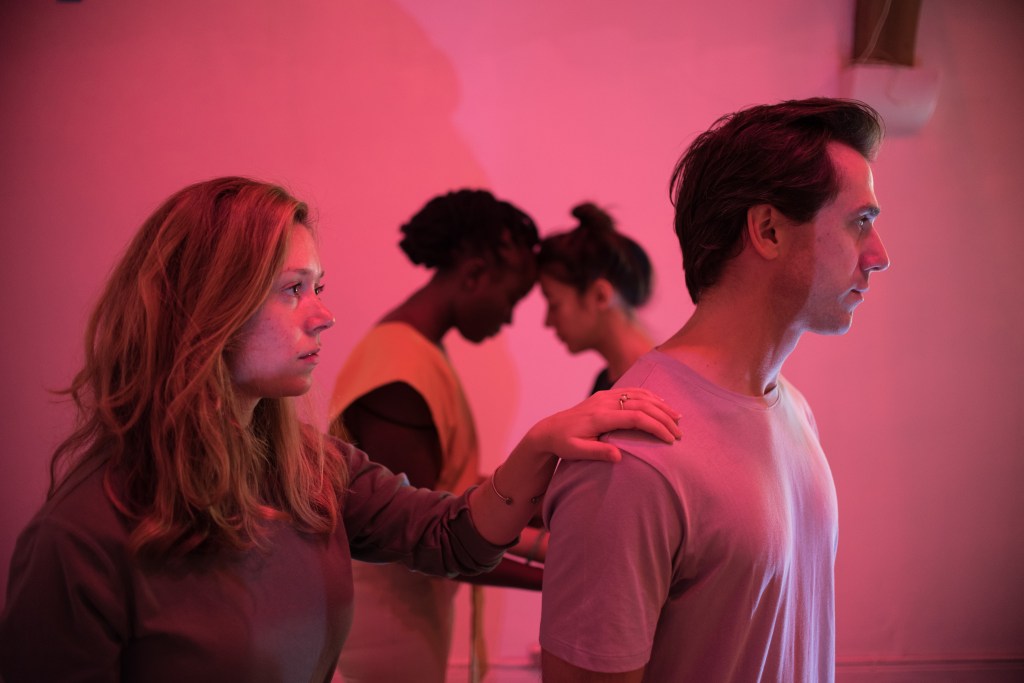
Photo of Daniel Ellis, Alison Deon and Rose Napoli by Robert Harding.

BK: Why are you so drawn to the themes of student power and authority?

RK: I’m really interested in that idea because I don’t know how the education system can grow and change and find what’s next, unless we address the way in which students are now on the same level as teachers. We aren’t as different as we once were. I think unless we figure out how to tackle that, the education system is going to be stuck in this bizarre route for a long time.

BK: What makes Trigonometry different from your other two shows in the series?

RK: In this particular case, I tried to take a different perspective than the other two plays. If I was to simplify it down, I think SHANNON 10:40, Mockingbird and Trigonometry are all about the same thing. Something happens where a student takes power, it’s unexpected, and it’s about the way into that, which I think is different between them. SHANNON 10:40 is a largely student perspective, Mockingbird is a largely teacher perspective and Trigonometry is about the parent perspective. I think that’s why this is the end of the trilogy. I sort of found three different ways into the same problem. I don’t think I’ve solved the problem in any of the plays, but I’m interested in finding out how using those different perspectives enlightens new aspects of it.
Trigonometry 1

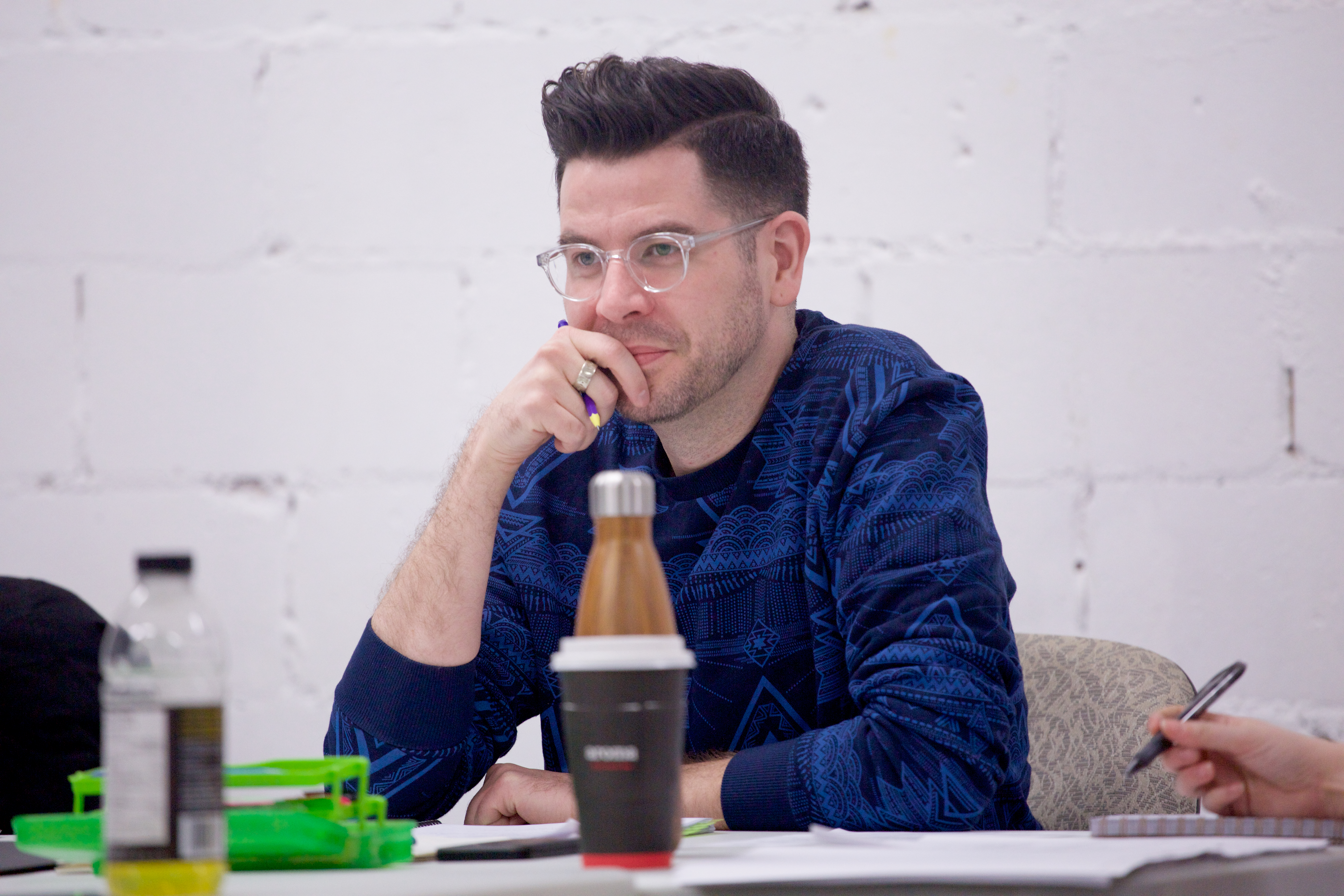
Photo of Rob Kempson by Robert Harding

BK: In the Greenroom has been able to talk to you about both shows in The Graduation Plays. You and I spoke at the beginning of your process and here we are at the end of it. Do you feel satisfied that this is the final play of the trilogy?

RK: I needed to work out what I wanted to work out. What all of this meant? Why this has been a multi-year process of writing all these things? I think this started as a nugget that I was picking at and I realized I wasn’t going to be satisfied just picking at it. I needed to go as deep as I could. I felt in writing the first two that I hadn’t quite uncovered everything that I wanted to uncover. I knew there was more there to explore, but I didn’t know exactly what that was going to be. The Graduation Plays, in a way, is a graduation for me as a writer and as an artist because I really gave myself the opportunity to spend time exploring a particular theme in a particular area. Not only with different plays, but in different structures of those plays with really different numbers of characters and really different play setups.

Photo of Daniel Ellis by Robert Harding

BK: Why the title Trigonometry?

RK: Everyone should read Sarah Ruhl’s 100 Essays I Don’t Have Time to Write. Sarah Ruhl is one of the greatest writers still living and that book says a lot of smart things that are very digestible. She talks a lot about play structure and one of the things she questions is why we see plays as having an arc and what would happen if a play had a different shape. I started thinking about that, what would a triangle shape play be like? The laymen’s answer is that it would have 3 people in it. I just started to think about why that was an interesting structure to explore. What did making a triangle play mean for me? Does this play have an arc? Of course it does, but it does happen in 3 separate parts. Each character is used in the same way. Each are only in 2 of the three scenes.

BK: How does trigonometry come into the structure of the play?

RK: The play is designed like a trigonometric function. If you know the sohcahtoa method, so SOH stands for Sine, which is opposite over hypotenuse; CAH stands for Cosine, adjacent over hypotenuse; and TOA stands for Tangent, opposite over adjacent. I built the play that way. If you assign each of those to characters and you sort of extrapolate as to why you might call those characters by those titles and then you apply those trigonometric functions to those characters, what happens in those scenes is mathematical.

Photo of Alison Deon by Robert Harding

BK: Incredible. Do you need to know anything about math to see the play?

RK: No. (laughs) If you watch it, you would never see that unless you really went into it with that perspective. That’s where the title came from. It came from me wanting to write a triangle play and I get a bit obsessed with ideas like that. I sort of spin into what could that mean structurally, what could that mean in content, in tone, and form, and all of the other things you think about. I love finding things to weave through.

One of the most common things teachers say is that math is all about relationships. If math is all about relationships between angles and lines and numbers and symbols and all of the things that go into that, then math is of humans and humans are of math. There is a connection there that maybe we like to sometimes deny. It was a really neat discovery… I also had to watch so many Youtube videos about trigonometry to try to remember.

Photo of Daniel Ellis, Alison Deon, Rose Napoli by Robert Harding

BK: Where did the inspiration for this specific story in the trilogy come from?

RK: I have no idea. I mean a lot of the catalyst for the first play, SHANNON 10:40, came from what was the 2015 fight against the new Sex Ed. Curriculum. This play riffs on that in a way that Mockingbird didn’t. I needed to explore it more actively. It started from there.

The other thing that is true of Trigonometry, is that I don’t really love any of the characters. That’s not something that people generally do. I tend to write people who I mostly like with some villains. I started thinking about people who I don’t agree with politically or philosophically or educationally. We are living in such a polarized world that we have to try to learn how we listen to one another and who’s deserving of that respect. I tried to listen to what those people had to say. They became some of the voices in the play.

BK: Why this story right now?

RK: I think that this is a story that is now. One of the things that I think is a fact in contemporary classrooms that is such a struggle are cell phones. It sounds so simple and silly and trite. The effect of having personal property that you can’t abscond or take away from kids that is so distracting to them changes the education game entirely. It changes the power dynamic between students and teachers. I think that anyone who has been in a contemporary classroom will see themselves in this play in a way that is frustrating.

BK: Oh yes. It’s insane, they’re just staring at their phones and re-watching Snapchat videos.   

RK: I’ve been in those rooms, where the integration of technology is really exciting and innovative, but where I get a bit lost, is the way in which it allows a whole other avenue for students to be making bigger choices in the way they choose to react to what their teachers are saying. It’s not only the choice of apathy or tuning out and looking at their phone, it’s also the choice of if they record you. Are they taking your picture? Are they texting their friends saying something about you? The power dynamic really changes because students have this thing that disables you. This play is for “now” because this is a story that happens everyday in schools and I really wanted to explore that.

Photo of Rose Napoli by Robert Harding

BK: Tell me about your cast?

RK: The actors are the most amazing humans. Rose Napoli is giving a performance that will be talked about for a long time. She is remarkable. I was new to Daniel Ellis. I saw him in The Circle and, working with him, he has just so many great insights about who the character of Jackson is and how he is able to tread the line between being a good kid that maybe does bad things. Alison Deon, who I think is one of the most under-used actors in the country, who I’ve known for a number of years from the Thousand Islands Playhouse, is a brilliant performer. Her range is enormous and it’s really exciting to be able to showcase her in this city. People deserve to see the work of all three of these actors. They’re just phenomenal.

BK: And your creative team?

RK: I’m once again collaborating with the fabulous Lisa Li. She’s the best and has been a real dream to work with as she always is. She’s also working with the support of Erin Vanderberg. Katie Saunoris is our marketing and publicity person. Beth Beardsley is our stage manager and is amazing and everyone should hire her. They are an amazing team. Dream dream dream.

Then we look into the design. Anna Treusch is our set and costume designer and is one of my most deeply loved collaborators. In the next 3 months, we are working on 3 shows because we work so well together. She forces me to work really hard. It’s a good relationship. Kaileigh Krysztofiak is a new collaboration for me and is a such cool up-and-coming lighting designer. When I found out that Andy Trithardt, who I’ve seen as an actor a million times, was also a sound designer, I wanted to get him on board. He’s looking at how the idea of trigonometry comes into the design. How and where do we see triangles and how do we hear that? How can we hear things in three? The design team is allowing this play to be explored more fully and deeply.

Photo of Anna Treusch, Beth Beardsley & Rob Kempson by Robert Harding

BK: What do you want audiences walking away with?

RK: I want them to be divided. My favourite thing is for audiences to walk out and have something to talk about on the car ride home. I don’t want them to come out and have the same opinions of each of the characters. I want people to like one character over the other. Questioning who is making the right decisions for the right reasons. I hope that there is a lot of disparate conversations happening after the show. I really want audiences to walk out with something to chew on for themselves. John Patrick Shanley’s Doubt is such a brilliant parable not only because it’s such a well written play, but because it makes you feel doubt. You walk out feeling the thing that he asks you to explore through these characters. While my play is not called Doubt, I want people to walk out feeling differently about the people that they just witnessed and maybe testing their own morals or testing their own values through the lens of these characters on stage. That’s exciting…I think, I hope!

BK: Anything else we need to know about?

RK: This play stands on its own, so if you haven’t seen the other two in the trilogy that’s okay. You don’t need to. There’s nothing that you will miss. For those who have seen both or any part of it, I think that this will be a really great conclusion for you. I feel so grateful that I have been able to work with collaborators on all three of these pieces that have allowed me the artistic freedom and desire to explore something as fully as I can. If you want to see the outcome of that, I’d encourage you to come out and check out the show.

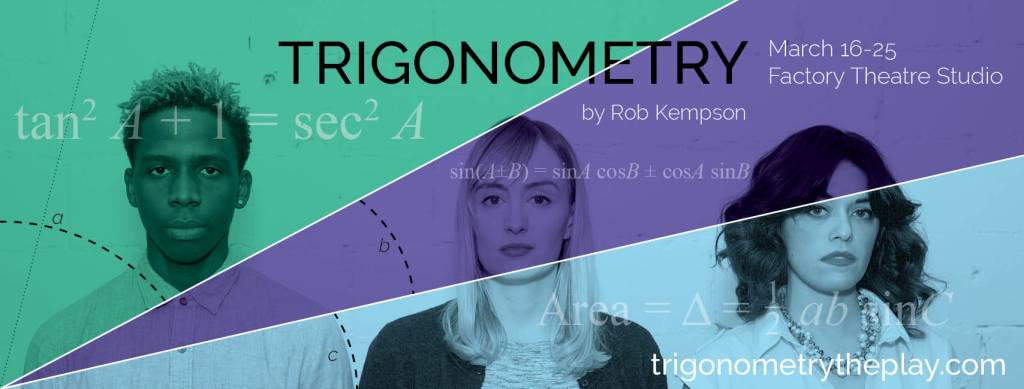
Trigonometry
Who:
WRITER & DIRECTOR: Rob Kempson
SET & COSTUME DESIGNER: Anna Treusch
LIGHTING DESIGNER: Kaileigh Krysztofiak
SOUND DESIGNER: Andy Trithardt
FEATURING: Alison Deon, Daniel Ellis, Rose Napoli
PRODUCER: Lisa Li
PUBLICIST: Katie Saunoris
ASSOCIATE PRODUCER: Erin Vandenberg

What:
Gabriella wants action. Jackson wants a scholarship. Susan wants a family. In this new play by Rob Kempson, three disparate people find themselves bound together by desire, destiny, and a few scandalous photos. Trigonometry is about how far we go to get what we want: what we do to survive.

Where:
Factory Theatre, Studio Space
125 Bathurst Street, Toronto, ON M5V 2R2

When:
March 16 – March 25

Tickets:
416.504.9971
trigonometrytheplay.com

Connect:
#trigtheplay
w: trigonometrytheplay.com
fb: Trigonometry Facebook Event
t: @rob_kempson

Meet Some of the Cast & Characters: 

In Conversation with Trey Anthony, playwright of “How Black Mothers Say I Love You”

by Bailey Green

NB: Trey uses the spelling of womyn when referring to black women in her directors note, so we have respected that in this piece within her quotes.  

Trey Anthony was inspired to write How Black Mothers Say I Love You when she read The Top Five Regrets of the Dying. During that time, Anthony’s grandmother was diagnosed with terminal cancer. Anthony decided to interview her grandmother and when she asked her if she had any regrets, she said her biggest regret was leaving her children behind in Jamaica when she moved to England to seek a better life for her family. She believed that her daughter, Anthony’s mother, had never forgiven her for that decision. “The more research I did, I realized there were so many womyn who were affected by those decisions – by womyn leaving third world countries and migrating to first world countries,” Trey Anthony explains. “There was a history of a lot of Caribbean families, a sister, mother, aunt leaving and I wanted to explore what happened to these families after they reunite. No one talks about the damage being done to these families – to my mother and grandmother’s relationships.” These relationships live at the centre of How Black Mothers Say I Love You. 

beryl-bain-and-ordena-stephens-thompson-in-how-black-mothers-say-i-love-you-joseph-michael-photography

Anthony’s mother left England to live in Canada when Anthony was 9. Anthony and her brother remained behind in England, while her sister travelled to Canada with their mother. “We always had a level of distance. We struggled to connect emotionally,” Anthony says of her relationship with her mother. “And I feel it was because I was left from ages 9-12, during very formative years, that I struggled to develop that relationship. And for my sister, who was never separated from my mother, there is a closeness in their bond that my mother and I were never able to build.” Anthony discusses how her research speaking to daughters of women and women who had left brought about a new healing and a shift in her perception. Her mother became more than just a family member, but a woman who made choices to better herself. “It helped me heal from some of the anger and what I thought I missed out on. It is still a journey and it can trigger me but I am a lot more forgiving of her. The first time my mother saw the piece she broke down crying.”

allison-edwards-crewe-ordena-stephens-thompson-beryl-bain-and-khadijah-roberts-abdullah-in-how-black-mothers-say-i-love-you-joseph-michael-photography

How Black Mothers Say I Love You focuses on three daughters returning home to their mother, Daphne, after receiving news of a ‘devastating diagnosis’. The reunion forces them to confront the past. “The heartbeat of this play is really the story of these women trying to love each other,” Anthony says. The main character, Claudette (played by Khadijah Roberts-Abdullah), is the daughter who was left behind. Anthony says that creating nuance in the character of Claudette and revealing the deep feelings of abandonment behind her bitterness and anger was a challenge. “You see some forgiving and redeeming qualities instead of just a womyn who is angry at her dying mother.” 

allison-edwards-crewe-and-ordena-stephens-thompson-in-how-black-mothers-say-i-love-you-joseph-michael-photography

How Black Mothers Say I Love You has returned to Factory Theatre as part of the 16/17 season for an extended run after the show sold out last May. When asked about how the show has changed this time around, Anthony says: “having the luxury to tweak the various scenes and have some more dramaturgical work, and to have the support of a producing team, has made me able to focus more on the creatives. Having two new actors in the roles [Beryl Bain as Cloe and Khadijah Roberts-Abdullah as Claudette] has helped it have a new dynamic and energy.” Anthony also praises collaborating director Nisha Ahuja for her creativity, specifically noting her work on the transitions and making the piece more movement oriented.

ordena-stephens-thompson-khadijah-roberts-abdullah-and-allison-edwards-crewe-in-how-black-mothers-say-i-love-you-joseph-michael-photography

For Anthony, one of the greatest joys of this piece has been telling a Caribbean-rooted story in a mainstream space and to give voice to those women. “Many people who have seen this play have talked about never seeing their families onstage,” Anthony says. “And for friends who are white, they take it for granted that they can see their lives in some way in any theatre across the city and that is not a luxury that people of colour have.” How Black Mothers Say I Love You speaks across race and class, says Anthony, because at the heart of the piece is a story of a family who is trying to love and is dysfunctional in that love. “As black womyn we don’t get that opportunity to be well-rounded characters with layers,” Anthony says of wanting to focus on black women in black storytelling. “We can be the angry black womyn, or the sassy one, or the one on welfare… I want all of these womyn to go on this roller coaster of emotions and be well faceted, be loving, crying, jealous. So you can see the anger, joy and abandonment […] For me, to hire womyn who look like these womyn onstage and get to be these full characters, that’s groundbreaking and what I want to see.”

beryl-bain-ordena-stephens-thompson-khadijah-roberts-abdullah-and-allison-edwards-crewe-in-how-black-mothers-say-i-love-you-joseph-michael-photography

How Black Mothers Say I Love You

1617_hbmsily_950x200

Who:
A Trey Anthony and Girls in Bow Ties Production
Presented by Factory Theatre
Written by Trey Anthony

What:
A devastating diagnosis brings Daphne’s daughters home where they are forced to confront a traumatic six year separation in their past and their individual quests for love, reconciliation, and forgiveness. How Black Mothers Say I Love You is a poignant and hilarious examination of our desire for truth and understanding from what has been left unsaid. Featuring an original score by Juno Award-winning composer Gavin Bradley and a thought provoking and deeply personal script from ‘da Kink in my Hair creator Trey Anthony, How Black Mothers Say I Love You returns to Factory after being the hottest ticket in town last May.

Where:
Factory Theatre Mainspace
125 Bathurst St.

When: 
February 9 – March 5

Tickets:
factorytheatre.ca


“Two Truths and a Lie… Oh, and a Can of Spam” – In Conversation with Storyteller Graham Isador

Interview by Brittany Kay

I had the joy of sitting down with Graham Isador, one of the creators and storytellers of Two Truths and a Lie, opening this week as part of the Next Stage Theatre Festival. We spoke about the fundamentals of the show, the Storytelling community in Toronto, and how sometimes what we really need is just a feel-good performance where we can sit back and laugh.

Brittany Kay: Tell me a little bit about your show Two Truths and a Lie?

Graham Isador: Rhiannon Archer, Helder Brum and myself tell three outrageous stories, one of which is completely fictional. The goal of the performance is to trick the audience into thinking that all of them are false or all of them are true and at the end somebody has to guess which one is the lie. If they guess right, they win a can of Spam.

BK: A can of Spam?

GI: A can of Spam.

BK: Alrighty! So there is audience participation?

GI: Ish. Do you hate audience participation?

BK: Some people do. It really depends on my mood that night.

GI: Well it’s very limited audience participation. We’re probably going to single someone out. They don’t have to do anything other than picking out which story is fake. It’s basically a fun storytelling show.

BK: Are there different stories each night?

GI: We are switching them up. So each one of us has a lie story and a truth story and, depending on the night, we decide before the show who’s going to tell what.

BK: Where did the idea for this show come from?

GI: Well it’s like the party game, right? It was just kind of a very easy, recognizable format to put the stories in and hopefully entertain some people. Helder, Rhiannon and I have all had pretty successful solo shows throughout the past year. Rhiannon’s Life Records sold out a complete Fringe run at the Backspace of Theatre Passe Muraille. Helder did very, very well with the show called Born with a Tale and I did a show called Situational Anarchy in this past SummerWorks Festival. We put together a proposal because we wanted to work together to do some sort of storytelling thing with the Fringe and this is what we had come up with for the Next Stage Festival.

BK: Where do these stories come from? Do we know what the stories are about?

GI: Nope. We’re not putting that out there. We’ve discussed what we’re going to use. Alternates included a story Rhiannon refers to as the Legend of Mudbutt, the time Helder ate a pepper so spicy he questioned his place on the space-time continuum, and a time that I became a pallbearer for a man I never met. But what we’ve come up with to share is a lot of fun. Or if it’s not, we lie until it is!

BK: What’s the process to craft and rehearse these stories? Do the three of you work together?

GI: I mean, we are all performers who are constantly doing shows. I perform probably once or twice a week. Rhiannon and Helder both perform more than that because they are stand-ups, so we’re always working on new material and always putting out different stuff. It’s the kind of material that we’ve sort of perfected, or are trying to perfect, at different shows through the city. It’s honing those skills down down down until we’ve got those tight 5-8 minute pieces to be able to give to the people.

BK: What’s your rehearsal process like?

GI: (whispers) There isn’t one. Hahaha…

Testing out the stories at different shows is kind of like our rehearsal process. They’ve been developed in front of a live audience to figure out what jokes are working. We said to each other, “Come up with 8 minutes, don’t go over that 8 minutes, and we’ll figure it out the night of.” We’re in the antechamber space. It’s a half hour. It’s fun, low-key and easy for the audience.

15727201_10157974964950015_6243318068359184894_n

Photo Credit: Tanja Tiziana

BK: Why is this show’s concept important right now for Toronto audiences?

GI: I think, first and foremost, this is just a show that we hope is entertaining. It’s going to be a fun half hour and a cool night out with your friends. It’s not one of those things where there are bigger through lines or emotional arcs. Don’t get me wrong, I enjoy finding morals to stories and bigger truths to that stuff, but there’s also times where you want something a little dumb and hopefully people like it.

This is honestly a night where we are telling jokes. We want to entertain some people and send them home happy. It’s a feel-good event in the winter.

BK: How did you first start working with Rhiannon and Helder? Did you know them through the storytelling community? 

GI: I did a show with Rhiannon called Raconteurs, which is a monthly event that happens at the Tranzac Club. It’s a big storytelling event, which brings in about 100 people. We both admired each other’s work and wanted to be in each other’s shows. I run Pressgang out of the Garrison, which has become a little bigger with about 80-100 people per show. Rhiannon and Helder’s is called Fire Side, it happens at Dufferin Grove Park when the weather permits. We sit around a campfire and tell stories to each other.

BK: That’s wicked.

GI: Yeah, it’s free. People might have cheeky beers… It’s nice. It’s a good way to do things.

BK: I want to go to that.

GI: It’s awesome. We have marshmallows. People bring dogs. It’s a really fun show to do.

BK: What about director Tom Arthur Davis?

GI: Oh, we don’t need to talk about him.

BK: Hahaha. How is he as a director?

GI: Terrible. Just useless. I give him no credit for anything I’ve done.

No, no. We’ve known each other since University. We went to UofT together. We didn’t talk to each other for the first year and then eventually we started giving each other the head nod when we would see each other on campus. We became friends once when we got really drunk together at an improv jam in a basement. We lived together for a while and worked on various projects. He was the co-director for my SummerWorks show. We co-directed for a play I wrote called Served that happened at the Fringe two years ago. He’s been a part of Pressgang Storytelling on and off since its inception like 5 years ago. He’s genuinely the most talented director I know in this city and a total garbage human being.

BK: Nice. Good. He’ll like this.

GI: Yeah, no I love him like a brother. He’s excellent. He’s very, very good. So it was one of those things where we thought for the little rehearsal time that we had, we needed an outside eye to make sure we weren’t being too self-indulgent. Tom is good at being an outside eye and good at telling me when I’m being too self-indulgent, which is more or less all the time. So it’s a great fit.

BK: Haha. Love that. Anything else we should know about Two Truths and a Lie

GI: The goal of this show is to make people laugh. I can’t speak to my own talents but I think that Rhiannon and Helder are some of the funniest people in this city. In terms of up-and-coming comedians, they have both performed on JFL42 this year and they both have up-and-coming projects (that they’re not allowed to talk about) but are going to be very, very big deals in the spring time. It’s the recognition of talent and being able to catch them before they’re going to be a huge deal in this city and I’m really glad that a hack like me can come along for the ride.

BK: What do you hope audiences will walk away with?

GI: I hope they just go, “Wow, that was outrageous and remember when that happened?” and that they giggle at some stuff and then relay this information to their friends.

BK: What are 3-5 words that would describe your show?

GI: Just the best party.

Rapid Fire Question Round:

Favourite…
Movie: The Royal Tenenbaums
Book: Permanent Midnight.
Play: Swimming to Cambodia.
Food: Tacos
Place in Toronto: Top steps of Castle Loma.
What are you currently listening to: Jeff Rosenstock/Frank Turner/Converge.
Best advice you’ve ever gotten: Try and say as little as you can. 

Two Truths and a Lie


truths

Photo Credit: Tanja Tiziana

Who:
Presented by Pressgang Theatre
Created by Graham Isador, Helder Brum, and Rhiannon Archer
Director Tom Arthur Davis
Featuring Graham Isador, Helder Brum, and Rhiannon Archer

Where: Factory Theatre Antechamber

When:
Wed      January 4th – 9:40 pm
Thurs   January 5th  – 6:10pm
Fri         January 6th  – 8:40pm
Sat         January 7th  – 7:40pm
Sun       January 8th  –  5:40pm
Mon      January 9th  –  8:25pm
Tues     January 10th – 7:55pm
Wed      January 11th – 5:55pm
Thurs   January 12th  – 8:40pm
Fri         January 13th  – 6:40pm
Sat         January 14th  – 5:00pm
Sun        January 15th  – 4:25pm

Tickets:
fringetoronto.com


“Community. Creativity. Craft.” In Conversation with Scott Garland on Sing For Your Supper at the Storefront Theatre

Interview by Brittany Kay

Scott Garland has announced his departure from Storefront Theatre‘s Sing for Your Supper (SFYS). Before his final show on January 2nd, we had the chance to sit down with him and discuss what this event actually is, how it helps to foster our community’s sense of togetherness and why events like these are so important in our theatre community

Brittany Kay: What is Sing for Your Supper?

Scott Garland: SFYS is a monthly cold read series held at the Storefront Theatre, in which new writers submit incomplete, unpublished works that are then read by first-come-first-served performers who show up on the night. They get the script an hour beforehand and we then perform them on the Storefront stage that night.

BK: How do the scripts get chosen for that night?

SG: For the month prior to the night, I send out a call for scripts on social media and anyone who will hear me: We need scripts, 12 pages max to be read. They send them to me at our email address singforyoursupper.sf@gmail.com. I set a deadline, which is usually the Friday before the event, and I read everything that is submitted to us – that’s our promise. We will always read every script and then we whittle it down to about 5 or 6 scripts and that’s what gets presented.

BK: How many scripts would you say you get in a month of submissions?

SG: We’re averaging about 10 incomplete scripts every month.

Photo Credit: John Gundy

Photo Credit: John Gundy

BK: Where did this event first begin?

SG: Well this is actually a tradition that started with Red One Theatre a long time ago and it was done in a few pubs. It started with Ben Blais, Brenhan McKibbon and Tyrone Savage. That was less of a show and more of people getting together with scripts and reading them. It’s had various versions and then finally about 3 years ago when Red One Theatre occupied what is now the Storefront Theatre, they wanted to bring it back. It’s changed hands a couple of times. Danny Pagett hosted it for a while, then Ben Blais and Brenhan McKibbon. I had just started going because I was performing in Rarely Pure’s production of As You Like It with Ben Blais at the Storefront. He and I got along and he liked my cold reads so he asked if I’d be interested in organizing it or taking it on. I said, “You betcha Ben,” and so I did.

BK: What was your take on the night? How did you change or tweak it to make SFYS what it is today? 

SG: I started creating a bit of a variety night out of it. SFYS has become more of an open mic night for actors. Actors don’t get a lot of chances to do cold reads of new work. This is an opportunity for people to get together with no stress, no pressure, to just mess around with some text and their craft and also for writers to possibly experiment with their stuff. In the spirit of trying to give it a little flourish, I started bringing people in. Kat Letwin, who’s a very talented performer, a wonderful comedian and a great sketch writer in her own right, covered for me for a month while I was unavailable. She’s a first-class performer so, unsurprisingly, she did very well and so I said, “What if you stuck around and we co-hosted it together?” She actually just celebrated her 2-year anniversary co-hosting and we’ve been really happy to keep her. We’ve also been very fortunate to have a local magician, Leigh Beadon, who actually premiered some magic at an earlier rendition of SFYS. He’s our halfway point at intermission. He’ll try out some feats of mentalism on the crowd. They’re always consistently mind-blowing. They make you believe. They really do.

Photo Credit: John Gundy

Photo Credit: John Gundy

BK: Why is it so important for the Toronto theatre community to have an event like this? 

SG: One of the metaphors I’ve kind of used for SFYS is that it’s a bit of an elevator lobby to the indie theatre scene. We get people from all areas of the community; people who are both indoctrinated in the community or have never been to the Storefront, or people who know nothing about theatre and just show up. It’s a hub. It’s really a crossover space where members of the community come together and create art together.

For me, it’s a seed-planting and grass-nourishing event. It’s free, no one’s getting paid. All are welcome. It’s free to submit. It’s a pretty equal opportunity event because it’s first-come-first-served for readers. We do try to ensure that new readers get first priority. The best way new and interesting art can happen is if you get as many different people in a room together, creating together. It’s an opportunity for writers, actors and the un-indoctrinated to kind of experiment with the theatre community in a low stakes environment.

It’s also a dramaturgical tool for writers, which can be invaluable. You have a room full of artists with a stack of scripts and a tickle trunk full of various props and costume pieces, so let’s make some work.

BK: This is quite the meet and greet, a place where people can connect. 

SG: Yeah, exactly. Part of what we do for SFYS is that if you have any projects, workshops, shows, classes or auditions coming up that you want to spread the word on, you get 30 seconds to say your piece.

BK: What’s the turn out usually like?

SG: We never have less than 30 people. It’s cabaret style so people can come and go.

Photo Credit: John Gundy

Photo Credit: John Gundy

BK: Why are you leaving?

SG: Because I’m just not that good at it. No. No. I kid. I kid.

I’m very proud of what I have done and what the event has become under my time, but I feel in order for the event to grow beyond what it currently is, it deserves fresh eyes and a new artist with a greater reach in terms of the community. Cameron Wyllie who is a very funny guy from the comedy community, is taking over my hosting duties. He is a sketch writer and performer and he produced Toronto Sketch Fest earlier this year. I feel he has much more experience producing events than I do, so I feel the event will be in very good hands.

Marissa Heintzman is taking over most of the administrative duties. She has her Masters from the University of Glasgow and has expressed much more interest in administrative handling and has actually written a thesis on the effects of modern drama and modern theatrical writing on the current generation. I feel that she will bring so much insight in terms of the sociological implications that an event like SFYS can provide to a community. Kat Letwin is staying on board. She has been, and continues to be, an irreplaceable part of SFYS.

BK: What do you hope the future is for this event?

SG: SFYS under my guidance has been an equal opportunity for female readers. One of the strongest causes I am passionate about is equality for female writers and actresses’ voices on stage. I’m a big fan of HERstory Counts, who actually previewed at SFYS last year. My biggest failing has been in outreach and diversity of communities. Art benefits from diversity. The event is only 3 years old and hopefully this will reach into as many communities as it can. SFYS can introduce people from various communities to each other, if nothing else, to foster greater community building.

BK: That’s lovely.

SG: It’s truly a platform, it’s a stage, it says, “Come one, come all.” I’m hoping more groups will approach SFYS looking for partnership on certain projects. That would be nice. Again there’s no money or funding involved in SFYS. The only real currency in this event is each other, the talents we have and the work we make. I’m hoping that an artistic bunz trading zone can happen at SFYS.

Photo Credit: John Gundy

Photo Credit: John Gundy

BK: Anything else we need to know about SFYS?

SG: It’s the first Monday of every month. Really come one, come all. If you’re reader sign up starts at 7pm, but some people have been showing up at 6:30pm.

I will also say that I’m consistently overwhelmed by the talent we have at this event. There’s something admirable in people trying something for the first time and it working out spectacularly. That truly is the virtue of live theatre. The amazement of a cold read is that if it happens once, even if the script goes on to publication, you really encountered the spark of something truly new and wonderful.

BK: 3 words that describe SFYS?

SG: Community. Creativity. Craft.

Photo Credit: John Gundy

Photo Credit: John Gundy

Sing For Your Supper

About:
All are welcome to participate. FREE ADMISSION

Script submissions will be selected by our
incomparable hosts Kat Letwin, Scott Garland, and Cam Wyllie,
alongside indie theatre instigators.

SEND SCRIPT SUBMISSIONS TO:
singforyoursupper.sf@gmail.com

The scripts will then receive a live workshop by Toronto talent on a first come first serve basis.

SIGN UP FOR PERFORMANCE OPENS AT 7pm
CURTAIN AT 8:00

Where:
Storefront Theatre, 955 Bloor Street West

When:
January 2, 2017

Find Out More: storefronttheatre.com/sing-for-your-supper/

Artist Profile: Rosamund Small, Playwright of Outside The March’s “TomorrowLove”

Interview by Brittany Kay

Rosamund Small has always been the most kind-hearted and generous artist that I know in this city. Her passion and love for her craft is always apparent. She is insanely smart, courageous and incredibly funny, which always shines through in her work. We sat down over nachos to talk about her current show TomorrowLove, which opens tonight with Outside the March. We talk about the magic in site-specific/immersive work, her writing process and the much anticipated experience audiences will have in this fantastical show.

Brittany Kay: Tell me a little bit about your show?

Rosamund Small: The show is called TomorrowLove. It’s an immersive experience with Outside the March. It’s about love and it’s set in many different versions in the very near future, where one piece of amazing technology exists. Everything else is pretty much the same as our world except for just one thing. It’s about exploring different relationships and how this one thing activates change in the way that two people relate to each other. Sometimes it ends up bringing people closer together and sometimes it pushes them further apart. TomorrowLove touches on a lot of things to do with love and identity and sometimes consent and sometimes loss. The dream is that it will be a varied experience no matter what. There’s a lot of material and the idea is that you’ll wander through this futuristic environment and find yourself in these different stories.

BK: So things are happening…

RS: Simultaneously. There are multiple things happening at the same time. I think sometimes immersive theatre is structured so that you purposefully miss things. You miss whole stories, you miss the beginning, and you miss the end. In TomorrowLove, you grasp an entire story. It’s short but it’s complete, and then there’s another one and another one. It’s quite curated and carefully put together to make sure that you get the entire narrative and then a different entire narrative.

Photo by Neil Silcox

Photo by Neil Silcox

BK: Can you talk about this lottery system the actors are going to take part in each night? There are so many layers to this experience!

RS: So many layers! It’s got a lot going on underneath in terms of how the show is put together. One really exciting thing that we came across is that I wrote all of the characters to be gender blind, so they are not necessarily man or woman. I just didn’t make that decision when I was writing it.

Typically we have really gendered stories about anything from a break up to sexual violence to anything really to do with how two people relate in a relationship. Those stories can be super valuable, but in this case I wanted to sort of push out of those ideas and explore the idea that if I didn’t know the gender of the person, how would I navigate that in the writing? The characters have genders because whatever actor is playing them inhabits their gender, but that, I think, is part of a larger piece of the feeling of the show. It’s about the self and the individual and what is innate to you and how did you end up in your life?

There is also an aspect of the show where every night there’s a lottery and the actors get assigned their roles.

BK: So the actors have to learn a lot of material?

RS: Yeah.

BK: Shit, that’s fun. Cool!

RS: That is the reaction I’m hoping for: “That’s fun!” I hope they all say that. I think it’s going to be one of those things that ends up being really fun and then really hard and you cry and then it gets really fun again. All of the actors are going to be learning about as much as Hamlet or a little more, in terms of numbers of lines

BK: Wow!

RS: They are also playing different people, so they’ll inhabit very different stories. In one sense, in a lot of theatre, you feel like you want to rehearse and rehearse until you’ve hit something, but in another way that sense of rehearsal can take away from a sort of urgency or hopefully a sense of live-ness that I think we’re finding. It’s a big risk, obviously. They’ll be rehearsed. Their scene partner will be changing. Their goals will be changing. I think the experiences intrinsically will be a little bit out of control. Where you end up is a little bit out of your control. That’s a really big theme of the show.

Photo by Neil Silcox

Photo by Neil Silcox

BK: How did you start writing this? How did this idea come to be?

RS: I started working on it about two years ago. In a way it started because Mitchell Cushman and I wanted to work on another project together. It took us a really long time to shape what that would be. We had some specific goals. We wanted to make theatre that would appeal to people that often don’t go to the theatre. That’s kind of a tenant of a lot of theatre companies, but definitely of OTM. He’s really generous and I think he really wanted to create something that was my voice. It’s not like it was going to be something that he would come up with and I would execute. He really wanted to do something that we both felt really passionately about.

We started with short stories about sex. The idea to push them into a place that couldn’t quite happen was the next thing, so then you end up in the world of technology. For me, personally, I realized that the idea of a show about technology doesn’t really interest me because I think about technology a lot in a literal way. I can think about my phone and what it means but I think this show is more of a metaphorical access point to that. The pieces of technology are very nearly possible, in fact, I think a few of them have become more possible since I’ve started writing them.

BK: What kind of technology are we talking here?

RS: One is an implant that you can get that prevents you from saying certain things that you really want to make sure you never say… so you don’t let something slip, which obviously has huge implications for relationships. Another one is you can choose to show your partner an extended montage of all of your memories. Another one is an online chatting app that actually finds you your soul mate. Another one is you can get a piece of someone’s DNA put into a little mixture and inject it into yourself so that you can experience their emotions.

BK: Why site-specific and immersive for this show?

RS: I think immersive and site-specific theatre is very magical because you immediately don’t know what’s going to happen and that’s very much how I feel about all relationships. I think how I feel about progress and technology is really surprising and personal. Immersive theatre really lends itself to heightening that experience. Sometimes people have an idea of immersive theatre being scary or that it’s going to put you on the spot or make you uncomfortable and I think, in a lot of ways, it’s the opposite of that. It’s an invitation to this world.

Photo by Neil Silcox

Photo by Neil Silcox

BK: I know a lot of your plays has been verbatim or immersive in their nature and presentation. What draws you to that kind of work? What makes you keep doing this?

RS: It’s funny because TomorrowLove is such a departure from that. This is heightened and fiction.

The draw to documentary and to interviews and to Vitals (which was fiction but really well researched) is that the world is really interesting. I would always advise writers who were stuck in their writing or were just starting to write, to think about starting there because it grounds you in the way that people actually talk and the way that things actually happen. You put so much of your heart and yourself into your documentary work but a lot of the time people don’t know that because they assume it’s more distant from you. I think, for this piece, it’s scary because it’s going to be really hard to hide that the characters and observations are going to seem like they are from me.

BK: What was your process to write this script?

RS: This is such a boring answer because it’s such a writer answer: I would just start. A lot of it is really just like improvisation except I was writing it down. I would just go. I would always go for a relationship problem or a change in a relationship or a relationship crisis and then ask how would a piece of technology either begin that or change that or heighten that? So I never made up a piece of technology and wrote the play to go with it. I started to write the story and then the necessary technology would merge into the story.

There are definitely pieces that are inspired from things that have happened to me or to people that I’ve loved. I think all writers steal shamelessly. They are much more me, honestly. They are much more from my own questions about people. Fiction is so embarrassing, somehow.

BK: The audience is invited to the Aorta? What is that?

RS:

BK: Ahh, a mystery?

RS: (she smiles.)

BK: Love that. How are your actors rehearsing this show?

RS: There has to be more than one thing rehearsing at once because there is so much material. They are all crazy pros. These artists are really, truly the real deal and really experienced, as well as being really good. They are like a crazy dream. It’s a real ensemble. So we’re reading the pieces, we’re doing the pieces, and we’re trading off because there will be more than one actor playing every part. There’s a bit of a tap in tap out mentality going on. We also have two amazing assistant directors (Llyandra Jones and Griffin McInnes) and Mitchell and myself. We’re all “do-si-do”ing the rehearsal process.

Photo by Neil Silcox

Photo by Neil Silcox

BK: Are there any fears or excitements for this show?

RS: No.

I’m joking. I’m joking so hard.

I think the fears and the excitements are always the same thing. The fear and the excitement is that I think the pieces are very vulnerable. The characters are in really vulnerable places. I feel very vulnerable. They’re really raw, sometimes in a comedic sense and sometimes in a tragic sense with really painful experiences. So the fear and the excitement is about sharing that, but that’s also such a part of theatre and such a part of love.

BK: What’s your working relationship like with Mitchell Cushman? How did you guys meet? What makes you want to continue to collaborate with him?

RS: We met at the Paprika Festival. He was working there and I was one of the oldest participants. He directed a staged reading of mine in the festival and so that’s the first time we worked together really. I think you can tell immediately when you work with someone like him that you can just trust him. You can trust him to be honest. You can trust him with your work. Actors trust him. He’s just a really sort of subtly supportive and reassuring person, you know? You also trust him because it’s so obvious how wicked smart he is.

He saw a little bit of Vitals and he asked to direct it and we turned it into Outside The March doing this huge production of it. It was incredible. It’s a very close working relationship. We’re really in each other’s business. It’s not like I write the script and he directs the show, it’s very collaborative. We argue and we compromise and we work really well together. I’m incredibly lucky to work with someone like that and to work with our whole team, as well.

BK: Why Outside The March for your show?

RS: I think the short answer is because this is the kind of work that Mitchell wants to develop with the company. I remember when I saw their production of Mr. Marmalade and it blew my mind. I was like this is the kind of theatre that I want to do.

BK: What do you want audiences walking away with from this show?

RS: That’s hard because you can’t really control it, no matter how hard you try. I hope they experience some empathy and have been entertained. I think entertainment is really undervalued as a quality. Not thoughtlessly, but entertained. I think it depends what kind of person you are – if you are interested in a mind-bending puzzle, you might be interested in crazy technology and its implications, if you’ve been through a break up, it might stir some things up, might make you think about your own life or it might just be an experience that you leave behind you at the door. I just hope for something.

Rapid Fire Question Round

Favourite Book: What? That isn’t fun, that’s so hard.

Favourite Play: What? What is this? Like which is your favourite parent Brittany?

Favourite Food: Pizza. Is that a boring answer? It’s why I moved to Little Italy.

Favourite Place in Toronto: The Island, Ward’s Island specifically.

What are you listening to: I’m leaning heavily into this Carly Rae Jepsen album “Emotion”. It’s like really good… Love good pop music!

Best advice you’ve ever gotten: Katherine Cullen once told me, “When you feel like you just can’t go on and something terrible has happened, it’s really important to just go to bed and wake up tomorrow.” We can fall asleep and escape and wake up and something will be recharged in us. It’s amazing.

TomorrowLove

by Rosamund Small, Presented by Outside The March

unnamed-2

Who:
Written by Rosamund Small
Directed and Developed by Mitchell Cushman

Ensemble
Damien Atkins
Katherine Cullen
Paul Dunn
Amy Keating
Cyrus Lane
Mayko Nguyen
Oyin Oladejo
Anand Rajaram

Producer – Michelle Yagi
Stage Manager – Kate Sandeson
Production Manager/Technical Director – Alanna McConnell
Scenic Design – Anahita Dehbonehie
Lighting Design – Nick Blais
Costume Design – Lindsay Dagger Junkin
Composition and Sound Design – Richard Feren
Choreographer – Robert Binet

Associate Director – Llyandra Jones
Associate Director – Griffin McInnes
Associate Production Manager – David Costello
Apprentice Stage Manager – Kate Hennigar
Assistant Producer – Deanna Galati
Front of House and Group Sales Manager – Sabah Haque
Assistant Choreographer – Cassandra Martin
Production Consultant – Katherine Devlin Rosenfeld
Publicist – Samantha Eng

What:
An intimate immersive encounter that imagines the future of romantic connection.

Navigate your way through a series of simultaneously-unfolding duets, in which innovations in technology grant physical transformation, time and space travel, immortality, the extraction of the human soul, and a fridge that expands to hold infinite groceries—all in the name of love.

If you roll over in bed and reach for your iPhone, if you store more memories on your feed than in your brain, if you’ve ever longed to upgrade yourself or your partner, then welcome to TomorrowLove™.

From the creative team behind Vitals (2014 Dora Awards for Outstanding Production and Outstanding New Play).

Where:
The Aorta (733 Mt Pleasant Rd)

When:
Show runs from From November 19 – December 18 (Mondays excluded)

Tickets:
Tickets: $40 General, $30 for under 30/arts workers http://tomorrowlove.brownpapertickets.com/

Connect:
w: outsidethemarch.ca
fb: /OutsideTheMarch
t: @outsidethemarch
ig: @outside_the_march