Skip to content

Posts tagged ‘toronto’

In Conversation with David Yee about “Walk the Walk”, fu-Gen’s National Festival of Asian Canadian Women

by Bailey Green

During a fu-GEN theatre planning meeting in 2010, former general manager Carin Lowerison remarked on the lack of plays produced by the company that were written by Asian women. It was an off the cuff comment but the weight behind the statement hit home. “I really wanted to do something,” says fu-GEN artistic director David Yee. “Stats were coming out about the percentages of women directors and writers across the country, and reality is a fraction of those [directors and writers] are women of colour. Theatres were called out and they would say that they believe in women and women of colour, but they just don’t know any, or everyone’s busy, or we don’t have access. And then the initiatives by theatre companies weren’t about engaging with communities or putting a focus on the work.”

Walk the Walk is a national festival presented by fu-GEN theatre and six partner theatres from across the country. The format for the festival was inspired by a conference the company had mounted in 2010 called GENesis. The conference had staged readings, panels and paper presentations from academics in the field of Asian Canadian theatre. It was fu-GEN’s first foray into something large scale and was a week geared towards meshing art and academia. But with Walk the Walk the focus will be on new work by Asian Canadian women from across the country.

“The plan with Walk the Walk was to partner with organizations who had historically not done very well supporting women of colour, even if that was now taking an upswing,” Yee says of the new festival. “We sent out our offer to a lot of theatres. Some of them just didn’t respond, some responded that they didn’t have the time or the money, but some of them really engaged with us. Manitoba Theatre Centre really engaged with us and worked to find a candidate, and to make up the money they were missing from their budget. We found six theatre companies who would go the distance and were invested in changing the landscape.” Yee mentions 2B theatre and Theatre New Brunswick who searched tirelessly to find a candidate. fu-GEN held on for a month before they had to move on. At a national panel at GENesis in 2010, there was an empty chair to represent Atlantic Canada.

The goal of Walk the Walk is to connect artists with theatre companies that may not have had the opportunity to engage with their work. Walk the Walk seeks to create routes of access for women of colour. Mel Hague is facilitating the KXIII this year and the playwright unit is comprised of four emerging Asian Canadian women. “We’re partnering them with the more established creators in the main event for mentorship opportunities and celebrating the work that is out there,” say Yee, “ and it’s exceptional work.”

The week includes four new play readings, a panel, a cabaret and the annual Potluck Festival.

The festival opens with the funny and touching Burning Mom. Written by Mieko Ouchi from Edmonton, Burning Mom tells the true story of the author’s mother and her decision to go to Burning Man after the death of her husband. Tuesday night presents Chinoiserie by Marjorie Chan, “Marjorie engages with history in such an intersting way,” says Yee. “She deals with epic, complex human emotions and roots them in these sort of grand mysteries.” Wednesday night is a panel on the link between nostalgia and colonization, and the friction between them. The panel is facilitated by cognitive psychologist, neurologist and artist Dr Shanti Ganesh from the Netherlands.

Thursday night is Da Jia by Sophie Gee from Montreal. Da Jia is an Asian Canadian meditation on Arthur Miller’s All My Sons and is a multilingual play told in English, Mandarin and Cantonese (with surtitles.) And Friday night is Chinese Vaginies, a performance installation presented by Natalie Gan (one third of Vancouver group Hong Kong Exile). Yee doesn’t reveal the content of the piece, but shares that it is an interactive one on one, that somehow Drake’s involved and that the performance is an investigation of food, labour, racism, violence and the human body. The weekend closes the festival with a cabaret and the Potluck Festival and KXIII.

“It’s stunning, exciting work,” Yee says. “These communities have been under-served for so long and the strength of the theatre community has always been determined by its women. All of the mentors I have had in building fu-GEN were women and women of colour. So when I compare it to my personal history, I find it so strange that that isn’t the work that is celebrated or lauded nationally. They have been the ones driving artistic innovation to a greater degree than anyone.”

Walk-the-Walk-1b-revised-2

When: June 13th – 29th

Where: Factory Studio Theatre, 125 Bathurst Street

Tickets: fu-gen.org

For the full festival schedule and more information, visit: fu-gen.org

In Conversation with Will King on Eugene Ionesco’s “Rhinoceros”

Interview by Ryan Quinn

Ryan Quinn: So, you are directing Eugene Ionesco’s Rhinoceros for Seven Siblings Theatre Company. It’s an adaptation by Derek Prowse. Is it a new adaptation?

Will King: No. So what we’re trying to do is find as many contemporary hooks into the play as possible. A lot of that has been in the staging of it, making it very minimalist instead of its traditional setting. We were rather looking for locations we might find ourselves in in Toronto. The first quarter takes place in a beer garden, something you might see as a semi-interior in one of the breweries in the city. It has a local and very communal feel. So, for a show like Rhinoceros about the spread of populism and sensationalism, it has to start in a very public location. We thought it would be nice if people felt very comfortable and immersed in the setting. It feels very similar to the actual location the performers are in.

From there, it gets more private and the characters get more distant from the audience. So we see it go from public, to a semi-private office, to two different houses, one of which is a terrarium.

RQ: Why this show, right now?

WK: I think we are in an era that deals with sensationalism possibly more strongly than ever on an individual level. We know that this play was written in response to fascism and Naziism in the Second World War, but now we live in an age of facebook, and buzzfeed, a sense of self-propaganda. It’s important that we look at ourselves, and our own sense of what otherness is, and how we deal with constant sensationalism and populism.

I think there are many reasons the last Canadian election went the way it did, but one of the biggest pulls for Trudeau and the liberals was that he was the one with traditionally Canadian values. He was the everyman that we thought shared our same moral compass. So there’s definitely a sense of how politics and new ideas are sold, for better or worse.

But it’s important to me that this play doesn’t become just about the politics. I think it would be easy to slap on something about the Trump campaign and make it about that. I mean, I think people will still make connections to that extraordinary and horrifying bout of sensationalism happening in the States. But I didn’t want that to be what it was about. It’s about intersection in any kind of area, in belief, race, gender, sexuality, politics. Whatever that otherness is for the audience, it’s that otherness for the characters in the play.

RQ: This show deals with the allure of mob mentality…

WK: For sure! We’re trying to play with that theme in our physicality a lot.

RQ: So how do we reconcile that idea with the current idea that the “outsider” is more morally genuine than everyone else? Trudeau, Trump, and Sanders are all sold as outsiders. Not to say that their politics are in any way similar, but that seems to be the campaign that works.

WK: I think in this play we can eventually sympathize with the outsider, while at the same time we see them as (literally in this case, since it’s a rhinoceros) tools of chaos and destruction. I mean, for the people who join the rhinoceros, suddenly their way of living is beautiful and wonderful. I want the audience to question, you know, “why not join the rhinoceros?”. You get to roll around in the grass and be comfortable. We totally understand why it’s so easy for people to want to join them, and I think that happens politically, as well.

RQ: Tell me a bit about the rehearsal process.

WK: This was done as a ten-day intensive. That was inherently challenging and difficult. We go through a lot of work with the Michael Chekhov technique, getting on our feet and finding centers, archetypes, character bodies. We’re trying to break through the text analysis in a physical way, so we’re not banging our heads against the wall. It’s helped us find a really visceral and accessible clarity. Our next step is going to be to really focus on creating an atmosphere in a set that’s constantly being created and destroyed by the actors. We’re using chalkboard paint and different color schemes for individual worlds to really highlight that this is a world that’s constantly changing and shifting.

We also have ten challenges that were assigned to the actors, things like creating a physical rhinoceros from two or more people, or an immediate breaking into tears, things that we’ve used as tools to tell the story. I’m there to make sure the story is clear and everything fits together, but those goalposts, as it were, are there to help the actors work toward a kind of structure on their own as well.

RQ: What can you tell me about Seven Siblings and your mandate?

WK: The company was founded by Madryn McCabe, Erika Downie, and myself. The three of us started the company through the teaching certification program at the Michael Chekhov consortium in Ohio. As a company, we like to do work that sits in the realm of fantastical realism, things that are larger than life. I’d say it’s playful and visceral, and grand, but also very true to life. There’s a lot of work that can still be truthful while really going to strange and conceptual places. For us, the most important thing is joy, that’s the focus even in times of exhaustion and duress. We find that frees performers up to stop worrying about a final performance, to focus instead on the playfulness and discovery.

We want people to be able to look outside themselves and see their lives through metaphor for a while. To take something very personal from an idea that’s absurd or strange. I think we’re lucky that we can do that in the theatre.

We’ve also been trying to extend that sense of play to our promotional campaign as well, doing street-level things that lend themselves to word-of-mouth promotion.

RQ: What do you want people to talk about on the way home from this show?

WK: I hope it elicits a conversation about positive political discourse. Often when we see someone with different political views from our own, we dismiss them, but it’s valuable to have an honest debate about their views. I think that would benefit our society.

I mean, I hope they have fun, too! Without all the allegory, if you saw this show as a farce, it’s very entertaining! There’s something important at the heart of it, but something really fun and alive on the surface.

RQ: Congratulations on the show!

WK: Thanks, Ryan!


Seven Siblings Theatre presents:

Rhinoceros

Smoke Rhinoceros

A play by Eugene Ionesco
Adapted by Derek Prouse
Directed by Will King
Featuring Veronica Baron, Jim Armstrong, John Lovett, Andrew Gaunce, Erika Downie, Liz Bragg, Margaret Hild, Amrit Kaur, Mardi O’Conner
Assistant Directed by: Erika Downie
Produced by: Madryn McCabe
Production Manager: Kate McArthur
Stage Manager: Jocelyn Levadoux
Lighting Design: Parker Nowlan
Front of House: Gwendolyn Hodgson

Run Time: 90 minutes

When: June 2-5, 8pm, doors open at 7:30

Where: The Rhino Bar & Grille (1249 Queen St W).Our performance venue is on the 2nd floor.

Tickets: Artsworkers $15, General $19, At the door $20 cash http://www.sevensiblingstheatre.ca/rhinoceros/

Connect:

Twitter: @SevenSiblingsCo

Facebook: sevensiblingstheatreco

Instagram: @sevensiblingstheatre

Performed with Permission by Samuel French Inc.

Artist Profile: Jordi Mand – Playwright of CAUGHT, on stage now at TPM

Interview by Brittany Kay

I had the utmost pleasure of talking with the incredible Jordi Mand, playwright of CAUGHT, which opened this week at Theatre Passe Muraille in their Backspace. We spoke about creating your own work, the inner struggles you face when graduating university, and the differences between doing the job and getting the job.

Brittany Kay: Tell me a little bit about your new play? 

Jordi Mand: Caught takes place in the security holding room of a major department store in Toronto. It focuses on a female security guard and a teenage guy who she has caught shoplifting and how the situation unfolds between them. A police officer arrives to process him and the tables are sort of turned on this security guard. She thinks she has caught this shoplifter but everything starts to go awry for her. That’s focusing more on the events of the actual play, but the piece, itself, has changed a lot over time. To me, it’s really about justice and interpersonal justice – justice between people and their steep inner personal justices that they feel. I’ve spent a lot of time thinking about how some people in this world for lesser reasons seem to be able to get away with things and other people can’t. How does that come to be? What are the ingredients of our lives that bring us to that place? What is our moral code that allows us to actually break the rules or make the rules? That was a really big launching point for the show.
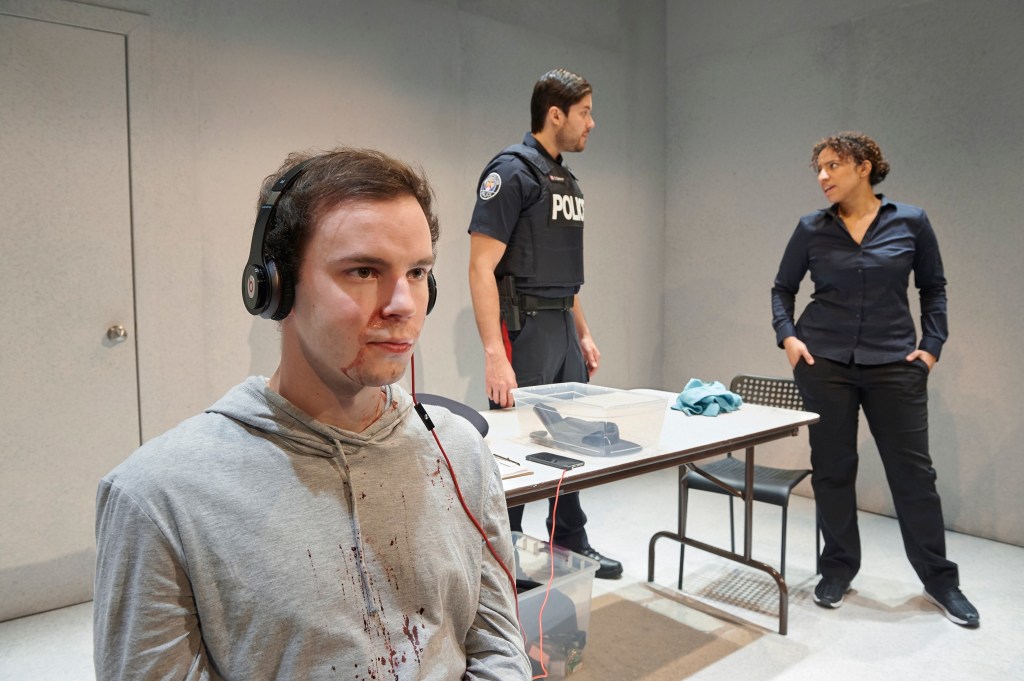
Photo of Jakob Ehman, Meegwun Fairbrother, Sabryn Rock by Michael Cooper.

Photo of Jakob Ehman, Meegwun Fairbrother, Sabryn Rock by Michael Cooper.

BK: There was a lot of development that went into this play. How did it come to be?

JM: It’s actually had a bit of a long life. So in 2009/2010 I was part of Nightwood Theatre’s Write from the Hip Unit, which is their emerging writer’s unit for emerging female playwrights. Write from the Hip has changed considerably in terms of its format, but at that time the objective was to write a 15-minute piece and so I wrote the first 15 minutes of Caught. Andy McKim at Theatre Passe Muraille asked me if I wanted to present something or hear something read at their Buzz festival. I hadn’t touched the piece in about a year and then decided I wanted to hear it again. I had been a resident artist at TPM for a number of years and both Andy and I knew we wanted to work on a project together. We were circling around different ideas and at the same time we both came back to that piece and the themes of justice and injustice, entitlement and consequences that are found in the play. We both agreed that there was a longer life for this piece than just a few minutes and started exploring it. I had been working with Andy dramaturgically and further developing it. There was a workshop of a earlier full draft in September and now we’re sharing it with the city.

BK: Why TPM? 

JM: When I graduated theatre school, I had been working for Obsidian Theatre in an administrative capacity. I was their Director of Development and Obsidian had done a co-production with Roseneath Theatre and TPM and it was just as Andy was moving into the theatre as Artistic Director. I first got to know him then and the philosophy of TPM, which I just sort of fell in love with. I just found their attitude towards storytelling and their artists and emerging artists really real and wonderful. They had put a call out around that time for Elephants in the Room, which was their emerging artist program, and they were looking for people to help launch that. So I approached them and said it was something I was really interested in doing. I became one of the four co-founders of Elephants in the Room. We also started Crapshoot, which still happens and so I’ve had a long relationship with TPM. I think a lot of artists, especially in this season who are sharing stories and are part of TPM, have similar connections with the TPM. The company has been an integral part of their journeys as they have been moving forward in this crazy theatre world. Then I became a resident artist with TPM and Andy and I really wanted to tell a story together and I wanted to tell a story with that company and Caught just seemed like the right fit.

BK: What a lovely journey.

JM: Yeah! Sort of a natural evolution over many, many years.

BK: Why the title Caught?

JM: The action is certainly a big part of it. I love how it has to do with how we find ourselves caught, either by our own doing, people catching us, us being caught by our own habits and our own hang-ups that we can’t get past, us being caught within society’s rules and regulations of what we can and cannot do – how that sometimes can work in our favor and sometimes it can work against us. We’ve really been spending a lot of time in rehearsals talking about how we can get these characters caught as much as possible. It’s also part of the ride for the audience and part of the fun of it – how can we get into as much trouble as possible?

Photo of Sabryn Rock, Jakob Ehman and Meegwun Fairbrother by Michael Cooper.

Photo of Sabryn Rock, Jakob Ehman and Meegwun Fairbrother by Michael Cooper.

BK: Tell me about your team?

JM: I’ve known Sabryn Rock (who plays Trisha) for a decade now. We went to the National Theatre School together. She’s amazing. I’m really spoiled, it’s a really incredible team. Jacob Ehman is playing our kid, James.

BK: I saw him in Sophia Fabiilli’s play “The Philanderess” in the Toronto Fringe and just thought “Who are you? You’re amazing!”

JM: I am really thrilled for him that he is getting the attention that I think he really deserves. He’s such a talented actor and he gives so much. I love watching him work on this piece because James is a confusing character, Jakob is such a spontaneous actor. It’s wonderful watching him process the play, moment by moment. I know what the character is going to do next but I don’t know what Jakob is going to do next. It’s really an actor’s play. The joy and pleasure of this world is really the moment-by-moment, tiny details that each character either brings to the other and the journey that the actors take their characters on. An actor named Meegwun Fairbrother plays our police officer and he’s a real presence in the room. As soon as the character walks in, everything changes. I feel that way with who Meegwun is as a person as well, so that’s just really amazing that those two line up. Sarah Garton Stanley who is the Associate Artistic Director of English Theatre at Canada’s National Arts Centre is our director. She is so focused in her storytelling. Each moment is so fresh and calculated. She has a really great brain and heart for this world. Our design team is fabulous. It feels like the right ingredients in the room for our world.

BK: Tell me about the design concept?

JM: It’s one room, one location, almost like a holding deck. There’s only a table and chairs. It’s very neutral. It has very little personality and it’s almost as if there’s the forth wall and part of it has just been cut out so you can see through it. Not like a two-way mirror… someone has just taken a knife and removed a chunk of it. So the audience will feel like a fly on the wall, like they shouldn’t be there or they’re intruding. It should feel a little bit like a scene of car accident on the street, where people are driving by and they can’t turn their eyes away from it. Hopefully we can do the same thing for our audiences. Fingers crossed!

Photo of Sabryn Rock and Jakob Ehman by Michael Cooper.

Photo of Sabryn Rock and Jakob Ehman by Michael Cooper.

BK: I’m going to put a hold on the play and ask about you. Tell me a little bit about your journey to where you are now.

JM: I’ve been involved in theatre for a long time. I was one of those theatre kids, where babysitters loved me because I would coordinate plays for parents to watch and they would sit upstairs and do nothing. I had been involved in productions as an actor as a kid for a very long time. I grew up in Richmond Hill and I was part of CharActors Theatre Troupe, where they had just auditioned to be one of the choirs in Joseph and the Amazing Technicolor Dreamcoat. They asked me if I wanted to be a part of it and that was a big thing for me as it was my first professional show. I missed school for a year. It really changed a lot for me. There was never a moment where I said, “I don’t want to do this.” At that point I thought I still wanted to act and so I went to Unionville High School, which is a performing arts school. Then I went to York for their theatre program for a year.

I’m not a particularly impulsive person, but there are these few markers in my life where I’m like, “I’m going to make this decision!” and I have no basis for it or even an understanding if it’s going to work out. York is great because it’s a generalized theatre program where in your second year you specialize. This might have just been the really bad student in me because school and I have had a bit of a complicated relationship, but I just remember hearing this voice being like “you need to be in a more of a conservatory program”. Someone I went to high school with who I considered to be the best actor was at the National Theatre School and I just remember saying, “I have to go there.” I started looking at all of the artists that really inspired me and a lot of them had graduated from NTS.

BK: So you left York before specializing?

JM: Yes. I auditioned for the acting program at NTS and got in. I went there really thinking I was going to focus on classical theatre, with my ultimate intention of acting at Stratford or Shaw. I was very focused on that being my trajectory. What I didn’t anticipate was that when I was there I would find this unexpected joy in creating my own work. The curriculum in our second year was focused more on creating your own work and largely for yourself. I ended up finding that work really enjoyable and craving it more, which was a big surprise for me because I thought I had really defined for myself what I thought I was going to do.

I graduated and moved to Toronto and started auditioning. I had applied to SummerWorks the year after I had graduated with this solo show that I had written in school. It was about my family and me. I used my own name. It was a very personal story. I applied and they said that they were interested in my voice but they were not offering me a slot in the festival. They had offered me a spot in the Under-25 Reading Series instead, which provided the opportunity to develop my piece with a mentor, followed by a live reading. They partnered me with Hannah Moscovitch.

BK: Wow! What an amazing person to be paired up with.

JM: Right?!

BK: Could you ask for a better mentor?

JM: No. It was crazy. That was sort of one of two path-changing moments, I think. Even when I was at school and we were graduating, I was still conflicted about whether I wanted to be an actor. My parents are pretty academic and they are huge supporters and lovers of the arts but they are not artists. I don’t come from an artist family. I really felt that after going to a conservatory, where you don’t get a degree and you don’t get a diploma, the idea of me saying that I don’t know if I want to act anymore, felt like such a slap in the face for them and that I was letting myself down. It sounds so silly saying it out loud, but I actually felt so ashamed that I wasn’t sure if I wanted to keep acting. So in meeting Hannah, who had gone to NTS and who had been in the acting program, who had really started very seriously on her trajectory as a writer at that point, was the first person I could actually talk to about writer things. She was the first dramaturge I had in my life. She was the first mentor I ever had. Sometimes when you find the right person at the right time it just makes all the difference. She answered every question that I had. We worked really closely together. There was something about it that, as I was working on that piece, and as I was working with her, something just started to feel right.

BK: So that was it for your actor days?

JM: I just wasn’t always prepared to do the work as an actor that I should have been. I liked the idea of getting the part but once I got the part I was like, “well I guess I gotta do this now.” Actors have to have such a commitment and dedication to the process. I just don’t think I have that as an actor. Whereas, as a writer, I can see the difference in my process now, in that case. Meeting Hannah and working with her was a huge game-changer for me.

BK: So what happened with Summerworks and your play?

JM: I ran into Michael Rubenfeld on the street and he said, “Just to let you know, we’re going to hire an actor to read your piece for you.” I was confused because the play was about my family and me. I was writing it for me. I was supposed to be in it.

His response was, “That’s fine and you can pick it up and take it wherever you go afterwards, but I think it would be really helpful for you to just hear it.”

BK: How did that change things for you as a writer?

JM: As I started writing, knowing that in mind, I decided to change the character’s name from my name because I thought it was bit silly for somebody else to say it. Then I stared changing other details and this solo show went from being one actor on stage to there be being three actors on stage, with multiple characters. What seemed like such an inconvenience at the time, turned out to be one of the biggest gifts. I was really only writing for as well as I could act as opposed to telling a story fully. If I started writing in territory that really scared me as actor, then I would stop writing it, because it was just for me. Somebody else having to do that work meant that I could go anywhere. It never occurred to me to write for other people. So the combination of working with Hannah, somebody who was really at the rising point of her process as a writer, and this large shift writing for other people made everything click. That was the key moment I unlocked everything. From there, I’ve been writing pretty seriously ever since.
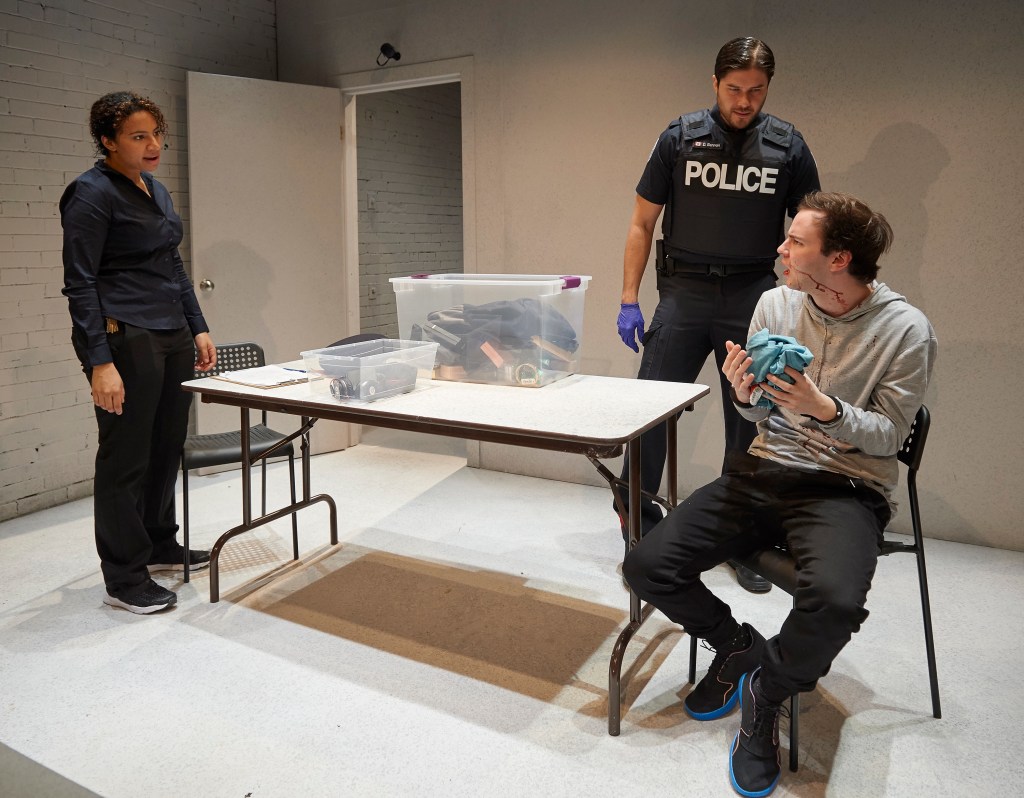
Photo of Sabryn Rock, Meegwun Fairbrother and Jakob Ehman by Michael Cooper.

Photo of Sabryn Rock, Meegwun Fairbrother and Jakob Ehman by Michael Cooper.

BK: Where do you find inspiration for your work?

JM: My life. There is a lot of me in every world that I touch. People may see it and not know anything about that. I’m really inspired by my family. I’m very inspired by the world that we are living in, this city and beyond. What is it that is defining and challenging and turning our world right now? I’m really worried about the state of our world right now. There’s just chaos in so many areas of our lives. I don’t know where it’s going to go, but in the last 10 years even, things have changed so much. Our connections to each other have changed so much. I find inspiration in how troubling I find that. So that’s a large part of Caught, too. Who are we as people today? Who are we raising? Who is this next generation? Do we have any accountability to each other anymore? Do we mean anything to each other?

I have a lot of those questions. I find inspiration in fear, in anger and in not knowing. For me and for a lot of writers these plays sort of become our venues to try to work out a problem or a query.

Photo of Meegwun Fairbrother and Jakob Ehman by Michael Cooper.

Photo of Meegwun Fairbrother and Jakob Ehman by Michael Cooper.

BK: Is there a way you stay motivated to write? What are ways you keep the motivation alive and dedicate yourself to the work?

JM: The last two years I’ve found it really helpful to work on multiple projects. That’s the way it’s sort of panned out. If I feel like inspiration is resting a little bit, I find myself cheating on my plays with other plays that I’m working on. It’s not that I’m not working, I’m just working on something else. So that helps.

Thinking about an audience, I find, is the thing that always keeps it going for me. Continuing to come back to what’s at the heart of it. What is it that I’m trying to say? What is that I want audiences taking away? Writing is such a solitary process. You spend so much time here in your head. I mean, you have your team which is amazing, but then you’re in a rehearsal hall and it’s still pretty contained. Thinking about the people who are going to be receiving it; who you may never have any contact with, you never know how they are going to experience it and you can only hope that it’s the way that you intend. Thinking about them, that magical audience, is the biggest thing for me.

BK: What do you want audiences walking away with?

JM: Right now, today, I would really like audiences to walk away and think about how they are treating other people and how they are treating themselves in relation to other people in this crazy world.

Photo of Meegwun Fairbrother and Jakob Ehman by Michael Cooper.

Photo of Meegwun Fairbrother and Jakob Ehman by Michael Cooper.

Rapid Fire Question Round:

Favourite Book: Today, I will chose The Unbearable Lightness of Being by Milan Kundera.

Favourite Play: Shape of Girl by Joan MacLeod

Favourite place in Toronto: My bed.

Favourite Food: Berries.

Favourite Movie: Toy Story.

Last play you saw: The Public Servant.

Best advice you’ve ever gotten or words to live by: Do the work. Focus on the work.

Advice for emerging artists: Do what works for you. The amount of work you get might mean you might not be able to sustain yourself in any capacity. I’ve talked to a lot of artists recently and they’ve expressed a shame or trepidation about having part-time jobs or full-time jobs to support themselves. They think they have failed or they’re dishonouring their craft in some capacity, but I don’t think there’s one way to make something happen for yourself. I think everyone’s life and reality is different. You have to shape your life in a way that you can do the work and do it with a full heart and not have to feel guilty for making excuses for yourself. Don’t ask yourself, why you’re not doing it like this person or that person. You have do it the way you do it. I wish someone told me that early on. It would have saved me a lot of sleepless nights. It’s so hard. It’s hard for everyone, even the people it doesn’t seem hard for. Look for mentors and make connections. Treat those connections like gold. Find people that help you do what you want to do. 

CAUGHT

A Theatre Passe Muraille Production. On stage now until April 24th.

Who:
Written by Jordi Mand
Directed by Sarah Garton Stanley
Dramaturgy by Andy McKim
Starring Jakob Ehman, Meegwun Fairbrother & Sabryn Rock
Production Design by John Thompson
Sound Design by Debashis Sinha
Assistant Director: Donna Michelle St. Bernard

Where: Theatre Passe Muraille Backspace, 16 Ryerson Ave. Toronto.

When: March 31 – April 24, 2016

Tickets: Pay-What-You-Can Saturday & Sunday 2pm Matinees, $17 Under-30, $20 Artsworkers, $28 Senior, $33 General Admission

passemuraille.ca/caught

Connect with us

Connect with us!

Spread the word: #CaughtTO

Theatre Passe Muraille – @beyondwallsTPM

In the Greenroom –  @intheGreenRoom_

Brittany Kay – @brittanylkay


In Conversation with Jennifer Brewin about “The Public Servant”, on stage now until April 3

by Bailey Green

“A healthy, strong civil service makes for a freer, diverse and inclusive world, and that is just my world view,” says Jennifer Brewin when asked about what she hopes audiences will take away from the upcoming production of The Public Servant (presented by Common Boots Theatre and Nightwood Theatre). “We vote for politicians and those are the people who determine what kind of civil service we’re going to get. An accountable robust civil service is best for everyone.”

The Public Servant began about 6 years ago, shortly after Brewin was made Artistic Director of Common Boots Theatre (formerly known as Theatre Columbus). Brewin knew she wanted to work with Sarah McVie, Haley McGee and Amy Rutherford and she was drawn to the idea of exploring the strains of public life. “The people who work in admin or in management are often these unsung heros,” Brewin says. “Literature tends to mock them or reduce them, and they haven’t had their place in the sun. So it was an important idea to me, especially because so many people who work in administration are women. Where are the songs about the heroic work of that, getting a report in on time or completing an audit. Those things create foundation, support and innovation.”

Photo Credit: Neil Silcox

Photo Credit: Neil Silcox

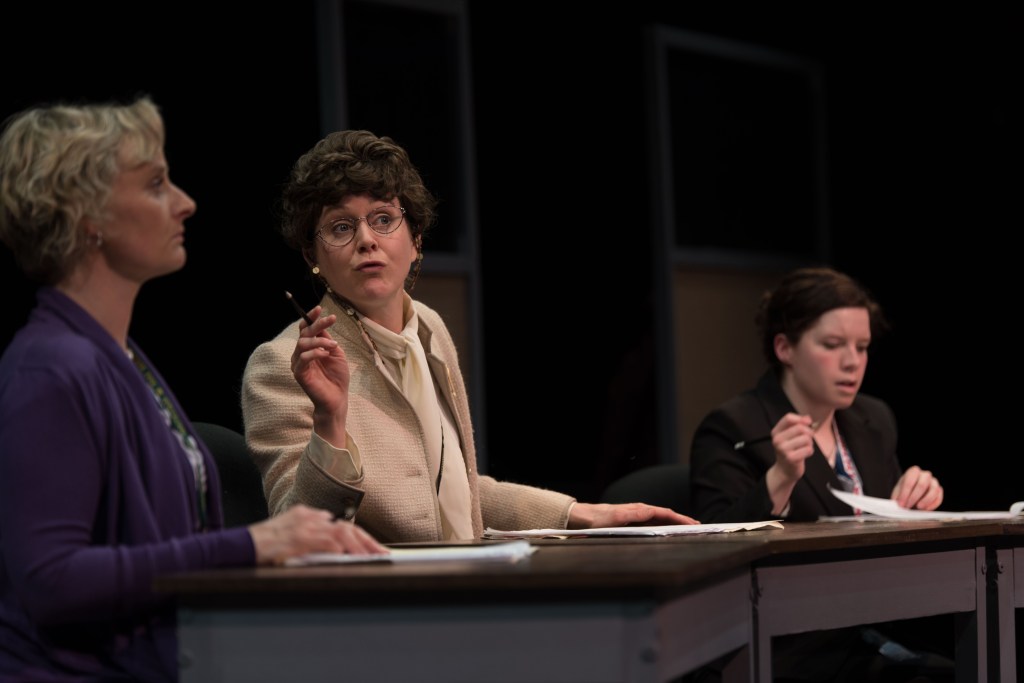
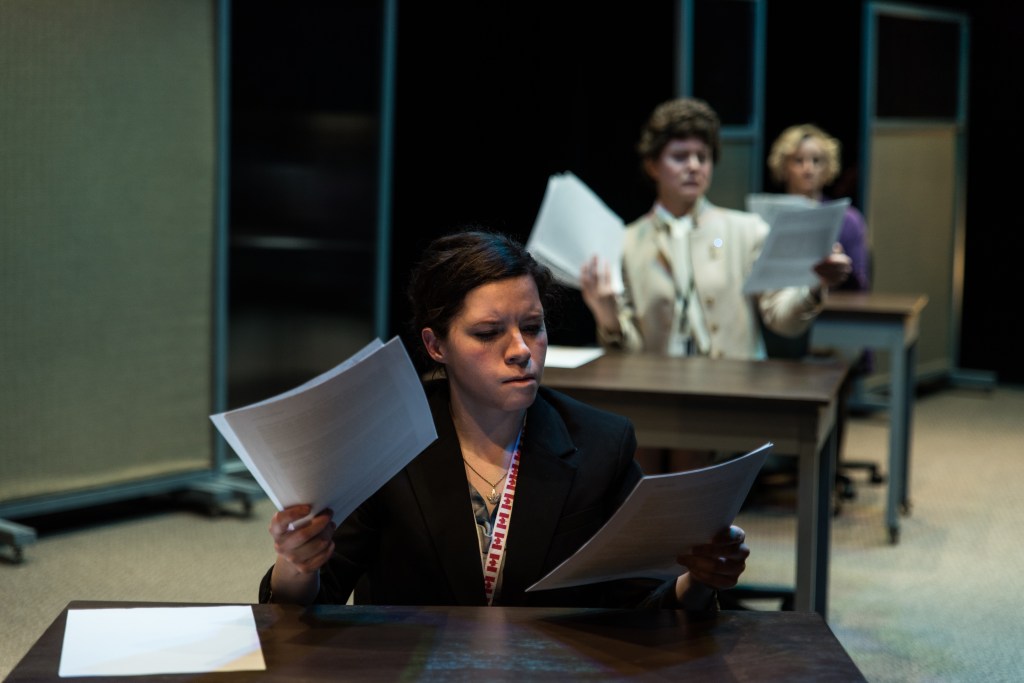
The team (Brewin, McVie, McGee and Rutherford) interviewed a wide range of women working in the public service in Ottawa. Over the course of their interviews, they encountered three generations of women working in the public service. There were the women who had worked during Pierre Elliott Trudeau’s time, who had been given responsibility to create new policies and laws for a more inclusive society. “They told incredible stories of fighting for equal pay, for changing maternity leave laws and regulations,” Brewin says. Then there were women who were currently working and were nearing the mid to end point of their careers. These women had worked during Mulroney, Chretien and Martin’s terms as prime minister. “They had faith in what they were doing but their faith was strained,” Brewin says. “Jobs were cut under the Harper administration and people were let go. And then we met young people going in to public service, which was a very different experience. They wanted to be good administrators and managers, but didn’t have particular ambitions to change the world.”

Photo Credit: Neil Silcox

Photo Credit: Neil Silcox

The women wrote the play through long form improvisation. Each of the actors was drawn to a different generation of public service and each character became a composite of the different people the team had met. The character of Madge, a young and eager public servant, originally created by McGee, brings us into the world of The Public Servant. The play originally premiered in Ottawa, where Brewin found it was incredibly exciting to watch a play about women speak to all kinds of people. For this run, McGee had booked a contract in London England, and the role of Madge was taken on by Amy Keating. “Amy’s understanding of the script and the story has really helped reveal new things about the play and the character,” Brewin says. “It’s been really exciting working with her and clarifying her intentions.”

When asked about Brewin’s joys and challenges when working as a director on the piece, she said, “The joy was experiencing Amy, Sarah, Haley and, later, Amy [Keating] interpret the entire art of the play/production. It’s incredibly exciting to throw up all our rules of engagement and just dig into it.”

The Public Servant

BrochureImage
Written by Jennifer Brewin, Haley McGee, Sarah McVie and Amy Rutherford
Directed by Jennifer Brewin
Produced by Common Boots Theatre (formerly Theatre Columbus) in association with Nightwood Theatre

What: The Public Servant is a comic-tragedy about women and administration. Step inside the halls of power as Madge, a young, idealistic and enthusiastic civil servant, gets ready to write her first official memo.
Based on the interviews of some twenty civil servants who shared harrowing tales of navigating the fuzzy divide between individual need and public good, The Public Servant reveals a journey of heroic dedication and professional betrayal, of overcoming cutbacks, bad managers and incompetent ministers. And how in the end, the demands of accountability and transparency seem to defeat even the best bureaucratic soldiers.

Where: Berkeley Street Theatre Upstairs
26 Berkeley Street

When: March 13 – April 3, 2016
Tuesday-Thursday, Saturday: 8pm
Friday: 7pm
Saturday-Sunday: 2pm
Wednesday March 30: 1pm

Tickets: Regular price $35

nightwoodtheatre.net


In Conversation with Sex T-Rex – Presenting their Double Bill at the Storefront until March 27

by Bailey Green

I had the pleasure of speaking with Sex T-Rex performers Seann Murray, Kaitlin Morrow, Conor Bradbury and director Alec Toller about their double bill, on now at the Storefront Theatre (Danny Pagett and Julian Frid were unable to stay for the interview but are also performing.)

It began with a quote from the movie Predator, “this stuff [chewing tobacco] will make you a goddamn sexual tyrannosaurus.” And then one night, before an improv set, the announcer shortened the improv troupe’s name from Sexual Tyrannosaurus to Sex T-Rex, and it stuck. Performer Conor Bradbury laughs at the memory, “Hey, when someone’s right they’re right! There’s no need to be precious about your comedy.”

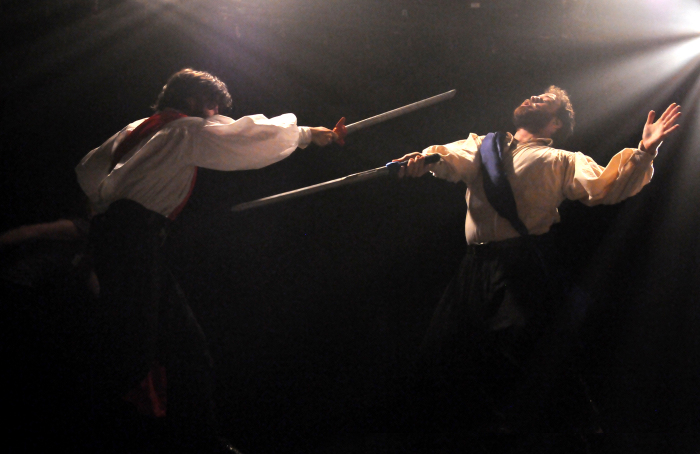
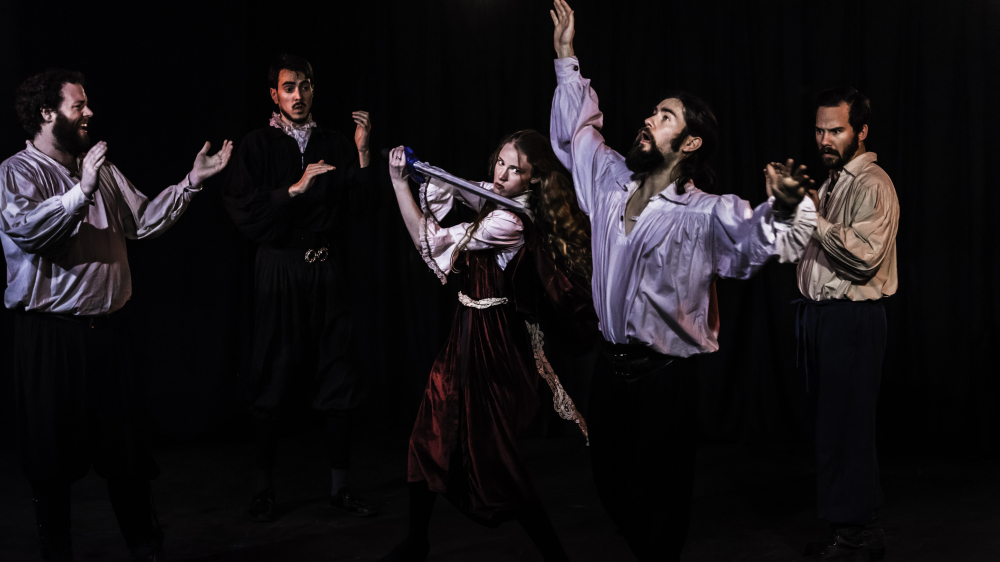
The group came together during their time at George Brown back in 2007-2008. Many elements of theatre school didn’t resonate with the actors but when they got together in stage combat class, then things really came alive. “It’s a triumvirate of violence really,” director Alec Toller jokes about the history of Sex T-Rex shows. “All of our action shows are centred around violence,” performer and producer Kaitlin Morrow adds. “Callaghan! was a lot of punching, Watch Out Wildkat is shooting and then Swordplay, which was loosely inspired by Princess Bride, has to do with, well, swords!”

Photo Credit: Cindy Lopez

Photo Credit: Cindy Lopez

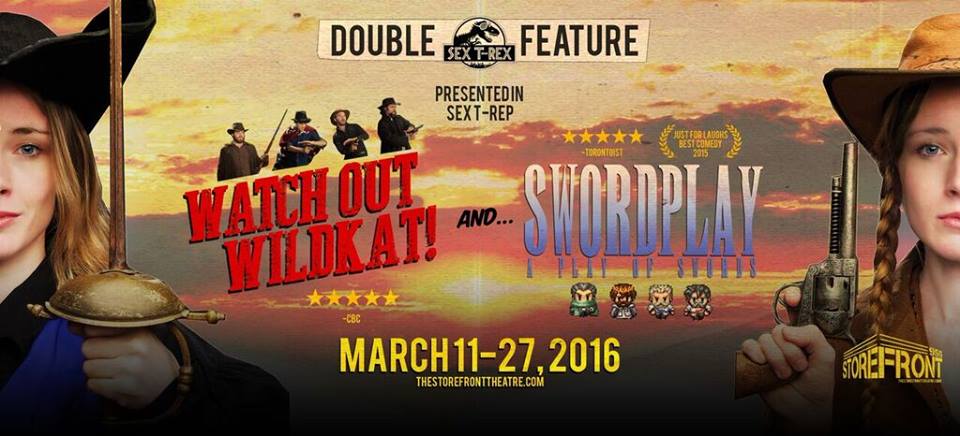
This double bill features Watch Out Wildkat! and Swordplay: a play of swords. “Even though we have done Wildkat in 4 cities and Swordplay in 2, we’re still riffing, especially in rehearsals,” Morrow says. “You can always feel when it happens,” Bradbury adds. “There’s this unspoken ‘keep it’ feeling when someone makes a good joke.” Toller says that the group strives for clarity above all else, “We do so much mime, and fake action movie stuff that we’re always fighting to be so precise.”

Toller directs the group’s scripted shows (they also do improv shows) which are written plays with a sketch origin. “It’s very collaborative,” Toller says. “It functions more like a collective, so basically I’m the person not on stage… where I belong… but my job is to manage what everyone wants to get out of it. This show is a remount, so we’re trying to improve as we go, punch things up, and that can be challenging because we have an existing structure but we don’t have an audience.”

Photo Credit: John Gundy

Photo Credit: John Gundy

Writer, producer and performer Seann Murray speaks to the group dynamic saying, “It’s very rare that we have camp A and camp B disagreements. Instead, we usually have eight ideas with each person having three and a half small ideas each.” Bradbury adds, “It’s almost like we’ll have one person who is camp A and one who is camp B, and everyone else just isn’t helping. But it always works out for the best. To have a bit of argument in the room means people care about the product.” Morrow adds, deadpanned, “So we just punch each other in the face until someone gives in.”

Photo Credit: John Gundy

Photo Credit: John Gundy

Murray writes the scripts for the group and describes the process:

“The first step is we identify the genre we want to work in. Then we watch movies and chat about the tropes we want to hit, what we want to see [in the show] from the genre. So it’s not just regurgitation, we want to honour the genre. Once we’ve consumed a bunch of media and batted ideas around, I write the script and we workshop it throughout the process. We often wind up with a small chunk of the script left, we stay true to the character and story more or less, but as Alec [Toller] said, there’s lots of really funny improvisers on the team so we’ll take a scene, work through it and put it back into the script.”

The group considers audience feedback invaluable. They often take their shows to Montreal Fringe before performing at Toronto Fringe. Montreal Fringe offers them the opportunity to try out new material and improve their work. “We change something after basically every show, we find something else we’ve never done before,” Bradbury says.

Photo Credit: Sharon Murray

Photo Credit: Sharon Murray

Morrow, the only female performer of the troupe, tells me how that for years she dealt with crippling nightmares centred around improv. Subconsciously, she wanted to get up and perform but she was terrified. Now, with 19 shows under her belt, she has realized that a bad set isn’t the end of the world and that the joy she feels from performing far outweighs the fear. “The first time I went up to improvise was for Shane Adamczak’s secret show Captain Spaceship in Montreal Fringe,” Morrow remembers. “He just assumed I was in the show because I was a part of Sex T-Rex, and when I tried to back out, he told me I couldn’t because there were no other women in the show. So I didn’t sleep for about a week, and then somehow I was backstage and then I was onstage and I did it. The relief was amazing, and you know, it wasn’t even bad!”

Watch Out Wildkat! & Swordplay: A Play of Swords

12733973_1287592624601107_2756752568443821603_n

Presented by Sex T-Rex
When: March 11th -­ March 27th, Wed­-Sun
Watch Out Wildkat! @ 7:30 PM & Swordplay @ 9:00 PM
Sundays @ 2:00 PM
Where: The Storefront Theatre, 955 Bloor Street West
Tickets: $20 for single show, $30 for both shows
Available at http://thestorefronttheatre.com/events/swordplaywatchout-wildcat/
Connect: sextrexcomedy.com