Skip to content

Posts tagged ‘toronto’

Artist Profile: Anusree Roy – Playwright & Performer of “PYAASA” at Theatre Passe Muraille until March 27th

Interview by Brittany Kay

I was lucky enough to sit down with my own personal mentor and friend, Anusree Roy, to talk about her upcoming production of Pyaasa opening today at Theatre Passe Muraille. In her dressing room, we spoke about the discipline it takes to be an artist in this business, the challenges of a remount, and her deep gratitude for Theatre Passe Muraille.

Anusree Roy in PYAASA. Photo Credit: Michael Cooper

Anusree Roy in PYAASA. Photo Credit: Michael Cooper

BK: Tell me a little bit about your show?

AR: Pyaasa is set in present time in Calcutta, India and it’s a play I wrote starting in 2006… so 10 years ago. It’s something that I’m coming back to, which I’m really excited about.

Untouchability is something that is constitutionally banned. Doctor B. R. Ambedkar, who was an untouchable himself, put forth this constitutional change. You can’t practice untouchabililty, but in India it’s very widely practiced. It’s changing, absolutely, but the caste system still very much exists.

When I wanted to write a play, I wanted to look at the world, that world, the caste system world, acknowledging my social location in the system, which is a higher caste person. We had untouchable people clean our toilets all the time and we treated them really badly and I treated them really badly because that’s the environment of the society you were raised in. Pyaasa is a journey about this beautiful young girl named Chaya and her life story in ten days, beginning to end of the show. She’s a girl who’s young, bright and wants to go to school desperately. That’s all she wants. It’s a fun show and it’s a heartfelt show. It’s also a sad show and a truthful show.

BK: It’s just you on stage. Is this is a one character show, or a show with many characters?

AR: I play four characters. Chaya, Chaya’s mother Meera, this other servant lady named Kamala, who both work for Mr. Bikash. So it’s 2 women, 1 man and 1 girl.

BK: Why the title Pyaasa?

AR: Pyassa means thirsty. There’s a lot of water and water nuances all through the play. The name came to me. It wasn’t something, where I was sitting there going what should I name my play? I just thought of it because subconsciously I was aware of the amount of water in the show. I think if I were to analyze why the way it works in the caste system, in the villages that are in the rural areas, our water tank is sacred because I’m from the higher caste and your not and you can’t get water from mine. There are a lot of disputes about water, which is a necessity in life. So when you cut something off that’s a necessity in life, it becomes even more important. The name came to me and I stuck with it. It’s allowed us to kind of really look at the play through that lens.

Anusree Roy in PYAASA. Photo Credit: Michael Cooper

Anusree Roy in PYAASA. Photo Credit: Michael Cooper

BK: There was a lot of development with this play in its first edition. What were the steps and processes it went through? Before this remount, how did it come about?

AR: In 2006, Thomas (my director), David (the designer of the show) and I were doing our masters together. I was having sushi with Thom and I was telling him about my life story back in India and telling him story after story about my past.

At one point I was talking about the untouchables, the caste system, and how it’s abolished but how it still exists and he stopped me and said, “There’s a play there. You know there’s a play there right?” I was like “yeah, okay.” And he insisted on saying, “No, there’s a play there and you have a three week deadline to get me a first draft.” I’m doing my masters and I have sixteen papers due, but he just kept on saying, “Get me a first draft in three weeks.” So in three weeks, I gave him the first draft and ironically, 90% of that first draft is what’s in the show today.

BK: If anyone can work under pressure, it’s you.

AR: It just came together. I felt so passionate about it. When you play a solo show, it’s not about how good your storytelling is, it’s all about how distinct each character is. Thom and I, while creating the show, did a lot of that character work. David, Thomas and I created a company together and we did our first one-night-only here at Theatre Passe Muraille. TPM was in a financial strain at the time and whatever money we raised, we gave it to them. We wanted a production space, so it seemed like a fair trade.

BK: That’s amazing. And ballsy.

AR: We just did it. We did it fearlessly and we did furiously and we did it in good faith. The universe was there. The play won 2 Doras for Outstanding Actress and Outstanding Writer and as a result of that, it just escalated. Suddenly we had a touring agent. TPM, beautiful Andy McKim, contacted us and said he wanted to produce the play and put in his very next season. That was his first season programming as an Artistic Director here. It just grew and grew. Our touring agent took us to many places: Vancouver, Ottawa, Victoria, and many others. It became our golden child. Honestly, it wasn’t something that we spent years labouring over. We just did it in good faith, really hoping it would bite and it did. And of course our awards helped us marketing-wise. That was the trajectory of the show.

For the last five years, the company is no longer together, but we’re all very good friends. Our lives have taken us very different places. David is doing a PhD, I’m more into film/television and theatre, and Thomas is the AD of Theatre New Brunswick. We’ve split as people but our core is the same. So when TPM contacted us to do the show again, we said of course, of course.

BK: What are the challenges and excitements of remounting a show?

AR: Challenges? It’s one person. I haven’t done a solo show in five years. It’s a lot of work. It’s A LOT of work. It’s kind of keeping your body in shape and your mind in shape. I feel like an athlete, you know what I mean?

Anusree Roy in PYAASA. Photo Credit: Michael Cooper

Anusree Roy in PYAASA. Photo Credit: Michael Cooper

BK: Oh for sure! It’s a whole marathon from beginning to end.

AR: Exactly. My meals are planned. My workouts are planned. Everything is very scheduled to save energy for those 5 hours of rehearsal and those 45 minutes of show. It’s a very intense show.

BK: What about the excitements? Anything you are looking forward to this time around?

AR: The excitements? It’s coming home to the boys. That’s what it feels like. TPM feels like home and the three of us are coming home.

BK: Why TPM initially?

AR: At the time, we knew it wasn’t doing well financially and we needed a space. So our proposal to them was, if you give us a space for one night, we’ll give you all the money we make. We didn’t know that it would grow. People stayed that night and said, “No no no no! This can’t just be one night. You have to do this show many, many, more times.”

TPM has always felt like home. It has supported me so much in my career, especially Andy McKim, huge shout out to him! My father calls him my theatre dad, because it’s true. He gave me that initial push you need as a creator when you’re 25. He gave me that. He really gave me that.

BK: That’s a lovely answer.

AR: It’s true.

BK: Because it was created in 2006, why does this story need to be told to audiences today?

AR: Because it’s still relevant. Judith Thompson, in one of the earlier versions, came to see the show and she asked me “Why is it relevant for a Canadian audience?” I found that really fascinating and at the time I didn’t have an answer for her. She told me to look at the homelessness in Toronto – look at the way we treat street people here, as if they don’t exist. People with mental health issues, they’re doing their thing and we’re just walking by.

We, as a society, practice classicism in the most heinous way. We do it. All of us do it. I’ve done it. I do it constantly because when you’re in a rush, you’re going, and you don’t want to give a panhandler money. There is a division in class that we practice. How is that different from the play I’m doing that’s set in India? It’s not really. I am segregating you and someone is segregating someone in India. It’s the exact same thing.

Anusree Roy in PYAASA. Photo Credit: Michael Cooper

Anusree Roy in PYAASA. Photo Credit: Michael Cooper

BK: Where do you find inspiration for your work?

AR: The truthful answer to that would be prayer. I have a very good, solid relationship with prayer and meditation. I really quiet myself when I need to think as to where the character is going and what their journey is or what the story will be. I’m writing a play for Nightwood Theatre right now called Trident Moon. It’s a ten person show and so I have to come up with characters for that and their journey. How do you sustain yourself for a three-year mark as it’s taken me three years to write the play. It’s prayer. It’s quieting yourself. Finding it inside of you, versus outside. Those things are true and I know that because I practice it.

BK: How do you commit to this kind of work?

AR: Discipline. Discipline. Discipline. There is no shortcut to success. I truly believe it. My mom always tells me that. It’s with everything. You wake up and you do the work. You don’t think about it. You don’t whine about it. You don’t wait for the inspiration to hit you. You don’t wait for Monday. You don’t wait for your soul to be ready. It is ready. Get up. Write. That’s it. I really practice it. You set your times, for me it’s four hours. Whatever it is in the day you decide to write, you turn everything off; your phone, the internet. You sit wherever you’re sitting, and you write. Do the job. Do not whine. Because the more you sit and wait for the clock to strike 12 and the inspiration to hit, it’s never going to happen. That’s not reality. You live in a state to be inspired. You’re not sitting there, waiting for inspiration to show up to write. That’s bullshit. That is bullshit. What I learned as a young writer, and I’m really grateful for it, is that discipline and inspiration are two separate things.

Success comes to people that work hard and opportunity arrives. That’s it. They work hard. You just do your job and let the world take care of itself. There’s a lot of glamorizing of what it is to be inspired in order to write. I do not prescribe to that. I prescribe to the discipline route. You will write shit, don’t get me wrong on that. There are days when everything you’re writing is shit. That’s the process. And then when you get there and it’s not shit. If you write everyday, something will be good. One day something is good and whatever is not, you throw away. But you wrote, versus sitting and waiting.

BK: You are absolutely right.

AR: You have to train like an athlete.

BK: Do you have a definition for success or what it means to be successful for you?

AR: That my parents are proud of me? I don’t know… (she laughs) I think my nine-year-old self wants me to make my parents happy. I don’t think that will ever go away. But my adult self is very goal orientated, in everything in my life. I strive to achieve them. But how do I define success? Going to bed in gratitude, knowing that I achieved my goals… but mainly to make my parents happy.

BK: How do you wear so many different hats, especially in this production? How do you divide your time?

AR: Priority and sacrifice. I have to make sacrifices for things that I want to do. I don’t socialize a lot, because I don’t have time. When I do socialize, I don’t do other things. It’s just knowing that whatever you’re doing is all you’re doing. Wearing so many hats has taught me that time becomes very valuable, so I have to make time for my partner. He is extremely important to me. I can’t have him feeling like I’m neglecting him because of work and I can’t neglect my work. It’s always a balance. One thing that I do fail miserably at is how to answer back to emails on time. I’m consistently behind. I get about thirty emails a day and I cannot get below the fifty-email mark. I feel like everyday my inbox goes up to a hundred and four emails and I get down to fifty but I can’t go past it. It just doesn’t happen.

BK: What about playwright versus actress in this show?

AR: When I’m a playwright in the show that’s all I’m doing, and I don’t care what actor Anusree feels. When I’m actor Anusree, I have to not care what playwright Anusree thinks. I have to do the job.
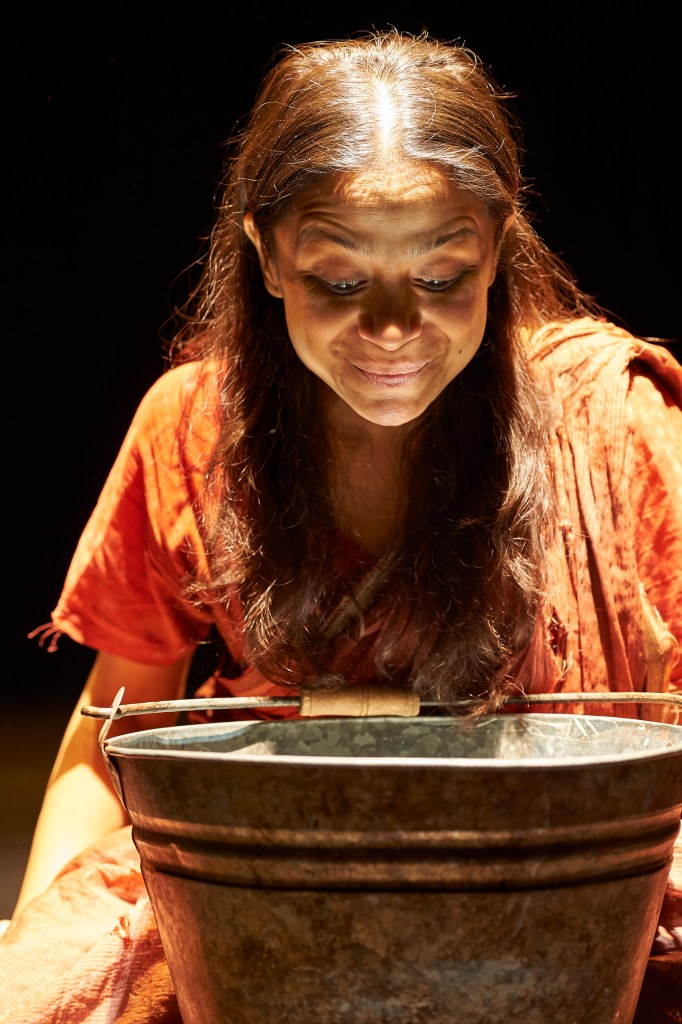
Anusree Roy in PYAASA. Photo Credit: Michael Cooper

Anusree Roy in PYAASA. Photo Credit: Michael Cooper

BK: What are your goals and plans for the next five years?

AR: I would like to make a transition to television where I write for TV and produce. Here is why; write this down. DON’T skip this…

I want to see the stories of my people on screen. Television is an incredible medium and I am deeply inspired by what I’m watching, but I do not watch our stories of people of colour on the screen. It’s important that a medium that has such a wide reach, share our stories, that we are more than the secondary characters… We are more than that! That’s something I want to do. Of course, I want to keep doing theatre. There’s no question about that. I have to. It feeds my soul. But television is something I want to make a transition to simply because I want to, because the medium is good and the writing is so good for TV. I want it to have stories from my people.

BK: Do you have advice for emerging artists?

AR: I’ve talked about this before, but I really, really believe in discipline. Do the work! Don’t participate in Facebook debates. Don’t participate in this convoluted need to please. Don’t participate in bringing each other down. Do YOUR work and the rest will follow.

I have a red folder, which my mother told me to start in 2006 that houses all of my rejection letters and all of my acceptance letters. To this day, I get rejected from things constantly, as I get accepted to things constantly. That’s how our business works. But it houses all of it to keep me on track and keep me grounded and focused on the work, because if I just save the rejection letters that doesn’t serve. If I just saved the acceptance letters, that’s not true. Because I house all of them, it makes me realize how much it actually takes to be an artist.

My true advice, honestly, is do the work. If you’re an emerging artist, contact every senior artist that inspires you and ask him or her to meet and take them out for coffee. Have conversations with them. Ask them if you can help them. You’ll be amazed at how approachable they are. Fear gets you nowhere. Fear is boring. You have fear. We all have it. So if you’re scared, it’s not going to serve you. You think a senior artist is not scared? We’re all equally scared because we’re just people sitting on a rock spinning through the universe doing nothing really. My best friend Barbara came up with that and I thought that was the most profound thing I ever heard because it’s true.

The more you do the work, the more it cultivates work. Then you’re more interesting and people are more interested. Ask senior artists what their trajectory and transitions were because they’ve all done the work. Ask to work with them. You’re going to be amazed at how many say yes because they’ve been through it or they’re going through it in their career right now. I’ve been fortunate to be in the business for the last ten years but I’m a complete newbie in the television world. I don’t think you’re ever not emerging if you’re constantly in a state to learn.

Rapid Fire Question Round:

Favourite Food: Mom’s cooking

Favourite Movie: Oh no! I can’t tell you, it’s too embarrassing. For Drama, it would have to be House of Sand and Fog. For ridiculousness, it would be Two Weeks Notice.

Favourite Book: Fall on your Knees, Ann-Marie MacDonald

Favourite Play:  Crackwalker by Judith Thompson

Favourite place in Toronto: Annex.

Best advice you’ve ever gotten: “Apply to everything”, from Thomas Morgan Jones. It even applies to life, not just career – Apply yourself. Or in terms of your career – Apply to everything. Best advice he ever gave me in 2006 and now we’re working together again.

PYAASAPYAASA TPM Cover Photo DRAFT C

Who:
A Theatre Passe Muraille Production

A Celebratory Remount of the 2008 sold-out TPM run, launching TPM’s 50th Anniversary Celebration Play Series, featuring the original creative team:

Written and Performed by Anusree Roy
Directed by Thomas Morgan Jones
Production Design by David DeGrow

What: “Life is not easy, Chaya… but you have to believe in it.”

Set in Calcutta, Pyaasa (meaning “thirsty” in Hindi) tells the story of Chaya, an eleven-year-old untouchable who dreams of nothing more than learning her times table. When Chaya’s mother begs a woman from a higher caste to give Chaya a job at a local tea stall, Chaya’s journey from childhood to adulthood begins and ends over ten days.

A moving and heartfelt play, Pyaasa illustrates with subtlety and nuanced truth the inequalities and injustices that persist through the Indian caste system. But it also speaks to us about the inequalities and injustices that are all around us here in our own community.

Anusree Roy is a Resident Playwright with Theatre Passe Muraille.

Where: Theatre Passe Muraille Backspace, 16 Ryerson Ave. Toronto.

Tickets: Pay-What-You-Can Saturday & Sunday 2pm Matinees, $17 Under-30, $20 Artsworkers, $28 Senior, $33 General Admission
passemuraille.ca/pyaasa

When: March 3-27, 2016
Tuesday to Saturday Evening – 7:30pm
Saturday & Sunday Matinee – 2:00pm

Connect with us!
Spread the word: #PyaasaTO
Anusree Roy – @i_write_plays
Theatre Passe Muraille – @beyondwallsTPM
In the Greenroom – @intheGreenRoom_
Brittany Kay – @brittanylkay

In Conversation with Julia Krauss of “Orpheus and Eurydice”

by Bailey Green

The tale has been told for centuries in many ways but in basic terms the story of Orpheus and Eurydice goes something like this: Eurydice and Orpheus fall in love. One day Eurydice enters the forest and is bitten by a snake. She succumbs to poison and dies. Orpheus enters the Underworld to find his love and with his beautiful singing, charms Hades. Hades permits Orpheus to lead Eurydice out of the underworld on one condition – that Orpheus must not look back at her. Not once. But as they walk, Orpheus cannot contain his fear. He looks back and Eurydice is lost to him forever.

Four years ago, co-directors Julia Krauss and Nicholas Walsh were living in Kitchener. After seeing a version of Orpheus and Eurydice at Ghost River Theatre in Calgary, they were intrigued by the imagery of this myth. Walsh at the time was running a youth company, and so Krauss and Walsh decided to work with teens using the myth as a jumping off point. What emerged was a story of youth and first love, pain and loss.

The piece toured for two years to high schools in Southern Ontario. “Last year, when we moved to Toronto,” Krauss says, “we wondered how and if the show would change if we worked with adult performers on it. Once you’re older, there’s a different kind of life experience.” Krauss and Walsh assembled a collective of twenty performers—young professionals who have finished their education in dance, theatre or physical theatre. “We were intrigued by what breaks a relationship apart, what will break that deal between two people,” Krauss says. “And the bodies are older, so they tell a different story.”

Walsh and Krauss are partners in life and in theatre. “We see ourselves as context keepers, the people who put the ends together,” Krauss says of their work in devised theatre. “We’re interested in collective collaboration work that shows the final product. Everyone is passionate about it, and that shows in the final project.” Walsh, a drummer with a love for basketball, has a great sense of organization on stage and a strong awareness of sound and music. Krauss describes herself as a visual person, finding imagery in bodies and their shapes. “We balance each other out in that regard,” Krauss says of Walsh. “When we first did the piece, it was a celebration of our partnership. And so it’s been really lovely to revisit it. Being in a committed relationship is not always roses and sunshine, which we can explore with an older cast because they have had similar experience.”

Julia Krauss was born and raised in Germany and left when she was 19. Two years later she came to Canada and discovered that her accent created barriers for her to get involved with theatre. “I felt reminded that I am different,” Krauss said, “and it became something I was aware of because of casting directors. But when I worked with Majdi Bou-Matar at the MT space, he is all about celebrating cultural background. The work [we were doing] was created through improv and for the first time I felt free. That was my personal entry to devised work. Suddenly I fit in and was recognized for what Majdi called my ‘German expressionism’.”

Krauss feels grateful and inspired to work with a large ensemble of courageous and open artists. “One of my mentors when I first went into devised work told me why would you rely on your own brain when you have twenty to twenty-five people in the room?” Krauss remembers. “Everyone has a voice and story, and we, as directors, keep the bigger picture in mind […] but I love the rehearsal process. It’s a beautiful thing to watch people share and offer something really vulnerable.” Krauss hopes the piece asks audiences to consider what it takes to stay in a “functioning, fluid human relationship with another person,” and consider what may hold us back from truly embracing another person.

Orpheus and Eurydice

O&E-10_10_10 ad (1)

Who:
Presented by Theatre TOnight

performed by
/ rhiannon bronnimann
/ cheryl chan
/ roberto ercoli
/ mateo galindo torres
/ vivek hariharan
/ marion henkelmann
/ julia hussey
/ sarah ignaczewski
/ mamito kukwikila
/ diana luong
/ brittany miranda
/ damian norman
/ brian postalian
/ amanda pye
/ hugh ritchie
/ shakeil rollock
/ kyle shields
/ dylan shumka-white
/ elizabeth stuart-morris
/ kathia wittenborn

directed by
/ julia krauss
/ nicholas walsh”

What:
“two people meet.
they fall in love. and it is thrilling. it is soft.
but it is also consuming and exhausting.

orpheus & eurydice
is an invitation to reflect on past and current relationships,
to wonder what could have been,
and to embrace what is now.

through the context of the myth, it presents
an emotionally raw and
physically captivating
exploration of our desire
for connection.

Where:
The Berkeley Street Rehearsal Hall, 26 Berkeley Street, Toronto

When:
March 16 – 20, 2016
Wed Mar 16, 9pm
Thurs Mar 17, 9pm
Fri Mar 18, 9pm
Sat Mar 19, 8pm
Sun Mar 20, 8pm

Tickets:
20 adult / $15 student, senior, or artsworker

For more information, visit their website here. 


“Surreal and Trashy” – In Conversation with Ali Joy Richardson, director of STILL by Jen Silverman

by Bailey Green

I have read other plays on the subject of a stillborn child…but none with language both surreal and trashy, none as funny, and none as moving.” – Marsha Norman (‘night, Mother)

Ali discovered STILL while searching through the Toronto Reference Library for a play to direct. She knew she wanted to direct a piece written in the last ten years and that preferably the play would be by a female playwright. While scanning through titles on the shelves, she saw the cover of STILL — the shadow of a baby in a stairwell. She read the character list: Morgan, a professor, Dolores, a sometimes dominatrix, Elena, a midwife and Constantinople, a giant dead baby. “I remember being uncomfortable because I kept laughing out loud in the library and then crying in public,” Ali remembers. “I knew I had to pick this script.”

STILL cast

Ali reached out to Annemieke Wade, Alicia Richardson, Julie Tepperman and Christopher Allen. Annemieke Wade’s reply: “I’m in and I’m pregnant,” Ali says. “So I said take a couple weeks, read the script and then she [Annemieke] reached out again and she was in. I was so, so glad.” Annemieke came on board to play Morgan, the professor who we find stuck in the womb of her own basement, wearing the clothes she wore when she delivered her stillborn child.

We find the giant dead baby, Constantinople, hitchhiking after escaping from the morgue. Constantinople is in search of his mother. “Christopher Allen’s physicality is so perfect, he is so tall and playful,” Ali says. “And the minute he speaks in the shows or moves it’s just bubbles of joy […] I asked him if he had any questions or worries about being a manifestation of a stillborn baby on stage and he said, ‘hm, nope.’ So he’s been so open to everything.”

Binocular full group

Alicia Richardson, who plays Dolores, said during table work that there are no heroes in the play. “No one fixes it,” says Ali. But the characters bring the audience into their world and deal with the subject matter with honesty, humour and candor. “Jen [Silverman] never lets you sit for too long. There’s permission to laugh,” Ali says. Dolores, the play’s self-made dominatrix, is kinky, funny, queer and unafraid to reinvent herself. Elena, played by Julie Tepperman, is the midwife who goes between Morgan and Dolores. It is through their dialogue we discover that Elena is under investigation for her practice. The stories intertwine and jump from basement to dilapidated hotel room.

For Ali, one of the greatest joys in directing this piece has been the opportunity to dig into fresh, challenging, unique female characters without the need to reinterpret due to dated or insufficient text. “The female characters are written beautifully and the relationships between women are really high stakes and complicated,” Ali says. “So to not have to fight against writing is so exciting.”

Note: STILL was inspired by a memoir called Ghostbelly, written by writer and professor Lisa Heineman in Iowa. Lisa was 46 when she gave birth to her stillborn son at home with a midwife. She wrote a brilliantly honest and heartbreaking memoir about her experience of grief and healing. If you’d like to read more about the collaboration behind STILL, please visit: http://howlround.com/authors/jen-silverman-elizabeth-heineman

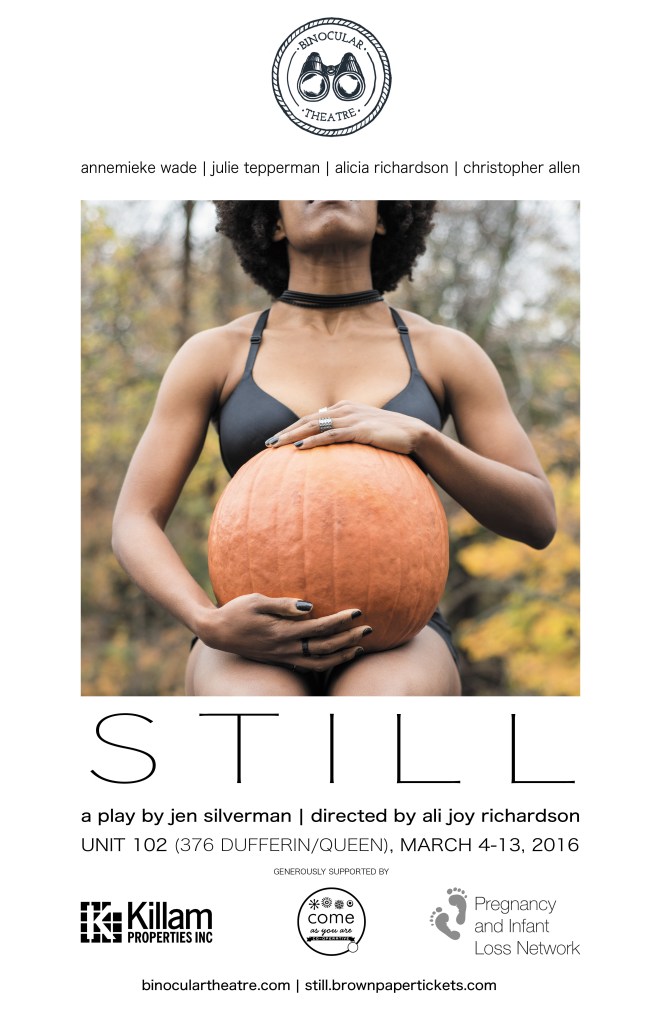
STILL

Still Poster 1

Who:
Directed by Ali Joy Richardson, featuring Julie Tepperman, Annemieke Wade, Alicia Richardson & Christopher Allen

What:
STILL is the story of a professor, her midwife, a dominatrix, and a baby who never got to be. Morgan’s son was born dead, Dolores is pregnant with a child she doesn’t want, and failed midwife Elena seeks either redemption or a career change. All three women confront their fears, desires, and each other, while Morgan’s baby is running out of time to find her.

Where:
Unit 102 (376 Dufferin Street)

When:
March 4 – 13, 2016

More details: http://www.binoculartheatre.com/still

Tickets: http://still.brownpapertickets.com/


Q&A with Darwin Lyons and Michelle Alexander, co-directors of Well Born

Interview by Bailey Green

BG: What about the script stood out to you?  

Michelle Alexander: Well, the first thing that comes to mind is the obvious answer: a woman haunted by a talking plastic baby. Can’t say I’ve ever come across that in a script before. As a director I’m most drawn to scripts that mess with audience expectation, i.e. scripts that make you think they’re a straight-up comedy and then stab you right in the gut when you least expect it. Celeste has taken subject matter that could easily be written as high drama and made it something special using her unique, twisted sense of humour and unapologetic approach to deep, uncomfortable, human truths.

BG: At the beginning of the play, where do we find the characters? Where are they, what obstacles are they facing?

Darwin Lyons: At the beginning of the play Elizabeth is five months pregnant. She and her husband Chris have just received the results of a test that tell them that their baby has a 50% chance of being born with some sort of incapacity. Elizabeth was adopted and never knew her birth mother and the results of this test make her question if she can handle the struggles of being a mother. Thankfully, she has a talking plastic baby to bounce ideas off of. Oh wait, that’s not so helpful. Elizabeth happens to be someone who likes to control everything, and she wants things to be perfect (I wonder what that’s like? Kidding… I know exactly what that’s like). This play is really the journey of Elizabeth trying to figure out how to accept the real version of life, even if it’s messy.

Photo of Sophia Fabiilli by Darren Goldstein

Photo of Sophia Fabiilli by Darren Goldstein

BG: What has the experience of co-directing been like? How do you navigate shared responsibilities and balancing a common vision of the production?

MA: Co-directing is the woooooorst. Never do it. KIDDING! Co-directing has its challenges, but with the right ‘match of minds’, two heads can truly be better than one.

Working in tandem with another director really forces you to ‘put the art first’ rather than your own ego. When you’re directing solo it can be easy to convince yourself your idea is definitely right and definitely brilliant. The act of bumping that idea up against someone else’s creative vision really forces you to evaluate whether or not it is the best choice for the story of the play.

How do we navigate co-directing? Honestly, I almost think of it like we are co-parenting a play-baby. Yeeeep, I said it! To raise our play-baby as best we can we have to commit to full, open communication, compromise and trust. If we get frustrated with one another we just throw our focus towards what decision will foster the growth and well-being of our play-baby.

*Side bar: I now fear the title of this interview will be ‘Michelle and Darwin made a Play-Baby.’

DL: Like all worthwhile endeavours and relationships co-directing with Michelle is awesome and also hard. The challenges come from the fact that we need to be really keyed into each other and communicate really well. We both work really long hours at many jobs, but we always take 30 seconds at the end of each rehearsal to check in with each other. We have an almost sign language type code—you good? Yes/no? Do we need to have a bigger chat? The joy of co-directing is that two brains are better than one. I believe that the more life experience to bring to the creation of a story the better it will be. Michelle and I have worked together a lot, and we know that our strengths and weaknesses really compliment each other. I don’t know what co-directing with someone else would be like, but I do know that what makes this collaboration work is that I trust her implicitly, I agree with her aesthetic, I think she’s incredibly smart and talented, and I know that we will be able to talk through any challenges.

Photo of Sophia Fabiilli by Darren Goldstein

Photo of Sophia Fabiilli by Darren Goldstein

BG: What has been the most challenging aspect of the process?

DL: This play jumps time, space and logic. Reading Well Born for the first time I loved how I felt like I was right inside of Elizabeth’s brain. It made me so excited because I feel like I get lost in my fantasy world and memories, it’s cool to see that reflected in a story. However staging that can be a bit of a challenge. How would you communicate to an audience that one second your in someone’s fantasy, then memory, then worst case scenario nightmare, then back to reality? Thankfully we have an amazing design team that is willing to really collaborate with us to help the vision of the show come to life.

MA: I’m an actor as well as a director, so I think my greatest strength as a director is working with actors, figuring out their characters, their moments. Staging is a whole other ballgame. Even thinking about staging complicated scene transitions or ‘fancy blocking’ gives me sweaty armpits. Celeste’s play requires a lot of fast scene transitions, many locations and some serious ‘theatre magic’. That has been the biggest challenge: How to fulfill the staging of this play in a fluid way while staying within an indie theatre budget.

BG: What has brought you the most joy in this process?

DL: Last week I ran into a friend and was telling her about the show and she launched into a story about how she struggled with something similar when she was pregnant. After sharing these intimate details from her life she sat back and said, “Sorry, I guess I just really needed to get that out.” It’s great to work on a story that people seem hungry for. I rarely hear women given the platform to talk about the real struggles and fears of being pregnant. I think the most important part of art is that it allows people an opportunity to say, me too! It allows them space to have their experiences shared, or for us to learn about an experience we might not have had. I love being a part of stories that are honest and also rarely told—this story is both. A huge benefit of that is that this story has attracted a wonderful team of actors, designers and production people to work with. Seriously, you would want to hang out with all of them if you got the chance to.

MA: The people! The cast and creative team working on Well Born are not only insanely skilled at what they do, they also work incredibly well as a team. Working on a new play is like following a moving target: the script is constantly changing, the design shifts as the script shifts, actors are given a new scene one day and then have it taken away the next… I know, you’re probably thinking ‘This is your joyful part of the process Michelle?!’ It is! Because when the whole team leaves their ego at the door, rolls up their sleeves and comes in with an attitude of ‘let’s find the guts of this thing!’ it’s not just ‘rehearsing a play’ it’s creating something new together. 

BG: What excites you the most about emerging female playwrights in Toronto? 

MA: That more and more are emerging every day! At Nightwood I get to read a lot of scripts by emerging female writers, and I must say, there are a lot of badass plays by women coming down the pipe! I’ve seen a lot of great scripts in the past few months that aren’t afraid to stand behind a strong point-of-view; that aren’t afraid to be messy and uncomfortable and that aren’t afraid to be funny! Celeste’s play is an example of the incredible, fierce and funny female writers in this city!

(Note: this Q&A has been edited for length and clarity)

WELL BORN

#WellBorn2016 produced by SoCo Theatre in association with Truth ‘n’ Lies Theatre

wellborn

What:

Mother-to-be Elizabeth is haunted by her inconclusive prenatal test results, the fact that she never knew her biological mother… and a talking plastic baby. Deeply personal and darkly comic, Well Born is a twisted dramedy about otherness, acceptance, and facing your fears by emerging playwright Celeste Percy-Beauregard.

Where:

Artscape Youngplace, Studio 109 (180 Shaw St.)

When:

Thursday March 3, 8pm
Friday, March 4, 8pm
Saturday March 5, 2pm
Saturday, March 5, 8pm
Sunday March 6, 8pm (Closing)

Tickets:

$25 general admission | $20 arts worker | PWYC on Sat Jan 27 at 2pm

*PURCHASE TICKETS ONLINE HERE!

*RSVP to the Facebook event to stay in the loop!


“Picasso & Einstein walk into a bar…” – In Conversation with Will King & Dylan Evans of “Picasso at the Lapin Agile”

Interview by Ryan Quinn

RQ: Tell me a little about the show itself and your production of it.

WK: Steve Martin (the established comedian, actor, writer, banjo aficionado) has written a play that features a young Pablo Picasso and Albert Einstein at the tipping point of their careers. It takes place at the Lapin Agile, a fictional bar in 1904 Paris, where notable intellectuals and visionaries go to talk about their manifestos. It also features a wide range of characters that gravitate to that space. It expertly deconstructs the intersection between art and science, and somehow manages to remain brilliantly funny.

We’re doing it site-specific at an event space in Kensington Market called Round. When we decided to produce it, we knew we wanted to get away from a traditional performance space. We wanted our audience to see the sparks fly between the actors, and really feel immersed in their revelations. We also thought they might like a beer!

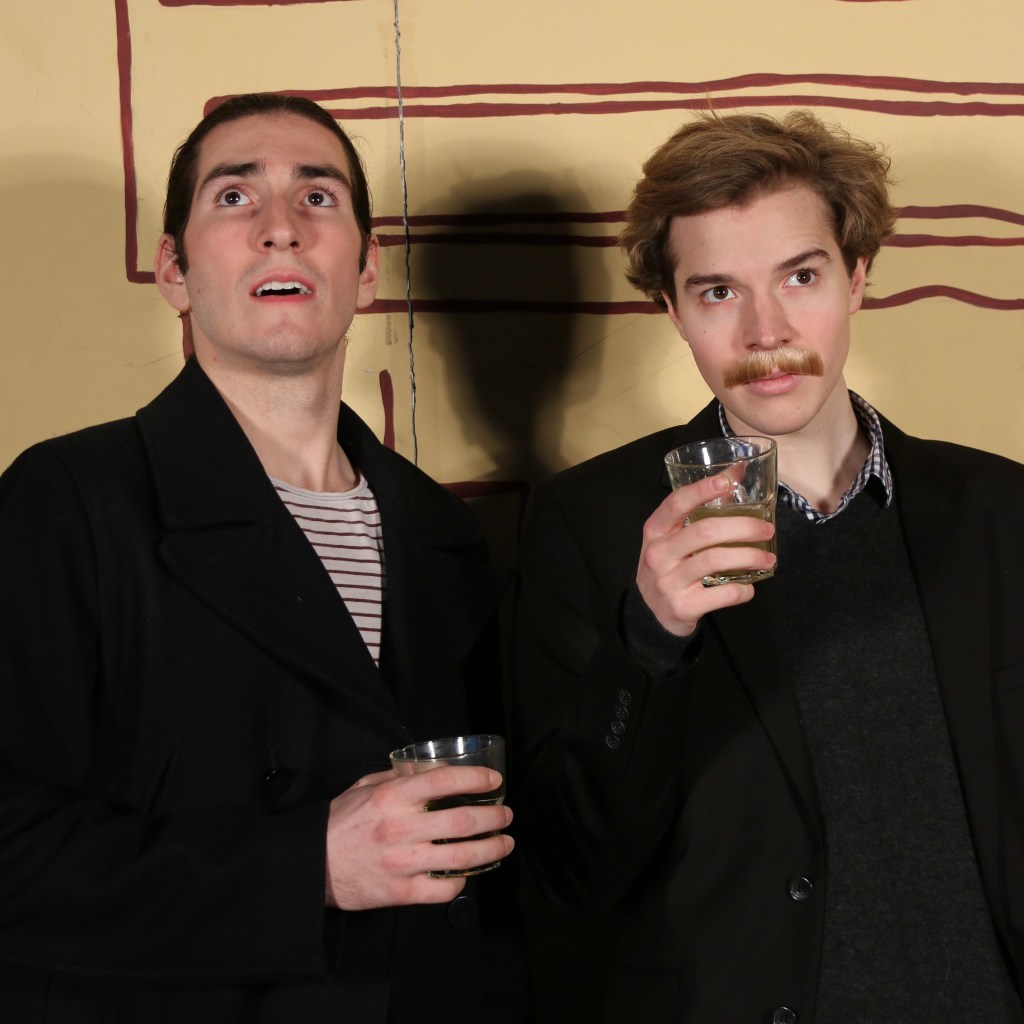
IMG_1484

RQ: In what ways do you think this show questions how we look at art or innovation?

DE: This play challenges anyone’s personal definition of art. Einstein argues that his scientific discoveries are art, whereas Picasso dismisses these as mere equations. Steve Martin tells us that science is more than numbers: it’s a vision, it’s imagination, and then it’s trying to capture that and turn it into something calculable. We can’t dive into a black hole, or travel to other solar systems, but we can dream it. And then we can take that dream and see if we can prove it.

RQ: How do you think your choice of site-specific theatre informs or enhances the piece?

WK: I love the intimacy. Performing in the round (pun intended) just feels right.

DE: I had a very clear image in my mind of what I envisioned the space looking like. When we walked into The Round for our photo shoot I was blown away by how much the space looked like what I had imagined. I had no trouble believing that I had just entered a bohemian Paris bar circa 1904. It makes a huge difference as a performer, and hopefully for the audience too. You’re right there in the bar with us. You can grab a drink and be a fellow patron in the Lapin Agile with a host of eccentric characters. So it is definitely an engaging performance and the wonderful venue is a big part of that.

RQ: What can you tell me about Seven Siblings theatre?

WK: Madryn, Erika, and I founded Seven Siblings Theatre while gaining our teacher certification at the Great Lakes Michael Chekhov Consortium in Kent, Ohio. We shared the same ideals of theatre, a similar process, and wanted to bring more Fantastic Realism into Toronto’s indie theatre community. We aim to help artists develop their psychophysical connection, and dig deeply into the atmospheres of each production. By the end of each process, our artists have a range of tools and exercises from the Michael Chekhov work to play with.

IMG_1645 (1)

RQ: Why did you choose this piece as your next production?

WK: I am adamant that everything we work on needs to present a new challenge. We’ve played with malleable classical text, highly dangerous subject matter, explosive absurdist and visual performance styles, and now we’re tapping into an immersive experience. This is one of the most playful pieces I’ve ever worked on, and the incredible duality between farce and intelligence made it a no-brainer.

RQ: If you were going to set this show in 2016, which people would be the closest parallels to the way this show characterizes Picasso and Einstein?

WK: That’s a tough one. A lot of the charm in this piece is that they’re diamonds in the rough.

DE: [In terms of banter] Stephen Hawking and John Oliver (because that first interview was too good not to have a sequel). Bill Nye and Bob Ross. Spock and Han Solo.

WK: Yeah. Einstein’s definitely the Han Solo of this show.

RQ: If you could give this show a soundtrack, what three songs would be must-haves?

DE:
The Scientist – Coldplay
The Life of Pablo (the entire album) – Kanye West (Tidal required)
Blue (Da Ba Dee) – Eiffel 65

WK:
Bistro Fada – Stephane Wrembel (watch Midnight in Paris for context)
Space Oddity – David Bowie
Sounds of Science – Beastie Boys

DE & WK:
*Bonus Track* Tubthumping – Chumbawamba


Picasso at the Lapin Agile

Presented by Seven Siblings Theatre

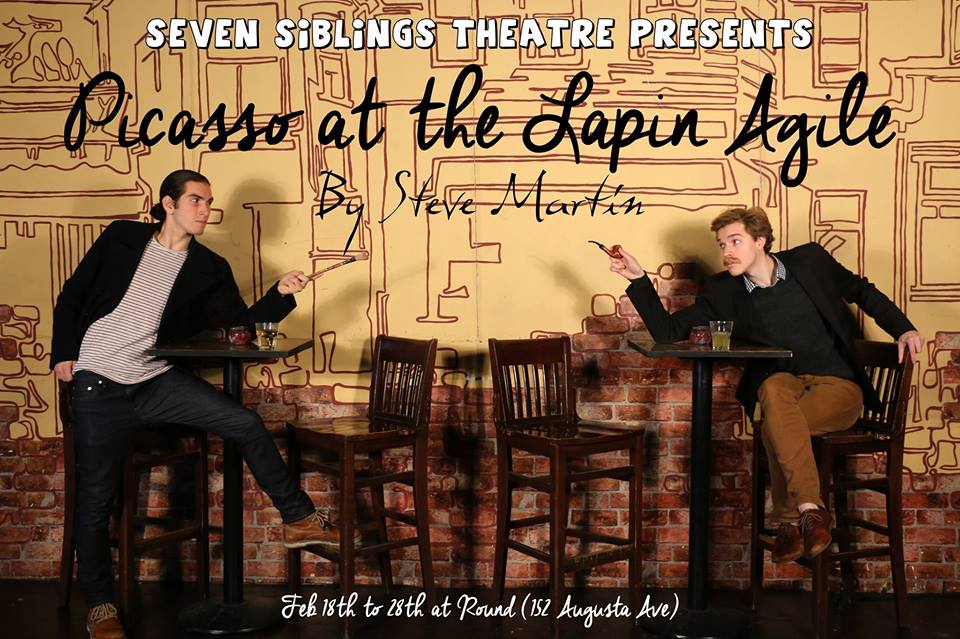
12494796_409711225904049_4751960345749307790_n

A play by Steve Martin

Who:
Directed by Erika Downie
Featuring Dylan Mawson, Jamie Johnson, Madryn McCabe, Will King, Erin Burley, Erik Helle, Dylan Evans, Andrew Gaunce and Maxwell LeBoeuf
Stage Manager Jocelyn Levadoux
Production Manager Kate MacArthur
Lighting Designer Parker Nowlan
Dialect Coach Margaret Hild

Run Time: 90 minutes

When:
February 25 at 7:30pm
February 26 at 7:30pm
February 27 at 2:00pm (Matinee)
February 28 at 7:30pm

Tickets:
February 25-28 $25

Where:
Round, 152A Augusta Avenue, Kensington Market, Toronto, Ontario

Tickets: http://www.sevensiblingstheatre.ca/picassoatthelapinagile/