Skip to content

Posts tagged ‘toronto’

“Environmentalism, Playwriting & Taking Your Time” In Conversation with Rosa Labordé, playwright of MARINE LIFE

Interview by Brittany Kay.

Rosa Labordé is one of the finest examples of a multifaceted, multi-talented, many-hats-wearing fierce female artist working in this city. Her work as a playwright, actor and director is highly praised and respected in this theatre community. We sat down to talk about her current production Marine Life, playing now at the Tarragon Extraspace only until December 17th. We spoke about how she approaches environmentalism, playwriting and the importance in taking your time with your work.

Brittany Kay: Where do you find inspiration for your work?

Rosa Labordé: Mostly, from the experiences that I have in life or what I perceive or observe going on around me. I’m usually interested in how we’re functioning as a greater society, as a greater whole and how that ties into how we treat each other as individuals. I don’t think they can be separated. I like to look at very big issues and then bring them down to their most essential level of human beings interaction with each other. In a world where can bully each other, I want to know what that looks like in the grand scale, like corporate bullying or the presidency right now in the United States and how that all ties in together and how they can’t be separate. Like the family is not separate from the greater society within which it lives… that’s usually what interests me most.

BK: How did you first get into playwriting and what brought you to where you are now?

RL: I always wrote when I was little. I think my first poem was published when I was seven in the local newspaper. It was always my thing and I always put on shows since I was really, really young. Then as I grew up, I got more into acting and I went to theatre school and they always said, “You know, it’s good to still write.” I kept writing and I found the playwrights who I most loved and I started to just do exercises in writing plays. I had a drawer full of plays that nobody ever saw that were just about differentiating character or how people speak to one another. I never went out and said “I’m going to be a playwright”, I was just like “I’m going to make a thing…” and that’s how it started.

BK: You’re also in television right now. How did that all happen?

RL: Well I was interested in it, for sure, and then I wrote my first pilot and my TV writing agent at the time said “You don’t write a pilot, you sell an idea.” Well how can I sell an idea? I need to know how to write a pilot. So I just wrote it and that went really well and CTV at the time bought it outright. We started going through development on it and then everything changed at the company. It didn’t end up going through but it was amazing to go “I’m just going to write and see what happens” and then it went somewhere.

From there, I went to the Film Centre. All of it ties into storytelling, whether it’s acting, writing, directing, writing for plays, writing for TV, it’s just about telling a story and the different medium that it works for. It’s all connected to story, even a voiceover job, you’re telling a story. That’s all my life has been, stories.
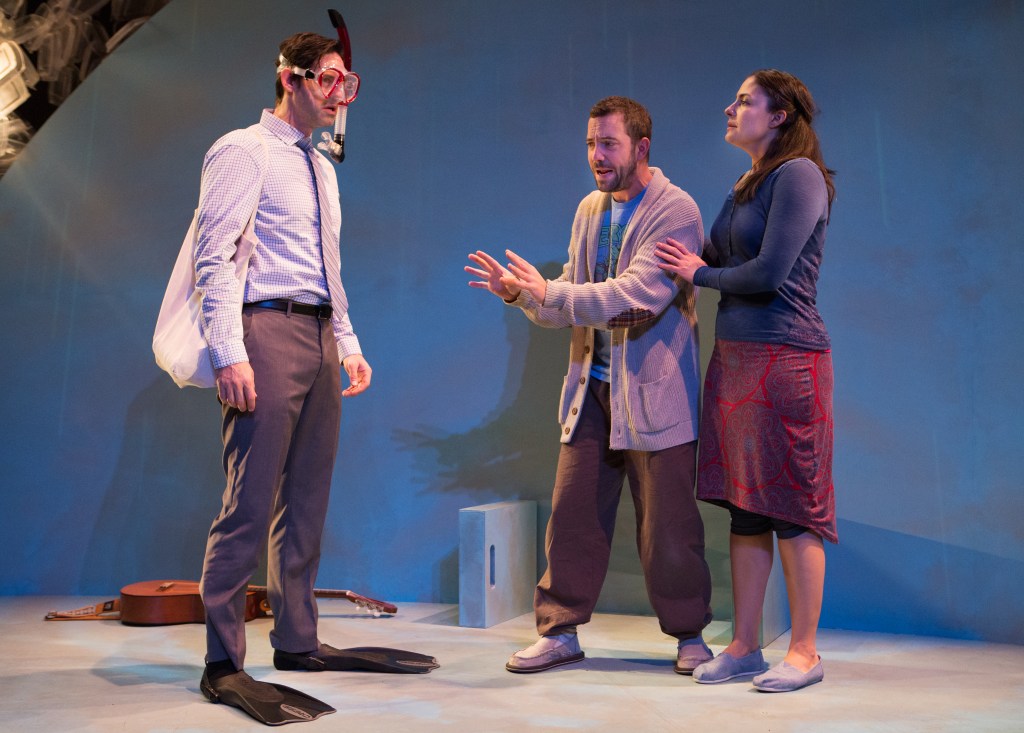
Marine Life, Tarragon Theatre. Photo by Cylla von Tiedemann.

BK: Tell me about Marine Life? Where did the inception first happen for that idea?

RL: Aluna Theatre was the company who originally commissioned it and I wrote it in my residency with them with grants from the Ontario Arts Council and the Canada Council. They really wanted me to make a piece that I would direct. They wanted me to make a piece that was completely mine. I didn’t listen to that for a bit and I did some early workshops with other people directing the readings and presentations, until, I went “Fine, I’ll direct it”.

At the time they were looking at a lot of work around water and also human rights. I just started thinking about our relationship to the environment and our relationship to water and our seas. That got me into the world of the plastic ocean, the islands made of plastic, pollution in the ocean and what it’s doing to the fish and the marine life. And because it relates back to the way that I see things, I started exploring the question – what is the self-destructive path we’re on? What is it in humans that have the desire to self-destruct just on a personal level? I kind of put these two things together. The characters are allegorical. They are representative of aspects of our humanity that move in a direction that is not always healthy for the whole. They can be quite toxic and some of what we’re doing to our planet is quite toxic, so I wanted to explore that, but in a way that was playful and fun. I think as soon as you get that didactic about environmentalism people turn off.

BK: Some political and environmental theatre isn’t for everybody. If you find a way to present the information in a humanized way, I think it could be more accessible for audiences.

RL: I think when you get someone to leave their house now, when they are so busy (technology seems to have made everyone busier) and they can stay in to watch Netflix in pajamas, is it because you want to teach them a lesson? I don’t. I like to be entertained. I like it to be a fun thing, that even if it’s a sad play, I like it when there’s a little bit of kissing or love or levity. That’s my hope, that someone can come to the show and see all the deeper meaning in the allegory and then if they don’t want to, they can also just enjoy some of the “play” and what I mean by “play” is in the playful sense.

BK: Who are the characters in your play and what is their story?

RL: Sylvia is an environmental activist but her activism has moved into the world of fanatic because she’s so upset about what’s going on that she’s taken it quite far. She falls in love with a corporate lawyer, who is basically on the other side of the spectrum of what she does. She also has a very co-dependent relationship with her sibling, which gets in the way. It becomes a strange kind of love triangle.
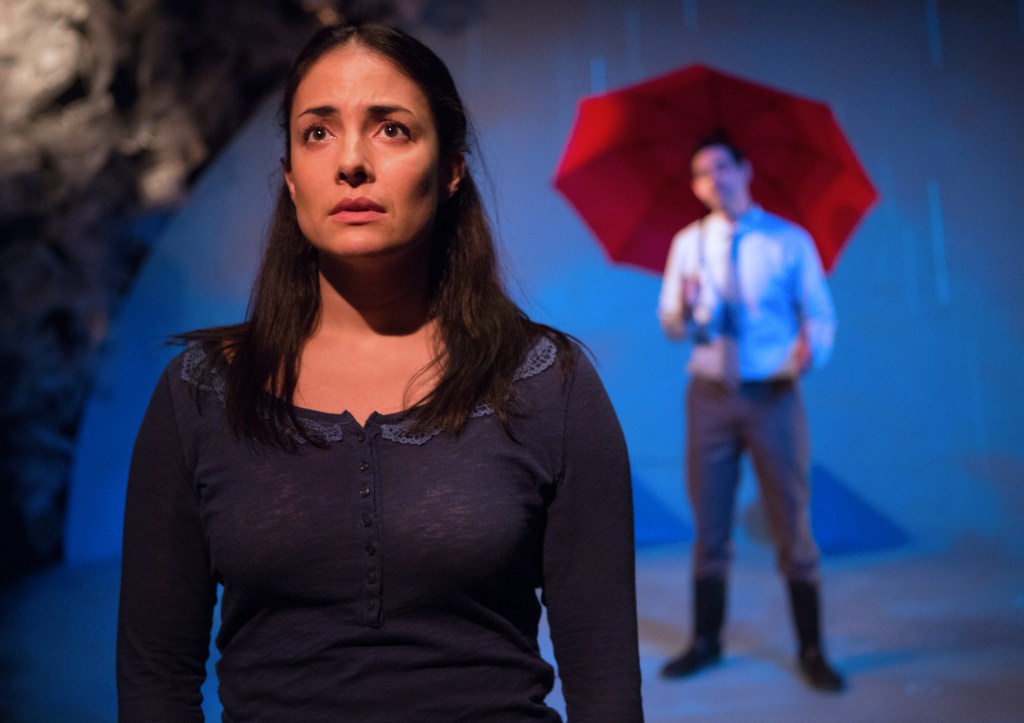
Marine Life, Tarragon Theatre. Photo by Cylla von Tiedemann

BK: There’s also music in this show? How does that play a part?

RL: I almost always like music in my plays. I had a play True and written right into it was a piano player. I love it being a part of the world and not just added on, but it being a part of the experience. I think playwriting is music. It’s all rhythm. It’s a score, basically, that you’re writing. It’s inextricably connected to have both actual musicians combined with this world that is already living in a rhythmic musical place.

BK: That’s so beautiful. What are you, a writer or something?

Laughter.

BK: This play went through several development stages in different festivals over the years. How did it grow from those first iterations to where it is now?

RL: Where it started was at Buddies’ Rhubarb! Festival and it was like 20 minutes, so it was just a look at these characters and who they might be. It built and moved from there. I was always working towards a flood in the first incarnations and then I’ve moved past that into, well, what now? We’re flooding all of the time. It’s a reality right now. In Quebec, there are still people dealing with the fallout of it. These people are literally homeless because floods destroyed their homes. Their homes were underwater. The water damage is insane. They can’t live there again and they’re just at a point where the Quebec government said we will pay. For a while, they were paying for housing, subsidizing hotel days and now they’ve pulled out of that. There are people in Quebec who are homeless because of flooding and it’s something that we’re not talking about. Climate change deniers are saying that it’s not us, it’s just the weather but it’s actually not just whether it’s a real thing and I find that really interesting and sad. It’s directly related to our overconsumption as a society, which, in a sense, the lawyer in my play represents – that kind of corporate desire to make more make more make more, sell more sell more sell more, but it’s a destructive act.

BK: Why is development and workshopping beneficial for any type of play?

RL: I think it’s so important to develop pieces and take your time figuring out what it is. The development process for this piece has been over 5 years and, in that time, I’ve also had two other plays produced and written on numerous television projects. It’s not like you’re just writing all the time for one piece. You put it aside and go, “Okay, I don’t want to let that go because I think it’s really important for us to think about these things, but how do I see it differently?” Whenever you get a chance to have an audience and have a response you can kind of connect to what is it that’s working and what is it that isn’t. It’s really useful to have “the what isn’t”. Here in Canada, we don’t quite have the structure that some other countries have in terms of developing something over a longer period of time. It can be so beneficial, even at Tarragon we get a week of previews, which is amazing. Whereas in London or New York, sometimes you get a month to 5 months to really go “what’s working and how is it working?” I think stretching it out a little bit and trying to learn the piece is a really helpful. 
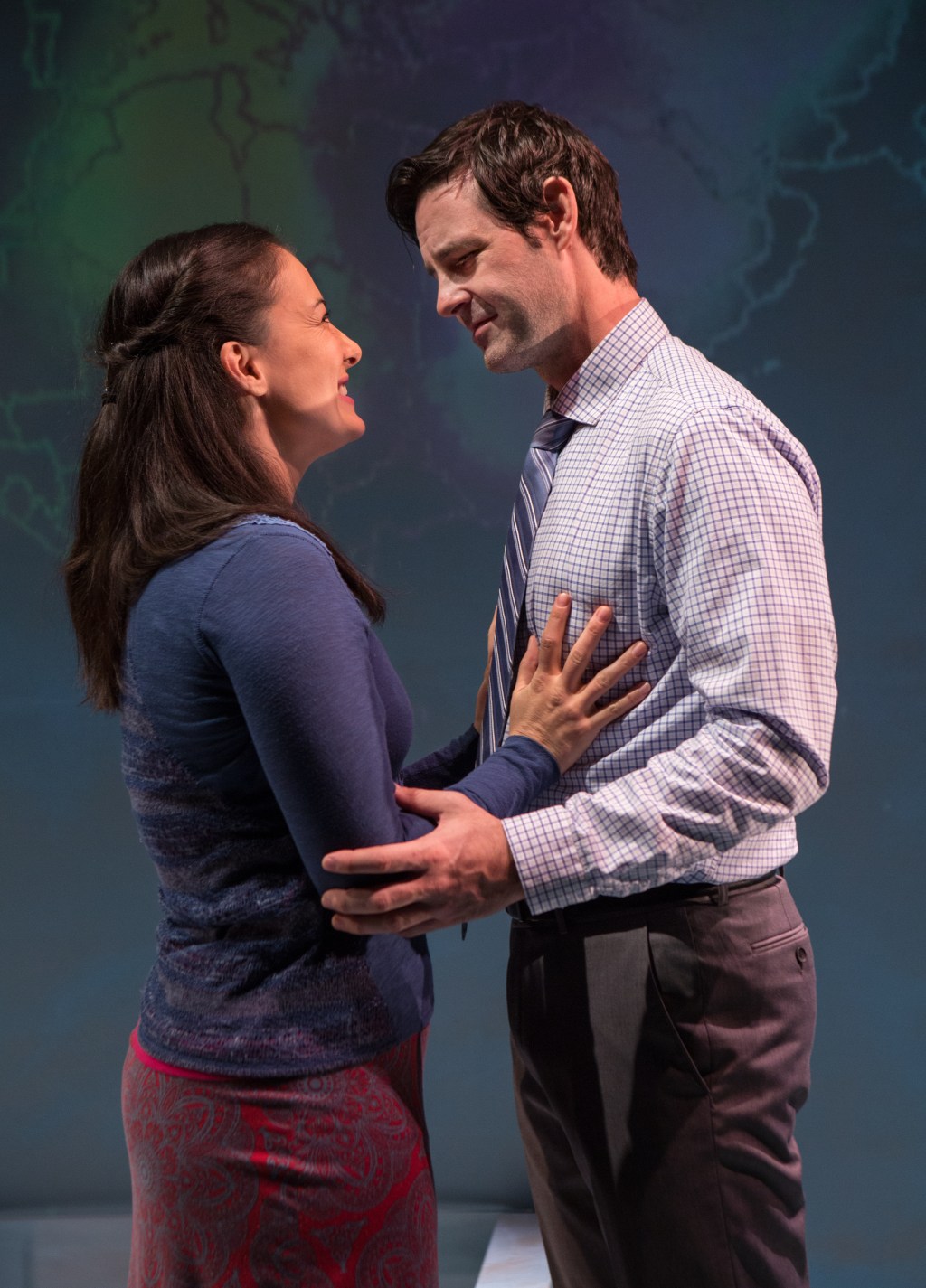
Marine Life, Tarragon Theatre. Photo by Cylla von Tiedemann.

BK: You are both playwright and director of Marine Life. How has that been difficult and helpful to wear both of those hats? How do you work between both?

RL: It can be a challenge. I really, really love directing and creating a world but where it can be challenging with new plays, is that if something is not working, the writer needs to rewrite it. Sometimes you actually just need to spend the time making it work. If everyone did their first few Shakespeare rehearsals and were like, “Ugh, it’s not working. We’re just going to have to cut those bits”, well, it’s not working because it’s really hard and you have to define every single moment of communication or it falls flat. One of my favorite Shakespeare productions was this group from the States who were dressed in all black clothes and wearing Keds. I saw them in high school and they were so great because all they did was play the action and make the story clear. Sometimes even with myself as a director, when we’re rehearing and something’s not working, I just say I’ll cut it. Only to realize later that, no, that was just a part of the process. We had a joke where I’ll say, “remember those lines I cut, you have to put them back in”. Most times you have to respect what the playwright is trying to say, but when I am both and I can be really self-critical, I go “It’s bad, what I was trying to say, I’m just going to change it.” To later think, no it’s pretty good, let’s make it work… that’s the challenging part of it.

BK: Why is Tarragon Theatre the right platform for this show?

RL: I love Tarragon and I think their audiences are really great and excited about going to the theatre. I think there’s already a lot of knowledge about environmental concerns for their audience, but this show does that in a playful way and allows them the space to think about it a little bit differently. It’s a smart audience that’s already thinking about these things and hopefully it allows their thinking to move in a bit of a different direction.

BK: Why this story right now?

RL: I think it couldn’t be more relevant because we are living our lives in a really dangerous direction and there’s a point at which we will not really be able to turn back. The depressing thing about doing the research for this project was talking to academics and environmentalists who are studying the effect of micro plastics on us. I was thinking this could get better and they would say no, it could be mitigated. That seems to be the overall place we’re at is this mitigation. It’s no longer reversible. It’s just what can we do to mitigate what we’ve done. A lot of it is about massive shifts in infrastructure and those shifts create massive economical shifts that people don’t want, especially the people who are sitting at the top of the economy where they’re benefiting from mass production.

BK: Are you an environmentalist?

RL: I care about our environment very much. I care about the world we live in. I kind of think I’m not anything. Am I a feminist, humanist, environmentalist? What am I? I can see all sides of a thing, which can be a blessing and a curse.

BK: What do you want audiences walking away with?

RL: I hope that they’ve had an enjoyable time. I hope that they’re left with some beautiful images and thoughts about where we are and thoughts about the good in us, you know to realize our potential for change. I hope it makes you think more about the changes in policy that need to happen to make a difference.

BK: Advice for other artists?  

RL: Don’t compare yourself to other people, just be on your own trip. Be yourself, that’s all you really got. All that really matters is what your personal experience is with the people in your life that you love and what difference you can make in that and being more connected to each other. We all want community and connection.

MARINE LIFE

Marine Life, Tarragon Theatre

Who:
Produced in collaboration with Aluna Theatre
Written & Directed by Rosa Labordé
starring Nicola Correia-Damude, Justin Rutledge & Matthew Edison
sound designer Thomas Ryder Payne
lighting & set designer Trevor Schwellnus
projection designer Trevor Schwellnus
costume designer Lindsay C. Walker
stage manager Robin Munro
surtitle translator Bruce Gibbons Fell
surtitle specialist Sebastian Marziali

What:
Save the world or save yourself? This romantic comedy sees Sylvia, an ecological activist, caught between her own environmental extremism and falling in love with a man who has a secret dependency on plastic. When the rains come and the flood water rises, who will survive the deluge?

Where:
Tarragon Extraspace
30 Bridgman Ave. Toronto

When:
On Stage now only until Dec 17, 2017

Tickets:
tarragontheatre.com

“Breaking out of the Ingénue” In Conversation with Eliza Martin: Playwright/Performer of “O”

Interview by Bailey Green.

We spoke with playwright and actor Eliza Martin about her upcoming solo show O, playing for two nights only at the Artscape Wychwood Barns on November 28 and 29. The play tells the story of Leigh, who is donning her flower crown to play Ophelia. During a tech rehearsal the day before opening, Leigh speaks to the audience about her experiences as the ingénue—namely crying and dying. Through Leigh, Martin challenges the notions surrounding these iconic roles for young women. We spoke with Martin about breaking out of the ingénue, her fascination with Ophelia and discovering her voice.

Bailey Green: Tell me about the genesis of the project.

Eliza Martin: So I started working on O in 2014 when I was about to graduate [from the University of Toronto and Sheridan College]. It was an Independent Study Project led by David Matheson, and I was interested in the character of Ophelia, perhaps for the reasons we all are. There’s that image in our head of the woman floating in the water, this history of all those famous paintings and I wanted to do a project exploring her.

BG: What else drew you to the character of Ophelia, what qualities did you want to explore more deeply?

EM: As a young woman in theatre, we think of ‘who I would play in that show’. We look at plays with the lens of the part we might be considered for. So for me, I recognized this frustration in this tiny, tiny role [Ophelia] and these limited situations that we see her in. We get her being a pawn for her dad and brother, her briefly talking to Hamlet and then as Mad Ophelia. Which is beautiful in its own right, but still—in a play that is three hours long, she only has these tiny moments, whereas Hamlet deliberates about one decision for pages. Yet for this one young woman, we get only a few glimpses into what she’s going through and hardly any text at all. At the time of my ISP, a friend of mine mentioned that she took a Shakespeare course in university and the professor spoke about the origin of Ophelia’s name—he said O is a nice emotional sound, and O is also a zero and it means nothing. I was enraged by that notion, so I called it O. I wanted this moment of defence – I just can’t let a female part mean nothing.

BG: How has this draft changed from previous drafts? Do you find your focus has changed?

EM: I think the focus has changed. It’s very much the same spirit. And a lot of the work Ali [Joy Richardson] and I did as co-creators has stayed in tact from when we workshopped O at the Paprika Festival. This time we’re digging a little deeper into the heart of both the character and the actor, Leigh. It’s a longer version and there’s a bit more darkness and ambiguity. We only had 30 minutes at Paprika, so it’s been great to be given more time to dig. I’m working with Rebecca Ballarin, who is new to the project, and our team is just amazing.

BG: How have you broken out of the ingénue role in your own career?

EM: It’s something that has always been kind of assigned to me? And because of that I used to view parts and opportunities through that lens. I’d approach Hamlet and think Ophelia and I would immediately slot myself into those expectations. And now, I have arrived at this crossroads, because if we’re going to play these parts we need to play them differently. Or perhaps they don’t belong anymore, and they need to be adapted. Or how can someone else play them to make them more compelling? Maybe I’m not the right person to play these roles anymore. I think we need to move forward with that knowledge, that these roles need to be changed or played by other people. There need to be new voices.

BG: What challenges you the most about this project?

EM: I think bringing my own self into it has been challenging. It started as a project where I wanted to explore Ophelia and Hamlet as a play and I wanted to do so with distance and from an academic perspective. But when I was working with Ali, she encouraged me to bring my own story which was very challenging and scary to do. That opened the door for the work we’re doing now, and collaborating with Rebecca, has moved the piece further in the direction I was going.

BG: Who or what is currently inspiring you?

EM: I’m very interested in the conversations being had about consent. I don’t think that was a conversation that was in O in the previous versions, but there’s a lot to be said about the power dynamic between a young woman and older man. I’m inspired by the women coming forward and talking about their experiences. It’s not something that goes very far in the show, I wouldn’t say that we really tackle issues of consent, but there’s a lot to be said for decisions we feel we need to make because we’re part of this big system. This is Leigh’s first real Equity gig, and she’s working with a well-known director, and she doesn’t feel that she is able to express herself or ask for changes that should be made.

Rapid Fire Questions:

Go-to cafe: Bloomer’s.

Album on repeat: Christmas music…don’t judge me!

Best time to write: Late at night—so toxic, so tempting.

Current favourite tea: Earl grey, any day.

Late night snack: Popcorn

O

Who:
Written and performed by Eliza Martin
Directed by Rebecca Ballarin
Sound Design by Nick Potter
Lighting Design by Steph Raposo
Production Stage Manager: Lucy McPhee
Script Advisor: Rachel Blair
Photo Credit: Neil Silcox

With Ben Hayward as Rod
and Lucy McPhee as Carol

What:
Hamlet opens tomorrow night and Leigh is ready to make her debut as Ophelia: wigged, primped, and donning her flower crown. During a brief hold in her tech rehearsal, Leigh takes the audience through basic acting skills for the ingénue and shares candid personal anecdotes, sparking a series of unsettling realizations.

O examines the stage life and death of the ingénue – the stories they tell, and the women behind them. Will we continue to accept that success for an actress means crying and dying through a career? Or can we find a way to keep our heads above water while turning the tide?

Where:
Artscape Wychwood Barns

When:
8pm November 29th & 30th 2017

Tickets:
$15, online & at the door
Tickets: https://www.brownpapertickets.com/event/3166903

Connect:
http://www.elizamartin.ca/

“Collaboration, Character-Driven Plays & 90s Pop Culture” A Chat with David Mackett, James Wallis & Julia Nish-Lapidus on DUBLIN CAROL by Conor McPherson, November 14-26

Interview by Hallie Seline.

We had the pleasure of connecting with David Mackett, James Wallis and Julia Nish-Lapidus to discuss their latest collaboration on Conor McPherson’s Dublin Carol presented by Fly on the Wall Theatre. We spoke about what drew them to explore McPherson’s plays, working with director Rod Ceballos, and riffing off the play’s setting in the 90s, we do a little 90s Rapid Fire Question session on bands, trends, and catchphrases, because… how could you not?!

HS: Tell me a bit about the show and what it’s like working on it.

James Wallis: Dublin Carol is set in the back room of a funeral home in Dublin on Christmas Eve. John is running the funeral home because his boss, the mortician Noel, is in the hospital; John’s showing the ropes to young Mark, Noel’s nephew (played by moi!), on a day when his estranged daughter tells him that his ex-wife is dying from cancer. The play deals with John confronting his past, present, and future – the choices he is making and those he will make. John is a realist but also full of fantasy. McPherson is a master at understanding the grief underneath the common man. John is broken and tries to confront his former demons but he’s also unwilling to see his complacency and hypocrisy in his life. It’s been a great pleasure to work on such a deeply sad play, and amazing to work on a play about intimate conversations and emotions. Since the majority of the work I do is Shakespeare, the sparse, yet detailed text is a joyful challenge.

HS: Tell me about working with director Rod Ceballos on this.

JW: I’ve known Rod for years but never worked for him. He’s a diligent director, always thinking about what is being said and done in the moment. He’s challenging to his actors: What’s going on right now? What do you need out of this moment?

It’s been a great lesson to watch him and David Mackett working together. They’ve spent a lot of time working together and it shows. Their professionalism and creativity is evident. They work carefully and with constant focus on John’s inner world.

Rod has a great deal of experience to offer an actor, and it’s been a great pleasure to learn and work with him. Plus, he’s a good guy. The room is full of friends working on a play with passion and hard work. That’s all I care about.

HS: David, what is it about Conor McPherson’s work that draws you to it and excites you?

David Mackett: I was first introduced to McPherson’s work when I was approached to do a site-specific production of The Weir, produced by MackenzieRo as part of the 2004 Toronto Fringe. What immediately struck me about his plays is how character-driven they are – McPherson has said in interviews that not much happens in his plays (i.e. there’s not a lot of “action”, as it were), but as the play progresses, you are gradually drawn into the inner lives of the characters you are observing – their feelings of grief, loneliness, and regret. And that’s what really excites me about his work – exploring the inner emotional lives of these characters through what is said, and perhaps more importantly, what is not said. In each of the McPherson plays I’ve worked on, something happens that forces the characters to re-examine their lives – the choices they’ve made – often leaving them with a suspicion that they’ve let life pass them by. I think that’s what we all wonder about: whether we are, in fact, seizing every opportunity that comes our way, and living our own lives to the fullest.

HS: If your audience could listen to one song/band/album before coming to see the show, what would it be?

DM: Dante’s Prayer by Loreena McKennitt

HS: I heard this show is set in the 90s, which I am ALWAYS into. Let’s do some…

90s Rapid Fire Questions

JW & DM: Julia Nish-Lapidus is a huge 90s pop culture fan/enthusiast, so we leave it to her to handle this rapid fire round:

Favourite 90s band:
Julia Nish-Lapidus: All Saints! Deborah Cox! Mariah! Jimmy Ray?

Favourite 90s fashion:
JNL: Platform shoes. I even had platform flip-flops, which were not comfortable. Though I always wanted to dress like Angela from My So-Called Life, and she would never wear those.

Favourite 90s movie:
JNL: Clueless… Empire Records.

Favourite 90s trend:
JNL: Inflatable housewares. I had a chair, an ottoman, a garbage can, and a Kleenex box holder.

What would be your 90s sitcom catchphrase?
JNL: Hop to it!

If you could give your 90s self one piece of advice, what would it be?
JNL: Stop pretending you’re too cool to like boy bands. We all know you went to an O-Town concert.

Describe the show in 5-10 words.
David:
Dublin. Christmas Eve. A visit. A man’s own ghosts. Whiskey. A chance.
James: An intimate Christmas sorrowful story time
Julia: Loss, loneliness, regret, and a chance at redemption.

Dublin Carol

Who:
Written by Conor McPherson
Presented by Fly on the Wall Theatre
Directed by Fly on the Wall’s Co-Artistic Producer, Rod Ceballos
Featuring: David Mackett, James Wallis and Julia Nish-Lapidus
Production Design by Patrick Brennan
Stage Manager: Cora Matheson

What:
Dublin undertaker, John Plunkett, is a man haunted by his past – a past he would sooner forget. It’s the morning of Christmas Eve and he’s back in his office with his new assistant, after overseeing an early morning funeral. Then an unexpected visit from his estranged daughter throws his daily routine into turmoil. It’s a visit that forces him to confront the ghosts of his past…but one that offers him a final opportunity to make things right.

Where:
Artscape Youngplace
180 Shaw Street, Toronto

When:
November 14 – 26, 2017

Tickets:
$15-$25
Preview (Tuesday, November 14): $15
Tuesday – Saturday: $25
Sunday Matinee: $20
flyonthewalltheatre.ca

“Loyalty, Musicality, Family and Leaving Home” In Conversation with Jeff Ho, creator and performer of “trace” at Factory Theatre

Interview by Bailey Green.

We spoke with Jeff Ho about his play trace, opening at Factory Theatre on November 16th (in association with b current performing arts). trace follows Ho’s own bloodline and lineage, from his great-grandmother, to his mother, to himself. The audience travels along with the journeys his family chose, or were forced to choose, over the course of their lifetimes. This two piano, one man chamber play spans decades and continents. Ho is the composer, writer and performer of the play. We spoke with Ho about loyalty, musicality, family and leaving home.

(Interview has been edited for length and clarity.)

Bailey Green: Can you tell me what sparked the desire to create trace?

Jeff Ho: I started writing trace when I was still at school at the National Theatre School. During second year, we have a component where we write our own solo show. I worked with Yael Farber, and she often says “What do your ancestors demand you speak?” and in my family we have this secret: My great grandma, she had my grandpa but she also had another son, and during World War 2 she had to make, well essentially, a “Sophie’s Choice” and she had to leave a son, my great-uncle, behind. From that deep guilt and shame, she never spoke of him. I did a lot of archaeological digging, looking at when she had run to Hong Kong after the Japanese invaded and set up internment camps. There was so much unspoken, like Unit 731 and essentially a Chinese holocaust. So I wrote a long form poem, trying to speak out for all of the atrocities and how she [my great-grandmother] ran most likely because of them. And Yael said that these stories end with me now, so I began working on all of this to trace and acknowledge and try to unearth my own history.

BG: Did you interview your mother or other family members? What did you learn through this process and did it change how you saw your family?

JH: It was super cool as a way to connect to my own mom. In a lot of ways, I paralleled the lost son in my family. I ran away from home to Montreal and it was a second rift trying to not disappear in my own family. So talking to her was this way of hearing all of these childhood stories, which was so important to me. My great grandmother… she was a lioness. She was a modern women, she smoked and she never married again. “I’m happy with my one son. I’m happy to live here now. I’m good.” And that’s what she was like. I would often bring my partner over during the interviews and so my mother spoke these stories in English. She would say, “Your uncle, he swam and swam and swam and he got there,” and found the most basic ways to communicate these epic stories. I got to see a picture of my mom when she came to Canada — a woman without any English, without my father, with two sons — and also who she is now.

BG: You have gone through multiple phases of development with the script. What are you learning so far in rehearsal?

JH: I’m learning about how to give all of myself. Composing the music and playing piano, that was director Nina [Lee Aquino]’s idea. Piano is something I have grown up with since I was 5. It’s another way to give myself through music. 

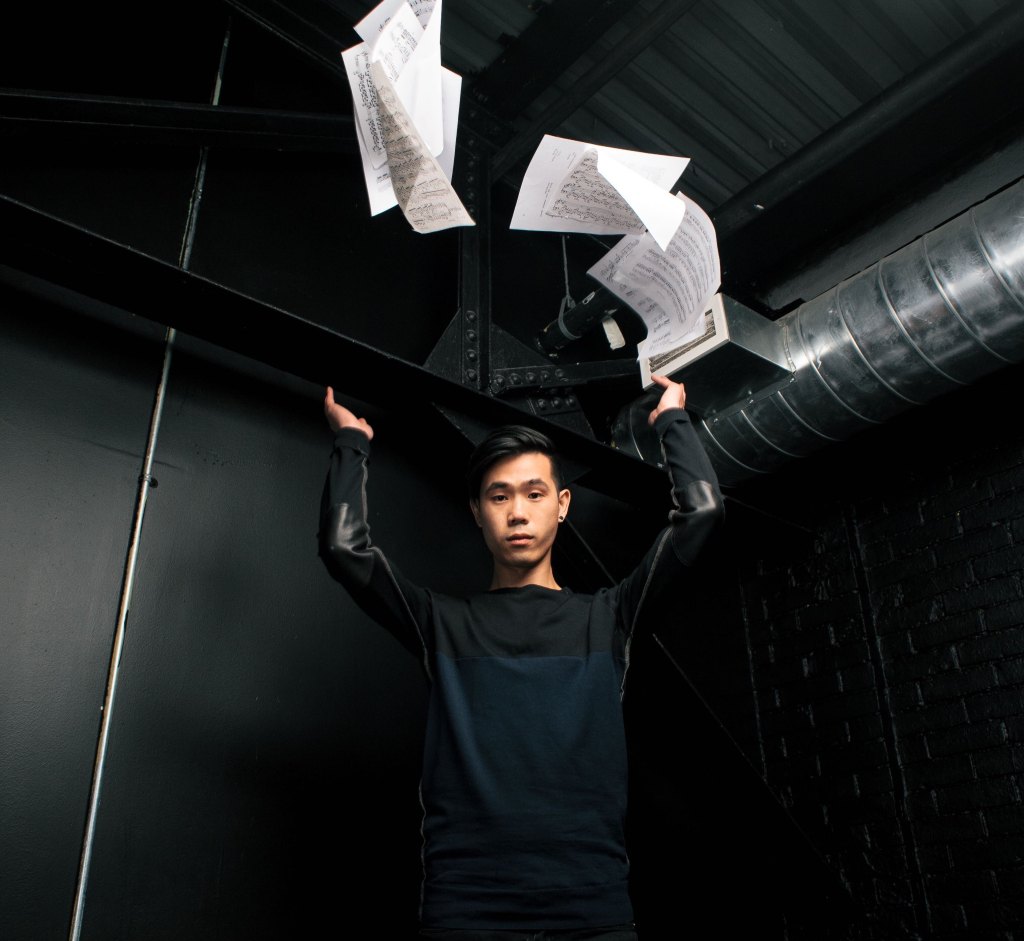
Jeff Ho in trace. Photo Credit: Marko Kovacevic

BG: Can you tell me more about your relationship to the piano, both as a musician and as a composer?

JH: I started in Hong Kong at 5, it was seen as a good skill set for me to have. I totally went into it adverse, but knew I had to appease my parents. I found my love for performance, though I never got along with any of my piano teachers. But I loved the applause! How I write and how I act stems through musicality, the mood of something. And any other language is just music and that really bridged the gap for me when my english was far worse [then it is now].

BG: The music of language is in the show, as well. Canto is such a musical language.

JH: Canto is always there for me. There are things that I just don’t know how to articulate in English. [Cantonese is] so succinct, it takes four words to say what it takes a paragraph to say in English. With Great Grandma and how she dealt with her kids and how she spoke her stories, it was important to include. We hear text from the women and the men speak through music. I didn’t want the men to speak, I wanted to hear the women and what they wanted to say, and we get the intention and feeling from the men from the piano.

BG: Tell me about working with Nina Lee Aquino.

JH: It’s a new relationship. I have known her as mentor, as teacher, as dramaturge, but I have never worked with her as director. We have a shorthand, but she loves using pop culture references and as an immigrant, sometimes I get lost! It’s a fluid and natural evolution. There’s a frankness to it. She will never let me off the hook, I can never hide in my words or anything, she will challenge me to get there and not to be precious.

BG: trace is so personal. What has been the greatest challenge creating it?

JH: In giving back and acknowledging my family, I have always dealt with the guilt of leaving my home. As a teenager I felt theatre was a greater calling but I was truly breaking my mother’s heart. There was a lot of ‘you’re a terrible son, you don’t honour our family’, and I can’t [honour them] in the way they want me to. I’m nomadic and mobile and artistic. But I can honour them in the way that I know, through everything I love.

BG: Have they seen it in any form?

JH: My mom has read snippets of it. I’ll transcribe things she’s said and show them to her. I’m excited and nervous for sure. Memory is fiction, and so I want to honour and reveal truths about our family.

BG: What are some of your inspirations right now?

JH: Yael Farber. When I get down on myself or I don’t know what I want to do, I read interviews with Yael Farber. She is the most articulate, does not settle for anything less than the painful truth, and she wants to shed light on what we’re capable of. I pull out my guts and get back to work. I’ve been wrapped up in Chopin, Rachmaninoff, the more turbulent composers. And Bijork’s song Black Lake, it’s about a pain and trauma in her family, and it’s 10 minutes long.

trace

Who:
Written by and starring Jeff Ho
A Factory production in association with b current performing arts
Directed by Nina Lee Aquino

What:
trace follows three generations of mother and son from the Japanese occupation of Hong Kong to Canada in the 21st century. Combining virtuosic original piano compositions with an incredible performance and lyrical text, this exquisite and stimulating one man chamber play offers a new look into the lasting implications of sacrifice across generations.

Where:
Factory Theatre Studio Theatre
125 Bathurst Street, Toronto

When:
November 11-December 3

Tickets:
factorytheatre.ca

Connect:
@kjeffho

In Conversation with Jay Turvey & Jeff Irving on “existential thriller” GRIMLY HANDSOME at The Assembly Theatre

Interview by Megan Robinson

“You’re a mouse in my hands. You’re safe.” – Grimly Handsome (Director Jay Turvey’s favourite quote)

The excitement that director Jay Turvey and actor Jeff Irving share for their upcoming production of Grimly Handsome, starting November 4th at The Assembly Theatre, is infectious. “You’re listening to people on the cusp of inspiration right now,” Irving says with a laugh.

Grimly Handsome is the first production of their new theatre company, Theatre Animal, as well as the play’s Canadian premiere. At one point in our phone interview, Irving bounces between some ideas for their company’s creative future, telling me, “our limit is our imagination.” Creating their own work is something they’ve been talking about for years.

The director and the cast of Grimly are all ensemble members at the Shaw Festival and they’ve been rehearsing the production in Niagara-on-the-Lake on and off for a couple of months now. With load-in happening the day after the interview, Turvey and Irving are looking forward to being in the new space that Unit 102 and Leroy Theatre have created near Queen and Jameson. “They’ve been great with us,” Turvey tells me. “I’m so glad they were able to create this space for small theatre to exist and continue.” With the turnover of small theatres in Toronto shutting down, this new space is a win.

Irving describes Grimly as an “existential thriller,” and then Turvey jumps in, elaborating, “There’s a murder. There’s a serial killer on the loose who is killing young people at Christmastime.” It is a play in three parts that is funny as well as scary. They reference another actor in the show, Ben Sanders, who says that it is unlike anything he’s seen before in Toronto.

Surreal and avant-garde, the story unfolds in a way that invites the audience to lean in a little closer to make sense of what is going on. In doing so, Irving says, it forces them to “practice listening and being present in the space.” The ending leaves itself open to interpretation but is not vague for the sake of being vague, instead the play is open-ended with the hope that afterward, the audience will walk away wanting to discuss their take on it.

Julia Jarcho, the playwright, is greatly influenced by Samuel Beckett and David Lynch, and Turvey has worked with designer Christine Urquhart to create a world reflective of this. In one example, Turvey explains how they’ve worked to create a forest that is both inviting and dangerous by using lots of red, greens and blacks, playing with Jarcho’s idea of Grimm’s fairytales. The result of the design is a dream world that is both urban and other.

It is a show that deals with themes of psychological unrest and plays into the universal and very human need to find our place in the grand scope of the world. This last part is what Irving says all young people think about a lot, or at least, he does.

Grimly Handsome, is being produced at the perfect time of year. “It’s basically Halloween and Christmas. People started celebrating Christmas yesterday.” Irving says with a laugh.

Why should you see the show? Irving pulls the final punch, “It’s going to be fucking fantastic.”

Grimly Handsome

Who:
Written by: Julia Jarcho
Directed by: Jay Turvey
Cast: Jeff Irving, Ben Sanders, Julia Course
Original Music: Paul Sportelli and John-Luke Addison
Lighting: Mikael Kangas
Costume and Set Design: Christine Urquhart

What:
The Obie-award winning play is a triptych of urban stories: two unusual Christmas tree salesmen peddle their wares on the street, two cops follow the trail of a serial killer and in a vacant lot people transform in ways they never thought possible. GRIMLY HANDSOME is a haunting, comic thriller that exposes the underbelly of the city and the animal in us all.

Where:
The Assembly Theatre, 1479 Queen St West

When:
November 3rd-November 19th
Thu – Sat 8pm, Sat 2pm, Sun 4pm

Tickets:
brownpapertickets.com