Skip to content

Posts tagged ‘Bailey Green’

Full Dark by Sharron Matthews at the 36th annual Rhubarb Festival

by Bailey Green

I saw Sharron Matthews perform cabaret for the first time at the Edinburgh Fringe Festival in August 2011. Her incredible vocals, dynamite stage presence and the way she reached out to her audience completely captivated me. About two years ago, when Sharron began her artists residency at Buddies in Bad Times Theatre, I witnessed the first incarnations of her new show, Full Dark. Full Dark had a different, gritty feel, and the piece dealt with themes of fear, loneliness and grief. Now, after several workshops and performances, Sharron is bringing Full Dark to the Chamber at Buddies for the Rhubarb Festival.

Sharron originally workshopped Full Dark twice before doing a full run at Sheridan College in the fall of 2013. After the Sheridan run, Sharron wasn’t sure she could return to the project. The subject matter had weighed heavily on her and writing the show, which had turned into more of a book show, had lost its joy. She sat down with Brendan Healy (Artistic Director of Buddies) for a long talk. Brendan suggested that Sharron bring in a director and a dramaturge. “I’d always been in charge of my own voice,” Sharron remembers, “but I’d thought about it. The distance [from the project], it helped me discover news things and be brave.”

photo by Mike Bickerton

Photos by Mike Bickerton

Sharron had seen The Gay Heritage Project in early winter of 2013 and had admired it for being moving and exciting work. Specifically she was drawn to how the creators, Damien Atkins, Paul Dunn & Andrew Kushnir, married storytelling and music. She connected with Andrew Kushnir and they set up a pair of three day workshops in March and October 2014 (attended by Sharron, Andrew, Brendan, with musical director Steve Thomas joining for the second one.) The workshops went well and Andrew Kushnir became the director and dramaturge of Full Dark at Rhubarb.

On working with Andrew, Sharron praises his intuitive nature as a dramaturge and his ability to stand even farther outside as a director to decide what serves the piece best. “Andrew sees what I’m doing and helps me find ways to get there when I’m not sure,” Sharron says, “I’m not giving away the steering wheel, someone’s helping me drive.” Cabaret is a meeting of minds, between performer/writer, director, dramaturge, musical director and musicians. Sharron raves of her team which includes Jason Chesworth on guitar and mandolin and Bob DiSalle on percussion. Musical director Steve Thomas has been her go-to chief arranger for many years and “is a really safe person to have on a trip like this.” Steve Thomas has a conflict with the run at Rhubarb, so stepping in to play piano is Wayne Gwillim.

As a constantly evolving artist, Sharron continues to push the her own boundaries as a cabaret artist. Earlier last year, she performed a Prince-themed cabaret at the Global Cabaret Festival at Soulpepper. And this past January, Sharron spent a month in Puerto Vallarta, Mexico hustling to promote her shows by day and performing two separate cabarets (made up of “previously loved material”) by night.

“I wanted to find new ways to tell a story, in cabaret,” Sharron says of her residency at Buddies. “For a long time I did the kind of ‘cabaret way’, essentially a lot of comedy so then I felt I’d earned myself a ballad. Now I want to tell deeper stories in the same format.” Of the process of rehearsing and creating a fresh production out of Full Dark, Sharron says “It’s very exciting and fresh and immediate. I get so excited about coming to work every day. I haven’t felt like that since I did Les Mis when I was 21.”

When asked about Rhubarb, Sharron expresses her excitement about a festival that celebrates pieces that are in transit, in action, in progress. Work that pushes boundaries and stories that are unique to the artists who tell them. As for the moment that Sharron looks forward to the most during Full Dark, she says it is right at the end. It’s a new mash up of “XO” by Beyoncé and “Glitter in the Air” by P!nk. “It’s a gift to myself because it’s right at the end. And I know it’s there,” Sharron says, “It’s a joyous song.”

Sharron Matthews: Full Dark

fulldarkkbanner

What happens when Canada’s best cabaret performer assembles a three piece band and takes a walk on the scarier side of the street? Full Dark expands Sharron Matthew’s signature style to delve into the darker sides of storytelling – about growing up fatherless, about being bullied, about sexuality and danger, the unacceptable, and the unexplained.

When: February 18-20 at 10:00pm

Where: In the Chamber at Buddies in Bad Times Theatre

Artists: creator / performer Sharron Matthews | director / dramaturge Andrew Kushnir | musical director / arranger Steve Thomas | guitar / mandolin Jason Chesworth | percussion Bob DiSalle

Tickets: included in your $20 Evening Pass

Full Dark is being developed by Sharron Matthews as part of Buddies’ Artist Residency Program

In Conversation with Morro and Jasp – “Anything Goes” at the Rhubarb Festival

by Bailey Green

Clown sisters Morro and Jasp are trying out a completely new recipe for fun, exciting and unpredictable theatre with their new creation Anything Goes — part of Buddies’ Rhubarb Festival. Anything Goes is exactly what it sounds like. Audience members are in for a unique “one on one on one” experience (dubbed by director Byron Laviolette) as they will interact directly with Morro and Jasp for a little less than ten minutes. I spoke with Heather Marie Annis (Morro) and Amy Lee (Jasp) about their upcoming performance, their years of clowning together and being a part of Rhubarb.

Anything Goes is new territory for the ebullient and open-hearted Heather and Amy. “We call ourselves structure junkies,” Heather laughs. “People may think our shows are improv, and in some ways they are, but it is based on a very specific script and structure.” With Anything Goes, most of that is out the window. There are infinite possibilities for how any given interaction will go. The pair discuss the options with open excitement, describing how perhaps an audience member may bond with one clown and turn against the other, or what will happen if a small group wants to all interact. Heather and Amy are most excited to see the potential of what can happen when an audience member is free to play without being conscious of an external audience’s judgement.

When asked about the most challenging part of preparing, the answer comes quickly: they can’t actually rehearse. Morro and Jasp venture out into the world for adventures and interact with strangers, but beyond being present and open there isn’t much else to set in place. “My desire for control is being seriously challenged,” Heather says. The pair’s background is not based in improv either, they begin primarily with Morro and Jasp. “We can go outside the boundaries because we know what they are,” Amy says. “This [Anything Goes] is wide open. Our only structure is the human being and then we find a connection.”

So to prepare, Heather and Amy have continued to exercise their improv muscles, as well as coming up with ideas of props to have in the room and scenarios to offer. They’re both conscious of the constant assessment required for a performance of this focused nature. “If they want us to just take the reins and do something we have ideas for a jumping off point,” Heather says. Amy picks up Heather’s train of thought, “We’re challenging ourselves to do this because we really want to give each person what they need and want in that moment. The ball is in their court to decide what kind of experience they want.”

When I ask the pair what they’re most excited about for Rhubarb this year, their words tumble over each other as their enthusiasm bubbles:

Heather: It’s so inspiring to see artists who are coming up with things, and someone says an idea and you’re like “my brain!”

Amy: We’ve never done Rhubarb before. It’s an amazing festival! I love Buddies, the space –

Heather: A basement, events happen –

Amy: It’s a world of possibility –

Heather: A theatre carnival and you get –

Amy: a choose your own adventure

Heather: kind of everything!

Morro and Jasp were born during Heather and Amy’s time together at York University. The pair ended up working on a piece written by Heather about two sisters named Jamie and Mackenzie. They played multiple characters and Amy fell in love with the character work of physical theatre. Byron Laviolette was at York as well at the time and he saw the piece. Laviolette had studied Pochinko clown and was very interested in the style. He had written a turn called “Reflections” about two clowns named Morris and Jasper. He saw Heather and Amy and liked their connection. “We were saying yes to everything,” Amy says of their first years out of school, “we had no idea what we were getting into, nor did we think we’d be here ten years later.” The trio moved on to train with Pete Jarvis for two years. Their first few shows were mainly for children as part of FringeKids! The women laugh and cringe as they remember the early years where they were simultaneously figuring out how to write theatre and how to be clowns.

MJ Old Timey 2

Then they were accepted into “adult” fringe for 2009. “We wanted to write a show about our clown characters going through puberty, we needed to tell that story,” recalls Amy. “We wanted to write the show we wanted to make without worrying whether it was appropriate. And so in Winnipeg 2008, they premiered Morro and Jasp do Puberty! Amy remembers her nerves to perform the show in front of family members and Heather bursts into giggles, “she was nervous because she humped her stuffed animal in this show. But it was so scary! We were really putting ourselves out there. People responded like, yeah that happened to me! I just didn’t think I could talk about it. Like when you go to the grocery store and hide your tampons in your bag. Like why is that a bad thing?” And the rest is clown history with their other shows, to name a few: Go Bake Yourself, Gone Wild, Of Mice and Morro… In May, they’ll be premiering a new show at Factory called 9-5, and then in July they’re bringing Morro and Jasp do Puberty to the Toronto Fringe before taking it across the pond in August to the Edinburgh Fringe Festival.

Ten years of clowning with your awesome clown sister makes for a tight bond and it’s evident in the way Heather and Amy finish each other’s thoughts. “I don’t know anything like it in my life. When we become the characters there is this amazing intimacy that happens,” Amy says of her partnership with Heather. “The boundaries are gone. We can say and do anything to each other [as Morro and Jasp.]” Heather adds, “it’s such a freedom we have with each other that we sometimes forget about that when we work with other people.” It only makes sense, as Morro and Jasp, just like Heather and Amy, have grown up together.

Morro and Jasp: Anything Goes

MJ Old Timey 1

Clown sisters Morro and Jasp are looking for someone to connect with. Could it be you? Come and see what happens.

When: February 11-14 at 7:30pm

Where: downstairs at Buddies

Artists: creator / performers Heather Marie Annis + Amy Lee | director / dramaturge Byron Laviolette

Tickets: included in your $20 Evening Pass


“Ohio” and Tadeu end their lives in the Montague Parkette at the 36th annual Rhubarb Festival

by Bailey Green 

Director, composer and librettist Bruce Dow’s upcoming piece in Rhubarb Festival, “the one with the goddamn long name,” is a new opera (?) about young love and suicide that focuses on the romanticization of suffering and depression in LGBTQ teens. This theatre-with-music creation tells the story of Ohio, a pre-op trans woman played by Jordan Bell, and her suicidal bully Tadeu, played by Jordan Fantauzzo. The performance will be 25 minutes of what would be a 40 minute first act in a three act piece. “Truncated like mad,” Bruce chuckles.

The action takes place in contemporary Toronto. Tadeu works in the back of his uncle’s meat shop in Little Portugal. Tadeu is in love with a trans woman and cannot accept that he is homosexual. His self-hatred manifests in the violent bullying of Ohio (and presumably others.) The other characters include his girlfriend and members of his high school clique (played by Cassie Doane, Kayla Coolen and Danik McAfee.) The themes are current and relevant. “We pretend that here [Toronto] it’s very liberal and forward thinking, but there are still many old world areas in town where it’s primitive,” says Dow. “We hear of middle class kids thrown out for being LGBTQ, of them committing suicide even when they have resources to seek help. How much of this happens here in our own neighbourhood?”

1

Photo Credit: Vince Ha


The piece originated from a performance Dow had seen as a child. The show was bunraku, a form of traditional Japanese theatre where three-quarter life size puppets play out the action. “You see the operators but you’re watching these amazing people, or puppets, act.” The plays have high emotion and drama, love and death. One particular bunraku writer completely captured Bruce’s fascination: Chikamatsu Monzaemon. Chikamatsu Monzaemon wrote a play called “The Love Suicide at Sonezaki” which tells a very romantic tale of trapped lovers who eventually commit suicide. Bruce was drawn to the story and adapted it, re-configuring the courtesan as Ohio and the young merchant clerk as Tadeu. The structure shifted and changed beyond the original, but the framework remains.

As for the question mark next to the words “new opera” in the show poster, Bruce describes it as a marriage between opera and theatre with music. “It’s my idea of contemporary music theatre but the libretto is how people would talk,” Dow describes after delving into a brief history of verismo opera. “It’s very graphic in content and description and language, and they’re all singing, God bless Buddies.” The music is written for two pianos, though for Rhubarb they will be singing to tracks with the help of associate music director and conductor Mike Ross. Bruce says the experience of writing has been both vulnerable cathartic and has ultimately lead him to claim the title of composer with a sense of acceptance and joy. “Working through this libretto has been very personal. Even though I am not a trans woman, I know people who are,” Bruce says of creating the character of Ohio. “I will never know what the experience is like, but I’m coming to understand it more and empathize.” Bruce also found himself reflecting on his own coming out at the height of the AIDS crisis compared to the different, and yet similar, realities faced by young LGBTQ teens now.

14

Photo Credit: Vince Ha


“The singers are incredible,” Bruce praises his cast. “Jordan Fantauzzo is a member of the Theatre 20 Emerging Artist Ensemble and he did his MFA at The Boston Conservatory. Jordan Bell has this kick ass voice, but I don’t think anyone quite knows how absolutely great of an actor he is. Brilliant.” The other three members of the cast, Cassie, Kayla and Danik are recent Randolph grads. Their characters’ presence in the show would expand as the show developed further and Dow describes them as “smart little actors” who are “fucking fierce.” Stage manager Katie Honek, who Bruce met while Honek was apprentice SM on Sextet at the Tarragon, is brilliant and completely on top of things. Associate Director and Dramaturge Isaac Robsinson is “a smart hothead who helps me make the libretto work.” Bruce laughs, “I’m having the time of my life working on this.” Bruce also credits Mel Hague for inspiring him as an artist to be brave and risk big.

As for Rhubarb, Bruce is thrilled to be a part of the festival. “Once you’re accepted you’re given carte blanche to go create. It’s really new work in the sense of the word. Raw, and not quite complete. I can’t wait to see what other people are doing.”


OHIO_banner

A new opera about the romanticization of suffering and depression in LGBTQ youth. This workshop presentation will feature early explorations of the music and writing for the first act of the show.

When: February 11-14 at 9:00pm in the Chamber

Artists: composer / libretist Bruce Dow | performers Jordan Bell + Jordan Fantauzzo with Kayla Coolen, Cassie Doane + Danik McAfee | dramaturge / associate director Isaac Robinson | production stage manager Katie Honek

Tickets: included in your $20 Evening Pass

The 36th Rhubarb Festival – Young Creators Unit Preview

by Bailey Green

I met with the Young Creators Unit (kumari giles, Faith-Ann Mendes, Andre Prefontaine and Brian Postalian) at Buddies in Bad Times Theatre to learn more about their individual upcoming performances as part of the 36th annual Rhubarb Festival.

The four artists, along with YCU director, theatre-maker Evalyn Parry, and myself sat around a table in the Buddies Antechamber to discuss the challenges, origins and highlights of their individual creations over a 5 month-long process. Identity, ancestry and memory are some of the common themes that weave their way through the four distinctly different pieces of theatre. The following is drawn from the transcript of our conversation. 

BG: Tell me about your piece, where it began and what it’s about.

Faith-Ann Mendes – Justice Spelled with V(engeance)

I’m working on a show about a young, black woman and her experience at college. It’s a coming of age story about my character, Mia. She starts off trying to fit in, and then it turns into her seeking vengeance. She comes from my time, past and present, at Queens [University] – Super white, super wealthy, and it’s almost comical how extreme it is. I had this feeling like, this can’t be real. And it’s also very violent. I wanted to talk about that and what I would want to happen in a very “theatre” way. [The piece] explores fantasy, rape on campus and the culture of white privilege.”

Brian Postalian – There Was and There Was Not

“My piece started from a place of me not being sure of my history as an Armenian. There was a genocide in 1915 and over a million Armenians were massacred by the Turkish. My grandfather and grandmother were survivors of this genocide. My grandfather was a young orphan who was brought over from Lebanon to a farm in Georgetown, Ontario. However, my grandfather passed away before I was born. My grandmother also passed away when I was young. I didn’t know what the family stories were. The piece has been an exploration of this history that I feel I have been bereft of… that is lacking. It’s changing constantly, but at the moment it’s exploring the relationship between two Armenian orphans in Lebanon who are trying to make sense of the haunting the genocide has left and how they can recover, if they can recover.”

kumari giles – things i cannot speak

“My piece is about what happens when you listen to and uncover body memory. The story comes through a character named kumari, which is also my name, and their grandmother atchcha, their great-grandmother and a mysterious boy who comes in to play. It’s inspired by my own journeys of listening to different things in my body, the people who come to reside in them and spirits who reside around me. The messages that get passed through blood and body and the messages that get passed through voices when they can’t be passed through your body. It relates to queer history, as well as ancestral history, and a longing to find home in an in-between place.”

Andre Prefontaine – (mE)dith Piaf

“My piece is about… how does one find their artistic voice when they spend so much time listening to others? And when life presents you challenges do you succumb to them, or do you rise above? So I paralleled instances in my life to that of Edith Piaf. She’s like a guardian angel that shows up at the very end and gives a sense of purpose to it all. It’s about living your life in a way to find the true sense of your voice, living with no regrets. And then embracing the past, because it’s what gave you your present tense voice and how you use it to then shape what your future will be.

I asked the four artists to describe to me what has been some of the challenges and highlights of this intense creative process. Andre expressed his initial intimidation, coming from a slam poet background as opposed to a theatrical base: “It was equally as exciting because all of my comrades came in with nothing but ideas. Over the past five months it has been so encouraging to see the amount of growth. I’m not in this by myself. I see their pieces grow and that’s the strength I want to have for myself.”

Brian chuckled and revealed to me that Andre is the group’s resident astrologist: “He gives us our moon and star readings for the week.” All four artists smiled as Andre nods and laughs. “It’s nice to know you’re not alone,” Brian continued, “other people have been there and are still going through it. The energy we’ve all brought to the room on a consistent basis just reflects on each other.” Brian emphasized how comforting the shared energy of the group has been in supporting the creative work.

kumari cut right to the core of their challenges: “The whole process is challenging because you have to write a show in five months. I’m grounded in movement, so it was very challenging for me. When text is spoken out loud there’s the challenge of what folks are expecting and what you want out of it.” kumari discussed how in their personal movement practice they often write text, but then the words are translated into pure movement and therefore the writing is never revealed to the audience. For kumari, the most exciting part was meeting with the group and finding solace in shared experience as they delved deeper into the ever-growing, ever-changing work. “Putting this show on its feet and discovering more about the story while workshopping it has been very exciting,” kumari nodded.

Faith-Ann stared at the ceiling as she considered her challenges. “I guess…” she began before cutting herself off with a firm, “no, I know.” The group burst out laughing and I couldn’t help but notice the mutual respect and support shared between the group. Faith-Ann described her biggest adjustment, which was transitioning from a solo process to a collaborative process, with a full-fledged professional company on top of it all. Faith-Ann concluded the interview by saying, “Writing can be such a solitary practice, but theatre is so collaborative. To have that kind of impetus to come together and compare other voices makes my writing better. Less isolated.”

The 36th annual Rhubarb Festival runs from February 11th to the 22nd at Buddies & Bad Times Theatre. 

For more information about the Rhubarb Festival’s Young Creators Unit and the dates & times for each of these performances, please visit their website. 


Artist Profile: Something Wicked This Way Comes… Q&A with the Macbeths – Amelia Sargisson & David Ross

Interview by Bailey Green

I interviewed actors Amelia Sargisson and David Ross who play the Macbeths in Shakespeare Bash’d upcoming production of the Scottish play. We discuss working with Bash’d, focusing on storytelling and taking on the title roles. 

About the actors:

Amelia was born and raised in Montreal, she moved to Toronto to attend Ryerson Theatre School under the direction Perry Schniederman. Post graduation she decided to stay in Toronto to pursue her career. Her love of the city was a “slow burn” and she finds the city’s openness to new, and international, ideas and methodologies inspirational.

David is originally from New Hamburg, a menonnite town, and didn’t start out as an actor. He actually left a career as an engineer to attend the University of Windsor’s Acting program. Both actors share a healthy list of theatre credits to their name with companies across the province and the country.

Bash’d does Macbeth, how will it be different from other productions?

AMELIA: There isn’t a concept per-se. Bash’d built their reputation on a bare bones approach to the text which highlights the characters with their relationships and scenes above all. The action isn’t transposed, it’s just letting the words do the storytelling.

DAVID: I get questions from people all the time, what’s your concept? Are you doing Elizabethan? But our goal is just to be clear with the storytelling. For example, we fight with Bowie knives and there are garments that distinguish people as military or non-military, but there’s no time period. The story telling is clear and our main focus.

Julia Nish-Lapidus, Maggie Blake and Hallie Seline. Photo by Kyle Purcell

Julia Nish-Lapidus, Maggie Blake and Hallie Seline. Photo by Kyle Purcell

On the challenges of these well-known roles: 

AMELIA: Director James Wallis has insisted several times in rehearsal that there is no “Lady Macbeth,” there is only you. In some ways I agree with him, I only have myself to bring to the part. I can only trust that the words and language of this character will be the gateway into her soul, heart and thoughts. Her ambition is fierce in a way that is kind of frightening. I would call myself fierce, but I would never consider murder to achieve my objective, thankfully, so trying to make that leap is where I have to fill in the blanks.

DAVID: The expectations of people are astounding and if I think that for a second I get a little panicked. People love this show. When people say they can’t wait, the outside part of me smiles and the inside says what the bleep. I am what I am. I draw on my life experience; I’ve had a scrap at a hockey game but I’ve never dissected humans on the battlefield and been lauded and given medals for it. I’m an urban dweller that grew up in the country. Growing up, I knew men that were honourable and noble, warriors and athletes. It’s been wonderful getting him [Macbeth] to walk when I wanted him to run. I lost a lot of sleep, but even that gave me insight into the show.

On building the marriage of the Macbeths:

DAVID: When I first found out about Amelia’s casting I was thrilled. But then I laughed a lot because the woman playing the love of my life is actually the wife of my mortal enemy onstage (Macduff, played by Kyle Purcell) and they got married during the rehearsal process! Amelia is amazing, as attested I think by how busy she’s been in the theatre world. It’s such a terrifying relationship, and she plays a character that convinces me that one of the worst sins in the world is a-okay. It’s exciting for me to be convinced by her and it’s tough to put up obstacles. The relationship, for me, is the crux of the play. When it starts to fall apart, the plays goes to hell.

AMELIA: James [Wallis] identified that we have good chemistry onstage and we didn’t have to work for that. The privilege of working with Dave is that he’s game to try it every way, preposterous or silly or wrong and in doing that we’ve discovered textures and layers in all forms. There’s only so much you can learn by talking about it [which we did] but sometimes you just have to get in the muck of it. It’s important for me to have esteem and love and admiration for this man, for his courage and nobleness. I have found that easy to access because he is all of those things, lovable with a true heart. 

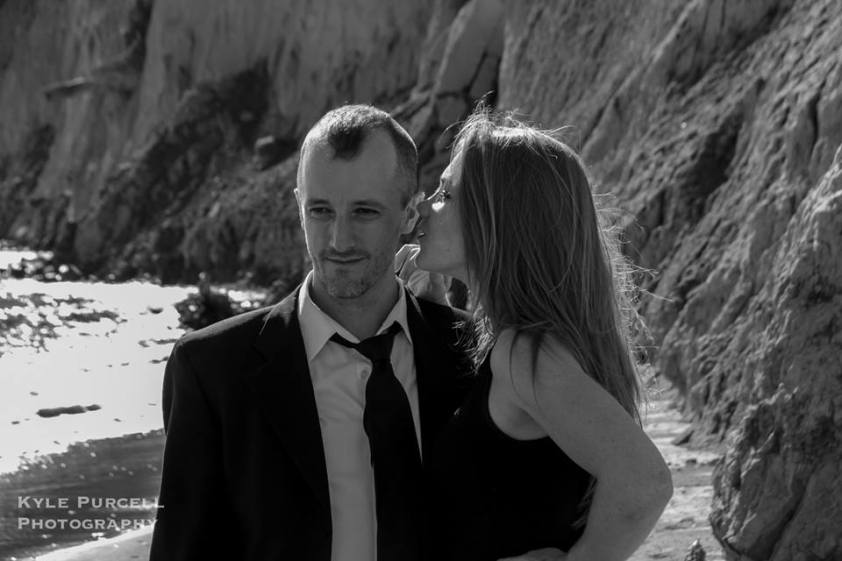
David Ross and Amelia Sargisson - Photo by Kyle Purcell

David Ross and Amelia Sargisson – Photo by Kyle Purcell

On working with Bash’d:

Amelia met Artistic Director James Wallis at Ryerson, and Amelia and David met when they were cast as the Capulets in Wallis’ staged reading of Romeo and Juliet, which was Bash’d first theatrical endeavor.

AMELIA: Beyond the first two staged readings, this is only the second full production I’ve done with Bash’d but it’s the first time James has directed me. It’s a privilege for me to work with him. His ability to illuminate the text is unmatched. The company is less practiced in doing tragedies, focusing on lighter content in the Fringe Festival. But last year they did R & J, and [Macbeth] is one of Shakespeare’s more mature tragedies. The company is continuing to grow and taking on more ambitious projects.

DAVID: Many things are different and the same. The same is James’ knowledge of Shakespeare. Before the show he has mined every source for context, meaning, double meaning, triple meaning, historical basis and he’s done that for every word of the play. What is different is I have never been a part of the rehearsal process this much. It’s my first crack at a title character. James and I have discussed things over drinks, through text and email, in moments passing each other in the hall. I have to say the process of building my character hasn’t been much different, but the journey is just a bit longer.

AMELIA: And the result will surely be different. 

Why theatre?

AMELIA: I believe in the power of a well-told story to affect people in different ways […] and to inspire them to make changes in their own lives. I love and appreciate the opportunity theatre creates for communion, to be in a room of sentient beings with a shared life and away from the solipsism of our glowing screens. The power of live theatre is very unique.


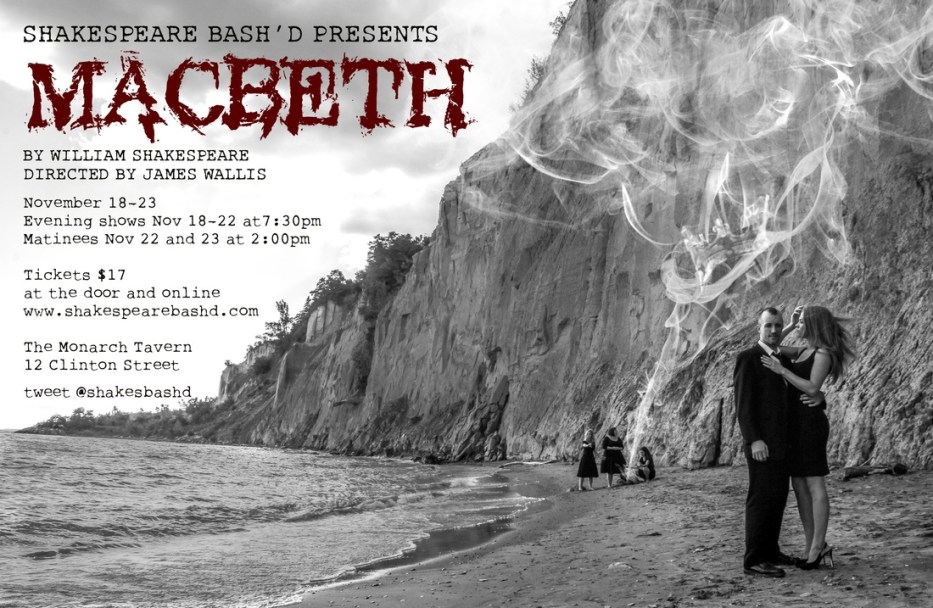
macbethcover

One week only, Macbeth runs at the Monarch Tavern (12 Clinton Street, just south of College) until Sunday November 23rd.

Tickets: $17 http://www.shakespearebashd.com/tickets.html

Follow Bash’d: @ShakesBASHd
Follow In the Greenroom writer Bailey Green: @_BaileyGreen
Follow In the Greenroom: @intheGreenRoom_