Interview by Hallie Seline
Julian R. Munds might be one of my favourite people to have a great conversation with about theatre and life. He speaks his mind, he’ll challenge me and he always makes me laugh. It was such a pleasure to chat with him about this newest play, The Good Doctor Holmes and His Children of God, about working with powerhouse Denise Norman as the challenging title role of Dr. Holmes, and on the importance of carving out a space for yourself to be the artist you want to be. Be sure to catch The Good Doctor Holmes and His Children of God on stage now only until May 21st in the Theatre Passe Muraille Backspace. All performances are Pay What You Can.
HS: How did you find this piece of history and what made you want to turn it into a play?
Julian R. Munds: I first became aware of the Pitezel case through am episode of Supernatural years ago. You know, that show that for some inexplicable reason is still on the CW. In the episode, the ghost of “America’s First Serial Killer” was haunting some building and the Winchester brothers had to stop the ghost. Anyway, the ghost was apparently the ghost of HH Holmes and I stored it in my brain. A few years later while pouring over old Toronto newspapers, I noticed that HH Holmes figured prominently in a lot of them. And I discovered that he was caught in Toronto. I then went on a search for the location. I am a very hyperactive person and need to keep myself occupied with many different projects lest I become downtrodden or bored. It is then I know I am not working on a challenge.
One of the projects was finding the original location of arrest. It was difficult to find. St. Vincent Lane, the place that Holmes was caught, has both moved and been renamed. There’s a lot of reasons for this. The government of Toronto “The Good,” for instance, feeling that the city’s reputation as a crime mecca covered in mud and runoff from the pork slaughterhouse – which it was in the early 1900s – was not a good one. They decided to do their best to cover up all the crime in the city. One thing they did was to erase St. Vincent Lane from existence. Move it two blocks from it’s original location and try to forget the horror discovered there in 1894. I had to go through tons of old maps to find it. Sat in the reference library and Toronto Archives for eons.
This rabbit hole opened up and I started to gain as many documents as possible connected with the arrest, the subsequent investigation, the personal accounts, and even a picture or two. For instance, I have a full facsimile of the notebook of Frank Geyer (the original investigator) sitting on my desk as we speak.
At the same time as I was doing this, I was also working on a sketch of a new play called “Bob, the Monster.” A play that investigates some ideas I was working on around the value of life, especially the value of a person who has been named guilty of heinous acts, and I discovered that both purposes could be combined. Eight drafts later, a one week workshop, another four drafts and BOOM: The Good Doctor Holmes & His Children of God. A Historical Fantasia, in that it is inspired by true events but I use the themes of the original event to investigate modern problems. Institutional Misogyny, Racism, Quackery, Anti-Intellectualism, and general alienation.

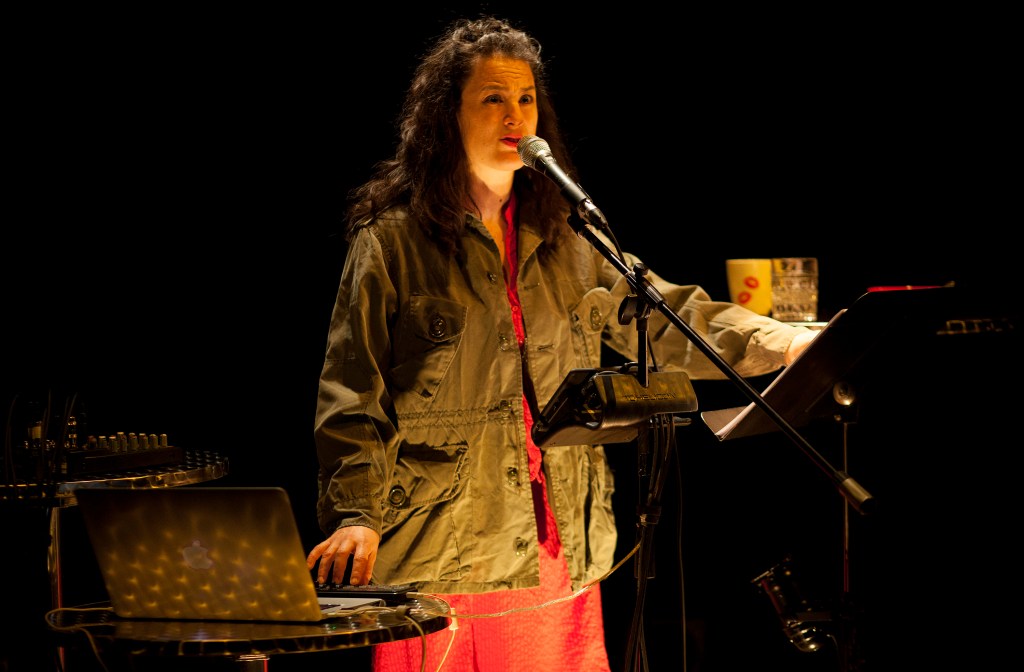
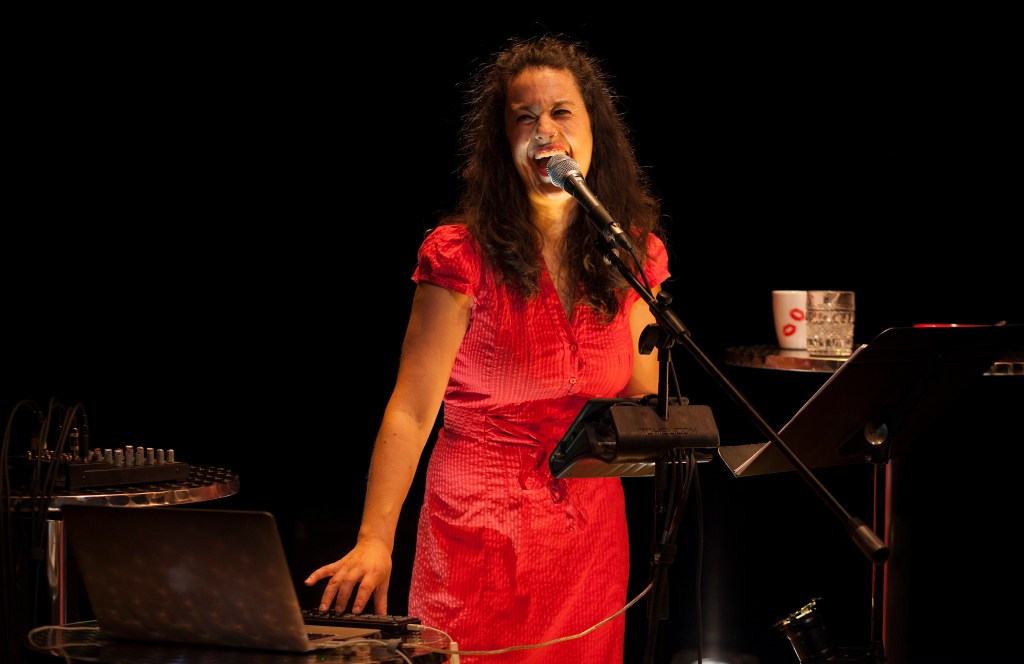
Photo of Denise Norman. Photo Credit: Sam Gaetz
HS: We can’t wait to see Denise Norman take on this challenging role. Can you tell me a bit about working with her and what you’re most excited about to see her bring to the role?
JM: Denise came to me as a fluke. In my undergrad at the University of Toronto, when I was “training” as an actor, and I’ll explain the quotes in a moment- Denise was one of my professors. She was one of the odder ones I must admit. A voice and movement teacher, her class was more about generally just fucking around. But what I remember most is the general relaxation or understanding that there is no finished product in the world. Everything is in a constant state of flux and doubly so in the world of theatre. This is
why theatre still exists. It is the only art form, aside from live music – particularly instrumental music – that can change from performance to performance. It’s why people go. They don’t go to be educated. They don’t go to be entertained. They go to experience. Theatre is about taking an environment, interaction, moment and expanding it into a full experience. Denise Norman is one of the first people that helped me realize this.
Fast forward to this past April. The original actor in the role of Holmes got sick. Dropped out. And Denise Norman applied. By far this role was made for her. There is something anchored and unexpected in the work she does on stage. She has fought hard to continue working on the stage and it is evident by her work there. Every moment she fights. And in a cast populated by fighters, John Chou, Suzanne Miller, and Jack Morton – a literal fighter – I’ve seen it – she stirs the place to create a hurricane. The designers Christine Urquhart, Lin-Mei Lay and Adrien Shepherd-Gawinski provide the lightning to her thunder. Adrien literally provides thunder. Also Virginia Cardinal – the best Stage Manager I know… I value her work so much.
HS: What drew you to become a playwright and what are you most interested in exploring in your work at the moment?
JM: Is that what I am? A playwright? I am not sure that I’m comfortable with that title. It implies that I sit at a pad of paper and pour dialogue onto a page then allow someone else to come along and bring it alive on stage. “There must be a kitchen sink here or a gun here” I’m not that guy. I’ve always thought of myself in much the same way one thinks of Zaphod Beeblebrox of Douglas Adams – “he’s just this guy, you know?” When I graduated from school I found myself launched into a world that did not want me. Tons of people are being cranked out of these institutions of higher learning now being told that they must do something this way to get a good mark. It gets beaten into brains. If you don’t fall inline then boom! You are not a human worth caring about. I came out of school broken – confused on who or what I was – ready to be taken advantage of to work in underpaid precarious work.
I had trouble reconciling myself to it. Then I decided, through the help of some faithful family, my mother, my two sisters, my wonderful nieces, and the old lady cat — who hit me a lot when I was depressed –that I needed to make a change. If the world didn’t want me – then damn it – I’ll make a corner that’s all mine. I began creating theatre that day. I don’t create plays. I tell no stories. I create experiences. Sounds. Feelings. Smells. Ideas. Don’t come to my plays expecting to learn about a subject. Read a book, see a doc, go to a lecture for that. My plays — for lack of a better word – are about being a part of something. I want you to come out of “Holmes” and feel shell shocked. Like you’ve gone through something.
That’s what I like to explore. How can I use all the tools of the theatre and art to leave an impact on the audience. The “Randoms” who walk through the door wondering what the hell did they just walk into? That’s my jam.

Photo of Denise Norman & John Chou. Photo Credit: Sam Gaetz
HS: Why did you decide to make the full run Pay What You Can?
JM: Insane. I know. But also worthy. Modern Canadian Theatre Institutions are like Janus, the two faced god. Out of one mouth moans a complaint on how no one is coming to the theatre, while in the other, is a demand to charge people more money for less satisfying shows. No one is listening to the fact that people don’t see a worth in going to the theatre. It offers them nothing. So theatre is worth nothing. Simple economics. Now, to rekindle a passion for the theatre we have to gamble. We have to start with nothing and build up a model that is more relevant. I decided, with my collective’s endorsement, to go ahead and find out what people thought the experience is worth to them. If they like it, they pay more. If they don’t have the cash, they tell a friend who pays. There is nothing but win. We have to give up old top heavy things to find that spirit again. This is my way of trying to do that. She exists! She’s just broke.
HS: Describe the show in 5-10 words:
JM: Creepy Fantastical Cloud of Sly Slickity Evil – with kickass design.
Rapid Fire Questions:
Favourite place in the city?
Outside of it. I don’t care for the city. I’m only here because this is where the art is. I love the countryside. Huron County. Anna Mae’s in Millbank. Best pie, a coffee, and they have this stuff called broasted chicken. But all right. I’ll play along. Kos patio in Kensington. I sit with the birds and eat pancakes.
Favourite play?
What a nutty question. Impossible for me to answer. I’ll give you my top five. Look Back in Anger by John Osborne, Twelve Angry Men by Reginald Rose, Who’s Afraid of Virginia Woolf by Edward Albee, The Lesson by Eugene Ionesco, One Flea Spare by Naomi Wallace.
If you could go for a beer and a chat with any playwright (alive or dead) who would it be and what beer would you order?
I don’t think I’d like to personally meet any of my favorite playwrights. I like to know them through their work. If I met them I would see them for what they are. Meat sacks with problems. I’d have trouble after that. I wouldn’t mind having an Absinthe with Antonin Artaud though. Imagine the nuttiness. I’d invite David Mamet to a drink, tell him to stop writing, and basically how he’s ruined a generation of male actors by telling them it’s ok for a male to yell obscenities at a woman for two hours and call it art. There is nothing more upsetting and vomit worthy in my mind than David Mamet.
Where do you look for inspiration?
I don’t look for it. I stumble on it. I read around 10 books a week. Listen to countless podcasts. Go for long walks. And talk to people all around my life. You find inspiration in the weirdest place. One of my plays was created after I could not stop a fire alarm from going off. Another, was created because I once saw a woman with a cell phone shut a door in the face of a downtrodden fellow smoking an unlit cigarette.
Best advice you’ve ever gotten or mantra you are currently living by?
“It doesn’t matter if you are the smartest guy in the room. The most good looking guy in the room. Be the last guy in the room.” – Michael Caine
“Life is meaningless but that doesn’t mean you can’t enjoy a good Yorkshire pudding.” – Peter O’Toole
“Nothing is written. All things can be changed..” – Thomas Edward Lawrence
“Quantity not quality” – anon
“If you can lose your backup job, may as well do the thing that makes you fulfilled.” – Jim Carrey
The Good Doctor Holmes and His Children of God

Who:
Playwright: Julian R. Munds
Dr. Henry Howard Holmes – Denise Norman
Benji/Carrie Pitezel – Suzanne Miller
Frank Geyer – John Chou Guard,
The Shadow – Jack Morton
Direction: J.R. Priestley
Scenography: Christine Urquhart
Sound and Composition: Adrian Shepherd-Gawinski
Designers: Lin-Mai Lay, Julie Skene
Stage Management: Virginia Cardinal
What:
In 1894 the bodies of two little girls were discovered in a Toronto basement by an eccentric, mild mannered, private detective. This was the beginning of a nightmare.
Julian R. Munds’ new play puts us in touch with one of the most prolific serial killers in history: Dr. Henry Howard Holmes. Holmes — a doctor, pharmacist, sometimes cannibal — constructed a hotel in Chicago for a singular purpose: to destroy human life. Charged in the deaths of nine individuals, Dr. H. H. Holmes is thought to be connected with more than two hundred disappearances during the Chicago World’s Fair of 1893.
In “The Good Doctor Holmes..”, Munds takes us into the interrogation room, puts HH at the forefront, in all his genius and all his horror, and weaves a labyrinthine fantasia that is sometimes an episode of Columbo and sometimes a tale by H.P. Lovecraft.
“We are asked to look into the eyes of a devil but what is found there is not what we expected. “ – Chris Tester, The Actor’s Podcast
With aid from the Quantico Behavioral Archive, personal journals of Carrie Pitezel, and using a modern perspective, this show drags the forgotten “Pitezel Children Case” from the shadows of the past and makes us question whether Toronto is truly “The Good.”
Where:
Theatre Passe Muraille Backspace
16 Ryerson Ave. Toronto
When:
May 11-21, 2017
Tickets:
By Phone: 416-504-7529
Online: artsboxoffice.ca








 inthegreenroom