Skip to content

Posts tagged ‘Shaina Silver-Baird’

Fringe Preview: “Ups. Downs. Keyboard. Dance. Millennials.” And more of what to expect in REGICIDE, a sketch comedy show at the 2015 TO Fringe

Interview by Shaina Silver-Baird

SSB: Can you tell us what “Regicide” means and how it affects this piece? 

Christian Smith: Yeah! Technically It means “Killing a King”. We aren’t trying to say anything by the name apart from we really loved when the Simpsons referenced it and we all thought it was a fun name. Naming a sketch comedy troupe is hard and silly. The concept of “Regicide” influenced the poster design and thus influenced some of the scenes we’ve created. We had a great designer to work with, Raul Delgado, and he created the poster. We took some of those themes and incorporated them into the show.

SSB: Regicide is not your standard play. What was the process for creating this show? 

CS: Well, writing sketch comedy can be hard because there are so many ways to create it. Everyone in the group came from a different background and have had different experiences, so we kind of all started writing on our own to begin with. I prefer to collaborate, but in this particular process I had to focus much more on my writing and it actually helped me get to the core of the idea quicker. As you know, Fringe approaches quickly once you hear you’ve gotten a lottery spot! There are also enormous benefits to pitching the idea in a room before that and to having the other creators brainstorm on it. In this case, we all had to shift the way we work and it was exciting.

It was a great learning experience as it is our first revue as the group “Regicide“. We brought in Kerry Griffin (current Second City mainstage director) to direct the show after we had a ton of material to show him and then he shaped it.

SSB: What’s it like working with Kerry Griffin? 

CS: Kerry is a great director and great guy. He doesn’t come in with any pre-conceived notions of the show or what he wants to see from the group. He reads the room, sees where our strengths lie and goes from there. He really allowed us to find our voices and then you can see him start to put a show together. He has great instincts and such an amazing sense of humour.

SSB: There are sooo many plays in the Fringe. What sets Regicide apart? 

CS: There are going to be so many good shows! Everyone has their preference in types of comedy and what they look for in a theatrical experience. If you’re looking for topical, creative, fun and (on occasion) thought provoking; then see our show. Personally, I like to use sketch comedy as a way to hold a mirror up to society and speak about concepts or topics that move/interest me. Sometimes we need to have a discourse about some things through the guise of a comedy show for us to know it’s okay to laugh about something. Or at the very least, have us start asking questions. I hope that makes sense. Sometimes comedy can tug at your heartstrings or punch you in the gut! That’s the kind of thing I’m interested in!

SSB: How was the team assembled? Did you know each other beforehand? 

CS: We all met in the Second City Conservatory program and here we are. We had some great people work with us. They run a great establishment there at the Second City.

SSB: Describe the show in 5 words.

CS: Ups. Downs. Keyboard. Dance. Millennials.

SSB: Who’s the one person you’d want to see this show? (Could be anyone alive, dead…)

CS: Well… since you said “could be anyone alive, dead….”, the ellipses made me think that I have to pick Tupac. No one knows either way if he’s alive or dead. I’d like the rumours to stop with us, here, at the Regicide show. He is now obligated to come see the show, one way or another. Gotcha Tupac!


regicide poster


Where: Helen Gardiner Phelan Playhouse, 79 St. George St., Toronto, Ontario

When:

July 01 at 08:15 PM
July 04 at 07:30 PM
July 06 at 05:00 PM
July 07 at 03:00 PM
July 09 at 12:15 PM
July 10 at 09:15 PM
July 11 at 03:30 PM

Connect with them:

Christian Smith – Writer/Performer    @ChristianVSmith

Sam Roulston – Writer/Performer      @SamWRoulston

Emma Davey – Writer/Performer       @TheEmmaJames

Gina Phillips – Writer/Performer         @GinaPhillips

Carson Gale – Writer/Performer         @Carson_Gale

Pete DeCourcy – Writer/Performer     @PeteDeCourcy

Kerry Griffin – Director                        @Kerry_Griffin

Nicola Dempsey – Musical Director

Georgia Brown – Stage Manager

Raul Delgado – Poster Design

Connect with us:

Shaina Silver-Baird – Writer             @SSilverBaird

In the Greenroom                            @intheGreenRoom_

Tickets:

http://fringetoronto.com/fringe-festival/shows/regicide/


In Conversation: Magic, Music, Mimmo & Mona: Theatre Rhea’s OREGANO

Interview by Shaina Silver-Baird

In Conversation with:
Rose Napoli (playwright/ “Mona”)
Matthew Thomas Walker (director)
Diane D’Aquila (“La Strega Nera”)
Richard Greenblatt (“Mimmo”)
Beau Dixon (composer/sound designer)
of Theatre Rhea‘s OREGANO by Rose Napoli.

Shaina: How would you describe Oregano? What’s the show about?

Diane: There are moments in your life that define you. Often death is one of them. And this play is what grows out of that. For every death there’s a birth – it can be metaphoric. But I think when those moments happen, you not only have to face them, but you learn something about yourself. You learn to accept who you are. The play is about all that, in the format of a fairytale.

Rose: In the face of death, one finds their voice. We take that literally in this play, because we talk a lot about the power of the voice. Mimmo is the little boy with a special voice, and Mona is a young woman who wants to be a writer. So it’s very much about the importance of your own voice in connection to the people that shape you.

Shaina: What was your inspiration for writing the play, Rose? 

Rose: The last time I ever saw my dad was 12 years ago. It was his birthday. It was late and it was after an opening of a show. And he stayed up and waited for me and we had a very strange conversation. We were sentimental in a way that we weren’t usually. And in a way, a lot of the things he was saying to me (I didn’t know it at the time), were veiled preparations for me to live without him. I remember we said we loved each other, which we also didn’t do often. I went to bed and I thought: I’m never going to see him again. And he died shortly after that.

I think it was because of that moment, even though the realization came later on, that I started to believe in magic. And I started to believe that there are things that are bigger than us. And family is one of them. So, with Oregano I was writing my dad’s life and his death from my imagination. It’s not autobiographical in the sense that it’s not my exact relationship with him and it’s not the exact way he died. But this is the way I imagined it to be.

Shaina: Matt, you often work in a site-specific format. How are you finding the experience of creating for the Storefront, which is more of a classic black box? 

Matt: It’s definitely different and site-specific is something I’m going to have to branch away from any time I’m working in a space where I can’t control all of the factors. So I’ve been getting advice in terms of how other directors work in this situation. We hired a great set designer – Jenna McCutchen – she offered a world and I started using that. I refer back to her designs, the space she’s created, constantly and that offers information much the way a site-specific venue would. I use that for inspiration. Even though we don’t have all the time in the space that I would like, it’s our constraint and it guides the show. We’re using it expressively, much the way I like to do working in site-specific venues. It’s just a different way of working, but the space is still at the forefront of my mind all the time.

Rose: We’re also using it in a very different way than I’ve seen this space used before.

Matt: That’s something we all decided was very important to us from the get-go. We wanted to see this space used differently than audiences are accustomed to at The Storefront. We wanted to try to change people’s experience when they arrive at this venue.

And I think we are on track to do so. I think it’ll be magical.

IMG_20150306_105312

In Rehearsal – Rose Napoli & Richard Greenblatt

Shaina: Diane and Richard, I know you’ve worked across the country, across the continent, in huge theatres. What continues to attract you to indie productions?

Richard: The script. I’m interested in working on stories, on characters, on scripts – either as a director, or as an actor – that interest me. I also love working on new work and working with younger people who’re coming up. I do a fair amount of it, like Late Company, which we did a few years ago and are remounting this year. So you choose the project mostly based on the script; secondarily on who else is involved and certainly not for the money. If a project is interesting, and the people are too, then you go for it. I mean I didn’t know Rose, I didn’t know Matthew…

Shaina: But they’re pretty awesome.

Richard: Really?! And Diane I’ve known forever, but we’ve never worked together.

Diane: I have worked a lot of my life in big, huge, honking theatres where a lot of time’s wasted and a lot of egos get in the way. For me it’s returning to my roots. I started with The Free Theatre and Tarragon – they WERE the indie theatres in the 70s and late 60s. The Free Theatre had a dirt floor – it was FREE when I played there. So for me, it isn’t about the money, it’s about getting back to basics, it’s about working with people that I have respect for, that I want to work with, that I haven’t had the chance to yet. It’s about the challenge. And this is more challenging than some of the other stuff I get often in the big box theatres.

Shaina: What has been the biggest challenge?

Matt: The collaboration has been lovely. We have actors who have worked all across our country in these big theatres and I love that they’re coming back to work with us in indie theatre. It’s really refreshing and it’s really invigorating. So that hasn’t been a challenge.

With independent projects, it’s always scheduling. That’s always a challenge because everyone’s always doing so much. But for some reason, when you set that as the challenge that needs to be faced from the get-go, it just makes it easier. You embrace it and you approach that creatively with a good spirit and everyone has to invest fully when they’re here. That’s absolutely been the case.

IMG_20150306_103242

In Rehearsal – Diane D’Aquila & Richard Greenblatt

Shaina: Beau, what attracted you to the project? What’s the experience been like for you adapting this story to music?

Beau: To echo what Richard said, it’s first and foremost about the story. The most difficult thing, but it’s also the most enjoyable and challenging, is using sounds to make sure that the audience is in the world of the fairytale. I really have to marry the sounds with the text. That’s one of the magical things about theatre: using sounds, the different frequencies, the pushing of air (as I like to call it), to create a world. When you have accomplished actors, and a story that really speaks for itself, you don’t want the music to get in the way. So there’s a real push and pull that’s happening between the sound and the text. And once you get that tension and release with the sound, and once the audience is engaged and thrown into that world, it IS magical.

But the real struggle is making it believable – making the audience feel that they too are using their creative brains and are immersed in that world without feeling forced into it.

Shaina: What was the initial inspiration to make the play so musical? 

Rose: In the play, Mona, the main character, has the chance to meet her father as a young boy – a young boy who Richard plays. He plays himself from 8 years old all the way to his 50s – his whole life really. This boy has a very special ability with his voice. When he sings, he can relax the people who listen to his music so deeply, that they reveal their deepest fears.

There was always meant to be a component that brought us back in time – there are many memories in the play. The music is the thing that brings us to the different time periods in the play.

And then that concept went to the next level having Beau on board, a composer who is so versed in MADE scores. You can see his set up down there – he is making music with the strangest things! So why not take it a step further, to embrace the magic of this play and have the sounds (the rain, the thunder, all of the soundscape in the show) happen live rather than through a soundboard.

IMG_20150306_103402

In Rehearsal – Rose Napoli & Diane D’Aquila


Richard: Doing that also enhances the magic of the theatre itself. And the reason theatre is magic is because it IS imagination. And what the play is about, in a lot of ways, is the imagination, and how you can create your life as you imagine it, to a certain degree. You can certainly deal with things in your life through the way you imagine them.

If you want to make magic in the theatre, you do it by showing what’s up the sleeve. You don’t try to hide it, because we can’t do it that well in the theatre. You can do that on film, you have CGI, but we don’t. So you can make magic by saying: “imagine this is the planet earth in my hand,” and then you smash it. And everyone goes along with it because the theatre is essentially naïve. To see Beau create a storm sequence by using a tarp and a weird can with a string attached to it, is far more magical than the most realistic sound you can tape and play back over a sound system.

Diane: And you know, you get these huge budgets at these big theatres and all of a sudden it goes into another medium. To be able to use your imagination with nothing is more efficient. It’s better story telling, than when you keep throwing money at a play. Because eventually the audience thinks: “What a small battalion! They brought 50 people onstage and I don’t believe it.” But with two or three people making a lot of noise with a good folio I go: “Well there’s an army!”

There isn’t enough money in theatre to achieve what the imagination can. 

Shaina: If you could have anyone in the audience to see this show, who would it be?

Rose: My dad.

OREGANO

by Rose Napoli, presented by Theatre Rhea at The Storefront Theatre

Oregano2 copy

On stage at The Storefront Theatre

Previews – Wed. March 11 – Thurs. March 12

Opens Friday March 13 – Sunday March 22

Tickets: theatrerhea.ca/tickets

In Conversation: “Melancholy Play” by Sarah Ruhl

A two-part interview by Shaina Silver-Baird

THE QUICK AND DIRTY: The Empty Room’s Melancholy Play (by Sarah Ruhl)

Rose Napoli

rosenapoli

Character: Francis.

Play in 5 words: Quirky, thoughtful, funny, sad, musical.

What is melancholy?: It’s a longing for something.

What makes you melancholy?: Oh god. What doesn’t? I’m a sap so: commercials, books, my friends, my lovers, pretty much everything.

What makes your character melancholy?: Francis is going through a depression in the play. She wants fulfillment in her life and she’s not finding it with her partner or with her lover or with her job.

What’s one reason people should come see this play?: Completely different than anything I’ve been a part of before. It challenges the idea of theatre as I know it.

Patric Masurkevitch

Patric

Character: Lorenzo.

Play in 5 words or less: Truly, madly, deeply.

What is melancholy?: A sadness of the soul.

What makes you melancholy?: The fact that my children are growing up.

What makes your character melancholy?: Love.

What is the best part of this process so far?: The company. I’m having a blast working with everybody. First of all, it’s a very collaborative process, and everybody has very strong ideas of what they want, but that doesn’t mean that they’re not willing to adjust and play with other people.

What’s one reason people should come see this play: Eva.

Karyn McCallum

Karyn

Role: Set and costume designer.

Play in 5 words or less: The poetic discourse on depression.

What is melancholy?: A pensive condition. It is when one isn’t projecting enthusiasm. I don’t personally equate it with sadness, I think of it as pensiveness. One might appear melancholy when retreating inwards.

What makes you melancholy?: I’m a very cheerful person. Things make me mad but they don’t make me melancholy so much… I suppose loss. I’ve experienced loss, in fact this year, the loss of a family member. I think loss of choices – a sadness about opportunities that have passed that can never be regained.

What makes the characters in this play melancholy?: Loss.

What the best part of this process so far?: In terms of approaching it as a designer, the non-linearity of the text is very freeing because it allows me to not make a literal space, because it doesn’t describe literal circumstances. It is a very freeing thing in terms of design.

What’s one reason people should come see this play?: It does offer different perspectives on melancholy and on compassion.

THE IN DEPTH DISCUSSION: with director Jeff Pufahl and lead actress Eva Barrie (Tilly)


Shaina: Why this specific play?

Eva: Jeff and I were looking for something to work on together, since 2013. We were bouncing back and forth between a couple ideas, never anything that was really sticking. And then I heard a snippet of text from this play in an open Viewpoints session, and I went to the reference library and I just started reading it, and midway through reading it I texted Jeff and said “What do you think of this?”

Jeff: I did my thesis on Sarah Ruhl in my MFA, and the second play I directed after that was Dead Man’s Cell Phone, which is another one of her plays. So Eva said: “Sarah Ruhl’s Melancholy Play”, and it was a natural fit because I have some experience in that area and I love this text. I read all her plays when I was doing my Masters and had noted this was a really fun and interesting puzzle to work on. This play is so much like a puzzle.

Shaina: How would you describe the play in 5 words or less?

Eva: Red, yellow, blue… (She laughs)… quirky, curiosity inciting

Jeff: Exploring sadness & love through the lens of poetry.

Shaina: I’ll accept it.

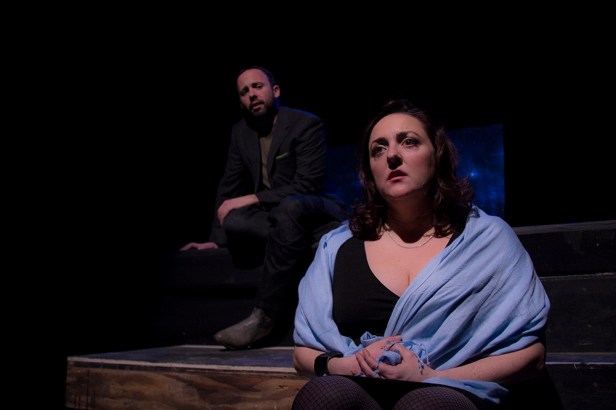
melancholy_jpgs-048

Photo Credit: Leah Good


Shaina: I know you guys met at the SITI company. Has that informed the way in which you’ve been working with this play?

Jeff: Yes. I think my experience with Viewpoints, has informed my whole way of looking at theatre. Especially as far as looking at theatrical elements as building blocks: time and space and architecture and text and character being all pieces of a puzzle that you can move around horizontally as opposed to stacking up vertically.

Shaina: Does that change the relationship of players and audience in any way?

Jeff: I’m not sure, because an audience’s experience and perception of a play is unique to their experience. So it’s difficult to say what the outcome will be.

Eva: I think this play specifically is so hard in that way because it is so reliant on audience involvement. I mean most are, but in this one specifically, I play to the audience a lot. They are partners.

Jeff: They’re really part of the conversation.

Shaina: So is the audience close enough that you can see them?

Jeff: Yes.

Shaina: That has to change things for you, Eva.

Eva: Yeah. Sarah’s also very specific. She writes: “Don’t talk at them, talk to them.” One thing that Jeff said on day 2 from her book is that “there’s no pillars.” An actor is worried and scared and in Sarah Ruhl’s plays there are no pillars, nothing to hide behind. And she meant set, but it’s just you up there. You cannot fake this language and you cannot fake the way we’re doing it either.

melancholy_jpgs-093

Photo Credit: Leah Good


Shaina: What has been the best part of the process so far?

Jeff: These past couple of days when we’re starting to see how the play begins to live and breath as its own entity, to put it together piece by piece. Right now we’ve worked on all of the pieces, so for me, starting to see it coming together is very exciting, from a directing standpoint.

Eva: For me, what is most funny about this whole process is I had this instinctual urge to do this play, but I couldn’t name why. And it was never a play that I could say “this is the way this should be performed”, which is why I like it. But during the first couple days of being thrown in it, I thought: I understand now why this play resonates so strongly with me, on so many levels. It was amazing to un-peel that and examine how I work with this kind of topic. Discovering how our humanity is in this play. Confronting my own humanity within this play. It’s made me weep A LOT.

Shaina: What does Melancholy mean to you?

Jeff: Melancholia, melancholy is a sadness. It’s a kind of longing. It can be thought of as: you’re missing something, a person who’s no longer there. Or the melancholy we experience when we realize that our youth has passed us by or is passing us – that we may experience a certain sadness just understanding where you are in life. The beauty that we witness in an experience and then the sadness when we realize that it’s going to end, can be thought of as various forms of melancholy.

melancholy_jpgs-046

Photo Credit: Leah Good


Shaina: So what makes you melancholy? And what makes your character melancholy?

Eva: One thing that makes me very melancholy is nostalgia. Just looking back in time. And I think that makes Tilly very sad too, but in a big way. She’s nostalgic for times she’s not experienced. For example, she is nostalgic for King Arthur and she carries that with her.

Shaina: It’s like humanity’s nostalgia.

Eva: These are the moments that are fleeting and passing and it’s overwhelming.

Shaina: Almonds play a huge part in this production. What do they mean?

Jeff: Well, yes the symbolism of the almond is threaded throughout the play. Sarah Ruhl likens it to the amygdala, which is the organ in the brain which is our emotional centre. It’s also a symbol of the mandorla – two circles overlapping, an intersection – which is the shape of an almond. And religious figures are often portrayed in that symbol, so it symbolizes figures in transformation or transfiguration – between two worlds. For the character Francis, her journey in this play is very clear. She transforms. And so the symbolism of the almond is key.

Melancholy Play

presented by The Empty Room

melancholy play

When: January 29th to February 8th 2015
Thursday – Sunday, 8pm
Where: The Collective Space, 
221 Sterling Road, Unit #5, Toronto
Tickets: www.eventbrite.ca/o/the-empty-room-47276585

Loss, Comedy and the Quaids: In Conversation with Amanda Barker & Daniel Krolik – Next Stage Theatre Festival’s Release the Stars: The Ballad of Randy and Evi Quaid

Interview by Shaina Silver-Baird

I had the pleasure of interviewing Daniel Krolik and Amanda Barker to discuss the upcoming run of their show “Release the Stars: The Ballad of Randy and Evi Quaid” appearing as part of the Next Stage Theatre Festival. Here they talk all things Quaid; the essentials for living on the run and creative inspiration. 

SSB: How do you think the piece has changed since your first, exceptionally successful run? 

Daniel Krolik: The thing I realized in rehearsals last week was that, more so than the numerous rewrites that we’ve made, the basic energy of the piece is what’s changed the most. In 2012, we were performing in an art gallery. No set, no lights, just us and our audience. We asked them a lot of questions directly and were basically in their laps for the show. Now it’s Amanda and me on a stage with all the trappings of a theatre piece. Even though much of our text is the same, the energy is more polished, more focused, more precise. It’s still as funny and sad and dangerous as it was at Fringe… just completely different at the same time.

Amanda Barker: It has grown in so many ways. There are undercurrented characters that run throughout the piece – they were always there, but we took the time to develop them and really examine who they were and what their journey was.  We make an appearance as ourselves as well, and we examine what it was like to meet the real Randy and Evi Quaid.

SSB: What inspired you to write this piece about the Quaids? 

DK: Amanda and I had both read the Vanity Fair article about Randy and Evi in 2010. We were trying to write something together, and we started experimenting with the idea of playing the Quaids. For me, the inspiration was twofold. First, Randy is a really good actor and has worked with most of the greats from the 1970s and 1980s. He was very close to a real comeback after his work in Brokeback Mountain, which got derailed with the events we cover in our show. I became intrigued with how this man, an established talent, was deprived (or deprived himself) of an artistic renaissance, and how devastating that would be for him. Then it was the Quaid’s experience with loss. Randy and Evi had lost a number of close friends in Hollywood – like Heath Ledger, Chris Penn, and David Carradine. How do you cope when the people in your life keep dying? How do you justify or process that? Beyond the outrageousness and the crazy Hollywood life, Randy and Evi’s story is about two people trying to stay connected in the face of terrible loss.

AB: Anyone who has heard even small pieces of their journey is fascinated. For me, it was a Vanity Fair article by Nancy Jo Sales (who also wrote the original Bling Ring article) that had me hooked. I think Daniel’s was with Esquire. He actually texted me from Montreal one night asking me what I thought about a show about the Quaids and I was like – YES! Let’s do this. For me, I was always interested in Evi. She was always labled as his crazy bitch wife and I wanted to know everything I could about her. Why did everyone think she was to blame? That’s something I wanted to examine. I wanted to know who she was. She’s a strong woman and an unabashed artist.

RELEASE-THE-STARS_DANIEL-KROLIK-AND-AMANDA-BARKER_PHOTO-BY-MARCO-TIMPANO

Release the Stars: The Ballad of Randy and Evi Quaid – Daniel Krolik and Amanda Barker. Photo by Marco Timpano

SSB: What was it like having the real life Quaids in the audience for your final performance in the Fringe? Did it change the show at all for you? 

DK: It was terrifying, because we didn’t know how they would respond to the show. We worked very hard to tell their story as objectively as possible, but we had no idea how they would react. Early on that night, I delivered a line of dialogue right to Randy, and he laughed. I relaxed and knew it would be ok from then on in. Amanda and I only had each other to rely on, and it’s probably the most exhilarated and connected I’ve ever felt in a show.

AB: It was insane….magical…..electric….terrifying. Daniel and I couldn’t talk once we were individually told before the show. That moment when our eyes met on stage will always be one of the single greatest moments that I will ever feel as a performer. We communicated everything in that moment – we both knew what we knew, and we both knew we were there to support each other, no matter the outcome. There may have been slight nuances that were different but for us in that performance but the show was always about their life through a media lense and so we made a safe structure knowing that they were there – we aren’t up on stage poking fun at the “Crazy Quaids”.  We never wanted the show to be that. That would have been easy and maybe funny but ultimately uninteresting for us as creators.

SSB: What was your process for creating this particular piece? 

DK: About two years of trial and error. Between our work with Jack Grinhaus, our director, and Megan Mooney, our dramaturg, scenes were reshaped, rewritten, added, taken out, cried over, put back in, ripped apart and put back together again. It’s been an extremely complicated and infinitely rewarding process.

AB: I have an English degree in addition to Theatre and have lots of experience in TV format as well but in the last decade I have also written a fair bit of sketch comedy and I think the sketch process is an easy format to get ideas and scenes generating. Being part of that world encouraged me to take risks as a writer and it taught me to generate material and to get out of self-editing. Daniel and I originally were just trying to motivate each other creatively so we challenged each other to write personal or character essays in various coffee shops in the annex.  Once possible ideas for a show started percolating, we wrote with Randy and Evi in mind as well as a shared grief experience that really affected both Daniel and me. Then it kind of followed a sketch format for a while. After about a year, what we had were a series of personal essays and sketches. We brought it to Jack Grinhaus who said – ‘yeah, I’ll play with you, but get a dramaturg!’  So we did, Megan Mooney. Both Jack and Megan have guided this piece in ways we couldn’t possibly imagine. I have so much gratitude for both of them.

IMG_6100

SSB: What are the 5 things you’d have to take with you if you were on the run like the Quaids? 

DK: A good book. An ipod with my entire music library. Cheese and crackers. My favourite orange hoodie. And a damn good bourbon.

AB:

  1. paraben free lip balm

  2. My ipad Mini with Netflix on it and tons of open disk space!

  3. All of my points cards. I am religious about them.

  4. A bathtub. I can’t live without one.

  5. Several bags of Smartfood popcorn

SSB: Are you afraid the Hollywood Star Whackers might accidentally come after you instead?! 

DK: I’d be honoured and humbled if the Star Whackers made the effort to track us down at Next Stage. I’d be thrilled. Who are the indie Toronto theatre Star Whackers? Names. I want names.

AB: Shit….now I am. I’ll take a career that people would love to kill me for, thank you very much.  I’ll take some residual cheques so big people want to murder me for them. These are the problems I want. Sign me up.

SSB: What inspires you as artists? 

DK: A billion things. Mostly it’s the amazing work of others. Right now, I’m in love with the late, lamented HBO series Enlightened, David Rakoff’s gorgeous final book “Love, Dishonor, Marry, Die, Cherish, Perish”, the insane and beautiful nightmare of a film Holy Motors, the food at the Whippoorwill Restaurant at Bloor and Landsdowne, and the How Was Your Week and Ronna and Beverly podcasts. And I’m giddy with anticipation at seeing all the amazing work by everyone at Next Stage.

AB: You know what inspires me? Doing shows where an interviewer asks me these kind of questions! I think I’ve done 60 interviews in the past year and most of them were about dildos (I was touring a parody of the 50 Shades of Grey Series). This is such an amazing change.

So, that said… My freedom inspires me, it always has. I love jumping into improv sets whenever I can, the freedom of it, the support of an ensemble – that is always inspiring to me. Shortly after the first Release the Stars ended, I went to Mexico City for work and had a day off. I went to Frida Kahlo’s house, the Casa Azul. I have never been so inspired as I was that day, standing in her studio. She had to create, there was no other option. It was not a question for her. Her energy still radiates from those walls and a world of colour poured from her. You feel it. I felt much the same a year ago – I was in Chicago and I came upon an exhibition of Vivan Maier. She was a nanny who took hundreds of photos her entire life. She took them because she had to, she loved to.  And they are haunting, some of the most articulate photos you’ll ever see. They were only found because she defaulted payment on her storage facility, she never did anything with them. It comes from a different place, that creative spirit that flies out of you in inspiration. Like a bird that wants to be set free and it is just up to you not to stand in its way – let it go, give it away. The female artists who fight to create inspire me, I suppose – I think that’s why I am so intrigued by Evi Quaid. I am most inspired when I am in a community of story tellers who fight to create – Next Stage is a thrill beyond thrill for me because that’s what all of us are and I can’t wait to experience the beautiful work that will surround us at the festival. It is beyond inspiring.

Release the Stars: The Ballad of Randy and Evi Quaid

1058936

Written and Performed by: Amanda Barker & Daniel Krolik
Directed by: Jack Grinhaus

Where: Factory Studio Theatre – 60 minutes

What: Comedy/Drama

WARNINGS: Adult themes

TicketsClick here

When:
Wed Jan 8, 9:00pm
Fri Jan 10, 5:15pm
Sat Jan 11, 7.30pm
Sun Jan 12, 9:30pm
Tue Jan 14, 9:00pm
Wed Jan 15, 6:45pm
Fri Jan 17, 7:15pm
Sat Jan 18, 2:45pm
Sun Jan 19 5:15pm

Watch their NSTF Teaser here:

In Conversation with Graeme McComb of George F. Walker’s Moss Park

Interview by Shaina Silver-Baird

The old record player whirring in the corner, surrounded by artists, students and west enders, Graeme McComb, of George F. Walker’s new play Moss Park at Theatre Passe Muraille/Green Thumb Theatre, and I were barely able to grab a seat when we met for our interview at Saving Gigi. He’s working in Toronto for the first time, hailing from the west coast, but I have a feeling this isn’t the last time we see him.

SSB: So how was opening night?

GMC: It was great. It was actually the premiere of the play, here in Toronto. The energy in the building was really good. Full house.

SSB: How are you finding being in Toronto for the first time? 

GMC: It’s great. The arts are very rich here. It’s really cool to come into a artistic community that feels so alive. In Vancouver it’s a little less so. The funding from the provincial government is not as high as in Ontario so there isn’t the same amount of work going on.

There are just way more theatres here than in Vancouver – more companies functioning. Even The Vancouver Playhouse – a big regional theatre – had to close a couple years ago. It’s really sad. So for me, if I wanted to be a consistently working actor, I’d have to move here.

SSB: How did you get involved with this show in particular? 

GMC: I did a show earlier in the year that Patrick McDonald cast me in called Cranked. It toured around BC, California and Tennessee – we went to Nashville. During the end of the run, he knew he was directing this play and he asked me to audition for it. And I went to the audition, and was lucky enough to get it.

SSB: So you already had a relationship with the director? What was it like working with him?

GMC: Yeah. Really good relationship. He’s a great guy. I wish he could direct me in every play that I’m in. The way that he has fun and makes us feel comfortable… his incite is very unique. And I really feel like I work well with him. We have similar styles in approaching the work. I like to have fun, but I like to get down to work. We kinda speak the same language.

563088_633857276657422_1380744818_n

SSB: Something I find so interesting about Green Thumb, is that they do youth theatre, but it’s not just for youth. It’s stories for everyone about youth. Can you speak to that? 

GMC: The show I did with them before this (Cranked) was for high school students. It had mature themes: it was about crystal meth and drug addiction. We have a Q and A after the show, so the students had the opportunity to ask me any question they wanted to. But sometimes I’d find the teachers asking a lot of questions and being very affected by it as well. The show’s created for the kids, to help them understand that these issues happen, but it’s a message for everybody about addiction and a journey through addiction. Even (Green Thumb‘s) elementary school tours are so well written and so well directed and produced, that they tour to theatres and the teachers get into them as well. I’ve seen a lot of them and watching that as an adult they’re still really moving and effective. But as a little kid… wow… they get totally into it.

SSB: It sounds like it has something to do with not talking down to kids. 

GMC: When I did Cranked, sometimes we’d do a show for 900 or 1,100 kids. And it was a one-man show – it was just me. So I’d be standing behind this backdrop and I could hear them just talking and talking. And I got the feeling that they were thinking: oh it’s just another drug play or just another drug message. But then the lights went down and I’d come on with just a microphone and I’d start beat boxing into the microphone…

SSB: You beat box?! 

GMC: You could just tell they were thinking: “What’s going on?!” And then I’d go into a monologue about old zombie movies and new zombie movies, comparing the two of them. And they’re expressions were like: “What the hell?!” And then I just go into a rap song. And by the first two, three minutes, they were into it.

SSB: So you rap too?

GMC: Well I’m not a rapper… but for the show I was. Green Thumb commissioned a rapper named Kyprios from Vancouver to write the songs specifically for the show. And they hired a DJ named DJ Stylust to make all the beats. So we got to incorporate all these original songs made for the show.

This character Stan, it’s just his personal journey. And the character is 17, it’s not an older person talking to them. It’s this young guy, going through rehab, going through addiction, stealing stuff from his family… And they really connect with it.

1422550_634279983281818_431582019_n

SSB: Your character in Moss Park, which is the show you’re doing right now, is also a young man dealing with some tough issues. Can you tell us what is that play about? 

GMC: George F. Walker who wrote the play, wrote a play in 1994 called Tough! and it’s based on three characters: Jill, Bobby and Tina. Bobby and Tina are together but they come from poverty and they have a rough upbringing. The play starts off with Tina accusing Bobby of cheating on her – he’s just a young guy, he doesn’t really know how to grow up. Then you find out Tina’s pregnant. This play is a sequel to it. It’s set three years later. They’ve had a little girl, Holly: she’s not onstage. It’s just Bobby and Tina this time. Jill’s offstage taking care of Holly. They’re trying to figure they’re life out because you find out that Tina’s pregnant again. She basically says to Bobby: “I have to have an abortion, because you can’t take care of a child and we have no money.” On top of that, my mom and I are getting evicted. It’s life or death the whole time, that’s how high the stakes are. For sixty minutes straight, it’s just Bobby and Tina trying to work through it, and fight for their relationship and their baby.

SSB: Moss Park is at Theatre Passe Muraille, which is not a youth theatre, it’s a general theatre open to the public. So unlike Cranked, which you brought straight into schools, it’s taking the youth story and putting it on for everyone: youth AND adults. Do you think that’s important? How does it compare to your experience with Cranked? 

GMC: Our opening audience, it was an older crowd. And Tina talks a lot about poverty, about coming from poverty. There’s a story about her grandfather and his experience. A lot of people could relate to that. I could see them relating to it. But then there was also all the youth content that a lot of the younger people could relate to as well. So it’s a show for anybody. It’s not a specific message driven piece. It’s a little hour of these two peoples lives and it doesn’t end full circle. They’re just fighting to be together, they’re fighting to have their child, they’re fighting to have a life and trying to figure it out. And they don’t give up. If they did give up there’d be no play.

SSB: I find there are a lot plays about relationship issues and poverty and trying life decisions, but focused on older characters. But in this case we have just two leads on stage.. and they’re both young. And it’s not a TYA show! That’s unusual. I know it gets me very excited, and a lot of people are excited to see it. 

GMC: For sure.

SSB: How was your experience working with the other lead Haley McGee?

1380317_633857113324105_865806414_n

GMC: It’s been amazing. She’s so perfect for the part. I keep telling her, I don’t know how I would do it without her. She’s so generous on stage and an amazing actor. And being from Vancouver, I auditioned with a lot of women who were my friends that I knew already. Then I found out I got the part and Haley had gotten it, and I thought: I don’t even know her, and we have to be in love! But she’s great, she’s wonderful. I couldn’t have asked for a better Tina.

SSB: This character, Bobby, comes from a different background than you. How did you go about getting inside his experiences?

GMC: It was really cool to have George in the rehearsal process the whole time. Him and Patrick have worked together for years so they’re really good at working together. Bobby is really close to George’s heart, both of the characters are, so he had a lot of really good incite about Bobby. A lot of the work was just building it in rehearsal through the text and through Patrick’s direction, and of course seeing myself in him as well. I’m young, he’s younger than me, but not too long ago I was his age. And I really relate to a lot of the stuff he goes through. For example, he wants so badly to figure his life out and to grow up, but he just doesn’t know how to do it. He’s never done it! He has a line, where he just wishes someone would tell him how to grow up: “Tell me how to grow up, tell me how to man up. I just don’t know how to do it!” It’s not like he’s says: “yeah I just really don’t want to.” He’s not passive. He’s fighting for it. He’s trying to figure that out the whole time.

So I love Bobby. He’s funny and he’s sweet. He just sometimes doesn’t say the right thing… but he’s trying to though! He means so well. But he just comes off … wrong.

SSB: So what your saying is Bobby’s situation is very relatable. You can just ask yourself: What would I do if I was in his situation?

GMC: Yeah. Because Haley and I were both creating our characters at the same time and feeding off each other, a lot of Bobby came from my interaction with her. This play is so much about the other person. For her it’s about me and for me it’s about her. So we’re on that level, working together, back and forth, back and forth, listening. It really works so well. And with George’s writing it’s so real. Patrick said he wanted to make it look like there was no direction – like nobody directed it. It’s just two people, working it out for an hour.

SSB: Which we all know about.

GMC: Exactly, we’ve all been through it. Everyone’s been through it.

That’s one of the things I love about the theatre: you can have an entire hour of people, in real time, just working something out. That’s one thing I find interesting about this play, it’s going on in real time. There aren’t time lapses, plot changes or location switches. It’s just two people in a space for an hour.

Some people have a hard time with it. They go to the theatre and want to leave feeling like everything worked out at the end. That might not be the case with this play – you probably won’t feel that way. Cause it’s the hard truth. It’s beautiful in that way – in that it doesn’t end in a: they go walking off in the sunset way. That’s the reality of their situation.

SSB: So Patrick wanted it to seem like there was no direction. Do you think you’ve achieved that? How does that manifest itself?

GMC: It’s a lot to do with the words and the actors. He said that yesterday, after opening. It’s a dance and it’s about a musicality between us. We were talking in rehearsal that we’re like jazz musicians. We know the key we’re supposed to play in and there’re a thousand different notes that we can play in that key. But as long as we’re in the same key, we can change every night. Patrick said: “you can do a thousand choices in that key, and they’re all going to be right. But you have to be in that key.”

It’s freeing as an actor to know you don’t have to stick to the same choices. And if Haley says something a different way than she did yesterday, I’m going to react to it a different way, and then we just go back and forth and back and forth. It’s like we’re playing music in this key. It’s really cool when that happens cause we really start cooking.

And the audience is like another musician. He’s the other guy in the band – the wild card. He still plays with us! And we just kind of go along with him. But he makes us change it up.

1456577_633857219990761_23189066_n

SSB: It’s kind of like being on a rollercoaster. You just jumped on and you can’t get off until it’s over.

GMC: Patrick used another visual metaphor, that it’s like skiing – gate skiing, navigating around specific obstacles down a hill. The start of the play you’re up there at the top of the hill, looking down at all the gates and you’re like: “Ok! Here we go!” And as you’re going down the hill you have to be in the moment from gate to gate to gate. You have to see maybe one or two gates ahead, but you have to be right in the moment. You can’t look too far ahead or you’ll bale. If you check out for a sec, the audience is going to know and the play will suffer. So that’s what’s really cool about George’s writing too, is it’s so in the moment, all the time. Patrick said that in George’s writing the characters say what they’re thinking exactly when they think it.

SSB: What was it like working on a new play by such an iconic Canadian playwright? That’s gotta be crazy in itself!

GMC: Yeah it really was! I know Patrick pretty well and they’re friends so that was helpful. I went to theatre school reading his plays, so when I auditioned for the play I was like: “Oh my god!” I was quite nervous coming to Toronto, to a new place, meeting this iconic writer. But he’s just a regular guy, really insightful. He knows a lot about those characters, knows a lot about theatre and it was great to get to know him and work with him. He was so open and so kind to us. I felt very comfortable to act in front of him. Which was great, because I definitely get performance anxiety.

I go on stage and I feel my senses get so heightened. I’m just in it so deeply. It’s kind of overwhelming but it makes me very focused. So I’ll be very on the ball, because I’m just so in the moment and the adrenaline’s pumping. I’m not thinking about the past or the future, it’s just right now.

SSB: So it ends up helping you.

GMC: It does. Sometimes it’s not very fun.

SSB: Is there anything you’d want people to know coming to see the play?

GMC: That’s a good question. Open your hearts to the characters. And just let it take you on a journey.

SSB: What inspires you as an artist?

GMC: It’s been very inspiring to come here. New work is very inspiring to me. Creating this character has been very inspiring. Telling stories. I’m very passionate about telling stories and being a medium for a message.

Moss Park

by George F. Walker, presented by Green Thumb Theatre/Theatre Passe Muraille

Where: Theatre Passe Muraille, 16 Ryerson

When: November 5th-16th, Tues-Sat 7:30pm, Mat Sat 2pm.

Tickets: $15-$32.50, Matinee PWYC, 416-504-7529, passemuraille.on.ca.