Skip to content

Posts tagged ‘Toronto Theatre’

“Recovery from Trauma, The “R” Word & the Power of Being A Storyteller in This Moment” In Conversation with Actor Tamara Podemski on THE MONUMENT at Factory Theatre

Interview by Bailey Green.

We spoke with award-winning Ojibway actor, dancer and singer/songwriter Tamara Podemski about playing the role of Mejra in Colleen Wagner’s Governor General award-winning play, The Monument. The Monument tells the story of a soldier, guilty of war crimes and fleeing from a death sentence, who gives himself over to a woman who has endured the horrific trauma of war. Factory Theatre’s production, directed by acclaimed Métis director Jani Lauzon, frames the play within the context of the centuries long war against the Indigenous people of Turtle Island. We spoke with Tamara about recovery from trauma, ‘the R word’ (reconciliation) and finding joy in darkness.

Interview has been edited for length and clarity.

Bailey Green: What was your relationship to The Monument prior to beginning this production? Had you seen other productions?

Tamara Pondemski: It was a brand new experience. I had heard it referenced as it is a famous play but I had never seen it, so I didn’t know it well enough to know what indigenizing The Monument meant, when it was presented to me.
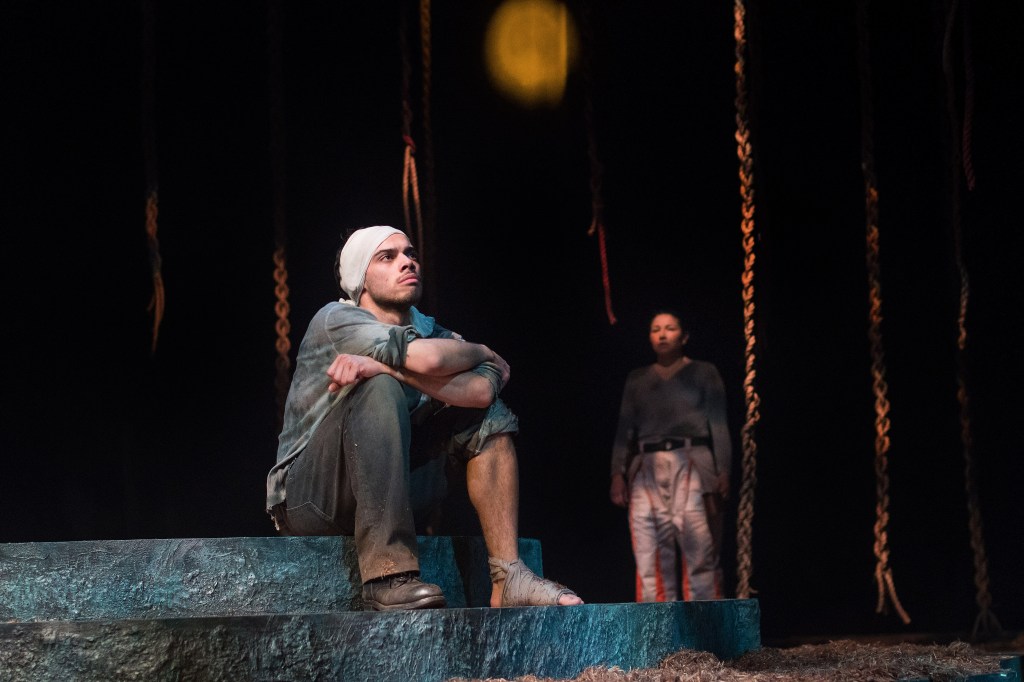
The Monument – Augusto Bitter and Tamara Podemski – Photo by Joseph Michael Photography

BG: Tell me more about your reaction reading the script for the first time, looking at the play through the lens of the war against the Indigenous people of Turtle Island.

TP: It’s very current. As an artist, an activist, and working in the Native community, this is the work I have been doing with Native youth, Native women, and conversations in my family. So there was nothing brand new but what was most exciting was that we would be able to explore this alternate method of storytelling. And through this transmission of knowledge, we would be able to shift this colonial narrative. The theatre just offers this beautiful alternative way to communicate really complex ideas without people feeling that it is stuffed down their throats. The power of the text is the power of the text, but what we are infusing into it is that different perspective, an indigenous injection into the work. The play wasn’t meant to be about war against Native people, but I believe it really does work and Jani [Lauzon] and Factory believes it works. It isn’t really a far stretch when you understand that a 500 year silent genocide has happened. When that is your experience, it’s not hard to see how The Monument fits. What is going to be really interesting is to see how ready people are to accept that that is what has been going on.

The Monument – Tamara Podemski and Augusto Bitter – Photo by Joseph Michael Photography

BG: Absolutely, I feel theres a resistance among settlers to revisit this history, theres willful ignorance there.

TP: Yes, and the sales pitch of Canada to the world is that we are this peaceful, equal, human rights focused and forward-thinking country. So it’s disrupting these notions to remind people that blood has been spilled here and it has been going on for longer than 150 years. We need to shake up their concepts of what it is to live in a country of war, the last place in the world people would say had participated in a war like this, and it’s an active war.

The Monument – Elahe Marjovi_s set design for The Monument incorporates conceptual imagery from The REDress Project. (Founder Jaimie Black www.theredressproject.org) – Photo by Joseph

BG: Tell me more about your character, what about her do you identify with?

TP: Mejra is a mother whose daughter has been murdered. She wants answers, she wants a resolution, she wants to find a place in her heart where she can reconcile the pain, anger and forgiveness with the perpetrators. I relate to her on so many levels because mostly in her application of how she tries to get the answers. She is so emotionally raw, she is very triggered and I relate a lot to that trauma response. I don’t often have the advantage of well thought-out behaviour or response. It’s very reactive and I understand that very well. As the granddaughter of a residential school survivor and the granddaughter of a Holocaust survivor, they passed that knowledge down to their children and we as a second generation of survivors have inherited that trauma. And we have the luxury to talk about it, my parents didn’t have that. We have a safe space to be able to process it. Recovery is more acceptable now and that wasn’t the experience of my parents.

I’m slightly different from Mejra, as she is very isolated in her grief and trauma. And in that one sense [she] isn’t reflective of how we grieve as Indigenous people – it is very communal. In a way that allows Mejra to be even worse off because she doesn’t have her community and is cut off. She is going through the grief on her own, which is why the need of another person with Stetko and also why they are perfectly matched. There’s a form of reconciliation, oh there’s the “R” word, but it is a beautiful example of it. And it’s a lot uglier than people want it to be. It’s ugly and messy and very triggering.
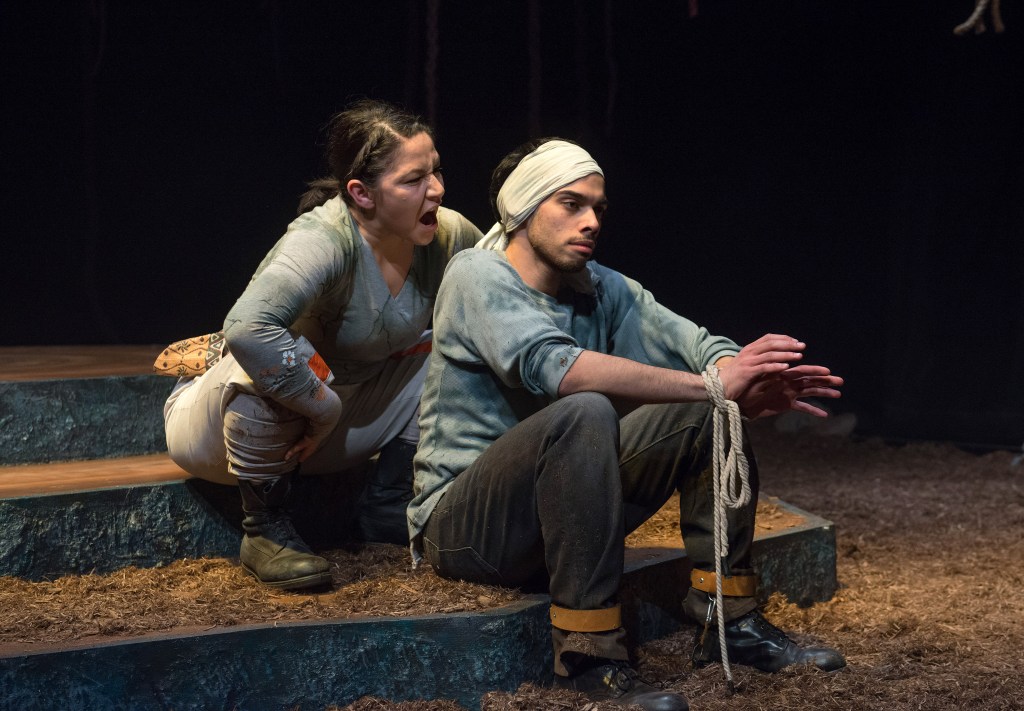
The Monument – Tamara Podemski and Augusto Bitter – Photo by Joseph Michael Photography

BG: What has been the most challenging aspect of working on this production, with triggering subject matter?

TP: This might sound a little weird…but nothing. I had prepared for a very difficult rehearsal process but what Jani has created is one of the safest spaces of creation that I have ever experienced. We start with each day with a smudge, as we are working with spirits and we’re asking the murdered and missing spirits of our sisters to be with us onstage. We have a responsibility to do that work in a respectful and culturally appropriate way. We’re considering our role as storytellers, the connection with each other and with our Creator, however you may define that. There is a safety that is created and it allows the strength and security to go to those places. For me, I’ve never done a two-hander so the stamina required, it’s more lines that I have had to work with, more time on your legs. You’re going non stop for the whole play. But that is just practical. Emotionally/spiritually I have been very supported by Jani and by my brother Augusto [Bitter, who plays Stetko]. Every day is joyful and an incredible experience. We are really privileged to be actors at this time. It’s a critical time as story tellers, to have this other access point to people’s minds and hearts when people are zoned in to their phones, tuning out of a quite oppressive world. It’s our job to crack open people’s hearts and minds.

The Monument

Who:
Written by Colleen Wagner
Directed by Jani Lauzon
Starring Augusto Bitter & Tamara Podemski

What:
The Monument tells the story of a soldier desperate to escape death for his war crimes who agrees to give himself to the complete servitude of an unknown woman. A harrowing and visceral journey of two people forced to confront the atrocities of war, this Governor-General’s Award-winning play asks questions that remain painfully familiar on our front pages today.

Re-imagining the conflict as the silent 500 year war that has been waged against the people of Turtle Island since European colonization, Lauzon’s lens on Wagner’s classic play will confront many of the dark and uncomfortable truths of Canada’s complicity around missing and murdered Indigenous women.

Where:
Factory Theatre Mainspace
125 Bathurst Street, Toronto

When:
March 15-April 1, 2018

Tickets:
factorytheatre.ca

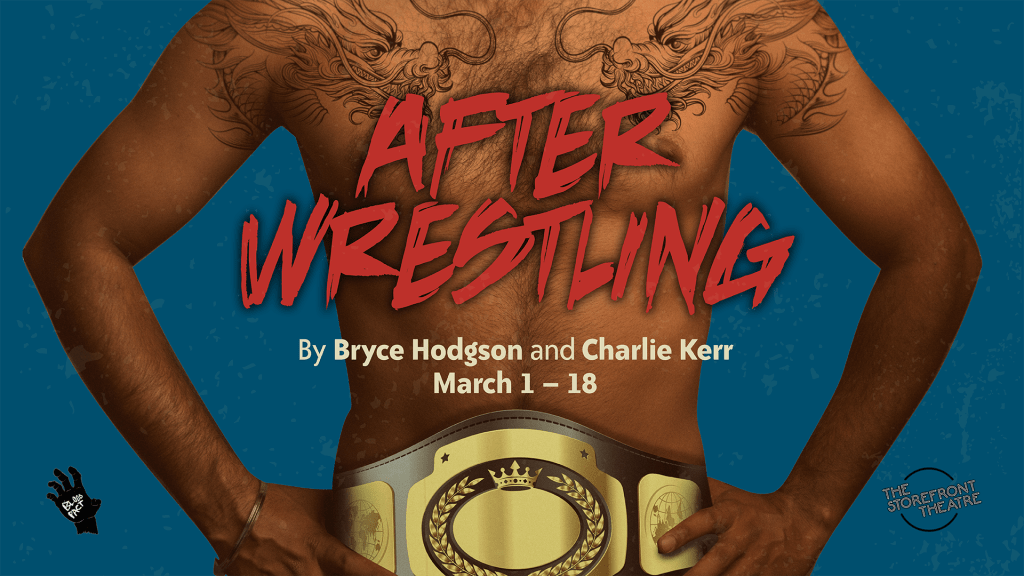
A Chat with Charlie Kerr, co-writer and actor in AFTER WRESTLING

Interview by Bailey Green

We got to chat with Charlie Kerr, co-writer and actor in After Wrestling, on stage now at Factory Theatre. We spoke about his collaboration with co-writer Bryce Hodgson, how he navigates working with two different creative hats, and on ending the stigma surrounding mental illness.

Bailey Green: How did you and co-writer Bryce Hodgson meet? When did you start writing together and what’s your process like as co-creators?

Charlie Kerr: Brycey and I met when we were ten and twelve years old. I was home schooled until the fifth grade when I started public school. Bryce and I were actually both in the program for kids with learning disabilities together. As we grew up, we played in punk bands together and have always been collaborating on one thing or another. In 2014 he suggested we write a play together and something clicked. Two plays later, it’s still the same process of getting in a room together, talking things through and trying to make each other laugh.

After Wrestling – Charlie Kerr – photo by John Gundy

BG: What was the genesis behind After Wrestling? Was there a particular event or incident that inspired the story or did it grow from exploring broader themes?

CK: Yeah, Bryce and I had a friend die by suicide about seven years ago, and it shaped our lives in a really unique way. One day Bryce came to me with this concept for a play of a young man named Hogan whose life is falling apart because his best friend died by suicide and his sister, Leah, who is forced to take care of and live with her wacky, grieving brother. And from there it just grew and evolved.

BG: What has the transition from co-writer to performer been like for you?

CK: Anthony Shim, who also stars in the play, took me aside pretty early on and told me not to be a writer on stage and that was incredible advice. I really took it to heart. So yeah, during the rehearsal process I had to let go of the fact that I co-wrote the thing and approach the character like anything else I would act in. It’s been incredible and surreal to do it for an audience because I have been saying Hogan’s lines for like three years now.

After Wrestling – Leah Osler, Gabe Grey – photo by John Gundy

BG: There’s been a shift in the conversation around mental health in the last few years. Do you feel the stigma is lessening? What do we still need to focus on?

CK: It was less than a hundred years ago when Sigmund Freud first suggested that human beings’ best bet for dealing with their mental problems was talking through them, until then hypnotism was the gold standard for mental health issues. So I believe we are progressing bit by bit everyday. Like, I am twenty-six and when I was a kid struggling and I was self-harming and having panic attacks all the time, I had no idea what was going on. I just thought I was bad at dealing with life. I had no concept that I had a chemical imbalance that could be treated. Ten years ago. there was not nearly the open mental health discussion there is today. While writing this play, I took a mental health first aid course. I think getting educated the best you can on the subject is one of the most productive things you can do. I mean, in all walks of life we need to focus on empathy love and kindness. Something I think we should focus on is the stigma against getting medication. That stigma, in my opinion, is particularly toxic because for some loved ones of mine it makes the difference of life and death.

BG: What do you hope your audiences walk away with?

CK: I hope they laugh and I hope they are entertained. And ideally I would hope they would leave having compassion for those who struggle with mental health issues and empathy for those who are grieving a death of someone close to them.

After Wrestling – Gabe Grey, Leah Osler, Charlie Kerr, Anthony Shim – photo by John Gundy

BG: Tell me about Blood Pact Theatre and about partnering with Storefront and Factory Theatre.

CK: Blood Pact Theatre was created and founded by Bryce, Libby Osler, Bri Proke and I. We created it in Vancouver and put up our first play that Bryce and I wrote in 2015. And then we brought our company out to Toronto for our second show after it was selected from Storefront’s open submissions and that turned out to be a great partnership. Then last year Factory Theatre asked Storefront if they could recommend any plays for their new season and they suggested After Wrestling. That’s the coles’ notes version, at least. But yeah, it’s an incredible team! We couldn’t be happier to work with this many talented kindred spirits. It’s a dream-come-true.

BG: Any upcoming shows or artists you would like to shout out?

CK: Sorry, I have such After Wrestling tunnel vision right now because we just opened so all I can really shout out is like Queer Eye For The Straight Guy, which I binged on netflix and loved. I saw Kat Sandler’s Bang Bang on my day off, which I thought was cool and made me laugh. Black Boys looks really good, Bunny looks awesome. I have seen two shows that Unit 102 put on and I love their work. The thing is Toronto is a city filled with great culture and a vibrant theatre scene. So you can’t really go wrong!

After Wrestling

Who:
Produced by Blood Pact Theatre with the generous support of Storefront Theatre in association with Factory Theatre
Written by Bryce Hodgson and Charlie Kerr

What:
When your best friend kills himself and Facebook stalking your ex-girlfriend just ain’t what it used to be, look no further than rolling in duck feces and living in the park. Unfortunately for Hogan, his sister and the cops don’t share his same enthusiasm for DIY self-help.

After Wrestling is a slacker-comedy turned suicide-mystery that finds itself in a booze- and grief- fuelled magic realism debate on love, life, and after-death.

Where:
Factory Theatre – Studio Theatre
125 Bathurst Street, Toronto

When:
March 1-18, 2018

Tickets:
factorytheatre.ca
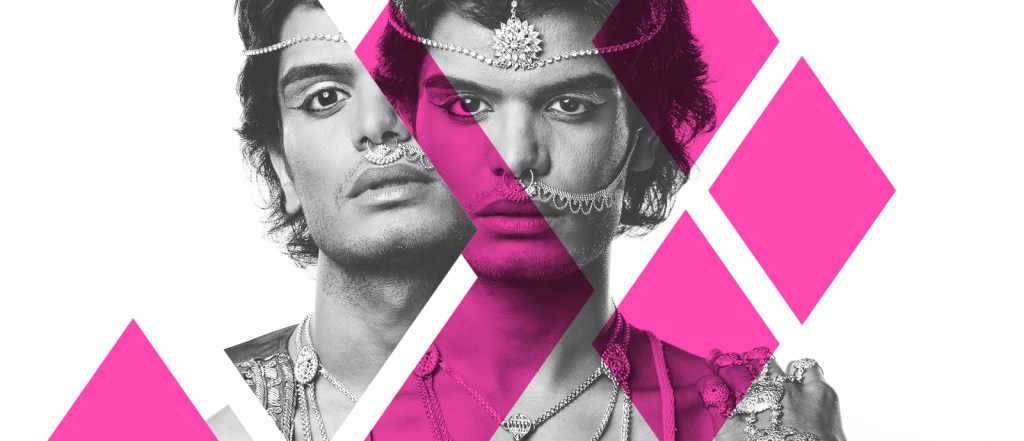
Artist Profile: Bilal Baig, Playwright

Interview by Hallie Seline.

It is an absolute pleasure to feature playwright Bilal Baig, chatting about what inspires him as an artist, the development of his current piece Acha Bacha, on stage this month with Theatre Passe Muraille and Buddies in Bad Times Theatre, and on writing “the story you need to tell”.

HS: What inspired Acha Bacha and how did the piece develop?

Bilal Baig: I was sexually assaulted when I was seventeen. One of the first things that was irrevocably changed after my assault was my relationship with my mother. I began to think: I’m queer, I’m not very religious, I like to fuck with gender sometimes and now I’m a survivor of sexual assault – will my mother EVER think I’m good?

I sat on this thought for about a year before I took a playwriting class with Judith Thompson at the University of Guelph and under her guidance, the first draft of the play exploded out of me in a few weeks in April 2013. That summer, I was connected to Damien Atkins, who worked as a dramaturge on the play (and is still a current mentor in my life). Through the Paprika Festival‘s playwright residency program, I met, worked with and fell in love with Djanet Sears, which resulted in an excerpt sharing of the play at the festival in April 2014, where Andy McKim was present. From that point on in the play’s developmental journey, I worked predominantly with Andy, Jiv Parasram and Brendan Healy as dramaturges.

Bilal Baig. Photo Credit: Tanja Tiziana

HS: I am very excited about the team working on the show. What has it been like working with these artists bringing your show to life?

BB: I am very excited about this group of artists coming together as well! There has been so much love in the room and a fiercely deep commitment to understanding the story and honoring it with such care, curiosity and empathy. I am in sincere awe of all the artists I get to work and play with every day throughout this process! So much love.

HS: What are you most looking forward to about sharing this show with audiences now?

BB: I’m really curious about what the conversations around power, sex and shame will be surrounding this play.

Bilal Baig. Photo Credit: Graham Isador

HS: I know that you’ve both developed work with the Paprika Festival and worked with them. What has been the impact of this outlet on your growth as an artist?

BB: Paprika has been instrumental in my growth as an artist. It was a playground for me (for five years!) to explore my artistic obsessions and learn from what it feels like to put your work out there when it’s not ‘ready’. Artists who I met through Paprika five years ago have become friends I collaborate with today.

HS: What is best piece of advice you’ve received either in life or in art?

BB: “Write the story you need to tell”. That was actually the prompt given by Judith, which lead to the first draft of Acha Bacha. I think I use this advice in my life as well!

HS: What inspires you?

BB: I’m inspired by genderqueer Indigenous, black, people of colour living their truth. I feel like my art is probably inspired by shitty events happening in the world that devastate/confuse/terrify/arouse me to the point where I can’t talk about it anymore and I must write it.

Bilal Baig. Photo Credit: Graham Isador

Rapid Fire Questions:

What are you watching right now? America’s Next Top Model.

If you could travel anywhere, where would it be? Fiji or New Zealand. Or Vancouver.

Favourite food: Mom’s chicken fried rice or biryani. Or pizza.

What other show are you most looking forward to this year? Trying everything in my power to catch Calpurnia before it closes. Looking forward to Prairie Nurse at Factory Theatre.

Current mantra or goal for yourself as an artist this year: You’re allowed to feel ambivalent about your work and this career you are pursuing. That is okay.

Acha Bacha

Who:
Co-Produced by Theatre Passe Muraille and Buddies in Bad Times Theatre.
Written by: Bilal Baig
Directed by: Brendan Healy
Featuring: Shelly Antony, Qasim Khan, Omar Alex Khan, Matt Nethersole,
and Ellora Patnaik
Set and Costume Design by: Joanna Yu
Lighting by: C.J Astronomo
Sound Design and Music by Richard Feren
Stage managed by Kat Chin

What:
For years Zaya has balanced his relationships with his religion and his queer identity. But as secrets from the past reveal themselves, and crisis strikes his family, he is torn between loyalties, culture, and time. Written by Bilal Baig, and directed by Brendan Healy, Acha Bacha boldly explores the intersections between queerness, gender identity and Islamic culture in the Pakistani diaspora. The show uses both English and Urdu to tell a story about the way we love, the way we are loved, and how sometimes love is not enough.

Where:
Theatre Passe Muraille Mainspace
16 Ryerson Ave. Toronto

When:
February 1-18, 2018

Tickets:
artsboxoffice.ca

Connect:
@beyondwallsTPM
@buddiesTO
#AchaBachaTO

In Conversation with playwright/director Kat Sandler and dramaturge Donna-Michelle St. Bernard on BANG BANG at Factory Theatre

Interview by Bailey Green.

We caught up with BANG BANG playwright/director Kat Sandler and dramaturge Donna-Michelle St. Bernard to discuss exploring collaboration, the stories we tell, and how sometimes it’s easy to ask but not as easy to listen.

BG: Kat, your new piece Bang Bang was commissioned by Factory Theatre. When did you start writing it and what initially inspired the piece?

Kat Sandler: Well, I had written a little bit of it at the Stratford writers retreat. When I met with Matt McGeachy and Nina Lee Aquino, they were interested in it, and decided to commission it for Factory. The show is inspired by the debate around racism, excessive force and shooting deaths by the police. And, of course, true stories and how we as artists tell those stories.

BG: How did Donna-Michelle St. Bernard come onboard? What were your initial reactions to the script Donna-Michelle?

Donna-Michelle St. Bernard: It was the summer of 2017 when we had a conversation about the play. We talked about her impetus before I looked at the script and our relative experience around the themes. When I saw the script I was surprised! I didn’t think you could do jokes with a story like this.

KS: I think there was a meeting before too! When I met with Matt and Nina, Matt said you need to meet Donna-Michelle and ask her questions. We had a beer at Tequila Bookworm and I’d like to think we hit it off! Didn’t we?

DM: We did but, at that time, I wasn’t sure if we were going to [get the chance to] work together.

BANG BANG – Jeff Lillico, Karen Robinson, Khadijah Roberts-Abdullah. Photo by Joseph Michael Photography

BG: What has challenged you the most in the writing of this play?

KS: It’s challenging to have your perspective shaken, to listen, and ask questions, and take constructive criticism, especially when it’s something outside your experience and a topic is controversial. There isn’t a correct way to write about it.

DM: And the other side of that is when you’re trying to bridge two diverse experiences. What can be assumed and what cannot be assumed and how to articulate that space between experiences.

BANG BANG – Sébastien Heins, Jeff Lillico, Karen Robinson. Photo by Joseph Michael Photography

BG: Were there characters you were developing whose voices you found more challenging to find?

KS: Well, the white writer is an experience I have and I can find places for humour and truth to make him multi-dimensional. And of course, the black characters have lives I have not lived.

DM: In working in the room that Kat assembled, what you get reinforced is there is no singularity of experience. The presence of Kat doesn’t represent all white writers and my presence doesn’t represent all black perspectives. And we have gender perspectives, generational perspectives and cultural perspectives that broaden out the characters as individuals.

KS: And then the actors have agency over the things they say and where they stand. They will go deeper in the psyches than I ever will.

BG: Did you have a piece of advice that resonated with you or helped unlock something in the piece?

KS: I don’t know. I think there’s been a lot of talk about asking the questions and listening to the answers. It’s easy to ask but not easy to listen.

BG: What do you hope your audiences walk away with?

KS: I think we’ve tried to create a challenging play that shows multiple perspectives and that is entertaining!

BANG BANG – Sébastien Heins, Jeff Lillico, Karen Robinson, Khadijah Roberts-Abdullah. Photo by Joseph Michael Photography

BG: How was this new territory for you both, Donna-Michelle you’ve just come from Cake and Kat you’ve written about so many different topics, what was unique about this process?

KS: I have had a lot longer to sit with the ideas from years ago, and then the actual process of finishing the script, which was a full year. I want to defer more to other voices in the room… not feeling like I need to but wanting to. And having an institution like Factory behind you in this place of risk as a writer and director, it’s been nice for my process where those two things are very deeply combined.

DM: This is my first experience of production dramaturgy. I had a lot of guidance in terms of the parameters in this unique kind of work, and I’ve had an unexpected amount of voice in this process. I feel more embedded in this than I expected. The process has been surprisingly unsurprising in the things we have had to do with all of our stories—the amount of care and the immediacy of consequences needed.

BG: Any shows or creators you would like to shout out?

DM: Forbidden, which is a commissioned work for Tapestry Opera where I’m working with composer Afarin Mansouri. It’s an experiment with Persian music and opera and hip hop that runs February 8-11.

KS: I’m a big fan of Jordan Tannahill, so Declarations at Canadian Stage.

DM & KS: And Acha Bacha!

BANG BANG

Who:
A Factory Commissioned World Premiere
Written and Directed by Kat Sandler
Performed by Sébastien Heins, Jeff Lillico, Khadijah Roberts-Abdullah,
Karen Robinson, Richard Zeppieri
Set design by Nick Blais
Costume design by Lindsay Dagger Junkin
Lighting design by Oz Weaver
Sound design by Verne Good
Dramaturgy by Donna-Michelle St. Bernard

What:
A white playwright uses the shooting of an unarmed young Black man by a police officer as a “jumping off point” for his hit play that is soon to be adapted into a major movie. As Hollywood comes knocking for the writer, he makes a surprise visit to the home of the officer involved. With Sandler’s trademark wit, BANG BANG traces the impact of what it means to be inspired by true events.

Where:
Factory Theatre Mainspace
125 Bathurst St. Toronto

When:
February 1-18, 2018

Tickets:
factorytheatre.ca

Connect:
Kat Sandler: @katsandler
Donna-Michelle St. Bernard: @BelladonnaNHP
Factory Theatre:
t: @FactoryToronto
fb: /FactoryTheatreTO 
#ftBANGBANG

2018 Next Stage Festival Profile: Leila Live!

Interview by Brittany Kay.

It’s easy to fall in love with Leila. She will have you giggling the second you meet her and will probably add herself into your contacts before you leave. If you haven’t seen her Formation video, you are missing out. I had the distinct privilege of talking to the Persian Princess herself about her show Leila Live! at The Next Stage Festival.

Brittany Kay: Who is Leila?

Leila: Hi there! My name is Leila and I am a real-life Persian Princess. I am originally from Tehran, Iran and have been performing my solo shows Love With Leila and A Very Leila Christmas across Canada (and one time in America before that disgusting monster became president) for the past three years. The critics have named me the ‘Persian Judy Garland’ but I self-identify as the ‘Persian Ariana Grande’ (as you will see in my show). People may also recognize me from my hit YouTube videos such as: The Fresh Queen of Tehran, My hijab brings all the boys to the yard, and my own take on Beyonce’s Formation.

My biggest dream—other than being a broadway star and having my own Netflix series—is to date Zac Efron. I think he is so talented, good looking and I believe we have a lot in common so we would be a really good match.

I have been quite active on Tinder lately – I am single and ready to mingle, looking for the right guy! No on has matched with me yet but I am staying optimistic and know that it will happen soon.

BK: What inspired you to create this story?

L: My newest show Leila Live! is my first venture into the world of CABARET! I wanted to start off this new year by trying something completely different. In this show, I am not only acting and telling a story, but I am showcasing a big variety of my talents such as: monologuing, dancing, original singer songwriting, stand up, impressions, sound effects and puppets. That’s right! There is a lot going on in this tight 30 minute show. We are really hoping to find potential agents, producers and boyfriends after one of the performances. If you are interested please email me: salam@laughwithleila.com

BK: Where else can we see some of your work? I see you have quite the social media following! How did that happen?

L: You know it really just happened naturally. I love to be social and I love to take pictures so Instagram is really the perfect platform for me. I am also on Twitter but I don’t like birds that much. On Instagram I am trying to show what it is like to be a touring performer but also to give advice to my internet friends – #tiptuesday and #wisdomwednesday have been quite popular posts. But none are nearly as fun as #mancrushmonday – I have to start posting about some guys other than Zac Efron though because I think he blocked me but my mother is looking into it for me. You can expect to see some new YouTube videos later this year as well as the launch of my very first album!

BK: Why is this show and more importantly Leila as a person, important for our community today?

L: Earlier this year someone told me that they had never seen a show with a Middle Eastern character who is portrayed as a nice and fun person. That made me really sad!!! We are not just the terrorists and angry cab drivers—we are real human beings with families, personalities, dreams, ambitions and are usually really freaking funny and full of joy. I want people to have fun with me! I want my audience to laugh and feel like they are just hanging out with me and not watching a ‘show’ in a theatre. Like we are friends, because we are friends! And in the end we get to see a little bit of ourselves in one another.

I just finished a run of my show A Very Leila Christmas in Kitchener with an amazing theatre company called Green Light Arts. We packed the theatre for 5 nights and even got the Mayor of Kitchener to come and sing a duet with me. The night was full of so much joy and laughter (and a few tears because let’s face it the holidays aren’t fun and games all the time) but so many people said that they have never smiled so much, that they didn’t know they could laugh so hard and that this kind of laughing was therapeutic. I mean, what is better than that really?

BK: Talk to me about Leilas Girlfriends?

L: Leila’s Girlfriends is one of my favourite projects I have ever done. It was a partnership program with the Immigrant Working Centre and the Good Shepherd in Hamilton. I hosted a storytelling workshop for newcomer women to help them share their own stories of being in Canada. The ones who felt comfortable enough joined me on stage for a performance on International Women’s Day. It was so empowering to watch these beautiful women stand up in front of sold out audiences and share their voice for the first time. I had shivers each night and had to hold my tears back. Some of these women are still very good friends of mine.

BK: Why is The Next Stage Festival the perfect platform for you and your work?

L: Well this is quite literally the next stage for me. This is the first time that I am performing a cabaret show. I am trying out never before seen material in a different style than I am used to and I get to do it 12 nights in a row! My mother and I have been rehearsing this showcase in our living room for a few months now and we are so excited to share it with an audience.

BK: Are there any other shows that you are excited to see in the festival?

L: My friend Christel Bartelse is performing her new clown show The Surprise in the same venue as me (Factory Antechamber). We did a Double Bill of our shows Love With Leila and All KIDding Aside last year at the Toronto Centre of the Arts and I am so happy to share a space with her again. She is so talented and funny and she has the most beautiful hair. Really, go check out her ginger locks – they are gorgeous.

BK: What do you want audiences walking away with?

L: My Instagram account on their phone.

BK: Anything else we need to know?

L: My venue is the warmest one in the entire building… so… that should be enough of a reason to buy a ticket.

Leila Live!

Photo Credit: Tanja Tiziana

Who:
Written and Performed by me (Leila)
Directed by my mother (Farideh)

What:
Real life Persian Princess seeking a real guy who is trusting, healthy, and has his Canadian citizenship. Must enjoy authentic middle eastern cuisine, hypnotic dance moves, and little bit of fluff and scruff. No smoking, drinking, or drugging allowed! If my parents don’t like you chances are I will 😉 Swipe right for singing, dancing, acting, joking, and modeling my me (Leila).

Where:
Factory Antechamber
125 Bathurst Street, Toronto

When:
January 3rd – 14th
January 10th – 5:55pm
January 11th – 8:40pm
January 12th – 8:40pm
January 13th – 5:25pm
January 14th – 3:55pm

Tickets:
fringetoronto.com

Connect:
fb: /badgirlleila
t: @_badgirl_leila
ig: @_badgirl_leila